4-1
Chapter 4 Shear Flow Dispersion
Contents
4.1 Dispersion in laminar Shear Flow 4.2 Dispersion in Turbulent Shear Flow 4.3 Dispersion in Unsteady Shear Flow 4.4 Dispersion in Two Dimensions
Objectives:
1) Derive shear flow dispersion equation using Taylor’ analysis (1953, 1954) - laminar flow in pipe
- turbulent flow
→ apply Fickian model to dispersion
→ reasonably accurate estimate of the rate of longitudinal dispersion in rivers and estuaries
2) Extend dispersion analysis to unsteady flow and two-dimensional flow
Taylor, Geoffrey – English fluid mechanician
4-2 4.1 Dispersion in Laminar Shear Flow 4.1.1 Introductory Remarks
∙ Taylor's analysis (1953) in laminar flow in pipe
Consider laminar flow in pipe with velocity profile shown below.
Assume two molecules are being carried in the flow; one in the center and one near the wall.
1) Rate of separation caused by the difference in advective velocity ≫ separation by molecular motion
2) Because of molecular diffusion, each molecule moves at random walk back and forth across the cross section
3) Fickian diffusion equation can describe the .
→ motion of single molecule is the sum of a series of independent steps of random length.
spread of particles along the axis of the pipes, except that since the step length and time increment are much different from those of molecular diffusion. We expect to find a different value of diffusion coefficient.
u0
a
4-3
Now, find the rate of spreading for laminar shear flow in pipe For turbulent flow, diffusion coefficient is given as
2
U TL
ε =< >
where U = velocity deviation TL= Lagrangian time scale
For laminar flow in pipe; <U2 >∝u02
2 L
T a
∝ D
where u0= maximum velocity at the centerline of pipe a = radius of pipe
D = molecular diffusion coefficient
Thus, longitudinal dispersion coefficient due to combined action of shear advection and molecular diffusion is given as
2
2 2
0 L
K U T u a
=< > ∝ D (4.1)
∼ time required to sample the whole field of velocities
∼ time scale for cross- sectional mixing
Mean square velocity deviation of the molecule results from the wandering of the molecule across the cross section.
Molecule samples velocities ranging from zero at the wall to the peak velocity u0 at the centerline.
→ K is inversely proportional to molecular diffusion.
4-4 4.1.2 A Generalized Introduction
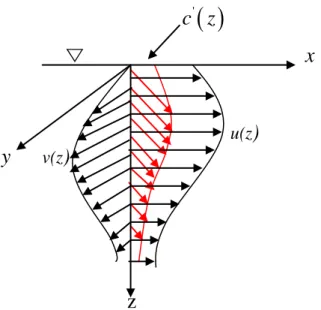
(a) example velocity distribution (b) transformed coordinate system moving at the mean velocity
Consider the 2-D laminar flow with velocity variation u(y) between walls Define the cross-sectional mean velocity as
0
1 h
u udy
= h
∫
(4.2)Then, velocity deviation is
( )
u' =u y −u (4.3)
Let flow carry a solute with concentration C(x, y) and molecular diffusion coefficient D.
Define the mean concentration at any cross section as
0
( )
1 h , ( )
C Cdy C f x f y
= h
∫
= ≠ (4.4)Then, concentration deviation is
4-5
( )
' ' '
, ( , )
C =C y −C C =C x y (4.4a)
Now, use 2-D diffusion equation with
2 2
2 2
C C C C C
u v D D
t x y x y
∂ + ∂ + ∂ = ∂ + ∂
∂ ∂ ∂ ∂ ∂
only flow in x-direction (v =0)
(1)
Substitute (4.2)~(4.4) into (1)
( )
2 2' ' ' ' '
2 2
(C C ) u u (C C ) D (C C ) (C C )
t x x y
∂ + + + ∂ + = ∂ + + ∂ +
∂ ∂ ∂ ∂ (4.5)
Now, simplify (4.5) by a transformation of coordinate system whose origin moves at the mean flow velocity
1
x ut u
x t
ξ ξ
ξ = − → ∂ = ∂ = −
∂ ∂
0 1
t x t
τ τ
τ = → ∂ = ∂ =
∂ ∂
Chain rule
x x x
ξ τ
ξ τ ξ
∂ = ∂ ∂ +∂ ∂ = ∂
∂ ∂ ∂ ∂ ∂ ∂ (b)
t t t u
ξ τ
ξ τ ξ τ
∂ = ∂ ∂ +∂ ∂ = − ∂ + ∂
∂ ∂ ∂ ∂ ∂ ∂ ∂ (c)
Substitute Eq. (b)-(c) into Eq. (4.5)
C 0 y
∂ =
∂
4-6
( )
2 2 '' ' ' ' '
2 2
( ) ( ) ( ) ( ) C
u C C C C u u C C D C C
ξ τ ξ ξ y
∂ ∂ ∂ ∂ ∂
− ∂ + +∂ + + + ∂ + = ∂ + + ∂
2 2 '
' ' ' '
2 2
( ) ( ) ( ) C
C C u C C D C C
τ ξ ξ y
∂ ∂ ∂ ∂
+ + + = + +
∂ ∂ ∂ ∂ (4.8)
→ view the flow as an observer moving at the mean velocity
→ u'is only observable velocity
Now, neglect longitudinal diffusion because rate of spreading along the flow direction due to velocity difference greatly exceed that due to molecular diffusion
2
' ' '
( ) 2 ( )
u C C D C C
ξ ξ
∂ + ∂ +
∂ ∂
.
' ' 2 '
' '
2
C C C C C
u u D
τ τ ξ ξ y
∂ +∂ + ∂ + ∂ = ∂
∂ ∂ ∂ ∂ ∂ (4.9)
→ This equation is still intractable because u' varies with y.
→ General solution cannot be found because a general procedure for dealing with differential equations with variable coefficients is not available.
Now introduce Taylor's assumption
→ discard three terms to leave the easily solvable equation for
'( ) C y
2 '
'
2
C C
u D
ξ y
∂ = ∂
∂ ∂ (4.10)
4-7
[Re] Derivation of Eq. (4.10) using order of magnitude analysis Take average over the cross section of Eq. (4.9)
→ apply the operator
0
1 h( )dy h
∫
' ' 2 '
' '
2
C C C C C
u u D
τ τ ξ ξ y
∂ ∂ ∂ ∂ ∂
+ + + =
∂ ∂ ∂ ∂ ∂
Apply Reynolds rule of average
'
' 0
C C
τ u ξ
∂ + ∂ =
∂ ∂ (4.11)
Subtract Eq.(4.11) from Eq.(4.9)
' ' ' 2 '
' ' '
2
C C C C C
u u u D
τ ξ ξ ξ y
∂ + ∂ + ∂ − ∂ = ∂
∂ ∂ ∂ ∂ ∂
Assume C C, ' are well behaved, slowly varying functions and C >>C' Then
' '
' ' '
C C , C
u u u
ξ ξ ξ
∂ >> ∂ ∂
∂ ∂ ∂
Thus we can drop
' '
' '
C , C
u u
ξ ξ
∂ ∂
∂ ∂
' 2 '
' 2
C C C
D u
τ y ξ
∂ = ∂ − ∂
∂ ∂ ∂ (d)
' C
u ξ
− ∂
∂ = source term of variable strength
→ Net addition by source term is zero because the average of u'is zero.
4-8 Assume that C
ξ
∂
∂ remains constant for a long time, so that the source is constant.
Then, Eq. (a) can be assumed as
'
C 0 τ
∂ =
∂
steady state.
→
Then (a) becomes
2 '
'
2
C C
u D
ξ y
∂ = ∂
∂ ∂
(A) (B)
→ same as Eq. (4.10)
→ cross sectional concentration profileC y'( )is established by a balance
between longitudinal advective transport and cross sectional diffusive transport.
<Fig. 4.3> The balance of advective flux versus diffusive flux In balance, net transport = 0
longitudinal advective transport
cross sectional diffusive transport
4-9
( )
' ' '' ' '
C C C 0
u Cdy u Cdy u C dxdy D dx D dx D dydx
x y y y y
∂ ∂ ∂ ∂ ∂
− +∂ + − ∂ − − ∂ +∂ − ∂ =
( )
u C dxdy' D C' dydx 0x y y
∂ ∂ ∂
−∂ +∂ ∂ =
( )
u C' D C'x y y
∂ = ∂ ∂
∂ ∂ ∂
Now, let’s find solution of Eq. (4.10)
2 '
' '
2
1 1
C C C
u u
y D ξ D x
∂ ∂ ∂
= =
∂ ∂ ∂ (e)
Integrate (e) twice w.r.t. y
( )
' ' '
0 0
( ) 1 C y y 0
C y u dydy C
D x
= ∂ +
∂
∫ ∫
(4.14)Consider mass transport in the streamwise direction
' ' '
0 0
h h
x
M q dy u C D C dy
x
∂
=
∫
=∫
+ − ∂ (f)
Substitute (4.14) in (f)
' ' ' '
0 0 0 0
1
h C h y y
M u C dy u u dydydy D x
= = ∂
∫
∂∫ ∫ ∫
(4.15)
since
∫
0hu C'{
'( )
0}
dy=0constant
4-10
→ Eq. (4.15) means that total mass transport in the streamwise direction is proportional to the concentration gradient
M C x
∝∂
∂
in that direction.
(g)
→This is exactly the same result that we found for molecular diffusion.
q D C x
= − ∂
∂
But this is q
diffusion due to whole field of flow.
Let = rate of mass transport per unit area
1
M C
q K
h x
= = − ∂
× ∂
per unit time Then, (g) becomes
(h)
where h = depth = area per unit width of flow
K = longitudinal dispersion coefficient (= bulk transport coefficient)
→ express as the diffusive property of the velocity distribution (shear flow)
Then, (h) becomes M hK C
x
= − ∂
∂ (4.16)
Comparing Eq. (4.15) and Eq. (4.16) we see that
' '
0 0 0
1 h y y
K u u dydydy
= −hD
∫ ∫ ∫
(4.17)4-11 K 1
∝ D
Now, we can express this transport process due to velocity distribution as a one- dimensional Fickian-type diffusion equation in moving coordinate system.
2 2
C C
τ K ξ
∂ = ∂
∂ ∂ (4.18)
Return to fixed coordinate system
2 2
C C C
u K
t x x
∂ + ∂ = ∂
∂ ∂ ∂ (4.19)
→ 1-D advection-dispersion equation C, u= cross-sectional average values
▪ Balance of advection and diffusion in Eq. (4.10)
Suppose that at some initial time t = 0 a line source of tracer is deposited in the flow (Fig. 4.4a).
→ Initially the line source is advected and distorted by the velocity profile.
At the same time the distorted source begins to diffuse across the cross section.
→ Shortly we see a smeared cloud with trailing stringers along the boundaries (Fig. 4.4b).
During this period, advection and diffusion are by no means in balance.
4-12
→ Taylor’s assumption does not apply.
→ Cross-sectional average concentration is skewed distribution (Fig. 4.4c).
If we wait much longer time, the cloud of tracer extends over a long distance
C
in the x direction.
→ varies slowly along the channel, and C x
∂
∂ is essentially constant over a long period of time.
→ C' becomes small because cross-sectional diffusion
2
0.4h t < D
evens out cross- sectional concentration gradient.
Chatwin (1970) suggested
i) Initial period:
→ advection > diffusion
ii) Taylor period:
2
0.4h t > D
→ advection ≈ diffusion
→ can use Eq. (4.19)
→ The initial skew degenerates into the normal distribution.
2
t 2K σ
∂ =
∂
4-13 4.1.3 A Simple Example
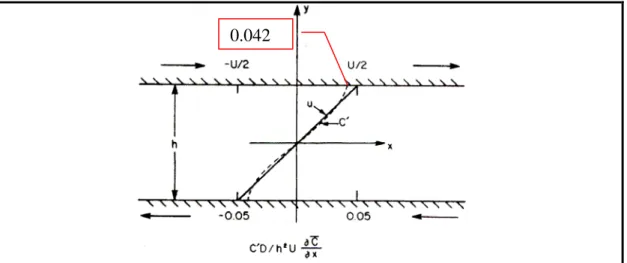
Consider laminar flow between two plates → Couette flow
Fig. 4.5 Velocity profile and the resulting concentration profile
( ) y
u y U
= h
2 2
1 0
h h
u U ydy h − h
=
∫
=' u u
∴ =
Suppose h2
t > D → tracer is well distributed
→ Taylor’s analysis can be applied From Eq. (4.14)
( )
' ' '
0 0
1 C y y (0)
C y u dydy C
D x
= ∂ +
∂
∫ ∫
'
2 2
1 ( )
2
y y
h h
C Uy h
dydy C D x − − h
= ∂ + −
∂
∫ ∫
(a)0.042
4-14
2 '
2 2
1 ( )
2 2
y y
h h
C U h
y dy C
D x − h −
∂
= ∂
∫
+ −2
' 2
1 ( )
2 8 2
y h
C Uy Uh h
dy C D x − h
= ∂∂
∫
− + −3
'
2
1 ( )
6 8 2
y
h
C Uy Uh h
y C
D x h −
= ∂∂ − + −
3 2 2
1 '
( )
6 8 48 16 2
C Uy Uh Uh Uh h
y C
D x h
= ∂∂ − + − + −
3 2 3
1 '
2 3 4 12 2
C U y h h h
y C
D x h
∂
= ∂ − − + −
By symmetry C' =0 @ y=0
3
1 '
0 2 12 2
C U h h
D x h C
∂
= ∂ − + −
2
' 1
2 24
h C Uh
C D x
− = ∂
∂
3 2
' 1
( ) 2 3 4
C U y h
C y y
D x h
∴ = ∂∂ − (4.21)
→ ' 1 2
@ ;
2 24
h C h
y C U
D x
= = ∂∂ −
→ '
2
1 0.042
24 C D
CUh x
= − = −
∂
∂
4-15 Dispersion coefficient K
2
2 2
2
( )
1 ' '
h y y
h h h
A
K u u dydydy
hD −
= −
∫ ∫ ∫
' ' '
2 2
1 ( )
2
h h
D h
u C y C dy
hD C
x
−
= − ∂ − −
∂
∫
' ' ' '
2 2
2 2
1
2
h h
h h
u C dy C h u dy h C
x
− −
= − ∂ + −
∂
∫ ∫
3 2
2 2
1 1
( )
2 3 4
h h
Uy C U y h
y dy
C h D x h
h x
−
∂
= − ∂ ∂ −
∂
∫
2 4 2 2
2 3
2 2 3 4
h h
U y h y
h D − dy
= − −
∫
2 5 2 3 2
3
2
2 15 12
h
h
U y h y
h D −
= − −
2 2
120 U h
= D
Note that 1 K ∝ D
→ Larger lateral mixing coefficient makes C'to be decreased.
From (a):
( ) '( ) '( ) '
2
DC y h
A C y C
C x
= ∂ − −
∂
4-16
4.1.4 Taylor's Analysis of Laminar Flow in a Tube
Consider axial symmetrical flow in a tube → Poiseuille flow Tracer is well distributed over the cross section.
( )
0 1 r22u r u
a
= −
→ paraboloid (a)
Integrate u to obtain mean velocity
2 dQ≅u πrdr
2
0 2
0a2 1 r
Q r u dr
π a
∴ = −
∫
4-17
1 2 2
0 0 2
2 r 1 r r
u a d
a a a
π
= −
∫
=2πu a0 2∫
01z(1−z dz2)2 2 1
2 0
0
2 2 4
z z πu a
= −
2
2a u0
=π
By the way, Q= ⋅u πa2
0
2 u u
∴ =
2-D advection-dispersion equation in cylindrical coordinate is
2 2 2
0 2 2 2
1 1
C r C C C C
u D
t a x r r r x
∂∂ + − ∂∂ = ∂∂ + ∂∂ +∂∂ (b)
Shift to a coordinate system moving at velocity 0 2 u
Neglect C t
∂
∂ and
2 2
C x
∂
∂ as before
Let r , ,
z x ut t
a ξ τ
= = − =
Decompose C, then (b) becomes
2 2 ' '
0 2
2
1 1
( )
2
u a C C C
D z ξ z z z
∂ ∂ ∂
− = +
∂ ∂ ∂
'
C 0 z
∂ =
∂ at z =1
Integrate twice w.r.t. z
4-18
2
' 0 2 1 4
8 2
u a C
C z z const
D x
∂
= − ∂ + (c)
' '
1
A
K M u C dA
C C
A A
x x
= − = −
∂ ∂
∂ ∂
∫
(d)
Substitute (a), (c) into (d), and then perform integration
2 2
0
192 K a u
= D
[Example] Salt in water flowing in a tube
5 2
10 / sec
D = − cm
0 1 / sec u = cm
2 a= mm
( )
6
(0.01) 0.004
40 2000
e 1 10 R ud
v −
= = = <<
× → laminar flow
( ) ( )
( )
2 2
2 2
2 6
0
5
0.2 1
21 / sec 10
192 192 10
K a u cm D
D −
= = = ≈
☞ Initial period
( ) ( )
2 2
0 5
0.4 0.2
0.4 1600sec 27 min
10 t a
D −
= = = =
0
0 0 0
2 x =ut =u t
( )(
0.5 1600)
800cm= =
800 4000
0.2 a
= =
x>x0 → 1-D dispersion model can be applied
4-19
Homework Assignment No. 4-1 Due: Two weeks from today
A hypothetical river is 30 m wide and consists of three "lanes", each 10m in width. The two outside lanes move at 0.2 m/sec and the middle lane at
0.4m/sec. Every tm seconds complete mixing across the cross section of the river (but not longitudinally) occurs. An instantaneous injection of a conservative tracer results in a uniform of 100mg/ℓ in the water 2 m upstream and
downstream of the injection point. The concentration is initially zero elsewhere.
As the tracer is carried downstream and is mixed across the cross-section of the stream, it also becomes mixed longitudinally, due to the velocity difference between lanes
1) Mathematically simulate the tracer concentration profile
(concentration vs. longitudinal distance) as a function of time for several (at least four) values of tm including 10 sec.
, even though there is no longitudinal diffusion within lanes. We call this type of mixing "dispersion".
4-20
2) Compare the profiles and decide whether you think the effective longitudinal mixing increases or decrease as tm increases.
This "scenario" represents the one-dimensional unsteady-state advection and longitudinal dispersion of an instantaneous impulse of tracer for which the concentration profile follow the Gaussian plume equation
( )
24 4 M x Ut
C exp
Kt Kt π
−
= −
in which x = distance downstream of the injection point, M = mass injected width of the stream, K = longitudinal dispersion coefficient, U = bulk velocity of the stream (flowrate/cross-sectional area), t = elapsed time since injection.
3) Using your best guess of a value for U, find a best-fit value for K for each and for which you calculated a concentration profile. Tabulate of plot the effective K as a function tm of and make a guess of what you think the functional form is.
4-21
◆ Dispersion mechanism in a hypothetical river
1) 3 lanes of different velocities
2) Every tm seconds complete mixing occurs across the cross section of the river (but not longitudinally) occurs, after shear advection is completed.
→ sequential mixing model
x 0 C x ε x
∂ ∂ →
∂ ∂
2 m
y
t W
≅ ε
3) Instantaneous injection
tm= 10 s; ua=0.2 m/s; ∆x=2 m
W
4-22
t=tm +
: After lateral mixing 0 67 100 33 0 0 67 100 33 0 0 67 100 33 0
(iii) t= 2 tm -
: After shear advection t= 2 tm +
: After lateral mixing
0 0 67 100 33 0 0 0 45 89 55 11 0
0 0 0 67 100 33 0 0 45 89 55 11 0
0 0 67 100 33 0 0 0 45 89 55 11 0
ii) t=tm -
4-23
4-24 [Re] Longitudinal Dispersion in 2-lane river
α = Area fraction of river occupied by slow lane 0≤ ≤α 1
uS =u uF = + ∆u u
u =cross-sectional mean velocity
(
1)( )
u u u
α α
= + − + ∆
Consider deviations:
( )( )
( )
1
1
S S
u u u u u u u
u u u u u u u
α α
α α α α
′ = − = − − − + ∆
= − − − ∆ + + ∆ = − − ∆
(
1)( )
F F
u u u u u u u u u u u
u
α α
α
′ = − = + ∆ − = + ∆ − − − + ∆
= ∆
(i) Before any processes
x u tm
∆ = ∆ ⋅
1−α α u+ ∆u
u Fast Slow
1−α α Cu
Cu
F S
Cd
Cd
∆x ∆x
4-25
(ii) Just before mixing (JBM) …. after advection only
(
1)
d u
C =αC + −α C
( )
( )( )
1 1
S d d d u
d u
C C C C C C
C C
α α
α
′ = − = − − −
= − −
( )
( )
F u u d 1 u
d u
C C C C C C
C C
α α
α
′ = − = − − −
= − −
(iii) Just after mixing (JAM)
d2
C =C
S 0 C′ =
F 0 C′ =
1
u C Au C d A
′ ′= A
∫
′ ′1−α α 0
Cu
F S
Cu
Cd
Cd
0
u2
C
u2
C F
S
d2
C
d2
C
∆x
4-26
( ) ( )
{ }
( ) ( )( )
{ }
( ) ( )( )
{ ( ) [ ] ( )( ) }
( ) ( )
JBM JAM
2
1 2
1 1
2
1 1 1 1
2 1 2
S F
d u d u
d u
u C u C u C
u C u C
u C C u C C
u C C
α α
α α α α α α
α α
′ ′≅ ′ ′ + ′ ′
′ ′ ′ ′
= + −
= − − ∆ − − + − ∆ − −
= − ∆ −
d u
m
C C C
x u t
∂ ≈ −
∂ ∆
( ) ( )
( )
( ) ( )
2
2 2
1 2
1 2
d u
d u
m
m
u C C K u C
C C C
x u t
u t α α
α α
− ∆ −
= − ′ ′ =
∂ −
∆
∂
= − ∆
<Example>
2
α = 3; ∆ =u 0.2; tm =10 sec
2
( )
1 2 2 2
0.2 0.0044
2 3 3 m m
K = − t = t
m 5
t = 10 20 30 K =0.0222 0.0444 0.0889 0.1333
4-27 4.1.5 Aris's Analysis
Aris (1956) proposed the concentration moment method in which he obtain Taylor’s main results without stipulating the feature of the concentration distribution.
Begin with 2-D advective-diffusion equation in the moving coordinate system to analyze the flow between two plates (Fig. 4.5)
2 2
'
2 2
C C C C
u D
τ ξ ξ y
∂∂ + ∂∂ = ∂∂ +∂∂ (4.29)
(1) (2) (3) (4)
Now, define the pth moments of the concentration distribution
( )
p(
,)
CP y ∞ξ C ξ y dξ
=
∫
−∞ (4.30)Define cross-sectional average of pth moment
1 ( )
p P A P
M C C y dA
= = A
∫
Take the moment of Eq. (4.29) by applying the operator
∫
−∞∞ξP( )
dξ(1) p C p Cp
d Cd
ξ ξ ξ ξ
τ τ τ
∞ ∞
−∞ −∞
∂ ∂ ∂
= = =
∂ ∂ ∂
∫ ∫
← Leibnitz rule[Re] Leibnitz formula
1 1
0 0
u u
u u
f d
dx fdx
α dα
∂ =
∫
∂∫
4-28
(2) p ' C ' p C
u d u d
ξ ξ ξ ξ
ξ ξ
∞ ∞
−∞ −∞
∂ ∂
= =
∂ ∂
∫ ∫
← integral by parts{ }
' p p 1
u ξ C ∞ ∞ pξ −C dξ
−∞ −∞
= −
∫
' 1 '
1 p
pu ∞ξ −Cdξ pu Cp−
= −
∫
−∞ = −(
2
3) p C2 p C
D d D d
ξ ξ ξ ξ
ξ ξ ξ
∞ ∞
−∞ −∞
∂ ∂ ∂
=
∫
∂ =∫
∂ ∂ ← integral by parts1
p C C p
D ξ pξ dξ
ξ ξ
∞ ∞ −
−∞ −∞
∂ ∂
= ∂ −
∫
∂ 1
p C
Dp ξ dξ ξ
∞ −
−∞
= − ∂
∫
∂{
p 1 ( 1) p 2}
Dp ξ −C ∞ ∞ C p ξ − dξ
−∞ −∞
= − −
∫
−2
( 1) p ( 1) p 2
Dp p ∞ξ − Cdξ Dp p C −
= −
∫
−∞ = −(
2 2 2
2 2 2
4) p C p CP
D d D Cd D
y y y
ξ ξ ξ ξ
∞ ∞
−∞ −∞
∂ ∂ ∂
= = =
∂ ∂ ∂
∫ ∫
Therefore Eq. (4.29) becomes
2 '
1 ( 1) 2 2
p P
p p
C C
pu C D p p C
τ − − y
∂ ∂
− = − +
∂ ∂ (4.33)
B.C. gives
0 0,
CP
D at y h
y
∂ = =
∂ ← impermeable boundary
u
0 Cξ =±∞=
u v’
4-29 Take cross-sectional average of Eq. (4.33)
2 '
1 ( 1) 2 2
p P
p p
C C
pu C D p p C
τ − − y
∂∂ − = − +∂∂
'
1 ( 1) 2
p
p p
dM pu C p p DM
dτ − − = − − (4.34)
Eq. (4.34) can be solved sequentially for p = 0, 1, 2, …
Equation Consequences as t→ ∞ 0
p = dM0/dτ =0 Mass is conserved
0 0
1 1
A ( ) A
M C y dA Cd dA
A A ∞ ξ
= −∞
∫ ∫ ∫
(4.33) → C0 2C20 D y τ
∂ ∂
∂ = ∂
1
p = dM1 ' 0
dt =u C M1 →consant (4.33) →
2
1 ' 1
0 2
C C
u C D τ y
∂ − = ∂
∂ ∂
2
p = dM2 2 ' 1 2 0 u C DC
dt = +
2
2 2
d K D
dt
σ = +
→ molecular diffusion and shear flow dispersion are additive
Aris’ analysis is more general than Taylor’s analysis in that it applies for low values of time.
2 2
2P 2P P 0
C C C
y y y y
∂∂ = ∂∂ =∂∂ ∂ ∂ =
4-30 4.2 Dispersion in Turbulent Shear Flow
4.2.1 Extension of Taylor’s analysis to turbulent flow
Cross-sectional velocity profile in turbulent motion in the channel is different than in a laminar flow.
Consider unidirectional turbulent flow between parallel plates
Bigin with 2-D turbulent diffusion equation
x y
C C C C C
u v
t x y x ε x yε y
∂∂ + ∂∂ + ∂∂ = ∂∂ ∂∂ +∂∂ ∂∂ (a)
Here, the cross-sectional mixing coefficient ε( )y is function of cross-sectional position.
, ,
C u v= time mean values;
0
1 T
C C cdt
= =T
∫
Let v=0, turbulent fluctuation v' ≠0
Assume x C y C
xε x yε y
∂ ∂ << ∂ ∂
∂ ∂ ∂ ∂
4-31 Then (a) becomes
y
C C C
t u x yε y
∂∂ + ∂∂ =∂∂ ∂∂ (b)
Now, decompose C and u into cross-sectional mean and deviation
( ) ( )
'
' ' '
( )
( ) y
C C
u u C C C C
t x yε y
∂ + + + ∂ + = ∂ ∂ +
∂ ∂ ∂ ∂ (c)
Transform coordinate system into moving coordinate according to u
' ' '
' '
y
C C C C C
u u
yε y
τ τ ξ ξ
∂ +∂ + ∂ + ∂ = ∂ ∂
∂ ∂ ∂ ∂ ∂ ∂
Now, introduce Taylor's assumptions (discard three terms)
' '
y
C C
u yε y
ξ
∂ = ∂ ∂
∂ ∂ ∂ (4.35)
Solution of Eq. (4.35) can be derived by integrating twice w.r.t. y
' ' '
0 0
1 (0)
y y
y
C C u dydy C
ξ ε
=∂ +
∂
∫ ∫
Mass transport in streamwise direction is
' ' ' '
0 0 0 0
1
h h y y
y
M u C dy C u u dydydy
ξ ε
= =∂
∫
∂∫ ∫ ∫
M C
q K
h ξ
= = − ∂
∂
' '
0 0 0
1 h y 1 y
y
K u u dydydy
h ε
= −
∫ ∫ ∫
(4.36)4-32
4.2.2 Taylor's analysis of turbulent flow in pipe (1954)
Set r dz 1
z =a → dr = a Then, velocity profile is
*
( ) 0 ( )
u z =u −u f z (a)
in which u* =shear velocity = τ0 ρ f(z) = logarithmic function
[Re] velocity defect law [Eq. (1.27)]
*
* 10
3 2.30
2 log
u u u u
a ζ
κ κ
= + +
in which κ= von Karman's constant ≈ 0.4 ς = distance from the wall
* *
3.75 5.75 log10
u u u u
a
= + + ζ
* 3.75 2.5ln u u
u a
ζ
− = +
4-33
The cross-sectional mixing coefficient can be obtained from Reynolds analogy.
→ The mixing coefficients for momentum and mass transports are the same.
i) momentum flux through a surface u
r
τ ε
ρ
= − ∂
∂ ☜ Daily & Harleman (p. 56)
ii) mass flux - Fickian behavior q C
ε ∂r
= − ∂
q
C u
r r
ε τ
∴ = =
∂ ∂
− −
∂ ∂
(b)
For turbulent flow in pipe, shear stress is given
0 0
r z
τ τ= a = τ (c)
Differentiate (a) w.r.t. r
* ( ) * 1
u df z dz df
u u
r dz dr dz a
∂ = − = −
∂ (d)
Divide (c) by (d)
0
* 1
z
u df
r u dz a τ τ =
∂ −
∂
(e)
Kinematic eddy viscosity
4-34 Substitute (e) into (b)
*
0 0
* *
( / ) 1
z az azu
u df df df
u u
r dz a dz dz
τ τ ρ
ε τ
ρ ρ
∴ = − ∂ = = =
∂
Now, it is possible to tabulate u r'( )=u r( )−u, ε( )r (f)
And, numerically integrate Eq. (4.39) [Taylor’s equation in radial coordinates]
to obtain C r'( ) using ( )ε r obtained in (f)
2 ' '
'
2
1
C C C
u ε r r r
ξ
∂∂ = ∂∂ + ∂∂ (4.39)
Again, numerically integrate Eq. (4.36) to find K 10.1 *
K = au (4.40)
in which a = pipe radius
( )
u* 24-35
4.2.3 Elder's application of Taylor's method (1959)
Consider turbulent flow down an infinitely wide inclined plane
*
' '
( ) u (1 ln )
u y y
= κ +
assuming von Karman logarithmic velocity profile
(a)
where
* '
'
1 1 du u u u u
dy κ y d
= − → = (b)
' /
y = y d
d = depth of channel
For open channel flow, shear stress is gives
'
0(1 )
du y
τ ρε= dy =τ − (c)
' '
' *
0 0
* '
(1 ) (1 )
( ) '(1 )
1 1
y y
y y y du
du u
dy y d
τ τ
ε κ
ρ ρ
κ
− −
= = = − (d)
Substitute Eq. (a) and Eq. (d) into Eq. (4.36) and integrate
'
2 2
1
( 1 ( )n 0.648)
n
C d d y
C x κ n d
∞
=
∂ −
= −
∂
∑
(4.44)* 3
0.404
K du
= κ (4.45)
Input κ =0.41 5.93 *
K = du (4.46)
du 0 dy =
4-36
d
4-37
▪General form for the longitudinal dispersion coefficient Introduce dimensionless quantities
' ' '
y ,
y y hy dy hdy
= → =h = (a)
'
'' ' '' '2
'2
u u u u u
u
= → = (b)
' '
E E
ε = ε → =ε ε (c)
where E = cross-sectional average of ε
u' = velocity deviation from cross-sectional mean velocity
u'2 =
1 ' 2 2 0
1 h( )u dy h
∫
= intensity of the velocity deviation (different from turbulent intensity)
= measure of how much the turbulent averaged velocity deviates throughout the cross section from its cross-sectional mean
Substitute (a) ~ (c) into Eq. (4.36)
1 '' '2 ' ' '' '2 3 ' ' '
0 0 ' 0
1 y 1 y
K u u u u h dy dy dy
h ε E
= −
∫ ∫ ∫
1 ' '
'2 '2 3 '' '' ' ' '
0 0 ' 0
1 1 y 1 y
u u h u u dy dy dy
h E ε
= −
∫ ∫ ∫
'2 2
1 ' '
'' '' ' ' '
0 0 ' 0
1
y y
u h u u dy dy dy
E ε
= −
∫ ∫ ∫
(d)4-38 Set 1 '' ' ' ' '' ' ' '
0 0 0
1
y y
I u u dy dy dy
= −
∫ ∫ ∫
ε (4.48)Then (d) becomes
2 '2
K h u I
= E (4.47)
▪Range of values of I for flows of practical interest
0.054 ~ 0.10
I = → I ≅0.10
Flow Velocity profile
Charac.
length, h
I K
(i)Laminar flow in a tube
2
0(1 r2)
u u
= − a a 0.0625
2 2
0
192 a u
D (ii)Laminar flow at depth
down on inclined plane
2
0 2 y y2
u u
d d
= − d 0.0952
2 2
8 0
945 d u
D (iii)Laminar flow with a
linear velocity profile across a spacing
u U y
= h h 0.10
2 2
120 U h
D
(iv)Turbulent flow in a
pipe empirical a 0.054 10.1au*
(v)Turbulent flow at depth down an inclined plane
*
(1 ln )
u y
u u κ d
= + + d 0.067 5.93du*
4-39 4.3 Dispersion in Unsteady Shear Flow
Real environmental flows are often unsteady flow.
- reversing flow in a tidal estuary; wind driven flow in a lake caused by a passing storm
unsteady flow = steady component + oscillatory component
Application of Taylor's analysis to an oscillatory shear flow (i) Linear velocity profile with a sinusoidal oscillation
sin 2
y t
u U
h T
π
=
(4.49)
where T = period of oscillation
▪'flip-flop' sort of flow
4-40 - reversing instantaneously between y
u U
= h and y
u U
− = h after every time interval
2 T
→ after each reversal the concentration profile has to be reversed
→ substitute – y for y in Eq. (4.21)
→ but enough time bigger than mixing time (Tc ≈h2 /D) is required before the concentration profile is completely adopted to a new velocity profile.
(1) T >>TC
- concentration profile will have sufficient time to adopt itself to the velocity profile in each direction
- time required for to reach the profile given by Eq.(4.21) is short compared to the time during which has that profile.
→ dispersion coefficient will be
T <<TC
the same as that in a steady flow
→ dispersion as if flow were steady in either direction
(2)
- period of reversal is very short compared to the cross-sectional mixing time - concentration profile does not have time to respond to the velocity profile - C'will oscillate around the mean of the symmetric limiting profiles, which is
C'=0.
→ dispersion coefficient tends toward zero
→ no dispersion due to the velocity profile
4-41
4-42
▪ Fate of an instantaneous line source when T <<TC
Solution of Eq. (4.13) by Carslaw and Jaeger (1959)
' 2 '
' 2
C C C
D u
τ y ξ
∂ − ∂ = − ∂
∂ ∂ ∂
' 2
sin ( 0)
y t
u u U u
h T
= = π =
B.C.
'
0 2
C h
y at y
∂ = = ±
∂
I.C. C y'( , 0) =0
Taylor ’s
equation for unsteady flow
u U y
− = h
unsteady source term
4-43 Replace unsteady source term ' C
u ξ
∂
∂ by a source of constant strength t =t0
by setting
* 2 *
0 2
sin(2 t )
C C y C
D U
y h x T
π τ
∂ ∂ ∂
− = −
∂ ∂ ∂
*
0 2
C h
y at y
∂ = = ±
∂
*( , 0) 0 C y =
where C*= distribution resulting from a suddenly imposed source distribution of constant strength
As diagrammed in Fig. 2.8, the solution for a series of sources of variable strength, can be obtained by
' *
0 0 0
( , ) 0t ( , ; ) C y t C y t t t d t
t
= ∂ −
∫
∂For large t
' *
0 0 0
( , ) t ( , ; )
C y t C y t t t d t
−∞ t
= ∂ −
∫
∂C*can be expressed by the sum
*( , ) ( ) ( , ) C y t =u y +w y t ( , )
w y t can be solved by separation of variables and Fourier expansion.
Further integration of the result leads to
4-44
( )
2 '
2 3
1
2 ( 1)
sin( 2 1)
2 1
n c n
Uh T C y
C n
D T x n π h
π
∞
=
∂ −
= −
∂
∑
−( )
1
2 2
2 1
2 1 1 sin 2
2 c n
T t
n T T
π π θ
−
−
× − + +
where
( )
1
2 2
1 2
2 1
sin 1 2 1 1
n 2
c
n T
θ π T
−
−
−
= − − +
Average over the period of oscillation of K
' ' 2
0 2
1 /
T h h
K u C dy h C dt
T − x
∂
=
∫ ∫
− ∂ ( )
2 1
2 2
2 2
2 2
4
1
2 1 (2 1) 1
n 2
c c
U h T T
n n
D T T
π π
−
∞ −
=
= − − +
∑
2 2
0
, 0
, 1
240
c
c
T T K
T T K U h
D
<< →
→ >> =
[Re] Case of T >>Tc
For a linear steady velocity profile, ysin u U
h α
=
2 2
1 2
120 sin
st
K U h
D D
= α
→ 0 1 2 2 240 K U h
= D is an ensemble average of Kst over all values of α
4-45 Intermediate behavior → Fig.4.7
0
0
0
0.1 0.03
1 0.8
10
c
c
c
T K K
T
T