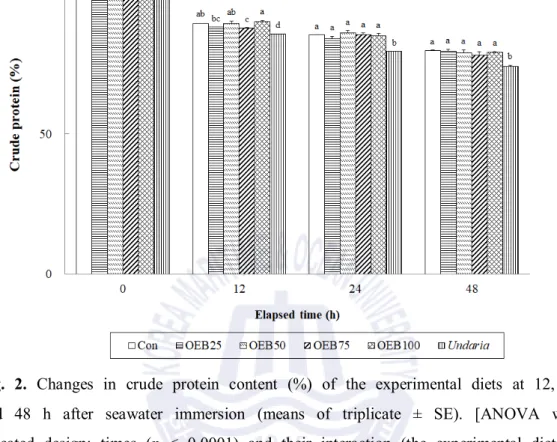
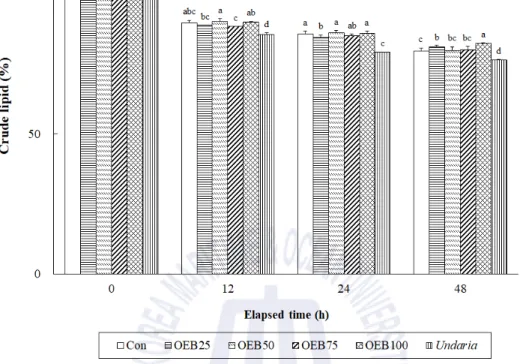
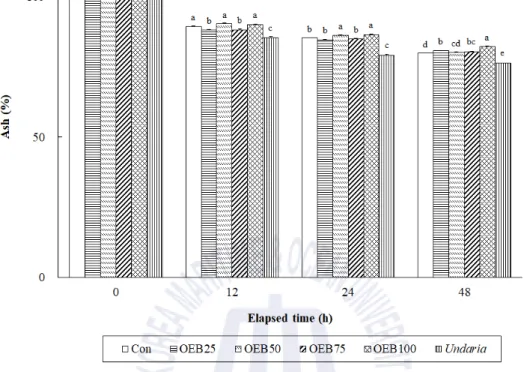
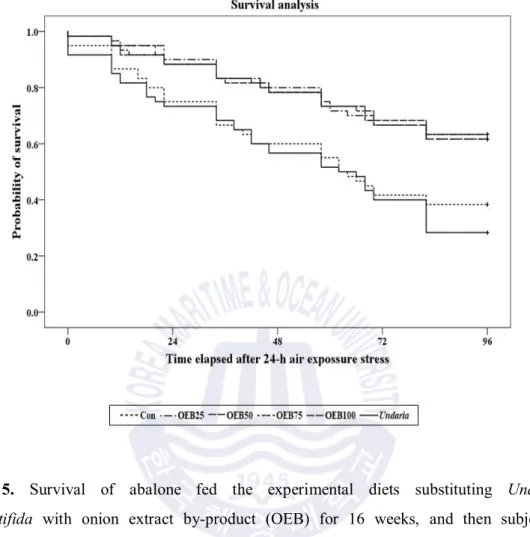
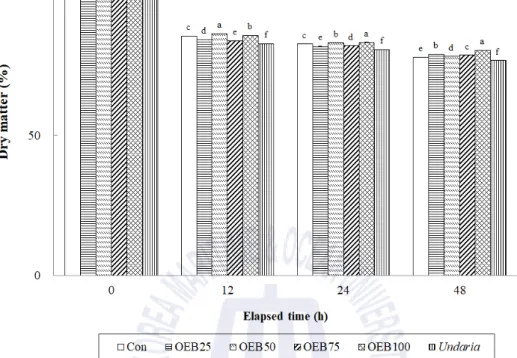
Different letters at each time point indicate significant differences (p < 0.05) between diets within each time point · 15 Fig. 5 Survival of abalone fed experimental diets replacing Undaria pinnatifida with onion extract by-product (OEB) for 16 weeks, and then subjected to 24-h air exposure for the next 4 days (mean of triplicates ± SE) (P <0.001 for Log Rank and Wilcoxon tests) ··· 23. Each diet was randomly assigned to triplicate groups of abalone and fed abalone once a day to satiation with little residue for 16 weeks.
The weight gain and SGR of abalone fed the OEB100 diet were lower than those of abalone fed the Con diet. The length, width and height of the shell and the soft body weight of the abalone mostly corresponded with the growth rate of the abalone. Survival of abalone fed the OEB25, OEB50, OEB75, and OEB100 diets was higher than that of abalone fed the Undaria and Con diets at the end of the 4-day observation period after 24 h of air exposure.
혼합사료에서 해조류를 양파즙 부산물로 대체한 후 검정전복(Haliotis discus)의 성장, 체성분 및 공기노출. 핵심 단어: Haliotis discus; 대체효과; 해초; 양파즙 부산물; 공기 노출 스트레스.
Introduction
Several feeding trials have been conducted to determine the suitability of fouling MAs such as Ulva australis (Ansary et al., 2019a), Sargassum horneri (Ansary et al., 2019b) and their combination (Ansary et al., 2019c) and other MAs ( Gracilaria lemaneiformis and Hynea spinella) (Qi et al., 2010;. Like onion, Allium cepa L. is the main vegetable plant cultivated worldwide (Roldán et al., 2008) and contains phenolic acids, quercetin, vitamins, flavonoids, sulfoxides, peptides, proteins and other bioactive compounds and acts as an important source of therapeutic agents with possible beneficial effects on human health, therefore it is recommended for the treatment or prevention of a wide variety of human diseases (Augusti, 1996; Breu, 1996; Jeong et al., 2009; Ramos et al., 2006).The popularity and consumption of onion as a vegetable for human consumption is steadily increasing worldwide due to its recognition as an important source of natural antioxidants, and its importance is expected to continue in the future (Kang et al., 1998; Roldán et al., 2008; Shin et al., 2010).
New antioxidants are generated by the maillard reaction during the heat treatment process before fruit and vegetable extraction (Kim et al., 2013; Robards et al., 1999), and the heat treatment also facilitates the collapse of their tissues and cells. Since the physiological activity including antioxidant capacity has been increased due to an increased bioavailability after heat treatment process (Choi et al., 2006; Dewanto et al., 2002; Kim et al., 2006b; Xu et al., 2007), their digestibility is in animals can be improved. In addition, many studies have revealed that administration of properly heated soybean meal improved growth performance, feed intake and feed efficiency of some fish (Arndt et al., 1999; Balogun and Ologhobo, 1989; Viola et al., 1983; Wilson and Poe, 1985).
Materials and Methods
- Preparation of the OEB
- Preparation of abalone and rearing condition
- Preparation of experimental diets
- Analytical procedures of the diets and carcass of abalone
- Monitoring survival of abalone subjected to air exposure stressor
- Water stability of the experimental diet
- Statistical analysis
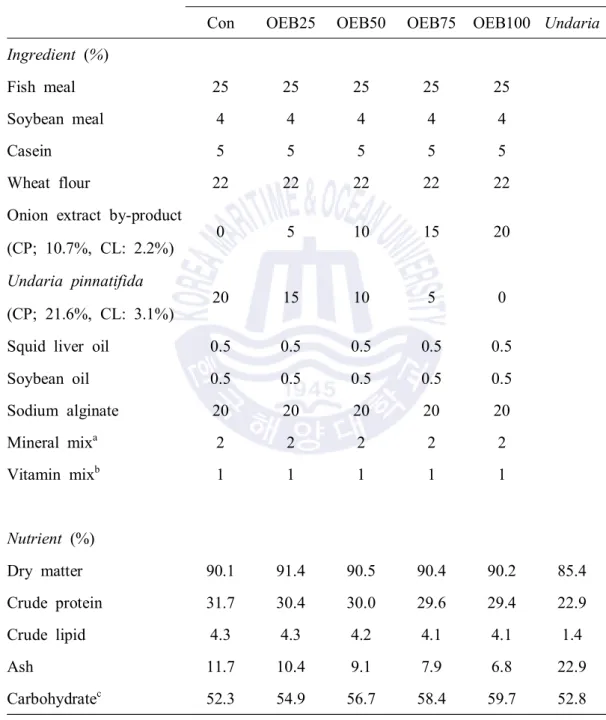
Twenty-two percent wheat flour and 0.5% squid liver and 0.5% soybean oil were included in the Con diet as a source of carbohydrates and lipids, respectively. The experimental diets met the dietary protein and lipid requirements for abalone (Fleming et al., 1996; Mai et al., 1995a, 1995b). Each diet was made into a fine paste using an electronic mixer (Samwoo Industry Co., Korea) and formed into 0.15 cm thick sheets, which were then manually cut into 1 cm2 flakes.
At the end of the 16-week feeding trial, 30 abalones from each net cage were randomly sampled and frozen at –20℃ for biological measurement and chemical analysis of abalone. Before examination, all specimens were slightly thawed followed by separation of the shell and soft body tissue. Shell length and shell width were measured in mm with a digital caliper (Mitutoyo Corporation, Kawasaki, Japan), and the ratio of soft body weight to body weight (the soft body weight + the weight of the excised shell) was calculated to determine an index of nutritional status of abalone. Wi))/feeding days]×100, where ln(Wf)=natural log of final mean weight of abalone and ln(Wi)=natural log of initial mean weight of abalone.
Separated soft tissue from all ears from each container was then homogenized and used for chemical analysis. After the 16-week feeding trial, 20 abalone from each mesh cage were re-fed using the same method as the feeding trial for 1 week to reduce handling stress during growth measurement, and then exposed to an air exposure stressor based on a slight modification of Cho et. al. Twenty ears from each mesh cage were completely dried and exposed to air for 24 h.
The nutrient levels of the experimental diets were assessed using the same procedure as the chemical composition of the experimental diets. The water stability of the experimental diets was tested by repeated measures ANOVA (Cody and Smith, 1991). Survival of abalone over a 4-day post-observation period following a 24-h air exposure was analyzed using the Kaplan-Meier survival curve, Log-rank, and Wilcoxon test.
In addition, a regression analysis was performed between body weight gain, SGR, shell length, shell width, shell height and soft body weight of abalone as the dependent variable and the amount of OEB replaced in the experimental diets as the independent variable.
Results
- Water stability of the experimental diets over time
- Growth performance of abalone
- Biological indices of abalone
- Chemical composition of the soft body of abalone
- Survival of abalone subjected to 24-h air exposure stressor
Different letters at each time point indicate significant (p <0.05) differences between diets at each time point. Different letters at each time point indicate significant (p < 0.05) differences between diets at each time point. Changes in crude lipid content (%) of experimental diets at 12, 24 and 48 h after seawater immersion (means of triplicates ± SE).
Changes in the crude ash content (%) of the experimental diets at 12, 24, and 48 h after immersion in seawater (triplicate mean ± SE). The retained ash content in all formulated diets was significantly (p < 0.05) higher than that in the Undaria during the same observation period after immersion in seawater. Abalone survival, ranging from 86.1 to 92.8%, was not significantly (p > 0.05) affected by U replacement.
Abalone fed all formulated diets showed significantly (p < 0.05) higher weight gain and SGR than those of abalone fed Undaria. Weight gain and SGR of calves fed the OEB25 and OEB75 diets were also significantly (p < 0.05) greater than those of calves fed the Con diet. However, abalone fed the OEB100 diet achieved significantly (p < 0.05) lower weight gain and SGR than those of abalone fed the Con diet.
Values (means of triplicates ± SE) in the same column sharing the same superscript letter are not significantly different (p > 0.05). Shell length, width and height and soft body weight of abalone fed the Con, OEB25, OEB50 and OEB75 diets were significantly (p < 0.05) longer, wider, taller and heavier than those of abalone fed the OEB100 diet, respectively and Undaria (Table) 4). The longest, widest, tallest and heaviest shell length, width and height and soft body weight were obtained in abalone fed the OEB50 diet.
However, the ratio of soft body weight to total abalone weight was not affected by dietary U replacement. Values (triplicate means ± SE) in the same column sharing a common superscript are not significantly different (p > 0.05). Survival of abalone fed the experimental diets replacing Undaria pinnatifida with onion extract byproduct (OEB) for 16 weeks, and then subjected to 24 hours of air exposure for the next 4 days (triplicate mean ± SE) ( p < 0.001 for Log Rank and Wilcoxon tests).
Discussion
Similarly, the dietary substitution effect of different sources of agricultural and fishery by-products, such as carrot leaf by-product, radish by-product, rice bran and sea squirt meal for MA on abalone growth performance (H. discus) have been reported (Baek et al., 2019; Choi et al., 2018; Jang et al., 2018; Kim et al., 2016; Lee et al., 2018). Improved plant digestibility (availability) by heat treatment may explain why abalone were fed diets replacing U. Quadratic relationships between growth performance (weight gain and SGR) of abalone fed all formulated diets and replacement level of OEBs for U. pinnatifida were explained in this study.
Because abalone feed slowly on a diet, abalone growth may depend on the stability of water in the diet. This may be another reason that ear fed all formulated diets achieved better growth than MA (Undaria). Greater shell growth (shell length, width and height) and heavier soft body weight in abalone fed all formulated diets except the OEB100 diet than in abalone fed Undaria in this study indicated that the biological seawater indices relatively well reflected in the growth rate of abalone. 2019) demonstrated that the growth of abalone (H. discus) fed compound diets replacing U.
The previous studies also reported that the growth performance of abalone was well reflected by the biological growth indices (shell length, height and width) and soft body weight of abalone (Amin et al., 2020; Lee et al., 2017a, 2017b; Stuart and Brown, 1994). The composition of the soft body of abalone was not affected by dietary replacement of U. pinnatifida with OEB in this study. 2019) reported that the chemical composition of the soft body of abalone was unaffected by the diets replacing U. pinnatifida with root-leaf by-product. 2015) also reported that dietary nutrient content did not affect the chemical composition of the soft body of abalone.
Abalone were subjected to 24-h air exposure stress to investigate the stress tolerance ability of abalone fed diets replacing U. Higher survival of abalone fed the OEB25, OEB50, OEB75 and OEB100 diets compared to the abalone fed Undaria and The con diets at the end of 4 days after observation showed that OEB has the potential to reduce stress and mortality of abalone exposed to air exposure. The highest mortality obtained in abalone fed Undaria indicated that abalone fed Undaria is less resistant to 24-h air exposure stress than that of abalone fed nutritionally balanced diet.
Superior weight gain and SGR of abalone fed all formulated diets than those fed the Undaria was observed. Shell length, width and height and soft body weight of abalone tended to correlate with growth rate. Effects of the different dietary additives on growth and tolerance of abalone Haliotis discus hannai to stress.