저작자표시-비영리-변경금지 2.0 대한민국 이용자는 아래의 조건을 따르는 경우에 한하여 자유롭게
l 이 저작물을 복제, 배포, 전송, 전시, 공연 및 방송할 수 있습니다. 다음과 같은 조건을 따라야 합니다:
l 귀하는, 이 저작물의 재이용이나 배포의 경우, 이 저작물에 적용된 이용허락조건 을 명확하게 나타내어야 합니다.
l 저작권자로부터 별도의 허가를 받으면 이러한 조건들은 적용되지 않습니다.
저작권법에 따른 이용자의 권리는 위의 내용에 의하여 영향을 받지 않습니다. 이것은 이용허락규약(Legal Code)을 이해하기 쉽게 요약한 것입니다.
Disclaimer
저작자표시. 귀하는 원저작자를 표시하여야 합니다.
비영리. 귀하는 이 저작물을 영리 목적으로 이용할 수 없습니다.
변경금지. 귀하는 이 저작물을 개작, 변형 또는 가공할 수 없습니다.
의학박사 학위논문
소아 확장성 심근병증 환자에서의 기능적 회복 및 임상적 악화 예측 모델
Development of
Cardiac Events and Functional Recovery Prediction Models
for Pediatric Dilated Cardiomyopathy
울 산 대 학 교 대 학 원 의 학 과
김 동 희
[UCI]I804:48009-200000368138 [UCI]I804:48009-200000368138
소아 확장성 심근병증 환자에서의 기능적 회복 및 임상적 악화 예측 모델
Development of
Cardiac Events and Functional Recovery Prediction Models
for Pediatric Dilated Cardiomyopathy
지 도 교 수 윤 태 진
이 논문을 의학박사학위 논문으로 제출함
2021 년 2 월
울 산 대 학 교 대 학 원 의 학 과
김 동 희
김동희의 의학박사학위 논문을 인준함
심사위원 김 영 휘 인 심사위원 유 정 진 인 심사위원 윤 태 진 인 심사위원 박 천 수 인 심사위원 곽 재 건 인
울 산 대 학 교 대 학 원
2021 년 2 월
Abstract
Background:Since both the risk of death and the probability of spontaneous functional recovery (FR) coexist in association with pediatric dilated cardiomyopathy (DCMP), management should be based on individualized outcome predictions.
Methods:A single-center retrospective review of 105 pediatric patients (age at presentation £ 18 years) with DCMP, managed between 1994 and 2017, was performed. Logistic regression was conducted to identify variables associated with FR and cardiac events (CEs), i.e., death or heart transplantation (HTPL), within two years after initial presentation. Two outcome prediction models were formulated using these variables.
Results:Twenty-six (24.8%) and 51 patients (48.6%) experienced FR and CE, respectively, within two years after initial presentation. Predictors of FR were younger age at presentation (hazard ratio [HR]: 0.98 per one-month increase;p= 0.001), post-myocarditis DCMP (HR: 5.16, p= 0.008), arrhythmia-mediated DCMP (HR: 29.74, p= 0.008), and higher left ventricular ejection fraction at initial presentation (HR: 1.06 per 1% increase;p= 0.079). Risk factors for CEs were older age at initial presentation (HR: 1.005 per one-month increase;p= 0.094), idiopathic DCMP (HR: 2.66, p= 0.020), and the need of extracorporeal membrane oxygenation (HR: 3.09;p= 0.081). The low-risk group who had higher probability of FR than CE in prediction model had a higher overall survival rate (76.9% vs. 52.1% at 10 years after presentation; log-rankp= 0.021) and a higher HTPL-free survival rate (71.5% vs. 25.2% at 10 years after presentation; log-rank p< 0.001) than the high-risk group.
Conclusions:Prognostication and management strategies for pediatric DCMP may be enhanced by risk stratification using outcome prediction modeling.
Key words:pediatric dilated cardiomyopathy, survival, functional recovery, heart transplantation, cardiac event, myocarditis.
Abstract word count: 266
Table of Contents
Abstract ... iv
Table of Contents... v
List of Tables, Figures, and Abbreviations ... vi
Introduction... 1
Methods ... 1
Patients ... 1
Diagnosis and definitions ... 1
Medical treatment ... 2
Statistical analysis ... 2
Results ... 3
Patient characteristics ... 3
Clinical outcomes and predictors of death without HTPL... 3
Predictors of FR and CE occurrence... 4
Formulation of outcome prediction model ... 4
Discussion ... 5
Conclusion... 7
Funding... 7
Compliance with Ethical Standards... 7
Conflict of Interest ... 7
Ethical Approval ... 8
Informed Consent... 8
References ... 9
Korean abstracts (국문요약) ... 30
List of Tables, Figures, and Abbreviations
Table 1. Comparison of the patient characteristics between the two eras ... 12
Table 2. Risk factors for decreased time to death before heart transplantation ... 14
Table 3 Predictors of functional recovery within 2 years after initial presentation... 16
Table 4. Risk factors for cardiac events within 2 years after initial presentation. ... 18
Figure 1. Overall Survival of The Entire Cohort. ... 20
Figure 2. Cumulative Incidence of Transplantation-Free Survival, Death Before Heart Transplantation, and Heart Transplantation... 21
Figure 3. Kaplan–Meier Curves of Clinical Outcomes Stratified by Eras at Initial Presentation; (A) overall survival, (B) transplantation-free Survival... 22
Figure 4. Cumulative Incidence of Functional Recovery in The Entire Cohort. ... 23
Figure 5. Probability Curves for Functional Recovery Within 2 Years After Initial Presentation According to (A) Age at Initial Presentation and (B) Initial Left Ventricular Ejection Fraction.... 24
Figure 6. Probability Curve for Cardiac Events Within 2 Years After Initial Presentation According to Age at Initial Presentation... 25
Figure 7. Cumulative Incidence of Transplantation-Free Survival, Death Before Heart Transplantation, and Heart Transplantation in (A) the Low-Risk Group and (B) High-Risk Group. ... 26
Figure 8. Kaplan–Meier Curves for Clinical Outcomes Stratified by Risk Groups (A) overall survival, (B) transplantation-free survival. ... 27
Graphical abstract. Outcome Prediction Models for Pediatric Dilated Cardiomyopathy. ... 28
Introduction
Dilated cardiomyopathy (DCMP), which is characterized by severe dysfunction and dilatation of the left ventricle, is the most common cardiomyopathic phenotype affecting children.1-4The annual incidence of pediatric DCMP has been reported to be 0.57 cases per 100,000 per year in North America.5Transplantation-free survival rates among pediatric DCMP patients remain poor despite recent advances in medical treatment6and mechanical circulatory support (MCS).7-10Nearly half of pediatric DCMP patients die early or require early heart transplantation (HTPL).5,11,12HTPL outcomes have improved markedly among both adults and children in recent years, rendering HTPL a potent therapeutic option.9,13,14However, children with DCMP may experience spontaneous functional recovery (FR) of the left ventricle, and HTPL tends to be reserved for critically ill patients during the early stage after initial diagnosis.15-17Therefore, it is important to identify subsets of patients who are likely to have poor outcomes and those who are likely to recover spontaneously, given that both death and FR tend to occur relatively soon after the onset of symptoms. We sought to formulate outcome prediction models stratifying risk among pediatric DCMP patients to facilitate appropriate and individualized early management.
Methods Patients
This single-center retrospective review analyzed data retrieved from the medical records of 105 pediatric patients (£ 18 years of age at presentation) with DCMP who were managed at our institution between December 1994 and November 2017. Sixty patients (60/105, 57.1%) were male, and the median age at initial diagnosis was 2.19 years (interquartile range [IQR], 0.52 to 11.63).
Medical record data were captured regarding demographic characteristics, familial history of sudden cardiac death or DCMP, medical treatments, and comorbidities.
Diagnosis and definitions
A diagnosis of DCMP was considered based on a patient’s clinical history and physical examination and confirmed by pathognomonic echocardiographic findings of an abnormally dilated left ventricular cavity and left ventricular systolic dysfunction (i.e. a left ventricular ejection fraction [LVEF] less than 50%). Although diagnoses were made mainly according to the phenotypic
characteristics of DCMP,5,11,12,18potential underlying genetic abnormalities, such as Turner syndrome or Duchenne muscular dystrophy, were also investigated during data collection. Arrhythmia-mediated DCMP was defined as DCMP that developed after an attack of electrocardiographically documented tachyarrhythmias. Myocarditis-induced DCMP was defined as DCMP that developed after an episode
of myocarditis, which was diagnosed by myocardial biopsy, cardiac magnetic resonance imaging, or laboratory findings (i.e. identification of viral markers or at least a 2-fold increase in serum cardiac enzymes at initial presentation). Patients without any demonstrable causes of DCMP were categorized as having idiopathic DCMP. FR was defined as recuperation from left ventricular dysfunction with an echocardiographically confirmed LVEF greater than 50%. The composite outcome of HTPL or death without HTPL defined cardiac events (CE). Study endpoints that occurred within 2 years of initial presentation were considered early FR or CEs.
Medical treatment
Intravenous immunoglobulin (IVIG) treatment was indicated within the first week after the initial diagnosis for patients who were deemed to have myocarditis. Steroid pulse therapy was reserved for patients who did not respond to maximal medical therapy and IVIG. Outpatient-based medications, including digoxin, angiotensin-converting enzyme inhibitors, beta-blockade,
antiarrhythmic agents, and anticoagulants were not accounted for in the statistical analysis because the prescription timing, duration of administration, and drug combinations varied widely among the patients.
Statistical analysis
All categorical variables are expressed as frequencies with percentages, and continuous variables are expressed as means with standard deviations or medians with IQRs. Kaplan–Meier analysis was used to estimate survival or freedom from time-related events, and differences between the groups were compared using the log-rank test. A Cox proportional hazard model was fitted to identify the risk factors for decreased time to death without HTPL, considering the performance of HTPL as a censored event. Variables with a p-value of less than 0.1 on a univariable Cox regression were included in the multivariable analysis. To develop predictive models for FR or CEs during a certain time frame after initial presentation, we identified predictors of FR and risk factors for CE within 2 years after initial presentation using logistic regression analysis, including variables with a univariable p-value of less than 0.1 in the multivariable analysis. Consequently, the probability of FR or CEs within 2 years after initial presentation was estimated using the statistically significant predictors of FR or CEs identified from the logistic regression analysis as follows.
Probability (%) = {exp(h) / [1 + exp(h)]} x 100 (h) = a + b1*x1 + …… + bk*xk
exp(h) = ea* (eb1)x1 *……* (ebk)xk
Accuracy of the calculated probability was validated with receiver operating characteristics curve.
Differences in the final analysis were regarded as statistically significant if p-values were less than 0.05. R software version 3.6.1 (www.r-project.org) was used for analysis.
Results
Patient characteristics
Thirty-five patients (35/105, 33.3%) had DCMP induced by myocarditis, 7 patients (7/105, 6.6%) had arrhythmia-mediated DCMP, and 5 patients (5/105, 4.8%) had doxorubicin-induced DCMP, and the remaining 58 patients (58/105, 55.2%) were categorized as having idiopathic DCMP.
Three patients had underlying genetic disorders (namely, Turner syndrome, Seckel syndrome, and mitochondrial disease), and 1 patient had Duchenne muscular dystrophy. Six patients (6/105, 5.7%) had familial history of sudden death or DCMP. The median LVEF at diagnosis was 25.5% (IQR: 17.5 to 31.0%). Fifteen patients (15/105, 14.3%) required extracorporeal membrane oxygenation (ECMO) at a median of 12 days (IQR: 0 to 50 days) after initial presentation, among whom 9 patients (9/15, 60%) underwent HTPL (7 patients on ECMO, 2 patients off ECMO). An additional 19 patients underwent HTPL without a history of ECMO support. Thus, HTPL was performed for 28 patients (28/105, 26.7%) at a median of 6 months (IQR: 1.9 to 27 months) after initial presentation.
Clinical outcomes and predictors of death without HTPL
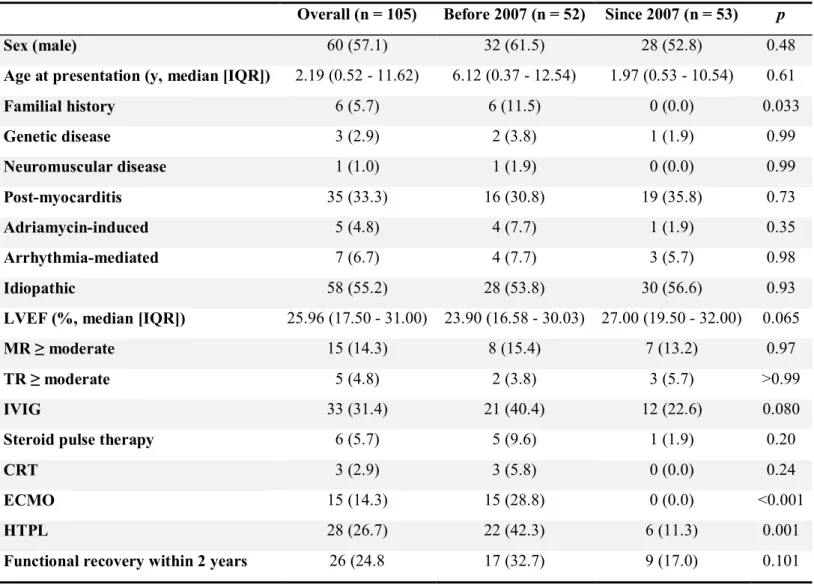
The median follow-up duration was 5.5 years (range: 0.1 to 25.1 years), during which 49 deaths (49/105, 46.7%; 39 deaths without HTPL and 10 deaths after HTPL) occurred. The overall survival rate at 10 years after initial presentation was 58.2% (Figure 1). The cumulative incidence curves in Figure 2 show that 36.8% of the patients died without HTPL, 27.7% underwent HTPL, and the remaining 35.4% were alive without HTPL 10 years after initial presentation. Figure 3A illustrates overall survival according to the eras of presentation, showing that there was a significant survival improvement from 2007 onward (75.0% vs. 39.9% at 10 years; log-rank p< 0.001). However, as Figure 3B illustrates, there was no significant difference in HTPL-free survival between the 2 time frames (35.3% vs. 33.9%; log-rank p= 0.5), signifying that improvement in overall survival in the latter era was mainly attributed to the more aggressive application of HTPL. Inter-era differences in patient characteristics are summarized in Table 1. The univariable Cox regression analysis yielded the following risk factors for decreased time to death without HTPL: earlier era at presentation
(presentation before 2007,p< 0.001) and significant tricuspid regurgitation (TR) at presentation (TR
≥ moderate;p= 0.033). After multivariable analysis, earlier era at presentation (HR: 4.13; 95% CI:
1.88 to 9.06;p< 0.001) and significant TR (≥ moderate; HR: 4.31; 95% CI: 1.26 to 14.77;p= 0.020) remained significant (Table 2).
Predictors of FR and CE occurrence
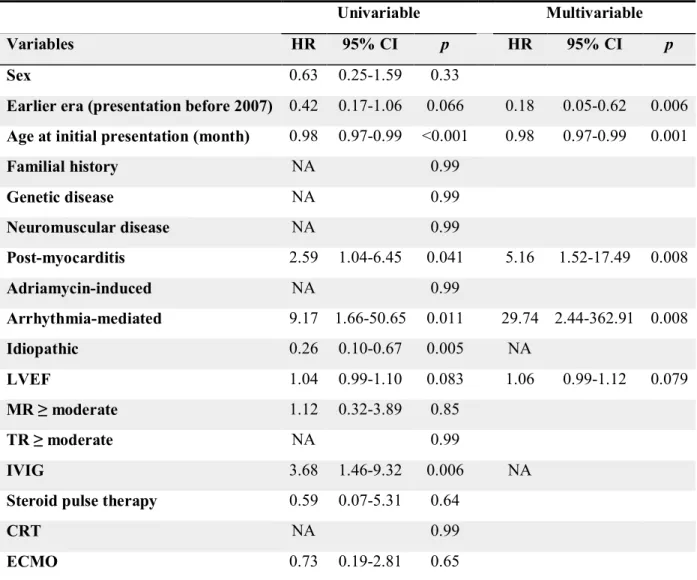
During follow-up, 33 patients (33/105, 31.4%) experienced FR at a median interval of 11.4 months (IQR: 5.9 to 21.3 months) after initial presentation. The cumulative incidence of FR is depicted in Figure 4. Two patients (2/33, 6.1%) experienced deterioration of left ventricular function after FR; these patients were 2.7 months old and 7.6 months old at presentation and exhibited mild deterioration of left ventricular function (LVEF of 48% and 42%) at 79 months and 67 months after FR, respectively. Two patients died of noncardiac causes after FR. An 18-month-old girl, who was 3 months old at presentation and experienced FR 8 months after her initial presentation, died of acute respiratory distress syndrome 7 months after FR. A 6.8-year-old girl, who was 6 months old at presentation and experienced FR 4.5 years after her initial presentation, died of an acute exacerbation of lobar pneumonia 21 months after FR. FR took place within 2 years after initial presentation in 26 patients (26/105, 24.8%). Univariable logistic regression analysis found recent era (presentation since 2007;p= 0.066), younger age at initial presentation (p< 0.001), post-myocarditis DCMP (p= 0.041), arrhythmia mediated DCMP (p= 0.011), higher LVEF at initial presentation (p= 0.083),
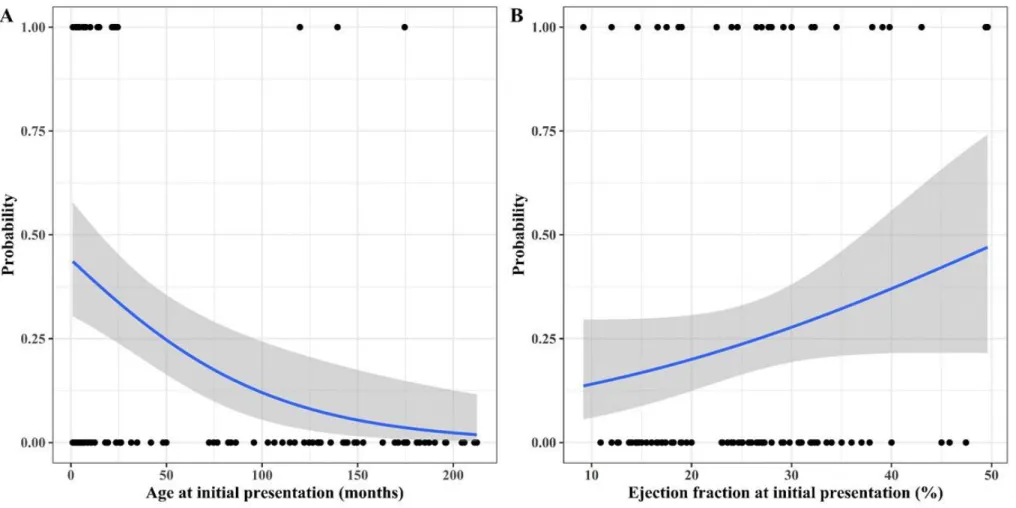
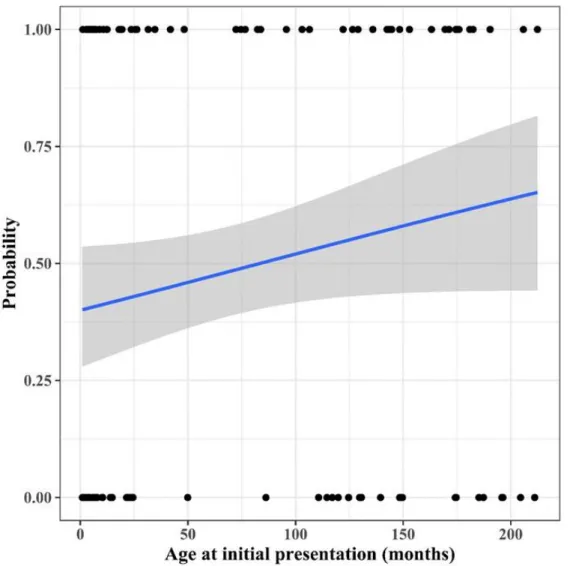
nonidiopathic DCMP (p= 0.005), and use of IVIG (p= 0.006) to be predictors for FR within 2 years after initial presentation. Multivariable analysis revealed the following independent predictors of FR within 2 years after initial presentation: recent era (HR: 5.56; 95% CI: 1.61 to 20.0;p= 0.006), younger age at initial presentation (HR: 0.98 per 1 month increase; 95% CI: 0.97 to 0.99,p< 0.001), post-myocarditis DCMP (HR: 5.16; 95% CI: 1.52 to 17.49;p= 0.008), arrhythmia-mediated DCMP (HR: 29.74; 95% CI: 2.44 to 362.91;p= 0.008) and higher LVEF at initial presentation (HR: 1.06 per 1 % increase in LVEF; 95% CI: 0.99 to 1.12;p= 0.079) (Table 3). The estimated probability curves for FR according to the age at presentation and initial LVEF are illustrated in Figure 5.
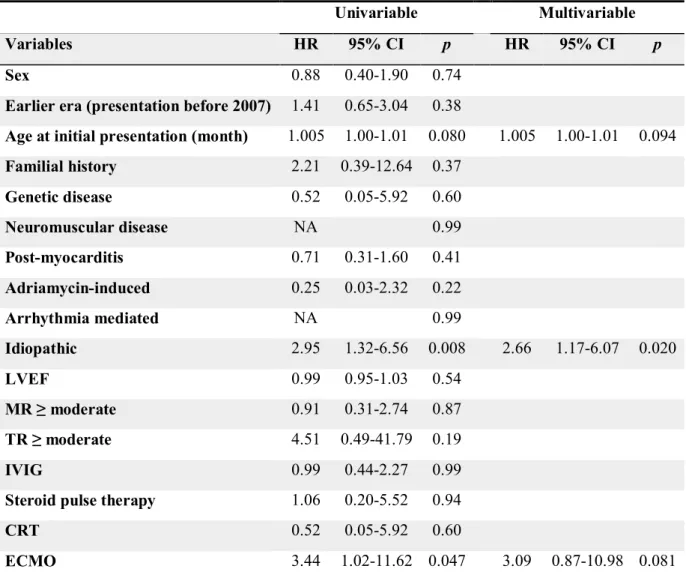
Within 2 years after initial presentation, 51 patients (51/105, 48.6%) had CEs: 31 patients (31/105, 29.5%) died without HTPL and 20 patients (19.0%) underwent HTPL. According to the univariable analysis, predictors of CEs within 2 years after presentation were older age at initial presentation (p= 0.080), idiopathic DCMP (p= 0.008), and the need for ECMO (p= 0.047). Older age at initial presentation (HR: 1.005 per 1-month increase; 95% CI: 1.00 to 1.01;p= 0.094), idiopathic DCMP (HR: 2.66; 95% CI: 1.17 to 6.07;p= 0.020), and the need for ECMO (HR: 3.09;
95% CI: 0.87 to 10.98;p= 0.081) remained independent risk factors for CEs after multivariable analysis. (Table 4). Estimated probability curves for CEs according to age at initial presentation are illustrated in Figure 6.
Formulation of outcome prediction model
Outcome prediction models were formulated from the predictors of FR or CEs within 2 years after initial presentation identified by the multivariable logistic regression analyses (Table 3, 4). As
the date of initial presentation could not be used for the prospective probability model for FR, the era effect was not used to formulate the equations. Therefore, age, post-myocarditis DCMP, arrhythmia mediated DCMP, and LVEF at initial presentation were used for the FR probability equation.
Similarly, age at initial presentation, idiopathic DCMP, and utilization of ECMO were used for the CE probability equation. Continuous variables, such as age in months and LVEF, were entered into the equations as numbers, and the presence or absence of the categorical variables were treated as 1 or 0, respectively.
Probability of FR within 2 years (%) = {exp (hFR) / [1 + exp (hFR)]} x 100
hFR= (-2.083) + (-0.017 x Age in months) + (1.344 x post-myocarditis DCMP) + (3.072 x arrhythmia mediated DCMP) + (0.038 x LVEF)
exp (hFR) = 0.125 x 0.983Age (months)x 3.834Post-myocarditis DCMPx 21.580arrhythmia mediated DCMPx 1.039LVEF (%) Probability of CE occurrence within 2 years (%) = {exp (hCE) / [1 + exp (hCE)]} x 100 hCE= (-1.104) + (0.005 x Age in months) + (0.979 x idiopathic DCMP) + (1.128 x Use of ECMO)
exp (hCE) = 0.332 x 1.005Age (months)x 2.662idiopathic DCMPx 3.089Use of ECMO
Using area under the receiver operating characteristics curve, calculated probability of FR and CE showed prediction accuracy of 0.836 (95% CI, 0.749 to 0.924) and 0.714 (95% CI: 0.614 to 0.813), respectively. Risk-stratification was attempted for the entire cohort using the 2 outcome prediction models, and patients were categorized into 2 groups: the low-risk group (n = 26, 24.8%) was defined as the subset whose FR probabilities were higher than their CE probabilities, while the high-risk group (n = 79, 75.2%) comprised the subset whose CE probabilities were higher than their FR probabilities. The cumulative incidence curves for the low-risk group show that 4.5% of the low- risk patients underwent HTPL, 24.0% died without HTPL, and 71.5% were alive without HTPL 10 years after initial presentation (Figure 7-A). The curves for the high-risk group show that 34.3% of these patients underwent HTPL, 40.5% died without HTPL, and 25.2% were alive without HTPL 10 years after initial presentation (Figure 7-B). The low-risk group had a higher overall survival rate (76.9% vs. 52.1% at 10 years after initial presentation; log-rank p= 0.021; Figure 8-A) and a higher HTPL-free survival rate (71.5% vs. 25.2% at 10 years after initial presentation; log-rank p< 0.001;
Figure 8-B) than the high-risk group.
Discussion
This study showed that the prognosis of pediatric patients with DCMP is still suboptimal in that a significant number of patients die early while waiting for HTPL. Although overall survival rates
have markedly improved,19transplantation-free survival rates have no changed much, which signifies that improvements in overall survival are mainly attributable to appropriately indicated and timely HTPL.14,20Notably, many patients with initially compromised left ventricular function experience FR of the left ventricle. Because both CEs and FR occur most frequently within 2 years after initial presentation, prognostication and management strategies should be based on proper risk stratification during this early stage. To this end, we sought to develop outcome prediction models for both CEs and FR. If the probability of CEs is higher than that for FR for a patient with DCMP, early registration for preemptive HTPL (or ventricular assist device) may be suitable. In the reverse scenario, the patient would benefit from the continuation of medical treatment, with anticipation of FR.
Given the donor shortage and the high frequency of rapid clinical deterioration after initial presentation in the pediatric population, registration for HTPL should be done far in advance once a patient is deemed to have a high CE probability.15-17, 21Various risk factors for death among pediatric patients with DCMP have been highlighted in the previous studies, such as older age, profound cardiac dysfunction, severe ventricular dilatation, and the need for hospitalization at initial
presentation.3, 5, 11, 15, 21-25This study additionally found that idiopathic DCMP and the need for ECMO at any point after initial presentation are significant risk factors for CEs within 2 years after
presentation. However, Cox regression analysis showed that moderate to severe TR at initial presentation was the only significant risk factor for decreased time to death without HTPL.
Association of significant TR could be a result of pulmonary hypertension caused either by severe left ventricular dysfunction16or by right ventricular dysfunction per se in patients with advanced DCMP.26 We identified certain causes of DCMP (i.e., myocarditis and arrhythmia) as predictors of FR, as similarly indicated in previous studies.3,12,22,27,28Appropriate and timely use of cardiac
resynchronization therapy, which has been indicated for adults with severe heart failure,29was not identified as a predictor of FR in this study. However, younger age at initial presentation was identified as a predictor of FR in this study, as indicated in other studies.24,30In the subgroup of patients aged less than 2 years at presentation (n=50), a significant number of patients experienced FR (n=27, 54%), especially within 2 years after initial presentation (n=22, 44%). Therefore, the
probability of FR compared with the probability of CE occurrence within 2 years should be carefully assessed before registering younger patients for HTPL. Given that deterioration of left ventricular function may occur after FR, vigilant outpatient monitoring and frequent reassessment of cardiac function are vital even for patients with FR.
There were several limitations to this study. Concerning the causes of DCMP, the high incidence of idiopathic DCMP in this study may be attributable, at least in part, to the retrospective
study design and consequent missing clinical information. Without pathognomonic findings of myocarditis, tachyarrhythmia, or a clinical history of the use of cardiotoxic drugs, the cause of DCMP was deemed idiopathic. Moreover, improvements in laboratory techniques used to diagnose
myocarditis, such as the assessment of troponin I levels instead of lactate dehydrogenase or creatinine kinase levels, further complicated the task of identifying underlying causes. Although it is
indisputable that HTPL is a final therapeutic option for end-stage DCMP, it is unclear whether HTPL was performed in a timely fashion for appropriately selected patients. Furthermore, the impact of medical treatment on the deferment of HTPL or improvements in clinical condition before HTLP could not be evaluated due to the multiple drug combinations and frequent regimen changes during the study period. Lastly, some may argue that this study cohort may not be representative because there were no patients treated with left ventricular assist devices (LVADs), which have been reported to be either an optimal supportive measure for bridging to HTPL9,13or an ideal definitive treatment modality (i.e., a potent alternative to HTPL) for facilitating FR among DCMP patients.7,10,13.LVAD might have modified the clinical course for many of the study patients who died without HTPL by rescuing patients from impending cardiac death, stabilizing the pre-HTPL state among patients with multi-organ dysfunction,8and avoiding ECMO-related complications.9,13However, given that application of LVADs would have been indicated for critically ill patients who were more likely to experience CEs than FR, the predictability of CEs in a cohort with LVADs may have been similar to that of a cohort without LAVDs if the application of LVADs or other forms of MCS was included in the CE definition.
Conclusion
With the outcome prediction models for CEs and FR, the probabilities of CEs and FR in each patient could be calculated and compared. Early registration for HTPL (or early employment of LVADs) is recommended for patients who are deemed more likely to experience CEs than FR, while aggressive medical treatment may continue for patients with higher probability of FR than CEs.
Funding None.
Compliance with Ethical Standards Conflict of Interest
The authors declare that they have no conflicts of interest.
Ethical Approval
This study was approved by the review board at the participating institution.
Informed Consent
For this type of study formal consent is not required.
References
1. Maron BJ, Towbin JA, Thiene G, et al. Contemporary definitions and classification of the cardiomyopathies: an American Heart Association Scientific Statement from the Council on Clinical Cardiology, Heart Failure and Transplantation Committee; Quality of Care and Outcomes Research and Functional Genomics and Translational Biology Interdisciplinary Working Groups;
and Council on Epidemiology and Prevention. Circulation. 2006;113 (14):1807-16.
2. Nugent AW, Daubeney PE, Chondros P, et al. The epidemiology of childhood cardiomyopathy in Australia. N Engl J Med. 2003;348(17):1639-46.
3. Alexander PM, Daubeney PE, Nugent AW, et al. Long-term outcomes of dilated cardiomyopathy diagnosed during childhood: results from a national population-based study of childhood cardiomyopathy. Circulation. 2013;128(18):2039-46.
4. Choudhry S, Puri K, Denfield SW. An Update on Pediatric Cardiomyopathy. Curr Treat Options Cardiovasc Med. 2019;21(8):36.
5. Towbin JA, Lowe AM, Colan SD, et al. Incidence, causes, and outcomes of dilated cardiomyopathy in children. JAMA. 2006;296(15):1867-76.
6. Kantor PF, Abraham JR, Dipchand AI, Benson LN, Redington AN. The Impact of Changing Medical Therapy on Transplantation –Free Survival in Pediatric Dilated Cardiomyopathy. J Am Coll Cardiol 2010;55:1377-84.
7. Miera O, Germann M, Cho MY, et al. Bridge to recovery in children on ventricular assist devices- protocol, predictors of recovery, and long-term follow-up. J Heart Lung Transplant.
2018;37(12):1459-1466.
8. Lorts A, Eghtesady P, Mehegan M, et al. Outcomes of children supported with devices labeled as
“temporary” or short term: A report from the Pediatric Interagency Registry for Mechanical Circulatory Support. J Heart Lung Transplant. 2018;37(1):54-60.
9. Kirk R, Naftel D, Hoffman TM, et al. Outcome of pediatric patients with dilated cardiomyopathy listed for transplant: a multi-institutional study. J Heart Lung Transplant. 2009;28(12):1322-8.
10. Cavanaugh JL, Miyamoto SD, da Cruz E, et al. Predicting recovery: successful explant of a ventricular assist device in a child with dilated cardiomyopathy. J Heart Lung Transplant.
2010;29(1):105-8.
11. Daubeney PE, Nugent AW, Chondros P, et al. Clinical features and outcomes of childhood dilated cardiomyopathy: results from a national population-based study. Circulation. 2006;114(24):2671- 8.
12. Hsu DT, Canter CE. Dilated cardiomyopathy and heart failure in children. Heart Fail Clin.
2010;6(4):415-32.
13. McMahon AM, van Doorn C, Burch M, et al. Improved early outcome for end-stage dilated cardiomyopathy in children. J Thorac Cardiovasc Surg. 2003;126(6):1781-7.
14. Tsirka AE, Trinkaus K, Chen SC, et al. Improved outcomes of pediatric dilated cardiomyopathy with utilization of heart transplantation. J Am Coll Cardiol. 2004;44(2):391-7.
15. Burch M, Siddiqi SA, Celermajer DS, Scott C, Bull C, Deanfield JE. Dilated cardiomyopathy in children: determinants of outcome. Br Heart J. 1994;72(3):246-50.
16. Arola A, Tuominen J, Ruuskanen O, Jokinen E. Idiopathic dilated cardiomyopathy in children:
prognostic indicators and outcome. Pediatrics. 1998;101(3 Pt 1):369-76.
17. Lewis AB. Late recovery of ventricular function in children with idiopathic dilated cardiomyopathy.
Am Heart J. 1999;138(2 Pt 1):334-8.
18. Grenier MA, Osganian SK, Cox GF, et al. Design and implementation of the North American Pediatric Cardiomyopathy Registry. Am Heart J. 2000;139(2 Pt 3):S86-95.
19. Singh RK, Canter CE, Shi L, et al. Survival Without Cardiac Transplantation Among Children With Dilated Cardiomyopathy.J Am Coll Cardiol. 2017;70(21):2663-2673.
20. Weintraub RG, Alexander PMA. Outcomes in Pediatric Dilated Cardiomyopathy: Quo Vadis?J Am Coll Cardiol. 2017;70(21):2674-2676.
21. Matitiau A, Perez-Atayde A, Sanders SP, et al. Infantile dilated cardiomyopathy. Relation of outcome to left ventricular mechanics, hemodynamics, and histology at the time of presentation.
Circulation. 1994;90(3):1310-8.
22. Alvarez JA, Orav EJ, Wilkinson JD, et al. Competing risks for death and cardiac transplantation in children with dilated cardiomyopathy: results from the pediatric cardiomyopathy registry.
Circulation. 2011 Aug 16;124(7):814-23.
23. Alvarez JA, Wilkinson JD, Lipshultz SE. Outcome Predictors for Pediatric Dilated Cardiomyopathy: A Systematic Review. Prog Pediatr Cardiol. 2007;23(1):25-32.
24. Everitt MD, Sleeper LA, Lu M, et al. Recovery of echocardiographic function in children with idiopathic dilated cardiomyopathy: results from the pediatric cardiomyopathy registry. J Am Coll Cardiol. 2014 Apr 15;63(14):1405-13.
25. Al-Wakeel-Marquard N, Degener F, Herbst C, et al. RIKADA Study Reveals Risk Factors in Pediatric Primary Cardiomyopathy. J Am Heart Assoc. 2019 Aug 6;8(15):e012531.
26. Doesch C, Dierks DM, Haghi D, et al. Right ventricular dysfunction, late gadolinium enhancement, and female gender predict poor outcome in patients with dilated cardiomyopathy. Int J Cardiol.
2014;177:429–435.
27. Akagi T, Benson LN, Lightfoot NE, Chin K, Wilson G, Freedom RM. Natural history of dilated cardiomyopathy in children. Am Heart J. 1991 May;121(5):1502-6.
28. Gupta S, Figueredo VM. Tachycardia mediated cardiomyopathy: pathophysiology, mechanisms, clinical features and management. Int J Cardiol. 2014;172(1):40-6.
29. Serdoz LV, Daleffe E, Merlo M, et al. Predictors for restoration of normal left ventricular function in response to cardiac resynchronization therapy measured at time of implantation. Am J Cardiol.
2011;108(1):75-80
30. Lewis AB. Normalization of function in pediatric dilated cardiomyopathy: recovery or remission?
J Am Coll Cardiol. 2014 Apr 15;63(14):1414-5.
Table 1. Comparison of the patient characteristics between the two eras
Overall (n = 105) Before 2007 (n = 52) Since 2007 (n = 53) p
Sex (male) 60 (57.1) 32 (61.5) 28 (52.8) 0.48
Age at presentation (y, median [IQR]) 2.19 (0.52 - 11.62) 6.12 (0.37 - 12.54) 1.97 (0.53 - 10.54) 0.61
Familial history 6 (5.7) 6 (11.5) 0 (0.0) 0.033
Genetic disease 3 (2.9) 2 (3.8) 1 (1.9) 0.99
Neuromuscular disease 1 (1.0) 1 (1.9) 0 (0.0) 0.99
Post-myocarditis 35 (33.3) 16 (30.8) 19 (35.8) 0.73
Adriamycin-induced 5 (4.8) 4 (7.7) 1 (1.9) 0.35
Arrhythmia-mediated 7 (6.7) 4 (7.7) 3 (5.7) 0.98
Idiopathic 58 (55.2) 28 (53.8) 30 (56.6) 0.93
LVEF (%, median [IQR]) 25.96 (17.50 - 31.00) 23.90 (16.58 - 30.03) 27.00 (19.50 - 32.00) 0.065
MR ≥ moderate 15 (14.3) 8 (15.4) 7 (13.2) 0.97
TR ≥ moderate 5 (4.8) 2 (3.8) 3 (5.7) >0.99
IVIG 33 (31.4) 21 (40.4) 12 (22.6) 0.080
Steroid pulse therapy 6 (5.7) 5 (9.6) 1 (1.9) 0.20
CRT 3 (2.9) 3 (5.8) 0 (0.0) 0.24
ECMO 15 (14.3) 15 (28.8) 0 (0.0) <0.001
HTPL 28 (26.7) 22 (42.3) 6 (11.3) 0.001
Functional recovery within 2 years 26 (24.8 17 (32.7) 9 (17.0) 0.101
AbbreviationsIQR interquartile range; LVEFleft ventricular ejection fraction; MRmitral regurgitation; TRtricuspid regurgitation;IVIGintravenous immunoglobulin;CRTcardiac resynchronization therapy;ECMO extracorporeal membrane oxygenator; HTPL heart transplantation
Table 2. Risk factors for decreased time to death before heart transplantation
Univariable Multivariable
Variables HR 95% CI p HR 95% CI p
Sex (male) 1.29 0.69-2.43 0.43
Earlier era (presentation before 2007) 4.00 1.83-8.76 <0.001 4.13 1.88-9.06 <0.001 Age at initial presentation (months) 1.00 1.00-1.01 0.49
Familial history 1.32 0.31-5.51 0.71
Genetic disease 1.82 0.44-7.58 0.41
Neuromuscular disease 2.39 0.33-17.50 0.39
Post-myocarditis 1.17 0.61-2.23 0.64
Adriamycin-induced NA >0.99
Arrhythmia-mediated NA >0.99
Idiopathic 1.66 0.87-3.18 0.13
LVEF (%, median [IQR]) 1.00 0.97-1.04 0.89
MR ≥ moderate 1.09 0.46-2.61 0.84
TR ≥ moderate 3.69 1.11-12.24 0.033 4.31 1.26-14.77 0.020
IVIG 0.74 0.36-1.52 0.42
Steroid pulse therapy 0.91 0.22-3.77 0.89
CRT 0.71 0.10-5.20 0.74
ECMO 0.97 0.34-2.74 0.95
AbbreviationsHRhazard ratio; CIconfidence interval; LVEFleft ventricular ejection fraction; MRmitral regurgitation; TRtricuspid regurgitation;IVIGintravenous immunoglobulin;CRTcardiac resynchronization therapy;ECMO extracorporeal membrane oxygenation
Table 3 Predictors of functional recovery within 2 years after initial presentation
Univariable Multivariable
Variables HR 95% CI p HR 95% CI p
Sex 0.63 0.25-1.59 0.33
Earlier era (presentation before 2007) 0.42 0.17-1.06 0.066 0.18 0.05-0.62 0.006 Age at initial presentation (month) 0.98 0.97-0.99 <0.001 0.98 0.97-0.99 0.001
Familial history NA 0.99
Genetic disease NA 0.99
Neuromuscular disease NA 0.99
Post-myocarditis 2.59 1.04-6.45 0.041 5.16 1.52-17.49 0.008
Adriamycin-induced NA 0.99
Arrhythmia-mediated 9.17 1.66-50.65 0.011 29.74 2.44-362.91 0.008
Idiopathic 0.26 0.10-0.67 0.005 NA
LVEF 1.04 0.99-1.10 0.083 1.06 0.99-1.12 0.079
MR ≥ moderate 1.12 0.32-3.89 0.85
TR ≥ moderate NA 0.99
IVIG 3.68 1.46-9.32 0.006 NA
Steroid pulse therapy 0.59 0.07-5.31 0.64
CRT NA 0.99
ECMO 0.73 0.19-2.81 0.65
AbbreviationsHRhazard ratio; CIconfidence interval; LVEFleft ventricular ejection fraction; MRmitral regurgitation; TRtricuspid regurgitation;IVIG intravenous immunoglobulin;CRTcardiac resynchronization therapy;ECMO extracorporeal membrane oxygenation
Table 4. Risk factors for cardiac events within 2 years after initial presentation.
Univariable Multivariable
Variables HR 95% CI p HR 95% CI p
Sex 0.88 0.40-1.90 0.74
Earlier era (presentation before 2007) 1.41 0.65-3.04 0.38
Age at initial presentation (month) 1.005 1.00-1.01 0.080 1.005 1.00-1.01 0.094
Familial history 2.21 0.39-12.64 0.37
Genetic disease 0.52 0.05-5.92 0.60
Neuromuscular disease NA 0.99
Post-myocarditis 0.71 0.31-1.60 0.41
Adriamycin-induced 0.25 0.03-2.32 0.22
Arrhythmia mediated NA 0.99
Idiopathic 2.95 1.32-6.56 0.008 2.66 1.17-6.07 0.020
LVEF 0.99 0.95-1.03 0.54
MR ≥ moderate 0.91 0.31-2.74 0.87
TR ≥ moderate 4.51 0.49-41.79 0.19
IVIG 0.99 0.44-2.27 0.99
Steroid pulse therapy 1.06 0.20-5.52 0.94
CRT 0.52 0.05-5.92 0.60
ECMO 3.44 1.02-11.62 0.047 3.09 0.87-10.98 0.081
AbbreviationsHRhazard ratio; CIconfidence interval; LVEFleft ventricular ejection fraction; MRmitral regurgitation; TRtricuspid regurgitation;IVIG intravenous immunoglobulin;CRTcardiac resynchronization therapy;ECMO extracorporeal membrane oxygenation
Figure 1. Overall Survival of The Entire Cohort.
Figure 2. Cumulative Incidence of Transplantation-Free Survival, Death Before Heart Transplantation, and Heart Transplantation.
Figure 3. Kaplan–Meier Curves of Clinical Outcomes Stratified by Eras at Initial Presentation; (A) overall survival, (B) transplantation-free Survival.
Figure 4. Cumulative Incidence of Functional Recovery in The Entire Cohort.
Figure 5. Probability Curves for Functional Recovery Within 2 Years After Initial Presentation According to (A) Age at Initial Presentation and (B) Initial Left Ventricular Ejection Fraction.
Figure 6. Probability Curve for Cardiac Events Within 2 Years After Initial Presentation According to Age at Initial Presentation.
Figure 7. Cumulative Incidence of Transplantation-Free Survival, Death Before Heart Transplantation, and Heart Transplantation in (A) the Low- Risk Group and (B) High-Risk Group.
Figure 8. Kaplan–Meier Curves for Clinical Outcomes Stratified by Risk Groups (A) overall survival, (B) transplantation-free survival.
Graphical abstract. Outcome Prediction Models for Pediatric Dilated Cardiomyopathy.
The probabilities of FR and CEs within 2 years after initial presentation can be calculated using outcome prediction models for pediatric patients with DCMP.
Medical treatment with close follow-up is advisable for patients who are deemed more likely to experience FR than CEs, while early registration for HTPL and aggressive employment of LVADs is recommended for patients who are deemed more likely to experience CEs than FR.
AbbreviationsDCMP, dilated cardiomyopathy; FR, functional recovery of the left ventricle; CE, cardiac event; F/U, follow-up; LVAD, left ventricular assist device.
Korean abstracts (국문요약)
서론: 소아 확장성 심근병증에서는 사망과 기능적 회복의 가능성이 모두 존재하기 때문에 환자 개인의 위험도에 따른 치료 전략 수립이 필요하다.
연구 방법: 단일 기관 후향적 연구로 1994 년부터 2017 년 까지 치료를 받은 105 명의 소아 (18 세 미만) 환아를 대상으로 하였다. 로지스틱 회귀분석을 이용하여 발병 후 2 년 내에 발생한 기능적 회복과 사망 혹은 심장이식으로 정의한 심장 관련 이상 사건의 위험인자를 분석하였다. 해당 분석을 이용하여 심장 이상 사건 및 기능 회복의 예측 모델을 구축하였다.
결과: 26 명 (24.8%) 및 51 명 (48.6%)의 환자에서 기능 회복 및 심장 관련 이상 사건이 각각 발생하였다. 기능 회복의 예측인자로는 발병 당시 젊은 나이 (나이 1 개월 증가 시 위험도 0.98, p= 0.001), 심근염 이후 발생한 확장성 심근병증 (위험도 5.16, p= 0.008), 부정맥으로 인한 확장성 심근병증 (위험도 29.74, p= 0.008), 그리고 발병 당시 높은 좌심실 구축률 (1%당 위험도 1.06, p= 0.079) 였다. 심장 이상 사건의
위험인자로는 발병 당시 고령 (나이 1 개월 증가 시 위험도 1.005, p = 0.094), 특발성 확장성 심근병증 (위험도 2.66, p = 0.020), 체외 막 순환기의 필요 (위험도 3.09, p = 0.081) 가 있었다. 구축된 심장 이상 사건 및 기능 회복의 예측 모델에서 두 사건의 가능성을 비교하여 전체 환자를 두 군으로 나누었을 때, 저 위험 군에서 생존률 (10 년 생존률: 76.9% [저 위험 군], 52.1% [고 위험 군]; p= 0.021) 및 심장 이식 없는 생존률 (10 년 생존률: 71.5% [저 위험 군], 25.2% [고 위험 군]; p< 0.001) 이 좋게 나타났다.
결론: 소아 확장성 심근병증에서 예후 예측 모델은 환자의 예후를 예측하고 치료 방침을 정립하는데 도움이 될 수 있을 것으로 보인다.