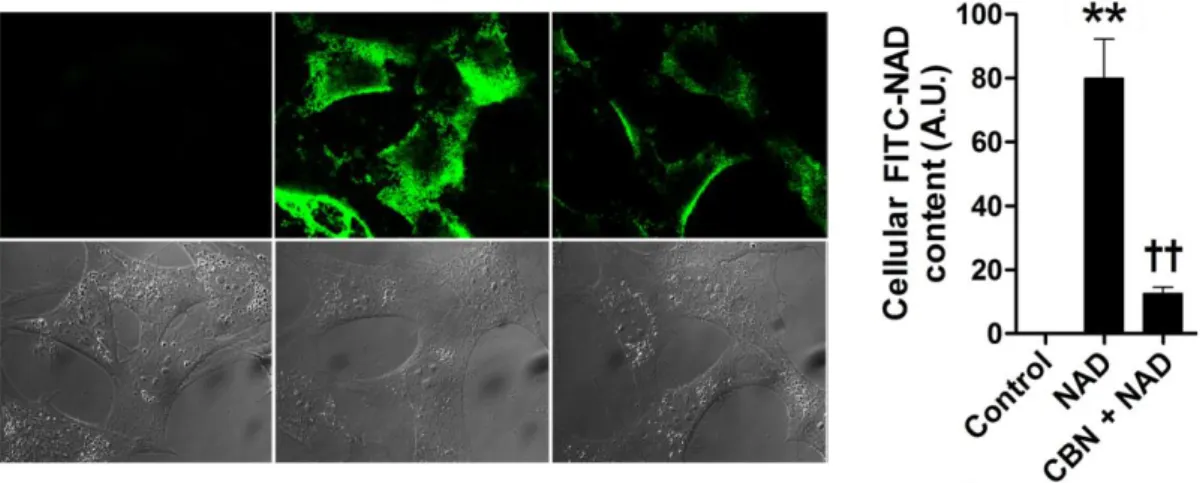
본 논문은 논문으로 제출되었습니다. 노은의 논문을 확인합니다. CBN의 부재 또는 존재 하에 N1 세포에서 FITC-NAD의 세포 흡수26 그림 7.
Hypothalamic gap junction inhibition blocks the increased MBH NAD content induced by exogenous NAD ···38. Effects of treatment of NAD on wild-type NPY promoter or NPY promoter with deletion of FOXO1 binding sites IRE2 (IRE2) and IRE3 (IRE3) ···48. MBH NAD content in lean mice and DIO mice with or without 4-week NAD.
Basal and BMAL1/CLOCK-stimulated PER1 promoter activity in N1 cells treated with FK866 alone or with NAD ···57 Figure 29.
Introduction
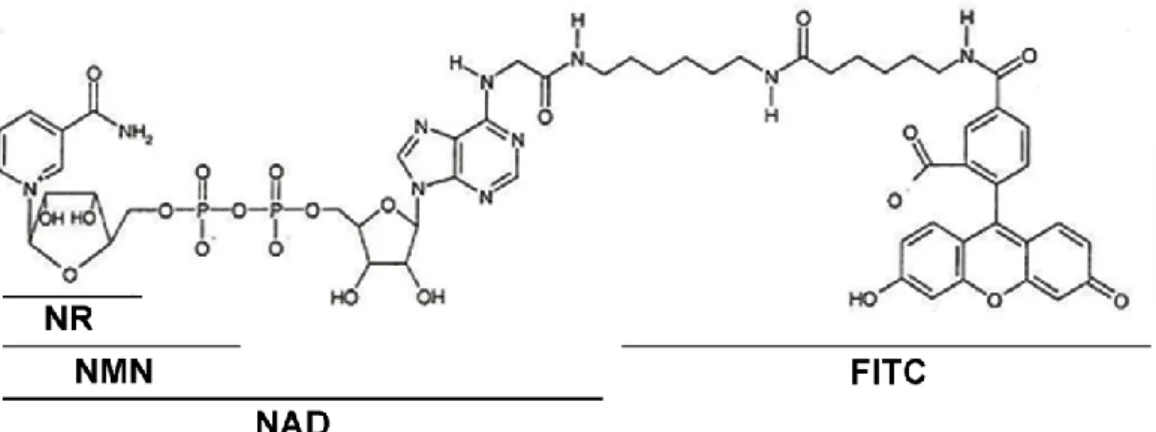
In mammals, most cellular NAD is synthesized through a recycling pathway in which nicotinamide is converted to nicotinamide mononucleotide. NR by the ecto-5'-nucleotidase (CD73), and that NR is then converted via.
Materials and methods
To visualize cellular uptake of FITC-NAD, cells were pretreated with CBN (1 μM) or vehicle. PBS) for 1 h before FITC-NAD treatment. Mice fed CD or HFD for 8 weeks with or without NAD supplementation were sacrificed by.
Results
Hypothalamic neurons uptake NAD through gap junction protein connexin 43
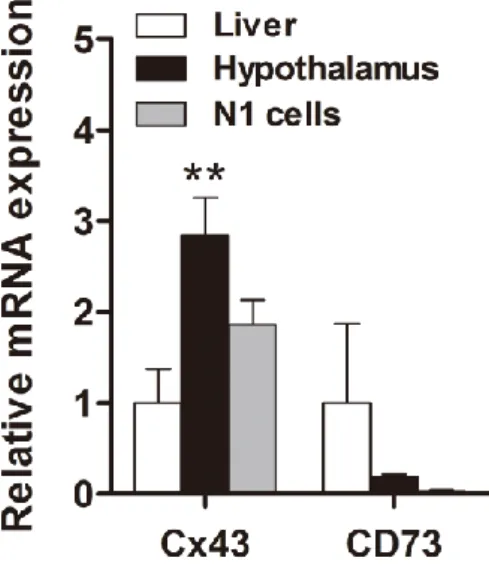
NMN and then to NR by the CD73 ecto-5'-nucleotidase [38], which is then transported into. The mRNA expression of Cx43 and CD73 in the young mouse liver/hypothalamus and N1 cells. RNA was also obtained from N1 cell, mouse liver and hypothalamus to compare the expression levels of CD73 and Cx43. mRNA expression was determined by real-time PCR analysis.
Blockade of NAD-induced increase in cellular NAD content by connexin inhibitor CBN or Cx43 siRNA. A and B) Cellular NAD levels were measured by HPLC after NAD (10 nM) treatment with (A) pretreatment with the gap junction inhibitor CBN (1 μM) or (B) siRNA-mediated knockdown of Cx43. To reduce Cx43 expression in N1 cells, cells were transfected with Cx43 siRNA (160 pmol/6 wells).
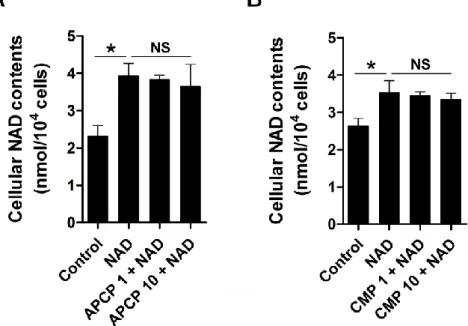
The same amount of non-targeting, scrambled control siRNA was administered to the control group. Cx43 siRNA treatment significantly reduced cellular Cx43 expression. Effects of NAD alone or with the CD73 inhibitors APCP and CMP on the NAD content of N1 cells. A and B) Cellular NAD content after co-treatment with exogenous NAD and CD73 inhibitors (A) APCP or (B) CMP.
FITC fluorescence was examined by live cell imaging system using confocal microscopy 1 h after FITC-NAD treatment (250 nM).

Central and peripheral administration of NAD regulates energy metabolism
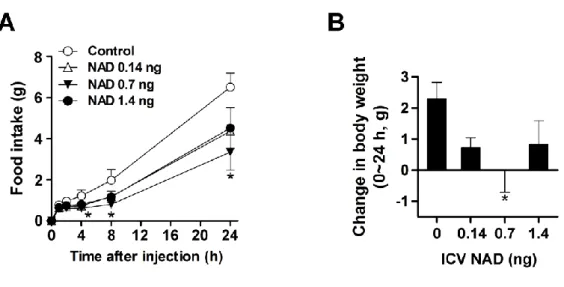
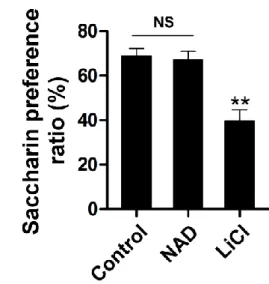
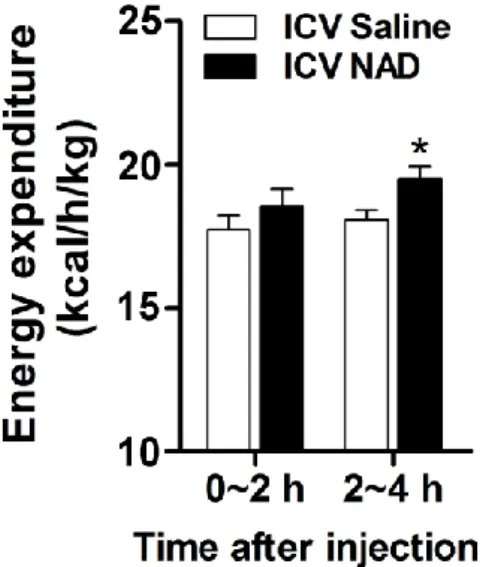
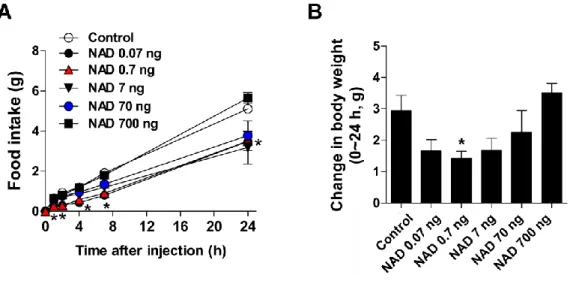
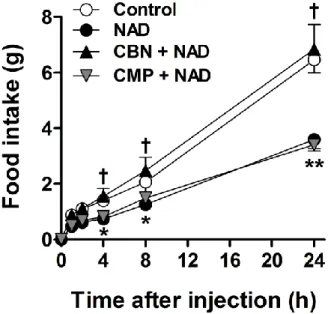
For this purpose, normal rats were fasted overnight and injected with NAD and 3 mg/kg) intraperitoneally in the early light phase. Effect of ICV injection of NAD (0.7 ng) or IP injection of lithium chloride (200 mg/kg) on saccharin preference ratio (n = 8). Either saline or NAD (0.7 ng) was administered ICV in the early light phase, and EE was monitored for four hours after NAD injection (n = 6).
Saline or NAD (1 mg/kg) was administered IP during the early light phase, and EE was monitored eight hours after NAD injection (n = 6).
Hypothalamic Cx43 is critical for the metabolic effects of exogenous NAD
Hypothalamic gap junction inhibition blocks the increased MBH NAD content induced by exogenous NAD. Knockdown was considered successful if MBH Cx43 mRNA or protein expression was decreased by >50% of mean Cx43 expression in controls. Effect of ICV NAD (0.7 ng) on overnight food intake and MBH NAD content in mice with bilateral intra-ARC injection of control siRNA or Cx43 siRNA (n = 45).
Under anesthesia, Cx43 siRNA (0.5 nmol in 500 nl/each injection site) was bilaterally microinjected into the ARC. Nocturnal food intake was measured on the second day after siRNA injection after ICV injection of saline or NAD (0.7 g) 1 h before lights-off. On the morning of day 3 post-injection, mice were sacrificed to collect the hypothalamic block or whole brain 1 h after ICV injection of NAD (0.7 ng).
Effect of IP NAD (1 mg/kg) on nighttime food intake and MBH NAD content in mice with bilateral intra-ARC injection of control siRNA or Cx43 siRNA (n = 45). On the second day after Cx43 siRNA injection (0.5 nmol in 500 nl/each injection site), nighttime food intake was measured after IP injection of saline or NAD (1 mg/kg) 1 hour before lights off. On the morning of the third day post-injection, mice were sacrificed to collect the hypothalamic block or whole brain, 1 hour after IP injection of NAD (1 mg/kg).
One hour after injection, the whole brain was sampled to examine the hypothalamic uptake of FITC-NAD.
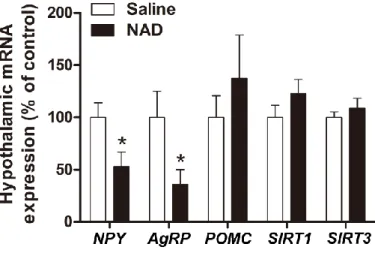
Extracellular NAD regulates NPY and AgRP transcription in a SIRT1-dependent
Effect of ICV injection of NAD on the mRNA expression levels of appetite regulating neuropeptides and sirtuins in the hypothalamic ARC. Mouse hypothalamic ARC was collected after 1 hour of ICV injection of NAD (0.7 ng) using the micropunch technique using a Harvard brain matrix and blunt 20 gauge metal needles (inner diameter 0.91 mm) (n = 8). Effects of NAD and FK866 treatment on the transcriptional activities of NPY, AgRP and POMC.
To investigate the effect of extracellular NAD treatment on the transcriptional activities of AgRP, NPY and POMC in vitro, a promoter assay of human AgRP, NPY and POMC was performed. SHSY-5Y cells for NPY and AgRP promoter analysis and AtT20 cells for POMC promoter analysis were transfected with pNPY-luc, pAgRP-luc or pPOMC-luc (50 ng) using Lipofectamine. Cells were lysed and extracted to measure luciferase activity with a luminometer and normalized for β-galactosidase activity.
Effect of treatment of NAD alone or with sirtinol or EX527 on NPY promoter activity. To test the role of hypothalamic sirtuins mediating the NAD actions, promoter assay of human NPY was performed. Effects of treatment of NAD on wild type NPY promoter or NPY promoter with deletion of FOXO1 binding sites IRE2 (IRE2) and IRE3 (IRE3).
Since FOXO1 is an important transcriptional regulator of NPY and the transcriptional activity of FOXO1 is modulated by SIRT-mediated deacetylation in peripheral metabolic organs, analysis of the NPY promoter was performed using the NPY promoter with deletion of FOXO1 binding sites. Forty-eight hours after NPY promoter transfection, cells were treated with NAD (0.1 nM or 10 nM).
Chronic NAD supplementation rescues blunted circadian rhythms in DIO mice
For chronic NAD treatment, NAD (1 mg/kg) was injected intraperitoneally daily, 1 hour before lights off, for 4 weeks (n = 6-7 for each group). At the end of the study, circadian patterns of energy expenditure and exercise activity were monitored in lean mice and DIO mice with or without 4 weeks of NAD supplementation (n = 67). At the end of the study, circadian patterns of food intake and feeding frequency were monitored in lean mice and DIO mice with or without 4 weeks of NAD supplementation (n = 67).
MBH NAD content in lean mice and DIO mice with or without 4-week NAD supplementation. MBH NAD content was measured using HPLC at the end of study period in lean mice and DIO mice with or without 4 weeks NAD supplementation (n = 6-7). Basal and BMAL1/KLOK-stimulated PER1 promoter activity in N1 cells treated with FK866 alone or with NAD.
The effect of exogenous NAD on the promoter activity of clock gene PER1 was tested. Forty-eight hours after transfection, cells were treated with FK866 (10 nM) with or without NAD (10 nM) for 2 hours. To study the effect of clock genes on NPY and AgRP promoter activity, cells were transfected with NPY or AgRP promoter-luciferase construct and/or plasmids expressing mBMAL1 and mCLOCK, and β-galactosidase (50 ng).
To examine the effect of clock genes on NPY and AgRP promoter activity, cells were transfected with an NPY or AgRP luciferase promoter construct and/or plasmids expressing mPER1 or mPER2 and β-galactosidase (50 ng).

Discussion
Conclusions
Ramadori, G., et al., SIRT1 deacetylase in POMC neurons is required for homeostatic protection against diet-induced obesity. Dietrich, M.O., et al., Agrp neurons mediate Sirt1 action on the melanocortin system and energy balance: roles for Sirt1 in neuronal firing and synaptic plasticity. Sasaki, T., et al., Hypothalamic SIRT1 prevents age-related weight gain by improving leptin sensitivity in mice.
Lagouge, M., et al., Resveratrol improves mitochondrial function and protects against metabolic disease by activating SIRT1 and PGC-1α. Belenky, P., et al., Nicotinamide riboside promotes Sir2 silencing and extends lifespan via Nrk and Urh1/Pnp1/Meu1 pathways to NAD+. Yoshino, J., et al., Nicotinamide mononucleotide, a key NAD+ intermediate, mediates the pathophysiology of diet- and age-induced diabetes in mice.
Kim, M.-S., et al., Role of hypothalamic Foxo1 in the regulation of food intake and energy homeostasis. Minokoshi, Y., et al., AMP-kinase regulates food intake by responding to hormonal and nutrient signals in the hypothalamus. Blundon, J.A., et al., Restoration of auditory cortex plasticity in adult mice by limiting thalamic adenosine signaling.
Hartman, M.E., et al., An optimized and simplified system of mouse embryonic stem cell heart differentiation for the assessment of differentiation modifiers. Bruzzone, S., et al., Connexin 43 hemi-channels mediate Ca2+-regulated transmembrane NAD+ fluxes in intact cells. Nikiforov, A., et al., Pathways and subcellular compartmentalization of NAD biosynthesis in human cells from entry of extracellular precursors to mitochondrial NAD generation.
Cantó, C., et al., The NAD + precursor nicotinamide riboside improves oxidative metabolism and protects against high-fat diet-induced obesity. Mills, K.F., et al., Long-term administration of nicotinamide mononucleotide attenuates age-associated physiological decline in mice. Zhu, Y., et al., Connexin 43 mediates white adipose tissue staining by facilitating the propagation of sympathetic neuronal signals.