the authors and do not necessarily reflect of the official
II. The Human Rights of Vulnerable People under
Kim Jong Un 11
1. Women 13
A. The Current Human Rights Situation 13
B. Discrimination in Different Spheres of Life 16
C. Domestic Violence 24
D. Conditions Faced by Repatriated North Korean Women 27 E. Sexual Health and Protection of Mothers 29
2. Children 32
A. Children’s Rights 32
B. Children’s Health and Welfare 34
C. Right to Education for Children 36
D. Rights of Children with Disabilities 42
E. The Reality of Orphans 43
3. Persons with Disabilities 45
A. Reality of the Rights of Persons with Disabilities 45 B. Efforts to Engage Persons with Disabilities at Home and in
Local Communities 47
C. Awareness of Persons with Disabilities 49
Vulnerable 53
IV. Conclusion 59
Table II-2 Time Required Each Year for Students to Learn about Subjects Related to Kim Il Sung, Kim Jong Il and
Kim Jong Un 38
Table II-3 Examples of Political Events and Systemic Mobilizations 39 Table II-4 The State of Labor Mobilization of Students 41
Vibrant Market (jangmadang) Activities 15 Figure II-2 Changes in Child Vaccination Rates Post-Covid 35 Figure II-3 A North Korean Child Carrying Another Child on
His Back 37
Figure II-4 Celebrations of the 80th Anniversary of the Birth of Kim Jong Il/ Joint National Meeting of the Korean Children’s
Union Organizations 39
Figure II-5 North Korean Children Revamping the Road 42 Figure II-6 Hamhung Orphanage Construction Change (2013~2021) 44 Figure II-7 A Disabled North Korean Person Moving on Crutches 48 Figure III-1 The Evolution of North Korean Markets: Pyongyang’s
Saerallim Market in the Tongdaewon Area 55
Figure IV-1 The Women’s Rights Situation 61
Introduction
I. Introduction
This report focuses on the human rights situation of vulnerable groups in North Korea under Kim Jong Un. These include women, the young, and the disabled.
North Korea has been sanctioned by the western world for its repeated provocations and nuclear tests. Furthermore, since Kim Jong Un came to power, especially since 2016, North Korea has faced the toughest sanctions in its history.
On top of this, Covid-19 is believed to have hit the North Korean economy hard.
The economic fallout of Covid-19 has been a universal global phenomenon, however poor countries with weak economic structures, such as North Korea, will have experienced an even greater impact. Nevertheless, the North Korean authorities decided to close their borders during the pandemic, and refused assistance from the outside world. To make matters worse, they also rejected Covid vaccines. These actions appear to have made life more difficult for vulnerable groups in North Korea, such as women, children, and the disabled.
Yet, North Korean marketization has been progressing for over 30 years.
And what is more, since Kim Jong Un has come to power, the state has sought to enshrine the rights of women, the young, and the disabled, legally and institutionally, while trying to highlight such efforts in discussions with the international community. The country’s Voluntary National Review (VNR) demonstrates this phenomenon and at least some such changes have been confirmed through North Korean defectors.
On the basis of this, the present report examines the human rights situation facing vulnerable North Koreans during the Kim Jong Un era including the Covid-19 period. The report first analyzes changes to human rights-related North Korean laws and institutions since 2012. Next, it presents the results of
in-depth interviews with North Korean defectors. This approach aids in determining how large the gap is between official institutions and actual realities on the ground in the country. The interviews were primarily with defectors who left in 2019. Since 2020, the border has been closed due to Covid-19, so it is difficult to directly survey how the North Korean response to the pandemic has impacted people on the ground. Hence, third, the report makes use of trade statistics, and the accounts of Chinese business people who have traveled to the North to examine the impact of Covid-19. Fourth, this report also utilizes satellite imagery from Google Earth to determine how the external environment, including schools and kindergartens, have changed.
The Human Rights of Vulnerable
People under
Kim Jong Un
II. The Human Rights of Vulnerable People under Kim Jong Un
1. Women
A. The Current Human Rights Situation
Immediately following liberation on July 30, 1946, the ‘Law on Gender Equality’ was promulgated in the North, and the North claims that legally and institutionally, gender equality and the rights of women have subsequently been guaranteed.1) In particular, the country’s constitution and its Family Act stipulate that men and women have equal rights to participate in politics and society, and in family life.2) On December 22, 2010, North Korea adopted the Women’s Rights Guarantee Act. The authorities claimed that this law “guarantees the equality of men and women, and provides a firm legal basis for realizing thoroughly a coherent state policy that guarantees the rights and interests of women.”3) Before this, in February 2001, North Korea joined the UN Committee on the Elimination of Discrimination Against Women (CEDAW) and submitted its first report to the committee in September 2002. However, it did not submit any more reports until 2016, when it submitted a combined report composed of
1) The North Korean authorities assert in Article 77 of the country’s revised constitution (1988) that women have the same status and rights as men. The state allows for reduced hours for mothers with multiple children, as well as to expand the provision of maternity hospitals, nurseries and kindergartens, and provide other forms of special protection to mothers and children. The state says it has put in place all kinds of conditions to enable women to enter broader society.
2) Article 17 (Chapter 3) of North Korea’s Family Act states that husbands and wives maintain their given and family names, choose their occupations in accordance with their hopes and skills, and can participate in socio-political life. Article 18 asserts that husbands and wives have the same rights in married life.
3) The Women’s Rights Guarantee Act is composed of a total of seven chapters and 55 articles. Chapter one sets out the basis of the law; chapter two sets out the socio-political rights of women; chapter three sets out rights to education, culture and public health; chapter four rights to work; chapter five to habeas orpus and property;
chapter six to marriage and family rights; and seven the guidance and control over women’s rights guarantee-related work. On this topic, see Lee Cheol-su, 2019, “Exploratory analysis of North Korea’s
‘Women’s Rights Guarantee Act’: Comparative Analysis with Existing Laws,” Unification and Peace, Vol. 11, No. 1, p. 232.
its second, third and fourth reports to the committee.4) The North describes the situation in the country in this 2016 report as follows: “North Korean women as the complete masters of society enjoy the same rights as men in all areas of life including politics, economic activities, society, and culture, and achieved great exploits for the prosperity of the motherland.”5) It should be noted that, given Kim Jong Un’s instructions are higher than the law, it is difficult to say that the reality of North Korea has changed due to the establishment of legislation. In addition, the report submitted to the UPR in 2019 said that the maternal health environment is improving across the board and, in the Voluntary National Review report submitted in June 2021, the country included information about the sustainable development goal to ‘Consolidate gender equality and rights of all women and girls’.6) In addition to this, it is worth noting that since taking power, the regime designated November 16 ‘Mothers’ Day’ for the first time in 2012, and has raised the status of the Woman’s League and sought to project the image of a state that respects the rights and interests of women.7)
Hence, since Kim Jong Un took power, North Korea has apparently attempted to revise or abolish customs and practices that discriminate against women. Meanwhile, according to a recent survey of defectors from North Korea, women’s rights have systematically improved in the country. More than anything, as women have gained greater economic power, they have become stronger in their domestic status. Furthermore, greater numbers of women have
4) This was the regular implementation report submitted under the UN Committee on the Elimination of Discrimination Against Women for 14 years when it submitted its first report. Hence it is seen as being worthy of particular attention. Do Gyeong-ok, 2016, The Actual State of the Rights of Women and Children in North Korea (Seoul: Korea Institute for National Unification), p. 2.
5) UN Doc. CEDAW/C/PRK/2-4 (2016), para. 2.
6) Democratic People’s Republic of Korea, Voluntary National Review on the Implementation of the 2030 Agenda (below ‘North Korea’s VNR Report’), pp. 23~24.
7) “Respecting women is the great virtue of communists, and an important indicator of a society’s civility [...] Party organizations must create a social spirit of loving women, centering them and helping them, and precisely implement policies for women.” Section of Kim Jong Un’s letter to the Seventh Congress of the Woman’s League held in June 2021 that calls for respect for women. See: Rodong Sinmun, June 22, 2021.
advanced into the informal economic sector as well as been appointed as officials in public and political sectors. Above all, North Korean defectors state that the younger generation is becoming increasingly aware of the value of gender equality and that domestic violence is declining.
Figure II-1 Enhanced Economic Status of Women as a Result of Vibrant Market (jangmadang) Activities8)
That said, this is a change that is more pronounced in the mid and lower sections of North Korean society, with more elite households seeing far less improvement in the status of women relative to men. For instance, the Committee of the ruling-Korean Workers’ Party has very few female members. In other words, women continue to face many barriers to entry in the political and official realms. The long-standing belief of fixed gender roles and consequent discrimination still persists in North Korea, and defector testimony indicates that
8) Yonhap News Agency, April 14, 2019. (Photo=Yonhap News Agency)
such perceptions were the cause of deepening inequality. This has become more prominent in rural areas than in cities. The closure of the North Korean border following the outbreak of Covid-19 is also bound to have a detrimental impact on the country’s economy, leading to decreased participation by women in economic activities. The social status of women in the North is expected to further decline as they are forced to take on heavier burdens.
B. Discrimination in Different Spheres of Life
When it comes to the status and role of North Korean women in society and at home, discrimination against women stemming from the existing feudalistic patriarchal order remains prevalent throughout North Korean society, creating a male-centered environment of gender discrimination. Such reality runs counter to the claims of North Korean authorities. In other words, the work that women and men are expected to do is different, with women still expected to serve men in a culture that perceives men as being superior. For instance, a defector in her thirties who left in 2019 having resided in South Pyongan said that while people increasingly favor daughters, feudal values persist and women are expected to handle household affairs and men to make money.
Women are not only entrusted with childrearing, but increasingly they are expected to serve as breadwinners, multiplying their burdens. For instance, another defector in her thirties who left in 2019 having resided in North Hamgyong said that North Korea was a comfortable country for men to live in.
Housework, childcare and money were all issues that women had to worry about, while men expected to be looked after. A defector in her forties who left in 2019 having resided in Ryanggang said feudal values still remain and if women travel with a child on their back, people may make fun of them. While there are cases of men cleaning or cooking, women are still expected to take care of the children. At the same time, a defector in her thirties who left in 2020
having resided in Tongrim county said that when women open their eyes, they head straight to the market to make money, and only come home after it gets dark, so their lives have not improved all that much. Equality was something she heard about sometimes on special occasions and, while there is a system of women’s rights, women do not actually enjoy them. A defector in his thirties who left in 2020 having resided in Pyongyang said that life was more difficult for women nowadays. Women have to trade so they have physically more arduous lives. Men go to state workplaces, while women are forced to act as breadwinners, forcing them structurally into market trade. They also do not receive better treatment socially.
In other words, institutional features have a strong impact on women. If men do not go to their state-assigned workplaces, they face punishment, whereas if women get married, they are not required to attend workplaces. Then, this system has now changed into a structure in which women are reversely discriminated against due to economic difficulties.
What is particularly noteworthy, however, is that gender roles as perceived by the younger generation are gradually diverging from the views of the older generation. For instance, a North Korean woman in her thirties who left in 2018 having lived in Hyesan, Ryanggang Province said that because women had to engage in economic activities, life had hard aspects to it, but compared to the period of famine in the late 1990s, gender equality had improved significantly.
Back then, men were considered worthy of privileges, but younger men today do housework, laundry and cleaning as well as look after the kids too. These are only some testimonies, but it can be inferred that the gender roles and predominance of men over women is weakening in the younger generation. In other words, a change in perception of the gender roles has been made by the younger generation and North Korea seems moving in a direction whereby as women become responsible for earning a living, men can no longer ignore them.
It appears that the growing participation of women in economic activities and men taking on a greater share of housework also have led to changes in the mindset of the older generation. Despite lingering stereotypes, housework is generally shared between the genders. This implies the diminishing strength of patriarchal values within society. For instance, a North Korean defector in his forties in her twenties who left in 2019 and previously had resided in Orang county in North Hamgyong said that the older female cousin she lived with worked in a market, while her husband helped with trade and also prepared evening meals and assisted with other housework too. Many female traders who worked in the nearby markets had husbands who cooked meals for them – the defector said that men had changed a lot. A male defector who had lived in Laos before coming to the South in 2022 said that female involvement in markets boosted their economic contribution, with men now being more involved in household chores.
Although perceptions of gender equality vary from family to family, the status of women continues to be elevated as they earn a living, causing fissures in the rigid patriarchal order that permeates North Korean society. In other words, such changes are more attributable to the sharing of housework by men who rely on the economic power of women than the expansion of social welfare infrastructure.
According to testimony, women are becoming better represented in both political life and public areas since Kim Jong Un took office. The advancement of women was found in various fields – given a survey of a wide range of industries, including foreign trade companies, state-owned enterprises (SOEs) and collective farm directors, work team leaders, sub-work team leaders, and also in the security services and criminal justice (Ministries of Public Security and State Security, judges and prosecutors). For instance, a North Korean defector in her fifties who previously lived in Hyesan, Ryanggang Province said
that the number of women cadres has increased in relative terms, while women with party memberships are employed as cadres without condition and are active in politics. A North Korean man in his forties who left in 2019 had witnessed a military tribunal in 2012. The court was presided over by a female judge who had come from Pyongyang for the task. In addition, a woman from Chongjin in North Hamgyong in her fifties who left in 2019 said that there has been much talk of equality in recent times, and women’s status has improved, so there are many women becoming party employees. A defector in her forties who lived in Ryanggang before leaving in 2020 said that she had not seen any female prosecutors but had seen many female judges, and the number of MPS and MSS agents in the Kim Jong Un era had risen significantly. Many women were now involved in social life in the country.
A North Korean defector in her thirties who left in 2019 having lived in Kaechon in South Pyongan said that there were women working as factory directors, work team and sub-work team leaders in state-owned enterprises and collective farms. Women with abilities could do whatever they wanted, she claimed. A North Korean man in his twenties who had lived in Tongrim county before leaving in 2020 said that there had not been any women in the MSS, but it seemed that there had been a significant increase in their number, and people now think that women can do everything men can. A man in his thirties who left in 2020 having lived in North Hamgyong said that the number of women working in positions of power, including factory directors, party secretaries, party officials, and primary-unit secretaries had increased, with some 30% of factory directors being female, and women officials, work unit leaders and directors being more popular with workers than their male counterparts.
This represents an at least partial improvement on the traditional, stereotypical views of the roles of the sexes, and of social perceptions of women.
However, some defectors have said that this is a consequence not of changing
social attitudes but rather the orders of Kim Jong Un. For instance, a North Korean man who lived in Kosong, Kangwon Province before leaving in 2021 said that the reason why the number of women working as prosecutors or police officers (MPS) increased is that Kim Jong Un issued a directive to this effect. A former female resident of Hyesan, Ryanggang Province in her fifties who left in 2019 said that there is a policy of appointing women to higher level jobs like factory directorships, work and sub-work team unit leaders, and a quota of 30%
women in cadre positions. At the same time, another former resident of the same area also in her fifties said that Kim Jong Un issued an order in 2019 that demanded women officials be widely utilized.
Changing perceptions and policy have also pushed up female enrollment in tertiary education. For instance, a North Korean defector in her twenties who left in 2019 said that when she was young, her father had wanted to have a son, but now having put all his daughters through university, he does not envy those who do.
Conversely, fields previously considered to be the domain of women with male involvement stigmatized are now seeing men enter. In fact, there are a growing number of cases of reverse discrimination against men. Further, through their purchases of items such as makeup, clothing, bags and shoes, women are now becoming major consumers.
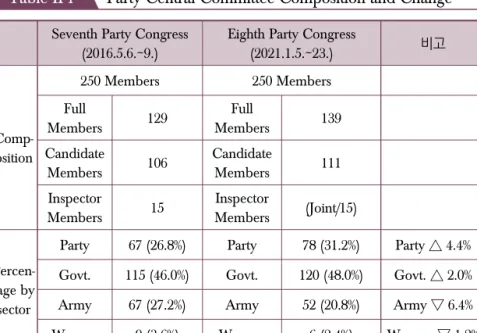
The rising prominence of women in official and political life is still largely visible in the middle and lower reaches of the state. However, the further up the power structure one goes, the less change that is visible. As noted earlier, there are few women in the Korean Workers’ Party (KWP) Central Committee (CC).
Composed of full and candidate members, the CC is elected at the KWP Party Congress, and includes the core power elite of the party state. At the seventh and eighth congresses held in 2016 and 2021 respectively, a CC of 250 members
was elected.9) The CC is composed of major officials from the party, government, and the military, forming the party leadership and state power institutions.10) However, as can be seen in <table 1>, of the 250 CC members elected at the seventh congress in 2016, only nine (3.6%) were women. In 2021 at the eighth congress, the number even fell to just six (2.4%). Over the first decade that Kim Jong Un had ruled, the power of the party center in the party-state had been strengthened, with the KWP’s central leadership institutions playing a crucial role therein. These numbers demonstrate how it remains far from easy to deal with discrimination against women.
Table II-1 Party Central Committee Composition and Change Seventh Party Congress
(2016.5.6.~9.)
Eighth Party Congress
(2021.1.5.~23.) 비고
Comp- osition
250 Members 250 Members
Full
Members 129 Full
Members 139
Candidate
Members 106 Candidate
Members 111
Inspector
Members 15 Inspector
Members (Joint/15)
Percen- tage by
sector
Party 67 (26.8%) Party 78 (31.2%) Party △ 4.4%
Govt. 115 (46.0%) Govt. 120 (48.0%) Govt. △ 2.0%
Army 67 (27.2%) Army 52 (20.8%) Army ▽ 6.4%
Women 9 (3.6%) Women 6 (2.4%) Women ▽ 1.2%
Reference: Kim In-tae, “Ten Years of the Kim Jong Un Era: The Composition and Change in the Workers Party’s Central Leadership Institutions,” INSS Strategy Report, No.
133 (Institute for National Security Strategy: 2021), p. 2.
9) See Kim In-tae, “Ten Years of the Kim Jong Un Era: The Composition and Change in the Workers Party’s Central Leadership Institutions,” INSS Strategy Report, No. 133, (Institute for National Security Strategy: 2021), p. 2.
10) Ibid.
At the same time, little has changed in rural areas when it comes to gender stereotypes and the social perception of women. For example, a man in his twenties who defected in 2020 testified that women's lives are more difficult in the countryside due to severe gender discrimination that comes from the countryside having a more feudal society than in the city. Gender discrimination remains prevalent in the countryside due to persisting feudalistic mentalities of gender roles in society.
Meanwhile, women’s increasing economic influence within the family adds challenges to the oppressive patriarchal order; and misbehavior such as extramarital affairs, alcohol abuse or violence by spouses is no longer tolerated as in the past. Indeed, some North Koreans claim that divorce has become a viable option if married life is no longer salvageable by reason of opium addiction or other drugs like ‘ice’ (methamphetamine). There is also testimony that the perception of divorce as a flaw is decreasing.
A growing number of reports from North Korean defectors indicate that, since divorce requires a trial, there is an increase in couples living together without registering their marriage. For instance, a man who lived in Pyongyang before leaving in 2020 said that the divorce system requires multiple hearings and is very procedurally complex, with divorce courts following party principles and procedures and lacking independence. Another female defector in her thirties who resided in Chagang province before leaving in 2019 said that there was a person in her area who had gone through divorce proceedings, paid the money demanded by the court, and that the case had taken over two years.
Hence, contrary to what is set out in the country’s constitution, divorce is still widely perceived to be institutionally difficult and unfavorable to women.11)
11) The North Korean Family Act says the following about the conditions of divorce in article 21: “If a spouse has brutally betrayed the love and faith of the couple, or for other reasons cannot continue to live as a couple, they may divorce.”
With respect to this, the Women’s Rights Guarantee Act and the Children’s Rights Guarantee Act, both passed in December 2010 are important. In particular, the following clause is worth noting: “For the sake of their children’s growth and development, parents should not get divorced, and state institutions, firms, organizations, courts et al. must, if the issue of a couple with children’s divorce is raised, educate the parents to not separate in order to ensure the interests of the child(ren).”
Hence, paradoxically, as the economic activities of women have expanded, they are faced with being responsible for both supporting their families economically and taking care of children. For instance, a North Korean defector in her forties who left in 2018 said that women could not be certain that when they got divorced that their children wouldn’t starve. It is therefore mainly women who have a strong maternal instinct who prioritize the raising of their children. North Korean laws on gender equality and family confirm the requirement to pay alimony; parties without custody are required to pay alimony while they are of working age. However, there is a structural issue exists with men’s inability proactively engage in economic activities. Where divorce leads women to being given custody of the children, the financial burden placed on women is further increased. In some interviews, defectors indicate that there is a lack of understanding about alimony conceptually. For instance, a woman in her sixties who left the country in 2019 having resided in North Hamgyong, another in her forties who left in 2019 having lived in Hyesan in Ryanggang province, one in her twenties who lived in Orang county, North Hamgyong before leaving in 2019 and one in her thirties who left in 2019 having lived in Kaechon, South Pyongyang all said that there was no clear concept of alimony in North Korea.
C. Domestic Violence
According to the North Korean constitution, marriage and the family receive the protection of the state (Article 78) and further all forms of domestic violence is prohibited under the Women’s Rights Guarantee Act (Article 46, Paragraph 1).
When this is violated, the level of the violation can be met with administrative or criminal action (Article 55 of the Women’s Rights Guarantee Act). However, the Criminal Code also stipulates that those who commit assault only face 1 year or less in a labor camp for criminals (Article 275), and there is no stipulation in the criminal code that directly deals with domestic violence.
Many North Korean defectors indicate that although domestic violence is still widespread in North Korea, it is rare for the authorities to intervene due to the social climate that regards domestic violence as a problem to be resolved within the household. For instance, a North Korean woman in her fifties who lived in Pyongyang before leaving in 2019 said that even if one reported domestic violence to the police (Ministry of Social Security), they would not help and would tell those involved to resolve the situation within the family. A man in his thirties who lived in Pyongyang before leaving in 2020 said that there was no system to report domestic violence, and people were forced to live with it.
Domestic violence occurs frequently in the North due to poverty, extramarital affairs, alcohol and narcotics, and not only women but also children are exposed to such violence. The Women’s Union that proclaims itself as helping to enhance women’s empowerment is also not very helpful in resolving domestic violence issues. Only where domestic violence rises to extreme proportions do perpetrators face prison – in labor camps.12) For instance, a woman in her thirties who lived in
12) On the other hand, article 14 of North Korea’s Assault Prevention Act states the following: “Social safety and relevant legal institutions must stop assaults, refrain from condoning them even when they receive reports regarding them and refrain from delaying action,” Article 13 stipulates: “Social safety and relevant legal institutions must guarantee a scientific and objective approach to investigating assaults, and apply administrative punishments or seek criminal prosecutions in accordance with the danger involved, regardless of the status and standing of the offender.”
Kaechon, South Pyongan before she left the country in 2019 said that extreme instances of domestic violence where men broke the legs or arms of their wives, or fractured their skulls would result in 1~2 months in a labor camp.
However, while the widespread and distorted view that domestic violence and feuds are caused by the mistakes of women is an issue, a bigger issue is that of women not wanting their husbands punished. This seems to explain the rarity with which men face legal sanction for violence against their spouses. As such, women exposed to domestic violence have not been protected by the state or society in North Korea.
However, there are many reports from defectors that domestic violence is declining. The violence by husbands is becoming less frequent as the voices of women with economic power grow within families.
For instance, a North Korean woman who lived in Hamhung, North Hamgyong before leaving in 2019 said that as women have become breadwinners, their rights and status in the household has risen. They no longer live as they once did, domestic violence is perceived by them as uncivilized and women share the view that they should separate from such men who commit it.
Where such violence does occur, women are more likely to separate or divorce their husbands, so men are more likely to control themselves.
In addition, women who can afford the huge expense of divorce have also emerged. For instance, a woman in her fifties who lived in Hamhung, North Hamgyong said that while women generally live with being hit, they seek divorce if they really cannot tolerate such behavior. But while it can take 4~5 years to get a divorce having separated, she was able to get one more quickly because she could afford to pay the requisite bribes. This means, on the one hand, inequality has widened as women with money are able to divorce, but on the other, while domestic violence remains a daily occurrence, such testimony
points to changing perceptions of violence.
Above all, such changes have been most pronounced among younger members of North Korean society. The young see violence as uncivilized, and as a reason to avoid marriage. For instance, a former female resident of Hyesan (Ryanggang) in her twenties who left in 2020 said that if men could not hold to standards set during courtship when married they would struggle to get married, and thus have to put in a lot of effort. Hence young newly married women and even those with young children choose divorce if they face violence in the home.
That said, as seen above, even when women decide they cannot tolerate domestic violence and seek divorce, there is a widespread perception that divorce is procedurally complex and very expensive. Hence, faced with such barriers, women have also sought de facto divorce through separation.
Another noteworthy point with respect to violence in the home is the growing gulf that exists between rural and urban areas. Whereas women in cities have increasingly become economically active and strengthened their status in the home, those in the countryside have fewer social opportunities.
Consequentially, while the former have seen violence decline relatively, those in the countryside are still afflicted by deep-rooted feudal social perceptions that give rise to pervasive violence and few rural households, including women, even see this as a problem.
Meanwhile, it is very difficult to grasp the reality of sexual violence in North Korea as sexual violence mostly occurs in secret, and victims are highly likely to be reluctant to disclose what happened to them. In particular, in regions where military forces are stationed and within the military itself, the problem of sexual violence is particularly acute. What is more, defector interviews indicate that punishment is lax. For instance, a man in his twenties who
previously lived in Tongrim county, North Pyongan, and left in 2020, said that instances of rape in the military involving superiors and their subordinates were hushed up and, even when raised, female subordinates were just discharged or expelled.
In cities with rail stations, prostitution is prevalent in areas surrounding accomodation but here again enforcement and punishment is reportedly lax.
For instance, a North Korean woman in her thirties who lived in South Pyongan before she left in 2019 said that there are places where prostitution occurs, and police are involved, so enforcement of bans is not that strong.
There are instances where sexual violence is not recognized as such due to inadequate understanding. In many instances, women being forced due to social structural factors, unaccompanied by physical violence, into relations of sexual exploitation or harm are not understood as being victims of serious sexual violence. The lack of education to prevent sexual violence and general sexual education is also a likely cause. Indeed, the lack of appropriate sexual education in North Korean society makes it structurally difficult for socially healthy ideas regarding sex to be forged. Surveys of North Korean defectors also indicate that sex education is highly inadequate. Indeed, even talking about sex is considered to be socially embarrassing. Hence, even when women are exposed to sexual violence, they generally do not understand how serious the issue is.
D. Conditions Faced by Repatriated North Korean Women The North Korean authorities have shown no interest in resolving the structural causes of the vulnerability of their people to trafficking. Further, to make matters worse, there is said to be an increasing trend toward further strengthening the punishment of women who have been trafficked. In general, the level of punishment is determined based on the length of the
defector’s stay in China. It has been identified from the testimonies of female defectors who have recently left North Korea that the severity of punishment for forcibly repatriated female defectors has increased after Kim Jong Un came to power. A North Korean defector in her 50s who defected in 2019 said that victims of human trafficking used to be sent to labor training camps (danryundae), but recently they are sent to prison camps (kyohwaso) for five to ten years.
In particular, border control and crackdowns on defection have been continuously reinforced alongside stricter border controls from the Chinese side since the beginning of the Kim Jong Un regime. For instance, according to a defector from North Pyongan who left in 2019, originally Sinuiju had constructed an embankment in the city’s surrounding area to prevent flooding, and to see the Yalu River view, one could walk along the embankment. But from 2015, a barbed wire fence was put in place, surveillance cameras installed, and other security features strengthened so that people could no longer stand on the embankment to enjoy the view of the river.
As a result, the cost of a bribe to avoid punishment in case of forced repatriation is skyrocketing, and it appears that the success rate of re-defection has also decreased dramatically. In addition, surveillance and crackdowns on defectors’ families continue. However, testimonies have been collected claiming that while North Koreans often fell victim to human trafficking during defection in the past, the heavier punishment by both North Korea and China for human trafficking had led to a decrease in cases of human trafficking. As the cost of defection has soared, only those with money are able to defect from North Korea. Also, since their destination is unmistakably South Korea, punishment seems to be harsher if they were found to have attempted to defect, with testimony indicating as such in some instances. For example, a North Korean defector from South Pyongan who left in 2019 said
that the costs of defection were at least 15 million KRW, with the reason being that Chinese crackdowns on people trafficking have made it necessary to go direct to South Korea.
One of the most serious human rights violations against women inflicted by North Korean authorities is the practice of involuntary abortions during the forced repatriation process as well as inhuman treatment in the investigation process. As criticism by the international community has grown over cases where forcibly repatriated pregnant female defectors were made to have abortions and to leave their newborn children unattended to die. North Korea is found to have allowed such women to give birth in some regions and attempted to send the newborn children to their Chinese fathers. However, there are still allegations from some defectors who claim to have witnessed or heard of incidents where forcibly repatriated female defectors bearing babies of Chinese men were made to undergo an abortion in the process of repatriation.
E. Sexual Health and Protection of Mothers
North Korea’s constitution sets out clear principles for the protection of children and mothers.13) However, it is well known that many North Korean women suffer from poor health conditions including malnutrition and anemia resulting from economic difficulties that have continued since the 1990s, excessive labor to support the livelihoods of their families and psychological burden caused by mounting responsibility for their families. According to
‘Trends in Maternal Mortality 2000 to 2020’ released by the World Health Organization (WHO) and UNICEF, while material mortality rates per 100,000
13) Article 6 of the Family Act also states: “The special protection of the interests of children and mothers is the coherent policy of the Democratic People’s Republic of Korea. The state shall show a proactive interest in guaranteeing the conditions for mothers to properly raise and educate their children.”
births have halved in the last 20 years, the country still has high rates compared to OECD countries like South Korea. The major causes are postpartum hemorrhage, high blood pressure, hepatitis in pregnancy, and complications resulting from unsafe abortions. This points to the backwardness of North Korean medical facilities and institutions, as well as the low level of social awareness.
Above all, the North Korean Medical Law forbids abortion except in cases where the mother’s life is in danger (Article 28 of the Medical Law). A number of testimonies have been collected reporting that since abortion is legally prohibited, abortion is carried out at a retired doctor’s home rather than at a hospital or by a visiting private doctor. In particular, unmarried women have abortions at home in order to not leave a medical record, and only married women use hospitals for abortion. Above all, what is noteworthy is the absence of evidence regarding male contraceptives. Many defectors are unaware of the existence of condoms or else have never seen them. In other words, contraception is largely forced upon women alone.
Contraception and abortion also appear to be factors that hurt the health of women of childbearing age. There is little attention to medical accidents that may occur in private homes with insufficient medical equipment, and the risk of abortion is inadequately recognized. Some defectors have reported that they have heard cases of death during abortion procedures but there are not many such cases.
Meanwhile, although medical care related to childbirth is free of charge by law in North Korea, North Korean defectors testified that childbirth does incur costs.
North Korea guarantees various institutionalized benefits for pregnant women to ensure maternal access to healthcare.14) Childbirth-related services are free of
14) Lee, Geum-soon et al., North Korea’s Right to Health (Seoul: Korea Institute of National Unification, 2018), pp.
34~37.
charge, maternity leave is guaranteed for women and there are provisions in law such as one that prohibits nighttime work by women who are pregnant or have newborn infants. However, it appears that in reality, North Korean people still do not receive sufficient support during pregnancy and childbirth.
One of the most important indicators related to maternal health is the maternal mortality rate. As mentioned earlier, in its national report submitted to the UPR in 2019, North Korea announced that its maternal mortality per 100,000 live births decreased from 62.7 in 2014 to 53.2 in 2017.15) It is encouraging that maternal mortality decreased by nearly 10 deaths per 100,000 in three years, but the number is still high from an international point of view. In addition, according to the Trends in Maternal Mortality 2000 to 2020 report published by the WHO in 2023, North Korea’s maternal mortality was 107 per 100,000 live births in 2020, which is significantly incongruous with North Korea’s report.16) It appears that home births are attended by private doctors or unqualified midwives. However, giving birth to a child in an environment that is not properly equipped with necessary medical instruments will inevitably result in a lower emergency response rate than childbirths in hospitals. This practice is considered to be one of the factors that cause the relatively high maternal mortality rate.
Lastly, it is noteworthy that there seems to be an improvement in the use of sanitary pads as the rate of using them instead of old clothes or pads made of gauze is increasing. In particular, North Korean sanitary pads used to be expensive and low in quality, but there were many testimonies claiming that North Korean sanitary pads are now about 3,000 won to 5,000 won and come in attractive packaging and have various functions, which are even better than
15) UN Doc. A/HRC/WG.6/33/PRK/1 (2019), para. 70.
16) WHO, Trends in Maternal Mortality 2000 to 2020: Estimates by WHO, UNICEF, UNFPA, World Bank Group, and the United Nations Population Division (Geneva: World Health Organization, 2023).
Chinese sanitary pads. It appears that using disposable sanitary pads has become essential, particularly among the younger generation living in cities in the DPRK. However, women living in rural are still unable to use sanitary pads, and largely rely on gauze.
2. Children A. Children’s Rights
North Korea ratified the UN Convention on the Rights of the Child on September 21, 1990, and it entered into force one month later. Further, on November 10, 2014, it ratified the Optional Protocol on the Sale of Children, Child Prostitution and Child Pornography, entering into force the same year on December 10. The UN Convention on the Rights of the Child mandates that parties submit a report to the UN Committee on the Rights of the Child within the first two years of the convention entering into force, and every five years thereafter. The North submitted its first report in February 1996, its second in May 2003, and then its third and fourth as a combined report in December 2007. Thereafter, it submitted a fifth report almost ten years later in April 2016.17) Before this, over the 2008 to 2015 period, it claims to have made significant efforts to support the rights of children including passing the Children’s Rights Guarantee Act (2010), the General Education Act (2011), legislation to institute 12-year mandatory general education (2012), creating a Korean Children Aid Commission (2013), and ratifying the Optional Protocol on the Sale of Children, Child Prostitution and Child Pornography (2014).18)
Thereafter, North Korea has reported in the 2019 UPR that they have put in
17) Do Gyeong-ok, 2016, The Actual State of the Rights of Women and Children in North Korean, pp. 1~2.
18) Ibid., p. 35
place measures to successfully enhance the welfare of children. High quality medical services are provided at scale, and child nutrition is managed scientifically from infant mortality rates to rates of chronic and acute malnutrition. Further, culture, leisure and sports facilities have also been constructed to promote the creative thought of students.19) Further, in 2021, in its Voluntary National Review report released as part of the implementation of the Sustainable Development Goals (SDGs), North Korea reported that it had made significant progress in reducing child mortality rates, and that it aimed to reduce them to 12 in 1,000 by 2030 for children under 5.20) Above all, since Kim Jong Un came to power, regime propaganda has extolled the improved education environment and conditions, the expanded modern facilities for cultural activities and the large children’s hospitals established, which demonstrates interest in the growth of children and improving their nutrition.21) In other words, the North Korean authorities have said they are making efforts to modernize facilities for orphans, including nurseries and orphanages, and expand medical and rehabilitation for the disabled.
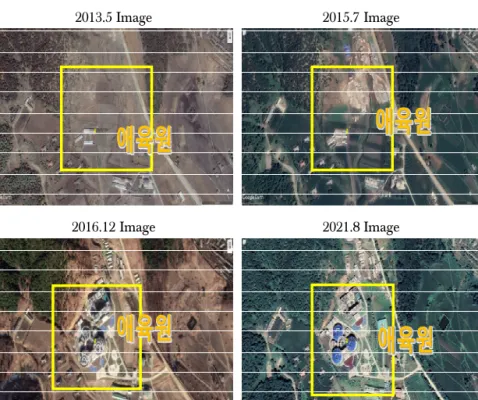
Google Earth satellite images and North Korean defector testimony indicate that modernized nursery and orphanage facilities have been built in major cities like Hamhung and Sinuiju (<Figure Ⅱ-6>). However, when examining the construction process and operation status of these facilities, it seems that the burden on the people is increasing due to the submission of various social tasks.
It is also questionable whether these facilities can be used by orphans.
19) UN Doc. A/HRC/WG.6/33/PRK/1 (2019), paras. 61-64.
20) DPRK, “Democratic People’s Republic of Korea Voluntary National Review On the Implementation of the 2030 Agenda”, The United Nations, June, 2021, p. 19, <https://sustainabledevelopment.un.org/content/documents/
282482021_VNR_Report_DPRK.pdf> (Accessed July 6, 2021).
21) DPRK, “Democratic People’s Republic of Korea Voluntary National Review On the Implementation of the 2030 Agenda,” The United Nations (June, 2021), p. 19, <https://sustainabledevelopment.un.org/content/documents /282482021_VNR_Report_DPRK.pdf> (Accessed July 6, 2021).
B. Children’s Health and Welfare
In order to increase the fertility rate, North Korean authorities have promoted policies such as providing subsidies for multi-child families and expanding childcare facilities since Kim Jong Un came to power. The North reported in the 2019 UPR that the state set as the main target of the health sector to further improve the public health service to increase the average life expectancy of the population, reduce the infant mortality rate, increase the rate of assisted delivery by skilled health workers and bring other key health indices into line with those of the world’s most advanced countries.22) In its 2021 VNR, the DPRK reported that between 2012 and 2020, new health facilities were established in a modern style, including the Breast Tumor Institute of Pyongyang Maternity Hospital, Okryu Children’s Hospital, Ryugyong General Ophthalmic Hospital, and Ryugyong Dental Hospital, and the government started a new construction project in 2020 to build Pyongyang General Hospital.23)
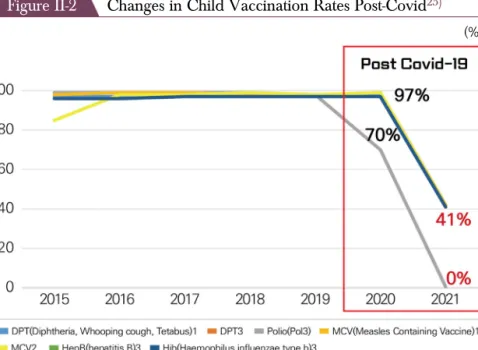
According to estimates submitted to international institutions, vaccination rates have increased considerably, especially under Kim Jong Un, as can be seen in Figure II-2. Nearly all North Koreans have reportedly received vaccines for diphtheria, polio, measles and other infectious diseases. Between 2015 and 2016, the number of North Koreans who had received the second dose of the measles vaccine jumped from 85% to 98%.
The issue is that, as Covid-19 persists, vaccination programs for infants are being hit. According to the Covid-19 Vaccine Delivery Partnership Situation Report submitted by UNICEF, the WHO, and the Global Alliance for Vaccines and Immunization (hereinafter GAVI), only Eritrea and North Korea had not started Covid-19 vaccines.24) An even bigger issue is that it is not only Covid-19
22) UN Doc. A/HRC/WG.6/33/PRK/1 (2019), para. 35.
23) DPRK, “Democratic People’s Republic of Korea Voluntary National Review On the Implementation of the 2030 Agenda,” p. 18.
vaccination rates that are low, but also other vaccination rates among infants. As
<Figure II-2> shows, DPT vaccination rates have fallen, with the number of first doses administered dropping from 98% in 2020 to 42% in 2021, and second doses from 97% to 41% - a fall of more than half. Similarly, polio vaccination rates have fallen, 98% in 2019, to 70% in 2020, but hit 0% in 2021 because no vaccines could be imported during the pandemic. With MCV, first and second dose rates also fell from 99% to 42% and 41% respectively. Other vaccination rates have also fallen to similar extents.
Figure II-2 Changes in Child Vaccination Rates Post-Covid25)
(%)
* This is an approximation.
24) UNICEF, WHO and GAVI, “Covid-19 Vaccine Delivery Partnership Situation Report,” (October 2022),
<https://www.who.int/publications/m/item/covid-19-vaccine-delivery-partnership-october-2022> (Accessed on April 5, 2023), p. 7.
25) WHO, “Democratic People’s Republic of Korea: WHO and UNICEF estimates of immunization coverage:
2021 revision,” <https://cdn.who.int/media/docs/default-source/country-profiles/immunization/2022-country- profiles/immunization_prk_2022.pdf?sfvrsn=fb196045_3&download=true> (Accessed September 4, 2022).
According to surveys conducted to date, North Korea’s vaccination rate for disease prevention appears to have been improving. However, amid the prolonged Covid-19 situation, there is a possibility that vaccinations for infants and toddlers, which have been carried out thus far, are not proceeding smoothly.
North Korea’s Ministry of Health has continued to carry out its infant vaccination project in cooperation with UNICEF and the GAVI, but its border blockade and restrictions on the movement of people and goods due to Covid-19 have had an adverse impact on the supply and demand of essential vaccines. In particular, without Covid-19 vaccinations and a stable supply of essential medicines and medical devices for the vulnerable, the health situation of North Koreans will inevitably deteriorate.
Although the situation is not at its worst, it has been found that a significant number of North Korean children still suffer from malnutrition. According to a report by the FAO, the proportion of North Korea’s malnourished population fell from 42.6% in 2018 to 43.0% in 2019 and slightly decreased to 41.6% in 2020, but 10.7 million people are still malnourished.26) The ratio of the malnourished population (41.6%) in 2020 is higher than 19.1% in Africa, 22.9% in the least developed countries, and 29.6% in low-income countries.27) There is a likelihood that the Covid-19 lockdown measures put in place since January 2020 are causing food instability and disrupting food supply and demand for North Koreans who had already suffered from chronic food shortages.
C. Right to Education for Children
North Korea is paying attention to enhancing the right of orphans and children with disabilities by modernizing facilities for orphans such as child-caring
26) FAO, IFAD, UNICEF, WFP and WHO, The State of Food Security and Nutrition in the World 2022 (Rome:
FAO, 2022).
27) Ibid.
institutions (yugawon) and orphanages (aeyugwon) and expanding medical and rehabilitation facilities for children with disabilities.28) The North appears to introduce relevant laws domestically while actively engaging in communication with the international community about the rights of persons with disabilities.
Figure II-3 A North Korean Child Carrying Another Child on His Back
However, this appears to mainly be occurring in major cities. A not insubstantial amount of testimony indicates that less marketized and urbanized rural areas and smaller cities have lower school attendance rates because of economic hardships that push children into economic activities to survive.
28) In its 2021 VNR report on the implementation of the SDGs, North Korea highlighted significant progress in reducing child mortality and set a goal of reducing the mortality rate of children under 5 to less than 12 per 1,000 by 2030. DPRK, “Democratic People’s Republic of Korea Voluntary National Review On the Implementation of the 2030 Agenda,” The United Nations, June, 2021, p. 19, <https://sustainabledevelopment.
un.org/content/documents/282482021_VNR_Report_DPRK.pdf> (Accessed July 6, 2021).
For instance, a North Korean defector from Nampo who left in 2019 said that while rates of school attendance are high in cities, they are lower in rural areas where children are more concerned with survival than attending school.
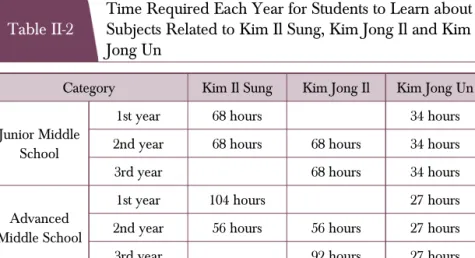
Even where pupils are able to access education, the North Korean curriculum violates the rights of North Korean children to an education. North Korea’s educational curriculum still leans heavily towards political ideology education and focuses on idolizing the present Supreme Leader and his family, as <Table II-2> shows.
Table II-2 Time Required Each Year for Students to Learn about Subjects Related to Kim Il Sung, Kim Jong Il and Kim Jong Un
Category Kim Il Sung Kim Jong Il Kim Jong Un
Junior Middle School
1st year 68 hours 34 hours
2nd year 68 hours 68 hours 34 hours
3rd year 68 hours 34 hours
Advanced Middle School
1st year 104 hours 27 hours
2nd year 56 hours 56 hours 27 hours
3rd year 92 hours 27 hours
Source: Lee U-tae et al., North Korean Human Rights White Paper 2022, (Seoul: KINU, 2022), p. 404, see Table IV-5.
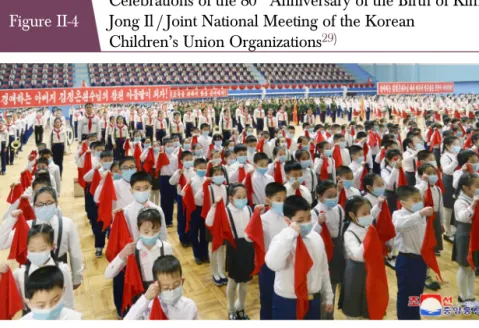
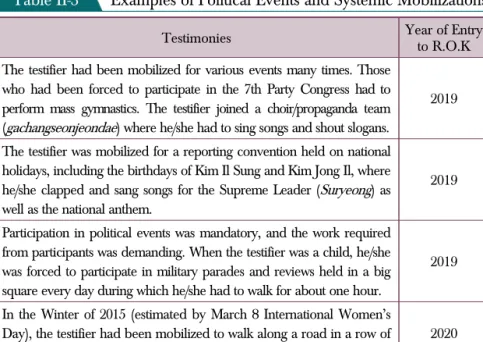
Moreover, as can be seen in Table II-3, education on political ideology is routinely carried out not only in the regular school curriculum but also in compulsory organizational life, including through the Korean Children’s Union (sonyeondan) and Kim Il Sung Socialist Youth League; such activities are forced on participants.
Figure II-4
Celebrations of the 80th Anniversary of the Birth of Kim Jong Il / Joint National Meeting of the Korean
Children’s Union Organizations29)
Table II-3 Examples of Political Events and Systemic Mobilizations
29) Korean Central News Agency, 12 February 2022. (Photo=Yonhap News Agency)
Testimonies Year of Entry
to R.O.K The testifier had been mobilized for various events many times. Those
who had been forced to participate in the 7th Party Congress had to perform mass gymnastics. The testifier joined a choir/propaganda team (gachangseonjeondae) where he/she had to sing songs and shout slogans.
2019
The testifier was mobilized for a reporting convention held on national holidays, including the birthdays of Kim Il Sung and Kim Jong Il, where he/she clapped and sang songs for the Supreme Leader (Suryeong) as well as the national anthem.
2019
Participation in political events was mandatory, and the work required from participants was demanding. When the testifier was a child, he/she was forced to participate in military parades and reviews held in a big square every day during which he/she had to walk for about one hour.
2019
In the Winter of 2015 (estimated by March 8 International Women’s Day), the testifier had been mobilized to walk along a road in a row of people and sing while waving fans or flowers for 30-minutes at a time.
2020
Such political events and propaganda mobilizations by the system are more concentrated in Pyongyang.
The above demonstrates that even as North Korea claims to protect the rights of children to develop, pupils are mobilized to participate in political events and regime propaganda. Hence, the rights to rest and leisure are being violated by the authorities. Such physical burdens and disruption to studies inflict suffering on North Korean children.
Meanwhile, North Korea stated that all forms of child labor are prohibited by law, but it has been identified that children aged 16 to 17 are still enrolled in military-style brigades.
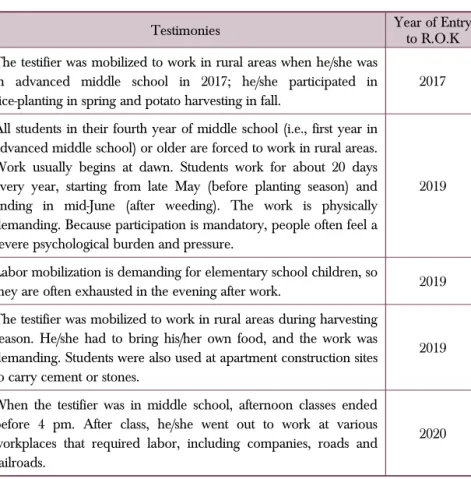
Looking at the North Korean curricula, in North Korea, the junior middle school curriculum includes tree-planting, and the advanced middle school curriculum includes tree-planting and production labor. According to defector testimonies, students are frequently mobilized for various tasks after school or during school hours in addition to the official school curriculum. Students are mobilized for weeding and rice-planting in spring and for potato-harvesting in fall.
It is said that mandatory annual rural mobilization is physically demanding as it involves work that mostly starts early in the morning, and because it is mandatory is also imposes a great psychological pressure. Further, when mobilized to the countryside, students must live and eat with the rural households they work alongside, making their lives more difficult. Students are mobilized for construction work such as transporting sand and pebbles, logging, and railroad
Testimonies Year of Entry
to R.O.K There are various political events. A flower-presenting event is held
in front of Kim Il Sung portraits (taeyangsang) on Kim Il Sung and Kim Jong Il’s birthdays, New Year’s Day and national holidays, and those not attending the event are severely punished.
2020
construction. Those who are ill can be exempted from participation, but it has become a custom to pay money in order to be excused from mobilization.
Table II-4 The State of Labor Mobilization of Students
Testimonies Year of Entry
to R.O.K The testifier was mobilized to work in rural areas when he/she was
in advanced middle school in 2017; he/she participated in rice-planting in spring and potato harvesting in fall.
2017
All students in their fourth year of middle school (i.e., first year in advanced middle school) or older are forced to work in rural areas.
Work usually begins at dawn. Students work for about 20 days every year, starting from late May (before planting season) and ending in mid-June (after weeding). The work is physically demanding. Because participation is mandatory, people often feel a severe psychological burden and pressure.
2019
Labor mobilization is demanding for elementary school children, so
they are often exhausted in the evening after work. 2019 The testifier was mobilized to work in rural areas during harvesting
season. He/she had to bring his/her own food, and the work was demanding. Students were also used at apartment construction sites to carry cement or stones.
2019
When the testifier was in middle school, afternoon classes ended before 4 pm. After class, he/she went out to work at various workplaces that required labor, including companies, roads and railroads.
2020
Meanwhile, at school, North Korean children are required to provide rabbit pelts, copper or iron, and waste paper, which they have to collect. Where they are unable to, they may be subject to aggressive treatment by their teacher.
What is more, when their families are struggling economically, children lose the opportunity to access education because they have to engage in activities to help their families survive.
Figure II-5 North Korean Children Revamping the Road30)
The Committee on the Rights of the Child has thus expressed concern that students’ right to education could be severely infringed upon due to the frequent mobilization of their labor for agriculture and construction as part of their school curriculum.31)
D. Rights of Children with Disabilities
North Korea pays attention to promoting the rights of children with disabilities. It appears that the DPRK has enacted relevant domestic laws while it claims to be engaging in active communication with the international community regarding the rights of persons with disabilities. In particular, North Korea claims be working toward improving quality education for children with disabilities, such as expanding education facilities for the disabled and expanding IT infrastructure through its implementation report of the Convention on the Rights of Persons with Disabilities (hereinafter CRPD).
30) Yonhap News Agency, November 25, 2014. (Photo=Yonhap News Agency) 31) UN Doc. A/HRC/WG.6/33/PRK/2 (2019), para. 87, 88.
Further, in its 2019 UPR report, North Korea stated that it has adopted the Regulations on Schools for the Blind and Deaf to provide relevant legal and institutional grounds.32)
However, most of the North Korean defectors who testified have never witnessed or heard of educational facilities for persons with disabilities, and no specific testimony on the operation of special classes or rehabilitation and vocational training for disabled children seems to have been collected. There were fragmented reports that a kindergarten for children with hearing disabilities has opened on the outskirts of Pyongyang.33) However, there are only 11 special schools for children with visual and hearing disabilities across North Korea. In particular, the fact that there are no such schools in Yanggang Province demonstrates the inadequate situation of special education for children with disabilities in North Korea.
E. The Reality of Orphans
Since Kim Jong Un came to power, North Korea has endeavored to expand and support facilities such as orphanages (aeyugwon) and child-caring institutions (yugawon) for vulnerable children, including orphans. However, how much the right to education and health of vulnerable children has actually improved should be confirmed in the future. In particular, conflicting testimonies were collected on the existence of homeless orphans (kotjebi).
North Koreans who defected in 2019 testified that there were no homeless orphans (kotjebi), and only one or two in marketplaces (jangmadang) as the price of rice had been stable before the outbreak of Covid-19. In addition, a number of testimonies were collected that homeless orphans (kotjebi) were
32) UN Doc. A/HRC/WG.6/33/PRK/1 (2019), para. 11.
33) “North Korea opens kindergarten for hearing-impaired children,” UPI, 1 July, 2016, <https://upi.com/635 2451> (Accessed 6 July 2021).
rarely seen in their neighborhoods. On the other hand, there were testimonies reporting the number of homeless orphans (kotjebi) is still high or increasing in the DPRK.
Figure II-6 Hamhung Orphanage Construction Change (2013~2021)
2013.5 Image 2015.7 Image
애육원 애육원
2016.12 Image 2021.8 Image
애육원 애육원
Source: Author’s Compilation utilizing Google Earth and Interviews with North Korean Defectors
North Korean authorities are known to send homeless orphans (kotjebi) who are caught to accommodation facilities that are also called “relief centers,”
“lodging centers,” “boys’ education centers,” “lodging centers for drifters” or
“protection centers” for the purpose of protecting and managing them.
However, it is possible that the newly established orphanages (aeyugwon) were built for the purpose of controlling and managing orphans. In other words,
there is a possibility that orphanages (aeyugwon) were established in part to show off policy achievements to the residents by the Kim Jong Un regime.
3. Persons with Disabilities
A. Reality of the Rights of Persons with Disabilities
The North Korean authorities, conscious of discrimination against the disabled pointed out by the international community, adopted the Disabled People Protection Act. The first article of the 2013 version states: “This act [was adopted] to contribute to the creation of a strict system and order for the rehabilitation and education, cultural life and work of disabled people in order to provide a better living environment and conditions for them.” The second article defines the disabled as “citizens that have limited or have lost bodily [and/]or mental function and have difficulties living normal lives”, and “the state respects the personhood of the disabled and guarantees the socio-political rights, freedoms and interests of them just as it does healthy citizens.” The law includes articles with stipulations on rehabilitation (chapter 2), education (chapter 3), cultural life (chapter 4), labor (chapter 5). In addition, there are stipulations for the protection of the disabled within the Social Insurance Act, the Socialist Labor Act, and the Social Security Act.
The Korean Federation for the Protection of the Disabled (KFPD) operates to uphold the rights and interests of the disabled. The KFPD develops programs including survey work with the disabled, programs to improve their health and living conditions and improve the social perception and interest in the disabled;
the KFPD has committees in each province, city and county.34) The KFPD has
34) CRC, “Consideration of Reports Submitted by States Parties under Article 44 of the Convention: The Combined Third and Forth Periodic Reports of States Parties Due in 2007: Democratic People’s Republic of Korea,”
UN Doc. CRC/C/PRK/4 (2008), para. 134.