Phalthy Hap*
* The Vice Director of the Graduate Program of the Royal University of Law and Economics in Phnom Penh, Cambodia. He obtained a Doctoral Degree in law, specializing in land law at Nagoya University of Japan in 2010. Email: [email protected].
Ɇ. Introduction
ɇ. Squatters in Cambodia A. Causes
1. Food Shortages
2. Problems of Land Management 3. Political Dilemmas
B. Social Impact
1. People’s Confidence in Government Policy 2. Social Security
3. Economic Development
Ɉ. Policy Considerations
A. Stability of Landownership 1. Land Development 2. Land Transactions B. Promotion of Development
1. Squatter Areas 2. Vacant Land C. Social Welfare
1. Vocational Training 2. Loan Policy
ɉ. Conclusion
location of squatters in Cambodia. The possibility to get the benefit from the land requires that the government find ways to ensure the fair land dis- tribution to every citizen and encourage land use. Each relevant government agency therefore plays a vital role in achieving the goal.
Methodologically, this article has resulted from interviewing more than 100 squatters and some NGO staff whose work relates to the improvement of the squatters’ living standards during the summer of 2006. This research relies on legal documents from government agencies and other related documents from NGOs. The actual understanding from this fieldwork makes it possible to realize what the facts are and how to analyze those facts and use them to achieve a better outcome.
The research found that instability of land ownership is a cause of squatting.
Also, unused land attracts landless people to locate in. The complicated pro- cess of issuing land certificates deters landholders from registering their land.
Overall, the findings propose two main legal suggestions. First, the stability of landownership, which prevent the owners from any fear of losing owner- ship and also encourages the landowners to invest in land, should be seri- ously taken into account. Second, adverse possession may allow the adverse possessors to claim for certificates of ownership if there are imprecise aspects in the status of particular properties.
Key Words: Squatters, Vacant land, Landless, Landownership, Social Land Concession, Certificate of ownership
Manuscript received on May 7, 2013; review completed on July 15, 2013; accepted on August 28, 2013.
transform their rundown housing into permanently livable homes, to avoid eviction, and to obtain the deeds to abandoned buildings.1
Since the collapse of the Pol Pot regime in 1979, the land management of Cambodia has encountered many experiences. The government first at- tempted to establish collective ownership without private property right aimed to promote solidarity among people who had been debilitated from the dark regime. The state established the Department of Management of Agri- cultural Economic Policy under the Ministry of Agriculture which played a role in preparing and organizing solidarity groups for farming.2 In each vil- lage, the villagers were divided into solidarity groups for farming where the group members worked together in the farms. After harvesting, they shared the crops with their members. In the early 1980s, collective ownership was strengthened; however in the late 1980s, the practice became ineffective.3 This being the case, and reforms were apparently needed.
In 1989, the land policy changed remarkably. Homeownership was provid- ed to families whose occupation of houses was recognized by the local au- thority. Yet, with respect to cultivated land, only the right of possession was recognized. The reforms also attempted to create the Department of Cadastre to proceed with land grants.4
The land grant process cannot be understood without an explanation of the structure of the organization of local administration. Cambodian territory is divided into twenty-three provinces and one capital, further sub-divided into districts. Each district is also separated into communes hereinafter called lo-
1. Morgan Oliver Mirvis, Allocating and Managing Property Rights on Manhattan’s Lower East Side, 60 N.Y.U. Ann. Surv. Am. L. 543, 544 (2004).
2. Voan Lim, Land Regime in Cambodia, at 7-8 (July 2006).
3. Id. at 7-9. In 1989, a right of possession over cultivated land which was no more than 5 hectares had to be issued by a District Governor, while a right of ownership over residen- tial land which was no more than 2,000 m2 had to be issued by Provincial Governor, and right of land concession which was more than 5 hectares had to be issued by the Ministry of Agriculture.
4. Voan Lim, Karkrubkrorng deithli nao kampuchea [Land Management in Cambodia], 3 (May 24, 2007).
cal authorities. The admission of occupation from the local authority is evi- dence for occupiers, and the provincial/municipal authority which is helped by the local authority has a key role in preparing for land registration.5
The 2001 Land Law of Cambodia states various ways for acquiring the ownership of immovable property. The effect date of the Land Law, which is August 31, 2001, is very crucial for discussion. Mainly, the law recognizes all legal possession before August 31, 2001 and a peaceful and uncontested possession no less than five years.6 More remarkably, although a peaceful and uncontested possession was less than five years, the possession was al- lowed to continue until five years and then if it was fine, the ownership right was recognized.7 It is noted that in Cambodia, soon after land privatization in 1989, the people just came to locate on land without informing local author- ity; however, later on those people could be accepted as members of villages since they acquired documents8 necessary to support their identification. If they have stayed on a parcel of land for no less than five years prior to 2001 and fulfilled the requirements of law,9 they could claim for a certificate of ownership. In squatter areas where the government planned to develop, the authority first needed to investigate how far legal rights of such squatters should be recognized. If the squatters had all necessary legal documents such as family book, identity card, and voting card, they would claim for fair and
5. Sub-decree on the Procedure to Establish Cadastral Index Map and Land Register, No.
46 ANK/BK, May 31, 2002 (Cambodia), available at http://www.pic.org.kh/fileadmin/
user_upload/Files/Library_Resources/CLRDA_Legal_Database_PDF/Part_10_-_Land_
Agriculture_Forestry_Fishery/ANK-46-02_Procedure_for_Est_of_Index_Map_and_
Land_Register_Eng.pdf. The main purpose of this sub-decree is to establish the proce- dures for systematic registration. See also Sub-decree on the Sporadic Land Registration, No.48ANK/BK, May 31, 2002 (Cambodia), available at http://www.pic.org.kh/fileadmin/
user_upload/Files/Library_Resources/CLRDA_Legal_Database_PDF/Part_10_-_Land_
Agriculture_Forestry_Fishery/ANK-48-02_Sporadic_Land_Registration_Eng.pdf.
6. Land Law of Cambodia, NS/RKM/0801/14, Aug. 30, 2001, arts. 29-30 [hereinafter the 2001 Land Law).
7. Id. art. 31.
8. A Memorandum by Public Interest Legal Advocacy Project of Community Legal Educa- tion Center, 2 (Aug. 9, 2006). Residents of Group 78 have shown through documentation that they have fulfilled these requirements—house statistic receipts, house and land sale contracts, title transference contracts, family record books, identity cards, and house- repairing requests.
9. The 2001 Land Law, supra note 6, art. 38. The first paragraph states the possibility to get ownership if the possession is unambiguous, non-violent, notorious to the public, continu- ous, and in good faith.
just compensation. This issue has become a serious problem in Cambodian society.
Many people occupy land but do not have certificates of ownership.10 Some do not have any legal documents because they came to locate on a vacant piece of land whose owner did not possess continuously. Others fled from their land to avoid insecurity during the civil war, and when they returned, their land was possessed by other people. Consequently, people without cer- tificates of ownership met disputes with those who have certificates of owner- ship of the same land parcels.
In order to help solve the social problems, identifying squatters and land use is more crucial. The people, in squatter areas, who do not fulfill the re- quirements of law, are treated as illegal squatters. The authorities can evict them from their areas. Since squatters are illegal, they have no right to op- pose the development of squatter areas. More importantly, other people who are willing to illegally evict occupants threaten the position of squatters.
However, if an owner does not make use of their land, the eviction of the squatters becomes useless because the land may be kept for speculative pur- poses. More social problems are certain to abound since the 2001 Land Law does not prevent land speculation. Therefore, removing illegal squatters from squatter areas can contribute to release of a big burden of the government if the true landowners make use of their land.
Implementing the land law as well as other relevant laws and regulations will also prevent the squatters from illegal occupation of a piece of land. Ar- ticle 29 of the 2001 Land Law forbids any beginning of occupation for pos- session. This land law provides the competent authority with the full rights to stop all illegal occupation by any necessary means. The authority also has the power to verify that occupants fulfill the requirements of law.11 Moreover, the law required a sub-decree12 to determine the procedures for establishing a cadastral index map and land register through systematic adjudication, and
10. National Cadastral Commission, Supplementary on Land Disputes, 5 (Feb. 6, 2006).
11. The 2001 Land Law, supra note 6, arts. 30-34. Article 30 can be interpreted that even people who occupied land for more than five years without peaceful occupation could be considered as illegal occupants and a certificate of ownership is not subject to be given.
Moreover, Article 34 directs the punishment of people who occupied the property belong- ing to private persons without a certificate when the law came into force.
12. Sub-decree on the Procedure to Establish Cadastral Index Map and Land Register, supra note 5.
another sub-decree13 to determine the procedures related to the sporadic reg- istration of all immovable properties. By following these two sub-decrees, all land certificates are to be issued by the competent authorities giving full con- fidence to the owners without fear of losing their land. There is consequently less chance for people who are looking to squat since it becomes easier to see who has illegally resettled.
The 2001 Land Law provides an opportunity for poor people to improve their lives.14 There is room for the landless or poor people who require land for residential use and/or for family farming. The commune authority can recognize, through the chief of the village, those who really need land. The local authority is required to submit a local social land concession plan to the provincial authority for approval. The goal of social land concessions is to encourage making use of land productively. Therefore, squatters who fail to legally resettle could acquire a definite certificate of ownership through social concession land.
This article depicts how squatters in Cambodia, according to the laws, could improve their standards of living. Section 1 is the introduction. Section 2 introduces the causes leading to squatting and the impact on the society.
Section 3 proposes some possible solutions which could be taken as mea- sures by the government with a view to implementing sustainable develop- ment. The last section is the conclusion.
II. Squatters in Cambodia
Economically and politically weak, squatters provide crucial inex- pensive [labor] for the development of the booming Asian econo- mies. Instead governments emphasize the fact that a sizeable land area is occupied by the settlements as well as the problems related to health, economic and social issues. However, in terms of micro- economics, squatters are actually the most intensive users of land
13. Sub-decree on the Sporadic Land Registration, supra note 5.
14. The 2001 Land Law, supra note 6, art. 60; Sub-decree on the Social Land Concession, No.19ANK/BK, Mar. 19, 2003 (Cambodia), available at http://www.gocambodia.com/
laws/data%20pdf/Sub%20Decree%20on%20Social%20Land%20Concession/Sub%20De- cree%20on%20Social%20Land%20Concession%20.pdf
both in terms of population density and economic productivity.15
A huge number of people have been flowing into Phnom Penh, the capital of Cambodia since the first coalition government was formed in 1993. Not surprisingly, a majority of countries have also experienced massive domestic migration from rural to urban areas after wars although the number varies from one country to another.16 For instance, in Peru in the 1940s and 1950s, rural inhabitants were enticed into the capital of Lima where there was the possibility of better economic and employment opportunities.17 In Phnom Penh, similarly, the way of life was much more convenient than that in the countryside and thus lured provincial inhabitants into the city. The influx of these people led to increasing social problems because they did not possess land certificates.
In order to grasp how social problems arise from the vast influx of pro- vincial people to the city or urban areas, this chapter explores the historical causes leading to squatters and shows the impacts on the society therefrom.
A. Causes
Before going into the detail of causes of squatting, one should first under- stand the meaning of “squatter.” There is inconsistent terminology used to describe those who have an improper location in Cambodian society. Set- tlers who are living in vacant plots of land where most of them do not have legitimate documents are called squatters.18 Black’s Law Dictionary19 defines squatter as having two meanings: first “a person who settles on property
15. Dato’ Lakhbir Singh Chahl, Municipal Land Management in Asia: A Comparative Study (CITYNET, 1995) This publication is the result of a study by the Economic and Social Commission for Asia and the Pacific carried out over the period May 1994 to February 1995 in collaboration with the Regional Network of Local Authorities for the Management of Human Settlements (CITYNET), http://www.unescap.org/huset/m_land/index.htm (last visited Jan. 6, 2008).
16. Winter King, Illegal Settlements and the Impact of Titling Programs, 44 Harv. Int’l L.J.
433, 435 (2003).
17. Id. at 436.
18. Community Legal Education Center, Eviction and Resettlement of Sambok Chab Village, Phnom Penh, Cambodia, 1 (June 6-8, 2006); ADHOC, A Turning Point? Land, Housing, and Natural Resources Rights in Cambodia in 2012, at 18 (Feb. 2013).
19. Black’s Law Dictionary 1439 (8th ed. 2004).
without any legal claim or title” and second “a person who settles on public land under a government regulation allowing the person to acquire title upon fulfilling specific conditions.” The second definition of Black’s Law Diction- ary resembles the concept of social concession-holder in Cambodian laws.
Stephen Jourdan defines a squatter as a person who claims to have acquired title by adverse possession.20 Although the term squatter has no legal signifi- cance, in England, if a squatter possessed land more than 12 years, the true owner becomes dispossessed.21 Neither a definition nor concept of squatters exists in Cambodian laws; that is why the legal protection of those people is interpretably vulnerable.
This sub-section shows the causes of squatters in Cambodia which arise from the shortages of food, the problems of land management and also politi- cal dilemmas.
1. Food Shortages
An understanding of the situation of squatters is necessary to realize why squatters have a strong incentive to settle on someone else’s land. When left with no alternatives, people will do whatever they can without being ashamed or thinking of any legal effect. The possibility to survive is always the first goal. Usually in urban areas, people can easily make a living by selling goods or food nearby or from their houses. Moreover, the companies which are mostly located in the city may provide a chance for people who are looking for work. Furthermore it is also possible for people who have their own motorbikes to become motor-taxi drivers in the urban areas.
Facing food shortages causes people to migrate from one place to another.22 As the size of families rapidly increased23 and farming areas were limited,
20. Stephen Jourdan, Adverse Possession, 3 (2003).
21. A. J. Hawkins, Law Relating to Owners and Occupiers of Land, 86-87 (Butterworth &
Co. Ltd. 1971).
22. Among 108 people were interviewed in August and September of 2006 in Phnom Penh Squatters Areas such as former Sambok Chab Village, Group 78 and Deikraham Village, 94% of the total interviewees came from provinces. See also Ben Crow, Understanding Famine and Hunger in Poverty and Development into the 21st Century, 55 (Tim Allen &
Alan Thomas eds., 2000).
23. Sovannarith So et al., Social Assessment of Land in Cambodia: A Field Study, 11 (Cambodia Dev.
Resource Inst., Working Paper No. 20, Nov. 2001).
food insufficiency came into existence. Mainly in the countryside the way of life became harder, thus some farmers were hopeless to continue their work as farmers. Since the market economy was introduced and national concili- ation emerged in the early 1990s, the development of the manufacturing industry started and gathered momentum in the labor-intensive capacity and light manufacturing industries, particularly garment factories.24 The garment factories have been mostly located in Phnom Penh. Not only the garment industry but also the construction industry has expanded sharply, reflecting a construction boom after the Paris Peace Agreements in 1991.25 This phenom- enon attracted an increasing rural population who were facing food shortages and looking for work.26
People will look for shelters after they have a chance to obtain food. For instance, Sambok Chab Village, which is located near Samdech Hun Sen Park in Phnom Penh, can be a focus for landless people to look for their re- settlement because it is the place where people can make a living easily. Be- fore the park was constructed, the number of people who located in Sambok Chab Village was relatively less than that after the park was in use27 because the settlers could easily sell goods in the park.
Parents will concentrate on their children’s schooling after they can have food and shelter. In the urban areas where the density of population is high, schools are more available. For instance, Chatomuk Primary School, Noro- dom Primary School and Preah Sisovath High School are nearby schools to Sambok Chab Village. Although the settlers’ daily lives are still miserable, they wish to send their children to school because they want a better future for their children. Therefore, a place where schools are available encourages settlers to locate in.
24. Toshiyasu Kato, Sophal Chan & Long Vou Piseth, Regional Economic Integration for Sus- tainable Development in Cambodia, 23 (Cambodia Dev. Resource Inst., Working Paper No. 5, Sept. 1998). The garment industry alone could create 165,000 jobs between August 1994 and March 1998.
25. Id. at 27-28.
26. Susan Fainstein & Scott Campbell, Urban Theory, 1 (1996).
27. Chutema Kep, Phnom Penh Municipal Governor, Report on the Management and Develop- ment of Community 4-5, No. 609RBK/Kr (Aug. 8, 2006). In 1992, there were 386 families who were living in Sambok Chab Village but on May 29, 2006 the number increased to 1352 families. Surprisingly, the number drastically increased to 3,163 families on June 6, 2006. Sam- dech Hun Sen Park was constructed in the mid 1990s.
2. Problems of Land Management
Cambodian land history has experienced many difficulties in land use and management. In ancient times, the land in the whole territory of Cambodia was owned by the king. People however had the right of possession over land, which was protected by law. The right of possession could be trans- ferred by succession or will and could be the subject matter of a sale, loan or rental contract. The right of possession could also be forfeited when the land was abandoned for a period of three years. In this case a new occupant could claim possession while the former possessor could not.28
Under the colonial period (1863-1953), the French colonists attempted to introduce the system of private property and ownership of land, but this policy was not entirely successful. The system was successfully introduced in some areas of rice growing plains but it was not in very large areas out- side the plains.29 The civil code of Cambodia which related to the property rights was promulgated in 1920 has been in use until 1975. The success of the implementation of laws was very limited. In the Pol Pot regime (1975- 79) no private ownership was allowed and all land had to be collectivized.
Collective ownership under the People’s Republic of Cambodia continued until 1989 and then the private ownership was surrendered to residential land while right of possession was given to cultivated land.30 It was widely believed that there was a fair degree of equity in the land distribution to the people in the villages during the land reform processes in 1989.31 However, just about a decade after 1989, the evidence showed that at the local level, there was extensively unsatisfactory land distribution, which led to landless- ness and land inequality; for example, the people who returned from the bor- der camps (Cambodia-Thailand) after 1989 did not receive any land.32
28. Matthew Rendall, Josee Tremblay & Patricia Baars, Land Law of Cambodia: A Study and Research Manual, 20 (East-West Mgmt. Inst., Inc. ed., Nov. 2003). This publication was made possible with support provided by the Asian Development Bank under the Imple- mentation of Law Legislation Project, ADB TA 3577-CAM.
29. Sovannarith So et al., Supra note 23, at 20.
30. Sub-decree on Granting House Ownership to the Cambodian Citizens, No.25ANK, Apr.
22, 1989.
31. Sovannarith So et al., supra note 23.
32. Nicholas Hartman, Cambodian Land Law: Its Impact on Current Trends in Landlessness and Land Inequality, 118 (2007).
The direct impact of land distribution between 1989 and 1998 on poverty reduction made the subsistence of some Cambodian people more miserable.
Although the data on land inequality is inadequate for research, the increase of land inequality according to the existing sources is clear,33 and shows that the rural poor are suffering most from this trend. Such rural people are often forced to undertake hazardous forms of employment, such as migrant work, which is an impetus to make them move from one place to another, especial- ly to urban areas.
Self-help housing in urban areas where work opportunity is easily found is the first resort for people who are migrating. Occupations of premises as homes have quite naturally been associated with specially endowed occa- sions. It should be noted that as of 1999, landless people consisted of 15.8 percent of the total families.34 When there are available vacant plots of land and no apparent forbidden resettlements, the landless people take the oppor- tunity to locate on the land. Such resettlements also lure other landless peo- ple to locate more on those vacant plots of land. Sometimes landless people buy houses or land from the former settlers or friends by transferring sale contracts, which were mostly recognized by lower levels of authority, such as the chief of the village.35 Sale contracts are mainly informal land transactions.
Such a flow of illegitimate documents has continued from time to time and the price of a house or land also increases from one to another since the land market gradually rises. Therefore, when the resettlement on land is not well restricted, improper settlement comes into existence.
In accordance with the Cambodian Constitution, the 2001 Land Law, which seems to solve the above problem, surrenders private ownership of land to any Khmer citizens who fulfill the requirements of law.36 The law assures the safety of certificates of ownership in which the landowners could sell, and exchange immovable property. Yet, this law does not aim to prevent land speculation, which seems to encourage the rich and the powerful to buy land without any limitation. Usually the poor are subject to sell their land when they have financial difficulties. Remarkably, the 2001 Land Law allows land-
33. Sophal Chan, Saravy Tep & Sarthi Acharya, Land Tenure in Cambodia: A Data Update, 48-49 (Cambodia Dev. Resource Inst., Working Paper No. 19, Oct. 2001).
34. Id. at 49.
35. A Memorandum by Public Interest Legal Advocacy Project of Community Legal Educa- tion Center, supra note 8 and see accompanying text.
36. The Cambodian Constitution (1993), art. 44; The 2001 Land Law, supra note 6, art. 8.
owners to wait systematic land registration which makes the poor more vul- nerable to lose their land since the registration hardly happens. As of 2012, the government registered and distributed 2.145.119 land certificates through systematic land registration.37
Also a widespread lack of legal awareness concerning land rights remains an intricate matter for the government that should be taken seriously into account. Although the Royal Gazette is a government institution to publish laws and legal documents, a limited number of people can access that pub- lication. With regard to legal necessities, people who have inadequate legal documents always suffer from the government policy, especially in the case of land expropriation. Although in some areas there was difficulty in obtain- ing a certificate of ownership, in most areas there was ignorance among the possessors of the fact that they needed a land certificate to confirm ownership for legal protection.38 More seriously, most rural people had no idea that the 1992 Land Law had been adopted39 thereby failing to follow the requirements of law. Therefore, failures to educate the public by the government and im- plement the law strictly resulted in lasting consequences for many households and especially problems made by an unfair judgment of the court.
Similarly the squatters who have incomplete legitimate documents are more likely to be vulnerable. An understanding of how the law is implemented is the necessary requirement for their legal protection, but is very limited due to a lack of legal knowledge.40 Although people abided for a long period of time, they faced financial limitations which prevent them from preparing le- gal documents. Thus without any doubt, the low level of income hinders the squatters from attending to the legal form of their property. This impact can be considered as a country’s chronic unprotected right problem, which be- comes a large concern for the government.
37. Intervention of H.E. Sovann Sar in Phnom Penh in Compilation of Conference Documents of the Sum of Work Output 2012 and the Work Plan for 2013 of the Ministry of Land Management, Urban Planning and Construction (Phnom Penh, Feb. 27, 2013).
38. Sovannarith So et al., supra note 23, at 121.
39. Id.
40. According to the interview in August-September 2006, 61% of 108 interviewees did not complete primary school.
3. Political Dilemmas
Cambodian leaders faced difficulties in concentrating on the development of the country due to the fact that there were many changes of the political regimes. The civil war, which persisted for a few decades, brought hardship such as a lack of human resources for the incumbent government. During the Khmer Republic (1970-75) there was insecurity throughout most of the ter- ritory of Cambodia thereby increasing fear among the people. Sadly, the Pot Pot regime (1975-79) killed nearly all the cadastral officers and destroyed all administrative documents.41 The remaining resources left by the Pol Pot re- gime were inadequate, and it was too hard for the later regime, the People’s Republic of Cambodia, to improve such a miserable situation immediately.
The land policy was then taken into account for the sake of the nation al- though many difficulties existed with the civil war more than a decade after 1979.
Also, political dilemmas cause improper resettlements. In the early 1990s, Cambodia experienced a national political reconciliation which compelled the politicians to concentrate mostly on their political party. The Cambodian People’s Party, which had been ruling the country solely after the collapse of the Pol Pot regime and had not experienced in multi-parties, tried to persuade people especially the poor to vote for the party by doing something more favor to them. In Sambok Chab Village, for example, in 1992 a Council of Ministers decided to provide 10 hectares of land in the suburb of Phnom Penh, where there was no infrastructure, to distribute to 386 families42
Political intervention is not an effective mechanism to solve land issues.
The Cambodian People’s Party which has ruled the country for more than 30 years appears to have failed in the managing of land by the rule of law since land issues strongly relate to a political tendency. For instance, land is- sues, which have been intervened by the Prime Minister, resulted in negative effect43 because the intervention exacerbates the legal system. As such, land disputes are more likely to depend on political leaders for their resolution.
41. Voan Lim, Land Regime in Cambodia, 7 (July 2006).
42. In 1992, squatters who were living in Sambok Chab Village were moved to live in the suburb of Phnom Penh without basic infrastructure. As a result, they left it and came back to stay in the same place. See also Sovannarith So et al., supra note 23, at 4.
43. Sovannarith So et al., supra note 23, at 122.
The competent authorities lessen their effort to strictly implement the laws and regulations. Therefore many people suffer from the improper implemen- tation of laws and regulations.
B. Social Impact
This sub-section discusses how the social impact caused by the squatters affects a country’s development, which may exacerbate the public confidence in the government, social security, and economic development.
1. People’s Confidence in Government Policy
Contriving to develop the areas where many poor are living often affects the daily life of the poor thereby curtailing the confidence of people in the government as a whole. As stated above, most squatters do not possess legiti- mate documents, and they are easily daunted by the authority. The squatter areas are often owned by the rich, who can have a complete legitimate docu- ment such as a certificate of ownership, which may legally evict the squatters from those areas.44 As a result, the development of such areas always exacer- bates the life of the squatters more seriously because they are subject to evic- tion to other areas without infrastructure and it is hard to access their living.
Such squatters become despondent that the government fails to improve their standard of living but only further exacerbates the poor conditions.
The shock of eviction makes squatters feel more miserable and family members undergo disconnection. For example, the husband lives in the city for work while the wife lives in the newly distributed plot. Some children who were also sent to the Non-Governmental Organizations (NGOs) in order to maintain their study lost a chance to be under the care of their parents.45 However, some children who followed their parents to stay in the new area
44. Matthew Rendall, Josee Tremblay & Patricia Baars, supra note 28, at 3. See also the judgment No.34 (Kh) dated on September 26, 2002 of the Phnom Penh Municipal Courts adjudicated that Mr. Khov Sambath has land ownership over the area where there are 44 families are living. Also a judgment No.2064/TPr dated on March 3, 2004 adjudicated that Mr. Lim Khy has a right of possession over land and also a land certificate where 237 families are living.
45. Loran Leguonvich, A Camp of Evicted People from Bassac Area: A Glance of a Photo- graph, Samné Thmei (Phnom Penh), July 3-9, 2006, at 6 (in Khmer Language).
stopped their study because of impossibility to access schools. Since the fam- ily’s financial resources are shared according to the separation of the stay, the family faces food shortages and other problems. Since no basic service net- work was installed from the outset, the squatters suffer a greater burden from poor health thereby making their livelihood more difficult.
The rich who own squatter areas are sometimes afflicted by the government order. As the land has not been regulated firmly by the rule of law as already mentioned, the political leaders always think of their own possible political gain.46 The politically-based government orders make the landowners fear for the loss of their land. For example, on May 28, 2006, the Prime Minis- ter announced that he would use the right to abolish some of the decisions of local cadastral authorities and provincial administrations who issued land ownership to powerful or rich persons. However, the Prime Minister did not mention the punishment of the relevant authority who issued land certificates improperly. This tendency reflects a prevalent attitude in the Cambodian po- litical culture that is characterized by absolute governance towards the ruling party, which is likely to govern the country by neglecting the implementation of the rule of law.
The inaccuracy of land management undermines public confidence in the governmental institutions. The laws and regulations which have to be imple- mented by the government strongly depend on the effectiveness of the imple- mentation of the government agencies. In Cambodia although the law exists, the competent authorities sometimes decide the cases in favor of the persons who may benefit them. Moreover, if the cases relate to the political issues or powerful persons, the local authorities fear making a decision, and therefore they submit the cases to the higher competent authorities or sometimes to the Prime Minister. For instance, in a land dispute of 12 families in Angkor Thom District, Siem Reap Province, neither the commune authority nor the district authority resolved it although the authority apparently saw how the case should have been done.47 Thus the poor felt hopeless in the possibility of receiving justice.
46. Sovannarith So et al., supra note 23, at 4.
47. Land Dispute of 12 families with Mr. Roeun Chuy in Angkor Thom District, Siem Reap Province (Radio Free Asia Broadcasted in Khmer Language, Mar. 13, 2007).
2. Social Security
The vacant plots of land which are left for speculative purposes provide a serious drawback to the decreased expressions of social discontent. In the urban areas, it is usually found that large parcels of land are enclosed with concrete posts for a long period of time. The owners just waited for a good chance to sell those vacant plots of land or construct some buildings on them.
In the meantime, the landless people, who usually migrate from one place to another and look for a place where a new condition of living can be found, start to settle on the vacant plots of land. This may become a huge impetus for many migrants to settle on vacant land and the duration of their stay can be more than five years without any violence. When the squatter areas re- quire development, the conflicts between the true owners and new squatters come into existence and sometimes demonstrations take place.
Although the 2001 Land Law recognizes a possession right until August 30, 2001, the possibility of legal protection to the poor squatters is still very limited. Usually, the legal documents are the best proof when a remedy to a land dispute is needed. Since the poor dwellers do not have much knowledge and financial resources,48 and especially do not understand how they can be protected by law through legal documents, they fail to pay much attention to the registration of their properties. On the contrary, the rich people pay more attention to the necessary legal documents in order to protect their property right because they have enough resources. Consequently, the more vulner- able people are the poor. For instance, even though the squatters had settled in Sambok Chab Village for more than five years before the adoption of the 2001 Land Law, they all faced eviction without fair and just compensation due to the fact that they failed to have a certificate of ownership.
When unfair and unjust compensation exists in such land questions, an unsatisfactory effect will provoke conflict. Since Sub-decree on State Land Management just existed in 2005, the land management system in Cambodia had difficulty in preventing illegal land grabbing. On the other hand, many poor came to locate on vacant plots of land without forbiddance from the authority. But when those vacant plots of land are needed for development or for other purposes, the government or authority just uses the order or notifi-
48. Muth Sruoch, Land Revolution Made by the Poor against the Powerful Persons Can Be First Exploded in Kilometlek 4 Village, Poipet, Moneaksekar Khmer (Phnom Penh), Apr.
6, 2006.
cation, which sometimes violently evicts the people who are living on those vacant plots of land.49 As a result, a confrontation, claim, and demonstration are certain to abound which lead to threat, arrest, and even killing the af- fected poor.
In addition to a defect in law, the security of ownership which is ensured by law exacerbates the livelihood of the poor squatters to some extent. The absence of a land tax fails to encourage landowners to invest in or make use of their land, and so gives heart to squatters intending to settle upon empty land. A country, in such a case of loss of taxation, loses not only national in- come, but also confidence in managing land itself. This trend causes the local authority to have less responsibility on their land management in their terri- tory. On the other hand, the chaotic resettlement movement available from vacant plots of land is difficult to stop. It is then hard for the government to relocate illegal squatters. Consequently, 127 communities amounting to 30,009 families50 were evicted.
3. Economic Development
With regard to free market principles, the 2001 Land Law fails to provide the legal tools necessary to limit land speculation, while a decrease of land atomization is seemingly predictable. Remarkably, the impact of free market encourages the poor to sell the land to speculators who have a good under- standing that the area is for the development target of government policy. As a consequence, there are more and more landless people who place pressure on government. However, any intervention by the government that is too drastic would likely do more harm than good for the rural poor.51 Since the rich could buy hectares of land unlimitedly and land certificates are easily obtained, much land which is for speculative purposes has been bought up.
Therefore, without a restriction to the land acquisition, land speculation can never be avoided.
The growth of land speculation has a huge impact on economic development.
The more the number of land certificate holders decreases, the more the
49. Cambodian Human Rights and Development Association, Human Rights Situation Report 2006, ADHOC Sixth Annual Human Rights Report, 42 (Report No. 6, Jan. 2007).
50. ADHOC, The Report of Land and House Rights 2011, at 2 (Mar. 2012).
51. Nicholas Hartman, supra note 32, at 122.
number of landless people increases. According to a survey conducted in 143 villages across 15 provinces and among 31,793 families, the landless people comprised of 13 percent, the people who had never owned land were seven percent, the landowners who had sold their land consisted of six percent, and the people whose land had been grabbed were one percent.52 As mentioned above, there is no restriction on the selling of land sold, the new landown- ers usually bought land and waited for high market price without improving any land use conditions. Land buyers often kept land vacant, which causes a serious impact on land productivity. Therefore this agricultural country could hardly improve their economic growth through the agricultural sector.
In an agrarian society, access to land is the most significant requirement necessitated to ensure the sustainable livelihoods of farmers. In this sense, land inequality, which arises from a defect in law, is a serious impediment for economic development. Cambodia, which remains an agricultural country with 84% of the total population being rural dwellers, has faced a huge land disputes in recent decades.53 This flow of problems increases year by year inexorably and more intricately in which some violence happens to serious death and injuries.54 The increase of landlessness and land inequality shows that the rural poor often suffer from their woes of loss of land. The serious problem may lead to a land revolution if no reasonable resolution is carried out soon.
Speculative land also provides extreme imbalances of resource alloca- tion in which one group or class dominates all others. Influential people or civil servants can use their knowledge of law to acquire landownership at the expense of those who are poor or less knowledgeable of the law. Those influential or civil servants always attempt to gain a certificate of ownership or a possessory land certificate of vacant land, and wait until the land market price increases. A recurrent land dispute over titling proliferated as more land
52. Parallel Report Under International Covenant on Economic Social and Cultural Rights, Prepared by NGO Economic, Social and Cultural Rights Monitoring Committee spon- sored by DanChurchAid 23 (Aug. 2002).
53. Id. at 22.
54. According to the interim report made by the cadastral commission, in 2003 the number of land disputes is 1,476 while in 2004 (as of Nov. 30), the number increases to 2,029. See also Cambodian Human Rights and Development Association, Human Rights Situation Report 2005, ADHOC Fifth Annual Human Rights Report, at 40-41 (Report No. 5, Mar.
2006).
was brought under a development purpose, which has surely led to a serious destruction of the livelihood of the poor. Thus the poor always face the loss of their properties making their life more miserable. Similarly in Paraguay, a country in South America, the recent empirical studies showed that the gain- ing of land depended on the competitiveness of the landholders, and that the holders who were not competitive lost the land.55
In addition to unequal land allocation, speculative land can be rudimentary causes of poverty and income inequality. Unequal access to land acquisition provokes a large distance between the poor and the rich. Those who could access more land gain much benefit from land speculation or commercial transaction. On the contrary, those who could access less land or do not ac- cess land will seriously suffer from a lack of housing and food security.56 Currently, the top 10 percent of households hold about 40 percent of the land while the lowest 50 percent own less than nine percent, which causes an impact on income differences.57 While there are wide discrepancies in the income, the people with little income become poorer.
The social problems, which arise from food shortages, will also exacerbate the country’s development. When parents are faced with a lack of food, they will rarely send their children to school. A lack of educational opportunities, which will increase illiteracy, makes it impossible for a country to develop in every field. When the literacy rate is high, it is easier for a country to de- velop58 since strong human resources are a main factor in improving a nation.
III. Policy Considerations
We can’t solve housing crisis unless we can help people find work so they can make payments on their homes.59
55. Steven E. Hendrix, Myths of Property Rights, 12 Ariz. J. Int’l & Comp. Law 183, 219 (1995).
56. Loran Leguonvich, supra note 45. See also Matthew Rendall, supra note 28, at 115.
57. Nicholas Hartman, supra note 32.
58. Asian Development Bank, Moving the Poverty Reduction Agenda Forward in Asia and the Pacific: The Long-Term Strategic Framework of the Asian Development Bank—2001- 2015, at 2 (Mar. 2001), http://www.asiandevbank.org/Documents/Policies/LTSF/ltsf.pdf (last visited Mar. 2007).
59. Barack Obama, U.S. President, The President’s Weekly Addresses, Feb. 21, 2009, http://
www.presidency.ucsb.edu/medialist.php?presid=44 (last visited May 1, 2013).
Land is a fundamental resource that is most effectively used and exchanged when rights to land are recognized by the state as a rule of law. In a society where many land problems are found, it is hard to see that society is well developed. Psychologically, people intend to develop their land if they are sure that their rights to land are legally protected60 unless otherwise stated in law. When a market economy makes inroads into a customary society where a gradually changing attitude towards group or individual ownership of land exists, conflicts and litigations over land rights are certain to abound.
The market economy inroad consequently results in private sector disputes, as well as conflicts between private and public interests.61 In Cambodia, the frequent intervention by the government in land disputes always results in vulnerable solutions because the interventions are in favor of political gain, which aggravates the implementation of laws. As such, government interven- tion may exacerbate the discretionary powers of the judicial institutions62 as well as the competent government agencies. Therefore, in order to make sure that all rights to land must be assured by law, all government intervention should be done in connection with government policy considerations and the government policy considerations must be implemented in accordance with a rule of law.
When all governmental mechanisms are conducted with regard to rules and regulations, the relevant government agents function depending on their role without fear of pressure from the higher ranking officials. A development policy made by the government must benefit the public or a majority of the people with careful considerations. This section argues that stable landowner- ship can work for the development of a country. The section also discusses how policy considerations can work towards the promotion of development and social welfare.
A. Stability of Landownership
A land market affects the value of land certificates to some extent. In the
60. Bernadette Atuahene, Legal Title to Land as an Intervention against Urban Poverty in De- veloping Nations, 36 Geo. Wash. Int’l L. Rev. 1109, 1115 n.24 (2004).
61. Tim Handstad, Designing Land Registration System for Developing Countries, 13 Am. U.
Int’l L. Rev. 647, 663 (1998).
62. Supreme Court Judgment, No.231, Aug. 8, 2006 (Cambodia); Letter of the Office of Council of Ministers, No. 588SCN, May 3, 2007 (Cambodia).
areas where there is no land market, the landowners usually do not pay much attention to gaining land certificates.63 For example, in the late 1980s, under conditions of subsistence cultivation, where land values were relatively low, people did not value land certificates and only recognized their land through the tradition and culture.64 Thus their landownership was confirmed depend- ing on the mutual agreements among neighbors and certification made by the local authority such as the chief of the village or sometimes the chief of the commune rather than a formal certification recognized by the state.65 On the contrary, the areas where the land market was available, landowners paid much attention to the land certificates because those land certificates could prevent them from land grabbing and also could be an incentive in terms of land transactions, such as land sale and land exchange as well as in property inheritance.66
Although the law fully recognizes only registered land, a limited legal awareness towards land certificates among the public remains intricate is- sues for the government to develop the country. Before the 2001 Land Law, applicants had to keep a receipt of a land application when they already ap- plied for the certificate. But most people considered that receipt as a land certificate while some others did not know any necessary documents related to land they should have.67 Therefore, the 2001 Land Law provides a definite certificate of ownership of immovable properties and states clearly that the cadastral institution has the responsibility to issue land certificates. Only the land certificate issued in the cadastral institution could prevent land certificate holders from any invasion. This sub-section argues that to secure landowner- ship is an impetus to develop land and also facilitates land transactions.
1. Land Development
Since land is an important resource for every country and community, care- ful land administration is very important to develop such a resource. In order to plan a sound land development, the developer must be aware of the basic
63. Sovannarith So et al., supra note 23, at 18.
64. Id. at 16.
65. Id. at 18.
66. Id. at 26.
67. Id.
facts concerning the land.68 If the landownership is unsecured by the govern- ment, the landowners do not intend to develop their land much more because they are scared of losing what they have spent on investing in that land. In contrast, land with secure ownership encourages landowners to invest in land, such as by constructing buildings or creating plantations.
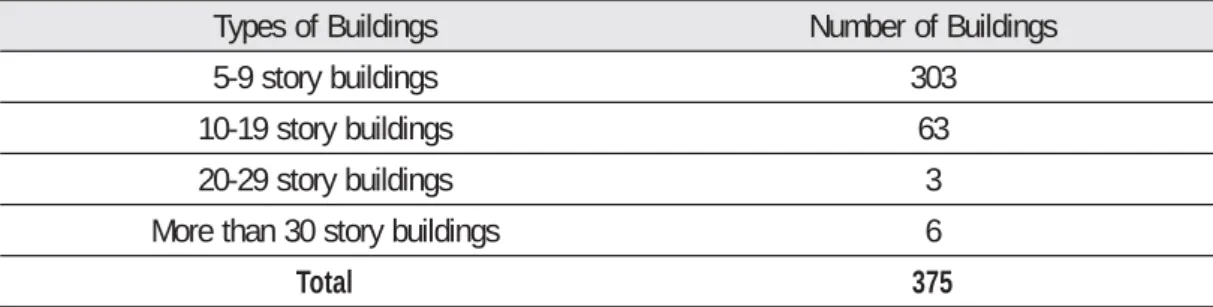
A secure landownership encourages the landowners to invest in their prop- erty due to the fact that the property will not be usurped. For instance, many individuals and private entities in Phnom Penh as well as in other provincial towns produced a construction boom in their own land69 since they could gain secure land tenure. It could be seen that a huge number of buildings, as shown in the table below, were constructed since the coalition government in 1993. This shows that a secure landownership is good incentive for landown- ers to commercially invest in their land and also a good way to contribute to the country’s development. Therefore, land can be filled with buildings, which can be used as commercial centers, markets, and apartments.
Table 1: Large buildings having constructed as of 2012 in Phnom Penh70
Types of Buildings Number of Buildings
5-9 story buildings 303
10-19 story buildings 63
20-29 story buildings 3
More than 30 story buildings 6
Total 375
A secure landownership also provides incentives to the landowners to en- gage in environmentally and agriculturally sound practices. People without a secure land ownership may invest in land less than those who have a secure ownership.71 A research conducted in the Central American country of Costa
68. Bernadette Atuahene, supra note 60, at 661.
69. Toshiyasu Kato, Sophal Chan & Long Vou Piseth, supra note 24, at 27-28.
70. Speech of His Excellency Sreng Khuong, Advisor to Samdech Teicho Hun Sen, Prime Minister of the Kingdom of Cambodia about Experience of Registration of Co-ownership buildings in Phnom Penh in Compilation of Conference Documents of the Sum of Work Output 2012 and the Work Plan for 2013 of the Ministry of Land Management, Urban Planning and Construction (Phnom Penh, Feb. 27, 2013).
71. Cambodian Human Rights and Development Association, supra note 49, at 195.
Rica showed that the increase of the income per farm significantly depended on the security of the land tenure.72 Similarly, in South America, some reports have concluded that the lack of secure landownership remained a main re- striction on the development of agriculture.73 Therefore, secure landownership encourages the landowners to make their land productive thereby contribut- ing to the increase of the nation’s produce.
The development of land through secure landownership reduces land dis- putes.74 When the land is always in use, that is there are plants and some- times gates, the neighbors are aware of their own land boundary even though this is a de facto recognition. On the contrary, if land is not secure, the land- holders are not likely to plant trees or to pay attention to building gates. As such, it is easy for people wanting land to invade the insecure land thereby making land disputes more frequent.
2. Land Transactions
Land, which may fall into a transaction goal for human beings to develop their living standards, requires legal support from the government in order to fulfill the human desire. Although land is permanent, landowners change property ownership. The land certificate holders, in this context, must be secured by the government, especially when the land is transacted. A secure landownership is therefore a positive tool for economic development because landowners can proceed with legal land transactions, such as collateral and sale.
Secure landownership could easily facilitate farmers to obtain loans for agricultural purposes. When farmers want to invest in farming equipment, they are able to receive loans to finance the purchase because they can make personal guarantees by use of a land certificate as collateral. The Civil Code of Cambodia promulgated in 2007 assures that immovable property can be used as real security rights to secure the payment of a debt by way of rights
72. Id. at 194.
73. Id.
74. Alexandre (Sandy) Kedar, The Legal Transformation of Ethnic Geography: Israel Law and the Palestinian Landholder 1948-1967, 33 N.Y.U. J. Int’l L. & Pol. 923, 974 (2001);
Sophal Chan & Sarthi Acharya, Land Transactions in Cambodia: An Analysis of Transfers and Transaction Records, at 5 (Cambodia Dev. Resource Inst., Working Paper No. 22, July 2002).
of retention, security liens, pledges, mortgage, and transfer as security.75 This advantage of law encourages people to actively take part in land transactions.
Land transactions can also proceed with sale contracts or contracts for ex- change if landownership is well secured. In idealized free market, private landownership surrenders full right to the landowners who cannot be de- prived of their ownership unless otherwise stated in law. Thus landowners are allowed to sell or exchange their property to the buyers when needed.
Although there are some restrictions76 to the contract by way of sale or ex- change, the concerned parties can benefit each other by fair and proper agree- ments. The transactions benefit not only the parties, but also the state, which gains revenue through tax payments on the property transacted.77 Noticeably, the transactions can never be valid unless all the contracts of transfer of own- ership are recorded with the cadastral administration.78
Lease on immovable property, which has a secure land certificate, plays a major role in the increase of agricultural productivity through land transac- tions. Concerning a contract of lease on immovable property, the owners could get the rental from the lessees.79 Since the leases can be long term such as 15 years or more,80 the lessees who have resources to invest in land may easily lease the land for producing the crops. The landowners incapable of farming due to a lack of working force or agricultural resources can still get benefit from their land through lease agreement. This is therefore a good means to improve not only the living standards of landowners who are not
75. Civil Code of Cambodia, No.NS/RKM/1207/030, Dec. 8, 2007, art. 767 [hereinafter the 2007 Cambodian Civil Code].
76. Id. arts. 66-67. The following persons are forbidden to sell their property: a person who is not the owner of the property offered for sale; a joint-owner of an undivided property without the consent of the other joint-owners; and a person whose immovable property is the subject of seizure. The following persons are not allowed to purchase: a guardian cannot purchase the property of his ward; a curator cannot purchase the property he/she administers; judges or government officers cannot purchase the property over which they have jurisdiction or that they were charged to sell; a person whose property is under fore- closure cannot purchase this property. Also spouses cannot transact the property between each other.
77. Id. art. 69. (Art. 69 ¶ 2 states that “A contract of sale of immovable property shall be reg- istered only when all parties have proven by evidence that all taxes on the subject property have been paid.”)
78. Id.
79. The 2007 Cambodian Civil Code, supra note 75, art. 248.
80. The 2007 Cambodian Civil Code, supra note 75, art. 244.
able to invest in land by themselves but also land productivity. In Vietnam, for example, the government recognized a defect in the 1988 Land Law which did not allow the Vietnamese people to lease land thereby discourag- ing the increased agricultural productivity or foreign investment. This became an impetus for Vietnam to adopt a new land law in 1993 which recognizes land leasing by giving increased rights and security to the Vietnamese land- users.81
B. Promotion of Development
A vigilant land administration is a good strategy for the development of land. A government thus must concentrate on a land development plan aimed at improving the way of life of the citizens. All plans must have advantages and disadvantages. However, most vantage points for a development plan are more preferable to disadvantages. In order to reach this goal, it is therefore necessary that the government make policy considerations based on the most vantage points. For example, in order to develop one area in the future, plan- ners should carefully study the details of the impact which may be caused by the development plan.
This sub-section proposes some considerations for the promotion of de- velopment in squatter areas and vacant land. Squatter areas exist throughout the world especially in the developing countries which require a very careful management from the local authority. Also vacant land which causes a huge loss of land productivity should be necessarily taken into account for their effective use. Thus this sub-section also proposes some measures to enforce landowners to make use of land.
1. Squatter Areas
A true list of squatters is an important instrument in realizing who is really staying in the squatter areas and therefore ensures that every squatter will obtain benefit from a development plan if the government plans to develop those squatter areas. In this regard, the local authority plays a vital role in controlling the accurate number of people in the area. Since a squatter area
81. Hong Anh Tran, Case Note and Comment: An Assessment to the Vietnamese Land Law and Regulation, 13 Wis. Int’l L.J. 585 (1995).
is an easy place for the flow of people, a rapid increased number of squatters in the list cannot be predictable if there is no acceptable existing squatter list before a development plan starts. For example, in Deikraham Community A in Village 14, Tonle Bassac Commune, Chamkarmorn District of Phnom Penh, when the government planned to develop the village, the number of the families in a required list of the squatters was exaggerated.82 Therefore, in order to obtain an accurate list of squatters, the government should have a statistical number of the squatters in all squatter areas certified by the com- petent authority every year although they are not in the forthcoming develop- ment plans.
Obtaining an accurate number in a list of the squatters becomes more effec- tive in managing a squatter area if squatters are divided into small groups. A large number of squatters in each community may cause counting inaccuracy because, in that community, the community members do not know each other and therefore it is hard to control the accurate number.83 A small group of about 30 families in the community provides an opportunity to a group leader to control the group members very well.84 Also a group allows group mem- bers to know each other clearly. This is a good way to easily check the list of squatters in each community with small groups. If there is any person that comes to live in the group, each group member, especially the group leader knows and therefore could claim against the new comer. The list of squatters should be frequently announced to those who are living in the squatter areas and guaranteed by the authority as a legitimate list of squatters. However, those who have names on the list should permanently stay in squatter areas with some conditions or otherwise have their names removed from the list.
The leaders of small groups should be given responsibility to confirm who do not stay in the areas.
The forbiddance of the sale of a house may also be a positive means to
82. In a list prepared by the chief of Deikraham Community A subsequently certified by the District Governor of Chamkarmorn, there are 289 families in which 48 families were ex- aggerated (on file with author).
83. Report on the Management and Development of Community prepared by the Phnom Penh Municipality, No. 609/RBK/Kr (Aug. 8, 2006). The report recognized the mistake of con- trolling the statistic of the people in the community thereby having a negative effect on the individual rights and implementation of laws.
84. A personal interview made in August and September of 2006 showed that in a large com- munity of around 200 families, it is hard for each community to know each other.
prevent chaotic settlement in squatter areas. The local community usually knows very well that squatters do not have enough legal evidence to claim for the ownership, but those squatters have stayed for a long period of time.
Therefore, they have no right to sell their house or land. In order to achieve this goal, a list of squatters plays a crucial role in preventing a sale because a buyer will not be permitted to record the name on the list. Since all sale contracts are not recognized, those who still buy the immovable property in squatter areas by any means must not be recognized in a list of squatters.
Thus the buyers will never have their name on the legal list, which is rec- ognized by the competent authority thereby deterring them from buying im- movable properties in the squatter areas.
2. Vacant Land
Imposing land taxes is a good strategy to reduce vacant land. Cambodia follows a land registration system which will provide the information neces- sary for a successful tax system. A land taxation system could provide sev- eral benefits such as increasing national revenues, producing a fairer system because all land is specifically identified, and strengthening the local authori- ties by giving responsibility to collect land taxes.85 Moreover, landowners in- tend to improve their land if the landowners are obliged to pay the taxes be- cause they require income from the land. In contrast, if they do not have any duty with their land, they are more likely to keep their land for speculative purposes without any improvement. For example, in the suburb of Phnom Penh, large plots of vacant land that are enclosed by fences or walled gates are awaiting a good chance to be sold; therefore, the Cambodian government should consider imposing land taxes in order to improve productivity of large parcels of vacant land.
Also, by forcing landowners to effectively make land productive is an- other good strategy in reducing vacant land. Although land is taxed, the enforcement of land use86 brings many other advantages to the country such as increasing productivity and providing information necessary to identify tax payers and punish unused landowners. If landowners do not invest in
85. Bernadette Atuahene, supra note 61, at 664.
86. Land use can be assumed as an economic activity and it is determined by economic forc- es. See also Mather, A.S. Land Use, 26 (1986).