하수하니다 하수이을 마권눈사을 하수이을 해수 해수 자니니다 using 이지부사랑(CKD, PSA). Here, extracts are obtained via precipitation of magnesium dissolved in seawater using CKD and extraction of magnesium using H2SO4··· 46 Table 3 XRF analyzes of precipitated solids by adding acetone to. Here, extracts are obtained via precipitation of magnesium dissolved in seawater using CKD and extraction of magnesium using H2SO4··· 47 Table 4 Changes of Mg concentration and pH by adding acetone to.
Ko ápe ojehupyty umi extracto oñembohykúvo magnesio disuelto y marpegua ojeporúvo PSA ha ojeipe a magnesio ojeporúvo H2SO4··· 49 Cuadro 5 Análisis XRF umi sustancia sólida oñembohykúva oñembojehe ávo acetona. Pévape ojehupyty umi extracto ojeprecipita rupi magnesio disuelto y marpe ojeporúvo PSA ha ojeipe a magnesio ojeporúvo H2SO4··· 50. Umi extracto ojehupyty precipitación magnesio disuelto y marpegua ojeporúvo PSA 회수하기 에리 3 ary orekóva.
바닷물에서 추출한 마그네슘을 4배 이상 농축한 용액에 아세톤을 첨가하여 황산마그네슘을 침전시켰다.
Background
As South Korea is surrounded by the sea, the recovery of magnesium from seawater is expected to improve our country's national competitiveness and the economic effects of industrial markets. When magnesium is recovered from the ore, the first step is to extract the magnesium using acid and the second step is to precipitate the magnesium by injecting the alkaline substance (Elsner & Rothon, 1998; . Ozedmir et al., 2009). Elsner and Rothon (1998) recovered precipitated magnesium hydroxide by drying at high temperature. 2009) performed the experiment that hydrochloric acid was added to magnesium, then the magnesium was extracted and the solution was boiled to precipitate and recover the magnesium chloride.
2001) recovered magnesium by adding NaOH to bittern where the magnesium concentration is 100% higher than normal seawater. First, they placed sulfuric acid to remove the calcium in the brine and carboxy methyl cellulose was added to precipitate magnesium hydroxide which was produced by adding NaOH. The technology of extracting magnesium from seawater to produce magnesium (magnesium oxide) is already commercially available in the world, but it is not easy to ensure economic efficiency.
When we recovered magnesium using conventional precipitation, an alkali, the main problems were precipitation and filtration of magnesium hydroxide.
Objective
In addition, the economic costs associated with alkaline precipitants such as NaOH and NH4OH can be described as the main problems in practical use. Among the many ways to solve this problem, an alternative is to find that the alternative is to replace the cheap settler. For example, industrial by-products such as paper pulp ash (PSA), cement kiln dust (CKD), slag and fly ash can be used as a replacement settling agent.
Henrist, C., Mathieu, J.-P., Vogels, C., Rulmont, A., Cloots, R., 2003: Morphological study of magnesium hydroxide nanoparticles precipitating in dilute aqueous solution, Journal of Crystal Growth 249, pp . 321-330. Lehmann, O., Nir, O., Kuflik, M., Lahav, O., 2014: Recovery of high-purity magnesium solutions from RO brine by adsorption of Mg(OH)2(s) on Fe3O4 microparticles and magnetic solids separation , Chemical Engineering Journal, 235, pp.37-45. Ozedmir, M., Cakir, D., Kipcak, I., 2009: Magnesium recovery from magnesite tailings by acid leaching and production of magnesium chloride hexahydrate from leach solution by evaporation, International Journal of Mineral Processing, 93(2), pp.
Shim, J.D., Lee, D.H., 2011: Microstructure control, Forming technologies of Mg alloys and Mg scrap recycling, Journal of Korean Institute of Resources Recycling, 20(1), pp.69-79.
Production of concentrated magnesium solution from
Materials and Methods
- Materials and analyses
- Methods
- Magnesium precipitation
- Magnesium extraction
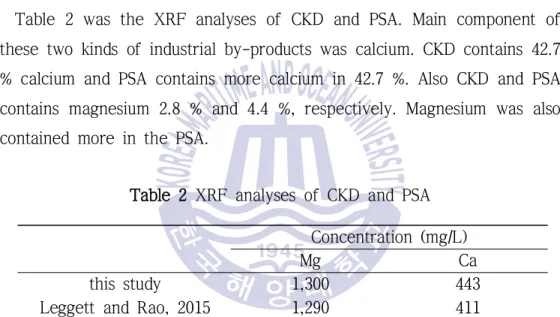
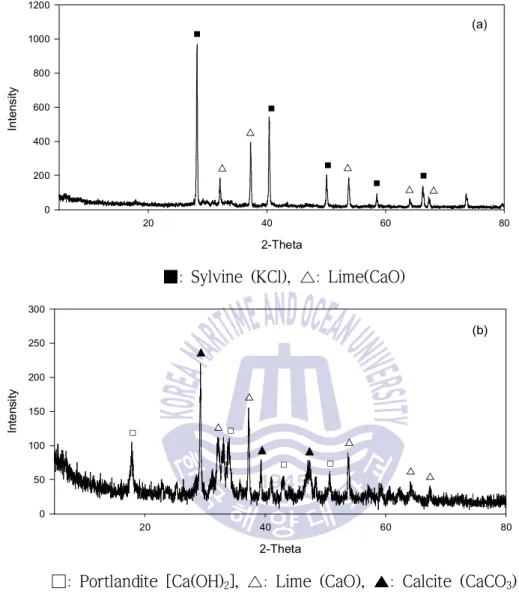
To detect the particle size of CKD and PSA, laser diffraction particle size analysis (Beckman coulter, LS 13320) was used. X-ray diffraction (XRD, Shimadzu, Optima 8300) and X-ray fluorescence analyzer (Shimadzu, XRF-1700) were used to analyze the composition of CKD and PSA. Each industrial by-product and distilled water were mixed at a ratio of 1:5 (g:mL) and the pH was measured after filtration (Lee et al., 2011).
Magnesium from seawater was precipitated into magnesium hydroxide by adding alkaline matter to seawater, and magnesium was extracted with a small amount of acid and made a high concentration magnesium solution. Three kinds of alkaline substances (NaOH, CKD, PSA) were used to precipitate magnesium in seawater. 4 M NaOH with seawater was mixed at 250 rpm for 30 min and the suspension was filtered with 0.45 µ filter.
The calcium and magnesium concentration of the filtrate was measured using AAS and the pH was also measured. Magnesium was precipitated with a formation of magnesium hydroxide using three types of precipitants and sulfuric acid was used to extract this magnesium. A variety of sulfuric acid concentrations were used to establish the optimum concentration of sulfuric acid.
Before the magnesium extraction experiment, solid sample was prepared with the method of "2.2.1 Magnesium precipitation" and the precipitant amount to the seawater was added more than optimum condition.

Results and Discussion
- Seawater and material analyses
- Magnesium precipitation
- NaOH
- CKD
- PSA
- Magnesium extraction
- NaOH
- CKD
- PSA
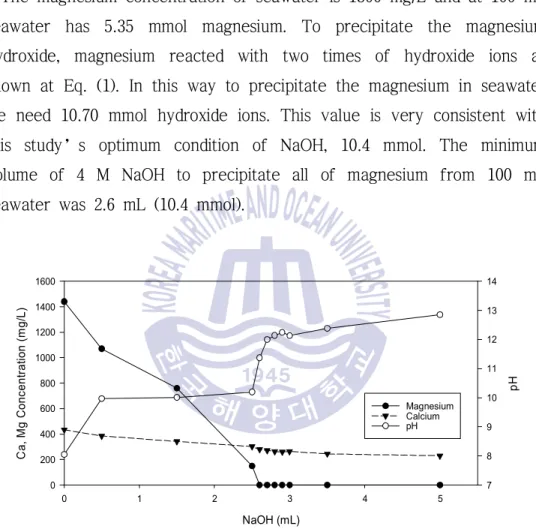
However, the solubility product (Ksp) of calcium hydroxide was higher than the magnesium hydroxide. And the magnesium concentration of filtrate became 0 mg/L when the NaOH injection volume was 2.6 mL (10.4 mmol). 3 Variations of the magnesium and calcium concentrations and pH in the filtrate obtained after the precipitation with the 4 M NaOH.
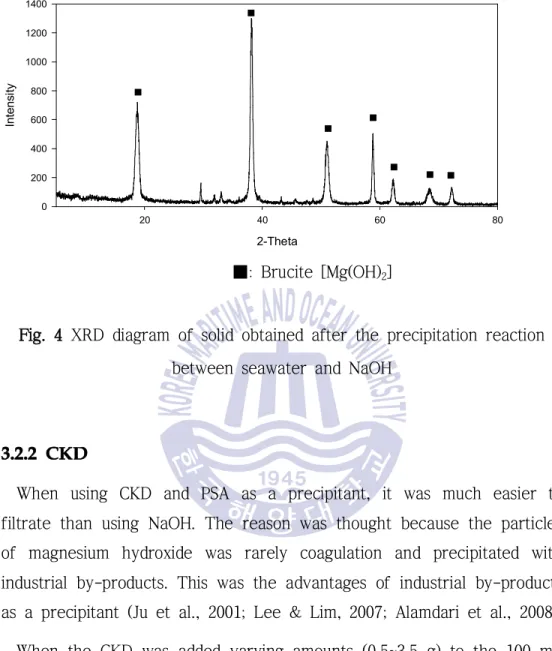
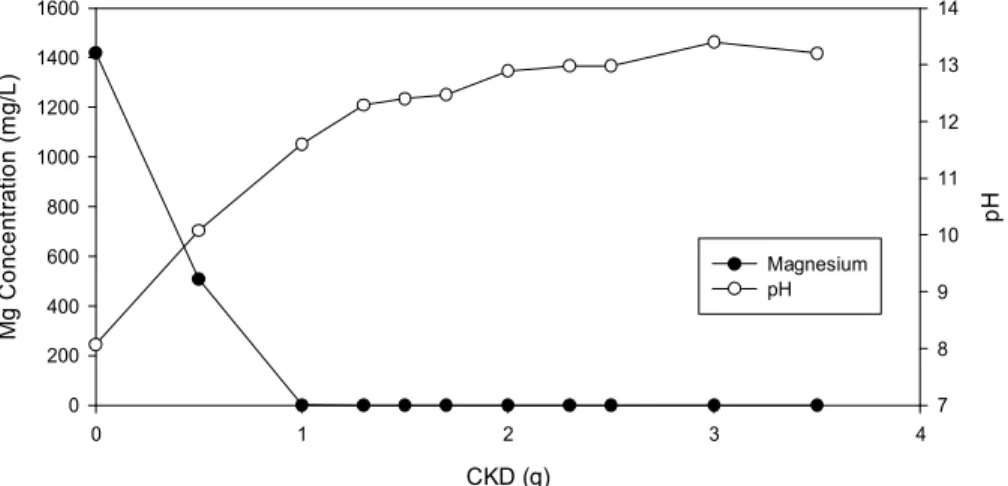
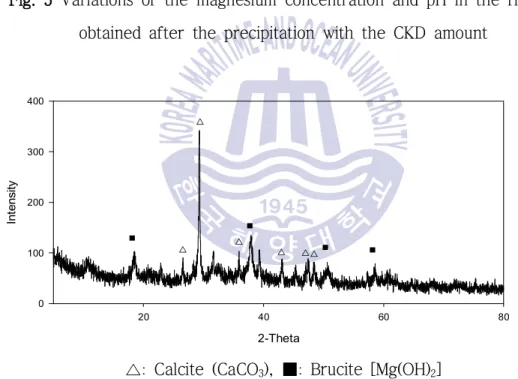
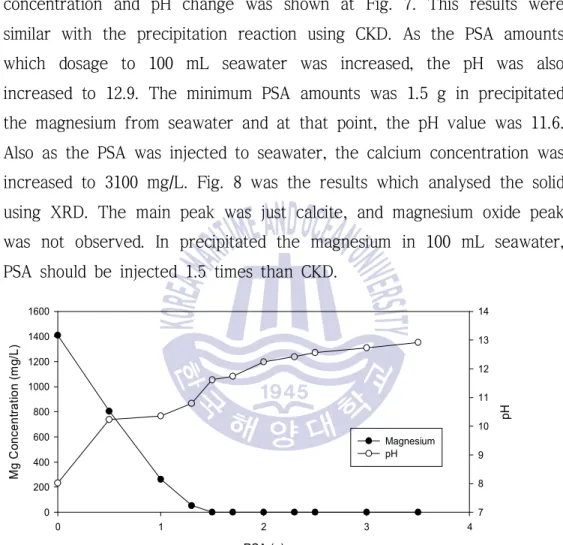
The main point was magnesium hydroxide and this presence was the reason for the precipitation of magnesium hydroxide. 5 Variations of magnesium concentration and pH in the filtrates obtained after precipitation with the amount of CKD. 7 Variations of magnesium concentration and pH in the filtrates obtained after precipitation with the amount of PSA.
Because magnesium hydroxide has been mixed with industrial byproducts, it is difficult to separate physically. However, sulfuric acid concentration was higher than 0.3 M, magnesium concentration and pH were stable. This means that the optimum sulfuric acid condition was 0.3 M and 40 mL for the extraction of magnesium from 200 mL of seawater.
At the optimal condition, the magnesium concentration of the filtrate was 5225 mg/L and the 40 ml filtrate has 209 mg of magnesium. The magnesium concentration of the filtrate was 4975 mg/L and the pH was 0.20 when the sulfuric acid concentration was up to 1.0 M. However, when the sulfuric acid concentration exceeded 1.0 M, the magnesium concentration and pH changes were small.
Based on 100 ml seawater, the optimum condition to extract magnesium precipitated by CKD was 1.0 M sulfuric acid 20 ml. At the optimum condition, the magnesium concentration was 4975 mg/L and the calculated magnesium recovery efficiency was 76.5% (Eq. 7). The magnesium concentration of the filtrate was 5775 mg/L and the pH was 0.56 when the sulfuric acid concentration was up to 1.5 M.
The magnesium concentration gradually increased and the pH decreased gradually as the sulfuric acid solution was from 1.5 M to 4.0 M.

Conclusions
Here, the volume of H2SO4 is fixed at 20 mL and PSA is used as the precipitant. According to the results of this study, we were able to make a magnesium solution whose concentration was 3.8-4.4 times higher than the concentration of magnesium in seawater (about 1300 mg/L). With this study, we look forward to a solution using industrial by-products such as CKD and PSA.
Alamdari, A., Rahimpour, M.R., Esfandiari, N., Nourafkan, E., 2008 : Kinetics of magnesium hydroxide precipitation from sea bittern, Chemical Engineering and Processing, 47, pp.215-221. Anil, K., Syamal, R., 1974: Solvent extraction behavior of magnesium and calcium in versatile acid-amine systems, Separation Science and Technology, 9(3), p. A study on the separation and recovery of magnesium from bitter waste, Journal of the Korean Environmental Sciences Society, 10 (5), pp. 381-386.
Recovery of high-purity magnesium compounds from seawater by an isothermal supersaturation technique with ion exchange, industrial &. Leggett, C.J., Rao, L., 2015: Complexation of calcium and magnesium with glutarimide dioxime: implications for the extraction of uranium from seawater, Polyhedron, 95, pp.54-59.
Precipitation of magnesium sulfate from concentrated
Experiment
- Recovering the magnesium sulfate from the artificial
- Recovering the magnesium sulfate from the seawater
- Collecting the used acetone
- Material analyses
- Recovering the magnesium sulfate from the artificial
- Recovering the magnesium sulfate from the seawater · 44
- Using PSA as a precipitant of magnesium
- Collecting the used acetone
The process of recovering magnesium from seawater was divided into three steps (pre-precipitant, extract and precipitant). The sample was prepared to experiment with the final step, precipitant, adding the acetone to the sample to precipitate the magnesium sulfate powder. The acetone mixing ratio was determined through "2.2.1 Extraction of magnesium sulfate from the artificial magnesium solution".
After the experiment of "2.2.2 Recovery of the magnesium sulfate from the sea water", the final filtrate (120~160 ml) was taken in round bottom flask and connected with fractionation column and cooler. Variations of magnesium sulfate precipitation efficiency with pH of the artificial magnesium solution were shown in Fig. The precipitation efficiency of solid magnesium sulfate changed per acetone ratio and pH, and the efficiency range was 75~95.
In the steady state rate, the precipitation efficiency of magnesium sulfate was increased when the pH was high. Variations of the magnesium sulfate precipitation efficiency with the volume ratio of acetone to solution are shown in Fig. However, the pH was higher, but the variations of the magnesium precipitation efficiency with the acetone ratio are lower.
The higher the pH of the artificial solution and the acetone ratio, the greater the amounts of precipitated magnesium sulfate. Among these conditions, when the pH was 1.20 and the ratio artificial solution:acetone=1:2 (v:v), the amount of magnesium sulfate was the maximum and the efficiency was 96.40. Mg(OH)2(s) + H2SO4 → MgSO4 + H2O (1) Magnesium sulfate is very soluble in water, and if the temperature is high, the solubility will be high.
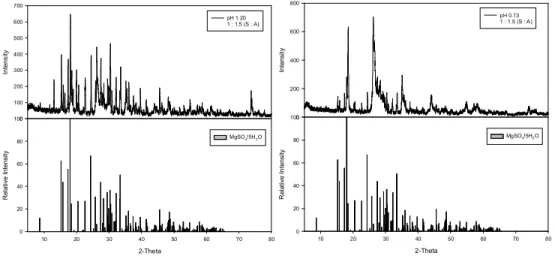
When using 0.5 M and 1.0 M sulfuric acid, the precipitated magnesium sulfate was magnesium sulfate tetrahydrate and magnesium sulfate hexahydrate, respectively. In this study, the last step of the experiments was carried out for the recovery of magnesium from seawater. The pH was higher, the acetone ratio was higher and increased the efficiency of the precipitated magnesium sulfate.
Since the concentration of magnesium was 1300 mg/L, he was able to obtain 12.3 kg of magnesium sulfate hexahydrate from 1 ton of seawater.