This thesis presents liquid-solid and liquid-liquid phase separation in aqueous systems. We will describe these systems in two ways: the growth of a single crystal within aqueous solution and the modeling of the liquid liquid with an aqueous solution of the two-phase system. In Chapter 1, we give an overview of the theory that relates to each other chapters, such as phase separation, crystallization and aqueous two-phase systems (ATPS).
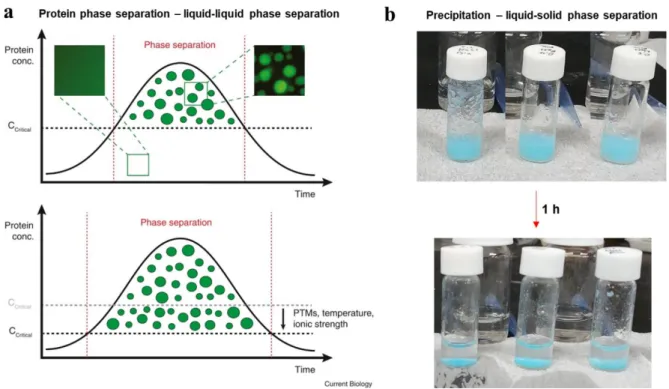
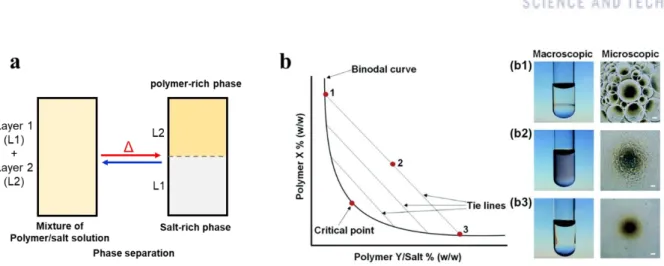
In a liquid-liquid mixture, phase separation occurs when the concentration of one liquid is high enough to form a single phase. If the mixture temperature is high, the phase production concentration is also high. First, liquid-liquid phase separation in a chamber that has surface-etched patterns results in guided ATPS patterning.
Second, a light pattern projected onto a chamber heats the fluid locally and causes phase separation in illuminated regions.
General Introduction
Phase separation
Liquid-solid phase separation
Crystallization
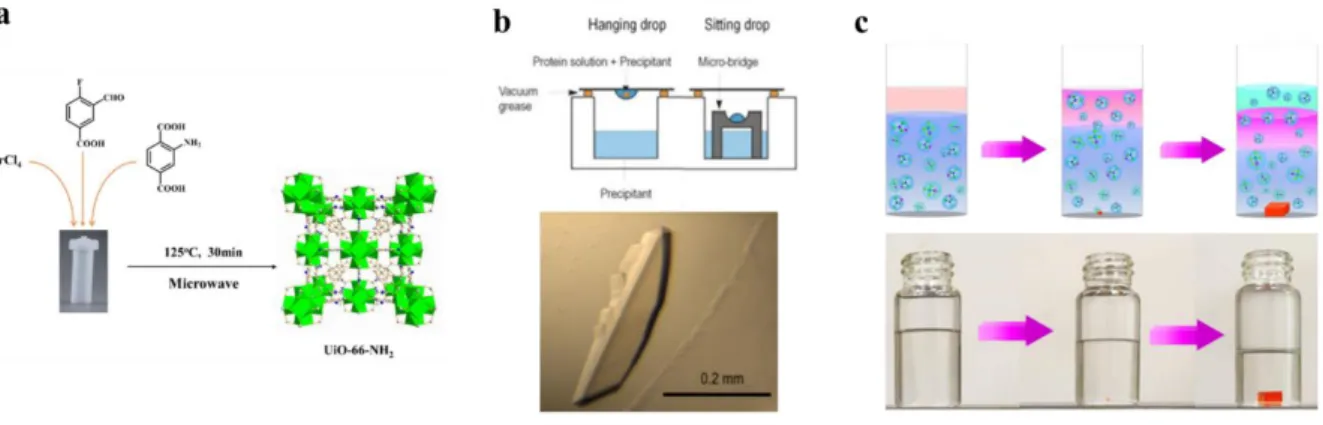
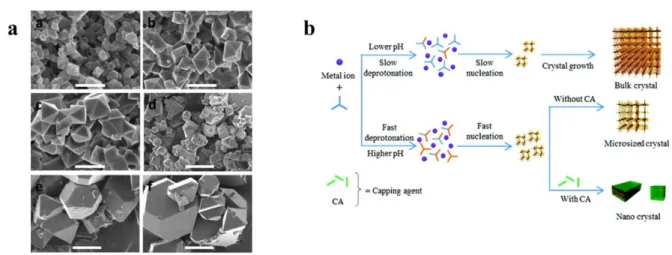
Crystallization of Metal-Organic Framework (MOF)
Aqueous Two-Phase Systems (ATPSs)
Uniform and directional growth of centimeter-sized single crystals of cyclodextrin-based
- Abstract
- Introduction
- Results and discussion
- Conclusions
- Experimental Section
- Reference
Representative images of CD-MOF-2 (Rb) crystals (a) after reseeding; and of CD-MOF- 3,4 (b) after reseeding. c) A photograph of a CD-MOF-2 crystal placed on a graduated paper and against a ruler. Scale bars correspond to 2 mm. a) PXRD spectra of CD-MOF-2 (Rb) single crystals powdered after initial crystallization and after reseeding match the calculated pattern (b) large, single crystals of CD-MOF-2 exhibit dominant, etc. Simulated spectra are also shown in all panels. a) N2 uptake isotherm and calculated BET surface area of CD-MOF-2 (Rb) crystallites.
Schematics and experimental images illustrating the directed growth of large CD-MOF-2 (Rb) crystals confined to PDMS molds. Scale bars correspond to 2 mm. c) The PXRD pattern of before and after staining of CD-MOF-2 (Rb) by Au NPs. SEM images of prepared CD-MOF-2 (Rb) crystals by bulk mixing and layered diffusion method.
In situ MOF crystallization studies (phase diagrams) of (a) single crystalline CD-MOF2 (Rb), (b) CD-MOF-3 (Cs), (c) polycrystalline CD-MOF-2 (Rb), and (d) ) CD-MOF-3 (Cs) after crystallization time, percentage of diffused methanol. a) The PXRD pattern of large CD-MOF-2 (Rb) single crystals intact and after cracks.
Guided pattern formation of Aqueous Two Phase Systems (ATPSs)
Abstract
The dynamics of this process depend on the convection currents and the wetting of the container walls. When we rotate the pattern in the top wall by 30º and fix it, the pattern of the entire room has twelvefold symmetry. Apart from the pattern in the chamber, the composition of the ATPS solution is the same as in the experiment above.
This arrangement follows neither the pattern on the top wall nor that on the bottom wall of the container. Before the chamber was inverted and the temperature of the ATPS solution increased, the pattern of PEG-rich droplets had sixfold symmetry. The light pattern can be projected onto the ATPS solution regardless of the engraved or embossed pattern.
Phase separation of ATPS solution with TMA-capped gold nanoparticles in a bulk system and light-induced patterning. a) Before and (b) after phase separation of the base solution above 60. After increasing the temperature of the solution above 60 ℃, most of the dyes were placed in the salt-rich phase and the nanoparticles in the PEG-rich phase. Before the reaction proceeded, the color of the solution was purple due to each additional color in the ATPS solution (DYE-blue, NP-red).
The red part (salt-rich part) was created inside the solution after the phase separation following the illumination pattern. Various of the patterns such as (a) engraved letter, (b) embossed letter, (c) small circles, (d) small hexagons, (e) concentric circle and (f) concentric square were formed by lighting the pattern on the surface of the chamber. If the temperature of the ATPS solution is increased, the required concentration of each phase for phase formation also increases.
Aggregated nanoparticle by pattern formation. a) black precipitate appeared after irradiation on the surface of the chamber. We observed black precipitates at the edge of the illumination pattern in the solution (Figure 3.9 (a)). 15-17 Therefore, these colorless crystals in the ATPS model were formed by recrystallization of the salt in the PEG-rich zone of the model.
The second method is to increase the temperature of the liquid in certain areas of the chamber with a specific lighting pattern.
Introduction
Results and discussion
Conclusions
In this chapter, we demonstrated the possibility of precise liquid-liquid patterning in ATPS by two different methods; one engraves the pattern on the inside of the chamber to place one liquid phase with a specific arrangement. We only proposed two different ATPS in this chapter, but there are many combinations to form ATPS utilizing ionic liquids, transition metal salt and other polymers. So we can create the fluid pattern, which has specific properties depending on the type of ATPS.
These experiments also focused on basic methodology and material demonstrations, but this work may, over time, have connections to "guided" phase separation in living cells.
Experimental Section
각 상분리의 경우, 액-고상분리의 예로는 수용액에서 MOF(금속-유기골격체)의 단결정 성장이 있었고, 액-액분리는 이를 이용한 액체-액체 패턴의 생성이 있었다. 수성 2상 시스템. 저는 이렇게 설명하고 싶습니다. 2장에서는 위에서 설명한 바와 같이 수용액 내에서 단결정의 성장을 통해 액체와 고체의 상분리를 설명하고자 하였다. 루비듐, 세슘 금속과 전분에서 대량 분리가 가능한 당의 일종인 γ-사이클로덱스트린을 이용하여 금속-유기 골격체를 합성하고, 합성된 MOF의 단결정 성장에 대한 연구를 지속하고 있다.
증기 확산법의 단순 결정 핵 생성 속도를 조정하여 측면 크기가 6~7mm인 단결정(다른 결정상이 혼합되지 않은 결정)을 얻었습니다. 금속의 종류에 따라 하나는 입방체 모양이고 다른 하나는 잘린 육팔면체 결정체입니다. 메탄올 비율이 높을수록 메탄올이 분산되는 속도가 빨라지므로 내부에 몇 개의 큰 단결정이 성장하는 대신 작은 단결정이 많이 형성되어 더 이상 성장하지 않습니다. 비율이 너무 낮으면 묽은용매에 함유된 수분이 증가하지 않고, 용해도가 감소하지 않아 결정이 생성되지 않는다.
6~7mm 정도의 단결정을 생성한 후 이를 씨앗으로 사용하여 더 많은 결정을 성장시키는 재시딩(reseeding) 방식도 사용됐다. 이 방법은 크기가 약. 6~7mm 위에 도달하면 크기를 더 늘릴 수 있습니다. 종자결정이 용해되지 않도록 수용액의 농도를 조절한 후 증기를 가한다.
우리는 결정을 성장시키기 위해 이러한 재시드 방법을 사용했지만, 결정이 원하는 방향으로만 성장할 수 있도록 일부 결정면을 인위적으로 차단하려고 시도했습니다. 종자결정을 돋보이게 하기 위해 금나노입자로 착색한 후 종자결정의 여러 면을 막은 틀을 마련하고 그 틀에 결정을 넣은 후 결정성장을 계속하였다. 그 결과, 블록킹된 면을 제외한 모든 면에서 결정이 성장하여 L자형 결정을 얻었다.
3장에서는 수용성 2상 시스템을 이용한 액체-액체 패턴 생성에 대한 연구가 진행되었다. 또한, 패턴을 형성한 후, 패턴이 생성된 영역과 패턴이 생성되지 않은 영역의 고분자/염의 농도가 다르기 때문에 이를 이용하여 소재의 재결정화에 활용이 가능한 것을 확인하였다. 특정 지역.