
North Korea's Agricultural Reforms and Challenges in the Wake of the July 1st Measures / By Choi, Soo Young -- Seoul: Korea Institute for National Unification, 2007. This paper examines the changes and challenges facing North Korea in its efforts to reform the agricultural sector in the aftermath of the 1 July measures.

Overview of the Agricultural Reform Measures In North Korea, there were no true reforms before the 2002 July
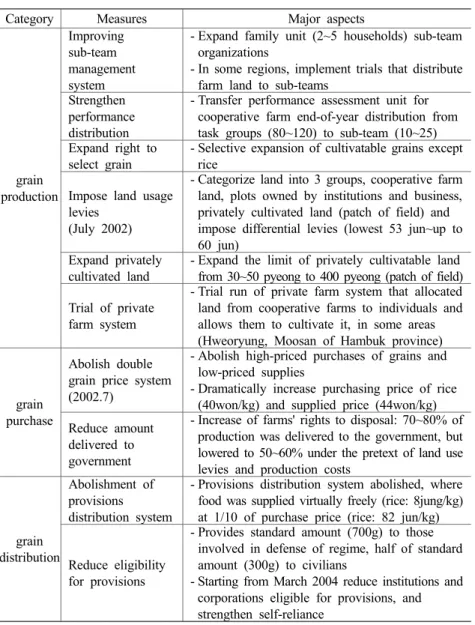
The unit of performance evaluation that is applied to the distribution of cooperative farms at the end of the year was passed from working groups to sub-teams. In addition, restrictions on the amount of land that could be privately cultivated were increased from 30~50 pyeong to 400 pyeong.
North Korea has now recognized that the market is part of the planned economy and since it has reorganized the farmers' market into an integrated market, the market trade of agricultural products through the market is increasing.
Easing Collectivism, Encouraging Responsible Farming
The expansion of privately cultivated land is understood to be concentrated in the Hweoryung and Moosan areas in Hamgyung Province. There is a possibility that the gardens cultivated by an individual family will expand in number, mainly in the inland mountainous regions, but since the expansion of agriculture in family gardens would be like the recognition of private agriculture, it would therefore be difficult to implement in all over the country.
Private Farming Trials
North Korea had introduced a new and improved version of the sub-team management system in March 1996 and had conducted trials in certain areas. The widespread implementation of the sub-team management system since July 1 measures aims to distribute agricultural products in different quantities according to performance.
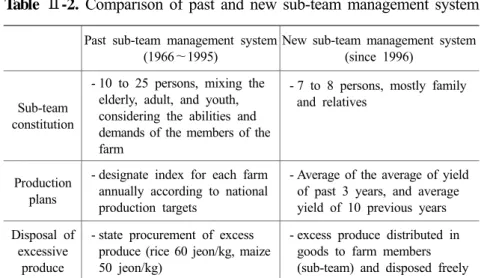
Expansion of the distribution principle based on performance
PriceㆍCirculation: rationalization of national prices, introduction of integrated market
Elimination of the Double Price System of National Prices
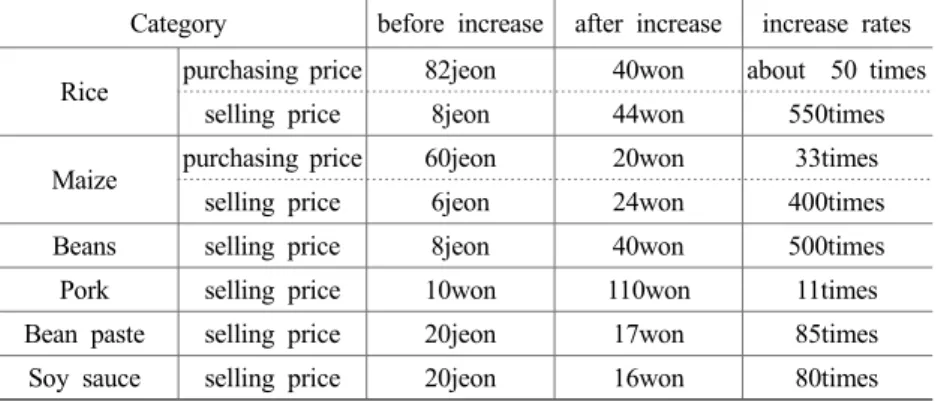
North Korea has tried to motivate farmers by raising the purchase prices of agricultural products (especially grain) to a more realistic level. A dramatic increase in the purchase prices of agricultural products (including livestock products) will lead to an increase in the income of farmers, so that the conditions have improved to expand and improve the living conditions of farmers and the agricultural sector in general. At the same time, North Korea raised the distribution prices (state prices) of agricultural products traded in state stores or government retailers so that the new prices were closer to the products traded in farmers' markets (market prices). ).10 The government price (sale price) for rice was raised from 8 jeon to 44 won per kilogram (550 times), 6 jeon to 24 won per kilogram for corn (400 times), 8 jeon to 40 won per kilograms for beans (500 times).
There is no significant difference in prices for citizens who want to buy grains (rice, corn) at the food distribution center or at the farmers' market.11 The price of pork (raw) was increased eleven times, from 10 won to 110 won per kilogram. In 2003, it was revealed that rice provided as aid to North Korea was sold for 46 won (paid distribution) and it appears that state prices for these items are beginning to change.
Introduction of Integrated Market
2003 that rice provided as aid to North Korea was being sold at 46 won (paid distribution) and it appears that the government's prices for these items are beginning to change. grains) are distributed and manufactured goods that were once illegal at farmers' markets are now traded legally. All products with legal and illegal sources of supply are traded in the integrated market, as the origin of smuggled goods and goods illegally issued from the official (planned) sector is difficult to trace. Currently, as of December 2003, it is estimated that there are around 300 to 350 integrated markets established around North Korea.
Individual stores in the integrated market do business and pay state taxes and market use fees that range from 40 to 60 won per store. In the old farmers' market system, only individual citizens could register and do business, but in the integrated markets, state-owned enterprises and cooperative groups can also participate, so that 5%.
- Changes in the Production Sector
- Increases in Production due to Higher Motivation The index that directly represents the problems of North Korea’s
- Farms (Farmers) Selfishness
- Changes in Distribution Methods
- Increases in Relative Income of the Agricultural Sector (Farmers)
- Changes in Prices and Retailing
- Continuous Rises in Agricultural Products Prices
- The expansion of the commercial retailing network
North Korea claims that despite price adjustments and increases in the cost of living due to the July 1 measures, there have been no changes to the distribution system that guarantees the basic subsistence of the population. The fact that the national price (distribution price) has been rationalized (increased) to the level of market prices means that the role of the distribution system has actually been reduced. It appears that the physical contraction of the distribution system following the July 1 measures has not placed too much of a burden on household finances.
This reorganization of the distribution system was implemented mainly through the differentiated increase in the cost of living. Through the July 1 measures, North Korea sought to reduce the role of the farmers' market and establish the socialist distribution system through the national retail network. However, after the July 1 measures, the role of the government distribution system has been reduced, and urban consumers now buy 50%.
After all, after the July 1 measures, recent changes in the distribution system of agricultural products in North Korea have led to a reduction in the role of the official retail network and.
Agricultural Reform
Goals of North Korea’s Agricultural Reform A. Conditions for the Agricultural Reform
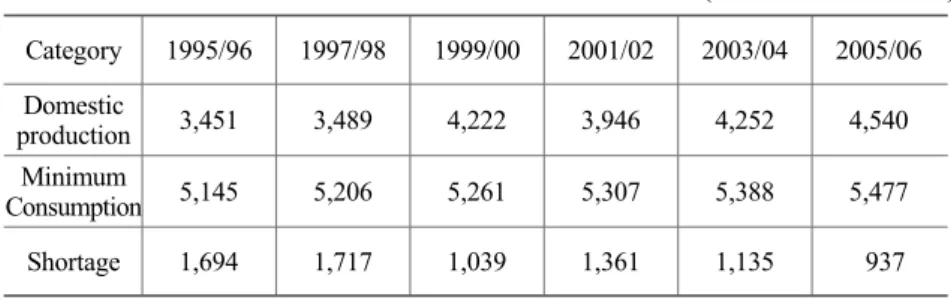
North Korea has not yet implemented a full-scale reform policy, but around the time of the July 1 measures, some reform measures were implemented in the agricultural sector. However, this does not mean that there is a possibility that the system and organization of North Korea's agricultural sector will actually be reformed. However, contrary to the intentions of the North Korean government, the various reform measures have caused irreversible changes in the agricultural sector.
Due to the continuation of inflation after the July 1st measures, farmers' demands for the rights to sell more freely on the market increased. As a result, there was a partial relaxation of the collective system in the agricultural sector.
Basic Goals of the Agricultural Reform
- Challenges to Agricultural Reforms
North Korea's agricultural reform should be implemented gradually in two big steps, firstly, changes within the economic regime and secondly, fundamental changes to the economic regime. The autonomy of collective farms should be expanded to change the management objective to a profit-seeking structure and economic incentives. In the second phase of changes in the economic system and regime, it is necessary to enable different rights to use land, expand private property and the scope of farmers' economic activities.
The distribution system must be eliminated, and instead a market-centered distribution system must be established and the state monopoly supply system gradually transformed into a competitive system. Therefore, in the second phase, a simple price system must be established where prices for agricultural products are determined by the principle of supply and demand within the market.
Reforms in Ownership Forms: Separating Land Ownership and the Right to Use Land
The government supply system and market trading should coexist, but at the same time the supply through the national distribution network should be reduced. To motivate farmers' desire for higher production levels, a fundamental reform in ownership must be implemented. This is because ownership of the means of production is the most important requirement for farmers, as well as the most effective incentive for higher motivation.
More specifically, the inputs needed for farms that the collective farms own, such as arable land, livestock and agricultural equipment, must be rented or transferred to individuals. Ownership of the land (arable land) remains with the collective farms, but individual farming households should be given long-term use rights and gradually be given the right to transfer, inherit and mortgage the land.
Introducing and Expanding the Farming Family Production Responsibility System (Family Farms)
Ultimately, however, the main goal would be to establish governing bodies for individual farming units. It will be difficult to obtain immediate ownership of large means of production for individual households during the process of introducing and expanding the farm house production responsibility system. If the use of the means of production, especially the long-term use of land becomes possible, then the next step will be to grant various rights related to rights of use (lease, settlement, inheritance, etc.).
The most suitable structure for such a system of production responsibility in the agricultural sector would be the family farming system (family contract or family tenancy system), where individual farming households are responsible for farming activity. Meanwhile, when land is allocated where the quality of the land varies, the most reasonable method would be to adjust the standard according to quality levels. 32.
Raising Purchasing Prices
That is, input prices should be increased to close the gap in market prices and encourage farmers to participate in the government-run official distribution system. Meanwhile, there are also ways to increase purchasing prices, which means a direct financial burden for the government. However, increasing distribution prices for agricultural products would lead to an increase in overall national prices and ultimately inflation.
At the same time, it is important to reduce this national price control function. In other words, the double prices and distorted system of relative prices of all products should be changed to a single price system.
Convert to a Market-Oriented Distribution System
The distribution system of agricultural products controlled by state stores should be gradually reorganized into a system managed by the market. The reforms related to prices and distribution of the agricultural sector need to be implemented together with reforms of land systems and agricultural production systems. To provide incentives to farmers, purchase prices for agricultural products should be gradually increased to a level that is more realistic.
Therefore, the distribution system should shift towards a direction where market trade for agricultural products produced by farmers should be expanded. The national distribution network should be gradually reduced and the commercial distribution network expanded so that a mechanism can ultimately be built whereby prices for agricultural products are determined by market supply and demand.

