North Korean Political Dynamics of the Kim Jong-un Era
Ken E. Gause
The political dynamics associated with the Kim Jong-un regime have taken a number of twists and turns since the beginning of the third gen- eration leadership transition at the end of 2011. Beginning in 2010 at the Third Party Conference and carrying through the first two years of Kim Jong-un’s rule, the focus was on the revitalization of the Party apparatus.
During this period, the purges of the high command began while at the same time the Party leadership bodies witnessed a dramatic growth in representation of military and security personnel. The fusing together of the military and Party leadership appeared to bring stability at the top echelons of the leadership structure — something the young leader would need as he worked to consolidate his power. The next phase of Kim Jong-un’s consolidation process began with the surprising purge and execution of Jang Song-taek at the end of 2013. On the surface, this move by Kim Jong-un appeared highly risky and premature. More recent disclosures suggest that Jang posed an existential threat to Kim’s ability to consolidate his power. Acting pragmatically and swiftly, Kim Jong-un removed the threat and began to transform the political dynamics inside the regime while at the same time assuming the role of the Control Tower. As a consequence, Kim’s personal apparatus has begun to grow and the Supreme Leader’s decision-making patterns and interaction with the inner circle of advisors has begun to reflect his evolving role within the regime. The Seventh Party Congress in May will likely serve as a coronation of the Kim Jong-un era.* But whether he will be able to fully consolidate his power remains to be seen.
Keywords:Kim Jong-un, Suryong, leadership, stability, songun, gener- ation
* This paper was completed before the Seventh Party Congress took place in May 2016. Some footnotes have been added during the editorial process in order to reflect the findings of the congress.
Introduction
Kim Jong-il’s death in December 2011 brought about the hereditary transition of power to a third generation when Kim Jong-un, Kim Jong-il’s youngest son, now in his early 30s, assumed the mantle of Supreme Leader. In a little over a year, he acquired all the titles of political power, including Supreme Commander, First Secretary of the Korean Workers’ Party (KWP), and First Chairman of the National Defense Commission (NDC). In December 2013, Kim Jong-un violently purged his uncle, Jang Song-taek, in a move that seemingly accelerated his power consolidation.
This paper examines the political dynamics of the four years of the Kim Jong-un era. In addition to charting the rise and fall of the core group of leaders who make up the circles of power around the new Supreme Leader, it lays out a model for how the regime operates based on the major events from the end of 2011 through the begin- ning of 2016. This model argues that Kim Jong-un is the ultimate decision-maker and sole source of legitimacy for the regime although he has yet to fully consolidate his power. While he may have been invested with inherent legitimacy by virtue of his position as Supreme Leader and he appears to have stabilized the regime in the aftermath of the purge of his powerful uncle, Jang Song-taek, he still needs to mature into the position and learn to effectively wield his power. This process of demonstrating leadership capability and relationship building could take one to two more years, although the coronation of Kim Jong-un era will come in May with the Seventh Party Congress.1
1. North Korea held its Seventh Party Congress at the beginning of May (May 6-9) and, in accordance with expectations, it was a coronation of the Kim Jong-un era. Kim was given the title “Chairman of the Workers’ Party of Korea,” a position that his grandfather once held. The Central Committee also elected 19 members and 9 alternate members of the Politburo, reduced the Central Military Commission from 19 to 12, and created a 10 member Executive Policy Bureau of the KWP Central Committee (ostensibly replacing the Secretariat). Kim Jong-un used his keynote speech to reaffirm existing positions rather than introduce new policy proposals. He stressed the correct- ness of the Byungjin line, as well as holding open the door for possible positive movement in inter-Korean relations.
Kim Jong-il’s Efforts to Maintain the SuryongSystem
The Kim Jong-un era can be divided into several phases, each tied to the Kim family’s efforts to first transfer to the hands of a third gener- ation leader and then consolidate power within them. The first phase began while Kim Jong-il was still alive. It was characterized largely by the reinvigoration of the Party apparatus.
In the months after Kim Jong-il’s stroke in August 2008, the regime began to grapple with the implications of his hub and spoke leadership model, which was informal in its structure and tied intimately to one man. How would it be possible to pass this model to a new leader who lacked the connections and power that Kim possessed?
When Kim’s choice of his third son, Kim Jong-un, as his successor became known within leadership circles in 2009, these issues became magnified. Not only was Kim Jong-un in his late 20s, but he had only been involved in regime affairs for a short amount of time.
Instead of relying on the existing leadership infrastructure, Kim Jong-il began to repair the Party apparatus, which had been allowed to atrophy since his own assumption to power in the mid-1990s. By restoring the Party, Kim could create an institutional framework for the legitimate transfer of power. Kim’s method of rule, the so-called
“hub-and-spoke,” where he was the center of several formal and informal chains of command, would be nearly impossible to transfer to his son, especially given Kim Jong-un’s age and political inexperience.
By surrounding his son with powerful and loyal members from his close aide network within the formal Party apparatus, Kim Jong-il could enhance Jong-un’s chances of surviving a transition, at least in the short term. If this were done through a formal Party gathering, legitimacy would automatically be conferred on the heir apparent and presumably could not easily be undone after Kim’s death.
In terms of the succession, Kim Jong-il’s apparent strategy was to surround his son with patronage networks along three axes (Kim family, Party, and military) so as not to make him vulnerable to any one regent or a collective leadership. Given enough time and skill at
power politics, Kim Jong-un could build his own patronage system and ensure his own survival.
The Third Party Conference, held in 2010, also took steps to smooth the hereditary transfer of power. It revised the Party Charter by increasing the flexibility surrounding the holding of Party con- gresses. The new charter deleted the provision that a Party Congress had to be held every five years and replaced it with a provision stipu- lating that the Central Committee only needed to give a six month notice for an upcoming congress. This change would allow the Party more flexibility in dealing with the unfolding demands of the succes- sion without calling the process into question.
Probably more important, the Party Conference attempted to knit together songun (Korean for “military-first”) politics and the “Party Center” to create a sustainable leadership that would support the succession. The Central Military Commission was newly defined as
“organizing and leading all military operations.” Furthermore, the new charter stipulated that the chairman of the commission would be concurrently held by the Party’s general secretary. This upgrade sug- gested that the Party’s military body would become a critical institu- tion from which the heir apparent might consolidate his power, for the move would allow him to control both the Party and the military when he eventually became general secretary. Finally, a reference to
“Military First” Politics was inserted into the charter, which now read that “the Party will establish military-first politics as a basic political system of socialism.” For many Pyongyang watchers, this latter revi- sion validated the transformation in the hierarchy of power from Party-Government-Military that existed under Kim Il-sung to a hier- archy of Party-Military-Government.
The political structure that Kim Jong-il had created, and which lasted until his death a little over a year later, was evolutionary and not something permanent. Many of the old guard remained in place, now populating the resurrected Party leadership bodies. How the decision-making process would work under Kim Jong-un and the policies that would result from this process remained opaque to the
outside world. Most Pyongyang watchers speculated that a continua- tion of the policies of Kim Jong-il would remain in place, at least in terms of the broad strategic guidelines until Kim Jong-un fully con- solidated his power.
Ensuring the Transition of Power
As Kim Jong-un assumed the titles of power in the days after his father’s death, a debate began to emerge within Pyongyang watching circles around one essential question: In the absence of clear institutional arrangements for leadership change, can leaders (even in familial and personalist-based systems) guarantee that their chosen candidate will prevail? The initial moves tied to the transfer of power suggested that Kim Jong-il and his closest associates had significant concerns that Kim Jong-un would be able on his own to secure a foothold as the new leader, much less consolidate his power.
Nearly 50 hours after Kim Jong-il’s death, the North Korean pro- paganda apparatus sprang into action, informing the world of Kim’s passing and proclaiming Kim Jong-un the “great successor.” Moving at a rapid pace, the transition of power moved smoothly as the young Kim received the titles “Supreme Leader” (ch’eogo ryo’ngdoja) and
“Supreme Commander” (Choson inmin’gun ch’oego) of the armed forces.
The speed at which this conveyance of authority onto the new leader occurred — including using the Politburo, versus a full Central Com- mittee meeting, to announce Kim Jong-un’s formal role as head of the armed forces — suggested the regime’s desire to squelch any doubt about the succession and the legitimate and rightful heir. At the Fourth Party Conference and 5th Session of the 12th SPA, both held in April (2012), Kim Jong-un received the remaining titles of power.
He was named to the newly-created posts of First Secretary of the Korean Workers’ Party and First Chairman of the National Defense Commission, leaving his father to assume the eternal posts of General Secretary and Chairman of the NDC. As was widely expected by the Pyongyang-watching community, Kim also assumed a seat on the
Presidium of the Politburo and became Chairman of the Central Military Commission, giving him formal control over the Party and military apparatuses. Within four months of Kim Jong-il’s death, the founda- tion of Kim Jong-un’s role within the regime had been established.
In addition to bolstering Kim Jong-un’s leadership credentials, the Fourth Party Conference continued the reorganization of the indi- viduals around him, presumably in accordance with plans laid down by Kim Jong-il before his death. Personnel moves at the Party Conference highlighted two trends. First, it continued the promotion of individuals close to the Kim family to the highest and most sensitive positions within the regime. Second, it underscored the new leadership’s commitment to revitalizing the Party as an important instrument of governance during this period of transition. Although characterized as filling vacancies, the regime appeared to replace nearly one-third of the Politburo, many through unannounced retirements or dismissals.
The leadership also continued the trend of blurring the distinction between military and security personnel and civilian Party leader- ship. These personnel moves were likely designed to ensure a tight command and control over the military, an organization that could not be allowed to roam free and unchecked during the transition process.
Coming out of the Fourth Party Conference and into 2013, the final piece of the infrastructure for the transition and execution of power under Kim Jong-un came into focus. This was the so-called
“regent structure.” It was composed of three regents who served as the gatekeepers, ensured Kim’s situational awareness, assisted him in developing critical relationships, and guided his decision-making.
All three had their own functional responsibilities and influence.
Kim Kyong-hui (67) was the premier regent and wielded the most influence with Kim Jong-un. She was reportedly the only per- son allowed to verbally discuss policy with her nephew; others had to make their suggestions in written form. She was responsible for coaching Kim Jong-un on how to conduct politics and took the lead in ensuring that he developed the critical relationships throughout the regime that he would need in order to rule on his own. As a blood relative and the alleged keeper of Kim Jong-il’s last will and
testament,2 she was responsible for ensuring that the Kim family equities were respected and protected. In this capacity, she apparently had veto power over all decisions except those made by Kim Jong-un himself.
Kim Kyong-hui’s formal power was revealed at the Fourth Party Conference. She was elevated within the Central Committee apparatus from department director to KWP Secretary for Light Industry. She was also a full member of the Politburo, a post she received at the Third Party Conference. Behind the scenes, according to South Korean sources, she engineered the promotions of several Party, military, and government leaders to key positions within the leadership ranks.
Jang Song-taek (67) was, for all intents and purposes, the number two leader within the regime next to Kim Jong-un. Because of Kim Jong-un’s youth and inexperience, Jang likely assumed the metaphorical role of “control tower.” He reportedly saw most, if not all, of the reports and message traffic earmarked for Kim Jong-un. He was allowed to prioritize this paperwork, but could not alter it in any way. He inter- acted with the various issue task groups to work through options and reach a consensus for Kim’s final decision. In this regard, he worked closely with Kim’s personal secretariat. Jang maintained control over the portfolios for the economy and internal security. He also had input on foreign policy, especially as it related to China. Given his apparent meetings with two private U.S. delegations to Pyongyang in 2012, he may also have had influence on North Korean relations with the United States.
At the Fourth Party Conference, Jang Song-taek was elevated from alternate member to full member of the Politburo. He was also a vice chairman of the National Defense Commission, as well as the director of the KWP Administrative Department, which oversaw the organizations responsible for internal security. He reportedly over- saw one of the largest and most diverse patronage systems within the 2. The contention that Kim Kyong-hui was the keeper of Kim Jong-il’s last will and testament is speculative, but is part of several defector narratives of the story of Kim Jong-il’s last days. Author’s interviews in Seoul in 2012 and 2013.
North Korean leadership.
Choe Ryong-hae (63) was the most junior of the regents surround- ing Kim Jong-un. His role was to ensure the loyalty of the military.
More than that of any other figure, Choe’s status was catapulted at the Fourth Party Conference, moving up in the formal leadership rankings from 18th to 4th. Already an alternate member of the Politburo (since the 2010 Third Party Conference) and KWP secretary, Choe was ele- vated to the Politburo Presidium. He also became a vice chairman of the Central Military Commission. Not a professional soldier, Choe was a vice-marshal and director of the General Political Bureau, the Party’s surveillance organ within the armed forces. He apparently had a direct channel to Kim Jong-un; his reports were not subject to vetting by Jang Song-taek. While the relationship between Choe and Jang was not clear, the potential existed for Kim Jong-un (with Kim Kyong-hui’s assistance) to play the two off against each other in order to create space within the inner core of the regime to grow his own power and influence.
The picture that emerged by 2013 was that the Supreme Leader was operating inside a highly structured bubble surrounded by gate- keepers. His interactions outside of this bubble were somewhat man- aged by these officials, but he had the ability to reach out to the wider North Korean leadership in order to access reservoirs of information and advice, and to build relationships for the future.
Putting Songun Back in a Box
At the same time that an infrastructure was being constructed around the Supreme Leader, other measures were being taken by Kim Jong-un and the regent structure to ensure the unassailability of his position within the regime. Under Kim Jong-il, the military had assumed the preeminent position within the regime with the Songun (“Military- First”) Policy.3 The Party structure was allowed to atrophy and the 3. Kim Jong-il’s “military-first” ideology defined national security as the regime’s
high command began to enjoy preference within the economy and access to hard currency funding streams. Although the term “Songun”
has continued to feature prominently in the North Korean lexicon, the military leadership in the Kim Jong-un era has come under attack and its influence has appeared to wane.
In the first two years after Kim Jong-il’s death, a debate within the Pyongyang-watching community unfolded around the continued viability of songun as the guiding philosophy of the North Korean regime. Those who argued that it was still front and center in terms of how Kim Jong-un ran the country pointed to the growing military and security forces representation on the leading state and recently reinvigorated Party leading bodies. At the Fourth Party Conference in April 2012, the regime increased the percentage of military and internal security personnel on the Politburo to its highest level since before 1980. The two groups now made up more than a third of the total membership.4
This extrapolation of representation on leadership bodies as an indication of power and influence inside the regime, at least at the institutional level, however, is somewhat misleading. Military First politics cannot be understood apart from the Supreme Leader and his position within the regime. Under Kim Jong-il, the concept of the center (dang jungang) of the Korean Workers’ Party was used in North Korea to refer specifically to the Supreme Leader. He was the locus of power and the regime’s “brain.” The military served as guardian of the Supreme Leader, who must be protected and never allowed to be vulnerable. It was within this context that songun guided political and economic life in North Korea, dominating the political system (i.e., serving as a guiding ideology). In this sense, the military was not just responsible for defending the country from external threats;
top priority and gave the Army and the defense industry preference in the allocation of national resources. Kim’s preference for the military as an insti- tution correlated with a de-emphasis of the Party, whose governing structures atrophied under his rule.
4. In 2010, they had represented a quarter of the Politburo, which was the same share they had after the 1980 Party Congress.
it also acted as a legitimizing force throughout the regime. All policy goals were articulated through the lens of songun and then dissemi- nated to other organizations with specific strategic and tactical rec- ommendations for implementation. The military, as such, served as the nervous system of the body politic. This is why the National Defense Commission was made the highest state body in the 1998 constitution, which laid the foundation for Kim Jong-il’s rule.
Within the first two years of Kim Jong-un’s rule, the concept of songunbegan to be transformed and its centrality to regime dynamics began to be replaced by the Party. This was made clear in August 2013 when on the 43rd anniversary of Kim Jong-il’s songunideology, the Supreme People’s Assembly released a new Kim Jong-un theoretical work on the topic.5Although the new Kim Jong-un work continued to emphasize the importance of songunideology, it seemed designed to clarify internally that the leadership viewed the Party as overseeing and directing the military. Kim’s work contained a new, very explicit formulation on the importance of Party guidance for the military — the “direction ahead” for the Korean People’s Army (KPA) is “straight forward . . . in the very direction our Party indicates.”6The new work also described the Party as the “lifeline” of the Army and added that the Army’s “might” was “inconceivable” without Party “leadership,”
a formulation not present in Kim Jong-un’s earlier comments on October 2012 at the 60th anniversary of Kim Il-sung Military University, when he addressed the issue of Military First.7Gone was the notion 5. KCNA, August 25, 2013. Kim Jong-un, to that point, had released four “works”
since taking power. These pronouncements are considered the most authorita- tive since they come from the Supreme Leader. The work let the North Korean leadership know that Kim Jong-un had decided to publically weigh in on the key issue of Military First ideology.
6. Pyongyang radio, August 24, 2015.
7. Kim Jong-un’s new formulation contrasted with his father’s use of the more limited version in his 2003 work on songun, which emphasized the importance of the Army and described the military as the “strongest revolutionary orga- nization” and the “best lifeline of the revolution.” Kim Jong-un’s omission from his work of a pro-military formulation was a clear indication that he was trying subtly to distance himself from the antiparty message implicit in
of the military’s role as the guiding agent of the regime.8
The emphasis on the Party’s guiding role over the military was further emphasized as the leadership continued its practice (begun on the eve of the Third Party Conference) of placing regime loyalists into senior high command slots or giving them general officer ranks.
These individuals were top party operatives who had little or no mil- itary experience. Perhaps the most significant personnel move was the emergence in early 2012 of Choe Ryong-hae as director of the General Political Bureau (GPB). A long-time party official and regime loyalist, Choe in his new position became the regime’s top political watchdog over the military. Other prominent civilian appointments to oversee the military and who were given military rank included Kim Jong Un’s influential uncle (Jang Song-taek) and key party munitions officials, Pak To-chun (KWP Secretary for Defense Industry), Ju Kyu-chang (director, KWP Machine Industry Department), and Paek Se-bong (chairman, Second Economic Committee).
Probably the most telling indication of the decline in military’s influence has been Kim Jong-un’s repeated shuffling of his senior generals.9 This began in 2012 and has continued well into 2016. Of particular note has been the turnover within the high command rosters tied to command and control.10
his father’s interpretation of placing the military above all other affairs.
8. Under Kim Jong-il, the military assumed various roles under the guise of the Military First Policy: Military as the Deliverer and Provider, Military as the Problem Solver, Military as the Engine for Social Engineering, Military as the Creator and Advancer of New Culture, Military as the Synthesizer of Body- Mind-Spirit, and Military as the Exemplar. See Han S. Park, Military First Politics (Songun): “Understanding Kim Jong-il’s North Korea,” KEI Academic Paper Series2, no. 7 (September 2007).
9. According to a ROK government study, an average of 40 percent of senior military figures have been promoted or demoted every year since the death of Kim Jong-il. See “Reshuffles in North Slowing Down,” JoongAng Daily Online, December 16, 2015.
10. Kim has also made personnel changes in the cabinet and the Party apparatus but not as frequently as he has reshuffled top military officers. The rapid rate of turnover within the high command in the Kim Jong-un era far surpasses what was witnessed under Kim Jong-il and Kim Il-sung.
• The Director, General Political Bureau (GPB) has been turned over three times (Kim Jong-gak,11Choe Ryong-hae, and Hwang Pyong-so)
• The Minister of People’s Armed Forces has turned over six times (Kim Yong-gun, Kim Jong-gak, Kim Kyok-sik, Jang Jong-nam, Hyon Yong-chol, and Pak Yong-sik)
• The Chief of the General Staff Department (GSD) has turned over five times (Ri Yong-ho, Hyon Yong-chol, Kim Kyok-sik, Ri Yong-gil, and Ri Myong-su)
• The Chief of the GSD’s Operations Bureau has turned over six times (Kim Myong-guk, Choe Pu-il, Ri Yong-gil, Pyon In-son, Kim Chun- sam, and Rim Kwang-il)
These positions have traditionally played an influential political role within the regime. Under Kim Jong-un, these individuals have assumed roles more akin to advisors than political actors, although it could be argued that Hwang Pyong-so, who came from the KWP Organization Guidance Department, continues to conduct politics at the second echelon of power.12 The others have largely been drawn from the field commands and, therefore, lack the extensive patronage systems that their predecessors depended on to exert influence within the highest circles of power around the Supreme Leader. Even Kim Yong- chol, the director of the Reconnaissance General Bureau and presumed mentor and close advisor to Kim Jong-un, has on two occasions been demoted and re-promoted, a punishment that the young Leader has used on numerous occasions to send a signal to the senior officer corps.
Kim Jong-un’s strategy to put songunback into its proper context within the pantheon of North Korean ideology has not always gone smoothly. It has had unintended consequences on the conduct of politics surrounding the Supreme Leader and affected the traditional 11. Kim Jong-gak, as first vice director of the GPB, acted as the de facto director
following the death of Cho Myong-nok in 2010.
12. Although a known figure in the North Korean regime since 2002, Hwang Pyong- so’s political fortunes began to rise rapidly in 2014 when he was promoted to vice marshal, appointed to the Central Military Commission, and replaced Choe Ryong-hae as director of the General Political Bureau. With the exception of a few periods where he appeared to follow Choe in the leadership ranking order, Hwang has been portrayed since 2014 as Kim Jong-un’s closest confidant.
balance of power that had existed at both the institutional and indi- vidual level. The dynamics that were consequently unleashed within the regime came to a head at the end of 2013, the repercussions of which continue to this day.
The “Royal-Court” Economy and the Surprising Demise of Jang Song-taek
Critical to Kim Jong-il’s machinations to create a bulwark around his heir apparent was to secure the support of the Kim family for his vision of the transfer of power. In the months after he suffered a stroke in 2008, Kim Kyong-hui and Jang Song-taek took on many of the day-to-day responsibilities for running the regime. Subsequently, Kim Jong-il secured Jang’s support for Kim Jong-un as his successor by allowing the latter to build his patronage system without fear of reprisal and appointing him to the National Defense Commission, first as a member and then a vice chairman. These moves, while logi- cal given the apparent attempts by the military and Party to drive the succession process in the early 2000’s, which Kim Jong-il eventually shut down, created a situation whereby the smooth transition of power could become undermined by the powerful actors around the new Supreme Leader.
Four years into the Kim Jong-un era, regime dynamics were effectively divided between the period before and after one watershed moment, the purge and execution of Jang Song-taek. It was a moment that has in many respects defined Kim Jong-un as a leader, although debate continues as to what type of leader he is. Is he a ruthless, maniacal, undisciplined leader willing to eradicate any sign of threat, real or imagined? Or, is he a pragmatic leader who is willing to do what is necessary to ensure that the path to consolidated power remains open and unobstructed? Regardless of the answer, Jang’s demise sur- prised the Pyongyang-watching community and destroyed the general consensus surrounding the dynamics of leadership which existed before December 2013, the belief that Kim Jong-un, while the ultimate
decision-maker, was surrounded by a regent structure and the “Control Tower” (Jang Song-taek), which provided significant guidance over the decision-making process.
How one defines leadership dynamics post-Jang depends on the perceived motivation for the purge. Some argue that the purge resulted from an ongoing struggle between Jang Song-taek and an alliance of the Party, military, and security services, which all had motives for wanting him eliminated. Jang had used his position on the NDC to augment his growing empire within the regime, centered on the KWP Administrative Department. Using his privileged access to the Supreme Leader and his role as the “Control Tower,” Jang had raided hard currency operations and purged enemies. This theory posits that Jang eventually was outmaneuvered in his power struggles at the second echelon. Kim Jong-un, all the while, stood above these struggles and eventually came down on the side of the victors. Another theory along these lines suggests that Kim was not a disinterested bystander, but a front man acting on the guidance of the powerful KWP Central Committee Organization and Guidance Department.
The logical outcome of these theories is that Kim Jong-un is a leader with severe constraints on his power, subject to genuine checks and balances.
These theories, while addressing part of the story, appear to come up short as leadership dynamics continue to play out in the post-Jang era. Kim Jong-un has continued to purge these institutions and individuals, once assumed to be tied to the conspiracy against Jang Song-taek. This suggests that Jang’s demise was ultimately sealed by the fact that he lost the trust of the Kim family, namely Kim Jong-un and Kim Kyong-hui. Since Jang’s execution, another more comprehensive theory has emerged that places the “royal-court”
economy, the monies used by the Kim family to remain in power, at the center of the plot. It argues that Jang Song-taek had used his posi- tion to not only raid hard currency operations, but also to tap into funding streams dedicated to the “royal-court” economy. He also allegedly brought suspicion on himself by not following through on orders to retrieve Kim family funds from foreign banks, namely those
in China. These suspicions within the Kim family reportedly led to an investigation that ran from 2012 to October of 2013 which uncovered improprieties and evidence of Jang’s empire-building schemes. The end result was a decision to purge Jang Song-taek in such a way that he would never be able to return to the center of politics.13If this theory is correct, the Kim family found a common cause with other regime elements to rid North Korea of a potential second center of power. Kim Jong-un, far from being a passive actor or a “puppet,” was a central player and benefactor of a masterful political maneuver. His role as Supreme Leader is unchallenged and his path to the consolidation of political power is unobstructed for the time being.
The Evolution of Kim Jong-un’s Mechanisms of Power In the post-Jang era, the leadership landscape has undergone funda- mental changes in three domains: Kim Jong-un’s personal apparatus of power, the larger Party and security landscape, and Kim’s inner circle of advisors. The regent structure dissolved and was replaced by a growing Supreme Leader personal secretariat and processes designed to allow Kim Jong-un to assume the role of the Control Tower. While some members of the old guard remain (mainly Party leaders), younger cadres have crept into the senior leadership circles. A new generation of the Kim family has also begun to appear, led by Kim’s younger sister, Kim Yo-jong.14
13. For a more detailed examination of Jang’s purge, see Ken E. Gause, North Korean House of Cards: Leadership Dynamics Under Kim Jong-un(Washington, D.C.: Committee for Human Rights in North Korea, 2015).
14. Ibid., Kim Yo-jong appears to be following a career trajectory similar to that of her aunt, Kim Kyong-hui, who had an influential role in decision-making during the Kim Jong-iI regime. Other members of the Kim family are less visible. Kim Jong-un’s older brother, Kim Jong-chol, appeared at a London concert in 2015. Although his role in the regime is not clear, his appearance could be a signal of the coming generational shift. Finally, Kim’s older half- sister, Kim Sol-song, has been the center of discussion among some defectors as playing a key role behind the scenes.
The removal of Jang Song-taek from the pantheon of power has had widespread consequences for the organizational alignment of command and control inside the regime. This is due to the shifting of the “Control Tower” responsibility from Jang to the young Supreme Leader. The growth and transformation of his personal mechanism for wielding power had been the least visible but likely most critical aspect of Kim Jong-il’s daily responsibilities. According to some Pyongyang-watchers and senior-level defectors, Kim Jong-un began to construct his personal secretariat soon after he became heir apparent in 2009. For the next few years, his capacity to wield power was closely tied to the Secretarial Office of the Central Committee (SOCC). This makes sense because Kim Jong-un would increasingly be given access to the reports coming from and going to Kim Jong-il’s office. After Kim Jong-un became the official heir apparent in the wake of the Third Party Conference in 2010, he was bestowed additional situa- tional awareness and allowed to receive reports as they made their way to his father. Some Pyongyang-watchers have speculated that Kim Jong-un not only received these reports, but also was allowed to make comments as they were processed so that his father would understand his point of view on matters of state. Kim Jong-un’s per- sonal secretariat most likely played an important role in assisting the heir apparent in understanding the reports and putting them in context.
Sometime shortly before or after Kim Jong-il’s death in December 2011, Kim Jong-un’s personal secretariat began to separate from his father’s power apparatus. Descriptions of this new office differed from those of his father’s Secretariat. While Kim Jong-il’s personal secre- tariat was described as huge, numbering nearly 300 members at one point, Kim Jong-un’s office during this period was described as more intimate, numbering fewer than fifty core members. Its role, function, and manner of operation, however, appeared to be similar to those of Kim Jong-il’s personal office, absent the broader administrative structure of the SOCC. In the same manner as his father’s personal secretariat, Kim Jong-un’s office received, classified, and facilitated documents addressed to the Supreme Leader and then issued instructions. It also
administered the younger Kim’s schedule, itineraries, protocol and logistics, and presumably liaisoned with the Guard Command to ensure his security.
According to recent reports, the separation between Kim Jong- un’s and Kim Jong-il’s personal offices ended with the purge of Jang Song-taek. Before the purge, Kim Jong-un’s personal secretariat had ties to the regents, especially Kim Kyong-hui and Jang Song-taek, in terms of coordinating meetings and processing incoming reports.
This would not be surprising because ever since Kim Jong-il’s stroke in 2008, the Kim family clan has formed the first line of defense around Kim Jong-un. In addition, Jang served as “Control Tower,” which necessitated his direct liaison with the SOCC, the large apparatus that was closely tied to the Kim Jong-il’s personal secretariat. As the
“Control Tower” role has moved to the Supreme Leader, this apparatus has apparently now become tied to Kim Jong-un’s personal secretariat.
As for the leadership of Kim Jong-un’s personal mechanism for wielding power, it is opaque and the subject of much speculation. His younger sister, Kim Yo-jong has been associated with both his per- sonal office (as a gatekeeper and keeper of his schedule). Following the purge of Jang Song-taek, her status began to rise. She has allegedly been given responsibility for several of the hard currency lines of operation tied to Department 54, which was allegedly at the center of her uncle’s schemes within the regime. According to some sources, she has been appointed Chief Secretary, handling the delivery of reports from the Party, Cabinet, and NDC to Kim Jong-un.15 His 15. Other individuals have also been associated with Kim Jong-un’s personal secretariat. One of the more notable is Kim Jang-son, the director and chief secretary of the National Defense Commission [NDC] Secretariat. Some defectors have identified this secretariat as Kim Jong-un’s executive office responsible for scheduling, itineraries, protocol and the flow of reports, policy documents and communications to and from the Supreme Leader. However, more recent reports suggest that Kim Jang-son has not been seen in public since 2014.
Reports at the time said that he had become chief of protocol when Kim Yo- jong assumed the post of Chief Secretary. Other reports suggested he had been sent to a “revolutionization course” because of corruption. “Kim Jong Un Makes Sister His Chief Of Staff,” Chosun Ilbo Online, March 31, 2014.
older half-sister, Kim Sol-song, is rumored to be a key director within the personal secretariat, possibly overseeing General Bureau 73, which oversees the allocation of Supreme Leader finances throughout the regime. She has extensive experience working inside the Party and state apparatus. She began work in Kim Il-sung’s Presidential Office in her teens before moving to the KWP Propaganda and Agitation Department, where she worked with one of her father’s closest asso- ciates, Kim Ki-nam. In the late 1990s, she allegedly moved into her father’s personal secretariat, as a department head and the chief of Office 99, which had responsibility for some of the more sensitive financial accounts and the acquisition and proliferation of technology.
In the 2000s, reports began to surface that Kim Sol-song had become one of her father’s closest aides.
Filling the Vacuum Left in the Wake of Jang Song-taek’s Purge Jang Song-taek’s demise was not only personal, it had organizational consequences. His purge created a void inside the regime that appears to have been quickly filled by Kim Jong-un and the Party apparatus. The result has been the creation of tighter chains of command and control and an expansion of Kim’s ability to control surveillance throughout the regime.
Following Jang’s removal, Kim Jong-un took steps to rearrange the organizational structure and lines of authority tied to the internal security apparatus as it related to the KWP Administrative Department.
On December 22, 2013, he reportedly issued an order for all administra- tive departments at the provincial, city, and county levels to cease their work pending an investigation. This was followed by the purge of those individuals directly tied to Jang Song-taek and his two key lieutenants, Ri Ryong-ha and Jang Su-gil. In the following months, nearly all officials tied to the KWP Administrative Department apparatus were demoted, excluded from future appointments, and reassigned throughout the Party apparatus. In January 2014, Mun Kyong-tok, who was the head of the Pyongyang apparatus, an alternate member of the Politburo, and
had once served in the KWP Administrative Department, disappeared from public functions. It was reported that the KWP Administrative Department was unceremoniously disbanded in February.16Most of its functions were returned to the KWP OGD, primarily within the depart- ment’s newly created 7th Group.17
Command and control of the internal security apparatus was not placed under the KWP OGD, except for the authority to vet senior appointments, which never left the OGD. Instead, direct oversight for the Ministry of People’s Security and the Ministry of State Security now rests with Kim Jong-un in his capacity as the First Chairman of the NDC. In other words, the chain of command that ran up through the KWP Administrative Department to the Vice Chairman of the NDC has been severed.
The Kim Jong-un regime went beyond enforcing stricter surveil- lance, launching investigations, and carrying out purges. Central to the allegations against Jang Song-taek was that he and the KWP Administrative Department were guilty of “empire-building.” As a consequence, part of the remedy was to reallocate the resources and the sources of hard currency throughout the regime. The military was a prime beneficiary of fund-generating bodies that once belonged to Jang’s ”empire.” South Korean media highlighted the example of the Taedonggang Tile Plant, which had once been subordinate to the KWP Administrative Department and run directly by Jang’s right- hand man, Jang Su-gil. When Kim Jong-un visited the plant in August 2014, he not only shifted the responsibility of operating the plant to the military, but he also changed its name to the Chollima Tile Plant, thus eliminating any ties to its tarnished past.
16. Other reports suggest that the Administrative Department has not been eliminated, but significantly curtailed in its responsibilities.
17. “OGD Rises in Power and Influence,” The Daily NK, October 1, 2015.
The Evolving Role of Senior Leadership
Contrary to expectations in the Pyongyang-watching community, a wholesale purge and reshuffle of the North Korean senior leadership did not immediately follow the purge of Jang Song-taek. What did happen over the course of 2014 and into 2015 was instead a careful reordering of the key individuals around Kim Jong-un. Much of the knowledge of this re-arrangement was only gleaned through careful tracking of appearances by individuals in close proximity to the Supreme Leader.
Jang Song-taek’s purge raised questions about the viability of the regent structure around Kim Jong-un. Over the next several months, the Pyongyang-watching community looked for signs regarding the fate of the other two regents, Kim Kyong-hui and Choe Ryong-hae. Kim Kyong-hui was last seen in public in September 2013 (three months before her husband’s execution), when she stood on the leadership podium during a military parade of the Worker-Peasant Red Guard Forces and a Pyongyang mass rally at Kim Il-sung Square to com- memorate the 65th founding anniversary of the State. Her name appeared sixth on the Kim Kuk-tae Funeral Committee list, which was announced shortly after Jang’s purge, quelling initial speculation that she had also been purged. However, other than a brief appearance in a documentary, she has not been seen or referenced in the North Korean media. The fact that her name was left off of the funeral com- mittees of Chon Pyong-ho, Kim Yang-gon, and Mar Ri Ul-sol, who acted as a surrogate father to Kim Il-sung’s children, suggests that for reasons still unknown (likely health-related), she has left the political scene.
Like Kim Kyong-hui’s status, Choe Ryong-hae’s position within the leadership has been cloaked in mystery. Often perceived as a rival of Jang Song-taek, Choe’s profile was expected to rise with Jang’s purge.
Many in the Pyongyang-watching community rushed to designate him as the new second-in-command within the regime. Throughout 2013, Choe accompanied Kim Jong-un on eighty percent of his guid- ance inspections. But, his position became uncertain in 2014 when he
seemingly disappeared for nearly a month in February and lost his position on the NDC and was replaced as director of the General Political Bureau by Hwang Pyong-so, First Deputy Head of the KWP Organization Guidance Department. While his status was diminished, he retained his portfolio as a KWP secretary and jockeyed with Hwang Pyong-so for status as Kim Jong-un’s closest aide until November 2015 when he again disappeared from public view,18 allegedly sent to a rural farm for re-education.19 Since returning to Kim’s side in December, his profile has diminished, but he remains a close aide within the Party apparatus as was evidenced by his high profile speech at an event to celebrate the 70th founding anniversary of the Kim Il Sung Socialist Youth League in January 2016.
Kim Kyong-hui and Choe Ryong-hae’s changing fortunes appear to indicate the end of the regent structure. As Kim Jong-un moves into his final phase of power consolidation, he has begun to transform the leadership model in order to maximize his direct control of the policy- and decision-making process. Instead of regents, he is now surrounded by senior advisors, who have varying degrees of influence, but no ability to dictate policy. While he continues to oversee formal leadership meetings, it is highly likely that he will adopt elements of his father’s “hub-and-spoke” leadership style in interacting with the wider leadership. As a consequence, Kim Jong-un’s personal secretariat will probably grow in size in order to accommodate the more informal aspects of his leadership style.
The purge of Jang Song-taek and the dissolution of the regent struc- ture have increased the political space around Kim Jong-un, which has been filled by a handful of rising individuals. Best described as key
18. In 2010, Choe Ryong-hae was made a KWP secretary. At the time, it was believed that he held the portfolio for military affairs. Since his reshuffling out of the defense apparatus, his Party portfolio has apparently changed to organizational works, which includes issues related to the country’s youth.
19. Choe, a senior secretary of the ruling Workers’ Party of Korea, is believed to have been sent off for re-education at as punishment for his mishandling of a newly built hydroelectric power plant project. “Top N.K. Official Returns To Public Eye After 3 Month Absence,” Yonhap, January 15, 2016.
advisors, these leaders often accompany the Supreme Leader. In addi- tion to their formal positions, they most likely enjoy further influence by virtue of their proximity. This influence sometimes manifests when they are ranked above their cohorts on recent funeral committee lists, which Pyongyang-watchers use to identify the formal leadership rank- ing within the regime.
Some of the more notable figures come from the Party and internal security apparatus — the two institutions most closely tied to the Kim Jong-un personal apparatus of power. Generally considered a benefi- ciary of Jang’s purge, the KWP Organization Guidance Department has assumed a more prominent role in the narrative of regime politics over the last two years. Jo Yon-jun, Alternate Member of the Politburo and first deputy director, has emerged as one of Kim Jong-un’s primary gatekeepers and enforcers of discipline within the Party leadership.
Hwang Pyong-so, another first deputy director, appears to be one of Kim’s closest aides and his leadership of the GPB gives him a unique span of control across Party and military lines.
As for the internal security apparatus, Kim Won-hong, the Minis- ter of State Security (MSS), has seen his star rise since the advent of the Kim Jong-un era in 2010. A member of the Kim Kyong-hui patronage system, Kim Won-hong has held key positions in the GPB and Military Security Command (MSC) before assuming the control of the MSS in 2012. He is rumored to be an active political player who helped engineer Jang Song-taek’s fall and has been implicated in power moves against several key regime figures, such as Choe Ryong- hae. Cho Kyong-chol, Kim’s successor as head of the MSC,20 is also rumored to be close to Kim Jong-un. The MSC, in conjunction with the GPB, has likely played a key role in the numerous purges of the high command. The powers and prestige of the MSC have grown over the last two years to a point where its role in securing Kim Jong- un’s safety has been compared to that of the Guard Command.
20. The North Korean media in March 2016 identified Cho Kyong-chol as head of the “KPA Security Bureau,” suggesting that his organization may have under- gone a name change.
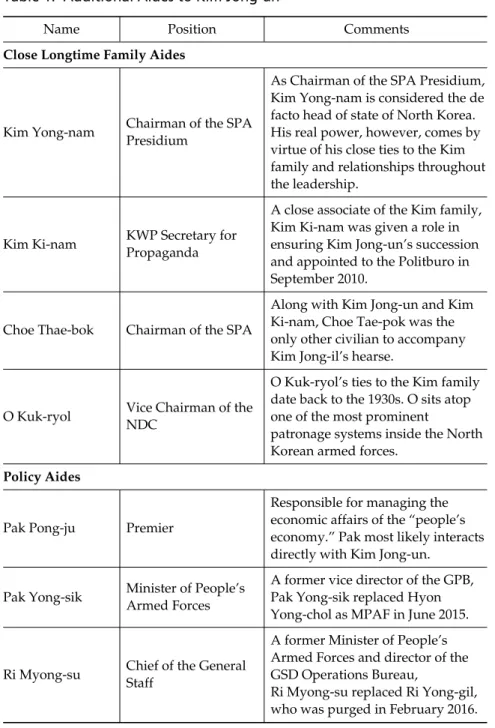
Table 1. Additional Aides to Kim Jong-un
Name Position Comments
Close Longtime Family Aides
As Chairman of the SPA Presidium, Kim Yong-nam is considered the de Chairman of the SPA facto head of state of North Korea.
Kim Yong-nam Presidium His real power, however, comes by virtue of his close ties to the Kim family and relationships throughout the leadership.
A close associate of the Kim family, KWP Secretary for Kim Ki-nam was given a role in Kim Ki-nam Propaganda ensuring Kim Jong-un’s succession
and appointed to the Politburo in September 2010.
Along with Kim Jong-un and Kim Choe Thae-bok Chairman of the SPA Ki-nam, Choe Tae-pok was the
only other civilian to accompany Kim Jong-il’s hearse.
O Kuk-ryol’s ties to the Kim family Vice Chairman of the date back to the 1930s. O sits atop
O Kuk-ryol NDC one of the most prominent
patronage systems inside the North Korean armed forces.
Policy Aides
Responsible for managing the Pak Pong-ju Premier economic affairs of the “people’s
economy.” Pak most likely interacts directly with Kim Jong-un.
Minister of People’s A former vice director of the GPB, Pak Yong-sik Armed Forces Pak Yong-sik replaced Hyon
Yong-chol as MPAF in June 2015.
A former Minister of People’s Chief of the General Armed Forces and director of the
Ri Myong-su Staff GSD Operations Bureau,
Ri Myong-su replaced Ri Yong-gil, who was purged in February 2016.
Name Position Comments
Kim Yong-chol’s ties to Kim Jong-un Director of the KWP allegedly date back to the early United Front 2000s, when he oversaw Kim Kim Yong-chol Department, Jong-un’s education at Kim Il-sung
Commander of the Military University. He replaced RGB Kim Yang-gon, who died in a car
accident in December 2015, as head of the UFD.
Former KWP Secretary An expert on defense industrial Pak To-chun for Defense Industry issues, Pak acts as a senior advisor
inside Kim’s personal secretariat.
Kwak Pom-gi’s elevation to the senior ranks of the leadership was Director of the KWP tied to Kim Kyong-hui and Jang Kwak Pom-gi Finance and Planning Song-taek with the expectation that
Department he could bring some pragmatism to the decision-making process concerning the economy.
O Su-yong succeeded Kim Kyong- hui in his current position. His KWP Secretary for formal rank within the leadership O Su-yong Light Industry rose dramatically from 47th on Kim
Kuk-tae’s Funeral Committee list to 19th on Jon Pyong-ho’s Funeral Committee list.
A close associate of the Kim family for years, Choe Pu-il is rumored to Choe Pu-il Minister of People’s be a favorite of Kim Jong-un. His
Security ranking slipped some following the collapse of the MPS-built housing unit in Pyongyang in 2014.
Along with Pak Pong-ju, Ro Tu-chol Ro Tu-chol Chairman of the State is one of the “young” technocrats
Planning Commission who are well versed in external economic affairs.
Jo Yong-won, assumed to be in his Jo Yong-won Vice Director of the late 50s, is handling work on
KWP OGD surveillance and censorship at the OGD.
Name Position Comments
Director of the KWP Ri Man-gon is a former KWP OGD Ri Man-gon Machine-Building deputy director.
Industry Department
Hong Yong-chil is a key official in Vice Director of the the daily management of the KWP Machine- country’s production of arms and Hong Yong-chil Building Industry military supplies. He appears to be
Department linked to the production of both conventional and advanced weapons.
Rim came on the scene in 2013 as a frequent cohort in Kim Jong-un’s guidance inspections and then disappeared only to appear on Rim Kwang-il Director of the GSD’s funeral committee lists at the end
Operations Bureau of 2015. This suggests he may have spent time in Kim’s personal secretariat as a military advisor before assuming his current post in January 2016.
Recently Departed Aides
Former GSD and MPAF. Led North Hyon Yong-chol Minister of People’s Korean outreach to Russia. Purged
Armed Forces and allegedly executed in April 2015.
Corps commander who came to prominence in 2013 and quickly Ri Yong-gil Chief of the General moved from GSD Operations
Staff director to Chief of the GSD.
Allegedly accused of corruption.
Purged in February 2016.21
21. Contrary to foreign media speculation. Ri Yong-gil was not executed. At the Seventh Party Congress, he was appointed as an alternate member of the Politburo and a member of the Central Military Commission.
In terms of public profile, a number of aides appear to provide counsel to Kim Jong-un along policy lines. Some hold formal portfo- lios, but several are retired cadre who may have positions within his personal secretariat. They are spread across several generations and increasingly their ties to Kim are driven by functional versus political realities.
The purge of Jang Song-taek and the subsequent reshuffle of key positions inside the Party and high command have raised questions about Kim Jong-un’s relationship with his advisors. The regent struc- ture, which provided critical, and most likely heeded, advice, has been replaced by a weakened advisory network around the Supreme Leader that is likely reluctant to provide honest assessments or pass on bad news and needed advice. This may account for the regime’s inability to sustain strategic-level initiatives and follow through on actions that at one moment appear important to Kim Jong-un and then seem to evaporate (such as the unexplained appearance of Choe Ryong-hae, Kim Yong-gon, and Hwang Pyong-so in Seoul in 2014).
Name Position Comments
KWP Secretary for Long time Party Secretary for ROK Kim Yang-gon ROK Affairs affairs. Mysteriously died in a car
accident in December 2015.
The son of O Jin-u, one of Kim Il- sung’s closest associates, O Il-jong supervised reserve forces, including Director of the KWP the four million-strong Worker- O Il-jong Military Affairs Peasant Red Guards. Disappeared
Department in 2015 and his name did not appear on funeral lists at the end of the year. Rumored to be serving time in a reeducation camp.
First Vice Director Disappeared in 2015 and his name Ri Chae-il of the KWP did not appear on funeral lists at
Propaganda and the end of the year. Rumored to be Agitation Department serving time in a reeducation camp.
This leader-advisor relationship was boldly portrayed in the North Korean media’s coverage of Kim Jong-un’s February 2016 visit to the Kumsusan Memorial Palace to pay homage to his father on the late leader’s birthday. In an unprecedented move, Kim chose to make the trip alone, accompanied only by his wife, Ri Sol-ju.22Absent was the large cadre of officials who had accompanied his trip to the palace in the past. The regime’s low-key handling of the visit appears designed to bolster Kim Jong-un’s image as a leader that can stand on his own.
Stability Inside the Regime
As 2015 drew to a close, Kim Jong-un’s plans for full consolidation of power, as well as securing the international aid needed to facilitate that process, appeared at an impasse. While the younger Kim has been able to place his stamp on the regime, much as his father did in 1998, the Byungjin policy has isolated the regime despite its best efforts to the contrary. At the same time, political cycles in Seoul and Washington increasingly make it difficult for any rethinking of the strategies of strategic patience and Trustpolitik (as was made clear by the lackluster inter-Korean dialogue which took place in December).
Finally, in that same month, one of the key voices on ROK affairs, Kim Yong-gon, was killed in a car accident, removing the architect of the recent inter-Korean strategy.
As a consequence, at the beginning of 2016, Kim Jong-un brought the charm offensive to a halt in favor of a more aggressive, brinks- manship strategy.23 Following a New Year’s Day speech that high-
22. Ri Sol-ju’s colorful outfit with a red top, which contrasted with the black dresses she wore in the past, could be an indication that the mourning period for Kim Jong-il is over and the focus of leadership is now fully on Kim Jong- un, “Kim Jong Un Visits Kumsusan Palace of Sun,” KCNA, February 16, 2016.
23. In January (2016), the South Korean media, citing government sources, announced that Kim Yong-chol, Director of the RGB, would succeed Kim Yang-gon in his portfolios for unification affairs, including the KWP Secretary for South Korean Affairs. If verified, Kim Yong-chol will be Pyongyang’s first military
lighted economic progress and inter-Korean dialogue, the regime on January 6 issued two highly authoritative pronouncements announc- ing that North Korea had conducted its first hydrogen bomb test in accordance with Kim Jong-un’s “final written order.” The unprece- dented step of linking the announcement to the Supreme Leader’s personal endorsement suggests that the decision to test was largely tied to Kim’s efforts to consolidate power.24 In other words, Kim chose a path of political expediency over a strategy with little poten- tial for near-term success.25 In the longer term, Pyongyang likely hopes that the increased tension on the Korean Peninsula will force Seoul and Washington to reorient their engagement strategies. How- ever, for the foreseeable future, Kim has staked the regime’s survival on short-term political and economic strategies with no real prospects for the realization of a “strong and prosperous state.” He has also made it clear that North Korea must (for the time being) adhere to the structures of Jucheand not rely on the outside world to solve the coun- try’s problems.26 This could create additional pressure within the official to be in charge of inter-Korean affairs, a signal that North Korea had shifted away from diplomacy to a brinksmanship strategy to handle its rela- tions with the South.
24. This was only the second time that state media had carried images of a “written order” by Kim Jong-un. It was the first time that the media had portrayed a nuclear test as being personally endorsed by the North Korean leader himself.
25. The announcement said the test would expedite the “cause of the Jucherevolu- tion,” a code phrase for the consolidation process. The regime also described the Seventh Party Congress as advancing the same goal. See “WPK Central Committee Political Bureau Decides To Convene ‘Party Congress’ May 2016,”
Rodong Sinmun, October 29, 2015.
26. On January 22 (2016), Rodong Sinmunpublished a special article on self- reliance and self-development. According to some analysts, it appeared to bring to a close a debate within the regime surrounding a decision to reject an aid package, which would have made the regime hostage to foreign powers. Speculation is that China may have offered such a package in return for positive movement on Pyongyang’s nuclear program. The article could also have been a response to growing anger within the donju. It contains an unusual number of references to money (“our people’s pride and honor that no amount of money can buy”) and foreign aid. It also comments on the atti- tudes of those — implicitly North Korean elites — considering the prospect
regime as Kim demands from his leaders and the growing economic elite (donju) ever-greater demonstrations of loyalty to him, needed to compensate the political and financial costs of the regime’s decision to aggressively push its national security agenda in the face of interna- tional sanctions.27
Looking Forward to 2016
The Seventh Party Congress is scheduled to take place in May 2016. It will be a venue for Kim Jong-un to carve out his role in the pantheon of North Korean leaders. The Party Congress is the appropriate mechanism for major policy announcements, as well as a refresh and restructuring of the leadership. It could become an inflection point for the regime in that Kim Jong-un will announce policies that fall outside boundaries laid down by his father, thus marking the real beginning of the Kim Jong-un era. It will no doubt be used to demon- strate the stability of the regime and tout the achievements of Kim Jong-un. New faces in positions of power are a real possibility as a new set of leaders emerges from the third and fourth generations.28 of such aid. The article makes clear that for the immediate future North Korea must look inward and not rely on such aid for its survival. See “Rodong Sinmun Adhering to Principle of Self-reliance and Self-development,” KCNA, January 22, 2016.
27. In a highly unusual move, Kim convened a joint meeting of the Workers’ Party of Korea’s Central Committee and the Party KPA Committee in February 2016.
Ostensibly advertised as an effort to strengthen the Party in the run up to the Seventh Party Congress in May, such a move allowed the central leadership to pledge an oath of loyalty to the Supreme Leader.
28. The expected generational turnover did not occur at the Seventh Party Con- gress. Personnel moves reflected a subtle shift toward civilians and slightly younger officials. The average age of the Politburo declined slightly for the first time since the 1950s. It is notable that Kim Jong-un’s younger sister, Kim Yo-jong was elevated to full membership in the Central Committee. Many familiar faces, however, remain at the highest ranks of the Party, including the Politburo Presidium (Kim Yong-nam, Hwang Pyong-so, Pak Pong-ju, and Choe Ryong-hae).
This will give the congress the veneer of a coronation, with Kim Jong- un publicly formalizing his consolidation of power. In reality, there are hurdles that Kim Jong-un must still overcome and the clock has started. Over the next two to five years, these hurdles must be con- quered or Kim Jong-un will likely face an increasingly restive regime whose durability has begun to weaken because of failures in the economic arena. While collapse might not be imminent, the dynamics inside the leadership could shift, making Kim Jong-un not an almighty suryong, but merely the veneer of legitimacy (serving as front man to a set of powerful actors behind the scenes) and caretaker to a doomed state.
Article Received: 2/1 Reviewed: 3/7 Revised: 3/19 Accepted: 3/21
Bibliography
Chosun Ilbo Online. “Kim Jong Un Makes Sister His Chief Of Staff.” March 31, 2014.
Collins, Robert. Pyongyang Republic: North Korea’s Capital of Human Rights Denial.
Washington, D.C.: HRNK, 2016.
__________. “Regime Leadership and Human Rights in North Korea.” International Journal of Korean Studies. Spring 2015.
Dong-A Ilbo Online. “Map of North Korean Power After Four Years Under Kim Jong-un.” December 17, 2015.
Gause, Ken E. North Korea Under Kim Chong-il: Power, Politics, and Prospects for Change. Santa Barbara, CA: Praeger Publishers, 2011.
__________. North Korean House of Cards: Leadership Dynamics Under Kim Jong-un.
Washington, DC: Committee for Human Rights in North Korea, 2015.
Haggard, Stephan. et. al. “Political Change in North Korea: Mapping the Succes- sion.” Asian Survey54, no 4: 773-800.
JoongAng Daily Online. “Sans His Aides, Kim Pays Respects to Late Father.”
February 17, 2016.
KCNA. “Funeral of Late Kim Yong-gon.” December 31, 2015.
__________. “Kim Jong Un Visits Kumsusan Palace of Sun.” February 16, 2016.
__________. “Rodong Sinmun Adhering to Principle of Self-reliance and Self- development.” January 22, 2016.
Mansourov, Alexandre Y. “Kim Jong Un’s First 500 Days: Consolidating Power and Clearing Political Space for National Revival.” International Journal of Korean Unification Studies22, no. 1 (2013).
Park, Han S. Military First Politics (Songun): Understanding Kim Jong-il’s North Korea. KEI Academic Paper Series2, no. 7 (September 2007).
Park Hyeong-jung. “What to Expect from the 7th Korean Workers’ Party Congress?”
KINU Online Series, CO 15-30. November 20, 2015.
Rodong Sinmun. “WPK Central Committee Political Bureau Decides To Convene
‘Party Congress’ May 2016.” October 29, 2015.
Tokyo Shimbun Online. “Two Close Aides of North Korean Leader Kim Allegedly Sacked for Unknown Reason.” December 9, 2015.
The Daily NK.“OGD Rises in Power and Influence.” October 1, 2015.
Yonhap. “North Korea’s Military Chief Executed on Corruption Charges.” February 10, 2016.
__________. “Top N. K. General Seen as New Point Man on S. Korea.” January 18, 2016.
__________. “Top N. K. Official Returns To Public Eye After 3 Month Absence.”
January 15, 2016.
Yonhap Online. “Decision to Send North Korea’s Choe Ryong-hae to Cooperative Farm is Part of a Restructuring of the Partisan Force.” December 3, 2015.