Vishnu Konoorayar K. and Jaya V. S.*
*Assistant Research Professors, The Indian Law Institute, New Delhi-110001, India.
Email: [email protected] and [email protected]. The authors gratefully acknowledge the editorial assistance from Ms. Tania Sebastian, Researcher, The Indian Law Institute. (This paper is an updated version of the paper presented at the International Conference on Asia-Atomic Energy Law organised by Korea Nuclear Energy Law Association on 1st of June 2011.
Ⅰ. Introduction
Ⅱ. Importance of Nuclear Power and Challenges in India
Ⅲ. Nuclear Law: A Conceptual Analysis
Ⅳ. Atomic Law in India: An Analysis
Ⅴ. Atomic Energy Law in Statutory Instruments
A. Advisory and Regulatory Bodies Constituted in India B. The Atomic Energy Act, 1962
C. The Civil Liability for Nuclear Damage Act, 2010
Ⅵ. Conclusion
daunting task as it has always been a process of choosing the best from many options like thermal, hydro, nuclear etc. Each option has its own merits as well as demerits, for example, if nuclear energy is opted, it is believed to be comparatively less polluting than the thermal power stations. This belief en- dures until something goes wrong.
In this context it is the purpose of the legal system to oversee that the meth- od of production of energy is designed to protect the interest of every stake- holder. Law relating to nuclear energy needs special attention, especially in the wake of Fukushima incident and hence it is imperative that this branch of law analyses experiences from different countries carefully. This paper analy- ses the nuclear energy law in India from the perspective of a lawyer.
Keywords: Nuclear Energy, Atomic Energy Act 1962, Civil Liability for Nuclear Damage Act, 2010, Nuclear Damages Claims Commission, Nuclear Insurance, Atomic Energy Regulatory Board, Nuclear Liability Fund, Nuclear Damage, Nuclear Accident, Nuclear Installation, Nuclear Reactor
Whatever might happen, whatever the circumstances, we shall never use atomic energy for evil purposes.
Jawaharlal Nehru (January 1957)1
Ⅰ. Introduction
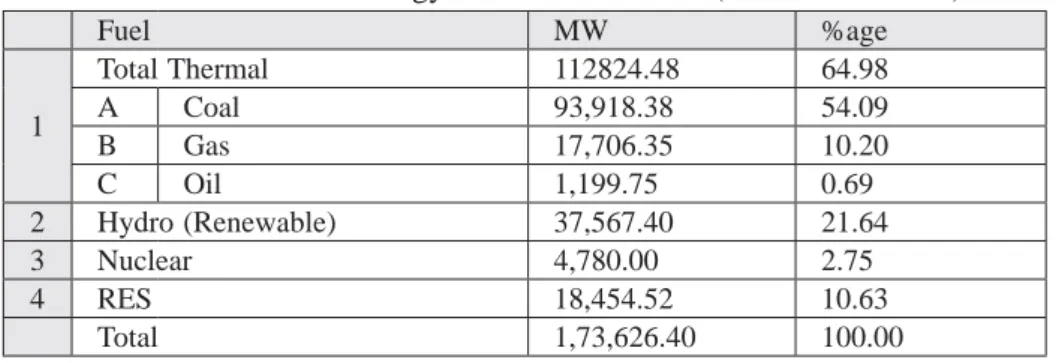
India has achieved a healthy economic rate at 8% per annum.2 In order to sustain this growth rate3, the country requires emphasis on creation of in- frastructure and enhanced supply of input (such as energy).4 The total com- mercial energy requirement in India is estimated to increase by 7.5 times in the next thirty years5, but the current growth rate is a meagre 3.29%. It is also important that the energy that is created do not pollute the environment, considering the imminent danger of climate change and environmental pollu- tion. This is possible by using renewable energy sources as well as by using nuclear fuels. The current sources of energy creation in India are as given below.
Table 1: All India Energy Sector at a Glance (as on 31.03.2011)6
Fuel MW %age
1
Total Thermal 112824.48 64.98
A Coal 93,918.38 54.09
B Gas 17,706.35 10.20
C Oil 1,199.75 0.69
2 Hydro (Renewable) 37,567.40 21.64
3 Nuclear 4,780.00 2.75
4 RES 18,454.52 10.63
Total 1,73,626.40 100.00
1. As quoted in Dhirendra Sharma, India’s Nuclear Estate, 31(4) Philosophy and Social Action 1, 3 (2005).
2. India GDP Growth Rate, Trading Economics, http://www.tradingeconomics.com/india/
gdp-growth.
3. The Government of India planned to achieve a GDP growth rate of 10% in the Eleventh Five Year Plan and maintain an average growth rate of about 8% in the next 15 years.
4. THE ENERGYAND RESOURCES INSTITUTE, NATIONAL ENERGY MAPFOR INDIA: TECHNOLOGY VI-
SION 2030 (SUMMARYFOR POLICY MAKERS), THE ENERGYAND RESOURCES INSTITUTEAND OFFICEOF THE PRINCIPAL SCIENTIFIC ADVISER, GOVERNMENTOF INDIA, http://bookstore.teriin.org/docs/books/
PSA%20Report-Summary.pdf.
5. Id. at 14.
6. Ministry of Power, Government of India, available at: http://www.powermin.nic.in/JSP_
SERVLETS/internal.jsp.
Renewable Energy Sources (RES) include SHP, BG, BP, U&I and Wind Energy SHP= Small Hydro Project, BG= Biomass Gasifier, BP= Biomass Power, U & I=Urban & Industrial Waste Power, RES=Renewable Energy Sources
Over the years, most of the energy that is produced is from hydropower stations coupled with thermal power stations. At the same time, energy production from nuclear power stations witnessed a negative growth even though the National Electricity Policy, 2005 portrays a need for increase in the share of nuclear power significantly by enhancing public sector invest- ments. 7 The overall generation in the country has increased from 723.793 BU during 2008-09 to 771.551 during the year 2009-10.8 The category wise generation performance is as follows:
Table 2: Over view of Power Generation in India (2009-10)9
Type Improvement/Decline %age
1 Thermal Improved by 8.6
2 Hydro Improved by 26.67
3 Nuclear Declined by 5.66
Ⅱ. Importance of Nuclear Power and Challenges in India
Nuclear power constitutes approximately 16% of the world’s electricity.10
7. MINISTRYOF POWER, GOVERNMENTOF INDIA, NATIONAL ELECTRICITY POLICY, 2005, at para 5.2.19, available at http://www.powermin.nic.in/whats_new/national_electricity_policy.htm.
It says: “Nuclear power is an established source of energy to meet base load demand. Nuclear power plants are being set up at locations away from coalmines. Share of nuclear power in the overall capacity profile will need to be increased significantly. Economics of generation and resultant tariff will be, among others, important considerations. Public sector investments to create nuclear generation capacity will need to be stepped up. Private sector partnership would also be facilitated to see that not only targets are achieved but exceeded.”
8. Ministry of Power, Government of India, available at http://www.powermin.nic.in/JSP_
SERVLETS/internal.jsp.
9. Id.
10. NUCLEAR ENERGYIN INDIAAND FOREIGN INVESTMENT, INDIA JURIS, http://www.indiajuris.
com/nuclear.pdf.
In the year 2009 alone more than 15% of the world’s electricity came from nuclear power.11 Apart from this, more than 150 naval vessels have been built using nuclear propulsion around the world. India, as on 2010, has 19 nuclear power plants in operation generating 4,560 MW with 4 others are under construction and are expected to generate an additional 2,720 MW of ener- gy.12 India is also envisaging an increase of contribution of nuclear power to overall electricity generation capacity from 4.2% to 9% within 25 years.13 According a latest Report from the Government, India has an ambitious plan to reach a nuclear power capacity of 63,000 MW by 2032.14 However this aim has been challenged by the recent public protests against establishment of new nuclear power plants. For example a 9900 MW Nuclear Power Proj- ect at Jaitapur, in the state of Maharashtra and another 2000 MW Nuclear Power Plant at Koodankulam, in the Indian State of Tamil Nadu have seen unprecedented public protest. Similarly the state government of West Bengal has refused permission to a proposed 6000 MW plant at Haripur citing safety concerns. The Non Proliferation Treaty has recognized the right of its parties right of access to peaceful uses of nuclear energy and an obligation to coop- erate on civilian nuclear technology.15 Similarly the Agreements of the Nucle- ar Suppliers Group16 also permit nuclear exports including reactors and fuel based on the comprehensive safeguards by the International Atomic Agency.
These Agreements intend that nuclear energy is not diverted from peaceful use to weapons programs. India, though not a party to the NPT, argues that the NPT instead of addressing the central objective of universal and compre- hensive non-proliferation, it aims at creating a small club of nuclear haves and a larger group of nuclear have-nots by restricting the legal possession of nuclear weapons to those states that tested them before 1967. Instead India, because of its geo-political position, insists a comprehensive action plan for a
11. Id.
12. Id.
13. Id.
14. The Economic Times, http://articles.economictimes.indiatimes.com/2010-10-11/
news/27616582_1_pressurised-heavy-water-reactors-fuel-cycle-indian-nuclear-society (visited Oct 11, 2011).
15. THE TREATYON THE NON-PROLIFERATIONOF NUCLEAR WEAPONS (NPT), http://www.
un.org/en/conf/npt/2010/npttext.shtml (last visited Nov 13, 2011).
16. See the website of the Nuclear Suppliers Group for details, http://www.nuclearsuppli- ersgroup.org/Leng/default.htm.
nuclear-free world within a specific time-frame and has also adopted a volun- tary No First Use Policy.17 However, India had a heavy price for this policy.
It could not avail any advanced technology and fuel from anywhere in the world.18 Meanwhile India also had to face sanctions from other states due to its controversial nuclear weapons programme. However citing India’s strong non proliferation commitments, and also on trade and economic as well as strategic and political reasons India entered into a Civil Nuclear Agreement with the United States of America after a decade long negotiations and con- troversies. Subsequently India also signed specific agreements with Interna- tional Atomic Energy Agency and committed to separation of civil use of nuclear technology from its weapons programme and also to permit inspec- tion by IAEA of its nuclear plants. As of now India remains the only country with nuclear weapons permitted to carry on nuclear trade with other countries despite the fact that it is not a party to the NPT.
Ⅲ. Nuclear Law: A Conceptual Analysis
The term nuclear law is defined as “the body of special legal norms created to regulate the conduct of legal or natural persons engaged in activities relat- ed to fissionable materials, ionizing radiation and exposure to natural sources of radiation.”19 But such a special legal regime needs to be interwoven with the normal legal hierarchy of every legal system.20 The purpose of such a special legal regime must be to “provide a legal framework for conducting activities related to nuclear energy and ionizing radiation in a manner which adequately protects individuals, property and the environment.”21
The quality of such a legal system depends on a multitude of interconnect- ed factors and issues, identifiable as: 22
17. For details read BHARAT KARNAD, INDIA’S NUCLEAR POLICY (2008).
18. Id.
19. CARLTON STOIBER, ALEC BAERETAL., HAND BOOKON NUCLEAR LAW 4 (2003).
20. Id. at 3.
21. Id. at 5.
22. Id. at 14-15.
(a) Does the current legislation make it clear that public health, safety, se- curity and the environment are overriding considerations in the use of nuclear techniques and material?
The Indian Law on atomic energy deals with the health issues as well as safety, security and the environment. As per section 17 of the Atomic Energy Act, the Central Government may make detailed rules for the protection of employees working in such places where there is a threat of radiation, for the disposal of radioactive wastes etc. And more impor- tantly the language of the Atomic Energy Act, 1962 is that of caution, safety and confidentiality. Similarly ‘losing of income arising from the destruction of environment’ may come under the definition of nuclear damage according to section 2 (g) (v) of the Civil Liability for Nuclear Damage Act, 2010. Various Rules are also drafted in this regard by the Government of India.23
(b) Are there major gaps or overlaps in the legal structure regarding the treatment of nuclear related activities or material, both those currently being conducted or used and those that can reasonably be expected?
There are no major overlaps on the Indian legal structure regarding treatment of nuclear related activities or materials. In India, Atomic en- ergy is the monopoly of the Union Government by virtue its presence in the Union List.24 The two legislations as well as the Rules are also consistent in this aspect. For any other person to do any other activity that is related to atomic energy requires to take prior sanction from the Union Government.
(c) Have the most important terms used in the legislation been given clear and consistent definitions in the statutory documents? Does the use of different terms and definitions, or a failure to define certain terms, pro- duce confusion about how nuclear related activities are to be regulated?
The definitions given in the two statutes and various rules have not been
23. For a detailed analysis on these issues read part IV of this paper.
24. Id.
challenged in any court of law, which may be because of their clarity.25 (d) Are the institutional responsibilities for regulating nuclear related activi-
ties clear and consistent, permitting efficient regulation without delays and bureaucratic conflicts?
(e) Does the present regulatory system involve unnecessary financial or administrative burdens on regulated entities or regulatory agencies that could be reduced in order to improve efficiency?
The Indian Atomic Energy law creates institutions with specific and well-defined roles. The procedure and duration of the decision making process are also defined.26 It is also important to note that all the regu- lated entities and regulatory agencies are controlled by the Government of India except individuals.27
(f) Does the present system fully comply with the State’s international legal obligations?
Further the IAEA also identifies eleven principles that are fundamental and are to be incorporated in every national legal system on nuclear law.28 They are as follows:
(a) The Safety Principle: The safety principle emphasis that the legal re- gime in a country should give utmost importance to safety of life and property of persons. This principle has two subsidiary principles. They are as follows:
i Prevention and Protection Principle: It holds that, the primary objec- tive of nuclear law should be to promote the exercise of caution and foresight so as to prevent damage that might be caused by the use of
25. Id.
26. Id.
27. Id.
28. Id. at 5.
the technology and to minimize any adverse effects resulting from misuse or from accidents.29
ii Precautionary Principle: It says that the fundamental purpose of any regulatory regime is to balance social risks and benefits. Where the risks associated with an activity are found to outweigh the benefits, priority must be given to protecting public health, safety, security and the environment. Of course, in the event that a balance cannot be achieved, the rules of nuclear law should require action-favouring protection.30
(b) Security Principle: The Security Principle suggests that any nuclear law system should include provisions against, both accidental or intentional, losing or abandoning radiation sources so as to pose threat to the life and property of the people. The same principle also cautions against ac- quisition of nuclear materials by criminal or terrorist groups.31
(c) Responsibility Principle: When there are so many parties involved in the use of nuclear energy,32 “the fundamental question is who is pri- marily responsible for ensuring safety?”33 Generally the entity that is usually considered as primarily responsible for safety is the operator or licensee.34 The fundamental principle is ‘that the operator or licensee should bear the burden of ensuring that its activities meet the applicable safety, security and environmental protection requirements.”35
(d) Permission Principle: Prior permission is required to do those things, which may pose serious threat or injury to persons or environment. As
29. Id. at 6.
30. Id.
31. Id. at 7. Also see chapters 14 and 7, 9, 12,13 of the book.
32. The use of nuclear energy typically involves numerous parties, such as research and development organizations, processors of nuclear material, manufacturers of nuclear devices or sources of ionizing radiation, medical practitioners, architect–engineering firms, construction companies, operators of nuclear installations, financial institutions and regulatory bodies.
33. Id. at 7.
34. Id.
35. Id. See also chapter 11.
nuclear use of nuclear technology inherently involves some risk, prior permission is always required. The law also clearly need to identify those activities that require prior permission.36
(e) Continuous Control Principle: A continuous monitoring of the activities to make sure that they are being conducted safely and securely and in accordance with the terms of the authorization. It also includes ‘free ac- cess’ by the regulatory officers to all premises where nuclear material is being used and stored.
(f) Compensation Principle: As preventive measures cannot completely exclude, but only minimise the possibility of damage, this principle re- quires that States adopt measures to provide adequate compensation in the event of a nuclear accident.37
(g) Sustainable Development Principle: The principle of sustainable devel- opment has special relevance in nuclear energy production. It is “because some fissile material and sources of ionizing radiation can pose health, safety and environmental risks for very long periods of time.”38
(h) Compliance principle: Nuclear energy production has been deemed to involve particular risks of radiological contamination transcending na- tional boundaries. There are many bilateral and multilateral instruments that aim at determining an international law of nuclear energy. The fundamental question is to what extent a particular state has adhered to these international legal regimes. It is also important that the national legal regime incorporates the provisions of customary international law also.39
(i) Independence principle: It is very important that the powers, functions and decisions of the Regulatory Authority that is constituted under the
36. Other words that could be used for permission are ‘authorization’, ‘licence’, ‘permit’,
‘certificate’ or ‘approval’.
37. Id. at Chapter 11.
38. Id. at 9.
39. Id.
nuclear law are not interfered by the executive or other branches of the State and also from entities involved in the development or promotion of nuclear energy.40
(j) Transparency principle: Erstwhile, information of nuclear materials was guarded, categorising it as ‘sensitive’ and ‘confidential’. In the recent past, however, the emphasis is “with the development of the peaceful uses of nuclear energy, however, public understanding of and confidence in the technology have required that the public, the media, legislatures and other interested bodies be provided with the fullest possible infor- mation concerning the risks and benefits of using various nuclear related techniques for economic and social development. The transparency prin- ciple requires that bodies involved in the development, use and regula- tion of nuclear energy make available all relevant information concern- ing how nuclear energy is being used, particularly concerning incidents and abnormal occurrences that could have an impact on public health, safety and the environment.”41
(k) International Co-Operation Principle: The level of international co- operation required is based on several factors. “First, in the area of safety and the environment, the potential for trans-boundary impacts requires governments to harmonize policies and develop co-operative programmes so as to reduce the risks of damage to their citizens and territories, the global population and indeed to the planet as a whole.
Also, lessons learned in one State about how to enhance safety can be highly relevant to improving the situation in other States. Second, the use of nuclear material involves security risks that do not respect na- tional borders. Threats of terrorist acts and the threats associated with illicit trafficking in nuclear material and the proliferation of nuclear ex- plosives have long been recognized as matters requiring a high level of international co-operation. Third, a large number of international legal instruments have been promulgated to codify the obligations of States in the nuclear field. Not only must governments comply in good faith with those obligations, but the terms of those instruments may limit
40. Id. at Chapter 2.
41. Id. at 10.
the discretion of legislators in framing national legislation concerning some matters covered by them. Fourth, the increasingly multinational character of the nuclear industry, with frequent movements of nuclear material and equipment across national borders, makes effective control dependent on parallel and joint approaches by both public and private entities. For all these reasons, national nuclear energy legislation should make adequate provision for encouraging public bodies and private us- ers of nuclear energy to participate in relevant international activities in the nuclear field.”42
Ⅳ. Atomic Law in India: An Analysis
As envisaged by International Atomic Energy Agency43, the provisions of law in the Indian legal system regarding atomic energy are found at four different levels namely the (a) constitutional level (b) the statutory level (c) Regulations or Delegated Legislation and (d) Non-Mandatory Guidance in- struments.
Atomic Energy Law at the Constitutional Level: In the Constitution of India the “…exclusive power to make laws with respect to any of the mat- ters…”44 connected with “atomic energy and mineral resources necessary for
42. Handbook 10-11.
43. Id. at 3-4. It says: The IAEA envisages that the “nuclear law must take its place within the normal legal hierarchy applicable in most States.” The handbook says that the nuclear law should be present at four different levels namely (a) the constitutional level, that establishes the basic institutional and legal structure governing all relationships in the State. (b) Immediately below the constitutional level is the statutory level, at which specific laws are enacted by a par- liament in order to establish other necessary bodies and to adopt measures relating to the broad range of activities affecting national interests. (c) The third level comprises regulations; that are, detailed and often highly technical rules to control or regulate activities specified by statutory instruments. Owing to their special character, such rules are typically developed by expert bod- ies (including bodies designated as regulatory authorities) empowered to oversee specific areas of national interest, and promulgated in accordance with the national legal framework. (d) A fourth level consists of non-mandatory guidance instruments, which contain recommendations designed to assist persons and organizations in meeting the legal requirements.
44. THE CONSTITUTIONOF INDIA, Article 246. (There are three lists in the Seventh Schedule of the Constitution of India. The First List enumerates all those areas where only the Parliament of India can make laws. The Second List contains areas where only the States can make laws
its production”45 is upon the Parliament of India (the legislative body at the federal level). The States do not have any power or role in making laws in the area of atomic energy. In pursuance of the powers conferred on it through this provision the Parliament of India has enacted legislations that are analy- sed in the next section.
Atomic Energy Law at the Statutory Level: At the Statutory Level, India has two specific legislations that deal with atomic energy. They are namely, (i) The Atomic Energy Act, 1962 and (ii) the Civil Liability for Nuclear Damage Act, 2010.
Atomic Energy Law at the Delegated Legislations Level: (i) Atomic Energy (Safe Disposal of Radioactive Wastes) Rules, 1987 (ii) The Atomic Energy (Working on the Mines, Minerals and Handling of Prescribed Substances) Rules, 1984, (iii) the Atomic Energy Radiation Protection Rules, 2004, (iv) the Atomic Energy (Arbitration Procedure) Rules, 1983, (v) the Atomic En- ergy (Factories) Rules, 1996, and (vi) The Atomic Energy (Control of Irradia- tion of Food) Rules, 1996.
Atomic Energy Law and the Non-Mandatory Guidance Instruments: The Government of India, Department of Atomic Energy also have come up with few guidance instruments such as (i) Guidelines for Nuclear Transfers (Exports) in the year 200646, and (ii) Guidelines for the Implementation of Arrangements for Co-Operation concerning Peaceful Uses of Atomic Energy with Other Countries in the year 2010.
So, it can be said that the Atomic Energy Law in India are in consonance with the prescribed IAEA hierarchy.
and the third list i.e. is known as the Concurrent List lists areas where both Federal or States can make laws.)
45. Id. at Entry 6, List 1, the Seventh Schedule. (Atomic Energy is placed in the Union List along with Defence of India, Army, Navy, Air force, Foreign Affairs and Diplomatic Rela- tions etc.)
46. Vide notification no. AEA/27(1)/2005-ER dated 1st February 2006.
Ⅴ. Atomic Energy Law in Statutory Instruments
In India, atomic energy is within the legislative purview of the Union Gov- ernment (Federal Government). An analysis of the following legislation re- garding atomic energy would reveal that the control, development and use of atomic energy have been the monopoly the Union Government.
A. Advisory and Regulatory Bodies Constituted in India
By virtue of its powers under the Constitution, the Government of India, constituted the Indian Atomic Energy Commission in the year 1948. The various purposes of such a body was to decide on the policy issues related to atomic energy. Similarly the Department of Atomic Energy, the nodal agency, was also created through a Presidential order under the direct supervision of the Prime Minister.
The Atomic Energy Regulatory Board (hereinafter AERB) was constituted on November 15, 1983 by the President of India by exercising the powers conferred by section 27 of the Atomic Energy Act, 1962 to carry out the reg- ulatory and safety functions under the Act. The regulatory authority of AERB is derived from the rules and notifications promulgated under the Atomic En- ergy Act, 1962 and the Environmental (Protection) Act, 1986. The mission of the Board is to ensure that the use of ionizing radiation and nuclear energy in India does not cause undue risk to health and the environment. Currently the AERB is the apex Regulatory and Supervisory body in India regarding atomic energy.
B. The Atomic Energy Act, 1962
47The Atomic Energy Act was passed in both the houses of the Parliament and received the assent of the President of India on 15th September 1962 for the development, control and use of atomic energy for the welfare of the peo- ple of India and for other peaceful purposes.48 This statute repealed the ear-
47. Act 33 of 1962.
48. Preamble to the ATOMIC ENERGY ACT, 1962.
lier Atomic Energy Act, 1948.49 In total this statute has 32 Sections and has authority to the whole of India.50 This Act came into force on 21st September 1962 when the Government of India published it in the official Gazette.
1. Definitions under the Act
It defines ‘Atomic Energy’ as ‘energy that is released from atomic nuclei as a result of any process, including the fission or fusion processes’51 It defines
“Fissile Materials’ as ‘Uranium 233, Uranium 235, Plutonium or any mate- rial containing these substances or any other material that may be declared as such by notification by the Central Government.52
Among other things it also defines radiation. It says that “radiation means gamma rays, X-rays, and rays consisting of alpha particles, beta particles, neutrons, protons and other nuclear and sub-atomic particles, but not sound or radio waves, or visible, infrared or ultraviolet light”.53
2. Whether radiation from cellular phone towers come within the above given definition of radiation?
Apprehension that the radiation emanating from large telecommunication towers would expose human beings living within the magnetic field to fatal deceases like cancer, embryo disruption and changes in DNA Structure etc.
culminated into a case54 (the first of its kind) before the Bombay High Court, wherein an expert committee was constituted. The committee submitted its report stating that currently there are no concrete evidence of any health hazard by these towers and the Radio Frequency from Mobile Base Stations have shown that the exposures are of a such lower magnitude than the inter- nationally accepted levels. The committee also recommended that a precau-
49. The ATOMIC ENERGY ACT, 1962. at section 31.
50. Id. at section 1.
51. Id. at section 2(a).
52. Id. at section 2(b).
53. Id. at section 2(h).
54. The Division Bench decision of the Bombay High Court in WP No.2112 of 2004 as referred in Reliance Infocom Ltd. v. Chemanchery Grama Panchayat, AIR 2007 Ker 33. Also see Reliance Telecommunications Ltd. v. S.I. of Police decided on 8.4. 2010 reported at MANU/
KE/2352/2010.
tionary approach should be adopted till further data are available. The Atomic Energy Regulatory Board also filed a report before the Bombay High Court, observing that the ‘Radio Frequency waves’ used for mobile phones are not covered under the definition of radiation as given in the Act and that they being non ionizing radiations, do not have the capability to ionize the matter with which they interact. On the basis of these expert opinions the court held that mobile phone towers as such do not pose any health risk but before any such tower is constructed, necessary permission/licence from the concerned authority is required.
Further it defines radioactive substance or radioactive material as “any substance or material which spontaneously emits radiation in excess of the levels prescribed by notification by the Central Government.”
3. General Powers of the Central Government
The following are the powers of the Central Government under the Atomic Energy Act, 1962.
1. To produce, develop use and dispose of atomic energy either by itself or through any authority or corporation established by it or a government company.55
2. To carry out research in matters connected with atomic energy.56
3. To manufacture or produce any prescribed or radioactive substances re- quired for production of atomic energy.57
4. To buy, acquire, store, transport and dispose any prescribed or radioac- tive substance for the production of atomic energy.58
5. To declare any information as ‘Restricted Information’ and prohibit it from publishing or making available to the public.59 The information can be restricted in the following cases.
a. The information can be restricted relating to the location, quality and
55. Supra note 53 at section 3(a).
56. Id.
57. Id. at section 3(b).
58. Id. at section 3(bb).
59. Id. at section 3(c).
quantity of prescribed substances and transactions for their acquisition (by purchase or otherwise) or disposal (by sale or otherwise.)60
b. It also can be restricted if it is relating to the processing of prescribed substances and the extraction or production of fissile materials from them.61
c. Any information relating to the theory, design, production and opera- tion of plants for the treatment and production of any of the prescribed substances and the separation of isotopes.62
d. Any information relating to the theory, design, construction and opera- tion of nuclear reactors.63
e. Information relating to the research and technological work on materi- als and processes relating to atomic energy may also be restricted.64 6. To declare any area or premise as ‘Prohibited Area’ where any work re-
lating to research, design or development is carried with respect to the production, treatment, use, application or disposal of atomic energy.65 7. To provide for control over radioactive substances or radiation generating
plant in order to (a) prevent radiation hazards (b) secure public safety of persons handling radioactive substances or radiation generating plant (c) ensure safe disposal of radio active wastes.66
4. Discovery of Uranium or Thorium
It is obligatory on persons discovering uranium or thorium to report about their discovery to the Central Government or any person authorised by the Central Government within three months of such discovery.67 Such an obliga- tion is also cast on every person who has reason to believe that Uranium or thorium occurs at any place in India. 68 If any person contravenes this obliga-
60. Id. at section 3(c)(i).
61. Id.at section 3(c)(ii).
62. Id. at section 3(c)(iii).
63. Id. at section 3(c)(iv).
64. Id. at section 3(c)(v).
65. Id. at section 3(d).
66. Id. at section 3(e).
67. Id . at section 4(1).
68. Id. at section 4(2).
tion he shall be punished with an imprisonment for a term, which may ex- tend to one year or with both.69
5. Control of mining or Concentration of substances containing Ura- nium
The central government is also empowered to impose certain terms and conditions on persons engaged in mining substances from which uranium can be isolated or extracted.70 The Central Government can also totally prohibit any person from conducting the mining operations etc.71 The Government can also decide as to whether to pay or not to pay compensation to the per- son whose activities are restricted or prohibited by the government. But if the central government decides not to give any compensation the reasons for such a decision shall be recorded in writing.72 If it is decided that compensa- tion will be paid the principles and procedure laid down in section 21 of the Atomic Energy Act shall be adhered to. But in calculating the amount of cal- culating the amount of compensation the value of the Uranium shall not be taken into account.73 Compensation is obligatory if the mining operation etc.
is prohibited and the amount of compensation shall be determined in accor- dance with section 21, but here also the value of uranium shall not be taken into account in calculating the amount of compensation.74 If any person fails to comply with any notice served on him under this provision or violates any terms and conditions that is imposed on him shall be punished with impris- onment for a term which may extend to one year or with fine or with both.75
69. Id. at section 24(2)(d).
70. Id. at section 5.
71. Id. at section 5(1)(b).
72. Id. at section 5(2).
73. Id. at section 5(3). The law applicable to treasure trove that it is the property of the crown is applicable to rare metals also. The applicable law in India, regarding treasure trove, the INDIAN TREASURE TROVE ACT, 1878 is different in this respect. Section 16 of the said Act makes it optional for the Government to acquire it and also makes paying compensation obliga- tory after considering the value of the treasure.
74. Id. at section 5(4).
75. Id. at section 24(2)(a).
6. Disposal of Uranium or materials containing Uranium in its natural state
If uranium in its natural state is found in any material, it cannot be dis- posed of without the previous permission of the central government.76 Simi- larly if any person has produced uranium, it shall be compulsorily be ac- quired by the Central Government. There is no procedure prescribed for this process. Once the notice is served it shall become the property of the Central government.77 Compensation shall be determined according to section 21 of the Atomic Energy Act. Here also while calculating the amount of calculation the value of uranium shall not be taken into consideration. The offences and punishments are similar to section 4.
7. Power of the Central Government to obtain information regarding materials, plant or processes
Under section 7 of the Act, the Central Government can by notice in writ- ing requiring information pertaining to any prescribed substance or plant designed for mining or processing minerals used for production of atomic en- ergy or any other information.78 If any person fails to comply with any notice served on him under this section or knowingly makes any untrue statement in any return or statement made in pursuance of any such notice he shall be punished with an imprisonment for a term, which may extend up to one year or with fine or with both.79
8. Power of Entry and Inspection
Any authorised person enter any mine or premises or land if he has reason to believe that any work is being carried out in connection with any pre- scribed substances used for the production of atomic energy may enter any premise or mine or land and inspect and make copies or extract of any draw-
76. Id. at section 6.
77. Id. at section 6(2).
78. Id. at section 7.
79. Id. at section 24(2)(b).
ing or plan or documents.80 If in the course of fulfilling his duty, the autho- rised person is obstructed the punishment prescribed is imprisonment, which may extend to one year or with fine or with both.
9. Power to do work in any land
The central government can after giving a notice and opportunity to be heard to the owner, lessee or occupier of the land, do any work over or be- low the surface of any land for discovering any substance from which in its opinion any of the prescribed materials can be obtained.81 The punishment prescribed under this Act is same as that of section 8. And after this initial work if the Central Government is of the opinion that any prescribed min- erals are present or obtained from that land or premise shall compulsorily acquire that land.82 In connection with this the Central Government can also acquire any ancillary rights such as conveyance or drainage or supply of wa- ter etc. The compensation shall be as per section 21 of the Act.
10. Compulsory acquisition of any prescribed substances or minerals or plants
After giving notice in writing and an opportunity to be heard, the central government may compulsorily acquire any prescribed substance or any min- erals from which any prescribed substance can be obtained or any prescribed equipment or any plant which is designed or adapted for mining or process- ing of minerals. Compensation in respect of such acquisition shall be paid in accordance with section 21.83 Here the provision does not say that the value of prescribed materials shall not be accounted while calculating the compen- sation. This compulsory acquisition shall not be considered to be a sale for any purpose whatsoever.84
80. Id. at section 8.
81. Id. at section 9.
82. Id. at section 10.
83. Id. at section 11.
84. Id. at section 11A. Inserted by the Amendment Act 59 of 1986 with effect from 21-9- 1986.
11. Acquiring a Mine
Under section 12 of the Act, the Central Government is empowered to acquire any mine or part of a mine from which, in its opinion, any of the prescribed substances can be obtained. The compensation in accordance with such acquisition shall be paid in accordance with section 21. Proviso to sec- tion 12 further states that in determining the amount of such compensation, no account shall be taken of the value of uranium, which may be obtained from time to time.
12. Novation of Contracts
If there is a contract between two parties the subject matter of which is production or use of atomic energy or regarding any research to matters con- nected therewith, the Central government can after giving a notice and an opportunity to be heard to the parties, transfer the rights and liabilities of any of the parties to itself. The parties whose rights and liabilities are taken away shall be paid compensation in respect of the loss as agreed. If the compensa- tion could not be determined through an agreement it shall be determined through arbitration as per section 21.85
13. Control over production and use of atomic energy
The Central Government may prohibit, subject to such rules as may made in this behalf, the following activities.
(a) The working of any mine or minerals from which any prescribed sub- stances can be obtained.
(b) Acquisition, production, possession, use, disposal, export or import of any of the prescribed substances or any minerals from which any pre- scribed substances can be obtained or the functioning of any plant de- signed or adopted for the production and use of atomic energy or of any prescribed equipment.86
85. Id. at section 13.
86. Id. at section 14.
However any such activities can be permitted through a licence issued by the Central Government. The central government can also refuse to give licence or issue a restricted licence.87 If any person contravenes any order made under this section or any condition subject to which a licence is grant- ed shall be punished with imprisonment, which may extend to five years or with fine or with both.
14. General rules pertaining to the issue of licence
The General Rules, as prescribed by the Act, for the issuing such licences are as follows:
(a) The extent to which information in the possession of or has been made available to the person to whom licence is issued should be regarded as
‘Restricted Information’.88
(b) The extent to which the area or premises under the control of the per- son to whom a licence has been granted should be regarded as a ‘Pro- hibited Area’89
(c) To provide for the conditions and criteria for location of any installation or operation of any plant in respect of which a licence has been granted or is intended to be granted including those necessary for protection against radiation and safe disposal of harmful by-products or wastes.90 (d) To determine the extent of the licencee’s liability in respect of any hurt
to any person or any damage to property caused by ionising radiations or any radioactive contamination either at the plant under licence or in the surrounding area.91
(e) To provide for funds by licensee either through insurance or by such
87. Id. at section 14(2).
88. Id. at section 14(3)(a).
89. Id. at section 14(3)(b).
90. Id. at section 14(3)(c).
91. Id. at section 14(3)(d).
other means as the central government may of sufficient funds to be available at all times to ensure settlement of any claims in connection with …any hurt to person or damage to property.92
A case came up before the Supreme Court of regarding the issue of in- surance for workers who are exposed to radiation while they on work.
In M.K. Sharma v. Bharat Electronics Ltd.,93the main contention of the petitioners was that the workers of Bharat Electronics94 who were work- ing in the transmitter assembly room are exposed to baneful effects of x-ray radiation. Through the order of the court Bhabha Atomic Research Centre conducted an expert study. The study found no clear proof of any injury or ill effect on the workers. The court ordered for strengthen- ing the safety measures at the factory. Further the court held that “workers within the sensitive portion of the factory should be covered by appro- priate insurance over and above general insurance”95 at the cost of the respondents.
(f) To prescribe the obligatory qualifications, security clearances, hours of employment, minimum leave and periodical medical examination of the persons employed and any other requirement or restriction or prohibi- tion on the employer, employed persons and other persons.96
(g) To prescribe other provisions relating to inspection, sealing of premises and seizure, retention and disposal of any article in respect of which there are reasonable grounds for suspecting that contravention of the rules has been committed.97
92. Id. at section 14(3)(e).
93. AIR 1987 SC 1792.
94. A Public sector undertaking that manufactures electronic components and equipment including integrated circuits, TV picture tubes and sophisticated Radars used by the country’s Defence establishments.
95. Supra note 93 at para 8.
96. Supra note 92 at section 14(3)(f).
97. Id. at section 14(3)(g).
15. Requisitioning of any substance for extracting uranium or pluto- nium
The central government have the right to require that any substance that contains Uranium, plutonium or any of their isotopes shall be delivered to the central government.98 After that the central government may extract the uranium or plutonium etc and return the substance to the person concerned.99 The government shall also pay compensation to the person from whom it is acquired according to the procedure established under section 21.100
16. Permission to use small quantities of natural Uranium
The central government may permit the use of small quantities of natural uranium for the purpose of examination, test or analysis.101
17. Control over radioactive substances
Under section 16 of the Act, the central government can even prohibit manufacture, possession, use, transfer by sale or otherwise, export and im- port, transport and disposal of any radio active substances without its written consent.
18. Power to make special provisions for safety
Under section 17 of the Act, the central government is empowered to make rules to ensure that safety measures are taken in handling radioactive substances wherever they are manufactured, produced, mined, stored, trans- ported or used. Whoever contravenes any rule made under this section or any requirement, prohibition or restriction imposed under any such rule shall be punished with imprisonment for a term, which may extend to five years or with fine or with both.
98. Id. at section 15.
99. Id.
100. Id.
101. Id. at section 15(2).
19. Restriction on disclosure of information
Under section 18 of the Act, the central government can restrict the disclo- sure of information, whether contained in a document, drawing, photograph, plan, model or in any other form which is related to a nuclear plant or the purpose or method of operation or any process. It also casts an obligation on individuals against disclosing information.102
In People’s Union for Civil Liberties103 v. Union of India104 the question arose regarding power of the government to impose reasonable restrictions against disclosing information related to nuclear power plants and nuclear in- stallations. The appellants (PUCL) sought disclosure of information from the respondents (Government of India) relating to the purported safety violations and defects in various nuclear installations and power plants across the coun- try. The appellants contended that the Atomic Energy Regulatory Board105 had prepared a report in the year 1995 documenting therein the safety defects and weakness citing 130 instances, which are said to be matters of concern.
The appellants raised the following contentions.106
(1) The Citizens have a right to have access to the copies of the AERB Re- port.
(2) Section 18 of the Atomic Energy Act, 1962 is invalid on the ground that there are no guidelines for the exercise of discretion in notifying a document as a Secret Document.
The appellants further contended that Right to Information is a fundamental right under Article 19(1)(a)107 of the Constitution and any of the restriction
102. Id. at section 15(3).
103. Herein after referred to as PUCL.
104. AIR 2004 SC 1442. This case was heard and decided before the enactment of the RIGHTTO INFORMATION ACT, 2005.
105. Hereinafter referred to as AERB.
106. Supra note 104 at para 20.
107. Article 19 of the INDIAN CONSTITUTION reads: “Protection of certain rights regarding freedom of speech etc. (1) All citizens shall have the right
(a) to freedom of speech and expression;
under clause 2 of Article 19 is not sufficient to deny the supply of informa- tion. They further contended that the guidelines/norms/safeguards taken by the nuclear plants towards not only the workers employed therein but also the general public should be disclosed in the light of Right to Life guaranteed un- der Article 21108 of the Indian Constitution. It was argued that non-disclosure of information under section 18 of the Act do not serve any public purpose.
On the contrary the Government of India contended that a matter that is sensitive by its very character and cannot be subject matter of a right to in- formation. It was also argued that in India no nuclear accident have taken place and the AERB consist of eminent persons who are independent and ca- pable of monitoring and taking strict measures regarding the safety of these plants. The counsel for the government further contended that if the report is disclosed the data contain therein could facilitate a reverse calculation about the country’s nuclear programme by the enemies.
Regarding the unconstitutionality issue of section 18 of the Atomic Energy Act, 1962, the court held that every statute carries with it a presumption of constitutionality. Such a presumption also extends to statutes that impose reasonable restrictions on a fundamental right. The court held that section 18 is not ultra vires the constitution because it has to be read in the context of other provisions of the Atomic Energy Act. These other provisions like sec- tion 14109 are related to a very sensitive subject. Based on these reasoning the court said: 110
(b) to assemble peaceably and without arms;
(c) to form associations or unions;
(d) to move freely throughout the territory of India;
(e) to reside and settle in any part of the territory of India; and
(g) to practise any profession, or to carry on any occupation, trade or business (2) Nothing in sub clause (a) of clause (1) shall affect the operation of any existing law, or pre- vent the State from making any law, in so far as such law imposes reasonable restrictions on the exercise of the right conferred by the said sub clause in the interests of the sovereignty and integrity of India, the security of the State, friendly relations with foreign States, public order, decency or morality or in relation to contempt of court, defamation or incitement to an offence”
108. Article 21 of the INDIAN CONSTITUTION reads: “No person shall be deprived of his life or personal liberty except according to the procedure established by law.”
109. For example section 14, which speaks about control over production and use of atomic energy.
110. Supra note 106 at para 40.
We do not think that having regard to the purport and object of the said Act, the provisions of section 18 have bestowed unguided and uncanalised powers on the Central Government. Sections 18 and 3 of the Atomic Energy Act had to be enacted by the Parliament as in wrong hands the information can pose a danger not only to the secu- rity of the State but to the public at large.
Similarly the court also negatively answered the question as to the right to have access to the copies of AERB report and right to have information re- garding the activities of the AERB. The Court recognised that right to get in- formation in a democracy is recognised all throughout and it is a natural right flowing from the concept of democracy. The Court referred to many of its own decisions on the issue. As early as 1975, in State of U.P v. Raj Narain111 the court held: 112
In a government of responsibility like ours, where all the agents of the public must be responsible for their conduct, there can but few secrets. The people of this country have right to know every public act, every thing that is done in a public way, by their public func- tionaries. They are entitled to know the particulars of every public transaction in all its bearing.
However, relying on the legal position that ‘no fundamental rights are absolute’ and considering the fact that the question is related to a sensitive subject matter the court held that “a reasonable restriction on the exercise of the right is always permissible in the interest of the security of the State.”113 The court were also of the opinion that the state can claim privilege for the decisions under section 18 of the Atomic Energy Act, 1962 and there are no
111. [1975] 3 SCR 333.
112. Id. at para 49. The court also discussed Indian Express New Papers v. Union of India, [1986] 159 ITR 856 (SC); Secretery, Ministry of Information and Broadcasting, Government of India v. Cricket Association of Bengal [1995] 1 SCR 1036; SP Gupta v. Union of India, [1982]
2 SCR 365. In all these cases freedom of information were held to be a fundamental right under Article 19(1)(a) of the INDIAN CONSTITUTION.
113. Id. at para 62. The court also referred to various decisions on the point from the United States of America like Zenul v. Rusk, 14 L.Ed. 2d 179 at 190; Kleindienst v. Mandal, 33 Law. Ed. 2d 683; United States v. Richardson, 41 l. Ed. 2d 678.
reasons for judicial review of those decisions.
The same issue was debated again in Citizens For A Just Society, through its Vice President, K. Pullaiah v. Union of India114 before the Bombay High Court. The case related to the area of west bank of Thane Creek, where the most prestigious Multi-Disciplinary Nuclear Research Centre of India, the Bhabha Atomic Research Centre (BARC) is situated, also adjacent to one of the most thickly populated cities in India, Bombay. Studies conducted were of the opinion that if an earth quake of magnitude 6 or more strikes Bombay, the stability of high rise buildings may emerge as a very serious concern. In this context the petitioners cautioned by dangers of 2004 Tsunami approached the court contending that the Report of the AERB which was published n the year 1996 should be made public as it had identified certain problems with nuclear establishments in India. The petitioners claimed that if tsunami again strikes, it would jeopardize the lives of people of Bombay. On the contrary the Union of India contended that the 2004 Tsunami had posed no serious danger to any of the Nuclear Establishments in India. The Union of India also contended that the BARC causes no radiation in the surrounding areas over and above the prescribed limits. Considering all these contentions the Court held: 115
The matter is extremely sensitive and it is difficult to comprehend what could be the repercussions and ramifications of the disclosures of such vital information. Security of the nation has to be of para- mount importance. There cannot be any compromise in that.
However the court directed the Union of India to look into the concerns of the petitioners. It said:116
The litigation may provide further opportunity of introspection for both the Atomic Energy Commission and Bhabha Atomic Research Centre to once again have the general overview of its safety mea-
114. 2005 (5) Bom CR 316.
115. Supra note 114 at para 40.
116. Id. at para 42.
sures and impact on environment.
20. Prevention of Entry into Prohibited Area
Under section 19 of the Atomic Energy Act the central government can prohibit the entry of any person or taking of photograph, drawing etc without permission.
21. No patents for an invention related to Atomic Energy
Broad powers are given to the Central Government under section 20 of the Atomic Energy Act, 1962. These powers are follows:
(a) No patents shall be granted to any invention that in the opinion of the central government is useful or relate to atomic energy.
(b) The central government shall have the power to inspect at any time any pending patent application and if it is important for atomic energy in- struct the controller of patents and designs to refuse that application.
It also casts a duty on the individuals to communicate to the Central Gov- ernment if any invention that he has made is related to atomic energy. Simi- larly if any person wishes to apply for patent abroad for a similar invention he has to get prior written permission from the central government. This restriction is applicable not only for applying for patents abroad but also for informing about this invention to any person abroad.117 A similar power is also given to the controller of patents and designs to refer any application to the central government for direction.118 It is also important to note that above powers of the central government if it comes in conflict with any of the pro- visions of the Indian Patents law119 the decisions of the Central Government shall be final.
117. Id. at section 20(4) and (5).
118. Id. at section 20(6).
119. Even though the ATOMIC ENERGY ACT speaks about the repealed INDIAN PATENTSAND
DESIGNS ACT, 1911 and not the current INDIAN PATENTS ACT, 1970, it seems it can be interpreted as above.
22. Principles relating to payment of Compensation
If any compensation is payable according to the Atomic Energy Act, 1962, there are two methods in which it can be paid.
(a) If there is any agreement on the amount of compensation between the parties it shall be paid in accordance with such agreement.120
(b) Where there is no such agreement the Central Government shall appoint an arbitrator, who is having expert knowledge as to the nature of the rights affected, who shall determine the amount of compensation pay- able.121 It is to be noted that according to section 11 of the Arbitration and Conciliation Act, 1996 an arbitrator is be appointed by the consen- sus of the parties. Here the Central Government unilaterally appoints an arbitrator without even consulting the other party to the dispute. Clause (2) of section 21 also lays down the procedure for making his award.122 (However the Atomic Energy Act says the word arbitration in this sec- tion shall not be understood as it is defined in any other laws) It says that in determining the compensation the arbitrator shall consider the nature, manner, extent and duration of the work.
23. Generation of electricity using atomic energy
According to section 22 of the Act, the Central Government shall have au- thority to develop a sound and adequate national policy in regard to atomic power and to co-ordinate such policy with the Central Electricity Authority and the State Electricity Boards or similar statutory corporations concerned with the control and utilisation of power resources. It shall also be autho- rised to implement schemes for the generation of electricity in pursuance of such policy and to operate atomic power stations. It also shall also fix rates for and regulate the supply of electricity from atomic power stations.123 The
120. Id. at section 21(1)(a).
121. Id. at section 21(1)(b).
122. Clause (5) of Section 21 says: “…nothing in any law for the time being in force re- lating to arbitration shall apply to arbitrations under this Act.”
123. Id. at section 22(1)(b).
central government can also have special arrangements with the Electricity Board of the State in which the atomic power station is situated.124
24. Offences under the Atomic Energy Act, 1962
For contravention of sections 14, 17, 17(4) or 18(2) a higher punishment with imprisonment, which may extend to five years and/or with fine, is pre- scribed.125 But for contraventions under sections 5, 7, 8 or 9 or any other provisions the punishment prescribed is imprisonment, which may extend up to one year and/or with fine.126 If a company commits the offence, every per- son who at the time of the offence was in charge of and was responsible to for the conduct of the business of the company shall be deemed to be guilty of the offence and shall be punished accordingly.127 But if he proves that any such offence was committed without his knowledge or that he exercised due diligence to prevent the commission of such offence he will not be held lia- ble.128 Clause (2) of section 25 says that if the offence is committed with the consent or connivance or is attributable to or neglect on the part of any direc- tor, manger, secretary or other officer of the company, they shall be punished accordingly. It is also to be noted that an offence under this Act shall be cognisable offence as per the Code of Criminal Procedure.129 But for an of- fence under section 8, 14, or 17 the complaint has to be given by the person authorised to exercise powers of entry and inspection.130 In case of any other contravention other than section 18 the complaint has to be given by a person duly authorised to make such complaints by the Central Government.131 Pro- ceedings in respect of contravention under section 18 shall not be instituted except with the consent of the Attorney General of India.
124. Id. at section 22(1)(c).
125. Id. at section 24(1).
126. Id. at section 24(2).
127. Id. at section 25(1).
128. Proviso to section 25(1).
129. Id. at section 26.
130. Id. at section 26(a).
131. Id. at section 26(b).