To ensure consistency, we take advantage of the slotted page structure commonly used in database systems. Again, we note that the slot header, which stores the page metadata in the slotted page structure, can act as a commit flag in the persistent cache of the database buffer. Next, we present two new database management schemes using a persistent buffer and slotted pages.
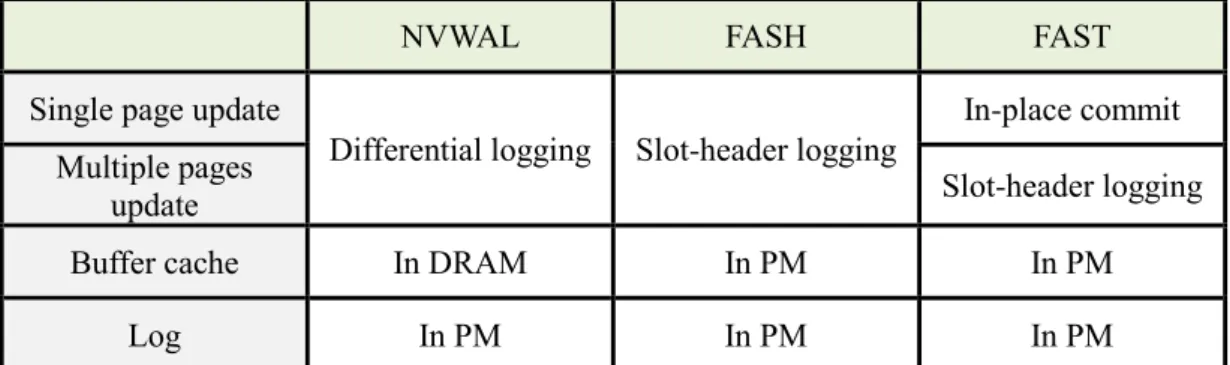
Slot header logging scheme is necessary for the case of updating pages more than one.
Introduction
Combining this feature with PM's byte addressability, we decided to use the slot header as a commit token. Using persistent pages with slices, we propose two new database management schemes, the in-place commit and the slot header logging scheme. The slot header recording scheme ensures consistency and atomicity using the recording method and reduces recording overhead by copying only the slot header, not the entire page.
The problem is that it is difficult to update the slot header atomically, because the atomic write rate of PM is expected to be 8 bytes [1, 6], but the slot header is larger than 8 bytes. It can atomically clean the data on the cache line size, so if the slot header is smaller than a cache line, the inserted page can be updated atomically. In this case, the slot header logging scheme is used because the logging technique is unavoidable.
The slot header registration scheme writes only the slot header, which is the same as the page update commit token, to the persistent slot header register and uses early checkpoints to eliminate search overhead of slot titles stored in the registry for future transactions. We created two versions, Fail-Atomic Slot Header Registration (FASH) and Fail-Atomic Slot Header Registration with CommiT in Place (FAST). FASH uses only slot header registration schemes and FAST uses both in-place registration schemes and slot header registration schemes.
Background
Recovery Techniques in Database System
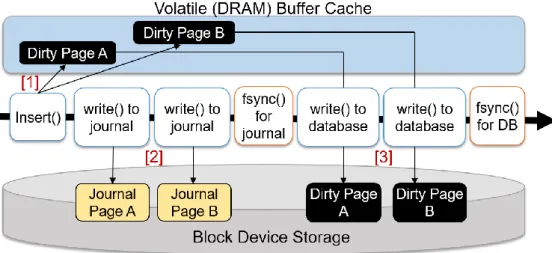
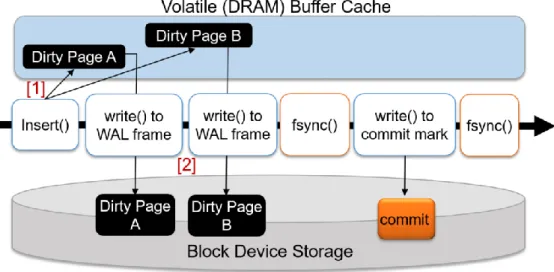
Additionally, the EXT4 file system layer amplifies write traffic due to file system journaling [7, 8] because the journaling method in the file system copies metadata blocks of database files and the diary. When data is inserted, (1) the DBMS updates page A and page B in the volatile buffer cache as the journal. And then, (2) writes the updated page from the cache buffer to the WAL file in storage.
If a system error occurs when the updated pages are written to the WAL file, the DBMS has original pages A and B in the database file, so it ignores the logged pages without the commit mark. If a system error occurs after the commit mark, the DBMS copies the updated pages from the WAL file to the database file. When the WAL file is full, the pages in the WAL file are copied to the database file.
Since the write operations for the WAL file are performed only when checkpoints occur, WAL technique works faster than journaling. However, both techniques have the disadvantage of creating redundant copies to block volatile buffer cache and device storage and writing the entire page even if we want to modify a part of a page. For persistent buffer cache, journal or WAL file doesn't need to be stored slowly and we don't need to copy whole page in journal or log.
Persistent Memory and Related Work
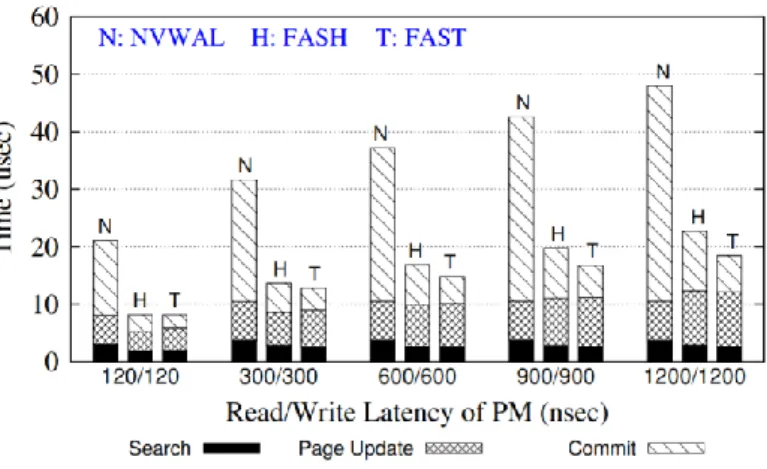
This is not simple because modifying existing data by overwriting can result in unstable state if a system crashes at an inopportune time. In the experimental part, we compared our proposed method based on PM-only system with NVWAL based on hybrid memory system. As a result, the single PM system performs better than the hybrid memory system despite the higher latency of PM than DRAM.
Slotted Page Structure
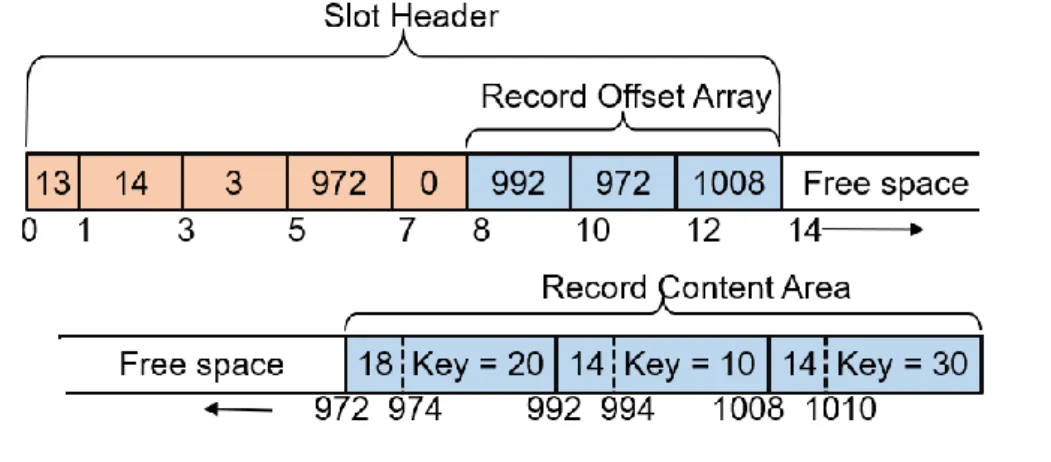
Start of the first free block at offset 1 refers to the first free space in the record content area when records are deleted. The remaining free spaces are linked as a list by storing the offset of the next free space in the previous free space. The number of fragmented free bytes at offset 7 is the total bytes of the small space that cannot fit in the record.

Failure-atomic Slotted Paging
Persistent Slotted Page Structure
In-place Commit Scheme
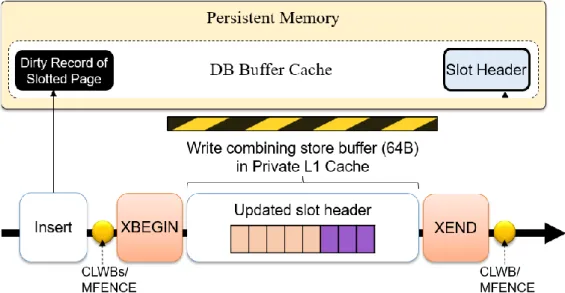
If the transaction failure persists, the fallback handler uses our other proposed scheme, slot header logging instead of an in-place update scheme. If the slot header size is smaller than the cache line size, RTM can guarantee error atomicity for writing cache lines. Then the updated slot header is stored in the write combination storage buffer and we call the XEND instruction when the write is completed.
Since the post-RTM slot header is in the private L1 cache, a cache line flush instruction is required to atomically write the slot header to the PM. This error slot atomic header writes the same as the in-place commit tag, ensuring consistency and durability of the insert transaction. So the transaction inserts the updated record as a new record and replaces the original record offset with the new record offset when atomically updating the slot header.
When a transaction deletes a record, it only changes the slot header in the persistent slot page. Another is that the size of the slot header is not larger than the hardware limit. If the slot header is larger than a cache line, we cannot use the in-place commit scheme.
Slot Header Logging Scheme
Slot-header logging plan has the persistent buffer caching, slot-header logging, and an additional commit flag that determines whether the slot header in the log is committed or not. There are two differences between slot-header logging scheme and existing write-ahead logging technique. First is that the slotheader logging scheme only saves the header of the pages, not the entire page.
We only write the slot header in the slot header log in PM because the slot header has the same role with a commit tag per page. Second, the slot-header-logging scheme checkpoints slot-header logs as soon as a transaction is committed. After writing entries, the slot-header-logging scheme writes the slot-header on pages A and B to the separate slot-header log.
By marking the commit token, the slot header registers, which were written before the commit token, become valid. If a system crashes before we set the commit flag, the updated slot headers only exist in the slot header register, not the actual pages, so we can ignore the slot header register. After the commit record is flushed into the slot header register, the slot header register scheme executes immediately by placing the slot header register check in the persistent buffer cache.

Implementation
- FASH
- FAST
- Split
- Defragmentation
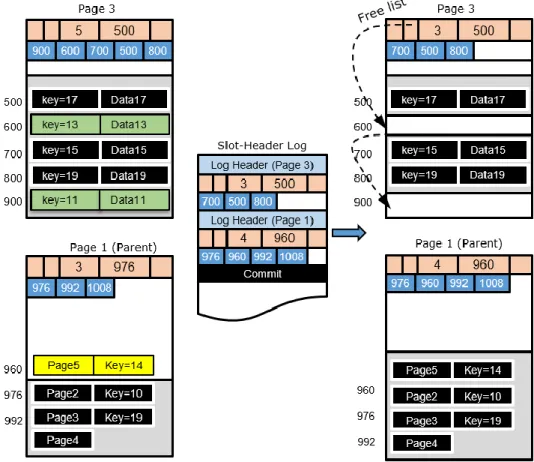
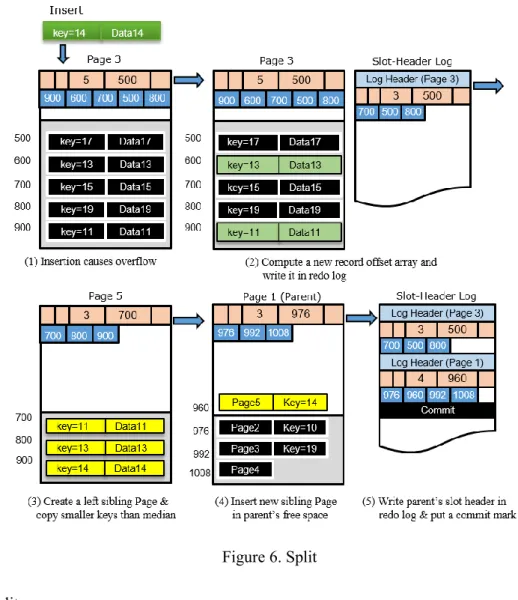
To reduce the I/O traffic, our split transaction causes the creation of one page and the modifications in the two pages - overflow page and its parent page. To invalidate half of smaller records, we need to modify the slot header of page 3. Since the new sibling page does not hurt the B-tree state, we do not need to store its slot header in the slot header log.
In the previous example, the page 3 and page 1 slot headers are stored in the redo log. We can now overwrite invalid records for the free list because other transactions find records from the updated slot header. Before placing a commit flag, changes to existing pages are invisible to other transactions and the slot headers written to the slot header log are invalid.
After the commit mark, we recheck the slot header logs with commit mark to the original page in the buffer cache. In addition, when a record is inserted into a page where page splitting occurs in the same transaction, there is not enough free space, so we need to perform defragmentation. Since we cannot perform the in-place update to the record content area of the parent page, we add a new record and store the slot header in the log that invalidates the existing record.
Evaluation
This is because the overhead of cache line flush and memory fence instructions for the record is increased while updating the record in place in FASH and FAST. The cache line flush instruction time for the record (clflush(record)) increases as the PM latency increases. However, this file does not contain cache line flush instructions for the slot header log.
Refers to the time when the cache line flush and memory fence commands are executed to store the WAL frame. Most notably, the number of FASH cache line flush instructions increases as the record size decreases when the record size is less than 64 bytes. In the case of FAST, because the post-in-place scheme limits the size of the slot header per cache line, it calls fewer cache line flush instructions than FASH, even when the record size is small.
Figures 12(a) and 12(b) show that the query execution time and the number of cache line fly instructions increase linearly with the number of inserts. But even with 512 inserts in a single transaction, FASH calls half of NVWAL's cache line flush instructions. Figure 12(c) shows the ratio of cache line flush instructions called by defragmentation among the total number of cache line flush instructions.
Conclusion
Condit et al., "Better I/O through byte-addressable, persistent memory," in Proceedings of the ACM SIGOPS 22nd symposium on Operating Systems princess, 2009, p. presented at Proceedings of the Twenty-First International Conference on Architectural Support for Programming Languages and Operating Systems, Atlanta, Georgia, USA, 2016. Noh, "Unioning of the buffer cache and journaling layers with non-volatile memory," presented at Proceedings of the 11th USENIX Conference on File and Storage Technologies, San Jose, CA, 2013.
Young, "Reducing excessive journaling overhead with small NVRAM for mobile devices," IEEE Transactions on Consumer Electronics, vol. Hodson, "Whole-system persistence," presented at Proceedings of the Seventeenth International Conference on Architectural Support for Programming Languages and Operating Systems, London, England, UK, 2012. Vandt, “Resolving journaling of journal anomaly in android I/O: multi-version B-tree with lazy split,” presented at Proceedings of the 12th USENIX conference on File and Storage Technologies , Santa Clara, CA, 2014.
Zhu, “Journaling of journal is (almost) free,” presented at the Proceedings of the 12th USENIX Conference on File and Storage Technologies, Santa Clara, CA, 2014.