Additionally, designed purely organic photoredox (PC) catalysts based on cyanoarene, one of the classes of thermally activated delayed fluorescence (TADF) compounds, were prepared to perform highly efficient organic (i.e., reductive dehalogenation) and polymer (ie, pressure-sensitive. adhesive syntheses, PSA). Then, based on the understanding of PC•‒ formation and degradation, highly efficient photoredox-mediated reductive dehalogenation combined with both ultra-low PC loading (about 0.005 mol%) and oxygen tolerance was realized.
Introduction to Photoredox Catalysis
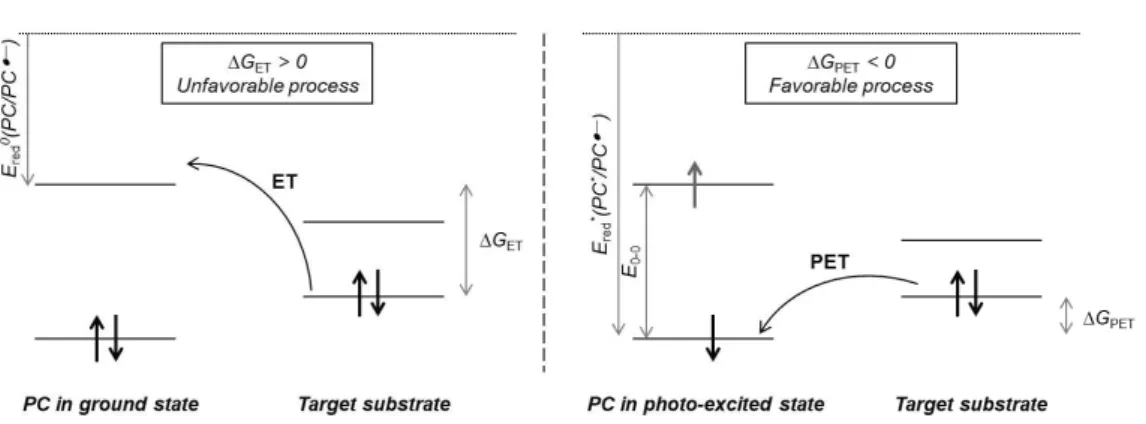
Photoredox catalysis enables the realization of an electron transfer (ET) process that is impossible between ground-state PCs and the target substrate, giving the energy of the absorbed photon (E0-0), i.e., the photoinduced electron transfer (PET) process. has a greater driving force (∆GPET) for PCs to be reduced (or oxidized) (Figure 1.2). Thermodynamics of ET and PET process of PC in ground and photoexcited states with target substrates in (a) reductive and (b) oxidative quenching cycles.
Organic Photoredox Catalysis
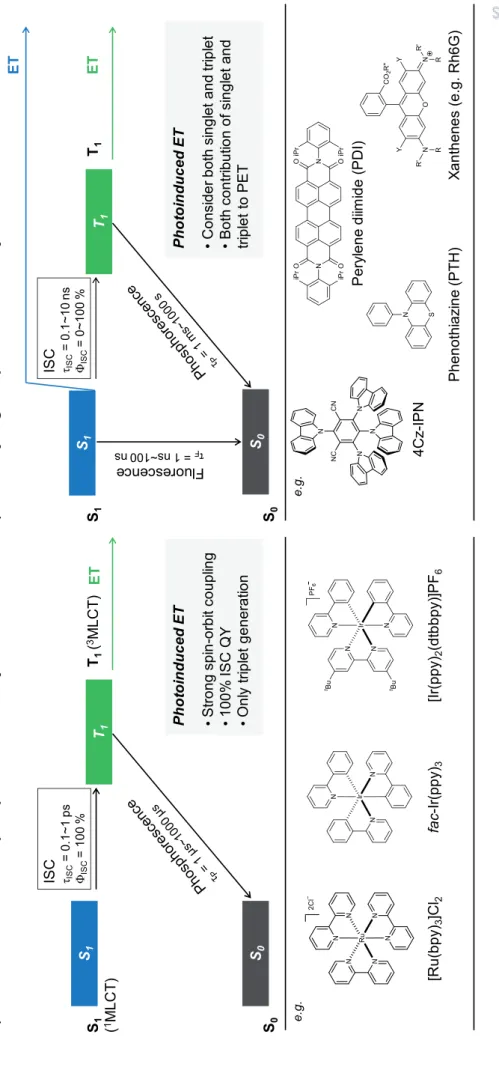
Photoinduced ET • Consider both singlet and triplet • Both singlet and triplet contributions to PET.
Consecutive Photoinduced Electron Transfer
Moreover, the mechanistic pathway of ConPET remains unclear in this field of photoredox catalysis, supported46 and contradicted47 by studies based on the transient absorption spectroscopy technique.
Thermally Activated Delayed Fluorescence Compounds in Photoredox Catalysis
Objective of the Dissertation
Despite the recent progress mentioned above, and apart from the existing examples of organic radical anions, there is no general guideline for the detection of PCs that efficiently generate PC•− with a very negative reduction potential under mild visible light irradiation conditions. In this dissertation, the general design strategy of these PCs was studied using the all-organic compound TADF as a model PC, especially cyanoarenes, to determine the origin of the well-formed PC•− and its behavior in actual photoredox catalysis.
Introduction
Experimental
Materials
General Procedure
- General Procedure for PC •− Formation
- General Procedure for Photodegradation of Cyanoarene-Based PCs
- General Procedure for Photoredox Reductive Dehalogenation
Newly dehalogenated products were characterized by GC-FID and 1H NMR spectrometer (400 MHz) with CDCl3 or DMSO-d6 as solvent. The yields of dehalogenated products were determined using GC-FID and a (5%-phenyl)-methylpolysiloxane column (Agilent HP-5).
Results and Discussion
Design Strategy
Their excited state redox potentials [Ered*(PC) and Eox*(PC•−)] were estimated from the Rehm–Weller equation, Ered*. The rate constants of all photophysical processes were evaluated from the experiments performed in the current work. a) ■formation of anionic radical PC.

PET Event Between 4DP-IPN and Tertiary Amines
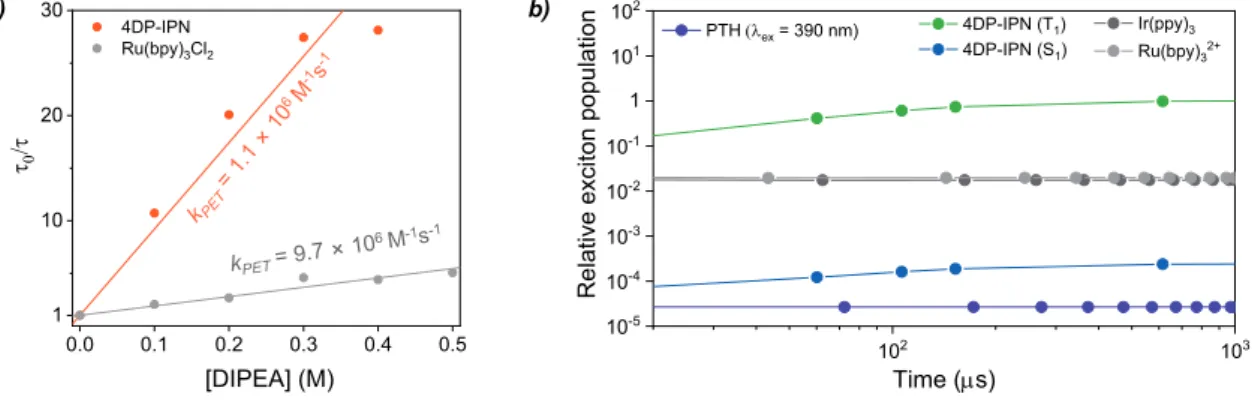
This model was based on the rate law to measure the PET capabilities of 4DP-IPN and compare it with those of other well-known PCs (Figure 2.4). The extinction coefficients of 4DP-IPN, Ir(ppy)3 and Ru(bpy)32+ were measured in CH3CN in our group. e) The exciton dynamics of selected PCs generated by pulsed photoexcitation. a) ■Jablonski diagram of 4DP-IPN b) ■Jablonski diagram of PTH e).
Formation of Radical Anion of Cyanoarene-Based PCs
The formation of PC•− was studied for a group of cyanoarene-based PCs with different redox potentials and T1-producing ability. The onsets were obtained by the tangential method: the intersection of the tangent set to the high-energy slope of the spectrum with the x-axis.80c Oscillator strengths were obtained from a TD-DFT calculation. literature measured in DMF.11e Due to i) approximation conditions, ii) errors in the experimental and theoretical (Strickler–Berg equation) determination of kISC, or both, the rate constants were evaluated as negative values.

Photodegradation of Cyanoarene-Based PCs
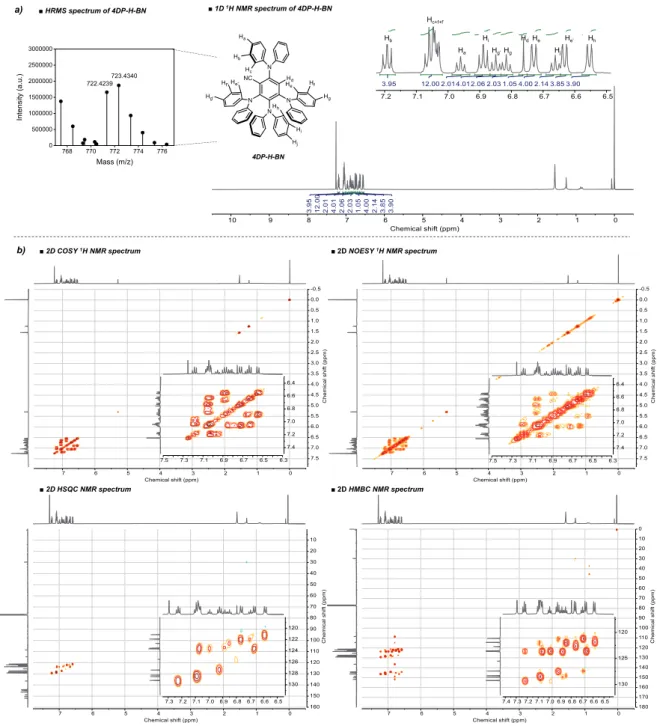
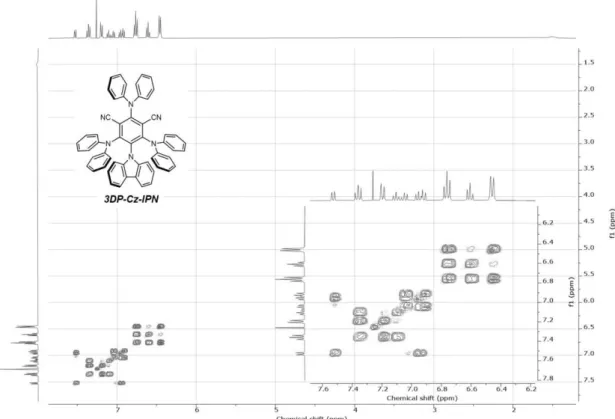
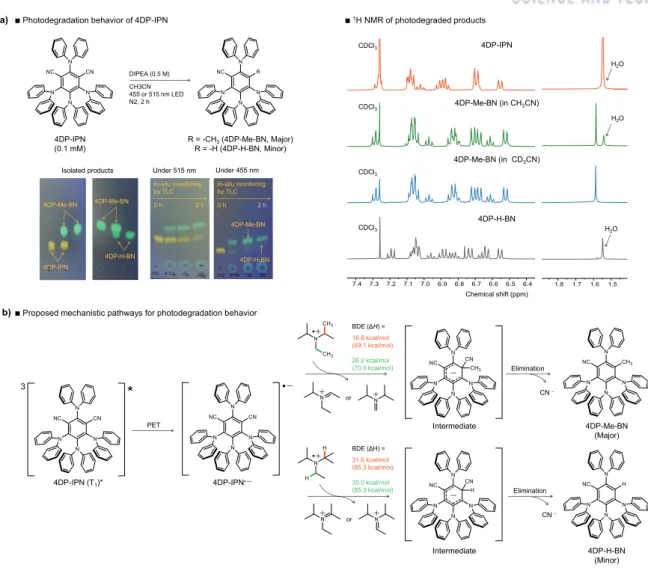
For the characterization of the isolated products, see Figure a) Photodegradation behavior of 3DP-Cz-IPN and 3DP-DCDP-IPN. Correlation between the –CH3 group and the aromatic group of DIPMA (0.5 M) .. 4Cz-Me-BN a) ■ Photodegradation behavior of 4Cz-IPN.
Dehalogenation of Activated Aryl Halides
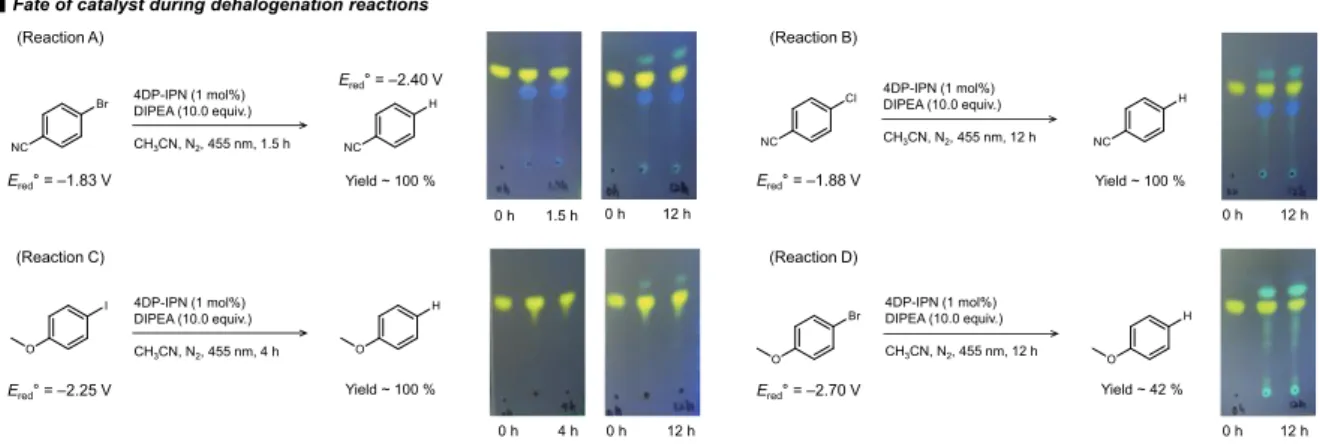
We investigated the photodegradation behavior of 4DP-IPN in real reactions to dehalogenate various aryl halides (Figure 2.23), using 10 equivalents of DIPEA as a sacrificial agent to verify our hypothesis. In other words, the ET from 4DP-IPN to 4-bromobenzonitrile was significantly faster than i) the 4DP-IPN formation and ii) the substitution reaction to form 4DP-Me-BN, which caused a large delay in the production of 4DP IPN. the PC degradation. The proposed mechanistic pathways for the 4DP-IPN photodegradation in the presence of aryl halides.
Despite the oxidation potential of the very negative excited state of Ir(ppy)3 (Eox*(Ir(ppy V), the relatively short duration of the excited state may have contributed to the higher charge required Ir(ppy )3 compared to that of 4DP-IPN Results of reductive dehalogenation of various aryl/alkyl halides in the presence of 4DP-IPN as PC. Injection of f1.5 and g3 mol% of 4DP-IPN was divided into three additions every 16 hours during the reaction.
Dehalogenation of Inactivated Aryl Halides
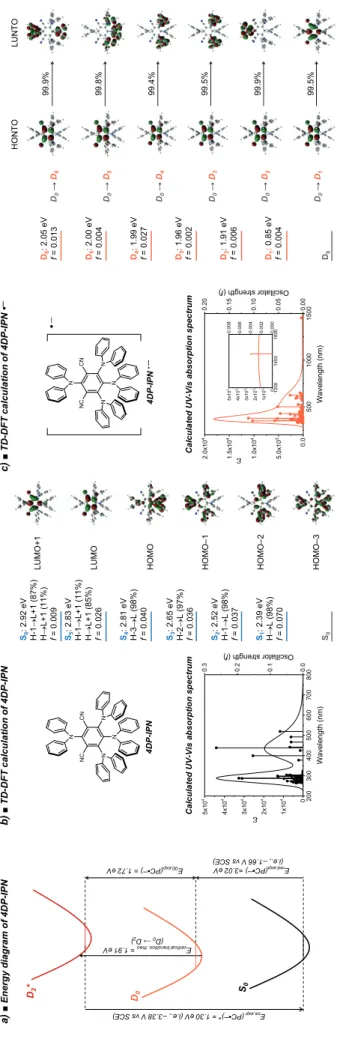
However, the theoretical evidence indicates the appearance of a near-infrared (NIR) band for the PC, which corresponded to the D1 state (SOMOoLUMO), independently of the chosen DFT functional. Nevertheless, the energy difference between the bands at, for example, 1,450 and 1,600 nm is only ~0.1 eV, which is within the error of the DFT calculations. The prepared 4DP-IPN solution changed color from dark green to yellow within seconds when an excess of 4-bromobenzonitrile was added.
However, the 4DP-IPN•− solution showed no noticeable color change with an excess amount of 4-bromoanisole, indicating that a multiphoton excitation mechanism and fast ET between 4DP-IPN•− and 4-bromoanisole can be ruled out (i.e., ConPET ). This is presumably caused by the short excited-state lifetime of 4DP-IPN•−.47 Other possible pathways, such as the XAT mechanism, through α-aminoalkyl radicals recently proposed by Leonori's group, 57 cannot be ruled out. There is an ongoing study on the dynamics of the excited states in PC•− and coupled ConPET processes.
Conclusion
Introduction
Above all, a new PC and a set of additives are given, which enable fast enough curing under visible light in the presence of UV absorbers. Due to the high catalytic activity of PC, UV-blocking adhesive films were prepared with only a small amount (10 ppm based on monomers). The role of tertiary amines is not limited to being sacrificial reductants, as they can act as initiators, oxygen scavengers, and crosslinkers, as shown by reviewing a number of amine-based reductants.
Understanding the function of the amine enabled us to improve the structure of amine-based reducers, reducing the need for additives (eg, an external crosslinker, initiator, or both) and increasing the rate of cure. In addition, we observed high oxygen tolerance behavior with a particular combination of PC and sacrificial reductants, which was only seen in systems using special agents, such as boron derivatives, 105,106 thiol derivatives, 107,108 and agents of chain transfer.109,110 Experimental chemical investigations and calculations are also used to provide a mechanism for oxygen tolerance. According to our analysis, this method can be widely used in various applications that require a highly effective visible light procedure, not only the production of UV-blocking adhesives.
Experimental
Materials
General Procedure
- General Procedure for Measurements of PET Rate Constant
- General Procedure for Bulk Polymerization and Film Curing
- Dynamic Folding Test of PSA Samples
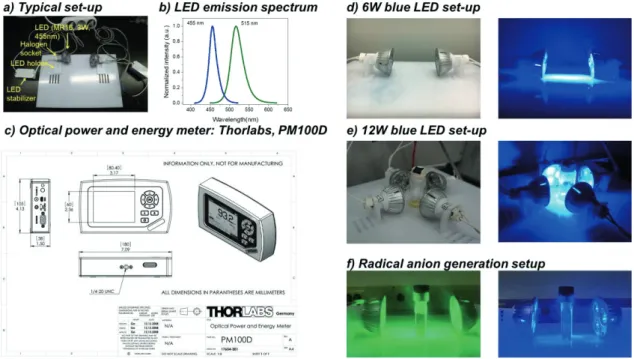
When all LEDs were turned on, the observed light intensity at the center of the film was about 6 mW/cm2 (373 nm, Fig. 3.3(d)). Because the energy meter detects the intensity of the entire spectrum of light rather than light of a single wavelength, the actual intensity of light of a single wavelength or 373 nm) is much lower than the measured value (Figure 3.3(f)). The fraction of single-wavelength light was obtained from the peak energy range of ± 0.15% (in eV) to estimate the single-wavelength light intensity.
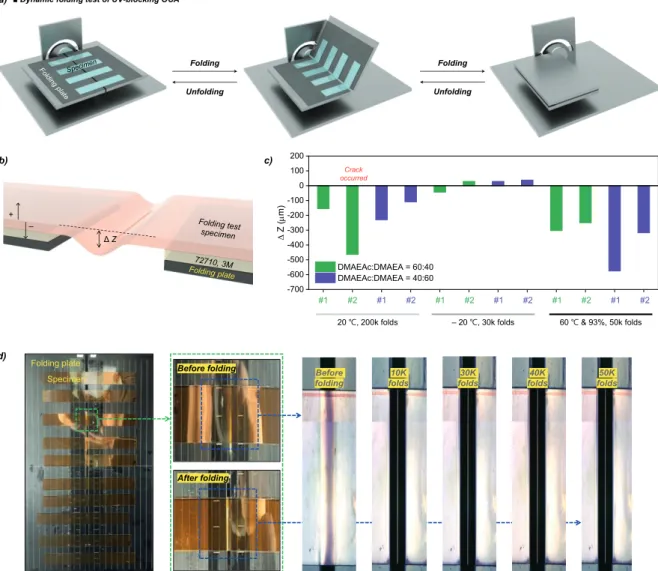
Single wavelength intensity was not evaluated due to the low intensity of the UV hand lamp and high noise. UV setup for (c) bulk polymerization and (d) film curing. e) Energy meter to assess light intensity. Adapted equipment (Foldy-200, FlexiGO, Republic of Korea, Figure 3.4) was used to evaluate the folding durability.111 The attached sample was folded inward during our dynamic folding test, and the device we used allowed us to maintain the folded length throughout the dynamic bending test (Figure 3.4(c)).

Results and Discussion
- Design Strategy
- Bulk Polymerization
- Origin of the Catalytic Performance
- Synthesis of UV-Blocking PSA
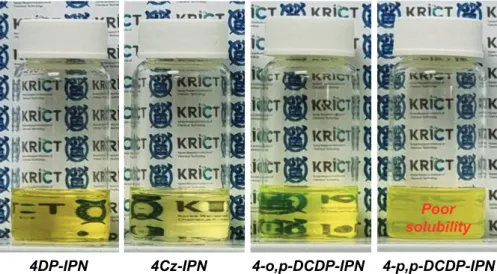
A PC and tertiary amine radical cation (R3N-+) result from the first PET reaction in the reduction cycle between the PC and the amine-based sacrificial reducing agent. The reduced HOMO energy of PC improves the −ΔGPET and thus the ET rate, because the PET between PC and the sacrificial reducing agent is often in the “normal region” of Marcus.17 Because the HOMO is localized in the donor group of the strongly twisted D –A type structure, for efficient absorption of visible light, we added a powerful electron-withdrawing group (i.e. the CN group) to the donor group to lower the HOMO energy (Figure 3.6). We performed the same polymerization with 10 ppm of each prepared PC in the presence of DMAEAc (5,000 ppm), selected as sacrificial reducing agent, under argon atmosphere and 455 nm LED irradiation to assess the catalytic performance of the generated PCs (18 W, 30 mm) . s; Table 3.2).
The fast and delayed fluorescence PL decay of PCs is shown in the inset. The relative T1 concentrations of 4Cz-IPN and 4DP-IPN at the photostationary state were approximately 10- and 100-fold greater than those of 4- o , p -DCDP-IPN, resp. Compared to 4Cz-IPN or 4DP-IPN, 4-o,p-DCDP-IPN showed less success in generating long-lived T1. The findings of these kinetic simulations adequately explain the greater catalytic performance of 4Cz-IPN (i.e. a high excited state population and moderate kPET).

Conclusion
Then, distilled water (2 mL) was poured into the reaction mixture to quench the excess NaH and methanol was added to precipitate the crude product, which was further purified by reprecipitation in CH2Cl2 //EA to yield the pure product as a yellow solid (0.140 ml). grams, 28%). Then, distilled water (2 mL) was poured into the reaction mixture to quench the excess potassium tert-butoxide, and methanol was added to precipitate the crude product, which was further purified by recrystallization in CHCl3/MeOH to yield the pure product. to be supplied as a yellow solid. (1.02g, 26%). Distilled water (2 ml) was then poured into the reaction mixture to quench the excess potassium tert-butoxide and methanol was added to precipitate the crude product, which was further purified by column chromatography on silica gel with a gradient of CH2Cl2/hexanes mixtures to give pure product as yellow solid.
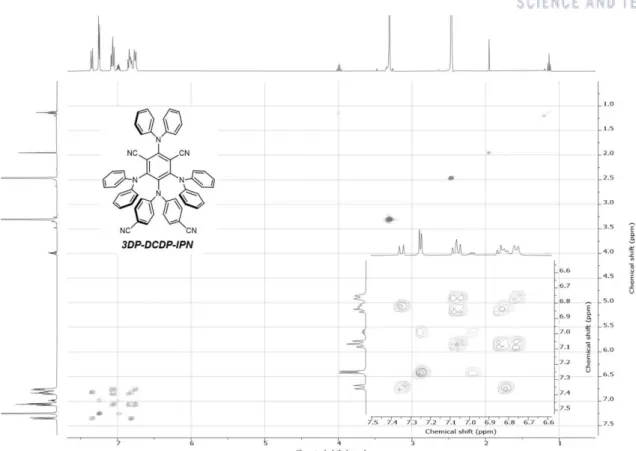
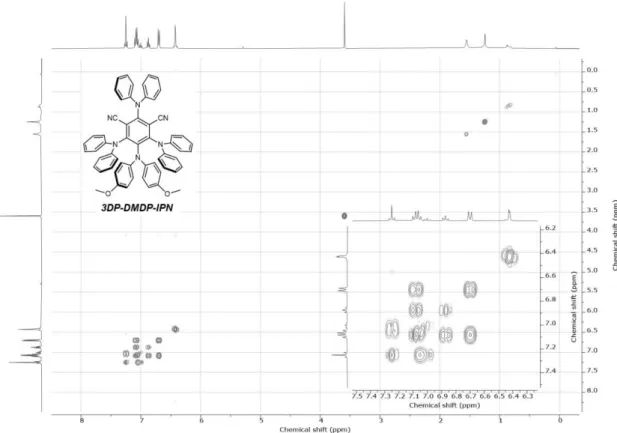
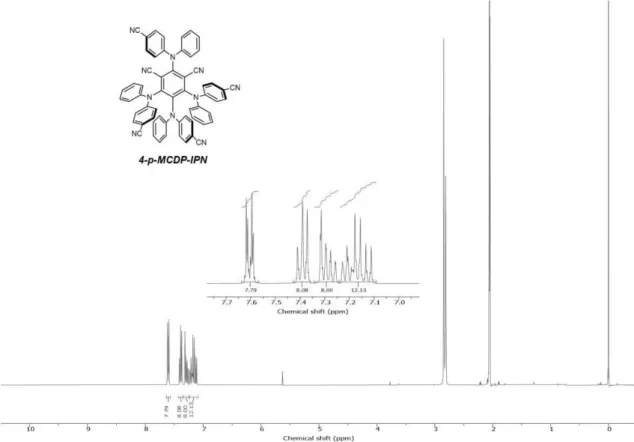
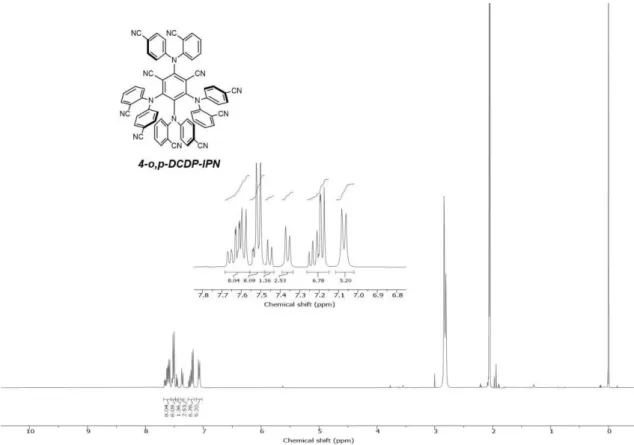
Distilled water (2 mL) was then added to the reaction mixture to quench the excess NaH and methanol was added to precipitate the crude product, which was further purified by column chromatography on silica gel with gradient CH2Cl2/hexanes mixtures to give pure product as a yellow solid. dust (0.117 g, 18%). Then, distilled water (2 mL) was added to the reaction mixture to quench the excess potassium tert-butoxide and methanol was added to precipitate the crude product, which was further purified by washing with CH2Cl2 to give pure product as a yellow solid . Distilled water (2 mL) was then added to the reaction mixture to quench the excess NaH.
Characterization of cyanoarene-based PCs
Computational details
Kinetic simulation
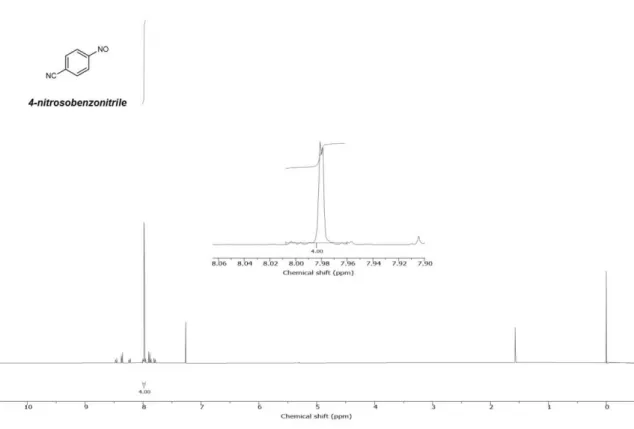
Due to the high injection temperature of GC-FID, no benzene product was observed in our GC-FID system. Due to the high injection temperature of GC-FID, chlorobenzene and benzene products were not observed in our GC-FID system. Mapping the multistep mechanism of a photoredox-catalyzed atom transfer radical polymerization reaction by direct observation of the reactive intermediates.
The cleavage of a C-C bond in cyclobutylanilines by visible light photoredox catalysis: development of a [4+2] cancellation method.