Metal-air batteries are promising alternatives to state-of-the-art lithium-ion batteries because of their high theoretical energy density. Na-air cells with the air electrode composed of Vulcan or Pt/C coated carbon paper exhibited excellent recharging with small charge-discharge voltage gaps (voltage efficiencies of 84.8 % and 97.6 %, resp.). over 18 cycles (total 180 h), compared to the cell with only the carbon paper electrode (79.0. These results are expected to pave the way for more economical and high energy density Na-air batteries.
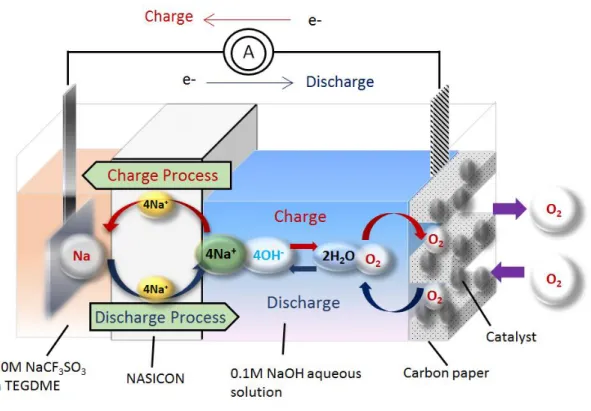
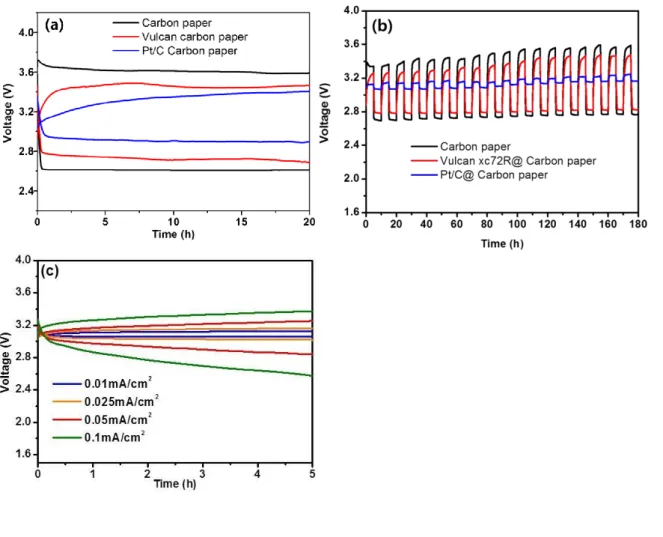
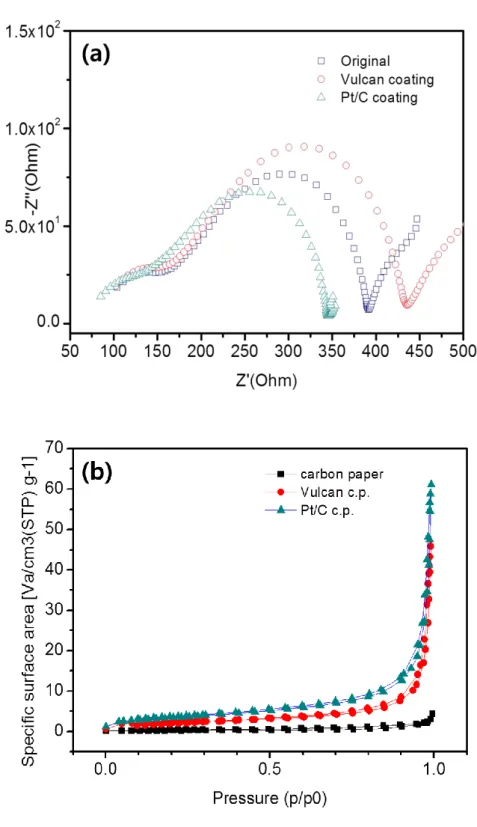
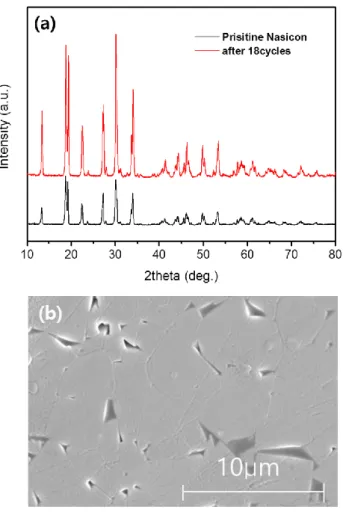
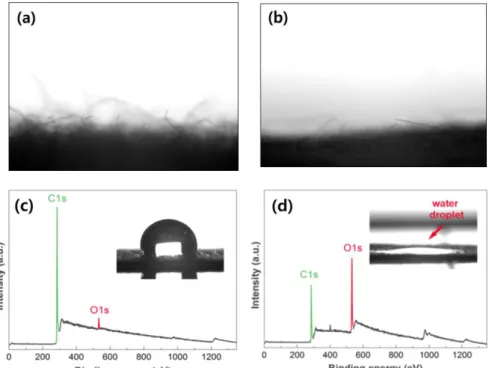
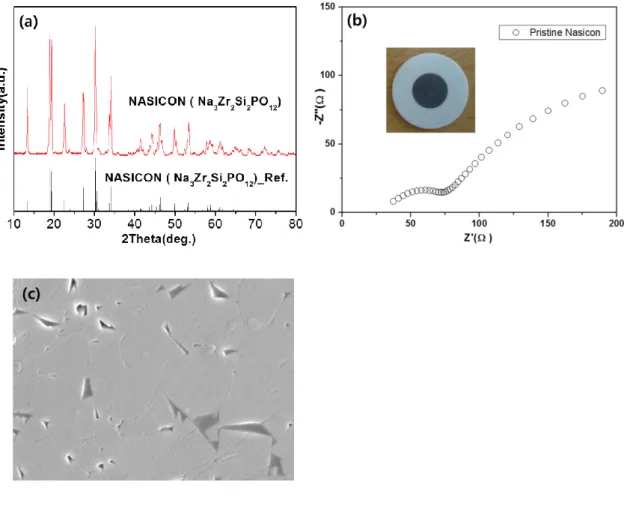
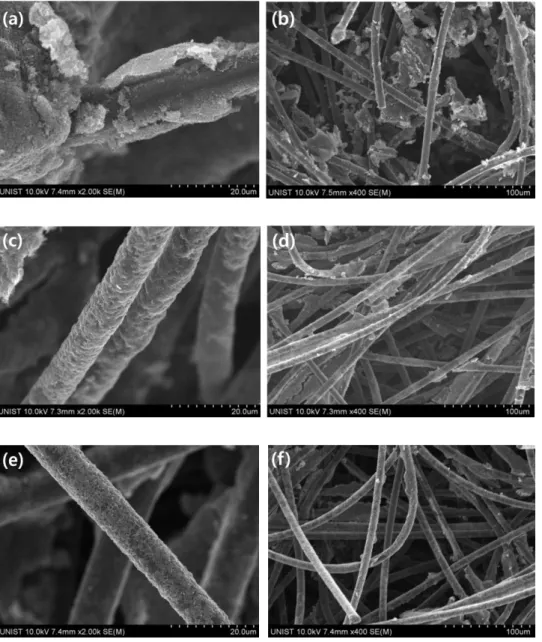
Figure 2. Schematic illustration of an aqueous Na-air battery and charge-discharge processes Figure 3. a) XRD pattern (b) Nyquist plot and (c) SEM image of NASICON separator. SEM images of (a) carbon paper (b) Vulcan xc72R coated carbon paper and (c) 50 % Pt/C coated carbon paper. a) First Galvanostat charge-discharge curves and (b) cycle performance of Na-air batteries with different air electrodes at 0.01 mA cm-2 and (c) charge-discharge curves of a Na-air battery coated Pt/C carbon paper with different current densities at 0.01-0.1 mA cm-2. a) BET data of 3 types of cathode electrodes, carbon paper, Vulcan coated carbon paper and Pt/C coated carbon paper (b) EIS data of 3 cells with three different carbon papers. a) Comparison of XRD patterns of NASICON before cell test and after 20 charge and discharge cycles (b) SEM image of NASICON surface before test and (c) after 20 cycles Figure 9. Comparison of charge and discharge curves of three different cells coated with Vulcan using different coating methods at 0.01 mA/cm2 for 5 h at 25 °C.
Figure 17 (a) Galvano Static initial charge-discharge curve and (b) cycle performance of Na-air batteries with different air electrodes at 0.01 mA cm-2.
Introduction
A previous study identified seawater as a new candidate for the cathode electrolyte of the aqueous sodium-air battery [19]. This phenomenon is one of the most important aspects for the future development of the aqueous Na-air battery. 7 (a) shows a different trend in the order of catalyst efficiency among the charge/discharge curves.
Moreover, the stability of the Na air battery system is one of the main concerns. Fig.14 Schematic illustration of activated carbon seawater battery coated with felt catalyst as cathode electrode. XRD (D/Max, Rigaku apparatus), impedance measurement and SEM (Verios 460, FEI company) were performed to examine the properties of the NASICON separator.
SEM was performed to confirm the catalysts coated on the surface of the activated carbon felt.
Rechargeable aqueous Na-air battery
Experimental methods and materials
- Cell preparation
- Electrochemical characterization
After heating for 2 hours at 110°C on a hot plate, the coated carbon papers were again dried at 80°C in an oven and used as the cathode (air electrode). Na metal (99.9%, Sigma Aldrich) was attached to the surface of the nickel mesh and used as the anode. The anode was placed in the bag, and the separator (NACICON) was then sealed with a bag, where one side of the separator was only exposed to air.
The anode part was then soaked in a 0.1 M NaOH solution and the cell was assembled with a cathode composed of a Ti grid as a current collector. Figure 1 Image of the structure inside the bag and digital image of the anode part of the bag cell. Scanning electron microscopy (SEM) was performed to verify the condition of the catalyst coated on the surface of the carbon paper.
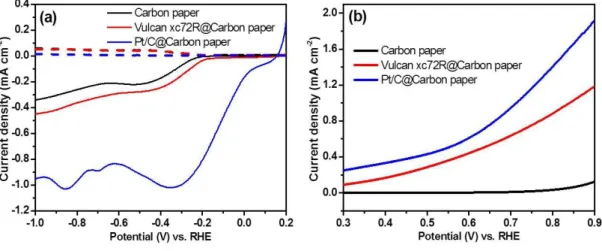
Linear sweep voltammetry (LSV) and cyclic voltammetry (CV) were tested in a three-electrode system using Hg/HgO as the reference electrode, Pt wire as the counter electrode, and glassy carbon as the working electrode, respectively.
Results and Discussion
- Surface investigation of NASICON
- Cathode electrode analysis
- Electrochemical performances
- Direction for optimization
3b presents the Nyquist plot of the ceramic separator on which a circular Pt electrode is deposited (the inset). The inset in (b) shows a digital image of the NSICON on which a circular Pt electrode is coated. 4a-4c present the morphology of the carbon paper electrodes with and without an electro-catalyst, such as Vulcan xc72R and Pt/C.
Similar to the ORR results, the Pt/C showed excellent catalytic activity for the ORR, revealing the bi-functional catalytic behavior of the Pt/C particles. Therefore, Pt/C can reduce the overpotential of the Na-air cells during charging and discharging. Considering the pH of the aqueous electrolyte, the theoretical voltage of the Na-air cell was calculated to be ~3.17 V.
The high-voltage performance of the cell using the Pt/C electrocatalyst was attributed to the better electrocatalytic activity of Pt/C toward both OER and ORR. Although the Vulcan-loaded cell showed a lower voltage efficiency than the Pt/C-loaded cell, the Vulcan-loaded electrode helped reduce the voltage gap compared to the cell with only carbon paper electrode. The voltage gap increased with increasing number of cycles for cells with only carbon paper and Vulcan-coated carbon paper, although the Vulcan-loaded cell showed smaller voltage gaps during cycling than the cell with carbon paper.
The charge-discharge curves of the Na-air cell were further tested using the Pt/C electrocatalyst at different current densities of 0.01-0.1 mA cm-2. The specific surface area of the Pt/C coated carbon paper was the highest followed by Vulcan coated carbon paper. Without the effect of the catalyst coated on the electrode surface, each cell would have a very different impedance.
7 (a) Nyquist plots of 3 cells with three different carbon papers (b) BET data of 3 types of cathode electrode, carbon paper, Vulcan coated carbon paper and Pt/C coated carbon paper. Fig.8 (a) shows the XRD patterns of NASICON and pristine NASICON after 18 charge and discharge cycles. Fig. 8 (b) and (c) show the surface SEM images of NASICON and pristine NASICON after 18 cycles.
The improved stability will have a direct effect on the overall performance of the newly manufactured system.
Introduction
The innovation of seawater as a cathode electrolyte and the safety of the NASICON membrane as a solid state electrolyte could lead to environmentally friendly sodium air batteries. Well-known catalysts, Vulcan xc72R and 50 % Pt/C, were used as reference catalysts for seawater battery OER and ORR.

Experimental methods
- Catalyst coating methods
- Cell preparation
- Electrochemical characterization
A mixture of catalyst and binder mixed with N-methyl-2-pyrrolidone as a solvent was prepared by grinding in a mortar, which was a difficult process to perform manually with reproducibility. A change in conditions may result in a different state of the slurry depending on the preparer, so it is not a suitable method for repeated experiments. This settling of the suspension is followed by the formation of clumps of catalyst particles, which reduce the overall surface area of the air electrode.
The next method that complements this disadvantage of dispersion of catalyst particles is via a. The principle of the mixing machine is the centrifugal force of horizontal rotation at 2000 revolutions per minute. 12 (a) ~ (f) represent the coated heated carbon felt fibers by each catalyst deposition method.
The condition of the coated fibers was found to be affected by the coating method. Particles of the catalyst and binder can be well dispersed by the faster rpm, which was sustained for 10 minutes. 13 Comparison of the charge and discharge curves of three different Vulcan coated cells by different coating methods at 0.01 mA/cm2 for 5 hours at 25 °C.
Fig.14 shows a large schematic diagram of the anode and solid state electrolyte combination within the seawater cathode electrolyte. For the anode, Na metal (99.9 %, Sigma Aldrich) is attached to the surface of the nickel grid as a current collector. Each cell must have a uniform size, the same amount of electrolyte, Na metal and the thickness of the NASICON separator (0.8 mm).
One of the important factors is the completeness of the sealing of the edges of the bag. Overcharged electrolyte causes the bag to swell, reducing the degree of contact between the Na metal and the NASICON ceramic membrane.
Results and Discussion
- Carbon felt analysis
- Electrochemical performances
- Direction for optimization
Fig. 16 (a ~ f) shows the morphology of the heated carbon felt electrodes with and without the catalysts, such as Vulcan xc72R and Pt/C. Preparation of a dilute slurry can support better adhesion of the thin film catalyst to the fibers. The cycle performance of the battery with the Pt/C catalyst was tested at 0.01 mA cm-2 for 25 cycles, because the cycle life is one of the most important factors for the practical applications of rechargeable batteries.
Despite this, the discharge voltage for each cell was relatively constant over repeated cycles, highlighting the excellent stability of the NASICON separator. Fig. 17 (a) Galvanostatic first charge-discharge curves and (b) cycle performance of the Na-air batteries with different air electrodes at 0.01 mA cm-2. However, considering the pH of the seawater electrolyte, the theoretical voltage of the seawater cell was calculated to be 3.468 V.
The standard cathode reaction potential shows about a 0.4 V difference due to the pH of the reaction environment. The following shows the overall reactions of the battery with seawater during the charging process; the potential is affected by pH. However, this aspect is natural and the important point is that the catalyst effect is maintained even at currents higher than 0.01 mA/cm2.
With the exception of the result at 0.25 mA/cm2, the Pt/C cells would have a smaller voltage gap than the original heated carbon felt at 0.01 mA/cm2. Therefore, this differential voltage gap highlights the great performance of the catalyst coated air electrode. 18 Charge-discharge curves of the seawater battery with Pt/C coated carbon paper at different current densities at mA cm-2.
A significant seawater battery catalyst effect was also observed at higher power densities. 19 represents the maximum power density of the reference electrode, bare heated carbon paper, and Pt/C. Therefore, LSV studied the catalytic activities of heated carbon felt, Pt/C and Vulcan xc72R coated heated carbon felt for ORR at a rotation speed of 1600 rpm in O2 saturated seawater solution.
RHE, which was higher than those of pristine carbon paper (-0.3 V vs. RHE) and Vulcan xc72R (-0.25 V vs. RHE), indicating that Pt/C plays an important role in enabling ORR in an alkaline electrolyte.

Conclusion