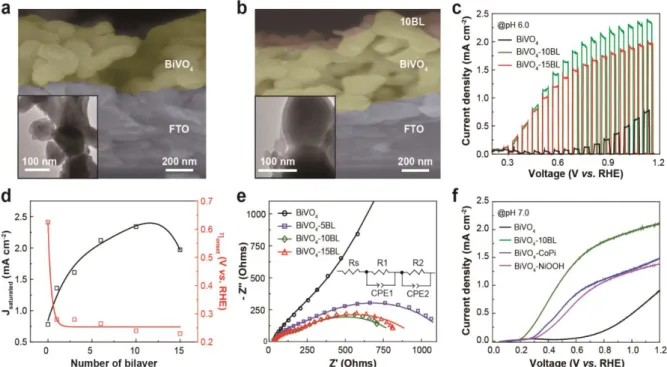
LSV curves showing the effect of (a) the number of OER BL and (b) illumination direction on the performance of the BiVO4 photoanode. Linear sweep voltammetry (LSV) curves showing the effect of the number of BL of Fe2O3. Effect of the thickness of PEI hydrogel on the PEC performance of BiVO4/CoPi photoanodes.
Research background
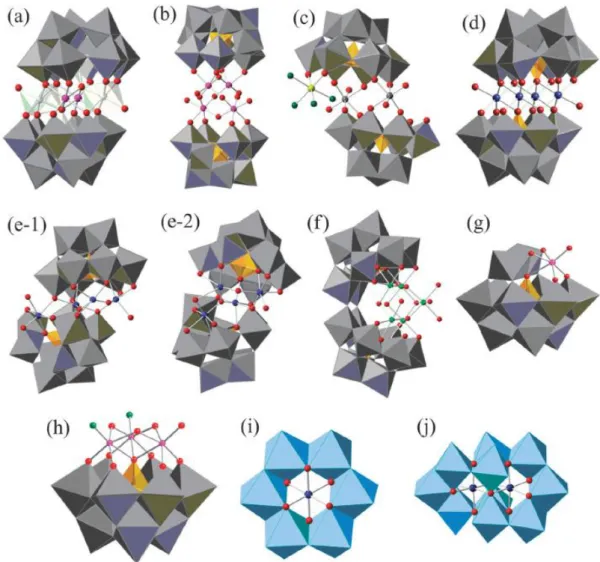
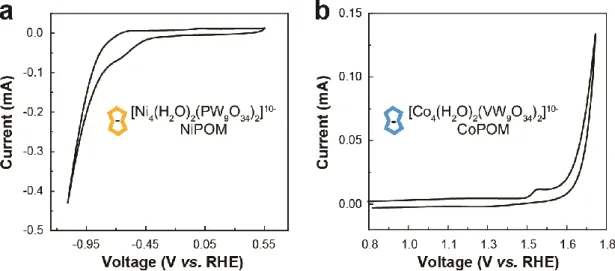
This result indicates that molecular POM requires a new deposition method and candidates as a linker material to drive highly efficient solar water splitting.20-22. After modification of photoelectrodes, we found improvement of PEC performance in terms of onset potential and photocurrent in solar water splitting. The desired properties of the catalysts for efficient solar water splitting (Copyright © 2019 Wiley-VCH, Weinheim),22 and (b) the PEC property of inorganic-based catalyst in water oxidation.

Dissertation structures
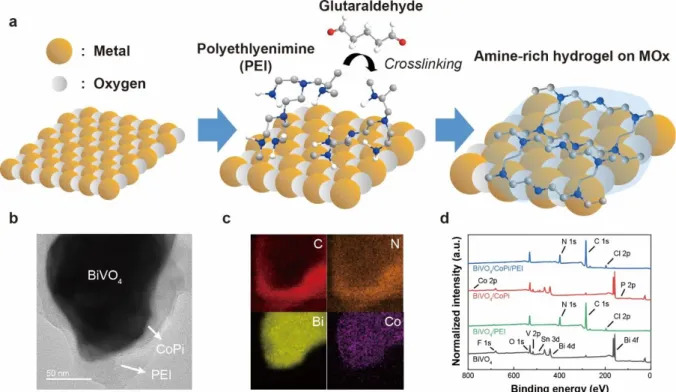
The interfacial dipole layer not only showed an increase in charge separation regardless of photoelectrode types, but also provided more efficient performance of PEC combined with CM. In this study, we fabricated polyethyleneimine (PEI) hydrogels containing abundant amine groups on various photoanodes to promote the slow four-electron transfer pathway, which causes poor water oxidation kinetics. The amine-rich hydrogel in the photoanode showed a significant enhancement of the PEC performance in terms of photocurrent and onset potential, and it was confirmed that the abundant amine groups in the PEI polyelectrolyte could act as a hole-attracting role and as a hydroxide exchanger by of the protonation process, thus improving the proton-electron transfer combined in PEC water oxidation (Figure 4).
Cu 2 O-BiVO 4 Photoelectrochemical Cells with Molecular Multilayers for Bias-Free
Experimental
After the pH of the solution was adjusted to 13, electrodeposition was performed at 30 °C and -0.4 V vs . A precursor solution for deposition of BiOI was prepared by mixing 0.04 M Bi(NO3)3·5H2O solution in 0.4 M KI solution (50 mL) and 0.23 M p-benzoquinone solution (20 mL) dissolved in absolute ethanol. After adjusting the pH of the precursor solution to 1.7, electrodeposition of BiOI was performed at −0.1 V vs.
Results and Discussion
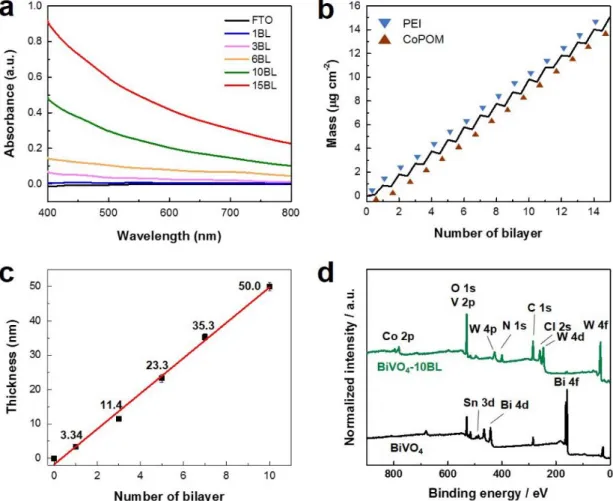
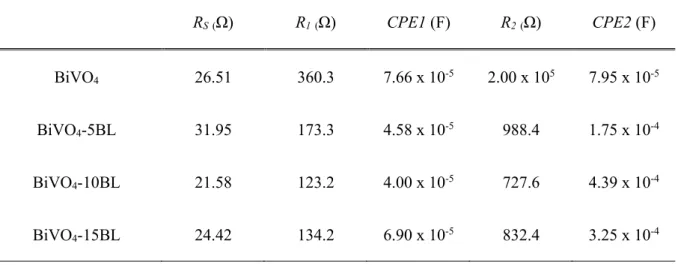
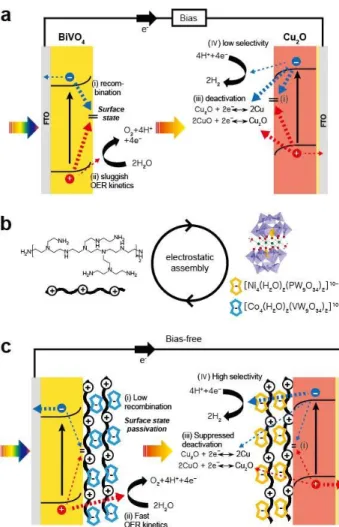
The improved stability of the Cu2O photocathode after the deposition of the HER CMs was also confirmed by ex situ XPS analysis (Figure 10). Formation of the OER CMs was investigated with (a) UV-vis absorption spectroscopy, (b) QCM analysis, (c) ellipsometry and (d) XPS. According to EIS analysis (Figure 14e and Table 2), the significantly improved performance of the BiVO4 photoanode after the deposition of the OER CMs resulted from (1) the enhanced charge transport to the interface and (2) enhanced catalytic activity, similar to the case of the Cu2O photocathode with the HER CMs.
Conclusions
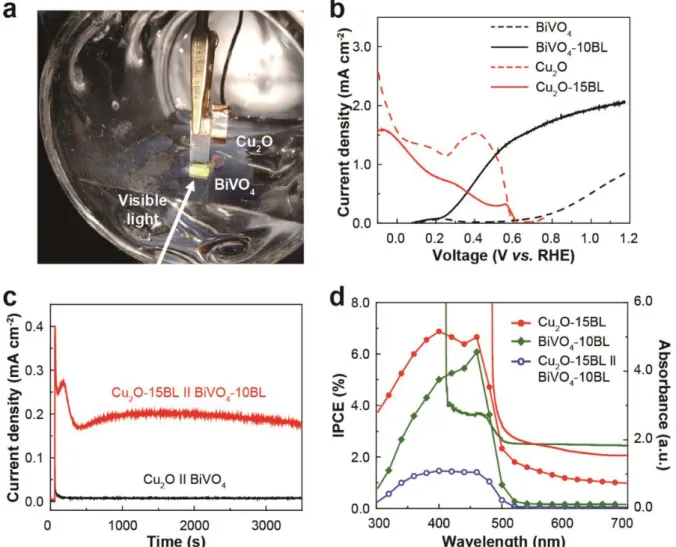
In the present study, we have successfully fabricated a bias-free PEC cell for general water splitting using only simple and environmentally friendly solution processes. Although the stability of the PEC cell needs to be further improved for practical application, the present study provides insight and flexibility for the design and fabrication of PEC cells. For the reasons described above, we believe that the present study may also provide insight into the design and fabrication of novel energy storage and conversion devices.
Catalytic Multilayers of Polyoxometalate and Polyelectrolyte for Efficient Solar Water
Experimental
Each BL of the CMs was deposited using the following procedures: dipping in the PDDA and POM solutions for 20 and 5 min, respectively, and washing with DI water for 30 s three times after each step. The average TOF of POMs in the overall CMs (kn,avg)—the number of oxygen molecules produced by each POM in a given time—was calculated using the following equation. The effective TOF of the POMs in the outermost BL of the corresponding CMs (kn,outer) was estimated using the following equation.
Results and Discussion
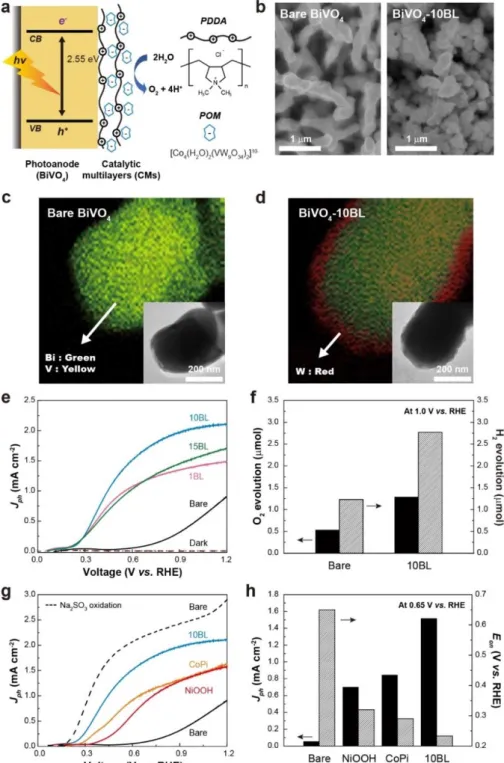
The conformal and uniform deposition of the CMs was also confirmed by surface-sensitive X-ray photoelectron spectroscopy (XPS), which showed the appearance of peaks corresponding to P and W of POM and N of PDDA, as well as the disappearance of Bi -peaks due to burial of the underlying BiVO4 photoanode after the deposition (Figure 24). XPS spectra showing the conformal and uniform deposition of the molecular CM on nanoporous BiVO4 photoanodes. The deposition of the CMs led to a significant improvement in the PEC performance of the underlying BiVO4 photoanodes (Figure 20e and Figure 26).
The EIS spectra of the BiVO4 photoanodes, both with and without the CMs, were a good fit using the proposed model (Figure 30). Nyquist plots for the kinetic analysis of the PEC water oxidation by BiVO4 photoanodes with and without the CMs. The deposition of the 1 BL CMs was accompanied by a shift of the low-frequency peak to a higher frequency.
EIS analysis showing the effect of the CMs on the catalytic charge transfer kinetics at the electrode/electrolyte interface. Because the CMs may have more influence on the interfacial properties of the underlying BiVO4. Effect of the CMs with a different n on the charge separation and transport kinetics in the bulk BiVO4 photoanode.
The outstanding performance of CM-modified BiVO4 photoanodes can be explained by the following: (1) enhanced charge separation/transport in bulk BiVO4 due to passivation of surface recombination centers by CM, (2) efficient charge transport from base BiVO4 photoanode to POM WOC with hopping conductivity due to the nanometer organization of PDDA and POM WOCs, and (3) the remarkable catalytic activity of CM, which includes efficient molecular WOCs.
Conclusions
Polyelectrolyte-Assembled Interfacial Dipole Layers to Improve Charge Separation
Experimental
Sn-doped Fe2O3 nanowires were grown on fluorine-doped tin oxide (FTO) by a hydrothermal method according to the literature.82 Briefly, 0.15 m FeCl3∙6H2O and 1.0 m NaNO3 were dissolved in deionized (DI) water. . Anodization was performed in a two-electrode configuration at 60 V for 30 min using a washed Ti foil as the working electrode and Pt as the counter electrode. Both cationic and anionic solutions of polyelectrolytes for the application of multilayered polyelectrolytes were prepared by dissolving PDDA and PSS in DI water at a concentration of 5 mg mL–1 and pH 7.
Multilayer polyelectrolytes were applied to the desired substrate according to the following procedure: each photoanode was immersed in a solution of PDDA and PSS for 5 minutes. This was followed by washing with DI water for 30 s three times after each immersion step. Morphological and surface roughness analysis of the photoanodes were performed using NX-10 AFM (Park Systems, Korea), JEM-2100 high resolution TEM (HR-TEM, JEOL, Japan) and TECNAI TEM (Thermo Fisher Scientific, USA).
Absorbance and thickness of polyelectrolyte multilayers were measured with a Cary 5000 UV-vis spectrophotometer (Varian, USA) and EC-400/M-2000. A multi-channel potentiostat/galvanostat WMPG1000 (WonA Tech Co. Ltd, Korea) was used to control the potential of the working electrode under the following conditions: Fe2O3 or TiO2 as the working electrode, Ag/AgCl as the reference electrode, Pt film as the counter electrode, and a scan rate of 20 mV s–1 for Fe2O3 and 10 mV s–1 for TiO2. EIS was performed under light using an SP-150 (Bio-Logic Science Instruments, France) under the following conditions: applied bias range from 0.4 to 1.6 V vs.
Jmax is the maximum theoretical photocurrent density calculated by the solar photon flux, and abs is light absorption efficiency of Fe2O3 by wavelength.
Results and Discussion
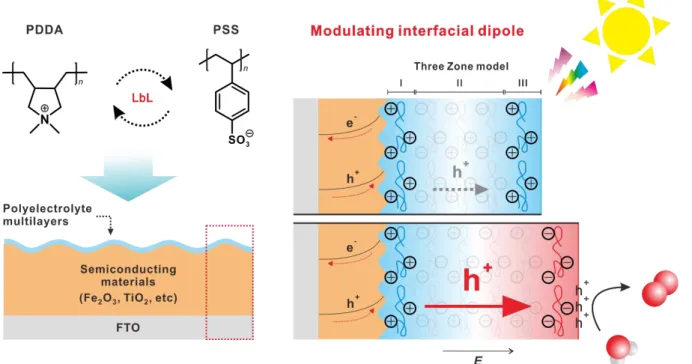
Cross-sectional TEM images of Fe2O3 photoanodes with polyelectrolyte multilayers (3 BL) at (a) low and (b) high magnifications. We then investigated the effect of the interfacial polyelectrolyte multilayers on the PEC performance of the Fe2O3 photoanodes. First, we investigated the effect of the thickness of the polyelectrolyte multilayer (i.e., BL) (Figure 46a and Figure 47).
To further investigate the effect of the interfacial dipole layer, polyelectrolyte multilayers were assembled under different ionic strengths. This is due to the charge screening effect of counterions, which reduced the interfacial dipole force of multilayer polyelectrolytes (Figure 48). Independent of the above observation, Mott–Schottky analysis showed that the deposition of multilayer polyelectrolytes caused an anodic shift in the flat potential of Fe2O3 (inset in Fig. 46a).
Their direction and magnitude can be precisely controlled by the number of BLs in multilayered polyelectrolytes. It is worth noting that the Mott-Schottky curves of the Fe2O3 photoanode became more linear after the deposition of multilayer polyelectrolytes. Taken together, our analyzes show that the deposition of multilayered polyelectrolytes can improve the charge separation efficiency of Fe2O3 photoanodes by forming an interfacial dipole moment (Fig. 52a).
Linear sweep voltammetry (LSV) curves showing the effect of polyelectrolyte multilayers on performance of TiO2 photoanode.
Conclusions
Boosting Proton-Coupled Electron Transfer with Amine-Rich Hydrogels for
Experimental
Polyethyleneimine (branched, Mw ~25,000), including primary, secondary and tertiary amine groups in an approximate ratio of 46/24/30, was used to make the hydrogel. BiVO4 was prepared by electrodeposition as previously reported.10 Briefly, 0.4 mol KI was dissolved in 50 mL deionized (DI) water and the pH was adjusted to 1.7 using 1 M HNO3. Electrodeposition was performed using fluorine-doped tin oxide (FTO), platinum-coated FTO, and Ag/AgCl as working, counter, and reference electrodes.
TiO2 nanotubes were produced by anodizing Ti foil as previously reported.109, 114 Briefly, NH4F was dissolved at 0.3 wt% in a solution of 1 to 9 (w/w) mixture of DI water and ethylene glycol. Anodization was performed at 60 V for 1 h in a two-electrode configuration using Ti foil and Pt plate as the working and counter electrodes, respectively. As prepared samples were thoroughly washed with DI water and ethanol and annealed at 450 °C for 2 h (curing rate of 2 K min-1) to form TiO2 nanotube photoanodes.
Cobalt phosphate (CoPi) co-catalyst was grown on BiVO4 by photo-assisted electrodeposition methods.46 A precursor solution of CoPi was prepared by dissolving Co(NO3)2∙6H2O at 0.15 mM in 0.1 M potassium phosphate buffer. (pH 7.0). PEC characterizations were performed by an SP-150 potentiostat/galvanostat (BioLogic Science Instruments, France) in a three-electrode configuration using a photoanode, platinum deposited FTO, and Ag/AgCl as the working, counter and reference electrodes, respectively. Throughout PEC analysis, 0.5 M sodium sulfate was used as an electrolyte, and its pH was adjusted with H2SO4 and NaOH.
Numerical fitting of EIS data was performed with an EC-Lab software (Bio-Logic Science Instruments, France).
Results and Discussion
Based on these results, we investigated the effect of the PEI hydrogel layer on the PEC performance of various photoanodes. Effect of the deposition of the PEI hydrogel on the PEC performance of various water oxidation photoanodes. d-e) comparison of the PEC performance of various photoanodes in terms of (d) photocurrent density and onset potential at 1.23 V vs. f) PEC O2 evolution profiles of BiVO4/CoPi with and without PEI. A high concentration of OH- under basic conditions can facilitate the formation of the first and second intermediates of water oxidation (i.e. *OH and *O). The pH-dependent protonation of branched PEI is expected to play a crucial role in the observed trend of the pH-dependent PEC performance.
Effect of pH on the PEC performance and physicochemical properties of the bare TiO2. To elucidate the origin of the enhanced PEC water oxidation by the PEI modification, we investigated the charge carrier dynamics of TiO2 photoanodes with and without the modification through EIS and rate law analyses. In summary, we report a facile and universally applicable method based on the modification of photoanodes with amine-rich PEI hydrogel to improve their performance in solar water oxidation.
Various photoanodes such as BiVO4, Fe2O3 and TiO2 exhibited significantly improved PEC water oxidation performance when modified with PEI hydrogel. Our results suggest that protonated amine groups of PEI hydrogel facilitate PEC water oxidation by promoting the PCET process and stabilizing the key intermediates, *OH and *O. Zhang, J.; Chang, X.; Li, C.; Li, A.; Liu, S.; Wang, T.; Gong, J., WO3 photoanodes with controllable bulk and surface oxygen vacancies for photoelectrochemical water oxidation.
F.; Sit down, P.; Selloni, A., Chemical Dynamics of the First Proton-Coupled Electron Transfer of Water Oxidation in TiO2 Anatase. Zhang, Y.; Zhang, H.; Liu, A.; Chen, C.; Song, W.; Zhao, J., Rate-Limited O-O Bond Formation Pathways for Hematite Photoanode Water Oxidation. Bae, S.; Kim, H.; Jeon, D.; Ryu, J., Catalytic multilayers for efficient solar water oxidation through catalyst loading and surface-state passivation of BiVO4 photoanodes.