«Ə. Б. БЕКТҰРОВ АТЫНДАҒЫ ХИМИЯ ҒЫЛЫМДАРЫ ИНСТИТУТЫ»
АКЦИОНЕРЛІК ҚОҒАМЫ
Қ АЗА Қ СТАННЫ Ң
Х ИМИЯ Ж УРНАЛЫ
Х ИМИЧЕСКИЙ Ж УРНАЛ
К АЗАХСТАНА
C HEMICAL JOURNAL of K AZAKHSTAN
АКЦИОНЕРНОЕ ОБЩЕСТВО
ОРДЕНА ТРУДОВОГО КРАСНОГО ЗНАМЕНИ
«ИНСТИТУТ ХИМИЧЕСКИХ НАУК им. А. Б. БЕКТУРОВА»
3 (63)
ИЮЛЬ – СЕНТЯБРЬ 2018 г.
ИЗДАЕТСЯ С ОКТЯБРЯ 2003 ГОДА ВЫХОДИТ 4 РАЗА В ГОД
АЛМАТЫ 2018
Основатель и главный редактор академик НАН РК
Е. Е. ЕРГОЖИН
лауреат Государственной премии в области науки и техники, заслуженный деятель науки,
заслуженный изобретатель Республики Казахстан, доктор химических наук, профессор,
генеральный директор АО «Институт химических наук
им. А. Б. Бектурова»
О с н о в а т е л ь и г л а в н ы й р е д а к т о р академик НАН РК
Е. Е. ЕРГОЖИН
Р е д а к ц и о н н а я к о л л е г и я:
У.Ж.Джусипбеков,
член-корреспондент НАН РК, заместитель главного редактора, Б.Н.Абсадыков,
член-корреспондент НАН РК, заместитель главного редактора Ч л е н ы р е д к о л л е г и и:
Вице-президент Российской академии наук, академик РАН А.Р.Хохлов, академик РАН М.П.Егоров, академик НАН Беларуси В.С.Солдатов, член-корреспондент РАН Е.Ф.Панарин, академик НАН РК М.Ж.Журинов, академик НАН РК И.К.Бейсембетов, академик НАН РК К.Д.Пралиев, академик АН Республики Таджикистан Д.Х.Халиков, академик АН Республики Узбекистан М.А.Аскаров, академик АН Республики Узбекистан С.Ш.Рашидова, член-корреспондент НАН Азербайджана Э.Б.Зейналов, Professor University de la Rochelle Brahim Elouadi, Research Director, Institute of Drug Discovery, Hebrew University, Jerusalem, Israel, professor V.M. Dembitsky, Director of Dicle University Graduate School of Natural and Applied Sciences, Turkey, professor H. Temel, доктор химических наук, профессор Б.С.Закиров, доктор химических наук, профессор Г.А.Мун, доктор химических наук, профессор К.Б.Ержанов, доктор технических наук, профессор Д.С.Бержанов, доктор химических наук, профессор Б.Т.Утелбаев, доктор технических наук, профессор С.У.Усманов
О т в е т с т в е н н ы й с е к р е т а р ь доктор PhD А.Е.Малмакова
«Химический журнал Казахстана» зарегистрирован Министерством культуры,
информации и общественного согласия Республики Казахстан (свидетельство о постановке на учет средств массовой информации № 3995-Ж от 25 июня 2003 г.), Международным центром ISSN в Париже (регистрационный номер ISSN 1813-1107 от 6 августа 2005 г.) и включен в Перечень изданий для публикации основных результатов научной деятельности, рекомендованный Комитетом по контролю в сфере образования и науки МОН РК (приказ № 532 от 15 марта 2013 г.).
А д р е с р е д а к ц и и:
050010, Республика Казахстан, г. Алматы, ул. Ш. Уалиханова, 106, АО «Институт химических наук им. А. Б. Бектурова».
Fax: 8-727-291-24-64. E-mail: [email protected]
© АО «Институт химических наук им. А. Б. Бектурова», 2018 Подписной индекс 75241 в Каталоге газет и журналов АО «Казпочта» или в дополнении к нему.
ИНФОРМАЦИОННЫЕ СООБЩЕНИЯ
УДК 547. 62-278. 54-114
E. E. ERGOZHIN, T. K. CHALOV, K. KH. KHAKIMBOLATOVA JSC "Institute of Chemical Sciences named after A. B. Bekturov»,
Almaty, Republic of Kazakhstan
TRACK MEMBRANES: METHODS OF PREPARATION AND AREA OF THEIR APPLICATION
Abstract. The article summarizes the results of theoretical and experimental research in the field of synthesis and application of track membranes, as the main component of modern waste-free environmentally friendly technologies. The features of formation of track membranes from various types synthesized by polymerization or poly- condensation of various monomers and chemical modification of the finished mem- branes are discussed. The results of studies on increasing their selective permeability, physico-mechanical and electrochemical properties are presented.
Perspective directions of their practical application for solving urgent problems of water treatment, processing of industrial effluent by extraction valuable components, separation of gas and liquid mixtures at high pressures and intensive regimes of mass transfer are determined.
Keywords: tracks, track membranes, accelerated ions, nuclear filters, pore diameter.
Track (nuclear) membranes are made of polymer films with a thickness of 12-23 microns by bombarding them with high-energy krypton ions piercing through the film. In the places of passage of individual ions, channels of destruc- ted material (tracks) are formed, differing in their physico-chemical properties from the material intact by ions. The selective dissolution of the ion-destructed material transforms the original film into a microfiltration membrane with through-pores of cylindrical shape, that is, when the ion-treated material is subse- quently etched in to alkali solution, and strictly identical through-holes are formed in place of the tracks.
The diameter of these pores can be varied in the range from 0.05 to 5μm, depending on the etching conditions (figures 1, 2). For the mass production of track membranes (TM), used the U-400 ion accelerator of the Nuclear Reaction Laboratory of the Joint Institute for Nuclear Research (JINR, Dubna, Russia), producing up to 1012 ions per second, which made it possible to produce TM with a pore density in the range 1·105−3·109 pores/cm². Their porosity is about 10- 15%. The main property of TM, distinguishing from other types, is high selec- tivity (all single pores have the same diameter with deviations of not more than 5%). Therefore, depending on the functional purpose (filtration of mechanical impurities, bacterial or virus suspensions, etc.), a corresponding TM rating, optimal for a specific microfiltration process can be selected.
The porous of TM system formed as a result of irradiation of thin polymer films by a beam of high-energy heavy ions with subsequent etching of ion tracks to the formation of uniform through holes (figure 3). Small pore sizes (from 10 nm
to po se ar ca H D m de an fo in be po
Figure 1 – Sc
Figure 3 – Mi
o several micron ores and their eparation of liqu For exampl re grown that athodes [1].
The specific However, an inc During the filtr mechanical prop ependence of th nd on the conc ound that the nteraction of th etween the pore ores interact [5]
cheme of obtaining
icrophotographs (S
ns), their calibra intersections uid and gaseous
e, on the basis are promising c productivity crease in the de ration process, perties are an im
heir strength on entration of str strength charac he elastic fields
es is less than 5 ]).
g TM
SEM TESLA BS-34
ation, the possib make TM a u s media, and for s of TM as tem for use in op of TM is bette ensity of the po , the membran
mportant perfo n the strength o ress on the por
cteristics of TM s near the pore
5 diameters, the
Figure 2 – Latex (
40) of metal structu
bility of modify unique materia r many other tas mplates, second
ptics and as a er, the higher th
res leads to a d ne may break ormance charac of the matrix m
es considered i M in some ca s (it is known en the elastic st
(control balls) on T
ures based on TM
ying the geomet al used both in
sks.
ary metal struc auto-emission ( he density of p decrease in stre k down. There teristic of TM.
material, on poro in [2-4]. It was ases depend on
that if the dis tresses around
TM
try of n the ctures (cold) pores.
ength.
efore, . The osity, s also n the tance these
The pore geometry in the standard TM is an ensemble of cylindrical holes of the same size. TM have found wide application in scientific research and in various manufacturing processes associated with the purification and separation of liquid and gas media [6]. There are also works devoted to their use as templates for the formation of tip nanostructures. In particular, the possibility of fabricating a metallized structure with a developed TM-based surface by electrolytic deposition has been shown [7]. The formation of needle microcrystals in pores of TM from polyethylene terephthalate was studied [8] upon filtration of a supersaturated aqueous solution of HIO3. It was found that the transverse dimen- sions and directions of the predominant growth of the formed faceted micro- crystals correspond to the configuration of the pores of the TM.
A technology has been developed for cleaning oil-containing toxic liquid waste from maps of land fills of their disposal [9]. A compact unit including four modules: separation the oil fraction by thin-bed sedimentation with preliminary aeration, flotating purification of water using coagulation, membrane filtration by TM, and oxidation [10].
TM (nuclear filters) widely used for analytical purposes (including for testing the bacterial contamination of water [11, 12], for the separation of blood components [13, 14], in the purification of drinking water [15], in recent years have been used in the purification of natural water – rivers, canals, lakes, ground and rain water, sea water [16-19]. Besides it, there were some reports on the use of TM for wastewater treatment [20-23].
As shown in [17, 18], for purification of water with high turbidity and chro- maticity using the membrane (including TM), the efficiencyis significantly increased when combining the processes of coagulation and microfiltration.
Membrane filtration is one of the most widespread laboratory and industrial processes for cleaning liquids from colloidal contaminants [24]. The process of cleaning technological media, based on membrane processes, is intensively developing, the processes of such filtration and the devices created in this process are being improved. One such method is pressure filtration, which allows for higher performance. TM are characterized by high productivity, selectivity of media separation (pore size dispersion is not more than ±2%), the possibility of regeneration and a number of other advantages. At present, membrane filtration processes using TM are involved in many technological schemes, and the scope of their application is expanding.
The term dynamic polarization of nuclei is understood as the process of achieving a high degree of polarization of electron spins in matter under the ac- tion of high-frequency magnetic fields, and the transfer of this polarization to a nuclear spin system [25]. Obtaining objects (targets) with high nuclear polari- zation is of great interest for elementary particle physics, since it is an instrument for studying spin interactions in experiments on scattering of particles by extracted beams of accelerators. The polarized target used in these experiments, the main part of which is the working substance, is a technically complex device.It combines several main parts necessary for the realization in the process
of the dynamic polarization of nuclei, such as a magnet with a strong permanent magnetic field (2.5-5.0 T), cryogenic systems providing ultra-low temperatures (T <0.5K), a source ultrahigh frequency. The main requirements for the working substances of the target are: a high content of polarizable nuclei in the material. In experiments with a polarized target, an important problem is also the effective cooling of the working substance. In order to avoid heating of the substance, especially from the heat release of the superhigh frequency and the consequent reduction in the degree of polarization of the nuclei, it is preferable to have a developed surface in the working substance. For this purpose, for example, wor- king substances, which are liquids, are used as frozen droplets in liquid nitrogen with a diameter of several millimeters.
In recent years, polymers have become increasingly used as the material of the working substance in the creation of targets with polarized hydrogen nuclei (protons or deuterons) [26]. These materials are solids, which greatly simplifies their use as targets and opens up new experimental possibilities. Polymers with the general formula (–СН2–)n and (–СD2–)n are especially interesting because of the maximum content of hydrogen atoms among solid organic substances. For some experiments in nuclear physics, a thin (film) target is especially needed based on these materials.
To impart paramagnetic properties to polymers, compounds exhibiting magnetic properties are introduced into their composition. As a substance with magnetic properties, a highly stable, volatile nitroxide radical 2,2,6,6-tetramethyl- piperidine-1-oxyl (TEMPO) with the general formula С9Н18NO. is often used.
Radical pairs have the ability to diffuse into amorphous parts of polymers, which leads to the formation of a paramagnetic system necessary for the creation of polarization of nuclei in matter by dynamic methods.
As a working substance of the polarized target, it is proposed to use a new material − polypropylene TM, obtained by irradiating polypropylene films with a beam of high-energy heavy ions followed by chemical etching of latent tracks of these particles [25]. To impart the paramagnetic properties necessary for the dynamic polarization of nuclei to membranes, a nitroxide radical TEMPO was introduced into the samples by thermal diffusion. Using the EPR method, infor- mation was obtained on the paramagnetic centers in the polymer matrix of mem- branes, the concentration of the nitroxide radical and the rotational mobility of the spin probe in them was determined.
In most cases, the process of surface hydrophilizationis used to impart a greater polarity to polymer materials. This means a steady significant increase in polarity, which is achieved by radical interference in the nature of the surface layer of the polymer. The chemical composition of surface macromolecules varies significantly. In [27] various methods of hydrophilization of polymeric materials based on physical and chemical influences are considered. The most frequently using methods include the treatment of polymers by herbal solutions or reagent pairs, thermal treatment (in particular, laser chemical) treatment, as well as in plasma or flame.One of the simplest and most frequently used methods of surface
hydrophilization is etching with chemical reagents, which leads to the formation of a thin surface modified layer with a large number of functional groups [27].
During the hydrophilization process, a suitable etching solution and optimal et- ching conditions selected for each polymer. In the case of polypropylene, for example, various solutions of mixtures of chromic and sulfuric acids, as well as concentrated nitric acid or used solutions containing persulfates. The processing of polymeric materials by elevating temperatures used both for hydrophilizing the surface of products and for modifying their volume. When the hydrophilizing surface of polymers exposure to high temperature, other factors also simulta- neously used: chemically active solutions, various particles, irradiation.
One of the methods for modifying the surface of polymer materials is the method of radiation graft polymerization, which is based on the generation of active radical and ionic sites under the action of ionizing radiation followed by the grafting variety of polymers from the gas phase or from solutions of monomers.
Radiation graft polymerization is mainly carried out by two methods. One of them is the irradiation of polymers in the presence of a monomer which is the method of direct grafting. In another method, the polymer is grafted by contacting the previously irradiated polymer with the monomer. The most common way to produce polymers with a modified surface is radiation graft polymerization by the method of preconditioning using low-energy electron accelerators. This method used to modify a wide range of industrial polymers: polyolefins, fluorine-contai- ning polymers, polyamides, etc. Disadvantage of radiation graft polymerization is the need to use expensive sources of ionizing radiation.
From the physical methods of action for hydrophilizing the surface of poly- mers, the most widely used method is plasma processing, the advantage of which is the change in the thin surface layer of the material due to the small depth of penetration of active plasma particles into its volume. The bulk of the polymer does not change, which is extremely important from the point of view of preser- ving the mechanical and physico-chemical properties of the materials being modified. In this connection, in a number of works published recently, a study of the effect of plasma on polymer membranes [28-30], including track [31-33], has been carried out to modify the properties. The results of the research show that the effect of low-temperature plasma of both unpolymerized and polymerized gases under different conditions by the nature of the membrane leads to a change in a number of properties: adsorption, selective, and transport [34, 35]. The study of these processes, depending on the parameters of the discharge and the composi- tion of the plasma-forming gas, in order to improve the surface properties of membranes, is dictated by practical and scientific tasks. In this connection, it is of great interest to study the process of hydrophilization of the surface of poly- propylene TM having hydrophobic properties, which inhibits their use in microfiltration of aqueous solutions.
The surface and electrochemical properties of polypropylene TM, processed in nitrogen, air and oxygen plasma have been studied[36]. The influence of the composition of the plasma-forming gas on the morphology of its surface was
studied. It has been established that the surface microrelief of membranes formed in the process of gas-discharge etching is changing. The effect of the plasma of nonpolymerizing gases, in addition, causing oxidation of the surface layer of the membrane, leads to the formation of oxygen-containing functional, mainly carbo- nyl and carboxyl groups. It is shown that an increase in the surface roughness of the membrane and its hydrophilization cause an improvement in wettability. The presence of polar groups in the surface layer of the membrane, in addition, causes a change in its hydrodynamic and electrochemical properties − the permeability and electrical conductivity of the modified materials are increased.
One the way of producing micro- and nanostructured metals is the matrix synthesis method, which consists in filling the pores of a matrix with the desired material. Pore parameters in the "parent" matrix can usually be adjusted: set their orientation in space, shape, and size and location density. Polymeric TM most often used as a porous material, and pore characteristics in which are specified both during ion irradiation of the initial polymer film and during its subsequent etching. The obtained pores are filled with various metals by electrodeposition.
This method, called "replication" ("template synthesis") develops in many countries [37-40], replicas from a number of metals received. However, the properties of metal replicas obtained by different authors are very different. The study of the electrochemical process of metal deposition in pores will allow us to determine the effect of electrodeposition conditions on the resulting metallic replicas, and then control the structure and properties of these replicas (figure 4).
Electrochemical processes of metal deposition are well studied and used in practice; for nanoscale structure in pores of TM. Nanowires made from cobalt have many potential applications due to the magnetic properties of this metal [41].
The process of producing micro- and nanostructured cobalt [42] was studied by
a b Figure 4 – Microphotographs of pore replicas with a diameter of 200 nm,
growth conditions potentiostatic (E = -580 mV). The side of the frame is 30.5 μm (a), 325 μm (b)
electrochemical filling of the pore channels of TM. Dependencies of the course of the process on the geometric (pore diameter) and electrochemical (potential, current density) parameters are shown.
Sulphated lignin is a composite non-uniform network organic copolymer formed as a by-product from the most common sulfate cooking of wood [43]. It is a valuable organic raw material for the chemical industry. The comparatively low molecular weight and the presence of reactive groups in combination with solu- bility in alkaline solutions make it possible to use sulfate lignin in the production of both polymers (as fillers and modifiers in the manufacture of plastics, rubbers and rubbers) and phenol-formaldehyde oligomers of the resol type, dimethyl- sulfoxide. It is also used in ceramic production as a plasticizer and as a binding agent in the production of paper plates and the like. In the future, it can become one of the significant sources of both low-molecular and polymeric valuable organic products.
To date, great progress has been made in studying the structure and appli- cation of sulphate lignin, but the questions related to the study of its colloidal chemical properties continue to remain relevant. This is primarily due to the fact that this information is important not only for the development of the theory of sulphate delignification of wood [44], but also for solving a number of applied problems of the pulp and paper industry, for example, finding new more eco- nomical ways of using sulfate lignin [45] and optimizing work of systems for local purification of lignin-containing wastewater. In connection with this, it is of interest to study the aggregation of sulfate lignin dispersions in solutions of elec- trolytes and, in the first place, the patterns of their coagulation.
The filtration through TM, differing in the diameter of the capillaries (from 50 to 2500 nm), studied the aggregate stability of dilute (10 mg/L) aqueous dispersions of sulfate lignin in solutions of NaCl and CaCl2 (0-10-1 mol/L) in the pH range 9.5-2.0 [46]. It is shown, that in the absence of salts, the liberation of sulphate lignin on the filters increases with decreasing pH and approaching the isoelectric point of sulfate lignin (pH 2.0). The introduction of salts leads to an increase in the delay efficiency of sulfate lignin, which becomes significantly higher in the case of CaCl2. Based on the data obtained, the sizes of aggregates of sulfate lignin formed in solutions of different composition are determined.
One of the ways to clean natural and waste water from coarse, colloidal and other contaminants is the method of coagulation. In practice, aluminum salts are widely used as such materials, during the hydrolysis of which polynuclearhyd- roxocomplexes and hydroxides are formed. The formation and coarsening of particles in the dispersed phase and, consequently, the efficiency of the water purification process depend on their parameters [47]. Therefore, it is of undoubted interest to investigate the effect of AlCl3 on the aggregate stability and particle size of aqueous dispersions of sulfate lignin, one of the specific pollutants of se- wage generated by the use of a widespread and water-intensive sulfate method for the production of commercial pulp. The features of aggregative stability of dis- persions of sulfate lignin and the sizes of their particles in solutions of various
el [4 (1 se A pH co fr pa re su an to bl re va Pr po dr th ap
st sm du na
lectrolytes in a 46, 48, 49].
The effect o 10 mg/L) aqueo eries of TMs wi AlCl3 has a sign H range 4.1-7.
oncentration inv rom 10-4 to 10-3
articles by AlCl One of the efractory glauc urgery, requirin nd some types ousoperations, a
lockage of surg esistance of refr ation of the hyp resented are [5 olyethylene ter rainage in the s he surface layer pplied (figure 5
a Fig
Lithographi tructures. The e mall size in a po
ue to its suffici anowires from v
a wide range of AlCl3 (0-10-3 ous dispersions o
ith capillary dia nificantly higher .0, which corre version of the c
M due to charg l3 hydrolysis pro urgent problem coma. Refracto ng repeated sur of secondary g as a rule, are th gically formed fractory glaucom
potensive effect 51] the results o
rephthalate (PE surgical treatme
r of membrane ).
a b gure 5 – Scheme of and membr
c and chemical ssence of the m orous matrix (te ient simplicity, various materia
of their conce
3 M) and pH (9 of sulfate lignin ameters from 50 r coagulating a esponds to a s coagulating abil
ge exchange of oducts.
ms in ophthalm ory glaucoma rgical procedure
laucoma. Unsu he result of pro ways of outflo ma to traditiona t is ensured by of the formatio ET) with a n ent of refractory
s, treatment in
c f the pore structure ranes modified in a
l methods usua method of matrix
emplate) [1]. In as well as the als.
entrations and .5-2.0) on the a n was studied by 0 to 2500 nm [ ability than NaC
significant hyd ity of AlCl3 occ f negatively cha mology is the su
includes both es, as well as uccessful attemp
oliferation of co ow of intraocul
al treatment, th the implantatio on and use of p nanostructured
y glaucoma. Fo an oxygen-con
d of the initial PET air plasma (b-d)
ally use for the x synthesis is th nterest in this me ability to man
pH are establ aggregation of d
y filtration throu 50]. It is shown Cl and CaCl2. I drolysis of AlC
curs in the trans arged sulphate l
urgical treatme primary glauc congenital, juv pts of antiglauc onnective tissue
ar fluid. Due t he long-term pr on of various dr polymeric TM surface as ex or nanostructurin
ntaining plasma
TM (a)
e synthesis of n he filling of por ethod of synthe nufacture micro
ished dilute
ugh a n that In the Cl3, a
sition lignin ent of
coma venile coma-
e and o the reser-
rains.
from xplant ng of a was
nano- res of esis is - and
The matrices can be manufactured by ion-track technology (irradiation of the polymer with heavy ions and subsequent etching of latent tracks), which gives a unique opportunity to create matrices with through or blind pores of cylindrical and conical shape. Then the pores in the resulting patterns are galvanically filled with various metals: copper, nickel, silver. Choose the conditions for uniform filling of pores with metal. The micro- and nanowires produced in the matrix can be used either in a growth matrix (metal/polymer composite material) or the poly- mer can be removed and individual micro- and nanowires are obtained. If metal is additionally deposited on one of the surfaces of the polymer in the process of galvanic filling of pores with metal, then after removal of the polymer, a "brush"
made of micro- or nanowires on a metal base is formed.
Earlier in [52], showed the possibility of using such brushes for electron emission. The possibility of ion emission from such substrates in mass spectro- metry has been demonstrated [53].
Matrix (template) synthesis in the pores of TM produces micro- and nano- wires of cylindrical and conical shape [1]. The technique of filling the pores of the matrix with metal (copper, nickel and silver) has been worked out. Since the polymer templates are dielectrics, they were first dusted on the one side with the metal that was being adsorbed. For galvanic deposition of metal in the pores of the template, a circuit consisting of a power source, a digital milliammeter and a special Teflon cell was used. The processes of desorption/ionization of biological molecules from metallic micro wires have been studied experimentally.
The relationship between the growth conditions and the morphological chan- ges that accompany the electrodeposition of copper in the etched channels of TM from PET has been studied [54]. TM was used with a diameter of etched channels from 5 μm to 50 nm. The experiments were carried out under potentiostatic condi- tions at different cathode potentials without forced mixing. The electrodeposition of the copper precipitate was carried out at temperatures 20 or 60°C. The morphology and crystallinity of copper nanostructures were studied using raster (JSM-840) and transmission (EM-125K) electron microscopy. It is found that an increase in overvoltage stimulates the formation of a polycrystalline structure of a micro wire, and a reduction in overvoltage stimulates the formation of a single- crystal structure of a micro wire. At the same time, the determining effect of the magnitude of the overvoltage on the features of the crystal structure of nano- meter-sized wires was not observed.
During the micro- and ultrafiltration of process fluids, a layer of gel deposits forms on the surface of the membrane, which inevitably leads to a decrease in the specific rate of the process (membrane permeability), down to its complete stop.
To restore the transmissivity of the membrane it is necessary to carry out its periodic regeneration, which is an integral element in the implementation of any membrane process. Moreover, we are talking about restoring the percentage of permeability that decreases due to plugging, clogging of the pores of membranes, the formation of deposits of different nature on their surface, in contrast to the reduction in the capacity of membranes due to irreversible shrinkage of the pores
under the action of the pressure gradient. Ultimately, the efficiency of regene- ration determines the service life in micro- and ultrafiltration plants, and, conse- quently, the economic component of the membrane process used [55].
Since the used TM for microfiltration of beer had very low mechanical sta- bility, the only and effective method of regenerating the membranes remains mechanical cleaning in combination with combined washing and disinfecting agents.
The applicability of countercurrent washes inevitably led to the rupture of TM due to its separation from the drainage substrate. The use of spongy bodies with a diameter from5 to 7 mm in combination with the operating agitator has shown successful results in restoring the permeability of TM. In this case, mem- brane regeneration is carried out without excess pressure applied to the film, and the intensity of the exposure to it was determined mainly by the level of detergent solutions on the surface of the membrane, their concentration, temperature, duration of action and the speed of rotation of the mixing device.
Methods of regeneration of various types of membranes in the process of micro- and ultrafiltration of technological liquids in food production using pilot plants are considered [55]. Algorithms for regeneration and washing of track, hollow fiber and ceramic membranes are given, the regime parameters (tempe- rature, duration, concentration, method and direction of feeding) are indicated, the kind of reagents used for micro- and ultrafiltration of technological liquids of food production, for example, the beer of unfiltered unpasteurized, enzyme preparation inulinase, water tap and curd whey.
Today, one of the urgent problems in the field of ecology is the purification of drinking water from bacteria, viruses and parasites, and alsoair purification.
The most effective means for filtering drinking water are TM, as well as the most needed application of TM have been found in the processes of fine air cleaning and as respirators.
At present, there are a lot of enterprises in our republic in this area, namely, in the Institute of Nuclear Physics of the National Nuclear Center of the Republic of Kazakhstan in the city of Astana, tests are conducted on irradiation and etching of the PET film, which is later used as a filtration means [56]. The Institute is one of the 18 member states of the Dubna Joint Institute for Nuclear Research.
The main functional feature of membranes is a high selectivity of filtration, which ensures high quality of the filtrate. The guarantee of high filtration quality is ensured by the advantage of the TM structure: a smooth surface. In contrast to fine air filters based on glass paper, in which the capture of particles is mainly due to the mechanisms of contact (particles of 0.3-1.0μm in size) and diffusion (par- ticles smaller than 0.3 μm), in TM the capture of particles occurs in a single sieve effect (a special case of the touch effect). Sieve is the effect that occurs when the particle size is larger than the pore size. The field of application of TM is deter- mined by the functional ability to ensure that particles with dimensions exceeding the nominal diameter of the membrane pores are guaranteed to be retained on the surface.
At the branch of the Institute of Nuclear Physics (Astana), work was carried
out on irradiation of a 19.41 μm PET film [56]. Three films with a length of 200 meters were irradiated, with various modes of operation of the isochronous
cyclotron DC-60 providing the given density of track pores. After irradiation, samples were taken from each film to control the correspondence of the irra- diation parameters to the specified properties.
Depending on the size of the particles, which must be retarded or separated, the diameters of the pores TM D must correspond to the task assigned to them [57]. Accordingly, as the pore size decreases, the membranes are divided into microfiltration (0.05 μm <D <5μm), ultrafiltration (0.005 μm <D <0.05 μm), nanofiltration (0.001 μm <D <0.005 μm) and reverse osmosis (D <0.001 μm).
Membranes of the latter kind can be considered an artificial analogue of biological membranes capable of separating ionized atoms and molecules.
TM formed in two main stages. First, the original non-porous materials are irradiated with high-energy particles (accelerated heavy multiply charged ions at the accelerator or fission fragments of heavy nuclei in a nuclear reactor) or through a mask by a synchrotron radiation beam. As a result, in the material, zones of destruction (material structure disturbances) are formed along the rectilinear trajectories of the bombarding particles, latent tracks. Then the tracks are chemically etched until the formation of through pores of a given diameter, the value of which is set by irradiation and etching modes. The nature of the etchant is determined by the material of the irradiated film. For example, for etching tracks in the most common polyethylene terephthalate for the production of TM alkaline solutions are used. This stage of the transformation of the irra- diated film into a membrane and gave the term track membrane.
The features of the porous structure of TM make them in the fundamental field an almost ideal model for studying the physicochemical mechanism of membrane filtration, and in practice they provide them with a selectivity that is record-breaking compared to other types of membranes. The pore sizes of TM lie in the range from several units to several hundred nanometers (track nano-, ultra- and microfiltration membranes). Thus, according to modern classification, TM is typical nanomaterials [57].
In 1972, at JINR (Dubna) under the leadership of Academician G.N. Flerov began work on the creation of method obtaining TM based on using accelerated heavy ions [58]. Methods have been developed for the production of PET-based TM with a porous structure that is comparable to TM produced using fission fragments. As a result, in 1974, both methods of obtaining TMhad been realized.
In the first method, irradiation of the polymer film is performed by 235U fission fragments, in the second method, multiply-charged ions of the accelerator are used to create the tracks.
On the basis of the SSC RF-IPPE (Obninsk), studies have begun to develop a reactor technology for the production of PET-based TM using the BR-10 reactor as an irradiator [59]. In the development of this technology, it was assumed that reactor TMs would have better selectivity values than those obtained with the
accelerator method. The basis for this assumption was the following circum- stances.
When irradiation takes place at the accelerator, ions enter to the film at the same angle. Due to the stochastic nature of the radiation, the resulting tracks are randomly distributed relative to one another. As a result, the distance between in- dividual tracks may be so small that after etching several pores can overlap. As a result, a through channel is formed of a larger size than the size of a single pore.
The dispersion of pores along the diameter worsens the quality of the membrane.
Therefore, in order to reduce the effect of this factor, it is necessary to introduce additional devices that help to change the angles of the entry of ions into the film in order to exclude the overlapping of pores over the entire thickness of the film.
When the film is irradiated on an accelerator, ions enter to the film at the same angle. Due to the nature of the fission, the emission angles of the fission fragments from the source have an isotropic distribution. Therefore, the fission fragments enter the film at different angles in the range of values determined by the design of the collimator. The overlap of pores, which retains the depth of the membrane, becomes unlikely. In the reactor production method, a much more uniform irradiation of the polymer film web is achieved than in the accelerator method, where a narrow scanning ion beam is used. The advantages of the reactor method include the simplicity of the device for forming a beam of fission frag- ments. At the same time, the reactor method is not devoid of shortcomings. The main drawback is the possibility of radioactive contamination of the membrane due to the braking of a number of fragments within the thickness of the film [59].
Track membranes are widely used as filters for fine purification of gases and liquids, for medical purposes (plasmapheresis, bacteriological and viral control, etc.), as spectral-selective diffraction filters, as well as for the creation of secon- dary micro- and nanostructures (tips, debris). The advantages of using TM are in the small pore sizes, their calibration, the possibility of modifying the pore geo- metry and their intersections. Membranes made on the basis of PET with a variation in porosity and pore diameters and their orientation relative to the TM surface were investigated [4].
When using any materials, its mechanical properties are always important.
The strength of TM with different porosity and pore orientation with respect to the surface was investigated [4]. Three main factors influencing the destruction of TM have been identified and analyzed; the influence of the stress concentration on the pores and the role of their interaction in the destruction are demonstrated.
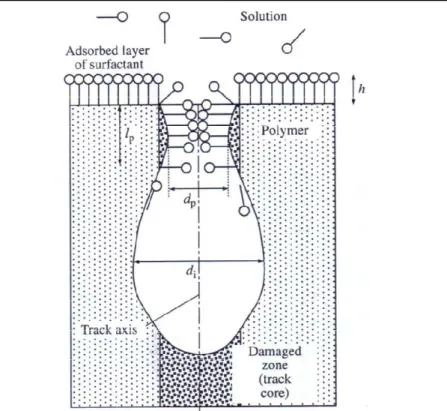
The formation of pores in polycarbonate films exposed to accelerated ions during their treatment with an alkaline solution containing a surface-active agent was studied [60]. It was found that the shape of the pores is determined both by the structure of the initial film and by the features of the interaction of the surface active agent with the surface of the polymer and its transfer to the track. Due to the inhomogeneity of the starting material, the cross-section of the pore track va- ries along the length of the pore. The presence of a surface-active agent leads to an additional effect. Being adsorbed to the surface of the film and to the inputs of
Figure 6 – Schematic diagram illustrating the initial stage of etching of heavy ion tracks in a polymer in the presence of a surfactant
etched heavy ion tracks, the surface-active agent molecules tend to reduce the etch rate, resulting in "roll-like" pores (figure 6).
The use of a surface-active agent as a component of a chemical etching solu- tion makes it possible to vary the shape of the pores of the TM with respect to direction, optimizing their efficiency and selectivity.
Investigation of the properties of polyethylene terephthalate TM modified by the polymerization of dimethylaniline in the discharge of direct current showed that membrane treatment on the anode provides polymer precipitation both on the membrane surfaces and on the pore walls [61]. The polymer obtained from di- methylaniline by plasma polymerization can swell in aqueous solutions, and the degree of swelling depends on a large extent of the pH solution. This process is associated with the formation of a positive charge on nitrogen atoms. The swel- ling of a layer of plasma-polymerized dimethylaniline on the surface of the pores causes a reduction in the pore diameter of the membrane. In membranes with a deposited polymer layer, partial reduction of pores is observed, leading to a decrease in water permeability in solutions at pH 1.2. At pH 4.6 there is no for- mation of charge on nitrogen atoms, and the polymer swells to a much lesser degree, thus leading to an increase in the permeability of the membrane. The introduction of iodine into the polymer layer leads to the formation of poly-
electrolyte, the swelling of which in the acid medium leads to a complete reduc- tion of the pores within certain pressure limits. As the pressure increases, the gel collapses due to the transition of the coil-globule, as a result, the permeability of the membrane increases sharply. The results indicate that PET-TM, modified in dimethylaniline plasma, is capable of reversibly changing its permeability depen- ding on the pH of the solution and the applied pressure.
The dependence on the electrical conductivity of KClaqueoussolutions in the pores of polyethylene terephthalate and polyimide track etched membranes on the solution concentration and pore diameter was studied by impedance spectroscopy [62]. It was found that the electrical conductivity values, calculated from the ex- perimental results, significantly exceed the standard values in the case of small pore diameters and low solution concentrations, and this difference is more pro- nounced in the case of PET-TM. As the solution concentration and pore diameter increase, the electrical conductivity of the solution in the pores tends to approach the standard values. The observed effect is explained by the presence of a free layer on the walls of the pores, which appears as a result of decomposition of the polymer caused by irradiation with high-energy ions. The contact of this layer with the solution leads to the formation of a gel layer filled with electrolyte and shortening the measured resistance of the membrane.
A plasma-chemical process was developed for the production of composite TM with an electrically conductive coating of nitride-titanium particles having a complex hierarchical structure [63]. Due to the deposition of nitride oxide on the surface of PET-TM, the membrane channels become asymmetric, and the film power is enhanced. The size of the pore openings in the composite membranes can vary over a wide range by changing the synthesis parameters. The possibi- lities of direct use of composite TM in electron microscopy for qualitative and quantitative fractionation by the size of microelements in natural waters by means of ultrafiltration have been demonstrated by the example of a number of macro- (C, Al, Si, Mg, Fe, P) and macroelements (Sr, U, Th).
Improved TM was used for the first time to study the distribution of elements between particles of different sizes and other water components. The properties of strengthened membranes are considered [64]. Factors affecting the quality of water in the Volga River near the water intake near the city of Dubna in the Moscow region and drinking water in various parts of the city are characterized by the fractional composition of macro and micro components.
The key problem of nanometrology is the development of relatively simple and reliable methods for measuring the geometric parameters of nanoobjects.
Such measurements are usually made using scanning electron (SEM) and scan- ning probe microscopes (SPM). The ability of SPM to perform a 3D survey of nanoobjects requires the presence of three-dimensional reference materials, among which, for example, step structures obtained by anisotropic etching of (100) -oriented silicon wafers can be mentioned. Three-dimensional silicon step- ped nanostructures are currently used for calibration and verification of SEM and SPM along with such traditional reference materials as the islet of gold for SEM
and oriented graphite for SPM. The potential of etched polymeric membranes with a conductive coating of titanium nitride for calibration and verification of SEM, as well as SPM operating in the scanning tunnel microscope and ACM modes, was demonstrated [65]. This universal reference material can be used both in ultrahigh vacuum and in environmental conditions.
The sorption of polyethylene glycol with a molecular weight of 3 and 40 kDa on TM at different pH has been studied [66]. Sorption of polyethylene glycol and the selectivity of its sorption increase by decreasing pH. The contact angles of the water with the membrane measured for both intact TM and for polyethylene glycol modified ones. Sorption of polyethylene glycol on TM reduces the contact angle of the film, which indicates an increased hydrophilicity of its surface. The fibers of human membrane aqueous albumin and the membrane aqueous insulin adhesive show that, unlike insulin, human serum albumin makes TM more hydrophilic than polyethylene glycol. Due to the relatively low surface tension, 5% by weight of human aqueous albumin completely displaces polyethylene glycol from the surface of the modified TM.
The ultrafiltration of aqueous solutions of sodium lignosulfonate through TM with pores of 30 nm was studied [67]. Their selectivity was studied depending on the concentration of sodium lignosulfonate (10, 20, 50 and 100 mg/dm3) and electrolyte NaCl (10-3, 10-2 and 10-1 M). It was shown that ultrafiltration of solutions of lignosulfonates is associated with the mechanism of "membrane- selective permeability-related" charge. Selectivity of membranes decreases with increasing concentrations of lignosulfonate and NaCl, as well as the degree of filtrate extraction.
Compared with proteins and water-soluble dyes, the adsorption properties of metal-ceramic and etched PET-TM are compared [68]. It is shown that metal- ceramic membranes have a noticeably higher adsorption capacity (calculated per unit surface area) than PET-TM. In this case, the nature of the adsorption of these substances on both types of membranes is very similar and is determined by the combination of ionic and hydrophobic interactions. The adsorption values of the main dyes are much higher than those of the acid dyes, because of the negative charge on the surfaces of the membrane. The isotherm of adsorption of the main dye of rhodamine 6G on PET-TM from the aqueous solution is characterized by growth in the concentration range below 1 μmol/l due to the presence of highly active adsorption sites on the surface. Adsorption of dyes is significantly reduced when isopropanol is added to the aqueous solution. Using as an example the base protein cytochrome C, it has been found that its adsorption on cermet membranes can be prevented by increasing the ionic strength of the solution.
The possibility of obtaining fracture discontinuities of trace membranes based on polyethylene naphthalate was investigated by electron microscopic studies [69]. These splittings make it possible to study the structure of the pore canal over the entire length of pores from one surface to the other (figure 7).
а b
Figure 7 –
Electronic microphotographs of membrane cracks based on polyethylene naphthalate obtained after a) UV irradiation with a LE-30 lamp for 7 days,
b) after exposure to high-energy protons with a dose of 107 Gy, c) after exposure to nitric acid vapor
c
Because of the high radiation and thermal stability of polyethylene naph- thalate films, thermal, ultraviolet and radiation treatment methods used for the production of brittle films of polymers such as PET, polycarbonate and poly- propylene are unsuitable for them. Processing samples with concentrated nitric acid vapor for 1.5 months makes them brittle. It is possible to obtain a good cross- section.
Based on the results of the study, samples of chemically resistant TM were obtained [23]. The structure of the porous membrane was formed by bombarding a polyvinylidene fluoride film (PVDF) with 41 MeV argon ions followed by thermal treatment and chemical etching. Ion-track membrane PVDF can be used for the production of a proton exchange membrane.
The surface diameter of the pores is approximately 250 nm. This value con- firms that the heat treatment and composition of the etchant accelerated the growth of the pores during etching compared to the results reported previously.
Conducting research confirmed the values of pore diameters. The results of this study and the use of thermal treatment of irradiated PVDF allowed to reduce the etching temperature of the through pores and increase the etching rate of the PVDF track. Thus, it can be expected that the technology of making membranes resistant to aggressive media will be developed in the foreseeable future, and PVDF membranes after appropriate grafting to change their surface properties will find application in fuel cells.
The possibility of using TM for subsequent treatment of biologically purified domestic effluents from individual buildings was investigated [70]. The depen- dence of pressure on the productivity of distilled water and the process of filtering of effluents for TM prepared from Russian and imported films, the dependence of the efficiency of the process and the efficiency of purification on the pore size of the membrane in the dead-end and transverse flow modes, the efficiency of traditional methods of regenerating TM using citric acid and the influence of the reverse washing to restore the efficiency of filtration of biologically treated domestic sewage.
Oxidative polymerization of pyrrole and N-methylpyrrole was studied using matrix synthesis on PET TM [71]. By scanning electron microscopy, it was found that a polymer film was formed on the surface of membranes and on the walls of membrane pores. The polymerization rates on the surface of membranes and pore walls, as well as the yield and structure of the polymer film, depend on the membrane parameters (pore length, diameter and porosity), the chemical structure of the monomer, the diffusion of polymerized solutions through the pores of the template and temperature.Methods for obtaining samples of a porous polymer for studying its structure using scanning electron microscopy are described. The technique for preparing cracks is supplemented by preliminary treatment of the polymer with radiation, photo- or thermo-oxidative degradation to make it brittle.
The advantages of this method have been demonstrated with Mylar, polycar- bonate and polypropylene TM [72].
The kinetics of isothermal evaporation of distilled water, which was in re- mote (10-15 mm) contact with porous TM, was studied by microgravimetry (deri- vatograph). When the H2O-TM system contained a dispersed medium, the sup- ramolecular structure of the water changed, and the number of clusters (coherent domains) decreased sharply. Extraction of the light phase from liquid water correlated with the chemisorption of H2O molecules containing a hydrogen para- isomer, which predominantly form coherent water domains [73].
The flow potential method implemented in a slot device using KCl solutions of 10-4-10-2 mol/L was used to study the electro- surface characteristics of PET films, both initial and irradiated with heavy ions, and also in the form of TM with pore sizes of 50 and 210 nm, made of these films [74]. Their potentials and sur- face charges are calculated. The obtained data indicate that irradiation of polymer films with heavy ions reduces the ζ potential and the surface charge. However, as a result of film etching, when preparing a TM, the potential and surface charge increase and exceed the corresponding values for the original film.
The processes of electric current flow through metal-covered TMs in air and in vacuum are consistent with the traditional concepts of the current dependence on the voltage in the dielectric [75]. The reversible change in the current-voltage characteristic during the transition from vacuum to air (and vice versa) can be explained by reversible processes of adsorption-desorption of atmospheric mois- ture on TM. The same sorption processes can explain the time dependence of the intensity of the current when the voltage is applied. In this regard, the identified effects should be taken into account when choosing the operational conditions of field emission nanostructures based on metal-coated TM in future technical applications.
The results of a structural study of conductive polymer coatings deposited on TM from PET by matrix synthesis are reported [76]. The following aspects of the quality of polymer coatings were studied: the ratio between the film and the granulated polymers, the polymer distribution over the surface, and the thickness of the polymer layers on opposite sides of the TM. The fraction of granular polypyrrole on the surface and in the pores of the film increased with the pore diameter. The decrease in the polymerization temperature reduced the amount of granular polypyrrole on the surface of the membranes, while its effect on water permeability of TM remained unchanged. A more uniform distribution of poly- pyrrole over the TM surface can be achieved by equalizing the density of the reac- ting solutions; but the fraction of granular polypyrrole on the surface of the membrane increased in this case. It turned out that the polymer coatings on both sides of the surface of the membrane matrix have different thicknesses. Poly-N- methylpyrrole completely covered only one side of the TM facing the monomer solution.
The features of etching of latent heavy ion tracks in PET prior to pore for- mation were studied [77]. It turned out that the etching process includes the fol- lowing steps: 1) penetration of the electrolyte into the pores due to capillary forces and removal of products of monomeric radiolysis; 2) swelling of cross- linked (due to secondary electrons) polymer regions around the tracks to form a gel layer; 3) removal of the gel layer and the formation of TM with a pore radius of 40-50 Å. Radiation-chemical processes in polymers affect the physicochemical properties of the resulting membranes. The microrelief of their surface was studied by the AFM method.
Surface-active substances are used to etch TM to form pores of specific geometry, for example, to obtain membranes with improved characteristics.
Knowledge of the state of the molecules of surface-active substances in tech- nological solutions, in particular, the patterns of their aggregation, is important for understanding the mechanisms of the action of surface-active substances on the etching of tracks. Data on the micellization of dodecyl (sulfophenoxy) benze- nesulfonate and nonylbenzene deca (ethylene oxide) in neutral and alkaline electrolyte solutions of various concentrations presented in [78]. The measu- rements carried out using small-angle neutron scattering. It is shown that cylin- drical (ellipsoidal) micelles formed in solutions. The characteristic sizes of
micelles as function of the surfactant and electrolyte concentration are deter- mined. The correlation of the obtained data versus the geometry of track nano- pores and the dynamics of their etching in surface-active solutions is discussed.
The structural and electrokinetic characteristics of microfilters versusof track coating with a pore radius of 1 μm and microfilters modified with a perfluorinated sulfocationite ionomer, depending on the pH and the concentration of KCl solutionswere studied [79]. The colloidal properties of the modified microfilters and the perfluorinated sulfo-cation exchanger membrane MF-4SK were com- pared.
Time-of-flight spectra of ions formed during the extraction of negative ions from the KI solution in a water-glycerin mixture by high-speed electric field pulses are analyzed using a source with a polymer-based interface. It is shown that the ions formed in the secondary processes of bombardment of the membrane surface contribute significantly to the observed spectra. It was found that the peaks of negative hydrogen ions have the highest intensity in the spectrum, which indicates the effective emission of these ions upon bombardment of PET by se- condary ions with an energy of about 6 keV. The main directions of modification of the membrane interface are described to reduce the fraction of secondary ions in the ion beam [80].
The properties of asymmetric nanopores obtained by chemical etching of tracks by accelerated heavy ions have been studied [81]. Procedures have been developed to control the size and shape of pores over a wide range. The presence of charged functional groups on the walls of pores is an intrinsic property of TM, which makes them a convenient object for studying electrokinetic phenomena in nanocapillaries. In electrolyte solutions, asymmetric "road" membranes exhibit a diode effect. Two methods of manufacturing asymmetric nanopores in PET films have been proposed and introduced into practice. The features of both methods, their advantages and disadvantages are considered.
The possibility of performing an energy-efficient irradiation of 20-μm PET films for the production of TM is considered[82]. Irradiation carried out on both sides of the film by an Ar8+ ion beam with an energy of 53.4 MeV, the energy of which was insufficient to form a through track. The characteristics of the obtained TM samples were studied. It has been found that these membranes can be used in some cases as a basis for manufacturing composite gas separation membranes.
The iron and cobalt-iron nanostructures synthesized in polymer ion-track membranes were studied by Mossbauer spectroscopy in combination with scanning electron microscopy, energy dispersive analysis, and X-ray diffraction data [83]. The nanostructures obtained are single-phase Fe1-xCox nanotubes with a high degree of polycrystallinity, the length of which is 12 μm; their diameter is 110 ± 3 nm, and the wall thickness is 21 ± 2 nm. Fe2+ and Fe3+ cations were found in nanotubes, which belong to the iron salts used and are formed by electro- chemical deposition. The Fe nanotubes show the distribution of the directions of the magnetic moment along the directions of the Fe atoms, while the Fe/Co nanotubes have a partial magnetic structure along the axis with an average angle
between the magnetic moment and the nanotube axis of 34° ± 2°. Substitution of the Fe and Co atoms in the nearest medium of the Fe atom in the structure of Fe/Co nanotubes leads to a significant increase in the hyperfine magnetic field on
57Fe nuclei (by 8.7 ± 0.4 kOe) and to a slight decrease in the Mossbauer line shift (by 0.005 ± 0.004 mm /s).
The results of an investigation of the friction process of a metal-polymer pair on a disc-scheme are presented[84]. The material for the study was TM from PET and had pores with a diameter of 0.4 and 0.8 μm. The influence of sliding velocity for membranes with pores of 0.8 μm is determined. It was shown that an increase in the pore diameter leads to decrease the coefficient of friction and its amplitude oscillations. The study showed that TM has sufficient resistance to wear and can be successfully used in surgical procedures in the layers of the cornea.
PET-containing etched membranes with an average pore size of 400 nm underwent UV grafting of polyacrylic acid after oxidation of internal surfaces by the H2O2/UV system [85]. Carboxylate groups of chains of grafted polyacrylic acid readily interacted with Cu2+ ions in aqueous solutions. These ions were con- verted into metallic copper nanoparticles by radiation-induced reduction of copper ions in a water-alcohol solution by gamma rays in a dose range of 46-250 kGy.
Copper ions chelating with COOH groups of polyacrylic acid chains grafted onto PET form an ion-polymer complex that prevents the formation of agglomerates during the reduction of copper ions to metallic nanoparticles. Detailed analysis by X-ray diffraction, transmission electron microscopy, scanning electron micro- scopy and energy-dispersive X-ray spectroscopy confirmed the superposition of copper nanoparticles with an average size of 70 nm on the inner surface of PET nanocannels. Samples were also examined by EPR spectroscopy for the subse- quent reduction of copper ions.
Track membranes based on PET, activated by low-temperature plasma, were modified using a solution of N-isopropylacrylamide in an organic solvent [86].
The filtration efficiency of the modified membranes was 2.5 times higher than that of the original TM.
On the basis of TM as templates, secondary metal structures are grown, which are promising for use in optics and as auto-emission (cold) cathodes. Four methods for analyzing the distribution of pores over the surface of TM (nuclear filters) are considered [87]. It is shown that on some TM samples the pore distri- bution function is Poisson, on the majority there is clearly a deviation from the Poisson distribution. The fractal dimension of the pore distribution in the TM does not describe the distribution law, but characterizes the interaction between the fields of mechanical stress near the pores.
Experimental studies carried out to obtain TM samples by irradiating a mo- nolithic PET film accelerated on the pre-fermentation section of the Kharkov Linear Heavy Ion Accelerator LUMZI by Ar12+ ions with an energy of 1 MeV/nuc- leus [88]. And the subsequent physicochemical treatment of the irradiated film to form pores of a given size and density. Electron-microscopic studies of pore etching in a polymer film were performed. Samples of TM with a pore diameter
≥ 0.05 μm prepared for the development of membranes with bacteriostatic action in water treatment systems.
X-ray microscopy as a method of observing hidden details, opaque in the visible range of polymeric materials, and biological objects with variable pene- tration depth and micron or submicron resolution increasingly attracts the atten- tion of researchers [89]. One of the reasons for this interest is due (for bioobjects) to the need to observe the processes occurring in biological tissues in vivo at the cell and whole organs level with submillimeter, and sometimes submicron reso- lution.
One of the main reasons restraining the widespread development of X-ray microscopy of these systems is as follows. In the short-wave part of the X-ray spectrum the absorption coefficients of many substances are small and very close.
With increasing wavelength the difference in the absorption coefficients in- creases, but with it absorption also increases.
The possibility of obtaining enlarged images of objects with a micron resolution is shown [89]. An image of a number of objects with an increase of ~ 20 has been obtained. It was possible to register enlarged images of holes in shock TM with a minimum diameter of about 2×10⁴ nm.
The problem of creating optical filters for soft X-ray and hard ultraviolet spectral regions with a high level of blocking of ultraviolet and visible back- ground radiation is discussed in Ref. [90]. Unlike traditional thin-film systems, filters based on TM-porous polymeric films with micron and submicron pores are investigated. For the production of filters it is proposed to use membranes of polyethylene naphthalate and polyimide, the ultraviolet absorption edge of which lies near the boundary of the visible region. A comparison is made of membranes from polyethylene naphthalate and polyimide with known porous PET-TM obtained by etching ion tracks. The spectral characteristics of polyethylene naphthalate and polyimide films are analyzed, the process of formation of track tracks during the serial processing of samples by accelerated heavy ions and chemical reagents is analyzed, the main parameters of the resulting porous structures are determined. polyethylenenaphthalate and polyimide TM can be used in x-ray astronomy as filters detectors of solar telescopes and in optical experiments with laboratory plasma.
In this review the state and properties of track membranes for baromembrane processes (micro, ultra and nanofiltration) are considered. One of the way to increase the productivity of membrane modules and their selectivity is to modify their porous structure.They are porous materials that are designed to purify liquid and gas mixtures from unwanted particles, to isolate specific components of the mixture.
REFERENCES
[1] Bedin S.A., Rybalko O.G., Polyakov N.B., Zagorsky D.L., Razumovskaya I.V., Bon- darenko G.G., Oleinikov V.A. Metallic micro- and nanowires, production by matrix synthesis and their application in mass spectrometry // Perspective materials. 2010. N 1. P. 98-104

![Table 2 – Values of the dielectric constant and coefficient the dielectric losses of some solvents [9]](https://thumb-ap.123doks.com/thumbv2/azdokorg/10578707.0/43.723.94.627.306.572/table-values-dielectric-constant-coefficient-dielectric-losses-solvents.webp)
![Figure 7 – Number of publications on use microwave radiation in chemistry [18]](https://thumb-ap.123doks.com/thumbv2/azdokorg/10578707.0/47.723.94.628.604.896/figure-number-publications-use-microwave-radiation-chemistry-18.webp)