H0: 3 factors do not have a significant impact on the market development of a high market capitalization cryptocurrency. H1: 3 factors have a significant impact on the development of the high market capitalization cryptocurrency market. H1: 3 factors significantly influence the development of the low market cap cryptocurrency market.
Literature Review
On the concept of cryptocurrency and early research
Also, some of the examples given below in the text show that cryptocurrency is extremely susceptible to media, social media and influencers due to its instability (Roubaud, 2019). food, museums, cinemas, drugs, alcohol, etc.), a person who has access to such information can completely control the life of the person of interest. The author concludes that based on such cases, it can be argued that cryptocurrency is one of the most unstable economic units.
Research on the risks associated with cryptocurrencies
Despite all these advantages of the emergence of cryptocurrencies, there are also a significant number of negative aspects associated with digital risks. First, the technological risk is associated with the fact that the benefits of digital technologies can be fully manifested only with a balanced development of organizations in the real sector of the economy. However, if parts of the economy undergo digitization at different rates, it can lead to a total imbalance in the entire economic system (Cross, 2020).
Secondly, the social risk is related to the fact that the development of the digital economy inevitably leads to a significant transformation of the labor market, which is complex and takes place gradually as more and more traditional sectors are involved in the digital economy. The problem is that such positions are usually occupied by representatives of the least competitive and most vulnerable parts of the population. Therefore, when digitalizing the economy, the state should consider the possibility of implementing special measures to adapt such categories of citizens to the potential problems. they can be confronted. As a result, an atmosphere of social tension will arise, which may lead to the rejection of the very idea of introducing the digital economy (Fung, 2018).
According to experts, in the cross-border world of the digital economy based on blockchain technology with its decentralization and the absence of a regulator, the role of the state will have to be reconsidered. This will lead to the abolition of the governing and controlling role of the state, the weakening of the state's regulation of the economy, the loss of the ability to exercise their functions and protect their sovereignty (Grassi, 2021).-new.
Empirical studies on the cryptocurrency market
According to a study by Conlon (2021), there is a brief positive relationship between expected inflation expectations and Bitcoin and Ethereum coinciding with the initial stages of the COVID-19 crisis. Indeed, the data shows signs of this behavior and the stock-to-flow ratio appears to be a leading driver of the price of Bitcoin. It is expected that the other coins are mainly driven by the use of the network, such as with XRP.
The analysis showed that financial drivers do not seem to move in step with the coins' prices. The price of Ether is a proxy for the overall popularity of the Ethereum network, which. Second, given that there is an equilibrium of cointegration, the model allows you to simultaneously control the efficiency of the market.
Cryptocurrency (CC) markets are once again in the spotlight of market participants, as the market capitalization of the first decentralized digital currency, Bitcoin, crossed the threshold of. By fitting asymmetric GARCH models, it is found that the yield from major cryptocurrencies demonstrates the stability effect, thus supporting market inefficiency. Empirical data from nonparametric and parametric tests also testify against the random walk hypothesis, thus confirming market inefficiency.
Research on the impact of the COVID-19 pandemic on the cryptocurrency market The brief history of Bitcoin and other major cryptocurrencies does not give researchers this.

Research on the impact of the COVID-19 pandemic on the cryptocurrency market The short history of Bitcoin and other leading cryptocurrencies does not give researchers the
As part of a comparison of the performance of stable gold-plated coins and cryptocurrencies, it was found that gold-backed cryptocurrencies were developed to increase the stability of the digital asset ecosystem and eliminate excessive volatility. The application of the quantile unit root test shows that stable gold-plated coins are closer to gold in terms of tail behavior than to bitcoin or tether. Moreover, the main objective of their research was to study the possible consequences of the first and second waves of the COVID-19 pandemic crisis on this system.
First, the dynamic total return and volatility ratio change over time, and these estimates show two peaks: one at the beginning of the sample and one at the beginning of the first wave of the global pandemic outbreak. The only exception is the euro, which, when analyzing the net dynamic volatility ratio, shows a clear net receiver profile at the beginning of the sample and a net sender profile throughout the first wave of the COVID-19 pandemic crisis. . This result demonstrates the particular virulence of this wave of the SARS-CoV-2 coronavirus pandemic in Europe.
The results of the study showed that the cryptocurrency network did not change significantly due to the outbreak of the COVID-19 pandemic on December 31, 2019 or the WHO's statement that the COVID-19 outbreak was a pandemic. This result is important for scientists and investors, since some of the existing conclusions in the literature, such as the presence of advantages in the field of stocking, efficiency and diversification, may be related to specific phases of the market.
How various factors affect the cryptocurrency market
Furthermore, the empirical results of Chancharat's (2021) research show that lagged returns inversely affect their actual oil returns. Also Nakagawa (2021) states that the number of cryptocurrency wallet users is positively related to the expected return on gold. He also says that uncertainty in the real economy is a crucial source of cryptocurrency volatility.
This topic is covered in a very limited body of literature and research, but Chohan (2017) argues that the growth of cryptocurrencies has been met with different regulatory and legislative responses in national jurisdictions, with some signaling approval of the general transactional and functional aspects of cryptocurrencies and others respond with legislative prohibitions or restrictions. There is information that the introduction of bitcoin is partly also due to the usefulness of cryptocurrencies to participate in illegal trade (Saiedi, 2020). Before explaining the research design, we will review the aims and questions of this research.
The research question is to identify what are the problems and prospects of the cryptocurrency market development and what factors influence their change. H0: 3 factors have no significant influence on the development of the cryptocurrency market with low market capitalization.
Design of research
Data collection
Results for high capitalized cryptocurrencies
In conclusion, the actual t-test is greater than the tabular one with a probability of 95% and proves that the observations are statistically significant. While the table value of F-test is 4.56, so the actual F value> than the table, which means that the significance is confirmed.
Results for low capitalized cryptocurrencies Regression
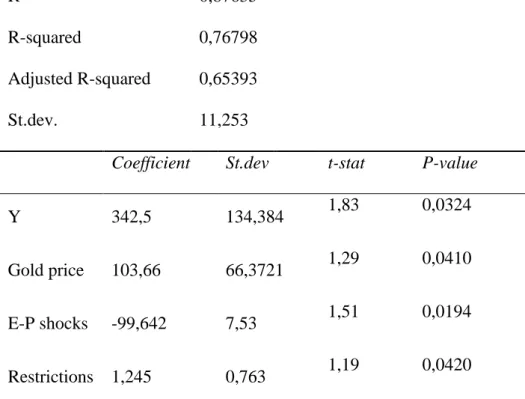
Regression statistics of factors affecting low market capitalization cryptocurrency market II model determination coefficient is 0.78, which shows that 78% of % of shareholders' decision is explained by selected factors and it is a high variance. Correlation coefficient is a statistical relationship between two or more random variables (or quantities that can be considered as such with an acceptable degree of accuracy) (Cohen, Cohen, West, & Aiken, 2002). In this case, changes in the values of one or more of these quantities accompany a systematic change in the values of another or other quantities.
In conclusion, the actual Student's t-test is greater than tabulated at 95% probability and proves that observations are statistically significant.
Discussion of results
For young and low capitalized cryptocurrencies, EPS did not show statistical significance, but factor of RR increases price volatility on these currencies. More restrictions are imposed on these types of currencies, then more fluctuations occur on the market. Interestingly, the rising Gold price has negatively affected volatility as these are substitute assets and can cause additional volatility.
BTC, LTC, XRPP are the main currencies and it is necessary for Kazakhstan crypto miners to understand what drivers affect further volatility. As we can see, EPS and RR imposed additional volatility in the last 2 years which the government could control.
Recommendations
Consistent with previous literature, Bitcoin's volatility has been documented to be much higher than that of other financial assets. In particular, Bitcoin's volatility is significantly increased a day before an article on Bitcoin regulation is published in a newspaper, the Financial Times. In the latter case, the effect is particularly strong, especially for the right side of the jump volatility component.
The value of a bitcoin is primarily determined by its stock-to-flow ratio, that is, the ratio of the total amount of BTC available to newly generated coins. According to the authors of the report, due to the inherent scarcity of the system, bitcoin should be valued on the model of gold: the production of bitcoins is difficult and the maximum number of coins is limited from the beginning. And the halving dates, that is, the halving of bitcoin production, are considered growth impulses, since the reward for the production of new coins in this case is halved.
Unlike Bitcoin, the value of the second largest cryptocurrency, Ethereum, largely depends on the number of verified smart contracts. Cryptocurrencies in the new economy: problems and prospects, Journal of Economic Research and Business Administration.