THE PERCEPTION OF THE EFFECTIVENESS AND GOALS OF THE PREFERENTIAL CAR LOAN PROGRAM REINTRODUCED IN 2022
by Diana Kunbulatova, Aidar Mussabekov, Arkhat Kanatbayev
Supervisor Dr. Md Noore Siddiquee
Master’s project
Paper submitted in partial fulfillment of the Degree of Master in Public Administration
Graduate School of Public Policy Nazarbayev University
Astana, Kazakhstan 19 November 2023
Table of Contents
CHAPTER 1. INTRODUCTION ... 4
Background ... 4
Preferential Car Loan Terms Description ... 8
Policy ... 9
Inputs ... 9
Outputs ... 9
Outcomes ... 9
Objectives of the Study ... 10
Outline of the study ... 10
CHAPTER 2. LITERATURE REVIEW ... 11
CHAPTER 3. METHODOLOGY ... 16
Research Question ... 16
Research Design and Research Methods ... 16
Survey ... 16
Interview ... 16
The Site and Data Collection ... 17
Ethical considerations ... 17
Limitation ... 17
CHAPTER 4. DATA ANALYSIS, RESULTS, AND DISCUSSION OF FINDINGS . 18 CHAPTER 5. POLICY RECOMMENDATIONS AND CONCLUSION ... 26
Appendix 1 ... 36
Appendix 2 ... 39
Appendix 3 ... 40
Appendix 4 ... 42
REFERENCES ... 43
ABSTRACT
The frequent instability of world commodity prices and recurrent crises have forced Kazakhstan to restructure its economy and move away from the extraction and export of raw materials. These occurrences prompted Kazakhstan to undertake an exploration of potential strategies that would optimize economic outcomes, therefore introducing preferential lending programs.
Existing theories and concepts emphasize the significance of government incentives promoting the automotive industry for technological, economic, and industrial advancements. Study findings analyzed the efficacy and practices of various automotive industries in different countries. Our theoretical framework illustrates how preferential lending, influenced by international experiences and government policies, contributes to the development of the automotive sector in Kazakhstan.
Paradoxically, limited research on the concentration of the car loan market and the effective implementation of preferential lending programs in Kazakhstan seems to exist. In this regard, employing a descriptive and comparative research approach through the utilization of surveys, collected from the public, stakeholders, and experts, enabled the gathering of relevant data regarding the respondents' perceptions of the goals and effectiveness of the preferential car loan program (hereinafter - the Program).
Our survey revealed the need for a more precise definition of the Program's goals.
The survey results showed that most of the respondents perceive the Program primarily as a tool to help citizens buy cars and support the domestic auto industry while others recognize it as harming the environment.
Our project proposes recommendations to improve the efficiency and transparency of the Program. These include defining objectives, introducing digital solutions, enforcing financial controls, enhancing public awareness, preventing car price increases, incentivizing electric vehicle production, and taking a holistic approach to automotive industry development. Implementing these proposals will allow Kazakhstan to optimize the preferential car loan program and more effectively address its objectives.
Keywords: Automotive Sector Development, Preferential Lending, Government Policies, Economic Growth.
CHAPTER 1. INTRODUCTION
Background
The significant drop in oil prices in 2014 led to an economic downturn in oil- dependent countries like Kazakhstan. As a result of this downturn, President N.
Nazarbayev, in his address to the people of Kazakhstan, "Nurly Zhol - the way to the future," instructed the Government of Kazakhstan to allocate 100 billion tenge for preferential lending for implementing projects in the food and chemical industry, machine building, and service sector (2015). Hence, with this direction, Kazakhstan emphasized the development of processing industries to balance out the country's extractive industries. The Government of Kazakhstan has made the strategic decision to prioritize the development of the local automotive industry as a means to drive economic transformation and enhance the processing sector in the medium and long term. The automotive industry has been found to have a significant multiplicative effect (2009) on many sectors of the economy, indicating its potential to drive economic growth.
Additionally, the structural adjustment of the economy can further enhance this effect, positioning the automotive industry as a key driver of accelerated economic growth.
Based on the classification provided by the OSCE (Galindo-Rueda, Verger, 2016), automobiles have a relatively high technological complexity compared to other manufactured goods in the national industry. Holding all other factors constant, this particular industry plays a more substantial role in driving the economy's structural transformation compared to other sectors.
To maintain this momentum, in 2015, the Government of Kazakhstan and the National Bank of Kazakhstan developed a Joint Action Plan, designed for 20 years, depending on the funding sources, to support domestic car manufacturers in producing final finished products (2015). The operator of this Program is the JSC "Development Bank of Kazakhstan," which is part of the group of companies of JSC "National Management Holding "Baiterek." Additionally, in 2019, the Program of lending to buyers of cars of domestic production was approved by the Board of the National Bank of the Republic of Kazakhstan (2019). This Program provides loans to individuals through the second-tier banks participating in the Program for the purchase of cars worth no more than 15 million tenge, the term of financing not more than seven years, and a nominal interest rate of 4% per annum. In contrast, the annual effective interest rate should not
exceed 7.5% per annum, considering the costs of the final borrower on insurance and registration of motor vehicles. The total financing limit under this Program is 82 billion tenge, including 26 billion tenge from the National Fund of the Republic of Kazakhstan, 16 billion tenge from the national budget, and 40 billion tenge from the National Bank of Kazakhstan. These funds are used repeatedly in the Program for car loans to individuals on a revolving basis. As of September 28, 2023, 34.4 thousand individuals were issued car loans worth about 200 billion tenge under the Program of the Development Bank of Kazakhstan (2023). Thus, the primary purpose of this Program is to support domestic automakers by stimulating consumer demand among the population by subsidizing the interest rate on loans.
On the other hand, the increase in car production in Kazakhstan hurts the environment. In this regard, as part of the Concept for the transition of the Republic of Kazakhstan to a "green economy," the Environmental Code of Kazakhstan in 2015 included extended producer responsibilities (EPR) to recycle through particular companies the waste generated after the loss of consumer properties in goods, including cars. Globally, there are around 400 schemes of EPR. Most of them are privately held businesses. Only four countries - China (for electrical and electronic equipment), a few US states, Belarus, and Taiwan - have largely state-owned EPR operators (OECD, 2019).
According to the online publication Kursiv (2022), the intermediary between automobile manufacturers and recycling companies was the “Operator ROP” LLP (EPR), whose sole founder was Aliya Nazarbayeva, the daughter of Kazakhstan's first president. The role of the private “Operator ROP” LLP was to collect the recycling fee from car owners and to build a holistic infrastructure for the recycling and disposal of worn-out cars, agricultural machinery, and other hazardous waste to protect the environment. According to the Minister of Ecology S. Brekeshev (2022), over the five years of existence, as of January 12, 2022, 691.8 billion tenge of recycling fees were received by the "Operator ROP" LLP.
In continuation to this, due to the events in Kazakhstan on January 11, 2022, and growing dissatisfaction among the population with the introduction of the utilization fee in Kazakhstan, President K. Tokayev instructed the Government to transfer the LLP
"Operator ROP" functions from private ownership to the state. As part of the execution of the order of the Head of state, "Operator ROP" LLP in 2022 returned 338.9 billion tenge to domestic automakers, paid about 49 billion tenge in taxes, and allocated about 100 billion tenge for a new program of preferential car loans (2022).
As a result, by the Decree of the Government of the Republic of Kazakhstan dated January 18, 2022, 100% of the share in the authorized capital of the LLP "Operator ROP"
from private ownership was transferred to the state. The Kazakhstani operator of the extended producer responsibilities was defined by the state company JSC "Zhasyl Damu"
under the Ministry of Ecology and Natural Resources of Kazakhstan.
This, in turn, led to the launch of a new Program by the Government of the Republic of Kazakhstan. On April 15, 2022, the Kazakhstani government amended the Rules No. 227 of financing by the operator of the extended liability of manufacturers (importers) organizations owned by the state and (or) the national management holding, to further finance projects in the manufacturing industry, aimed at improving the environment. By those rules, in May 2022, “Zhasyl Damu” JSC transferred 160 billion tenge, collected as a utilization fee, to the Industry Development Fund, a subsidiary of
“Baiterek National Management Holding” JSC, to implement a new 30-year Program.
This included transferring 100 billion tenge to individuals for purchasing cars of domestic production, 30 billion tenge to finance leasing of public transport of the domestic output and 30 billion tenge to fund leasing of agricultural machinery.
The Program's purpose is to provide measures of state support for manufacturing industry projects aimed at improving the environment by stimulating consumer demand and renewal of vehicles in the Republic of Kazakhstan, which adhere to the environmental standards specified by domestic manufacturers' technical regulations. Hence, on May 16, 2022, the Industry Development Fund launched a new Program, but second-tier banks stopped accepting applications on July 14, 2022, as the value of applications exceeded 100 billion tenge.
Considering that the Program operates on a revolving basis, in February 2023, the Industry Development Fund resumed the short-term reception of applications under the Program by returning borrowers 7.61 billion tenge of credit funds provided in 2022, which means that only 761 people had the right to receive a preferential loan for the purchase of a car of domestic production in the amount not exceeding 10 million tenge.
To ensure the transparency of obtaining a car loan, the Industry Development Fund has developed a unique online platform autonesie.kz, and applications opened at 10:00 a.m.
on February 6, 2023. However, as a result, the limit for accepting 761 applications ended 18 seconds after the start of accepting applications (Kapital, 2023), and the number of visitors to the site in the first minute exceeded 125 thousand people.
According to the Industry Development Fund, under the Program, reintroduced in 2022, 13,347 borrowers were financed for a total amount of 105.8 billion tenge, taking into account the revolving mechanism, for the purchase of cars produced by domestic enterprises LLP "SARYARKAAVTOPROM" and LLP "HYUNDAI TRANS KAZAKHSTAN."
Thus, by the end of September 2023, more than 305 billion tenge were allocated in total, and more than 47 thousand applications were approved within all existing programs of preferential automobile crediting, which operators are the Development Bank of Kazakhstan and the Industry Development Fund.
Having reviewed the relevant regulatory framework and other sources of information for the Program, we note attention to several important aspects.
First, according to the analysis of the monitoring agency Energyprom.kz (2023), at the beginning of 2023, the number of passenger cars in Kazakhstan was about 3.91 million units; that is, there are about 197 passenger cars per thousand people in Kazakhstan. In contrast, the number of passenger cars per 1,000 people in Western Europe is 2.5-3 times higher than in Kazakhstan (UNECE, 2023). The number of cars in Kazakhstan older than ten years has already reached 2.76 million units; seven out of ten vehicles in the country are over ten years old (the average car life). At the same time, the production of cars in Kazakhstan is about 114 thousand units per year (AKAB, 2023).
Total sales of cars in Kazakhstan are about 134 thousand units per year, and only replacing three million old vehicles will take about 20 years, which is higher than the average life of vehicles.
Secondly, according to the analytical digest of the First Credit Bureau, in 2021, only one in ten cars in Kazakhstan was purchased on credit. This means that the share of preferential car loans on total new car sales in Kazakhstan does not exceed 10%. In this regard, the First Credit Bureau believes that the state Program is not critical to changing the situation in the market.
Thirdly, the lack of transparency in the mechanisms of consideration of applications for a soft loan for the purchase of a car, the general excitement around the program of concessional lending, and the inadequate number of car dealers with new cars sold under this Program led to the growth of "shadow" car market and the formation of corrupt schemes for the illicit enrichment of certain interested persons at the expense of public funds.
Fourth, given that the Government of Kazakhstan artificially restrains prices for such a socially significant type of fuel as gasoline, our country is among the top ten countries in the world with the cheapest gasoline (Globalpetrolprices.com. 2023). It is obvious that this affects the desire of people to purchase passenger cars, and the government seeks to increase their domestic production. However, this aspiration of the Government of Kazakhstan seems contradictory since the growth of production and sales of cars with internal combustion engines does not contribute to improving air quality and also negatively affects the growth of greenhouse gas emissions.
Finally, by the decree of the Government of the Republic of Kazakhstan on September 19, 2023, the new Program, launched in May 2022, has been suspended (2022). After borrowers repay, the money from the Program will now be used to finance the public transport leasing program.
Despite the main activities of the Program (development of the autonesie.kz portal, advertising, and information promotion of the Program in the media), the government has not provided the exact objectives and context of the Program. Many Kazakhstanis complain about the terms of the updated Program, saying that additional requirements allegedly imposed by car dealers and banks make it difficult to take advantage of the preferential car loans. Thus, car dealers offer citizens cars with already installed additional expensive equipment, which cannot be refused. Second-tier banks impose comprehensive car insurance for the entire loan period (up to 7 years). In this regard, many Kazakhstanis negatively perceive the updated Program's conditions (Biz Media, 2022).
Preferential Car Loan Terms Description
The Program's operator is JSC "Zhasyl Damu," and the financial operator of the Program is JSC "Industry Development Fund." The lending terms for individuals purchasing cars closely resemble those of the Development Bank of Kazakhstan's Program, and they issue loans on a revolving basis, herewith:
• the cost of the car - not more than 15 million tenge;
• the term of financing - no more than seven years;
• interest rate - 4% per annum, while the annual effective interest rate should not exceed 7.5% per annum, considering the final borrower's cost for insurance and motor vehicle registration.
The second-tier banks (Eurasian Bank, Bank CenterCredit, Halyk Bank, and Forte Bank) examine individuals-applicants' solvency and decide whether to issue loans. In
turn, the Industry Development Fund checks the applications received for compliance with the terms of the Program (purchase of a car no more than once every two years).
Logic Model Policy
The Government of Kazakhstan reintroduced in 2022 Program to stimulate the domestic automotive industry, renew the vehicle fleet and improve the environmental situation in the country.
Inputs
The financial contributions from the payments made by citizens on recycling fees supported the Program. JSC "Zhasyl Damu" conducts operations, while the JSC "Industry Development Fund" provides financing operations.
Timeline
Source: authors’ elaboration Outputs
The launch Program allowed interested individuals to apply for loan financing from four second-tier commercial banks to purchase domestic cars in dealership centers.
Outcomes
- Increased domestic car production and sales.
- The EPR initiatives' positive contributions towards improving the environment.
- Development of the car industry and new workplaces, increasing tax revenues from automakers.
- Gradual localization (manufacture) of compounds and spare parts cars.
Objectives of the Study
- To study the perception of the program's effectiveness and goals among Kazakhstan's residents.
- To obtain the results of experts' assessment and their opinions about the Program.
- To analyze difficulties and problems related to the Program implementation.
- To propose recommendations to improve the Program.
Outline of the study
The first chapter describes the state program in Kazakhstan, explaining its emergence and step-by-step development.
The second chapter presents a literature review illustrating examples of similar car loan programs and state support measures for the automotive industry in other countries worldwide.
Our study's methodology is presented in Chapter 3. Data collecting methods, such as surveys and interviews, are thoroughly explored in this Chapter.
The primary component of this paper is described in Chapter 4, which offers the data analysis and associated study findings.
Based on our study and literature review findings, Chapter 5 outlines our proposals for strengthening the preferential car loan program.
CHAPTER 2. LITERATURE REVIEW
In recent years, Kazakhstan has acknowledged the importance of the automobile sector by supporting economic growth and providing job possibilities. However, a notable obstacle faced by the industry pertains to the limited availability and affordability of financing alternatives for consumers. In response to this challenge, Kazakhstan has implemented a strategy of utilizing preferential lending as a means to stimulate the expansion of the automotive sector. Prevalent in numerous nations, preferential lending programs have been extensively employed as a means to incentivize vehicle acquisition and foster the growth of the automotive sector. This literature review aims to explore the potential benefits that Kazakhstan can derive from an examination of the existing literature on preferential automobile loans. Specifically, this study will examine the effects and advantages of preferential lending in the automotive sector for both industry stakeholders and consumers, as well as the obstacles and constraints associated with such initiatives. By gaining insights into the experiences of other nations and examining scholarly research in this domain, Kazakhstan has the potential to formulate effective policies and initiatives aimed at fostering the expansion of its automotive sector and enhancing the affordability of automobiles for its citizens.
The study conducted by Attanasio et al. (2008) investigates the presence of credit constraints within the consumer credit market, specifically in relation to car loans. The researchers' findings indicate that the responsiveness of loan demand is significantly more influenced by variations in loan maturities compared to fluctuations in interest rates, with the exception of high income households. The authors emphasize the significance of incorporating borrowing restrictions into the analysis of consumer credit behavior and offer valuable insights into the factors influencing loan demand.
In the study conducted by Natsuda K. et al. (2022), titled "Industrial policy and automotive development: a comparative study of Thailand and Czechia," an examination is undertaken to investigate the strategies employed by Thailand and the Czech Republic in the development of their respective automotive industries. This study investigates the impact of government policies and incentives, as well as the role of foreign investment, on local businesses and workers. According to the authors, success is contingent upon a multitude of factors, including the extent of governmental intervention, the influence of foreign investment, and the unique attributes of the local economy.
In their publication, Jan and Hsiao (2002) discuss the advancement of the automotive industry in Taiwan. The authors argue that governments often promote the automotive industry to foster technological, economic, and industrial potential and protect domestic manufacturers in the early stages. The study concludes that the consumer role is crucial in evaluating the four-role model for developing the automotive industry in developing countries.
The study by Peter Wad and V.G.R. Chandran Govindaraju titled "Automotive industry in Malaysia: an assessment of its development," published in 2011, examines the development of the automobile industry in Malaysia. The study suggests that the Malaysian government's protectionist policies and efforts to support the infant industry still need to achieve industrial upgrading and global competitiveness. The authors recommend that the government keep a more open and competitive environment for the automobile industry to promote industrial upgrading, technological advancement, and competitiveness.
Pavlínek's (2016) article analyzes the relationship between the state, foreign capital, and the development of the automotive industry in Slovakia. The paper argues that the top auto corporations' investment strategies primarily fueled Slovakia's automotive industry's growth. Still, the state's support played a crucial role in this process.
The article also highlights the environmental and social costs associated with the growth of the automotive sector, such as pollution and the displacement of local communities.
In 2012, Ranawat and Tiwari conducted a study that examined the impact of government policies on the expansion and progress of the automotive sector in India. The research emphasizes the substantial influence exerted by governmental policies, namely protectionism, nationalization, and regulation, on the industry. The authors posited that the implementation of this policy played a pivotal role in fostering the expansion of the Indian automotive industry.
The study conducted by Putri Nadia Esa et al. (2019) looks into the relationship between car loan behavior and customer retention in the Indian context. The research provides valuable insights into the characteristics and behaviors of individuals who have utilized car loan products or services. The research employs a cross-sectional methodology, gathering data via an online survey and employing purposive sampling to select 310 participants who have refrained from using credit for a minimum of five years following the conclusion of their credit period. Governments can stimulate the growth of
the domestic automobile industry by providing preferential interest rates and installment plans, thereby creating incentives for consumers to purchase domestic cars.
The study by Kang and Mah (2020) highlights the importance of technology- intensive sectors in fostering economic growth, with a specific focus on the automotive industries in Korea and Romania. According to their argument, Romania has strategically utilized foreign direct investment (FDI) and technology transfer as key drivers for the development of the automotive sector, predominantly through collaborative ventures with renowned companies such as Renault and Daimler. In contrast, the Republic of Korea has prioritized the development of its technology skills by means of government-led projects.
Automobile industries in both nations, according to the authors, have substantially contributed to their respective economic expansions.
Concerning the auto loan market and lending institutions, Agarwal et al. (2008) offer valuable insights into the factors that influence prepayment and default rates on auto loans in China, therefore contributing to the understanding of this market and its implications for lending institutions. The findings of the study hold significance for preferential car loan programs, which aim to promote automobile ownership and foster growth in the automotive sector. However, the implementation of these financing schemes might potentially result in an increased likelihood of default, since individuals who may not meet the criteria for conventional loans are granted credit opportunities.
Hence, it is imperative for lending institutions to conduct a thorough assessment of the risks linked to preferential auto loans. This evaluation should encompass several elements, including the nature of the car serving as collateral, credit risk, and borrowers' income levels, in order to determine appropriate loan pricing.
A comprehensive examination of the state aid initiatives aimed at subsidizing automobile ownership in France, the United Kingdom, and the United States is presented in the study by Fol et al. (2007). The primary objective of preferential auto loans is to enhance the employment prospects of low-income families while helping them attain car ownership. The expansion of such programs, as the authors point out, may, however, destabilize the financing mechanisms and social legitimacy of public transportation. It is crucial to contemplate the trade-off that exists among the economic, environmental, and social issues that are linked to preferential auto loans. Although these loans may provide some advantages to the borrowers, they might not be an adequate resolution to the challenges that numerous low-income families encounter.
Kitano's (2022) study analyzes the efficacy of a subsidy policy targeting fuel- efficient and low-emission vehicles within the Japanese automotive industry. One distinctive characteristic of the subsidy program was a "cash-for-clunkers" initiative, which provided incentives for automobile owners to dispose of their outdated automobiles. Preferred auto financing can encourage the purchase of fuel-efficient and low-emission vehicles, according to the study. Eco-friendly vehicle procurement incentives (Preferential Car Loans) can serve as a supplementary measure to environmental policies in the effort to mitigate carbon emissions.
The 2016 KPMG Global Automotive Executive Survey brings attention to the growing significance attributed to electric vehicles (EVs). Executives in the automotive industry anticipate that electric vehicles (EVs) will soon dominate the industry as a result of rising petroleum costs, environmental concerns, and government incentives to promote healthier technologies. As a result, many automakers invest extensively in the development of electric vehicles and related technologies as a result. One prospective utilization of this phenomenon is preferential car loans, which may serve as a crucial mechanism for fostering the acceptance of electric vehicles (EVs) and autonomous driving technologies by enhancing their affordability for a wider spectrum of customers.
In his 2016 work, "The Development of the Automotive Industry in Post-Soviet Countries Since 1991," Sardor Tadjiev examines the influence of governmental policies on the development of the automotive sector in five post-Soviet nations: Russia, Ukraine, Belarus, Uzbekistan, and Kazakhstan. The findings of the study indicate that Russia and Uzbekistan emerged as very rich nations, mostly due to the inflow of foreign direct investments (FDI) and the implementation of favorable governmental policies. In contrast, Belarus and Kazakhstan have exhibited limited progress and faced significant challenges in their efforts to sustain themselves. This study underscores the significance of protectionist measures and foreign investments in enabling transformative processes, while also shedding light on the distinct trajectories pursued by various nations in their efforts to cultivate the automotive sector.
An additional article authored by Tadjiev and Donzé (2020) considers the progression of the automotive sector in Uzbekistan subsequent to the nation's attainment of independence in 1991. The authors review the government's policies to attract FDI and protect domestic industries, focusing on the automobile sector. One significant step in the development of the automobile industry was establishing a cooperative company called Daewoo Motor in 1992, which helped lay the foundation for the industry. The authors
argue that Uzbekistan's automobile industry has made significant progress since its inception, with the Government's protectionist policies and FDI playing a vital role in its development.
The report of the Agency of the Republic of Kazakhstan on Protection of Competition for 2022 analyzes the market of car loans. According to this document, the market of car loans in Kazakhstan is highly concentrated and dominated by three second- tier banks (70%): Eurasian Bank JSC, Kaspi Bank JSC, and Bank CenterCredit JSC. The share of Eurasian Bank and Bank CenterCredit increased in 2022 due to participation in the state program of preferential car lending. Thus, out of 100 billion tenge, allocated for the Program by the Industrial Development Fund, Eurasian Bank received 35 billion tenge, Bank CenterCredit - 27.5 billion tenge, Halyk Bank of Kazakhstan - 22.5 billion tenge, and Fortebank - 15 billion tenge for 30 years at 1% per annum for further lending to individuals. The Antimonopoly Agency notes that the problem of preferential car loans is a mismatch between the demand and supply of domestic cars. The program of preferential car loans creates risks of price growth for domestic cars. According to the Ministry of Industry and Infrastructure Development, sales of domestic cars increased by 16% in the first quarter of 2022 compared to the same period in 2021. Due to the sharp increase in the number of those wishing to participate in the program of preferential car loans, the Program was forced to suspend several times. As a result, borrowers had to wait for a long time for their turn for consideration of a loan application. In this connection, the Antimonopoly Agency proposes measures to develop competition in the car loan market.
By studying international experience and the impact of government policies on the development of the automotive industry and the consumer credit market, Kazakhstan can develop more favorable policies that promote sustainable economic growth. Although state support programs for car manufacturers and car loans are widespread and well- studied worldwide, there are not enough studies devoted to the program of preferential car loans in Kazakhstan. In this regard, our study is relevant to researchers and policymakers, though we invite researchers to explore other aspects of the Program. If enhanced transparency is achieved in subsequent iterations of this Program, it would enable other individuals to further develop upon our efforts and utilize the available data for their purposes.
CHAPTER 3. METHODOLOGY
This chapter describes the research methods employed to conduct the study. It will provide information about the selection of participants, sampling procedures, and the data collection processes. We will also describe the reasons for choosing qualitative research methods in this study and the data analysis stage.
Research Question
To achieve the objective stated above, this study aims to answer the following research question:
What was the perception of the effectiveness and goals of the preferential car loan program among the population and experts?
The mix method approach was applied without the proposed hypothesis to answer the research question.
Research Design and Research Methods Survey
The survey aimed to determine residents' understanding of the Program's goals and collect data on their demographic information, opinions, and experiences. It included questions about age, salary, gender, employment, education, awareness of Program objectives, Program usage, user experience feedback, preferences, and recommendations.
The survey questions are in Appendix 1.
A link to the online interview was sent to our acquaintances with a request to share it in the future. In total, about 700 invitations were sent out. However, only 130 people (or 18.57%) answered the questions on the provided link.
Interview
The interview aimed to gather insights from independent experts, government officials, and stakeholders regarding their assessment of Kazakhstan's preferential car loan program. Our interview consisted of 13 questions. It focused on understanding their perceptions of the Program's objectives, strengths, weaknesses, impact on the automotive industry, resource allocation, and suggestions for improvement. For this study, we used face-to-face semi-structured interviews with open-ended questions. Semi-structured interviews are the most effective way to examine experts' attitude because it does not limit either interviewer or respondent to a particular set of questions. At the same time, having a list of prepared questions allows us not to stay on topic and discuss the main points
investigated in the research. The participants were not asked to reveal personal information, they were guaranteed anonymity and participated voluntarily.
Out of the 18 individuals invited, only 5 were available for interview, which means a response rate of 27.8%. This relatively modest response rate highlights the challenges in obtaining feedback from this target group.
The interview questions and interview codes for identifying key points can be found in Appendix 2 and Appendix 4, respectively.
The Site and Data Collection
Data collection took place in August - October 2023 and targeted residents of Kazakhstan. This study primarily examined the implementation of the Program within the country. Interviews were conducted in Astana, the capital city of Kazakhstan. The choice of Astana as the interview location was based on the convenience for the researchers, who were situated in Astana, and because the city is recognized as a central hub for initiating government Program changes.
Ethical considerations
The interviews were conducted in full compliance with ethical standards. Before commencing the interviews, our interview questions and the oral consent form were submitted for approval to the NU GSPP Institutional Research Ethics Committee.
Before each interview, we identified ourselves, outlined the study's objectives, and informed participants of their rights. We emphasized to the participants that their involvement was entirely voluntary, and they could opt not to answer questions or terminate the interview at any point. We provided a guarantee of complete confidentiality to all respondents.
In order to safeguard anonymity, we refrained from requesting the names of the participants. As previously agreed with the respondents, access to hard copies of the transcripts was restricted solely to the researchers and our supervisor.
Limitation
Given that the Program is a governmental initiative and still in its stages of implementation within our nation, we encountered various constraints regarding the availability and accessibility of extensive data. Despite our diligent attempts and official requests, we experienced a lack of willingness from authorities to furnish in-depth statistics and program-related data. Instead, we were presented with broad, publicly available information that can be taken from the Internet (Appendix 3).
CHAPTER 4. DATA ANALYSIS, RESULTS, AND DISCUSSION OF FINDINGS
Survey
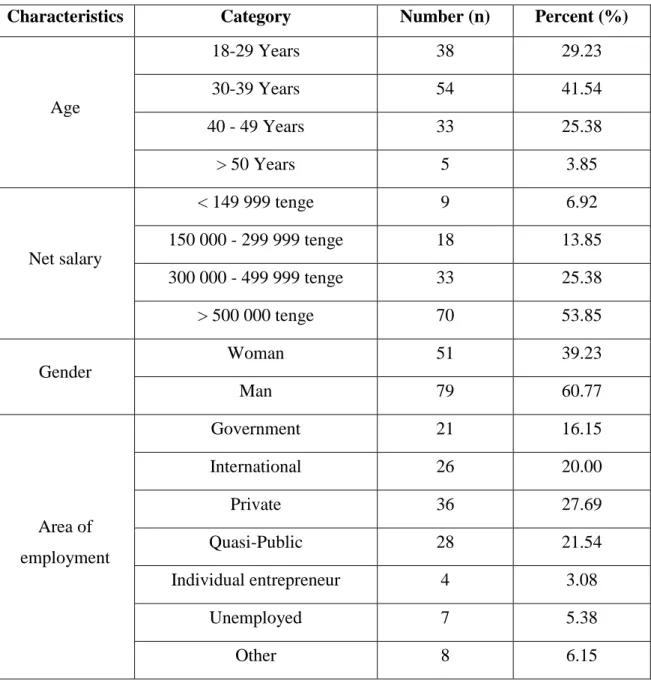
Characteristics of Survey Participants. This study was conducted on 130 respondents. Respondents from this study were dominated by men (60.77%), aged 30-39 years (41.54%), with a salary of 500 000 tenge and more (53.85%), from private companies (27.69%) and with the highest level of formal education - Bachelor’s degree (50%). The profile of the respondents who participated in this research is presented in Table 1.
Table 1 – Profile of respondents
Characteristics Category Number (n) Percent (%)
Age
18-29 Years 38 29.23
30-39 Years 54 41.54
40 - 49 Years 33 25.38
> 50 Years 5 3.85
Net salary
< 149 999 tenge 9 6.92
150 000 - 299 999 tenge 18 13.85
300 000 - 499 999 tenge 33 25.38
> 500 000 tenge 70 53.85
Gender
Woman 51 39.23
Man 79 60.77
Area of employment
Government 21 16.15
International 26 20.00
Private 36 27.69
Quasi-Public 28 21.54
Individual entrepreneur 4 3.08
Unemployed 7 5.38
Other 8 6.15
Education
Secondary school 1 0.77
College 7 5.38
Bachelor 65 50.00
Master 52 40.00
PhD 5 3.85
Type of respondent categories. In the survey, two individuals chose to respond only first part of questions and did not proceed further. According to the ethical considerations, they have rights to make such a decision.
After dividing respondents into 6 categories, individuals were directed to answer specific questions based on their respective categories. The type of categories of the respondents is presented in Table 2.
Table 2 – Categories of respondents
Category Category Number (n) Percent (%)
I have purchased a car using this particular Program, which started from May 2022
1 6 4.62
I have purchased a car using similar
program that was before May 2022 2 6 4.62
I tried to buy through the program, but it
was failed 3 33 25.38
I bought a car without using this
program 4 31 23.85
I don't have a car and I don't plan to use
this program 5 19 14.62
I don't have a car, but I plan to use this
program in the future 6 33 25.38
For Categories 1, 2, and 3, questions were asked to assess the simplicity of the program's application process, liked and disliked aspects, and an assessment of user satisfaction with services by various stakeholders. We also clarified information about
hidden fees and whether participants would recommend the program to others. The satisfaction rate with the application process was 2.51 out of 5, and the rate of service from stakeholders throughout the lending process was 3 out of 5 (where 1 is the lowest score and 5 is the highest). 27.27% of people indicated hidden payment - comprehensive car insurance and 72.73% would recommend the program. As for the program's attractive aspects, most respondents preferred a low-interest rate and a quick and simple application process. On the other hand, most of the participants did not like the sharp rise in prices for new cars, the lack of transparency in implementing the program, and the reduced availability of car dealerships.
Category 3 answered why they could not use the Program, the majority of respondents noted that they could not do it in time because the application form was closed within 18 seconds.
In categories 4, 5, and 6, in response to why they did not use the Program, many respondents indicated they did not have enough financial resources and/or time to do so.
To the general question of whether you think the Program is effective, 29% of the survey participants answered positively, 33% - negatively, and 38% - found it difficult to answer this question.
Most respondents refrained from feedback, but some suggested improvements, including limiting the use of local cars, improving applications, increasing budgets, holding lotteries, criticizing high-interest rates, and solving the problem of car prices and long queues at banks. Others sought transparency in relations with second-tier banks, lower rates, and Program simplification. These different points of view demonstrate the Program's complexity, pointing to the need for large-scale and deliberate changes to meet the needs and expectations of the general public.
Perception of goals. We asked to select the Program's goals, and participants could choose up to 3 options. The type of categories of the respondents is presented in Table 2.
Table 2 – Respondents' perception of goals
Goal Number (n) Percent (%)
To help citizens purchase a car 94 73.31
To support the domestic automotive industry 80 62.39
To increase employment in the domestic
automotive industry and related areas of 35 27.30
production
To reduce the environmental impact of waste
generated by old cars 23 17.94
To increase the share of processing industry and
decreased reliance on extractive industries 22 17.16
Other 5 3.90
Here are the top three main objectives of the Program based on the provided numbers according to survey:
● To help citizens purchase a car
● To support the domestic automotive industry
● To increase employment in the domestic automotive industry and related areas of production
Based on observations, it should be noted that respondents' answers to questions about the goals of the Program are quite different. Most respondents chose such goals of the Program as helping citizens buy a car and supporting the domestic automotive industry. At the same time, the smallest number of respondents chose such a goal as to reduce the environmental impact of waste generated by old cars. In this regard, it can be assumed that such a wide choice of answers is because the Program developers did not specify the exact goals, which are not so obvious.
Also, we used the computer application NVIVO 14 for the qualitative analysis of the perception of goals results. Thus, the most frequently occurring words in the respondents' answers to the question about the Program's goals were - help, citizens, domestic, car, automotive, industry, and program.
According to Appendix 3, the funds of the Program were allocated to improve the state of the environment. However, according to the survey results, many participants were unaware of this environmental aspect of the Program.
The program presented in 2015 was created in a very short time and was not thoroughly thought out about its goals, the parameters for evaluating its effectiveness, transparency, and communication with the population. It is obvious that the program's resumption by introducing additional cash injections in 2022 has all the same disadvantages since no practical changes have been made to the mechanisms and design of the program, except for an unsuccessful attempt to use avtonesie.kz website. We can draw these and some other conclusions based on the information obtained from the survey.
Interview
For interviewing five experts and representatives of interested Program stakeholders, we prepared more specialized questions about the goals, objectives, impact, and effectiveness of the Program. We used the computer application NVIVO 14 for the qualitative analysis of the interview results.
From the observations, it should be noted that the interviewees' answers to the questions about the Program's goals in Kazakhstan are pretty close to each other. The majority of respondents highlighted such objectives of the Program as helping citizens buy a car and supporting the domestic automotive industry. At the same time, only one respondent noted that the “program helps to stimulate the renewal of the country's fleet to meet environmental requirements.”
Respondents attributed such aspects as support of the population through the provision of preferential credit terms for car purchase, support of car manufacturers, revolving credit mechanism, and repayment of funds as the Program's strengths. As for the disadvantages of the Program, the experts mentioned insufficient funds allocated to cover the demand and the inability of the majority of the population to take advantage of the Program could lead to increased tension in society.
We combined several interview questions into one consolidated question about the Program’s impact. As a result, we received different answers from respondents claiming that the Program was timely introduced and implemented because it helped automakers to support demand for domestic cars due to the fall in the national currency's purchasing power against the Russian ruble in 2014. The program helped support the
population's purchasing power to buy cars, which improved citizens' quality of life and indirectly contributed to the development of the automotive industry.
To date, the production of domestic cars has increased to 113,000 units per year.
The impact of the preferential car loan program on car sales is estimated by experts at 1.5 to 10% of the total number of new car sales.
If we address the responses of stakeholders' interviews on how they can assess the Program, we can observe mostly positive perceptions and high assessment of the Program results. One interviewee believes the Program’s “results were awe-inspiring.” Another respondent argues that this Program “is the most effective state program.”
Within the realm of academic research, the concept of effectiveness has been used in various forms, including general evaluation of the program, evaluation of quality in healthcare, assessment of climate change propositions, value for money in economics or international development, and many others. According to Hinrichs-Krapels and Grant (2016), the assessment of research effectiveness involves determining the extent to which it has generated outputs, outcomes, and/or social benefits or influence. If the program has achieved any of the aforementioned results, it can be considered effective and/or successful in its research endeavors.
When we asked how the government could assess the Program and what indicators could determine its effectiveness, we received various answers that, first of all, it is crucial to understand what goals were initially set and whether there were any indicators. One such indicator of the Program's effectiveness could be the renewal of the vehicle fleet and the reduction in the number of cars older than ten years.
Another expert noted that to assess the Program's success, it is necessary to determine the final indicator to be achieved. In our case, this is the purchase of cars by the population on preferential financing terms. All the allocated funds have been utilized, so it can be considered that this final indicator has been achieved. At the same time, one of the experts noted that to ensure transparency and effective control over the expenditure of funds, it is necessary to ensure a proper oversight function to ensure that the funds are used correctly and in the public interest.
Finally, to our question about how the Program could be improved, we received the most responses that it is necessary to improve communication about the Program, to establish feedback on the Program from citizens, to digitize processes, to increase the number of funds for the Program to cover demand, and not only to engage in car assembly
confirmation in the respondents' answers that the Program, restarted by the government in May 2022, was suspended in September 2023.
To summarise, the experts who were questioned offered varying opinions on the Program's objectives. The primary objectives of the Program, which are seen as essential aims and are compatible with the findings of the citizen survey, were to assist residents in purchasing vehicles and to promote the domestic automotive sector. However, just one responder highlighted the Program's contribution to encouraging the replacement of the nation's vehicle fleet while considering environmental criteria. This implies that while everybody generally understood the Program's primary goals, there may be space for improvement in our comprehension of its possible environmental effects. In addition, it can be assumed that the decision to suspend the Program was taken by policy makers to eliminate the contradiction between the declared and real goals of the Program and its impact on the environment. In our opinion, the decision of policy makers to redistribute funds to finance the leasing of public transport is more reasonable and may in the future reduce potential environmental damage compared to the possible negative consequences of the Program.
The provision of favorable loan conditions to encourage vehicle sales, advantages to automakers, a revolving credit facility, and the Program's capacity to replenish funds are just a few of the program's assets that stakeholders have identified.
On the other hand, experts drew attention to possible issues such as a lack of funding to fulfill demand and worry that a sizable portion of the population will not be able to use the Program, which might create social tensions. These issues suggest that the Program's financial structure may be optimized and that expanding its accessibility could be an excellent place to start. Respondents' assessments of the program's effects were mainly favorable. The Program's influence on buying power, the general quality of life, and its function in times of economic uncertainty, like the depreciation of the Russian currency, were all acknowledged. Additionally, specific stakeholders offered quantitative data on the Program's effect on vehicle sales, demonstrating its significance in boosting the auto industry during the Program's early stages and its steady decline as production increased.
Most respondents who evaluated the program's success were pleased with and commended the program's outcomes. This demonstrates the Program's overall success in the view of the stakeholders. There have been requests for more precise indicators and thorough assessments to guarantee openness and accountability. Respondents suggested
several ways to enhance the Program, including bettering communication about it, developing methods for public feedback, digitizing procedures, and raising financing to fulfill demand. There was also a request to go beyond auto assembly and support domestic spare component manufacture in Kazakhstan. As an alternative to the Program, one expert suggested the government subsidizing the interest rate on car loans, expanding the Program's coverage to support citizens in buying cars. Another expert noted that the decision to reorient the preferential car loan program to finance the leasing of public transport, although belated, seemed more logical in terms of providing support to the population.
As a result, Kazakhstan's preferential auto loan scheme has irrevocably changed the auto industry and access to automobiles for individuals. Although there is no denying the allure of low interest rates, questions of price inflation, transparency, and program effectiveness need to be carefully considered. The Program's long-term survival and alignment with the constantly evolving demands of the general public and the domestic car sector depend on addressing these concerns. The Program's design and outcomes must be continually improved to remain an adequate and relevant project.
CHAPTER 5. POLICY RECOMMENDATIONS AND CONCLUSION
Recommendation 1: Clear program goals and evaluation
Setting up specific, quantifiable program goals is crucial for enhancing the program's efficacy. These objectives must be matched by precise completion dates.
Program administrators and participants may both understand what the program is trying to accomplish and by when by having clear program goals. The evaluation of the program depends on this definition of purpose.
In order to facilitate this, it is recommended that a structured performance management system cycle, encompassing elements such as design, implementation, utilization, and evaluations, be seamlessly integrated into the program design, as proposed by Helden, G. J. and colleagues in 2012. This integration is pivotal for a comprehensive approach to performance management, allowing for a thorough mapping of its diverse stages and the interplay among them, ranging from inception to assessment and re-design.
By adopting this approach, a framework is established, empowering policymakers, managers, evaluators, and researchers with a deeper understanding of performance management systems, aiding in the identification of pertinent research areas, and enhancing their ability to effectively communicate practical challenges and solutions related to the specific phases of these systems (Helden, G. J. et al., 2012). This cycle makes sure the program is regularly and systematically assessed in both qualitative and quantitative ways. In order determine how satisfied program participants, stakeholders, and experts are with the program's procedures and results, qualitative assessment entails gathering input from these groups. Quantitative evaluation entails gathering and examining data on program efficacy, including the volume of loans made, how they affect the ownership of vehicles, and the financial gains for the domestic car sector. It should be mentioned that based on the experiences of France, the UK, and the USA (Fol et al., 2007), Kazakhstan may choose to concentrate on a certain segment of the population, such as vulnerable populations, when deciding on the Program's target audience.
Updates and changes to programs should be based on the findings of these assessments. This iterative process enables continual program improvement, ensuring that it achieves its intended goals. In addition, the use of data-driven decision making and
routine feedback gathering encourage openness by making program performance indicators and accomplishments public.
Incorporating this suggestion will improve the program's effectiveness and focus while boosting public confidence. This reveals the program's dedication to accomplishing its objectives and readiness to accept responsibility for outcomes. Government officials and program managers can define objectives that will show the program's worth and influence, therefore defending its existence and financing, by explicitly describing the projected outcomes of the program. This degree of openness and dedication to development is essential to ensure that the Program develops to meet shifting conditions and new requirements.
Recommendation 2: Increase transparency through digitalization
Advanced digitization tools must be implemented in the Program in order to promote accountability and transparency. These tools have to be created to speed up the application and approval procedure, guaranteeing that everything goes without any difficulties. Additionally, managing a program's queue with blockchain technology or Distributed Ledger Technology (DLT) that may greatly increase transparency, eliminate the risk of redundant functionality, and lower the possibility of manipulation. Distributed Ledger Technology is a technical infrastructure and protocol that allows simultaneous access, verification and updating of records in an irreversible manner over a network spanning multiple entities or locations. The blockchain ecosystem includes blocks - the data structure used to keep records of transactions, which are distributed among all nodes in the network, and nodes - users or computers that hold a complete copy of the record or ledger (Garg R., 2023). The use of blockchain technology provides a safe and unchangeable record for keeping track of all program interactions and transactions. This reduces the possibility of fraud while simultaneously providing a visible and unchangeable record of program activities. Citizens may learn more about the status of their applications, where they stand in the line, and when they might anticipate receiving payment by allowing public access to this blockchain-based queue. This openness encourages confidence in the way the program is run.
Additionally, integrating practical digital tools throughout the application procedure lowers entrance barriers for program participants. The submission of documents, compliance testing, and communication are all made simpler as a result. The program will be able to reach a larger audience and ensure that more residents have the
straightforward. Utilizing digitalization technologies and blockchain technology increases program efficiency while also enhancing transparency. Because fewer manual administrative activities are required to manage applications and approvals, processing times are shortened, and administrative costs are reduced.
This recommendation will show how dedicated the program is to modernize its processes and making sure that it complies to the highest standards of accountability and honesty. It emphasizes the program's dedication to serve the public interest and is consistent with worldwide trends in the use of technology to enhance government services.
Recommendation 3: Ensuring financial transparency and accuracy through banking supervision
In accordance with the report prepared by the Agency for Protection and Development of Competition of the Republic of Kazakhstan (2023), the car lending services market is characterized by a low level of competition. At the same time, certain market participants strengthen their positions at the expense of funds provided by the state, and there is a lack of transparency in the distribution of funds under the program, which leads to high interest rates in the commercial segment and limited choice of financial institution. In addition, during the analysis conducted by the Agency, the mechanism for distributing funds under the preferential car loan program in 2022 was studied. This mechanism included the provision of loans by subjects of the quasi-public sector of second-tier banks. According to the terms of the loans, the Industrial Development Fund set financing limits for each automaker, which excluded competition between these second-tier banks.
Strict reporting criteria for participating institutions must be put in place in order to improve financial transparency and responsible administration of Program funds.
These banks should be compelled to submit thorough reports on how money is being used, including revolving funds and all associated financial transactions, on a regular basis. Because of this openness, the public and the government will be able to decide wisely how to distribute funding and lineups.
The state and its residents will have a clear understanding of how money is amassed in each particular bank and when it is amassed, thanks to regular financial reporting. In line with the program's objectives of giving citizens fair and equal access, this information will enable effective planning and reasonable queuing. It could be wise to think about switching to Otbasy Bank from the STB in order to increase oversight and
control. Otbasy Bank has the tools, procedures, and legal legitimacy to administer program funds efficiently. The initiative can considerably lower the dangers of power abuse or banks acting against their customers' best interests by utilizing the capabilities of Otbasy Bank. Otbasy Bank is an excellent contender for careful administration of the program's financial operations because of its emphasis on social development and low possibility for conflicts of interest.
This suggestion emphasizes the program's dedication to maintaining financial integrity and making sure that program benefits are distributed equitably and openly. The program is taking crucial efforts to lower risk and increase public trust in its operations by introducing reporting standards and learning more regulated financial management through a competent entity like Otbasy Bank.
Recommendation 4: Create effective communication channels with the public
The establishment of direct and efficient lines of contact with the public must be given top priority by Program Administrators in order to close the Program's continuous communication gap. The effectiveness of the program rests on effective communication, which helps to inform residents about the most recent program developments, guidelines, and updates. Additionally, it offers a crucial setting for resolving issues and obtaining insightful comments from program participants and the wider public. The survey findings illustrate the need for clear and consistent communication by revealing a wide range of public concerns, such as rising automobile costs, transparency issues, and anxieties about the affordability of vehicles. The correlation between a program's performance and its ability to meet the expectations and demands of the general audience is self-evident.
Active, two-way communication is necessary to achieve this objective.
While implementing this recommendation, program administrators ought to consider a range of methodologies:
Notifications and updates on a regular basis. Establish communication via email, text message, or a mobile app on a regular basis to keep members abreast of upcoming deadlines, interest rate adjustments, and program improvements.
Hotline and online support: Establish a dedicated hotline or online platform for questions, complaints, and feedback. This method must be easily accessible and used by experienced staff who can address a wide range of issues that impact all parties.
Public awareness campaigns: Launch a public awareness campaign using a
addition to highlighting the advantages of the program, these advertisements must to make it clear how members can ask for assistance and express their concerns.
Focus groups and surveys: Surveying participants on a frequent basis to get their input on their experiences and difficulties. This useful information may be utilized to modify the application in a data-driven manner.
The program can encourage more trust, contentment, and involvement among its target beneficiaries by implementing these measures to improve communication. A key component of success is fostering open and honest communication between program managers and the general public, ensuring that the program meets the evolving needs and expectations of the population that it serves.
Recommendation 5: Prevent speculative increases in car prices
The report prepared by the Agency for Protection and Development of Competition of the Republic of Kazakhstan (2023) measures of government support introduced in 2022 creates risks of rising prices for domestically assembled cars. Thus, according to information from the Ministry of Industry and Infrastructure Development, in the first quarter of 2022, prices for domestically assembled passenger cars increased by 16% compared to the same period last year.
We propose a resale limitation of at least three years for automobiles bought under the Program in order to address the issue of speculative price hikes. This action acts as a tactical precaution to lessen the possibility of market distortions and speculative activity while upholding the primary goal of the program, which is to make transportation more affordable for a wider range of the population. The survey findings show that program participants are deeply concerned about the quickly growing cost of cars. These inflationary patterns can be linked to increased demand brought on by program incentives, which may have encouraged sellers and other market players to speculate.
Imposing resale limitations is crucial in order to stop this activity and defend the interests of program recipients.
The recommendation is meant to make sure that people who buy cars via the program do so with the aim of using them themselves rather than selling them on to make money. The minimum three-year resale limitation was deliberately selected to strike a balance between program members' interests and market stability. This minimizes potential market distortions that can have an impact on car costs and availability overall in addition to safeguarding program users against price inflation.
To implement this recommendation, the following steps are required:
Legal basis: Clearly define the legal framework that prohibits the sale of automobiles acquired via the program for at least three years. To function as a deterrent, this system should have sanctions for infractions.
Program recommendations: A basic part of the terms and conditions of the program should include a resale restriction. It is important to make sure that everyone involved in the program is aware of this restriction prior to signing a loan agreement.
Monitoring Mechanism: The status of automobiles bought under the program's resale must be tracked by a monitoring system. This can entail keeping an eye on resale listings by engaging with pertinent authorities and online platforms.
The program may successfully address worries about speculative price rises by enacting a resale cap, ensuring that the core objective of the program—making automobiles more accessible for citizens - is accomplished without distorting or abusing the market. This action not only defends the rights of program participants but also fosters fairness and market stability.
Recommendation 6: Incentivize electric vehicle production
According to a KPMG report (2016), auto industry executives expect electric vehicles (EVs) to soon become the most significant trend due to environmental concerns, rising fuel prices and government incentives to encourage cleaner technologies. In this context, it is important to emphasize that Kazakhstan must keep up with global trends and growing market demand in order to ensure its automotive industry is competitive and meets modern standards in the field of ecology and energy efficiency. Therefore, the development and implementation of electric vehicles and other environmentally friendly technologies may become priorities for the automotive industry in Kazakhstan, taking into account global trends and market needs.
To capitalize on the global shift to environmental sustainability and promote long-term growth of the domestic auto sector, recommendations are offered to actively encourage domestic automakers to diversify into the assembly and production of electric vehicles and create the necessary infrastructure to support this transition. This multimodal approach promotes greener mobility alternatives and boosts the competitiveness of the domestic car sector. It is in step with global trends. Kazakhstan may substantially reduce its environmental impact while fostering innovation and employment expansion in the automobile industry by implementing this strategy.
On this basis, we propose that the automobile industry continue to evolve and