
I am extremely grateful to all the GSE: Professors of School Education for the incredible spirit of learning created in the university and beyond. A total of 15 participants studying in one of the schools in Nur-Sultan were purposively selected to share their views on this topic in three focus group discussions. Therefore, the liberal learning environment that is often central to the learner-centered approach can be questioned, which may reflect the current political premises of the country.
The findings of the study can help teachers improve the quality of their classroom practice.
Introduction
However, studies devoted to the discovery of student understanding, particularly of effective English lessons, as a reflective tool towards improving teaching and learning, are significantly underrepresented. The study also seeks to explore which pedagogical or learning theories underpin students' understanding of effective teaching learning. What are the understanding of twelfth grade students about an effective teaching of English in one of the schools in Kazakhstan.
Finally, my study can contribute to the gaps in literature regarding students' understanding of effective English language teaching in the Kazakhstani context and the contexts where English is taught as a foreign language.
Literature Review
Furthermore, Pennington and Richards (2016) and Weinstein (1989) emphasize that effective teaching must be delivered first and foremost, prioritizing students' emotional well-being. However, there are cases where students' beliefs about effective teaching do not match teachers' expectations (Williams & Burden, 1997). One of the studies that aimed to determine whether there is a match between teachers' and students' understandings is that of Alimorad & Tajgozari (2016), which analyzed how Iranian high-achieving and low-achieving high school students' perceptions of effective teaching varies. with that of high school English teachers.
The authors found some interesting findings: Although teachers believed that one of the students' needs in the classroom was kindness and attention from teachers, Another mixed methods study was conducted by Yağcıoğlu (2016) to assess students' and teachers' perceptions of to identify effective English teachers. Despite the difference between teachers' and students' views on effective teaching, it is worth pointing out that both high school and college students consider teacher professionalism to be the most important thing for effective teaching.
Learners' intrinsic motivation is considered in the study as one of the facilitators of students' active involvement in group activities. This means that the effectiveness of student collaboration may also depend on whether students are personally interested in benefiting from the process. This suggests that Tharp's standards for effective pedagogy can be effective in improving students' academic outcomes.
Similarly, students' active performance does not necessarily imply learning (Wilson & Peterson, 2006). In terms of the system, the focus of education in Kazakhstan is on the ultimate progress of the students, rather than on the learning process; this strategy is also called.
Methodology
The main reason was my professional background as an English teacher in one of the schools with the same organizational and functional requirements. The main strength of focus group discussions is “the ability to produce a concentrated amount of data on precisely the topic” (Morgan, 1997, p. 13). FGDs are not only one of the quick and easy qualitative research tools that allow participants to produce rich data, but can also create an environment for sharing valuable insights for the research that would be difficult to obtain in a one-on-one setting.
Also, due to the fact that the participants outnumber the researcher, the focus group discussion can reduce the perceived power of the researcher who can be seen as an authoritative adult, and participants, who in this case are lower in age and social hierarchy relationship is. to the researcher. The introduction of the purpose of the study together with the consent forms were given before the discussions. After the permission of the gatekeeper (the head of the school), the participants were recruited and provided with the consent form to be signed (see Appendix A).
I explained the voluntary nature of the study as well as their rights and withdrawal from the research according to their free will. In the case of the publication, the research will not use the personal information of participants as well as the schools' name for any purposes that will make the participants identifiable. First, I asked how students felt and whether they had already come up with the university choice and shared with them my teaching background to refer to the personal importance of the research topic.
Moreover, one of the classic limitations of FGDs is the quality of the data which depends on how the. These limitations can be addressed in the future studies of English language lesson effectiveness by ensuring a larger number of FGDs and selecting one of the mainstream schools that will represent a larger percentage of Kazakhstani school students.
Analysis and Findings
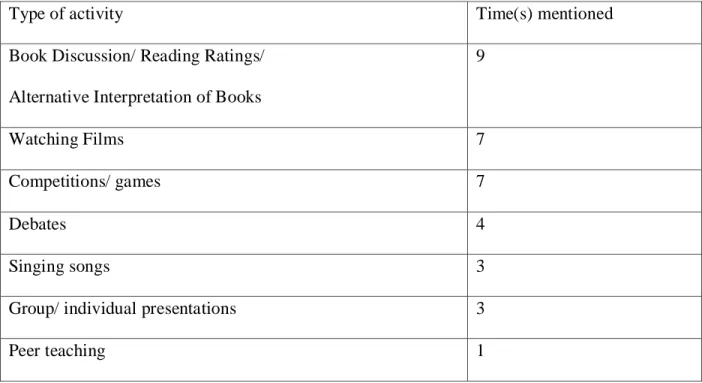
The third subtheme depicts the participants' understanding of the importance of giving equal attention to all language skills. Fifth, I present the participants' stories in terms of the feedback they provided to their teachers as a tool to ensure the effectiveness of English lessons. The majority of participants preferred interactive and participatory forms of collaboration that would involve all students in learning.
As one of the participants articulated: “I also agree that watching movies in English is interesting and useful. Additionally, participants emphasized the importance of incentives such as rewards or “candy” in motivating students to use only English in the classroom. Although the participants understood the importance of homework, some of them expressed that "sometimes it felt like a waste of time" (Zhangir, FDG 1).
Equally important was that the participants felt that their teachers could relate to them. This theme deconstructs theories of learning and pedagogy that have shaped participants' understanding of effective English language teaching. Therefore, to see how the participants understand effective English lessons in terms of learning styles, we will analyze their responses using Guthrie's (2011) model of classroom teaching styles.
Group work and active learning methods (for example debates, reading games and peer tutoring) were among the most common responses of the participants to a good English lesson. My analysis of the participants' learning processes will be based on these principles. They referred to the positive relationship between them and their teachers as one of the conditions for effective learning.
In terms of teachers' attitudes, participants claimed that effective learning takes place in an emotionally comfortable environment created by their teachers' positive attitudes towards them, giving them the opportunity to express their opinions regardless of their answers.
Discussion and Implications
Participants' belief in the effectiveness of group work relied on the extent to which group work could engage all students, student leadership skills to delegate equal input, and teacher guidance or timely instruction. Engaging in a group work activity that gathers students to work independently without constant teacher intervention ensures a more democratized learning process. Therefore, participants' position towards group work policies, teacher authority and curriculum preferences may also reflect current political patterns in Kazakhstan.
The participants preferred access to authentic learning resources, such as watching films in the original English language, as well as their teachers' articulations expressed only in English for all naturally arising situations in a lesson. However, Tajeddin and Alemi (2019) found that the personal qualities such as patience, kindness, kindness, strictness" (p. 16) that were nominated by both pre-service and in-service teachers were not included in Stronge's framework of effective teachers. ' characteristics. My participants also value a balance between teachers' friendliness and strictness seen on Tajeddin and Alemi's (2019) list, except for the teachers' quality such as patience.
Moreover, the finding does not confirm the discrepancy between students' and teachers' views in the context of education. Greenland, where the teachers pointed out the friendliness and positive attitude at the same level, with professional skills at the top of their list of effective teacher qualities, while the students. In this regard, my participants supported the beliefs of teachers in Greenland, highlighting teachers' personality traits and professional skills as important for effective study.
Moreover, teachers' ability to relate lesson content and new marriage to students' real lives were also seen as effective teacher qualities. The participants' multiple responses emphasized the importance of engaging "teaching tricks," ranging from teacher pranks to offering competitions, and showed that students need more involvement.
Conclusion
The second category of students' understanding included teachers' attitudes and characteristics that could create either a positive or negative learning environment, as a result of which affected the learning process. Furthermore, the students' discussions revealed the importance of feedback and dialogue between teachers and students to improve both the learning process and results. Therefore, it suggests that teachers should consider students' voices as a reliable instrument to assess their teaching effectiveness and plan the improvement of lessons accordingly.
Regarding the second research question, pedagogical theories and learning theories were extracted from the students' answers, including basic social constructivist theories. The characteristics of effective English teachers as perceived by high school teachers and students in Korea. You have been selected to participate in the study because you are 18 years old and a 12th grade student with the experience of learning English in the classroom.
TIME COMMITMENT: You will be asked to participate in a discussion with 4-5 other students from your class. CONFIDENTIAL & PRIVACY: All information obtained during this investigation will be kept confidential to the extent possible. The researcher clearly explained to me the background information and objectives of the study and what my participation in this study entails.
You are invited to participate in a survey entitled “12-year School Students' Understandings of an Effective English Lesson in a Secondary School in Nur Sultan”. You were chosen to participate in the study because you are an eleventh grade high school student and have experience learning English in the classroom.
