Institute of Management
On the rights of the manuscripts
SADUAKASSOVA ZHIBEK RIZABEKOVNA
«THE USE OF PROJECT MANAGEMENT METHODS IN THE PROFESSIONALIZA- TION OF MANAGEMENT PERSONNEL»
Educational program “7М04105 – Public policy”
In the field of training “7М041 – Business and management”
Master’s project for a Master’s degree in Business and Management
Scientific supervisor _______________ Khassen Z.R., Msc
The project is approved for protection: «___» ________________20__
Director of the Institute of Management ____________ Gaipov Z.S., d.p.s
Astana, 2023
Thesis abstract
1Degree Programme: Master of Public Policy Author: Zhibek Saduakassova
Title of thesis: The use of project management in the professionalization of management personnel
Supervisor: Hassen Zhandos Rashidovich
Year: 2023 Number of pages:129 Number of appendices: 34
Project management methods have become increasingly prevalent in various industries as organizations strive for efficiency, effectiveness, and successful delivery of projects. This thesis explores the role of project management methods in the professionalization of management personnel. It examines how the application of project management principles and techniques contributes to enhancing the skills, knowledge, and competency of
managers, leading to improved organizational performance.
The thesis reviews existing literature on project management and professionalization,
highlighting the key benefits and challenges associated with the use of project management methods in management development. It discusses how project management provides a structured framework for planning, organizing, and executing projects, enabling managers to effectively manage resources, mitigate risks, and to achieve project objectives. Furthermore, it explores how project management fosters cross-functional collaboration, enhances
communication and leadership skills, and promotes a systematic approach to problem- solving.
The study also addresses the challenges that organizations may face when implementing project management methods as part of management professionalization initiatives. These challenges include resistance to change, resource constraints, and the need for training and development programs. The thesis offers insights into strategies to overcome these
challenges, such as change in organizational culture, executive support, and investment in continuous learning and development.
In conclusion, the use of project management methods plays a vital role in the
professionalization of management personnel. It equips managers with valuable skills and knowledge necessary for effective project delivery and overall organizational success.
However, organizations need to address potential challenges and invest in the necessary resources and training to fully leverage the benefits of project management methods in management professionalization efforts.
1Keywords: project management, management professionalization, skills development, organizational performance, leadership, collaboration.
TABLE OF CONTENTS
Thesis abstract ... 2
Pictures, Figures and Tables ... 5
Terms and Abbreviations ... 7
1 INTRODUCTION ... 8
2 THEORETICAL FOUNDATIONS OF THE USE OF THE PROJECT APPROACH IN PUBLIC ADMINISTRATION ... 11
2.1 The essence and significance of the project approach in public administration ... 11
2.2 Methodology of integration of elements of the project management system ... 23
2.3 Features of project management standardization ... 34
2.4 Flexible methods and tools of modern management of State bodies ... 44
3 METHODOLOGY OF THE STUDY ... 49
Research methods ... 49
4 THE CURRENT STATE AND MECHANISMS OF APPLICATION OF THE PROJECT APPROACH IN PUBLIC ADMINISTRATION OF THE REPUBLIC OF KAZAKHSTAN ... 51
4.1 Analysis of the use of the project approach in public administration ... 51
4.2 Evaluation of the effectiveness of the implementation of state programs and projects ... 60
4.3 Project-network model of project management in the Republic of Kazakhstan ... 62
5. FOREIGN EXPERIENCE OF PROJECT MANAGEMENT IMPLEMENTATION IN FINLAND AND OTHER COUNTRIES ... 67
5.1 Analysis of the use of the project approach in public administration in Finland and other countries ... 67
5.2 Best practices of public administration and management ... 73
6 ANALYSIS OF THE MANAGEMENT OF STATE BODIES ... 77
6.1 Analysis of management problems of state bodies of the Republic of Kazakhstan ... 77
6.2 Analysis of management problems of public authorities in Finland ... 104
7 IMPROVING THE MANAGEMENT OF STATE BODIES ... 109
7.1 The model of public administration is the basis for improving the management of state bodies of the Republic of Kazakhstan ... 109
7.2 Maintaining a balance of powers, resources and responsibilities, delineating the powers of political and administrative civil servants ... 113
7.3 Optimization of information flows ... 115
8 CONCLUSION AND RECOMMENDATIONS ... 118
8.1 Conclusion ... 118
8.2 Recommendations ... 121
8.3 Further study suggestions ... 123
BIBLIOGRAPHY ... 125
APPENDICES ... 129
Pictures, Figures and Tables
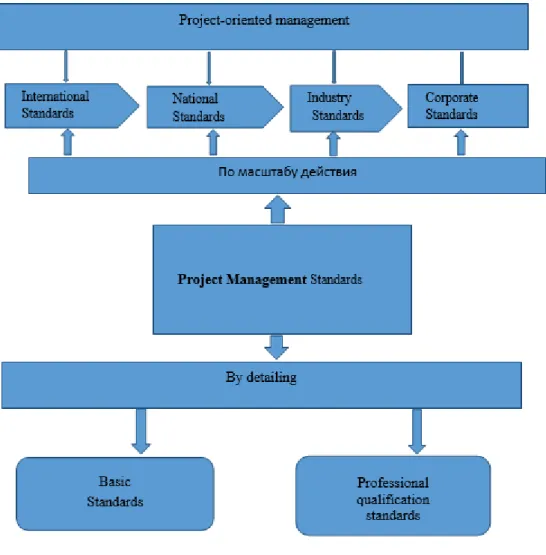
Figure 1. Classification of project management standards ………38
Figure 2. The essence of management………..45.
Figure 3. Comparing traditional management techniques with Agile……….47
Figure 4. Interrelation of documents of the state planning system………54
Figure 5. The main stages of the State planning system of the Republic of Kazakhstan. 56 Figure 6. Actual problems of modern civil service in Kazakhstan………88
Figure 7. Weak staff go to civil service (%)………...89
Figure 8. Main Problems of the Government institution (%)………..90
Figure 9. Self-assessment of professional competencies of civil servants (%)………….91
Figure 10. Self-assessment by civil servants of professional competencies in each area (%)……….…92
Figure 11. Assessment of the professional competencies of the immediate supervisor in each area (%)………..93
Figure 12. Assessment of professional competencies of heads of government institutions in each area (%)………..94
Figure 13. Assessment of the current state of the civil service in Kazakhstan (%)……….95
Figure 14. Implementation of project management will help to achieve the effectiveness of the decisions made (%)………95
Figure 15. Government institutions should work according to the principles of project man- agement (%)……….96
Figure 16. Civil servants are not interested in project management training (%)…………96
Figure 17. Heads of government institutions are not interested in implementing project
management (%)……….97
Figure 18. Downsizing of the state apparatus is necessary (%)………98
Figure 19. Level of trust to the immediate supervisor (%)………..98
Figure 20. How many years have you been working in the field of project management?99 Figure 21. Are you certified according to the standard project management?...100
Figure 22. Is there enough training on the implemented project-network model of project management in the Project Management Information System "Easy Project"?...101
Figure 23. How would you assess the level of coverage of project management implemen- tation among government agencies ?...101
Figure 24. What do you know about project management? What is it?...102
Figure 25. Have you participated in the implementation and operation of project manage- ment in your organization?...102
Figure 26. What assessment would you give regarding the work of project management in your state body?...103
Figure 27. Are you certified according to the Project management standard?...103
Table 1. Areas of knowledge of the PM and their functions……….31
Table 2. Groups of project management processes and their description………32
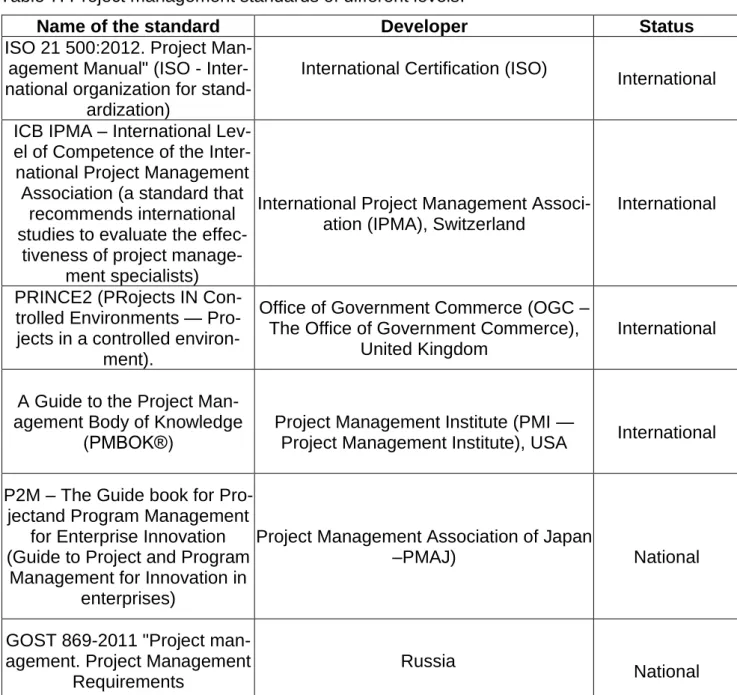
Table 3. Project management standards of different levels……….39
Table 4. Mechanism of implementation of state programs of the Republic of Kazakhstan ……….60
Terms and Abbreviations
ARKCSA − Agency of the Republic of Kazakhstan for Civil Service Affairs
MDIAIRK − Ministry of Digitalization, Innovation and Aer- ospace Industry of the Republic of Kazakh- stan
APAPRK − Academy of Public Administra-
tion under the President of the Republic of Kazakhstan
MNE RK − Ministry of National Economy of the Republic of Ka- zakhstan
NPO − National Project Office
ASPR R K − Agency for Strategic Planning and Reforms of the Republic of Kazakhstan
DGO − Digital Government Office
GA − Government agency
SDG − Sustainable Development Goals
PMIS − Project Management Information System
NPMS − National Project Management system
LEB − Local executive body
PMC − Project Management Center of the Office of the
Prime Minister of the Republic of Kazakhstan
RLA − Regulatory legal acts
OECD − Organization for Economic Co-
operation and Development
RBP − Republican Budget program
1 INTRODUCTION
This work is devoted to the study of the implementation of project management in govern- ment organizations and its improvement as a tool to increase efficiency. In addition, the master's project will provide general information on project management, its brief history, what work is currently being carried out in this area by the Government of the Republic of Kazakhstan, in particular by state bodies and other organizations.
What is project management. As we are all used to, a project is associated with the im- plementation of a certain object. There is also the term "project documentation", the devel- opment of which is carried out within the framework of certain norms and rules for the con- struction / design of various facilities.
However, project management implies a completely different meaning. This is not a new direction, it existed before, in different epochs of the development of our world, but there was no systematic or comprehensive view of management.
For example, the construction of historical objects that exist to this day. These are the pyr- amids in Egypt, the Great Wall of China are direct proof, given that their goals and func- tionality were different.
But they did not have a holistic concept for achieving the tasks set, there was no systemat- ic and comprehensive set of tools, there were no clear project roles and functions that are present in today's project management.
We can say that over the past fifty years, project management has been developing and improving in various industries. Today project management has become a professional activity and is used in various directions.
Given the huge competition and development of the leading countries, there is a need to improve the system of public administration. It is quite important that a dynamically devel- oping country should have the appropriate qualified personnel.
And today, the issue of professionalization of the state apparatus and the implementation of public administration reforms remains relevant in the Republic of Kazakhstan.
The adopted "Strategy Kazakhstan-2050" provides for the improvement of the manage- ment resource by creating modern institutions for corporate governance and management in the field of public service.
To date, many state projects and programs in Kazakhstan have been thoroughly devel- oped and characterize a clear sequence and logic, but often they are not completed or are not implemented at all. Such ineffective programs cause discontent among the population and become the basis for a decrease in people's confidence in the government. Proper and coordinated project management allows you to predict all kinds of risks that may arise at all stages of the project life cycle, and also allows you to organize, plan and control pro- jects in the most optimal way. That is why recently the discipline of project management has been considered as a separate direction in management, and the profession of a pro- ject manager has become in demand and now implies an expert capable of applying a wide range of methods and tools in practice.
One of the main reasons mentioned by experts is the inconsistency of the implementation of a particular program, the pursuit of many initiatives at the same time and an insufficient level of control. In addition, there is no responsibility for the achievement or non-
achievement of program targets, which ultimately leads to the inability to coordinate the entire process of policy implementation. However, the Government of Kazakhstan is taking steps to form a new model of public administration. The state implements advanced man- agement methods at all levels of government. One of these methods is project manage- ment. World experience shows that project management tools allow the most effective im- plementation of state projects and programs. Efficiency consists in significant savings in material and human resources.
In Kazakhstan, elements of project management are being introduced into the public sec- tor, but there is still no holistic systematic project-oriented approach to planning and im- plementing government projects and programs. Meanwhile, today the state programs are interconnected and together they make up the documents of the state planning system.
The purpose of the study
Elaboration of concrete proposals for the development of the project management system based on the analysis of the work and stages of the implementation of project manage- ment elements in the public sector of the country.
The hypothesis of this study is as follows: there are established complexes of selectively involved elements of flexible methodologies, the use of which positively affects the success of management in the public sector of the country.
To achieve this goal and test the hypothesis, the following tasks were set:
1. To analyze the academic literature on the topic:
a. To define the concept of flexible methodologies;
b. To determine the criteria for the success of the project;
c. To evaluate the effectiveness of the use of flexible methodologies and limitations of appli- cation.
2. Select a list of the studied elements of flexible methodologies.
3. Develop a questionnaire for conducting the survey.
4. Organize and conduct a questionnaire survey.
5. Interpret the results obtained.
6. To form practical recommendations on the use of flexible methodologies.
7. Determine the further direction of the study.
The work will consist of 8 parts.
2 THEORETICAL FOUNDATIONS OF THE USE OF THE PROJECT AP- PROACH IN PUBLIC ADMINISTRATION
2.1 The essence and significance of the project approach in public administration
At present, a necessary condition for sustainable economic growth is to increase the efficien- cy of the public administration system. The need for public administration arises from the need to ensure the implementation of state policy aimed at the effective use of natural, finan- cial, material and information resources.
In the modern conditions of formation and development of the Republic of Kazakhstan, an important task is to improve the approaches of the public administration system. The practical application of this system is not feasible without understanding and scientific substantiation of theoretical approaches to the study of public administration mechanisms. Without revealing the concept of "public administration approaches", it will be difficult to solve the problem of increasing its effectiveness, because the effectiveness of the public administration system depends on the availability of a set of properly coordinated, purposeful, successfully operat- ing and functioning approaches.
In terminological dictionaries, a different interpretation of the word "approach" is given (Alasoini & Kajander, 2019):
− a set of techniques, methods in influencing someone, in studying something, in do- ing business;
− a set of techniques for treating someone or something, considering something or in- fluencing someone or something;
− a set of techniques, methods in influencing something, introducing cases, studying something and others;
− a method or certain actions (procedures), used or undertaken to complete a task or solve a problem;
− a way of considering a problem;
− a set of techniques, methods in influencing someone, in studying something, awak- ening to something.
As we can see from the above definitions, the approach in all interpretations is defined as a set of techniques and methods of influence of the subject in the study of an object.
In our opinion, in the system of public administration, the approach is a direction of consid- eration of a process, a phenomenon in which, in relation to the object of management, the methodology of public administration should be implemented.
In this regard, we consider it appropriate to consider various approaches in public administra- tion that are used to implement public policy to achieve specific goals. In the theory of public administration, the following approaches are traditionally distinguished:
− an approach based on the allocation of various schools of management;
− process approach;
− system approach;
− situational approach;
− institutional approach;
− functional and structural approach;
− program-targeted approach;
− project approach.
The approach from the position of distinguishing different schools in management includes four actually different points of view.
These are the schools of scientific management, (Gilbert, 1991; Grant, 2007;Taylor, 1911) administrative management (Fayol, 1949; Urwick, 1952; Weber, 1978; Argyris, 1957; Blake
& Mouton, 1964; Follett, 1924; Likert, 1961; Maslow, 1943; Mayo, 1933; McGregor, 1960); as well as management science, or quantitative methods (Anderson et al., 2018; Heizer et al., 2016; Hillier & Lieberman, 2013;Render et al., 2018; Stevenson, 2018).
Representatives of each of these areas believed that they had managed to find approaches to the most effective achievement of management goals. Later researchers then proved that many of the answers to public administration questions were only partially correct in limited situations. Nevertheless, each of these schools has made a significant contribution to this area and overlap in the use of different approaches to public administration.
The process approach has a rich history of scientific and practical research and application, given that historically it emerged the very first. The foundations for the process approach
were laid by Taylor (1911) and such representatives of the school of "scientific management"
as Frank and Lillian Gilbert (1917), Ford (1903), Gratt (2007), and more fully developed by representatives of the school of "administrative management": Fayol (1949), Urwick (1952) and Weber (1978).
The process approach defines management as a series of continuous interrelated manage- ment functions. Researchers offer various lists of functions. The most optimal option is pro- posed by (Argyris, 1957) who identifies the following functions: planning, organization, man- agement, motivation, leadership, coordination, control, communication, research, evaluation, decision-making, recruitment, representation and negotiation or conclusion of transactions.
The system approach is the fundamental principle of the organization of public administration as a system and ensuring its functioning and development. It reflects an objectively neces- sary form of organization of public administration. This approach includes two aspects (Gilbert, 1991):
− system analysis as a way of explaining the objects and processes of public admin- istration and developing its theoretical model;
− system-creative activity as a practical process of implementing system management.
The organization and reproduction of the system are connected with system analysis as practice with theory
Many well-known scientists believe that the main idea of the system approach is to recognize the interrelationships and interdependence of elements, subsystems and the entire system of public administration with the external environment.
The structural elements of the public administration system usually include: institutional, regulatory, functional-structural, communicative, professional-personnel and professional- cultural subsystems (Grant, 2007).
According to Weber (1978),
"... the essence of a systematic approach to public administration consists, firstly, in considering objects and subjects of management as systems as interrelated sets of elements; secondly, in guiding the principles of a systematic approach in the analysis and synthesis of objects and subjects of management as systems;
thirdly, in using methods a systematic approach for the analysis and synthesis of management subjects as systems".
The above views of scientists indicate that both in the theory of public administration and in scientific management as a whole, much attention is paid to the systematic approach. Given that society is constantly evolving and changing, the strategy of public administration cannot be the object of accurate forecasting and planning. Nevertheless, the systematic approach focuses on the development of strategic management, which establishes common goals and ways of behavior of public administration as a whole.
Researchers of the situational approach to public administration argue that there are no op- timal structures. Moreover, public administration should be organized in such a way that it is at the level of the complexities and dynamics of modern society. The main idea of the situa- tional approach is to analyze the situation, that is, a specific set of circumstances that strong- ly affect a given administrative organization at a given time. Since a new situation is constant- ly at the center of attention, "situational thinking" takes on special importance within this ap- proach. Using this approach, it is possible to better understand which techniques will contrib- ute more to achieving goals in a particular situation (Fayol, 1949).
In our opinion, the development of the public administration system largely depends on the correct choice of situational variables of the external environment. The main situational varia- bles of the external environment include such factors as the political process, the state of the world economy, scientific and technological progress, socio-cultural changes, etc.
In the institutional approach, the subject of study are institutions and institutions that partici- pate in the development and implementation of managerial (political, administrative and le- gal) decisions.
The state, with an institutional approach, performs certain functions assigned to it by citi- zens: controls activities related to the specification and protection of the rights of owners;
creates channels related to the exchange of information; develops standards; creates areas related to the actual exchange of goods and services; forms a law enforcement system and produces public goods.
The effective use of an institutional approach in public administration should reduce transac- tion costs in the market. This, in turn, will promote the equality of entrepreneurs and maintain an optimal combination of the level of competition between them.
The application of the functional-structural approach in public administration involves focus- ing on the classification of functions, differentiation of structural units, organizational re- sources of state bodies and the entire management system as a whole.
In modern management theory, the functional-structural approach includes two aspects.
Functional aspect: the study of the internal mechanism of the functioning of the system ele- ments, as well as the study of the external functioning of the system – the interaction of the system with the external environment. Structural aspect: elucidation of the components that make up this system; determination of the natural connections of these components
(Stevenson, 2018).
It should be noted that the functional-structural approach can be successfully applied to solve the following tasks: establishing a link between the internal structure and the functions per- formed by the entire public administration system; developing the structure of a public admin- istration body depending on the functions performed; determining the number of managerial personnel depending on a number of specific factors.
The program-target approach in public administration is the most common means of imple- menting public policy, which links policy goals (plans, projects) with the available resources of target programs.
According to Grant (2007), the program-target approach is a method of highlighting the main goals and objectives of state, economic, social, environmental and cultural, territorial devel- opment, the development of mutually agreed measures for their implementation in a timely manner.
To date, the program-target approach is used as a tool for implementing the state social and economic policy of the development of the country and its individual regions, along with methods of forecasting and indicative planning, in order to: strengthen the unity and integrity of the state; overcome significant differences between regions in terms of development fac- tors, create prerequisites for the self-development of regions, functioning without transfers.
The project approach in public administration is one of the most progressive methodological approaches to the implementation of purposeful activities of the state.
According to many scientists Anderson et al.( 2018), the project approach in public admin- istration, along with the program-target approach, has recently received significant develop- ment. Its advantages are manifested in those cases when a quick solution of an unusual sit- uation, some main task is required, when there is a certain instability of the external environ- ment. The project approach allows for a greater concentration of resources in priority areas, reducing administrative and bureaucratic barriers in decision-making. However, in order to consider that the activity is based on a project approach, it is not enough to simply call the management object "project" and create a structural unit "project manager". The project ap- proach implies the creation of special conditions and the use of special standards.
The project approach is a fairly new direction in science, so it is difficult to fully assess today its true impact on the theory and practice of public administration. In order to determine the significance of the project approach in public administration, we need to disclose its key cat- egories: "project" and "project management".
American scientists Gray and Larson ( 2003) believe that "a project is a complex, non–
repetitive, one-time event, limited in time, budget, resources, as well as clear instructions for implementation, developed for the needs of the customer".
Another foreign researcher Kittinger (1982) calls the project "an investment activity in which financial resources are spent to create real assets that produce benefits for a long time" and
"an activity on which money is spent in anticipation of returns and which is logically subject to planning, financing and is carried out in the form of a certain unit".
Steinbuch (1998) offers a concise definition: "a project is a one–time intention to complete a task."
Kazakh scientists have also contributed to the definition of the essence of the concept of
"project". Domestic researchers Ospanov and Mukhambetov (1997) describe the project and the investment project as follows: "In essence, the project means the form of registration of the investment plan … The investment project ... acts as an organizational and economic action plan of the investor-borrower and a financial and economic justification of its effective- ness".
Another domestic economist Alzhanova (2004) believes that the project is a specially de- signed proposal to change the activities of the enterprise, pursuing a specific goal.
In his monograph "Innovative project: concepts, algorithms, marketing, management"
Mustafin (2008) gives the following definition: "The project is a complex, non–recurring event involving the introduction of a new one, limited in time, budget, resources, as well as clear instructions for implementation, developed for the needs of the customer".
According to researcher Mukanov (2004) a project is a process of purposeful change of a technical, economic, financial or social system, its transfer from one state to another.
The Entrepreneurial Code of the Republic of Kazakhstan defines the concept of
"industrial and innovative project". An industrial and innovative project is a set of measures aimed at technology transfer, creation of new or improvement of exist- ing production facilities, technologies, goods, works and services implemented within a certain period of time (Code, 2023).
For a comprehensive analysis of the concept of a project, one should also turn to internation- al theory and practice.
Thus, the World Bank under the project means a set of interrelated activities designed to achieve within a given period of time and with a fixed budget, the tasks set with clearly de- fined goals (Bank, 2023).
According to the ISO 21500 international standards, "a project is a unique set of processes consisting of coordinated and manageable tasks with start and end dates undertaken to achieve a goal." Achieving the project goal requires obtaining results that meet pre-defined requirements, including time, money and resources.
According to the German Industrial Standard DIN 69 901, a project is defined as "a design (intention), which is largely characterized by one-time conditions in their totality, for example, setting a goal, temporary, financial, human or other restrictions, differentiation from other in- tentions and specific organization of the project".
Analyzing the definitions of the concept of "project" by various scientists, international asso- ciations and standards, it is possible to identify some conditions and features inherent in this concept.
Having considered the various definitions of the concept of "project", it is possible to identify its characteristic features:
1. of start and end dates. A project is a short-term activity. The terms are determined by the plan;
2. The result of each project is a unique product or service;
3. focus of the project on achieving certain goals. This feature follows from the drawn up plan. That is, in fact, as many resources are attracted and used as required based on the plan.
The development of the project approach as a promising form of management is based on the methodology and the use of management tools, in which the concept of a project is the basis, including a meaningful characteristic of the subject and object of management. In turn, practical project activities are carried out on the basis of national and/or international ap- proaches, recommendations and standards developed as a result of generalization of practi- cal experience in both commercial and public administration. It should be noted that, despite a sufficiently long period of application of the project approach, the interpretation of the con- cept and the concept of the definition of the project continues to change due to the develop- ment of the theory and practice of project activities.
Thus, in the practice and methodological materials of the German Project Management As- sociation, the concept of "project" is defined through a set of significant features, the most important of which are the uniqueness of goals, novelty, urgency and limited resources, the presence of which is sufficient to consider the management object as a project (Anderson et al., 2018). As a rule, these signs make it possible to distinguish those types of activities that can be described by the concept of "project" from those for which it is impossible to do this.
A common feature of the works of these researchers is the consideration of the project ap- proach as a form of management activity.
At the same time, the author considers it necessary to emphasize that the project approach consists primarily in designing – choosing goals and priorities, forming projects, and only then – in the project method of organizing activities, in other words – in project management.
The most important feature of using the project approach is its positive, all other things being equal, impact on the effectiveness of the organization.
Summing up the characteristics noted in the listed works, the following can be distinguished:
- strategic – captures the emerging relationship of strategic and operational manage- ment in the current project management activities;
- economic – shows the effective distribution of financial and material resources, ensur- ing their concentration on solving priority tasks by reducing the dispersion of re-
sources, searching for internal reserves, strengthening control functions;
- organizational – ensures the orientation of departments to achieve the goals of the project, the organization of teamwork, reduces competition in current activities;
- motivating – notes the orientation of the project participants in achieving the ultimate goal, improving the efficiency of professional functions, reduces the loss of working time;
- consolidating – confirms the increase in the validity of decisions made in the organiza- tion due to the combined efforts of managers and specialists, excluding subjectivism and official abuse;
- communicative – demonstrates the coordinated work of the project team, which, from the practice of working in one project, extends to all the current activities of the organi- zation, promotes the exchange of experience, improving the competencies of employ- ees and team building;
- structured – related to the establishment of horizontal ties, the creation of temporary working groups, the exclusion of unnecessary structures and divisions.
Thus, based on the generalization of the above, we will consider the project as a unique set of actions, elements, processes that unfold and are carried out within a limited, predeter- mined period of time, and aimed at achieving the set goals and final results in this particular situation, characterized by the presence of limited managerial, financial and material re- sources.
At the same time, the application of the project approach is justified if the goals that are most significant for solving the tasks of socio-economic development are chosen, and their
achievement is focused on the minimum time and / or the amount of funds spent.
This definition of a project is inherently ambiguous, as a result of which it is used in various spheres of economics and management activities, as a result of which the differences of pro- jects consist primarily in the diversity of their results, which can become:
- a product that is an end product, or a part (component) of another product, or its improve- ment; a service and/or technology (procedure) for its provision; a document (for example, a draft regulatory act, a research project that provides new knowledge, information, regulations useful for practical application).
The development of the project approach in the field of public administration requires a radi- cal restructuring of the entire management system, the transition from a process approach to result-oriented activities.
For the implementation of projects, as a rule, it is envisaged to create a special organizational structure and appropriate management bodies.
The process of preparation and implementation of any project requires consistent passage of a number of mandatory stages (Alzhanova, 2004):
- analytical, giving an analysis of the situation, existing problems and challenges;
- targeted, aimed at choosing priorities, building a hierarchy of tasks and determin- ing results;
- instrumentalization, which allows you to select the most effective tools used in the implementation of the project;
- building plans and roadmaps, identifying key points of the project;
- project budgeting;
- assignment of project performance indicators and methods of their evaluation;
- definitions of project management bodies and key figures;
- determining the procedure for approval, making changes to the project documen- tation, termination and completion of the project.
The implementation of the project approach in the current activities of federal and regional executive authorities, local governments and budget organizations, in turn, involves:
− development of project preparation and implementation management methodology;
− creating and ensuring the work of new collegial bodies and departments that ensure work with projects;
− changing the system of training and development of employees related to projects;
− creation of a project incentive system; implementation of a project management in- formation system;
− audit of projects;
− integration of all elements of the control system with each other.
The practice of its use requires increasing the competencies of civil servants, the formation of cohesive project teams and a significant interest in achieving the final results and successful completion of projects.
In our study, the focus is not on the project itself, but on the application of the project ap- proach in public administration. In view of, that management includes various processes, each of them is given special attention. The project approach in public administration, as a form of management, in principle arises in parallel when initiating the project itself. That is, the project cannot exist without project management, since the project itself is the object of management.
Based on the above, it becomes obvious that the applied interpretation of the concept of
"project management" can be transformed into the practice of public administration.
In the system of public administration, project management involves the transition from monitoring the situation to a comprehensive system analysis, forecasting and planning of specific measures aimed at solving them.
Approbation and formation of project management in the public administration system can be carried out with the help of state projects that concentrate financial, administrative and public resources on priority areas of the country's development.
In our opinion, a state project is a system of processes aimed at achieving the strategic goals of the state to create a unique product or service within a certain period of time.
When applying the project approach in public administration, it is necessary to coordinate and concentrate the activities of authorities at various levels on strategic directions, and the
tasks solved for this should be distributed as accurately and reasonably as possible by levels of authority and available resources between the relevant authorities.
In our opinion, the application of the project approach in public administration:
− more clearly defines the goals of state programs and criteria for their achievement;
− optimizes resources;
− identifies and identifies risks;
− monitors the implementation of state programs in more detail;
− increases the socio-economic effectiveness of programs.
Thus, the generalization of the theoretical issues of the project approach in public administra- tion leads us to the following conclusions.
Firstly, in the system of public administration, the concept of "approach" is a direction of con- sideration of a process, a phenomenon in which, in relation to the object of management, the methodology of public administration should be implemented. Therefore, various approaches are used to implement public policy in the public administration system (an approach based on the allocation of different schools of management; a process approach; a system ap- proach; a situational approach; an institutional approach; a functional-structural approach; a program-target approach; project approach), which have their advantages and disad-
vantages.
Secondly, during the analysis of the definitions of the term "project" by various scientists and international associations and standards, we identified the characteristic features inherent in this concept (the presence of start and end dates, uniqueness, the focus of the project on achieving certain goals), and also proposed the author's interpretation of the term "state pro- ject".
Thirdly, when applying the project approach in public administration, goals are more clearly defined, resources are optimized, risks are identified and identified, the implementation pro- cess is monitored in detail and the socio-economic effectiveness of state programs is in- creased. Thus, the project approach can be considered a mechanism consisting of the or- ganization, planning, coordination and control of monetary and other resources within certain
deadlines for the implementation of the project, with a clear identification of the final goal based on the application of special standards.
2.2 Methodology of integration of elements of the project management system
The project management system is a set of organizational approaches and elements nec- essary for the implementation of a project. The scope of the application, the specifics of the organization, the complexity of the project and the availability of the necessary re- sources change the content of the project management system. The system is built in such a way as to meet the strategic goals and production resources of the customer as much as possible.
Let's consider some of the main approaches of the project management system, which are the basis for determining its structural elements:
1. An approach based on the internal development of projects. When using this approach, much attention is paid to specialists involved in the practical implementation of the project.
Based on the well-organized work of the staff, new innovative ideas appear, thanks to which projects have the necessary flexibility in modern conditions. At the same time, the internal development of projects depends on (Mukanov, 2004):
− individual development of specialists;
− development of team management, corporate culture and industrial and economic relations;
− industry-wide development and implementation of activities that stimulate the devel- opment of project management programs
In our opinion, the problems of internal development of projects are related to:
− unrealistic budget;
− poor management of communications, resources, requirements;
− uncertain criteria for the success of the project;
− poor or even absent risk management;
− insufficiently clear processes of control and change management. Basically, the so- lution of emerging problems depends on qualifications, experience, possession of
basic and advanced skills of project and operational management, personal abilities of project managers.
2. An approach based on high integration of various aspects of project management. This approach is focused on the implementation of the strategic plan of the organization. The relationship of project management with the strategic plan is a guarantee of long-term suc- cessful development of the organization.
To achieve the goals of the strategic level of development of the organization, project pro- grams are combined into portfolios and the entire range of project management tools is used. At the same time, it is necessary to clearly define the goals of projects and subpro- jects, be able to manage the content of projects (intermediate - at the project level; medi- um priority - at the program level; key - at the portfolio level) (Mustafin, 2008).
In accordance with this approach, project management requires cardinal adjustments – from conducting courses for project managers and specialists to changing the organiza- tional and financial and economic activities of the organization. In this regard, integration includes: the interaction of the project and the strategic plan; the relationship of the struc- tural units of the organization during the management of a specific project.
3. An approach based on the Project Management Development Model (PMMM).
The PMMM model contributes to the development of strategic planning of project objec- tives. This model includes 5 main levels (common language, common processes, common methodology, comparison, continuous development) reflecting different degrees of devel- opment of project management (Render et al., 2018).
As you can see, in order to apply this management model, it is necessary to plan the pro- ject correctly from start to finish and clearly monitor the progress of the planned tasks.
Therefore, the progress of the project is carried out on the basis of multilevel sequential work, long chains of approvals, interdependencies, complex budgeting schemes.
4. The marketing approach to project management is aimed at creating ideal products or services that satisfy their consumers as much as possible. For these purposes, the possi-
bilities of a systematic approach are used, in which all the key characteristics of the prod- uct are coordinated, its development, production, marketing, etc.
In general, the marketing approach in management (marketing management) is the analy- sis, planning, implementation of a business plan and monitoring of activities designed to establish, strengthen and maintain profitable exchanges with target customers in order to achieve certain objectives of the organization, such as making a profit, increasing sales, increasing market share, etc. In general, the marketing approach to project management is considered pre-project. Therefore, during the preliminary study, the results are outlined, the timing and effectiveness of the project to obtain the product are determined.
Risk management should be considered as an activity to manage the interaction of the project and risk factors, with the aim of minimizing deviations from previously made deci- sions.
Results are products of activities (works) that embody previously set goals. The results can be: tangible (products) and intangible (information documents, social effect); direct and indirect; intermediate and final.
Then the tasks and the necessary resources are determined sequentially. In addition, cal- culations of various types of costs arising during the implementation of the project are made and the achievement of the main objectives of the project is constantly monitored, the necessary adjustments are promptly made.
To implement projects, it is necessary to create a temporary organizational structure and an appropriate project management system. Therefore, the project manager is tasked with creating a management system that includes planning and organizing the execution of work, monitoring and coordinating the actions of all stakeholders of the project.
Levin (2016) believes that the main elements of the SOPM include: methodological, organ- izational, software-technical and motivational elements.
The methodological elements of the PMS consist of a set of methods, tools, tools, theories and approaches used in the implementation of the project. That is, the methodology is the basis for determining the order of execution of the project.
The organizational elements of the PMS organize the activities of the project participants and their integration within the framework of the project implementation. The organization- al elements of the SOPM include:
1) management and control bodies (Project Office);
2) project team members;
3) regulatory documents (rules of interaction of project participants, project manage- ment instructions, templates of necessary documents, job descriptions of employ- ees).
The software and technical elements of the PMS include software products that provide automation of strategic planning processes, coordination of financial reporting forms and integration with the document and personnel management system.
Motivational elements of the SOPM are a set of motivations that stimulate employees to effectively perform work within the framework of the project.
In our opinion, these elements are not universal, since according to the general theory of management, effective management is based on planning, organization, control and moti- vation. Thus, the proposed elements are the basis of the SOPM, which can be supple- mented with other elements depending on the special needs of the organization.
In our opinion, this set of elements is the basis of the methodology of the project manage- ment system, as it is based on the definition of:
− goals, product, project works (structure of the management object);
− structure and composition of participants in the project and program management system (management entity);
− responsibility centers that distribute functional responsibilities between project partic- ipants and establish contacts between them (project management processes).
The object of the project management system is the project itself as a complex of works organized in a special way, aimed at achieving a certain goal, the implementation of which is limited in time, and also associated with the consumption of specific financial, material, labour, etc. resources. In other words, the object of the PMS is the entire life cycle of the
project, starting from the identification stage and ending with an assessment of the results of an already implemented project.
The objects of the project management system can be:
− subproject (splitting the project into more manageable components that are man- aged as projects or transferred to contractors);
− a program (a group of interrelated projects and related activities managed in a coor- dinated manner to achieve such benefits that are impossible with separate man- agement);
− project portfolio (a set of projects, programs and ongoing activities to ensure them, which are combined to achieve strategic business goals);
− phases of the life cycle of the management object: concept, development, imple- mentation, completion;
− complexes of works, etc.
It should be noted that with the help of PMS facilities, the implementation of the state pro- gram becomes more transparent, as a result, the direct executors of the programs can effectively use and manage the available resources (financial, material and human).
The subjects of the project management system are the project participants, who act as one of the main elements of the PMS and carry out the formation of ideas and the imple- mentation of plans.
The subjects of management include:
− the main participants of the project (customer, investor, designer, contractor, man- ager, etc.);
− project team (technical and management groups);
− auxiliary project participants.
The main subject of the PMS is the customer, who acts as the future owner of the invest- ment object and the user. The customer is engaged in determining the main requirements and scope of the project, ensuring it’s financing, concluding contracts with various per- formers, organizing interaction between participants and exercising overall control over the
project. The customer may be legal entities or individuals who have pooled their funds in order to implement the project and obtain maximum income.
Investors who invest financial resources in the project can act as a customer. If the inves- tors and customers are not the same persons, then financial and credit organizations, in- vestment and venture funds and other organizations can act as investors. Investors are engaged in concluding agreements (contracts) with the customer, monitoring their imple- mentation and making payments, since they are full participants in the project and owners of all property acquired with their funds.
In domestic practice, it is customary to call design and other specialized organizations re- sponsible for the development of design estimates - the designer; organizations responsi- ble for the implementation of the entire project – the general contractor.
In foreign countries, a person or organization that has the right to professionally, on the basis of a license, develop design estimates, specifications, requirements for bidding (ten- ders), and sometimes to carry out general project management, is called an architect. And a natural or legal person who has a license to engage in engineering – a complex of engi- neering and consulting services of a commercial nature for the maintenance of construc- tion, preparation and provision of the process of production and sale of products, operation of industrial and other facilities - an engineer (Anderson et al., 2018).
The whole set of engineering services is divided into services related to the preparation of the production process and services to ensure the normal course of production and sale of products. Firms specializing in the provision of engineering services usually have the sta- tus of formally independent, that is, they are not subordinate to industrial, commercial or construction firms. The complex of engineering services includes the implementation of pre-design works, construction management of facilities, personnel training, supply of ma- chinery and technological equipment and other work.
If contractors, that is, individuals or legal entities performing work under a contract with the customer, will transfer part of the work (for example, of a sanitary nature) to individual en- terprises (firms, organizations), then they are considered subcontractors.
In recent years, various organizations or individual specialists (consultants, experts) have been involved in the implementation of an investment project to perform any tasks of a financial, legal, construction and other nature.
An important role in the process of implementing an investment project belongs to the pro- ject manager, who works under a contract (contract, hiring, etc.) and has high profession- alism in the project management system, since he is directly responsible for the implemen- tation of the entire project. The manager is engaged in planning, monitoring and coordinat- ing the activities of the project participants, in connection with obtaining authority from the customer (investor) or another participant related to the implementation of the project. In parallel with the project manager, the head of the investment project also works, usually a representative of a design or construction company. To the head of the investment project, the customer delegates the authority to implement the project and imposes personal re- sponsibility for the effectiveness of the project.
It should be emphasized that the main and auxiliary participants of the project are mainly directly dependent on the amount of funding, the degree of significance, the role in the so- cial and economic systems and other factors.
For the effective implementation of the project, a working group or project team is formed under the leadership of the manager. A project team is a team that temporarily unites to achieve common goals and solve project tasks.
The project team is divided into 2 groups:
− technical group – members of the project team directly involved in the production of the project product;
− management group – members of the project team, i.e. employees performing man- agement activities during the implementation of the project.
The organizational structure of the created team should meet the main objectives of the project implementation.
Along with the main participants of the project, auxiliary participants may also be involved.
These include suppliers, contractors, consultants, the management of the parent organiza-
tion and other interested parties. Also, employees of the organization can act as stake- holders if organizational changes are made during the implementation of the project.
It should be taken into account that sometimes conflict situations arise between stakehold- ers, leading to inefficient implementation of the project or to its closure at the initial stage.
The incompleteness of identifying stakeholders and taking into account their interests is an important factor that has a negative impact on the progress and effectiveness of projects.
In this regard, it is necessary:
− identify individuals, groups, organizations whose interests may be affected by the implementation of the project;
− identify the main key problems, limitations and opportunities, points of conflict of in- terests;
− to study the available materials, conduct additional research, contacts and discus- sions with interested parties.
As we have already noted, the goals of the project are to satisfy the interests of the partici- pants and create a project product.
At the same time, it is necessary to take into account the fact that each participant has their own goals in the project. So, for example, the goals of the participants may be (Armstrong, 2008):
− the customer's goal is to get the project product;
− the goal of the project manager is to achieve the project goal;
− the goal of the sponsor (or investor) is to make a profit from the project;
− the goal of performers is to get paid for their work.
Project management processes are the mechanism of influence of the subject of man- agement on the object of management through decision-making during the implementation of the project.
The bases of classification of project management processes are:
− functional areas of knowledge;
− stages of the management process;
− management levels.
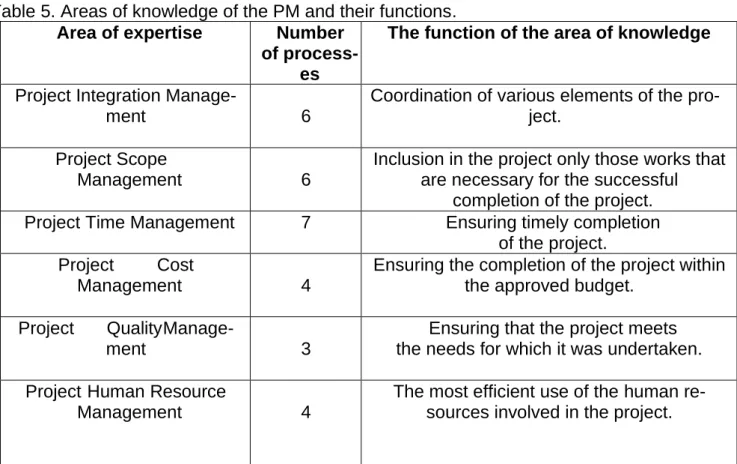
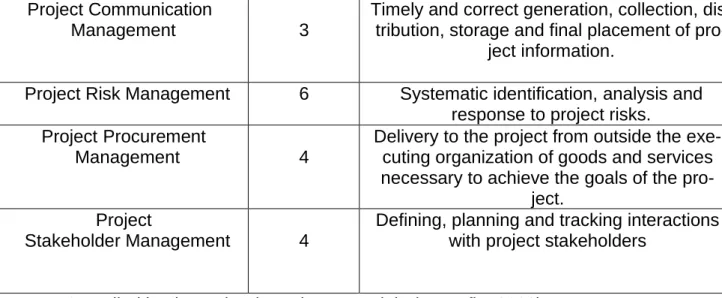
Like any system, SOPM has specific functions. In the international standard PMBOK®, the functional structure of the SOPM consists of 10 areas of knowledge. The content of the areas of knowledge of the PM and their functions are presented in Table 1.
All these functions are implemented through SOPM processes. In the process of project management, its goals and objectives are first determined. At the same time, it should be noted that the problematic aspects of the PM should not be considered only at the stage of the investment phase.
In this regard, the project management process is considered as an integrated process.
For example, insufficient knowledge of the investment opportunities of the project and poor conduct of pre-project studies in the pre-investment phase can create financial problems in the investment phase.
Table 5. Areas of knowledge of the PM and their functions.
Area of expertise Number of process-
es
The function of the area of knowledge
Project Integration Manage-
ment 6
Coordination of various elements of the pro- ject.
Project Scope
Management 6
Inclusion in the project only those works that are necessary for the successful
completion of the project.
Project Time Management 7 Ensuring timely completion of the project.
Project Cost
Management 4
Ensuring the completion of the project within the approved budget.
Project Quality Manage-
ment 3
Ensuring that the project meets the needs for which it was undertaken.
Project Human Resource
Management 4
The most efficient use of the human re- sources involved in the project.
Project Communication
Management 3
Timely and correct generation, collection, dis- tribution, storage and final placement of pro-
ject information.
Project Risk Management 6 Systematic identification, analysis and response to project risks.
Project Procurement
Management 4
Delivery to the project from outside the exe- cuting organization of goods and services necessary to achieve the goals of the pro-
ject.
Project
Stakeholder Management 4
Defining, planning and tracking interactions with project stakeholders
Note – Compiled by the author based on materials (Mustafin, 2008)
Such interconnection of the PMS processes requires high professional qualifications of the project manager and team members, since it is necessary to constantly analyze and monitor the progress of the project.
According to the international standard PMBOK®, each project (or for each phase of the project) has 5 groups of processes presented in Table 2.
Process groups consist of a set of actions that bring certain results. Project processes are usually carried out by people and therefore fall into two main groups:
− project management processes - related to the organization and description of pro- ject work;
− product-oriented processes - concerning the technical characteristics of the manu- factured product.
Table 6. Groups of project management processes and their description.
Process Group Number of processes
Description
Initiating Processes 2 Making a decision on the start of a pro- ject or its separate phase
Planning Processes 24 Definition, clarification of project goals andways to achieve them
Executing Processes 8 Coordination of performers and re- sources for the implementation of the
project plan
Monitoring & Controlling Processes
11 Ensuring the achievement of project objectives by regularly monitoring the status of execution and determining the
necessary corrective actions
Closing Processes 2 Formalization and correct completion of the project or its phase Note – Compiled from the source (Alzhanova, 2004)
During the implementation of the project, the PM processes and the product-oriented pro- cesses are closely interrelated.
According to the international standard PMBOK®, the project management system con- sists of 47 processes, 10 areas of knowledge and 5 groups of processes.
The integrated picture of the processes and areas of knowledge of the PM is presented in the form of a matrix of processes of the project approach.
Management levels are time periods in which the implementation of project management tasks of different objects and management entities is considered. Usually the hierarchy of management levels consists of:
− strategic level, covering the work throughout the project life cycle;
− the annual management level reviewing the project activities that were planned for the year;
− the quarterly management level reviewing the project work that was planned for the quarter;
− the operational level of management considering the work of the project, which was planned for a month, decade, week, day, shift, etc.
Each element of the project management system plays an important role in the formulation of project objectives. The methodology involves consideration of the elements of the pro- ject management system "bottom-up", that is, from the element
"Stages of the management process" to the element "Main and auxiliary project partici- pants". Structuring the elements of the project management system will allow to fully solve the planned tasks, ensure transparency, informativeness and timeliness of the processes carried out.
Thus, based on the integration of elements of the project management system, it is possi- ble to:
− logical and informational interrelation of all stages of the project management pro- cess – "Initiation – Planning – Execution – Monitoring and management – Comple- tion";
− a combination of structural parts (integration management, content, deadlines, cost, quality, communications, human resources, risks, contracts and stakeholders) of the
"Functional areas of knowledge" level;
− the methodology of the PMS to achieve goals in accordance with the requirements of project management.
2.3 Features of project management standardization
In market conditions, representatives of the largest management schools are engaged in research, analysis and systematization of modern experiences and methods of project management, as well as the development of standards. Guidelines and standards are the basis for the international and interdisciplinary nature of project management. In the world practice, project executors perform their work in accordance with a unified methodology and the requirements of standards.
At the same time, not everything is so clear, there is still no single established point of view on understanding the basics of standardization.
According to Volodin et al. ( 2015), when considering the problem of standardization,
"... it is necessary to answer an important question: what is a standard in general and how does it differ from a standard?”
A standard is a document approved by authorized bodies containing rules or characteris- tics of products, processes, services, compliance with which is not mandatory. A standard is a document that establishes requirements for the characteristics of products, processes, and services, compliance with which is mandatory."
As you can see, the standard is voluntary, but not mandatory. This is confirmed by the def- inition of the term "standard" in the Law of the Republic of Kazakhstan on Technical Regu- lation of November 9, 2004.
In accordance with this law, the standard is a document that, for the purpose of repeated and voluntary use, establishes rules, general principles and characteristics for objects of technical regulation.
According to the definition given by Tovb and Tsipes (2003) "the standard (from the Eng- lish norm, sample) is in the broad sense of the word – a sample, a standard, a model tak- en as the source for comparison with other similar objects".
In the economic dictionary, the standard is interpreted as "... a normative and technical document establishing a set of norms, rules, and requirements for the object of standardi- zation" (Alasoini & Kajander, 2019).
Summarizing the above definitions, we can highlight the features characteristic of the standard:
− a technical document approved by the competent authorities;
− set of rules and procedures;
− a typical sample.
Standards in project management have their own specific features. In research related to project management, the authors, to one degree or another, consider various features of the classification of standards. Each of these developments has a certain scientific and practical value, and therefore deserves attention from researchers.
In this regard, standards identify the following main institutional levels of standardization of project management (Render et al., 2018):
1) universal approaches, including standards and models of maturity of project man- agement (international standards, models of maturity of project management);
2) national project management standards: ARM (UK), VZPM (Switzerland), GPM (Germany), AFITEP (France), CEPM (India), PROMAT (South Korea), P2M (Japan), GOST R 54869-2011 "Project management. Project Management Requirements"
(Russia);
3) industry standards, including those based on universal approaches. For example, based on the RMVOK standard, the Public-Sector Project Management (2009) and Government Extensiontothe RMVOK 4® Guide (2006) standards have been pub- lished for the public and public sectors, respectively;
4) the corporate concept of project management is based on a certain standard and in- cludes a set of technologies, regulations, document templates, organizational struc- tures, distribution of powers and responsibilities of project management participants in a particular organization.
The presented classification, in our opinion, is not without drawbacks. In particular, all ma- turity assessment models determine which processes need to be improved at each level of the project management standards system. Therefore, it is erroneous to attribute maturity models only to the first level of project management.
According to the above authors, approaches to standardization in the field of project man- agement are based on the following principles:
− in international and national standards, the objects are glossaries, processes and methods of project management;
− in those areas of project management in which there are no standardization objects, they resort to professional and qualification standards.
This classification is of particular scientific and practical interest, since international stand- ards are applied in the field of project management, which are supported by relevant inter- national organizations. These standards define the main technical requirements for pro- cess management, project lifecycle processes, design processes, the level of competence of project managers and project management specialists. For different components, the requirements, norms and standards that allow us to speak about the professional compe- tence of the project manager and the quality of his work on the project are set in different forms.
Lawal and Ojo, (2020) hold a slightly different opinion, noting that the classification of codes of rules (standards) for project management includes, in addition to traditional inter- national and national standards, also public, corporate and private standards.
In their opinion, public standards developed by various associations of an associative na- ture can be applied in individual companies. In the future, these standards may be trans- formed into national standards.
The need to develop corporate standards appears when:
− the company carries out many projects in parallel with the main activity;
− the company has a project-oriented orientation.
Usually, private standards are developed for the implementation of projects, not only by one organization, but also by several organizations. Private standards are based on the norms and rules of the national Project management standard.
An almost similar approach to the allocation and classification of standards (international, national and corporate) is followed by Klijn and Teisman (2003) who rightly note that standardization in project management can extend to two types of elements of the SPM:
objects (organizations and individual projects) – elements described in the form glossaries, processes and methods; subjects (people) – elements described in the form of qualifica- tion requirements.
Thus, considering the opinions of different scientists, in our opinion, the following features of the classification of project management standards can be distinguished: