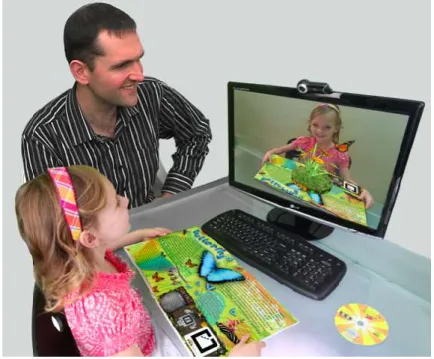
An Interactive Augmented Reality Alphabet 3-Dimensional Pop-up Book For learning and Recognizing the English Alphabet
By
HADEER KHALED YEHIA MOHAMED AHMED KHALIFA
Dissertation first draft submitted in partial fulfillment of the requirements for the
Bachelor of Technology (Hons) (Information Communication Technology)
SEPTEMBER 2013
Universiti Teknologi PETRONAS Bandar Seri Iskandar
31750 Tronoh Perak Darul Ridzuan
i
ABSTRACT
This document describes the process developing an Augmented Reality (AR) alphabet book mobile application. Using only an android phone camera, the child could view the superimposed virtual alphabet 3 dimensional objects in a fun and interactive manner using the marker-less physical alphabet book as the interaction tool. The reason behind choosing alphabet teaching as the topic of the book is that the Alphabet knowledge is the core knowledge of any language. It is a jump-start for children to start reading and recognizing words and sentences, thus learning the alphabet is extremely important, for many researchers, emphasizing on how early, child’s education shapes the child’s successful future. Though there are, a great deal of technology based alphabet books; parents still prefer buying the old style physical books or some might use a virtual technology based book application. The problem is that though the physical book possesses many benefits, that our generation and the generations long before us, have experienced, yet from the current generation children’s point of view, they may in fact find it dull and boring. For, it is commonly recognized, that the current generation children are surrounded all around by technology and gadgets, that can make them board, easily distracted, and may refuse to willingly use a plain non-technology book to learn, and if using a virtual application, they will lose the benefits offered by a physical book. Knowing this, the use of Augmented Reality should solve such a problem. For Augmented Reality (AR) is considered the best of both worlds, where, real and virtual objects are combined in the real environment, that will allow the use of both technology based application and a traditional physical book, combining the benefits of both and meeting the child and the parent midway. Although AR technology is not new, its possible potential in education is just beginning to be investigated.
The main aim of this research is to develop an interactive 3-Dimentional alphabet pop-up book, and using digital storytelling, to help teach children to learn and recognize the alphabets. The objectives of the study are to enhance the interactions of the alphabet book, by creating an android application that contains animated interactive 3-Dimentional models, interactive sounds, songs and music. Furthermore, to investigate the use of digital storytelling (music, sounds), interactions and animation effect in learning engagement, through using the augmented reality technology. The scope of this project and research is very wide, it includes the 3D modeling, texturing, rigging & animation, book design and content decision research, furthermore, Augmented Reality and Android application development. It also includes research on interactivity options to be implemented through user perspective observations. Finally, it was found that the children enjoyed using the application and sang along to the songs provided for phonics learning.
ii
TABLE OF CONTENTS
Abstract ... i
Chapter 1 ... 1
Introduction ... 1
1 Introduction & Background of Study ... 1
1.1 Problem Statement ... 2
1.1.1 Significance of the project ... 3
1.2 Objectives of Study... 4
1.3 The Relevancy of the Project ... 4
1.4 Scope of Study ... 5
1.4.1 Feasibility of the Project within the Scope & Timeframe ... 6
Chapter 2 ... 7
Literature review ... 7
2 Literature ... 7
2.1 Augmented Reality ... 7
2.1.1 Augmented Reality VS. Virtual Reality ... 8
2.1.2 Types of Augmented Reality ... 10
2.1.3 Devices used for Augmented Reality ... 13
2.1.4 Augmented Reality Applications ... 14
2.1.5 Augmented reality in Education ... 19
2.2 Storytelling in Education ... 25
2.3 Digital Storytelling and Augmented Reality ... 27
2.3.1 Digital Storytelling with Augmented Reality ... 28
2.4 Mobile Technology ... 29
2.4.1 Android Operating System ... 29
2.4.2 Mobile Learning ... 31
2.5 Alphabet Learning ... 32
2.5.1 Available Alphabet Means of Teaching & Learning ... 35
2.5.2 Current Alphabet Learning Approaches ... 38
iii
2.5.3 Available Augmented Reality Alphabet Teaching/ Learning
Application ... 44
Chapter 3 ... 47
Research Methodology & Project activities ... 47
3 Methodology & PROJECT ACTIVITIES ... 47
3.1 Planning Phase ... 48
3.2 Requirement Analysis Phase ... 48
3.3 Design Phase ... 49
3.4 Implementation Phase ... 49
3.4.1 Testing ... 49
3.5 Tools ... 50
3.5.1 Hardware & Equipments ... 50
3.5.2 Software, Platforms & SDKs ... 50
3.5.3 AR SDK and Platforms Comparison ... 54
3.5.4 Why Mobile (Android) ... 55
3.6 Project Activities ... 56
3.6.1 Initial Storyboard ... 56
3.6.2 Choosing the Alphabet Objects ... 56
3.6.3 Logo Design ... 60
3.6.4 Book Design ... 60
3.6.5 3D Modeling, Rigging & Animation ... 64
3.6.6 The Sound and Song of Storytelling ... 67
3.6.7 Development in Unity 3D ... 68
3.7 System Architecture... 69
3.8 Functionalities & Important Codes ... 70
3.8.1 Applying Animations ... 70
3.8.2 Applying Interactions ... 72
3.9 Challenges Encountered ... 73
3.9.1 Program Installation, Compilation & Learning Curve ... 73
3.9.2 Interaction & Animation ... 73
3.9.3 Time constrain ... 73
iv
3.10 Method of User Perception Survey and Observation Study ... 73
3.10.1 User Perception Survey ... 74
3.10.2 Key Milestones ... 75
3.10.3 Gantt Chart ... 76
Chapter 4 ... 77
Results & Discussion ... 77
4 Results & Discussion ... 77
4.1 Prototype ... 77
4.2 Pilot Study ... 80
4.3 Discussion ... 80
4.4 Another Pilot Study ... 82
4.5 User Testing Results ... 82
4.5.1 4.3.1 User Perception Survey ... 82
Chapter 5 ... 86
Conclusion & Future work and continuation ... 86
5 Future for expansion ... 87
REFERENCE ... 89
i LIST OF FIGURES
Figure 1: A little girl playing with an Ipad (Mannino, 2013) ... 3
Figure 2: Augmented Reality (Dubois, 2011) ... 8
Figure 3: AR ATM Finder Application (Cool App: ATM Finder with Augmented Reality, 2010) ... 9
Figure 4: Mixed Reality Spectrum ... 9
Figure 5: Virtual reality games on Kinect (Project Natal: Changing Gaming Virtual Reality, 2010) ... 10
Figure 6 : QR Augmented Reality example ... 11
Figure 7 : Marker-less AR (SmartAR) ... 12
Figure 8 : Markerless Augmented reality Calculator ... 12
Figure 9 : Google glass ... 13
Figure 10: Example of AR use in Medicine (ARISER Augmented Reality in Surgery) ... 15
Figure 11 : Student studying the human bone structure (Finley, 2011) ... 16
Figure 12 : Scene of the movie Avatar displaying an augmented reality 3-D Map ... 16
Figure 13 : AR game that makes the users collect virtual fairies in real environment (Inbar, 2013) ... 17
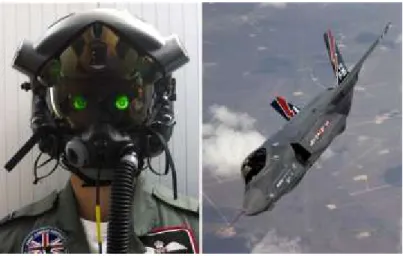
Figure 14: Air force Pilot wearing an HMS (Farmer, 2013) ... 18
Figure 15: Latest Adidas campaign using the logo as an AR marker ... 18
Figure 16: Metro Paris Subway on apple store (First augmented reality app hits the iPhone app store, 2009) ... 19
Figure 17: Child uses an AR popup book developed by Popar (Idealog, 2012) ... 21
Figure 18 : AR in Education of Archaeology and Cultural Heritage (AREL - Augmented Reality in Education and Learning)... 23
Figure 19: Learning Languages using LearnAR ... 24
Figure 20: The Boyhood of Raleigh by Sir John Everett Millais, oil on canvas, 1870 (Wikipedia). ... 25
ii
Figure 21 : Digital Storybook titles Bedtime Battle on apple store (KELLY, 2012)
... 28
Figure 22: WONDER BOOK: BOOK OF SPELLS AR popup storybook (Bill, 2012) ... 28
Figure 23 : 8-Reasons why people choose Android (Khatri, 2013) ... 31
Figure 24: Father and son reading a story through a mobile phone (Sándor, 2011) ... 32
Figure 25 : A Specimen of typeset fonts and languages, by William Caslon, letter founder; from the 1728 Cyclopedia. (Wikipedia) ... 33
Figure 26 : A French ABC-book printed in 1861(Wikipedia) ... 36
Figure 27 : 'Kate Greenaway's Alphabet' was published in 1885 in a miniature edition, and Edward Lear who had an alphabet published in 1871 ... 37
Figure 28 : My Little ABC Book; Alphabet B example ... 38
Figure 29 : ABC3D Book; Alphabet An example ... 39
Figure 30 : Jump Start Advanced Preschool ... 40
Figure 31 : Active Alphabet ... 41
Figure 32 : My Alphabet Book ABC ... 41
Figure 33 : Kids ABC Letters Lite ... 42
Figure 34 : ABC for Kids ... 42
Figure 35 : Alphabet App IOS ... 43
Figure 36 : I can Learn My ABCs interface ... 44
Figure 37 : AR Flashcard ... 45
Figure 38 : Screen shot of project using the Vuforia Play mode for dynamic testing in unity 3D ... 50
Figure 39: Modeling the Xylophone in Maya, to be used as an alphabet object for the letter X ... 51
Figure 40: Editing the ABC song on audicity ... 51
Figure 41:High-level system overview of Vuforia SDK ... 52
Figure 42:Image Target class Reference ... 52
Figure 43: Designing the Splash screen & Logo ... 52
iii
Figure 44 : Screenshot of a script that was written for the main menu gui ... 53
Figure 45 : Project view in unity 3D ... 54
Figure 46 : The Final Logo Design ... 60
Figure 47 : Vuforia Target markers process flow chart ... 61
Figure 48 : screenshot of an early book design, the apple page ... 62
Figure 49 : Screenshot of the final book design, the apple page ... 63
Figure 50 : Screenshot of the target manager database ... 64
Figure 51 : A Shark render view from Maya ... 65
Figure 52: Shark Rigging Controls in Maya to prepare for animation ... 65
Figure 53 : Jet-plane with the animation Path ... 66
Figure 54 : Smoke animation coming out of the Kettle ... 66
Figure 55 : Jelly beans jumping animation ... 67
Figure 56 : Helicopter Animation and its animation path in Maya ... 67
Figure 57 : Process of editing sounds in Audicity ... 67
Figure 58 : Developing the app in Unity ... 68
Figure 59 : System Architecture of the prototype ... 69
Figure 60 : Unity interface, showing the public declaration usage in the script above ... 71
Figure 61 : mesh collider attached to the ball model ... 72
Figure 62 : Application on an android device menu ... 77
Figure 63 : The Application GUI ... 77
Figure 64 : The Book Cover ... 78
Figure 65 : N n, Nest marker page 1 & N for nutshell song marker page 2 ... 78
Figure 66 : Letter Z for Zebra ... 79
Figure 67 : zebra imported from Maya to unity 3-D ... 79
Figure 68 : Duck model for letter D, imported form Maya after modeling and textured ... 79
Figure 69 : Penguin Model For alphabet P ... 79
Figure 70 : Violin model for letter V ... 79
Figure 71 : Rose model for alphabet R ... 80
iv
Figure 72 : Jet Plan for the alphabet J ... 80 Figure 73 : high school girls trying out the application ... 80 Figure 74 : A girl trying the alphabet O ... 80 Figure 75 : One of the users leaning to see the, where the 3-D model comes from ... 80 Figure 76 : high school students testing the application and trying to test the camera to see if it is in real time ... 81
Figure 77 : 3 years old girl, trying the application ... 82
1 LIST OF TABLES
Table 1 : Percentage of Market Share of Top Smartphone Platform (Survey in
US) (Fingas, 2012) ... 30
Table 2 : Vuforia vs String AR ... 54
Table 3: Final year project part-1 Key Milestones ... 75
Table 4: Final Year Project Part 2 Key Milestones ... 75
Table 5: Final year project part two Gantt chart ... 76
1
CHAPTER 1 INTRODUCTION
1 INTRODUCTION & BACKGROUND OF STUDY
It is common that every kid in either pre-kindergartens or kindergartens have a problem to start learning alphabet. Learning and mastering the alphabet knowledge is necessary for kids. Alphabet knowledge is crucial as a jump-start to read and spell (Adams, 1990; Ehri, 1987; 1998). Most of the times, parents will buy few of the alphabet books or any other learning tools in order to make sure their kids get familiar with the alphabet and can recognize them well before starting school. However, children nowadays get bored easily with the traditional plain books according to interview with parents. They want something advanced and different
Augmented reality (AR) is one of the emerging technologies that are widely used in various fields like medicine, advertising, military, travel and education. AR allows users to manipulate and retrieve data within the real world, and allows the user to experience the realness of an idea without endangering consequences.
It also allows the user to grasp and understand some logics, theories and facts that can’t be easily seen or used like understanding the human anatomy (muscles, tissues) or the solar system and universe.
However, Augmented reality for education is capable of providing interactive, interesting & fun learning to grab their attention and guarantee the higher possibility of understanding and to enjoying the subject being taught. The reason behind using Augmented Reality to develop the storybook is that AR combines both “real and virtual objects in a real environment” (Yuen, Yaoyuneyong, & Johnson, 2011).
Therefore AR is considered to be the best of both worlds (the real & the virtual).
Moreover, Shapiro, 1998 in How to Raise a Child with a High EQ: A Parents’
Guide to Emotional Intelligence mentioned, “Many people don’t realize the extent to which stories influence our behavior and even shape our culture.” Referring to these shows the importance of storytelling is an important part of human culture in both entertainment and education. Traditional storytelling by traditional physical books enables “multi-sensory” experiences including speech (narration), vision (seeing the book) and touch (turning pages and pointing)” (Zhou, Cheok, Pan, & Li, 2004)
2
Digital storytelling with AR integration will still use the traditional physical book to enable the children’s “multi-sensory” experience as mentioned earlier. Moreover AR will overlay the 3-D interactive virtual environment on top of the physical world (the storybook) using a technology (in this case mobile device (Android)).
Hence, the application will give the children a total imerssiveness in the story as if they are part of the magical story they are reading. For Augmented, reality is designed to “haze the link between the realities the user experiencing and the substances provided by technology”. (Thomas, 2012)
Finally, the aim of this study is to enhance the interactions of traditional books, while still keeping the main advantages of traditional physical books and this can be successfully implemented using AR. The basic idea behind this project is to develop a new interface by applying interesting interactive objects to capture the interest of the nowadays kid. The application will provide a realistic environment using 3-D graphics, sound, music and speech to encourage interaction between the child and the application, giving the child a popup magical experience.
1.1 Problem Statement
The current methods with learning the alphabet can be boring, dull and non- interactive. A new study by Common Sense Media finds mention in the New York Times that "children under 8 are spending more time than ever in front of screens,”.
Furthermore, Santoso, Fei Yan & Byung Gook (2012) added in their research that the present generation is accompanied by digital technology such as computers, video games, smart phones and mobile devices.
Therefore, nowadays, kids, even infants are native media literate. This scenario leads the kids to have an advanced expectation on the learning activities, which make them less interested to study using the plain traditional alphabet books, and would rather play with their gadgets and with the technology they are surrounded by.
While, parents still buy traditional books to help teach their children the alphabet.
Hence, the kids feel dull and bored.
3 1.1.1 Significance of the project
Current methods of learning obviously doesn’t match With the advanced technology nowadays, in a research by (Parhizkar, Shin, Lashkari, & Nian, 2011) found that children found that reading in conventional ways is dull and tiresome, where there are so many entertainments out there which is much more interesting than reading. (Parhizkar, Shin, Lashkari, & Nian, 2011) also concluded that teachers have to come out with ideas that would attract children’s attention to make the
“study more interesting in order to encourage the reading habit”. (Parhizkar, Shin, Lashkari, & Nian, 2011)
Figure 1: A little girl playing with an Ipad (Mannino, 2013)
The problems should be tackled as kids nowadays are more advanced and get bored easily if the learning process does not run efficiently. They are exposed to various technology advancement, thus they also might have different expectation on the learning process. Therefore, the common current methods of teaching the alphabet are worrying the parents, because their kids seem uninterested and do not want to learn the alphabet, which is the core basis of learning any language to start reading and writing.
Thus, an interactive digital storytelling alphabet application book should be developed to allow the kids to have fun and engaging learning process. Using augmented reality technology is the best of both worlds combines both virtual and real environment to give a magical mixture that combines both virtual and real
environment benefits.
4 1.2 Objectives of Study
The Study aims are to develop a fun and interactive AR alphabet Storybook for children to learn and recognize the English alphabet:
I. To enhance the interactions of traditional alphabet books by creating an interactive Augmented Reality user interface application on an android mobile for the AR book.
II. To investigate the use of AR digital story in engaging the children to learning alphabet.
III. To conduct a study on the effect of interactive AR animations on learner’s engagement.
1.3 The Relevancy of the Project
Augmented reality offer the new form of learning process making it more interactive, and interesting. The project aims to integrate the AR technology as learning tools. For the time being, the project will be developed based on recognizing the English Alphabet and learn how to pronounce them through songs.
Generally, the application will offer the children to read the AR books using the Android tablets or smart phones. With the advancement of AR technology, kids will be able to manipulate and interact with the virtual views of the book; thus making the learning becomes more exciting. If the project is successfully developed, the AR book can be readily used by the kids and the user’s perception study will be done accordingly. With the success of the project, the learning process should definitely be more fun, exciting and interesting.
5 1.4 Scope of Study
The objective of this project is to develop an interactive Augmented Reality based story with the possibility of introducing some game based learning. The game will be designed specifically for children of young age to help benefit from the learning advantages of storytelling mentioned in section 2.2. The scope of this project involves several areas that will be used in development as follows:
I. Augmented Reality is the emerging technology and widely used in various fields. One of them is in education field. Publishers and developers are interested to make the learning process becoming interesting in order to attract student or kid’s interest to learn. Thus, the project aimed to develop storytelling alphabet book using the Augmented Reality technology.
II. 3-D Design & Animation: Maya, Blender and other programs will be used to design and animate 3-D characters and props to be used in the AR book.
III. An Android (Mobile) Applications & Interaction: Since the Mobile technology is now available and very useful and affordable and not only adults are familiar with the use of such devices you can find 3 years olds carrying their smart phone and playing around with it. Thus, the project aimed to develop AR application on Android tablet instead of using the PC or computer. Since Android operating system is an open source and Google releases the code under the Apache License, it is the most common used operating system for smart phones rather than IOs (apple operating system). With the completion of the project, kids will be able to use the application embedded on their Android tablet while enjoying reading the AR books.
IV. A physical storybook: Adobe Photoshop and InDesign will be used to create the book 2-D graphics (marker images) and the storyline.
6
1.4.1 Feasibility of the Project within the Scope & Timeframe
In Summary, the target users for the application children with age ranging from three to 6 years old, preschool as well as early primary school. The application allows the child to read and listen to the story using their phone and a physical book, and by using AR, the children will be able to manipulate and interact with the 3-D models to learn and discuss what they have acquired from the book.
The project will be developed on two studying semesters as in eight consecutive months. The first four months will involve the first few phases of the methodology process, which are the planning, Analysis & designing phase (See Section 3.1-3.3).
In the second phase of the project (second 4 months) will be focused on developing, Implementation then testing (Section 3.4-3.5). Therefore if the tasks were properly managed and the time was wisely allocated this project should be feasible within the timeframe. (See Gantt chart for first phase Section 3.3)
7
CHAPTER 2
LITERATURE REVIEW 2 LITERATURE
2.1 Augmented Reality
As mentioned by (Graham, Zook, & Boulton, 2013) Augmented reality (AR) is an animator, direct or indirect, view of a physical, real-world environment whose elements are augmented by computer-generated sensory input such as sound, video, graphics or GPS data.
Therefore, the technology functions by improving the current perception of reality. AR is usually in real-time and in a semantic framework with environmental elements, such as the small news slip on TV while a movie is playing.
With the help of advanced AR, technology nowadays the information about the surrounding real world of the user becomes interactive and artificial information about the environment and objects can be digitally overlaid on the real world.
However, (Yuen, Yaoyuneyong, & Johnson, 2011) argued in their article titled A Survey of Augmented Reality Technologies, Applications and Limitations in the Journal of Educational Technology Development and Exchange; that such definitions that were mentioned earlier are” too simplistic for an evolving and expanding field” , For an AR system :
Combines real and virtual objects in a real environment. (Krevelen &
Poelman, 2010)
Registers (aligns) real and virtual objects with each other.
And
Runs interactively, in three dimensions, and in real time.
(Zhou, Duh, & Billinghurst, 2008) Simply define AR as technology “which allows computer generated virtual imagery to exactly overlay physical objects in real time” (p. 193).
8
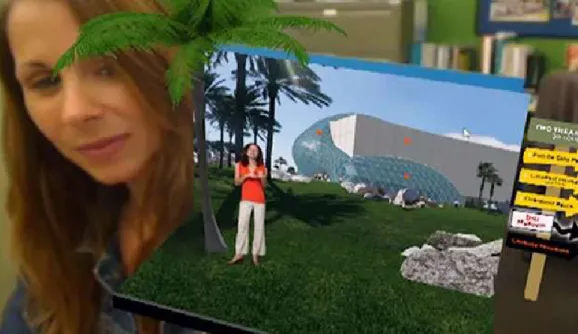
Figure 2: Augmented Reality (Dubois, 2011)
The goal of augmented reality (AR) is to add the information and significance to a real object or places. Augmented reality is designed to haze the link between the realities the user experiencing and the substances provided by technology.
Augmented Reality has received good acceptance from the people all around the world despite being relatively new developing technology. Though it is not fully developed, technological giants from all across the globe are constantly investing in research and development for the same (Thomas, 2012).
2.1.1 Augmented Reality VS. Virtual Reality
According to (Weng & Giap, 2008) member of the Faculty of Cognitive Sciences and Human Development, at the University Malaysia Sarawak described the difference between Augmented Reality and Virtual Reality by stating the following:
“Unlike Virtual Reality (VR) that aims at replacing the perception of the world with an artificial one. AR has the goal of enhancing a person's perception of the surrounding world. Being partly virtual and real, the new interface technology of AR which is able to display relevant information at the appropriate time and location, offers many potential applications; these include aiding in education, training, repair or maintenance, manufacturing, medicine, battlefield, games and entertainment”.
9
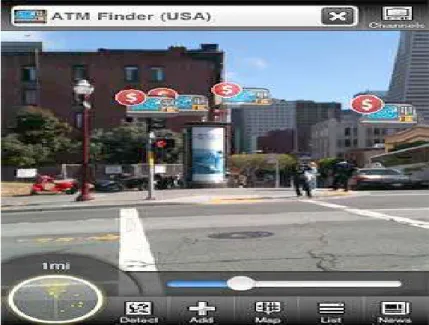
Figure 3: AR ATM Finder Application (Cool App: ATM Finder with Augmented Reality, 2010)
Meanwhile considering the array of the developing technologies, all seeking to modify, Augmented, interface with, or even replace our perceptions of reality, (Milgram & Kishino, 1994) wanted to clarify the difference between real & virtual considering the array of the developing technologies by defining four types of environments.
First is the real environment, which is the environment that everyone lives in. On the opposite end of the scale are virtual worlds (virtual reality), in which all information perceived by the user is computer-generated and completely unrelated to real world locations, objects, or activities. Between these two extremes, exist, at least conceptually, two types of augmented environments: Augmented Reality (AR), which takes the real world and real environments as its framework and inserts computer-generated content. While augmented Virtuality, in which a computer- generated world serves as the backdrop while real-world data are blended in and superimposed. Figure 4 illustrates the Mixed Reality (MR) spectrum, or the Reality- Virtuality (RV) Continuum, proposed by (Milgram & Kishino, 1994) .
Figure 4: Mixed Reality Spectrum
10
AR is closer to the real world on one end of the scale with the dominate perception being the real world which is improved by digital data. AV on the other hand is closer to a completely immersive virtual environment involving systems that are mostly computer generated, but would have some real world imagery added.
Virtual environments (VE) are environments that are totally simulated by the technology.
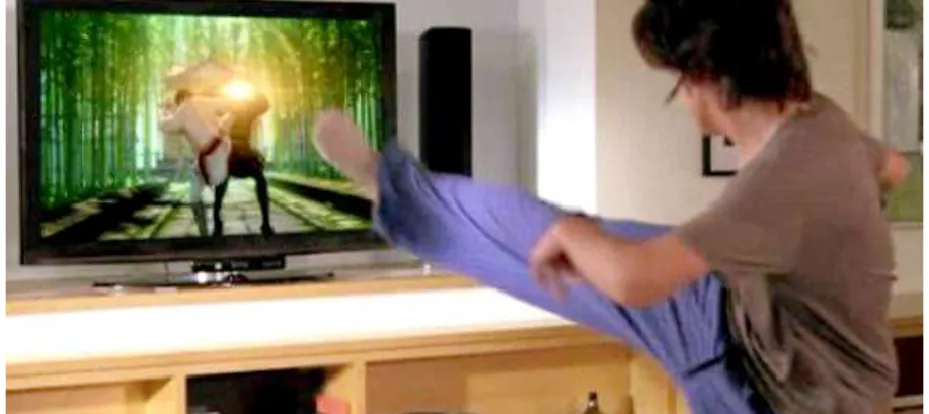
Figure 5: Virtual reality games on Kinect (Project Natal: Changing Gaming Virtual Reality, 2010)
As the technologies continue to rapidly advance, it seems possible that the virtual elements and real world elements, sharing space in mixed reality environments will become more and more difficult to tell apart.
2.1.2 Types of Augmented Reality
There are two types of augmented reality: marker-based which uses cameras and visual prompts, and marker-less which use positional data for example a mobile’s GPS and compass (Patkar, Singh, & Birje, 2013).
Marker Based 2.1.2.1
This technology uses physical-world symbols as a reference point for computer graphics to be overlaid. Marker-based AR typically uses the camera feature of mobile devices or computer to analyze and capture the markers. Users can observe different view of the real objects with the use of the markers. QR codes are mostly used in the type of AR.
11
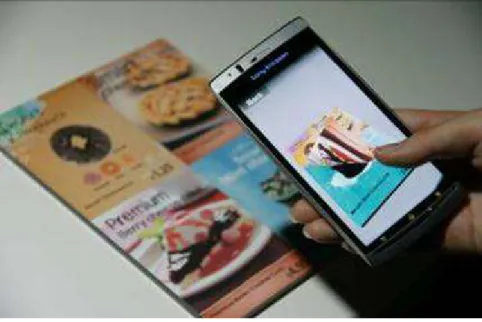
Figure 6 : QR Augmented Reality example
The other more advanced marker based on is including Popcode and GoogleGoggles. The position of the marker may results to different results sometimes. Users can move the markers to view the virtual model of objects in different angle.
Marker based AR is:
Marker-based AR uses a camera & a visual marker to determine the center orientation and range of its spherical coordinate system.
Most of the time, the applications using markers are an open source technology.
Marker-less 2.1.2.2
Marker-less AR typically uses the GPS feature of a Smartphone to locate and interact with the surrounding. There are few programs available to create the marker- less AR application, which includes ARIS, aurasma, and Layar. ARIS is an open source Augmented Reality and Interactive Storytelling program.
Using a Flash based browser interface, users can create AR games, tours, and other imaginable interactions for delivery on the iPhone, iPad touch (with camera), and iPad 2 ( Dartmouth Collage, 2013) .
Aurasma uses the smartphone's GPS, camera, accelerometer and other features to recognize the surrounding area and display interactive AR content without the need for barcodes ( Dartmouth Collage, 2013)
Layar displays digital information called "layers" in the user’s field of vision through their mobile device. Layars can be viewed using the Layar App for iPhone and Android based smartphones ( Dartmouth Collage, 2013).
12
Figure 7 : Marker-less AR (SmartAR)
Figure 7 above shows the marker-less AR application developed by Sony called
“SmartAR”. SmartAR technology uses “object recognition technology” to achieve the markerless functionality (Sony, 2012). It also boasts extremely accurate high- speed tracking, 3-D space recognition and interactivity.
Markerless AR is:
Figure 8 : Markerless Augmented reality Calculator
Currently one of the best technology for tracking
It performs active tracking & recognition of real environment on a type of support without using special placed markers.
Allows more complex augmented reality applications.
13
2.1.3 Devices used for Augmented Reality
Desktop
Head mounted devices
Mobile Devices
Eyeglasses
Figure 9 : Google glass
Contact Lenses
14 2.1.4 Augmented Reality Applications
Augmented Reality (AR) has been pursued in research because it may
I. Allow for the improvement of users’ perceptions, knowledge, and interaction with the real world (Azuma, et al., 2001) .
II. since, AR has the potential to improve productivity in real world tasks (Schmalstieg, 2001) (Krevelen & Poelman, 2010) mentioned that AR is the technology which is capable of creating the “next generation, reality- based interface” and is moving from laboratories around the world into various industries and consumer markets. (Yuen, Yaoyuneyong, &
Johnson, 2011)
Nowadays, the application of the augmented reality has been widely used in various fields including aviation, medication, industrial design… etc... However, (Ludwig & Reimann, 2005) offered an organizational scheme, which claims that AR applications fall into three main categories:
I. Presentation and visualization.
II. Industry.
III. Edutainment.
Additionally, Hamilton (2011) mentioned an extensive breakdown and analysis of AR applications within education, as well as within the media and entertainment industry, the gaming industry, the travel and tourism industry, the field of marketing, the expanding field of online social networks, and in everyday life. (Yuen, Yaoyuneyong, & Johnson, 2011)
Finally, it cannot be denied that AR applications have tremendous potential in all fields where rapid information transfer is critical (Krevelen & Poelman, 2010). For this reason, the development of AR in several nonacademic fields will be examined, before specifically addressing the applications of AR in education in section 2.3
Medical Applications 2.1.4.1
According to (Samset, et al., 2008), AR technology will not only be able to enhance medical surgical and clinical procedures by improving cost effectiveness, safety, and efficiency, medical AR systems may also assist in the invention of new surgical procedures (Yuen, Yaoyuneyong, & Johnson, 2011). AR systems have potential to support surgeons with navigation and orientation before, during, and
15
after surgery. AR systems can use streaming input data to create virtual superimposed images in real-time.
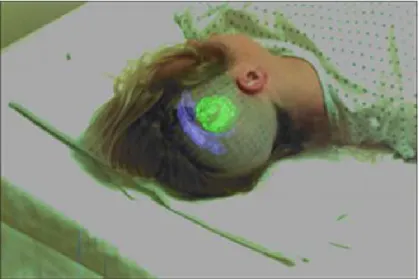
According to Dr. Michael Aratow Chief Information Officer for San Mateo Health Services, AR has been used and it has been playing a huge role in the medical field, for nearly ten years. One of the interesting uses for AR in the medical field involves live interactive imaging for assisting physicians, medical students and children. Minimally invasive surgery (MIS) includes procedures where a camera is inserted into the patient's body to help the doctor visualize the procedures he or she is conducting. In one example (Figure 8), this form of surgery is aided with the use of AR imagery of a brain superimposed onto the patient's head, giving the doctor a more tangible visualization. Another example involves being able to visualize a patient's spine in order to more accurately place a spinal tap, or other spinal injection.
Figure 10: Example of AR use in Medicine (ARISER Augmented Reality in Surgery)
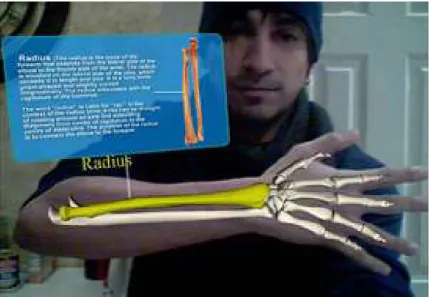
These visualizations can also extremely useful tools for educating both students and children about medicine. With the help of augmented reality projections of bones, muscles, nerves and other internal body parts, MED students can practice procedures on mannequins in a somewhat real-world game of "Operation."
Applications can also help teach kids and medical students about anatomy by allowing them to peek under the skin and reveal the inner workings of human bodies
16
Figure 11 : Student studying the human bone structure (Finley, 2011)
Entertainment 2.1.4.2
Augmented Reality has been in the entertainment business for almost a decade.
Augmented reality is implemented in several entertainment fields like cinematography, games and entertaining applications.
2.1.4.2.1 Cinematography
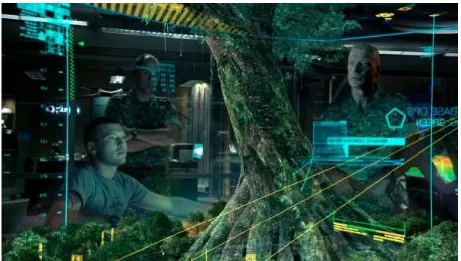
One of the most famous movies since using real-time Augmented & virtual reality is the movie Avatar the movie contains a lot still scenes in the film that features Augmented Reality. For example, the big map in the HQ that shows the Na’vi’s (the people from the movie) tree, the stacks of spaceships that use HUD screens to navigate or the plenty of toys in the researcher’s lab.
Figure 12 : Scene of the movie Avatar displaying an augmented reality 3-D Map
17 2.1.4.2.2 Electronic Games
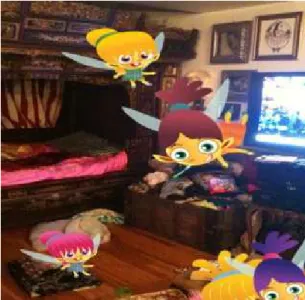
The electronic games industry and the social media industry are both broadening their scope to include AR technologies. Smartphone apps now allow users to fire AR Gatling guns, which appear to hit real-world objects. Smartphone apps and handheld game consoles have released games which let users track and collect virtual fairies (Figure 9) and other mythological creatures which appear in the real-world around them (Lewis, 2005). According to (Raju, 2009) AR games of these sorts are noteworthy for providing stress relief.
Figure 13 : AR game that makes the users collect virtual fairies in real environment (Inbar, 2013)
Military 2.1.4.3
For many years military AR applications involving the Helmet-Mounted Sights (HMS), worn by fighter and helicopter pilots have been used. These helmets allow users to view relevant information such as instructions, maps, and enemy locations.
(Yuen, Yaoyuneyong, & Johnson, 2011)
This information can also be displayed on a vehicle screen, or on the windshield of a turret. For the soldiers on the ground, as well as in the air, AR military-grade helmets are still in development, to be equipped with computers, 360-degree cameras, UV and infrared sensors, stereoscopic cameras.
18
Figure 14: Air force Pilot wearing an HMS (Farmer, 2013)
Wearing AR helmets, soldiers will be able to communicate with a massive “home base” server that collects and renders 3-D information onto the wearers’ goggles in real time. Several objects and people will be defined in specific colors to notify soldiers of friendly forces, potential danger spots, impending air raid locations, and other critical data. With the full deployment of AR technology, the aspect of military combat may be completely changed.
Advertising and Marketing 2.1.4.4
Advertising & Marketing is the most dominate field that AR has been used in such a massive way. Where companies normally seeking new ways to involve and interest their potential customers, have implemented a diverse amount of AR applications which present users with virtual objects, apparently sharing their space, which can be discovered and manipulated using natural movements and hand gestures.
For example, the leading-edge automotive campaigns are displaying full-size AR virtual cars in shopping centers and other public areas.
Figure 15: Latest Adidas campaign using the logo as an AR marker
19
Another example would be smaller products, such as toys, that can be viewed virtually in stores and booths worldwide. Furthermore, the more sophisticated campaigns allow users to use their Smartphones to view, rotate, and resize virtual models of products in their environment, such as furniture, so that they can gain a more accurate impression of how the item would complement their current furnishings and decorating scheme.
Travel & Tourism 2.1.4.5
AR is not necessarily only used in combat to help soldiers but AR is also used to enhance user’s experience navigating in the real world. Citizens are already familiar with using onboard GPS systems while driving, and familiar with online search apps to find locations and services. (Figure 14)
Figure 16: Metro Paris Subway on apple store (First augmented reality app hits the iPhone app store, 2009)
Additionally, nowadays with the growing use of social media, this happens to use data about people’s real-time, real-world locations. Furthermore, with the use of AR more comprehensive interfaces showing historical and touristic areas) and business (locations, services) information relevant to the surrounding environment in their real-world location.
Moreover, that is all by simply checking the smart-phone GPS, where recently there are available informatory smart-phone AR applications have been developed to help expand the users’ experience by supplying additional data based on their real- world location (Raju, 2009).
2.1.5 Augmented reality in Education
Given all of the developments that were mentioned earlier that demonstrates the functionality of AR, researchers have faith that AR has an immense potential insinuation and vast benefits in the augmented teaching and learning environments
20
(Billinghurst, 2002; Klopfe & Squire, 2008; Cooperstock, 2001; Shelton & Hedley, 2002) . For example, AR has potential to (Yuen, Yaoyuneyong, & Johnson, 2011)
I. Help teach subjects where students could not feasibly gain real-world first- hand experience (e.g. Astronomy and geography) (Shelton & Hedley, 2002) II. Engage, stimulate, and motivate students to explore class materials from
different angles (Kerawalla, Luckin, Selijefot, & Woolard, 2006);
III. Enhance collaboration between students and instructors and among students (Billinghurst, Augmented Reality in Education. New Horizns for learning, 2002).
IV. Foster student creativity and imagination. (Klopfer & Yoon, 2004)
V. Help students take control of their learning at their own pace. (Hamilton &
Olenewa, 2010)
VI. Create a genuine learning environment suitable to various learning styles (Classroom Learning with AR, 2010).
In an article written by (Yuen, Yaoyuneyong, & Johnson, 2011) on Augmented Reality: An overview and five main directions, mentioned that the researchers have explored the use of AR applications within a variety of fields and disciplines, many of which are already directly or indirectly related to education. For example, Sielhorst, Feuerstein, and Navab (2008) have broadly studied the 1990s AR medical display literature.
Moreover, other like Kaufmann and his team have focused their AR research on applications in mathematics and geometry by creating an AR system to facilitate learning between instructors and students (Kaufmann H., 2003; Kaufmann &
Dünser, 2007; Kaufmann H. &., 2003).
Additionally, researchers have explored the feasibility of various AR applications for use within the field e-learning systems (Cho, Lee, Soh, Lee, & Yang, 2007;
Liarokapis, Petridis, Lister, & White, 2002), architecture (Billinghurst & Henrysson, 2009; Thomas et al., 2001), interior design (Phan & Choo, 2010), and science education ( (Kerawalla, Luckin, Selijefot, & Woolard, 2006; Shelton & Hedley, 2002).
In the preceding subsections, some of the most significant educational applications of AR technology will be discussed: AR books, AR games, discovery- based learning, object modeling, and skills training.
21 AR Books
2.1.5.1
It is very likely that AR books will be the bridge that fills the gap between the digital and physical world. The AR technology has a great potential to offer students 3-D presentations and interactive experiences that are likely to appeal to digital native learners.
For instance, an AR book entitled “The Future is Wild: The Living Book” was developed by Meatio in Germany and was launched at the Frankfurt Book Fair in 2011. The book, with 42 integrated AR special features, demonstrates the potential of AR to encourage readers to build a connection to a book (Yuen, Yaoyuneyong, &
Johnson, 2011)
Another type of AR book experience is offered by AR pop-up books (Digilog Books), created by Gwangju Institute of Science and Technology (GIST) in South Korea, which can display 3-D characters spring from each page when readers wear a special pair of glasses. The AR system usually functions in real-time with 30 fps and supports about 300 pages without losing real-time performance (Yuen, Yaoyuneyong, & Johnson, 2011).
Figure 17: Child uses an AR popup book developed by Popar (Idealog, 2012)
Most importantly in addition, AR books can be used at the primary level. The Institute for the Promotion of Teaching Science and Technology in Thailand developed a 3-D augmented reality geology textbook, which teaches students about the discovery of the earth’s layers, relationships, differences, and functions (Yuen, Yaoyuneyong, & Johnson, 2011).
22
In addition, Magic Book, an AR interface system, allows AR content to be created for any normal book,” bringing the book to life “ (Yuen, Yaoyuneyong, &
Johnson, 2011) with animated and even interactive models drawn from the text or illustrations already in the book (Billinghurst, 2002).
Moreover, by using a more conventional AR technology, AR books have been released featuring animated images, overlaying and interacting with the pages of the book, and accompanied by music and sound effects (Billinghurst, Kato, & Poupyrev, 2001). Another approach involves AR ‘popup’ books, in which still or animated 3-D images hover over the pages of the book, often accompanied by sound (Billinghurst, Kato, & Poupyrev, 2001). Meanwhile, the development of the markerless AR tracking is assisting in the creation of more traditional board games, such as Monopoly, in a virtual augmented format.
Currently in our society, where critics of conventional literature have begun to become aware that even video games can be in stores, AR books will open the art of fiction and storytelling to an entirely new interface, demanding greater attention from the ‘authors’ to a variety of issues, such as the books unity, quality and immersiveness
The main reason why printed learning materials are favorable is to be able to make the systematic study. For example, the textbooks are generally well organized according to level of readers. Textbooks may involve many elements such as concepts, rules, analogies, and imagery so that information may be stored in long- term memory (Kikuo Asai et al, 2005). Augmented Instructions enable us to use a learning style based on printed materials and to access additional information using the concept of AR.
In augmented instructions, markers or tags are added to the text to identify virtual information related to the descriptions in the text, and are detected with an image- processing tool, ARToolkit (Kato, Billinghurst, Poupyrev, Imamoto & Tachibana, 2000). Figure 12 above shows a 3-D graphic image overlaid onto the scene captured by a camera (Kikuo Asai et al, 2005).
However, the potential of AR books to grab the attention of many types of learners, through many paths, is undeniable and very exciting for educators.
AR Educational Gaming 2.1.5.2
23
Educators often use games to assist student to easily grasp class concepts, but with the help of AR technology, the games that are based in the real world , when augmented it gives the educators’ powerful new ways to show connections and relevancy to the topic they are teaching. (Yuen, Yaoyuneyong, & Johnson, 2011)
Games that use marker technology often include a flat game board or map which becomes a 3-D setting when viewed with a mobile device or a webcam. Such games could be easily applied to a vast range of disciplines, such as archaeology, history, geography...etc..
Figure 18 : AR in Education of Archaeology and Cultural Heritage (AREL - Augmented Reality in Education and Learning)
AR games give the educators the opportunity to exploit a new visual and highly interactive form of learning. For example, SimSnails is an interactive visualization and teaching tool that helps the players “learn about, and experiment with, the concepts of natural selection and evolution” (Yuen, Yaoyuneyong, & Johnson, 2011).
Discovery-based Learning 2.1.5.3
AR Applications that convey information about a real-world place open the door of discovery-based learning it provides students with “up to the minute” (Yuen, Yaoyuneyong, & Johnson, 2011) information. Wikitude and similar mobile applications could transform school field trips by replacing paper question sheets with just-in-time information on locations, concepts and sites access activated by learners’ smart phones’ GPS when they encounter items of interest. Using AR future field trips can turn into virtual “scavenger hunts” (Yuen, Yaoyuneyong, & Johnson, 2011) with specific information on gathered from different locations.
24
Figure 19: Learning Languages using LearnAR
Another application, LearnAR www.learnar.org, uses AR technology to help students to have a more investigative, interactive and independent learning. LearnAR created a pack of ten curriculum resources and learning activities teachers and students to explore by using a webcam in numerous subjects, such as biology, chemistry, English, math, ...etc. (Yuen, Yaoyuneyong, & Johnson, 2011)
Such AR activities allow independent investigations of scenarios (e.g. Chemical reactions, learning about Sikhism, and exploring 3-D geometric shapes). LearnAR offers flexible learning, (Figure 16) which means it can be used in class by teachers and students or at home by students exploring the subjects independently
25 2.2 Storytelling in Education
Storytelling is an effective and important educational means for children, as stressed by the most brilliant men in history Albert Einstein & G.K Chesterton.
“If you want your children to be intelligent, read them fairy tales. If you want them to be more intelligent, read them more fairy tales. “- Albert Einstein (Albert Einstein Quotes)
“Fairytales don't tell children that dragons exist.
Children already know that dragons exist. Fairytales tell children that dragons can be killed ’- G.K. Chesterton
In addition, as mentioned by (Atta-Alla, 2012) in his journal that storytelling is a means for sharing and interpreting experience, “Human knowledge is based on stories and the human brain consists of cognitive machinery necessary to understand, remember, and tell stories”
(Schank & Abelson, 1995).
The stories are universal in that they can bridge cultural, linguistic, and age- related divisions. Storytelling can be adapted for all ages leaving out impression of age separation.
The stories reflect human thought as humans think in narrative structures and most often remember facts in a story form. Facts usually can be interpreted as a smaller version of a larger story, thus storytelling can supplements analytical thinking. Since, storytelling requires auditory and visual senses from the listener, a person who can learn to organize his/her mental representation of a story and recognize the structure of the language, and express his/her thoughts. (McKeough, et al., 2008)
Figure 20: The Boyhood of Raleigh by Sir John Everett Millais, oil on canvas, 1870 (Wikipedia).
26
Books may involve many elements such as storytelling, analogies, and imagery so that information may be stored in long-term memory (Kikuo Asai et al, 2005).
Besides, storytelling does encourage students to explore their unique expressiveness and can increase student’s ability to communicate thoughts and feelings in proper manner and means. Storytelling can be a nurturing way to remind children that their spoken words are powerful, that listening is crucial and that clear communication between people is necessary. Another benefits of storytelling is it allow students to gain verbal skills and becoming verbally proficient thus directly build their ability of resolving interpersonal conflict (Heather Forest, 2012). Storytelling can also act as an efficient way on passing values and wisdom so that young people who listen to the storytelling can identify the personal values from the imaginative situation, as well as identifying the wise and unwise actions that should be taken for some particular situation (Forest, 2012)
Below is a list of why Storytelling is important in education:
1. Storytelling is the oldest form of education
Cultures have always told tales as a way of passing down beliefs, traditions, and history to future generations. The stories are at the core of all that makes us human. (Hamilton & Weiss, 2007)
2. Familiarity The oral narrative form is familiar and so represents a useful tool for teaching. It allows the learner to engage with and consider new concepts, ideas and problems.
3. Reading Motivation Listening to stories instills the love of language in children and motivates them to read.
4. Focus & Investigative Stories might be discussing an issue, an artifact or a connection. A story may relate to a specific era or historic events.
5. Visualize & Perceive Stories generate incredibly imaginative responses in the listener. The story delivers and stimulates a series of vivid images in the any person’s mind. Moreover, if the storyteller has skill, then the imaginative experience of the listener is polysensual, with all five senses being called into play.
6. Empathize, Imagine, Interpret and respond
Response to the story is immediate and occurs as the narrative is being delivered and received. This response is fired by imagination, empathy with characters and situations, interpretation and visualization of the narrative and the analogies, metaphors and allegories within it. The narrative involves characters: whether they are children or adults or even strictly ‘human’ these provide a point of reference for empathy.
7. Explore, describe, inquire and question responding to the story
Through interactions between storyteller and audience in the exchanges that follow a storytelling session and when retelling a narrative, are processes of exploration, description, and inquiry and questioning.
8. Order, analyze, reflect, compare, connect and make judgments
Exploration, inquiry and questioning can be further developed into a more detailed analysis. For example, motivation - how and why characters acted and interacted in the way they did; cause and effect and the interconnections between the various elements of the story on a range of scales: both geographic and temporal; literal and metaphoric. And this can be taken further by making comparisons with other stories 9. Anticipation and problem solving Stories abound with playfulness. They can break the rules that apply
to everyday experience and perception, and at the same time can conform
27
to patterns of inevitability. Either way they present opportunities for listeners to engage with the prediction of outcomes. Trickster tales demonstrate cunning at the service of selfishness or for the sake of the common good. Tales of fools emphasize the nature of wisdom, and riddling tales exercise ideas of logic and choice.
10. Discern fact from fiction Stories deal with facts and fictions. They delight in ambiguity and paradox. Exposure to a diverse range of stories and narrative traditions help listeners to begin to discern truth from lies. Some stories delight in stretching plausibility to the limit; others capture truth with brevity and nostalgia. Even the most fantastical myths contain emotional truths, and can be expressions of metaphorical truths that cannot be directly expressed.
11. Construct meaning, assimilate and apply understanding
Developing understanding leads to the listener and the storyteller, constructing meaning from the narrative and with further support; this can be then applied to more familiar situations, contexts and experiences.
In this way the meaning of the narrative, however old its source and where and when it is set can be given a contemporary relevance for the individual's hearing, retelling and working with the story here and now.
12. Accepting, understanding and dealing with change
Stories deal with change. Change is something that everyone, without exception, has to deal with. The changes to the character may be social or economic, such as the change experienced by Cinderella, or physical, as in Beauty and the Beast, or emotional, as in the awakening of remorse and pity in so many epic heroes.
2.3 Digital Storytelling and Augmented Reality
Storytelling is an effective and important educational means for children.
Properly designed digital stories will provide a technology-based learning environment that provides students with more options than what is available in traditional learning.
Media have been used with more traditional delivery methods such as lectures, and tutorials to support the essential teaching objectives, such as clarifying and illustrating complex subjects, adapting to the individual learning styles of each student, improving and aiding and the recalling of subjects and topics. (Figure 21)
28
Figure 21 : Digital Storybook titles Bedtime Battle on apple store (KELLY, 2012)
Nowadays, in technology enhanced learning and teaching environments, storytelling is supported by various multimedia tools that are embedded in the learning channel in visual, auditory and kinesthetic formats.
Adding such aids makes a story become more facilitated and digitalized through which it becomes richer in content and application. The action referred as to the delivery of the story is known as “Digital (ly) (Story) Telling”. Digital Storytelling is the modern expression of the ancient art of storytelling.
According to Leslie Rule (2010)
“Digital storytelling is the modern expression of the ancient art of storytelling.
Digital stories derive their power by weaving images, music, narrative and voice together, thereby giving deep dimension and vivid color to characters, situations, experiences, and insights.”
In addition to the above, digital storytelling provides rich teachable moments in regards to helping students become media literate. Many different software programs are available that support Digital Storytelling.
2.3.1 Digital Storytelling with Augmented Reality
(Zhou, Cheok, Pan, & Li, 2004) Storytelling is an important part of human culture in both entertainment and education. The traditional storytelling using books enables multi-sensory experiences including speech (narration), vision (seeing the book) and touch (turning pages and pointing).
The aim with AR is to enhance the interactions of traditional books, while still keeping the main advantages of these traditional physical books. With the augmented reality (AR) technology, storytelling becomes more interactive and intuitive in the sense of human computer interaction.
Figure 22: WONDER BOOK: BOOK OF SPELLS AR popup storybook (Bill, 2012)
29 2.4 Mobile Technology
Mobile technology is defined as the technology that is mobile and portable, which allow variety of tasks to be performed via mobile devices such as PDA, laptops, cellular phone, smart phone or tablet. A standard mobile device has gone from being no more than a simple two-way pager to being a cellular phone, a GPS navigation system, a web browser, and instant messenger system, a video gaming system, and much more. It includes the use of a variety of broadcasted media such as radio wave, microwave, infra-red, GPS and Bluetooth to allow for the transfer of data via voice, text, video, 2-dimensional barcodes and many more (Mobile Technology Association of Michigan, 2013).
In 2012, 87% of world population own mobile devices. In today’s generation, mobile devices is a tool that everybody has as it enhances the daily communication the people, and allows some necessary transactions and tasks to be accomplished in less time. Mobile Technology provides various benefits in business (Gebauer &
Shaw, 8) and in education (Eschenbrenner & Nah, 2007) due to its mobility, and faster communication.
Today’s mobile computing is best used by use of the Internet on Smartphone devices, including the Apple iPhone, Google Nexus One, and RIM BlackBerry (DRESNER ADVISORY SERVICES, LLC; MicroStrategy, 2012)
The adoption rate of smartphones is far outpacing previously observed adoption rates of Internet or desktop-based technologies. The reasons are such mobile devices provide constant connectivity and communication between people and are convenient to carry, extremely powerful, and easy and fun to use (DRESNER ADVISORY SERVICES, LLC; MicroStrategy, 2012).
Hence, the number of people owning a smart phone is far much greater than the number of people owning laptops. Moreover, Mobile technology benefits many parties in today’s industry including business, education, health, banking and many others.
2.4.1 Android Operating System
Android is one of the widely used smart phone’s platforms. Android is a Linux- based operating system, which designed primarily for touch screen mobile devices such as smart phones and tablet computers (GSA Arena team, 2012).
30
Android, Inc. was founded in Palo Alto, California in October 2003 by Andy Rubin (co-founder of Danger), Rich Miner (co-founder of Wildfire Communications, Inc.), Nick Sears once VP at T-Mobile, and Chris White (headed design and interface development at WebTV) . On August 17, 2005, Google acquired Android Inc., making it a wholly owned subsidiary of Google. By the end of 2010, Android had become the world’s leading smart phone platform, while at the second quarter of 2012, it is announced that Android had a worldwide smart phone market share of 68% and 75% in the third quarter of 2012.
On September 2012, Hugo Barra VP of android products in google announced on google+, that there were 500 million devices activated and 1.3 million activations per day (Barra, 2012) .
Moreover, on July 2012, Android's market share in the United States reached the value of 52% (Fingas, 2012) ; meanwhile, it rose to 90% in the China market (Millward, 2012).
Table 1 : Percentage of Market Share of Top Smartphone Platform (Survey in US) (Fingas, 2012) Top Smartphone Platforms
3 Month Avg. Ending Jul 2012 vs. 3 Months Avg. Ending Apr. 2012 Total U.S. Smartphone Subscribers Ages 13+
Source: comScore MobiLens
Share(%) of Smartphone Subscribers
Apr-12 Jul-12 Point Change
Total Smartphone Subscribers 100.0% 100.0% N/A
Google 50.8% 52.2% 1.4
Apple 31.4% 33.4% 2.0
RIM 11.6% 9.5% -2.1
Microsoft 4.0% 3.6% -0.4
Symbian 1.3% 0.8% -0.5
The table above shows the comparison of percentages of the market share of the top smart phone platforms based on survey in the US in 2012. Android is still leading the chart and has just reached a new high of 52.2% for the US smartphone share as of this past July. Furthermore, an internal study by apple reveals eight
31
reasons why people choose android over iPhone (Sid, 2012) shown in the figure below:
Figure 23 : 8-Reasons why people choose Android (Khatri, 2013)
Moreover, up until today, numerous amounts of Android applications are being developed and published on Google Play or Amazon Appstore for people to download and use. As of June 2012, there were more than 600,000 apps available in the Google Play Store, and the estimated number of applications downloaded from the Play Store exceeded 20 billion (Fingas, 2012)
2.4.2 Mobile Learning
Mobile learning (M Learning) offers a new way to infuse learning into our daily life. Mobile learning uses mobile computing technologies to enhance the learning experience; these technologies can be blended to engage and motivate learners, at anytime and anywhere.
The advantages of m learning over e learning include flexibility, low cost, small size and ease of use (Jones & Jo, 2004). For instance, (Uther, Zipitria, & Singh, 2005) developed adaptive computer-assisted language learning software called Mobile Adaptive CALL (MAC) for mobile devices. MAC is aimed at helping Japanese-English speakers in perceptually distinguishing the non-native alphabet such as the (/r/) and the (/l/) in the English phonemic contrast with a visual aid.
32
Figure 24: Father and son reading a story through a mobile phone (Sándor, 2011)
Furthermore, Mobile game-based learning (MGBL) is quite famous lately and in demand, since many studies have found out that MGBL can improve learning motivation and interest, as well as develop creativity, For instance, an Environmental Detective game was developed by MIT and Microsoft in the Games to-Teach project. It is a handheld PC game where the player plays the role of the scientist to investigate a sudden of health problems stemming from point-source pollution problems (Antonellis, Bouras, & Poulopoulos, 2005) In the immersive learning environment, students experience real feelings and emotions as they do in a real world. Therefore, when mentioning immersive learning it automatically integrates with several new technologies specially Augmented Reality (AR) as mentioned in the earlier sections where AR creates an immersive learning experience.
Several studies have developed AR based learning games to explore how the AR technologies influence learning. For instance, (Daniel, Billinghurst, & Dieter, 2006) developed a handheld AR educational application in which a virtual character teaches users about art history.
This study explored how augmented reality offers benefits of effective and engaging educational application (Daniel, Billinghurst, & Dieter, 2006). Moreover, Faceret al developed a handheld AR game called Savannah, which was designed to encourage children to understand animal behavior. Children played the role of lions in a savannah, navigating the augmented environments with a mobile device.
2.5 Alphabet Learning
The alphabet is simply a collection of letters and the building block of any language. Letter knowledge among kid is one of the best predictors of reading and spelling acquisitions later in schools. This holds true in English, French, Dutch,