STRATEGIC
MANAGEMENT AND
EMPLOYEE PERFORMANCE:
A REVIEW AND
BIBLIOMETRIC ANALYSIS
Chan Ee Teng1, Faerozh Madli1*, Azaze-Azizi Adis1, Haslinda Hassan1 and Umi Wahidah2
1Faculty of Business, Economics and Accountancy Jalan UMS, Universiti Malaysia Sabah 88400 Kota Kinabalu, Sabah, Malaysia
2Fakultas Ekonomi, Universitas Sarjanawiyata Tamansiswa Yogyakarta, Indonesia
Received date: 30.6.2022 | Revised date: 20.7.2022 Accepted date: 22.8.2022 | Published date: 31.12.2022
ABSTRACT
Strategic management has become the most important practices that will help the organizations achieve their goals and employee performance will help organizations achieve their vision and mission. This paper conducted is to identify on how the strategy management effect on the employee performance in the organizations based on the scoping review of the relevant past studies paper. The Scopus database, VOS viewer software and Microsoft Excel has been used in this paper in order to analyse and determine the study of the paper review. With the large amounts of the research articles when scoping the data in Scopus database, the finalized amount that will be review is 177 papers that have been published between the year 2013 and 2022 and will analysed them by Preferred Reporting Items for Systematic Reviews and Meta-Analyses (PRISMA) and bibliometric analysis. This paper has organized into the several parts which include the sections that describing the methodology, results and
Chan Ee Teng, Faerozh Madli, Azaze-Azizi Adis, Haslinda Hassan & Umi Wahidah
100 | JAAAB Vol. 7 (December, 2022), ISSN 1675-9869
INTRODUCTION
Current Understanding
Recently, the COVID-19 pandemic was still spreading in the worldwide and have forcing the organizations have to change their current business situations and conditions. The organization especially the multinational organization must implement its own effective strategic management in order to determine a clear direction for the business development and able to continue operating during the pandemic (Kamar et al., 2020). According to the article from Elkhdr (2019), strategic management is a procedure of forecasting the prospect in the view of the interpretation of today’s trend and signs which will help the organization determine the correct direction in order to maintain the stability and growth of the organization. Therefore, with the effective strategic planning and management, the organization can achieve the important goals and create the value successfully (Bryson & George, 2020).
Strategic management is the most important practice that can differentiates the organization from other organization. So, strategic management is a key process in achieving an organization’s vision, mission, strategy and goals. Most of the multinational organizations are seems to be implementing the strategic management practices in order to match with their operations (Nzewi et al., 2017). Due to the COVID-19 pandemic, most of the organizations are forced to face the intensive competition in local and foreign markets. Therefore, in order to survive and thrive, the organization must have to implement the strategic management planning and models for purpose to maintain and increase their competitiveness in the marketplace (Mkheimer, 2018).
However, lack of effective monitoring and evaluation system in the organization will constrain the informed strategic management. In fact, the strategic management is the management of the entire organization to initiate the prospect. So, the organization has the obligations to understand the important of the relationship between strategic planning and performance management (Nzewi et al., 2017). Strategic planning is particularly effective for improving company efficiency (George et al., 2019) and performance management involves the setting and achieving objective at the employee level (Nzewi et al., 2017). Thus, without the strategic planning and performance management will result the organization fails to achieve some advantages and goals.
Therefore, the organization with a strong and effective strategic management may have the positive influence on the employee performance and will support the organization become success.
Evaluation of the performance is the best strategic for the organization allow them to identify their employees’ performance. So, the organization that has implemented this strategic for the employees will allow the employees have the opportunity to develop their career planning and determine their strong points and weak points on their own working behaviour and performance.
This evaluation also will help the organization to provide the goods salaries, offer the benefits and assess the employees’ behaviour for the employees through the evaluation of the performance (Kehoe & Wright, 2013). In fact, employee performance is one of the biggest keys to the organization efficiency and it can be achieved by using the relevant business strategies and planning (Nzewi et al., 2017).
Limitations
The study methods which is systematic literature review, bibliometric analysis and meta-analyses will be conducted in this study. Systematic literature review is the purpose to determine, evaluate and summarize the results and findings of all the corresponding individual studies on the strategic management and performance, thereby convenient the researchers to obtain the available evidence (Ganeshkumar & Gopalakrishnan, 2013). However, it has some limitations that all the researchers should be understand when conduct the research study that used the systematic literature review, bibliometric analysis and meta-analyses.
According to the article from Garg et al. (2008), abstracts that provided in systematic reviews and meta-analyses are only as reliable as the methods that used to estimate the effect of each major study. In other words, the study conducted by using the meta-analyses methods does not overcome the problems that were inherent in the major study’s design and execution. Besides, it also does not correct for biases that caused by selective publication whereby compared with the studies reporting smaller effect sizes, the studies reporting major effects are more likely to be determined, summarized and subsequently aggregated into the meta-analyses. It is because the authentic frequency of this frame of bias is unknown as more than three-quarters of the meta-analyses did not record any empirical evaluation of the publication bias.
Besides, there also has the plenty of evidence showed that key messages in the systematic literature reviews are often underestimated in result reducing their potential usefulness. For all the research study, the systematic literature reviews should be reported completely and transparently in order to enable the researchers to assess the strengths and weaknesses of the survey (Liberati et al., 2009). So, the systematic literature reviews that having the systematization and transparency will lead to the researchers taken into consideration in order to be an effective form of the research.
Besides, despite the bibliometric analysis has its advantages, this analysis is still fantastically new in the business research. In many cases, bibliometric analysis has not yet reached its full potential. This because the bibliometric research is relying on a restricted set of bibliometric data and strategics and additionally presents most effective piecemeal understanding of the sector being studied (Donthu et al., 2021).
Many scholars and researchers point out that it is important for the organizations to determine what an organization wants to control. According to the research study from Dauda et al. (2010), the managers and leaders should always use the strategic management in order to improve the employee performance in their organization. Despite there is the importance of strategic management in an organization, many managers and leaders lack of awareness about the role on the strategic management that play will improve the employee performance. In fact, it is the importance of the strategic management in an organization that can be identified by the relationship
Chan Ee Teng, Faerozh Madli, Azaze-Azizi Adis, Haslinda Hassan & Umi Wahidah
102 | JAAAB Vol. 7 (December, 2022), ISSN 1675-9869
Research Question
The objective of this paper is to identify the relationship between strategic management and employee performance. The methods which are PRISMA and bibliometric analysis that have been used in this paper by analysed with two keywords which are strategic management and employee performance. These analysis methods were used to respond to the research questions in this paper.
The research questions are stated as follow:
1. Which is the year that have published the most articles regarding the topic strategic management and employee performance?
2. What are the most cited journals, cited articles and authors in the field?
3. What are the most common keywords in the field?
After determined the objective of this paper, the valuable and accurate published papers will be selected and filtered the irrelevant papers by using the two keywords in the sample database.
The sample database is mainly using the Scopus database and the data will be analysed into two platforms which is Microsoft Excel and VOS viewer software. By identify the relationship between strategic management and employee performance, the process of the data collection will be mentioned in the Methodology part. This part will be presenting data collection process in the searching strategy, inclusion and exclusion criteria, extraction techniques and choice of synthesis method. Then, the collected data will be showing in the results and interpretations part.
Finally, the discussion and future agenda will be presenting in the last part of the paper.
METHODOLOGY
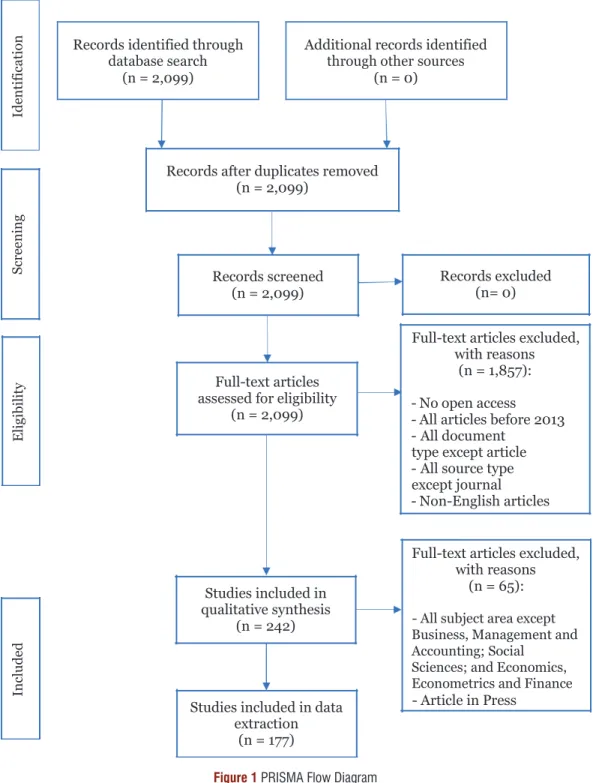
When conducted the research article review, the descriptive analysis and bibliometric analysis are the recommended methods used in order to study the relationship between strategic management and employee performance. According to the research from Tang et al. (2018), bibliometric analysis is the field to investigate the groups of the particular data. Most of the researchers used this method for purpose to analyse the articles such as the total number of published articles and journals per year, the number of citations per year, etc. Besides, the systematic review also is a method that summarizes the key points of the current knowledge on the particular topic which will answering the particular research question by meeting the certain eligibility criteria (Sneegas et al., 2021). So, in order to analyse the authors, journals and citations, bibliometric analysis method will be considered to conduct in this paper. This paper has structured the inclusion and extraction of the data by following the protocols of PRISMA and the process was stated in the Figure 1.
Searching Strategy (Scopus Database)
For this review paper, the searching strategy that has been developed to identify the relevant literature by using the Scopus database. In order to get the valuable and accurate articles, some unnecessary articles have been filtered by the database search and also two keywords which is strategic management and employee performance. The following keywords were showed as:
TITLE-ABS-KEY (strategic AND management AND employee AND performance) AND (LIMIT-TO (PUBSTAGE, “final”)) AND (LIMIT-TO (OA, “all”)) AND (LIMIT-TO (PUBYEAR, 2022) OR LIMIT-TO (PUBYEAR, 2021) OR LIMIT-TO (PUBYEAR, 2020) OR LIMIT-TO (PUBYEAR, 2019) OR LIMIT-TO (PUBYEAR, 2018) OR LIMIT-TO (PUBYEAR, 2017) OR LIMIT-TO (PUBYEAR, 2016) OR LIMIT-TO (PUBYEAR, 2015) OR LIMIT-TO (PUBYEAR, 2014) OR LIMIT-TO (PUBYEAR, 2013)) AND (LIMIT- TO (DOCTYPE, “ar”)) AND (LIMIT-TO ( SUBJAREA, “BUSI”) OR LIMIT-TO (SUBJAREA, “SOCI”) OR LIMIT-TO (SUBJAREA, “ECON”)) AND (LIMIT-TO (LANGUAGE, “English”)) AND (LIMIT-TO (SRCTYPE, “j”)). Then, the total records obtained through the database search is 2,099 papers.
Inclusion and Exclusion Criteria
The inclusion and exclusion criteria were based on the PRISMA protocols. Before the exclusion, the total research articles that have the relationship on the strategic management and employee performance were 2,099 papers in the Scopus database. The research papers were mainly focused on all open access within 10 years which in between 2013 to 2022. The papers that without open access and before the year 2013 were excluded in the list of data. Then, the subject areas will limit in the fields of Business, Management and Accounting, Social Sciences and Economics, Econometrics and Finance. Other papers that not in these fields also will excluded in the list.
Moreover, the document type was set in article and publication stage was set in final. This would be easier to get the valuable and accurate articles to analyse this paper. The source type also will include only journal type and the language of articles are only consider the English articles. All the non-journal and non-English articles were excluded in the list. In order to ensure the valuable and accurate of the articles, all the overlapping or duplicate articles also will be excluded. In result, there were 177 papers were selected and 1,922 papers were eliminated. Figure 1 shows the PRISMA flow diagram is regarding the literature inclusion and exclusion in every stage.
Chan Ee Teng, Faerozh Madli, Azaze-Azizi Adis, Haslinda Hassan & Umi Wahidah
104 | JAAAB Vol. 7 (December, 2022), ISSN 1675-9869
Identification Records identified through Additional records identified database search through other sources
(n = 2,099) (n = 0)
ScreeningEligibilityIncluded
Records after duplicates removed (n = 2,099)
Records screened (n = 2,099)
Full-text articles assessed for eligibility
(n = 2,099)
Studies included in qualitative synthesis
(n = 242)
Studies included in data extraction
(n = 177)
Records excluded (n= 0)
Full-text articles excluded, with reasons
(n = 1,857):
- No open access - All articles before 2013 - All document
type except article - All source type except journal - Non-English articles
Full-text articles excluded, with reasons
(n = 65):
- All subject area except Business, Management and Accounting; Social
Sciences; and Economics, Econometrics and Finance - Article in Press
Figure 1 PRISMA Flow Diagram Figure 1 PRISMA Flow Diagram
Extraction Techniques
By using the extraction techniques in the Scopus database, 177 papers were finalized and selected.
The characteristics of extraction were as following:
1. Article must in open access paper. No open access papers will be eliminated.
2. The published year of the article will be mainly focused in 10 years in between 2013- 2022. Articles that published before 2013 will be excluded.
3. The type of document for the articles must in article form. All articles not in article form are excluded.
4. The type of source for the articles must in journal fields. All articles not in the journal fields are excluded.
5. Article must be in English language paper. Non-English papers are not in the consideration.
6. The fields of subject areas must include Business, Management and Accounting, Social Sciences and Economics, Econometrics and Finance. All articles not in these fields will be eliminated.
7. The publication stage for the articles must be only article. All articles that stated article in press are excluded.
After the data extraction process, the major data and information of all articles has been finalized which include author’s name, article’s title, published year, journal’s name, article’s citations, abstract, keywords, references, subject areas, etc. Then, the finalize data were downloaded in the Excel form and will manually analyse the articles in order to determine the accurate of the findings for this paper (Maier et al., 2020).
Choice of Synthesis Methods
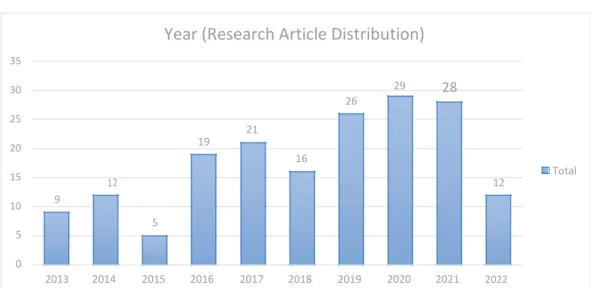
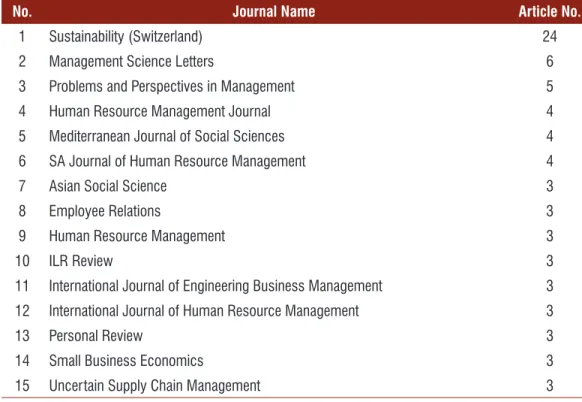
One of the methods will be carried out in this paper is descriptive analysis and will analysed the data that get from the Scopus Database by using the Microsoft Excel. The year of research article distribution will be generated into a bar chart in order to determine the highest number of research article distribution in which year and the result has been stated in Figure 2. Then, the journals also will be analysed in the table form which will easily to identify which journal has published the most articles regarding the strategic management and employee performance and also have list out the top 15 of journals as shows in Table 1. Additionally, the cited articles will be generated in the table form in order to determine the most cited articles that regarding the topic strategic management and employee performance and also have list out the top 15 of most cited articles as shows in Table 2.
Chan Ee Teng, Faerozh Madli, Azaze-Azizi Adis, Haslinda Hassan & Umi Wahidah
106 | JAAAB Vol. 7 (December, 2022), ISSN 1675-9869
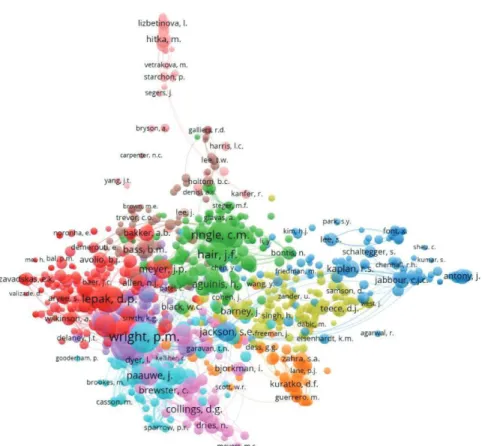
Another method that also will be used in this paper is bibliometric analysis and will analysed the data by using the VOS viewer software. This method will use the citations to determine the most valuable articles, authors and journals in a particular field. In other words, in order to generate the best result, bibliometric analysis will use the co-citation analysis to identify the database on journal co-citation stated in Figure 2, author co-citation shows in Figure 3 and keyword co-citation shows in Figure 4.
Thus, by using the VOS viewer software, the database will be generated into the network mapping in order to determine the relationship on keywords, authors and journals of this paper (Maier et al., 2020).
RESULTS AND INTERPRETATIONS
Descriptive Analysis
RESULTS AND INTERPRETATIONS Descriptive Analysis
Year (Research Article Distribution)
Year (Research Article Distribution)
35 30 25 20 15 10 5 0
29 28
26 19 21
16 Total
12 12
9
5
2013 2014 2015 2016 2017 2018 2019 2020 2021 2022
Figure 2 The Year of Research Article Distribution.
Figure 2 shows the number of research article distribution from the year 2013 to 2022 about the topic strategic management and employee performance. Based on the Figure 2, the highest number of research article distribution which is 29 in 2020 and the lowest number of research article distribution which is 5 in 2015. Then, 28 research article distribution in 2021 was ranked second and 29 research article distribution in 2019 was ranked in third. Besides, there have the same amount of research article distribution which is 12 was stated in 2014 and 2022 respectively.
Moreover, there have 9 research article distribution in 2013, 19 research article distribution in 2016, 21 research article distribution in 2017 and 16 research article distribution in 2018 that have shown on the above figure. Thus, there have 29 research article distribution in 2020 which is the highest number of research article distribution regarding the strategic management and employee performance in this year compared to the other years.
Journals
Table 1 Top 15 of The Most Articles Published in Journals.
No. Journal Name Article No.
1 Sustainability (Switzerland) 24
2 Management Science Letters 6
3 Problems and Perspectives in Management 5
4 Human Resource Management Journal 4
5 Mediterranean Journal of Social Sciences 4
6 SA Journal of Human Resource Management 4
7 Asian Social Science 3
8 Employee Relations 3
9 Human Resource Management 3
10 ILR Review 3
11 International Journal of Engineering Business Management 3
12 International Journal of Human Resource Management 3
13 Personal Review 3
14 Small Business Economics 3
15 Uncertain Supply Chain Management 3
Table 1 stated that the top 15 journals with the most published articles on strategic management and employee performance. Based on the table above, the highest number of the articles that have been published in the journal is Sustainability (Switzerland) which has published 24 articles.
The second journal is Management Science Letters that has published 6 articles and the third journal is Problems and Perspectives in Management also has published 5 articles. Besides, there have three journals that has published the same number of the articles which is 4 articles in Human Resource Management Journal, Mediterranean Journal of Social Sciences and SA Journal of Human Resource Management respectively. Then, the rest of the journals also has published the same number of the articles which is 3 articles in Asian Social Science, Employee Relations, Human Resource Management, ILR Review, International Journal of Engineering Business Management, International Journal of Human Resource Management, Personal Review, Small Business Economics and Uncertain Supply Chain Management. Thus, Sustainability (Switzerland) is the journal that has published 24 articles regarding strategic management and employee performance which is the most published articles compared to the other journals.
Chan Ee Teng, Faerozh Madli, Azaze-Azizi Adis, Haslinda Hassan & Umi Wahidah
108 | JAAAB Vol. 7 (December, 2022), ISSN 1675-9869
Co-Citation Network of Cited Sources Figure 2 The Year of Research Article Distribution.
Co-Citation Network of Cited Sources
Figure 2 The Journals Co-Citation Network Map.
Co-Citation Network of Cited Authors
Figure 3 The Author Co-Citation Network Map.
Figure 2 The Journals Co-Citation Network Map.
Figure 2 shows the co-citation network analysis of journals. With the sample of 177 articles, the total of 4,813 sources were identified. The minimum number of citations of a source was set to 4 and resulting the number of 419 articles are meet the threshold. In result, co-citation analysis of journals has generated into eight clusters.
The biggest cluster which is the colour red that have formed by 90 items is Human Resource Management Review. It has 92 citations and 3,991 link strength. Another journal that stands out is the Journal of Management Development with 57 citations and 3,181 link strength. The Journal of International Business Studies has 47 citations and 2,880 link strength. The Journal of World Business has 40 citations and 1,720 link strength. The Management Decision has 28 citations and 1,506 link strength. The Business Horizons has 28 citations and 1,014 link strength.
The Long Range Planning has 24 citations and 1,339 link strength. The International Journal of Manpower has 23 citations and 1,305 link strength. The European Journal of Marketing has 20 citations and 756 link strength. The Journal of Management Development has 18 citations and 498 link strength.
Besides, the second cluster is green colour with 81 items. In this cluster, Journal of Operations Management is the most visible compared to the others that having the 57 citations and 2,759 link strength. Another journal that stands out is the International Journal of Operations & Production Management with 40 citations and 2,233 link strength. The International Journal of Production Economics has 36 citations and 2,183 link strength. The Production Planning & Control has 35 citations and 2,438 link strength. The Management Accounting Research has 31 citations and 1,294 link strength. The International of Production Research has 28 citations and 1,886 link strength. The International Journal of Quality & Reliability Management has 27 citations and 832 link strength. The International Journal of Productivity and Performance Management has 22 citations and 833 link strength. The Accounting, Organizations and Society has 20 citations and 765 link strength. The Total Quality Management has 18 citations and 497 link strength.
Then, Sustainability is the journal that appear in the third cluster which is the blue colour by 68 items that having the 85 citations and 1,974 link strength. Another journal that stands out is the Acad. Manag, J. with 32 citations and 1,392 link strength. The Int. J. Hum. Resour. Manag. has 28 citations and 914 link strength. The J. Appl. Psycol has 25 citations and 1,129 link strength.
The J. Bus. Ethics has 24 citations and 660 link strength. The J. Manag has 20 citations and 831 link strength. The Acad. Manag. Rev has 17 citations and 678 link strength. The Research in Personnel and Human Resource Management has 14 citations and 771 link strength. The J.
Organ. Behav has 12 citations and 461 link strength. The Hum. Resour. Manag has 12 citations and 455 link strength.
Furthermore, the yellow colour is the fourth cluster having 48 items among which the Strategic Management Journal has appear with 129 citations and 6,309 link strength. Another journal that stands out is the Organization Science with 55 citations and 3,115 link strength. The Administrative Science Quarterly has 46 citations and 2,268 link strength. The Journal of Business Venturing has 39 citations and 2,360 link strength. The Small Business Economics has 31 citations and 1,913 link strength. The Management Science has 30 citations and 1,598 link strength. The Entrepreneurship Theory and Practice has 25 citations and 1,393 link strength. The Journal of Personality and Social Psychology has 23 citations and 1,301 link strength. The Industrial and Labor Relations Review has 23 citations and 1,215 link strength. The Academy of Management Perspectives has 18 citations and 956 link strength.
Additionally, the fifth cluster with 45 items is the purple one shows the journal Technovation having 25 citations and 1,308 link strength. Another journal that stands out is the Strateg. Mang. J. with 15 citations and 643 link strength. The Mis Quart. has 14 citations and 448 link strength. The J. Clean. Prod. has 14 citations and 328 link strength. The Acad. Manag. Rev has 13 citations and 485 link strength. The Int. J. Hosp. Manag has 13 citations and 263 link strength. The Acad.
Manag. J has 12 citations and 445 link strength. The J. Appl. Psychol has 12 citations and 333 link strength. The J. Knowl. Manag. has 11 citations and 539 link strength. The J. Manag. Stud has 11 citations and 489 link strength.
Moreover, the light blue colour is the sixth cluster having 45 items states the Academy of Management Journal having 244 citations and 11,724 link strength. Another journal that stands out is the Journal of Management with 181 citations and 9,959 link strength. The International Journal of Human Resource Management has 134 citations and 7,020 link strength. The Journal of Applied Psychology has 129 citations and 6,234 link strength. The Human Resource Management Journal has 105 citations and 5,266 link strength. The Human Resource Management has 103 citations and 5,124 link strength. The Academy of Management Review has 102 citations and 5,638 link strength. The International Journal of Human Resource Management has 93 citations and 4,392 link strength. The Personnel Psychology has 81 citations and 4,402 link strength. The
Chan Ee Teng, Faerozh Madli, Azaze-Azizi Adis, Haslinda Hassan & Umi Wahidah
110 | JAAAB Vol. 7 (December, 2022), ISSN 1675-9869
Then, Harvard Business Review is the journal that shows in the seventh cluster which is the orange one by 32 items that having the 72 citations and 3,157 link strength. Another journal that stands out is the Journal of Business Ethics with 66 citations and 3,242 link strength. The Journal of Organizational Behavior has 47 citations and 2,803 link strength. The International Journal of Hospitality Management has 43 citations and 2,723 link strength. The Journal of Cleaner Production has 40 citations and 2,422 link strength. The Tourism Management has 32 citations and 1,766 link strength. The Leadership Quarterly has 23 citations and 980 link strength. The International Journal of Contemporary Hospitality Management has 19 citations and 1.232 link strength. The Corporate Social Responsibility and Environmental Management has 18 citations and 888 link strength. The International Journal of Business Management has 12 citations and 376 link strength.
Last, the eighth cluster with 10 items is the brown colour stated that the journal Am J Pharm Educ having the 12 citations and 24 link strength. Another journal that stands out is the Multivariate Data Analysis with 10 citations and 358 link strength. The Using Multivariate Statistic has 7 citations and 252 link strength. The Acad Manage J has 7 citations and 49 link strength. The J Manag has 6 citations and 43 link strength. The Med Educ has 6 citations and 12 link strength. The American Culture Review of Public Administration has 4 citations and 160 link strength. The Organizational Culture and Leadership has 4 citations and 117 link strength. The Int J Hum Resour Manag has 4 citations and 48 link strength. The J Appl Psychol has 4 citations and 46 link strength.
Citations
Table 2 Top 15 of Most Cited Articles.
No. Article Title Authors Year Total
Citation 1 Knowledge sharing, knowledge leaking
and relative innovation performance: An empirical study
Ritala P., Olander H.,
Michailova S., Husted K. 2015 294 2 HR and analytics: why HR is set to fail the
big data challenge Angrave D., Charlwood A., Kirkpatrick I., Lawrence M.,
Stuart M.
2016 175
3 Examining the Link between Strategic Corporate Social Responsibility and Company Performance: An Analysis of the Best Corporate Citizens
Michelon G., Boesso G.,
Kumar K. 2013 156
4 Green human resource management: A comparative qualitative case study of a United States multinational corporation
Haddock-Millar J., Sanyal C.,
Müller-Camen M. 2016 108
No. Article Title Authors Year Total Citation 5 Critical success factors and green
supply chain management proactivity:
shedding light on the human aspects of this relationship based on cases from the Brazilian industry
Chiappetta Jabbour C.J., Mauricio A.L., de Sousa
Jabbour A.B.L.
2017 83
6 High performance work practices in small firms: A resource-poverty and strategic decision-making perspective
Kroon B., Van De Voorde K.,
Timmers J. 2013 80
7 Perceptions of HR practices, person–
organisation fit, and affective commitment:
The moderating role of career stage
Kooij D.T.A.M., Boon C. 2018 52
8 Environmental management and corporate social responsibility practices of small and medium-sized enterprises
Dey P.K., Petridis N.E., Petridis K., Malesios C.,
Nixon J.D., Ghosh S.K.
2018 51
9 The talent deal and journey: Understanding how employees respond to talent identification over time
King K.A. 2016 51
10 Exploring the HRM-performance relationship: the role of creativity climate and strategy
Heffernan M., Harney B.,
Cafferkey K., Dundon T. 2016 40 11 Work flexibility, job satisfaction, and
job performance among romanian employees-Implications for sustainable human resource management
Davidescu A.A., Apostu S.-A.,
Paul A., Casuneanu I. 2020 40
12 The direct and indirect effects of core and peripheral social capital on organizational performance
Fonti F., Maoret M. 2016 39
13 Performance management practices in lean manufacturing organizations: a systematic review of research evidence
Bellisario A., Pavlov A. 2018 38
14 Does governance confer organisational resilience? Evidence from UK employee owned businesses
Lampel J., Bhalla A.,
Jha P.P. 2014 36
15 The role of wisdom leadership in increasing job performance: Evidence from the Egyptian tourism sector
Elbaz A.M., Haddoud M.Y. 2017 36
Chan Ee Teng, Faerozh Madli, Azaze-Azizi Adis, Haslinda Hassan & Umi Wahidah
112 | JAAAB Vol. 7 (December, 2022), ISSN 1675-9869
Table 2 shows the top 15 of most cited articles regarding the topic strategic management and employee performance. Based on the table above, the article “Knowledge sharing, knowledge leaking and relative innovation performance: An empirical study” that written by Ritala P., Olander H., Michailova S., Husted K. is the most cited article in the field of strategic management and employee performance. This paper was published in 2014 in Technovation and it has 294 citations in the Scopus database. Then, the second most cited paper is “HR and analytics: why HR is set to fail the big data challenge” has published in 2016 in Human Resource Management Journal which was written by Angrave D., Charlwood A., Kirkpatrick I., Lawrence M., Stuart M. with total 175 citations. While the third most cited paper is “Examining the Link between Strategic Corporate Social Responsibility and Company Performance: An Analysis of the Best Corporate Citizens” written by Michelon G., Boesso G., Kumar K. in 2013 in Corporate Social Responsibility and Environmental Management with the total 156 citations.
Besides, the paper “Green human resource management: A comparative qualitative case study of a United States multinational corporation” written by Haddock-Millar J., Sanyal C., Müller-Camen M. has the total of 108 citations in 2016 in International Journal of Human Resource Management.
Then, the paper that written by Chiappetta Jabbour C.J., Mauricio A.L., de Sousa Jabbour A.B.L. is
“Critical success factors and green supply chain management proactivity: shedding light on the human aspects of this relationship based on cases from the Brazilian industry” has the total of 83 citations in Production Planning and Control in 2017. Additionally, the paper “High performance work practices in small firms: A resource-poverty and strategic decision-making perspective”
written by Kroon B., Van De Voorde K., Timmers J. has the total of 80 citations in 2013 in Small Business Economics. Moreover, the paper that written by Kooij D.T.A.M., Boon C. is “Perceptions of HR practices, person–organisation fit, and affective commitment: The moderating role of career stage” in 2018 in Human Resource Management Journal with the total 52 citations.
Besides, there have same number of total citations which is 51 citations in two papers. One of the papers is “Environmental management and corporate social responsibility practices of small and medium-sized enterprises” written by Dey P.K., Petridis N.E., Petridis K., Malesios C., Nixon J.D., Ghosh S.K. in Journal of Cleaner Production in 2018 and another paper is “The talent deal and journey: Understanding how employees respond to talent identification over time” written by King K.A. in Employee Relations in 2016. Furthermore, there also have another same number of total citations which is 40 citations in two papers. One of the papers is “Exploring the HRM- performance relationship: the role of creativity climate and strategy” written by Heffernan M., Harney B., Cafferkey K., Dundon T. in Employee Relations in 2016 and another paper is “Work flexibility, job satisfaction, and job performance among romanian employees-Implications for sustainable human resource management” written by Davidescu A.A., Apostu S.-A., Paul A., Casuneanu I. in Sustainability (Switzerland) in 2020.
Strategic Management and Employeeperformance: A Review and Bibliometric Analysis
Moreover, the paper “The direct and indirect effects of core and peripheral social capital on organizational performance” written by Fonti F., Maoret M. has the total of 39 citations in 2016 in Strategic Management Journal. Then, the paper that written by Bellisario A., Pavlov A. is
“Performance management practices in lean manufacturing organizations: a systematic review of research evidence” has the total of 38 citations in Production Planning and Control in 2018.
There have the same number of total citations which is 36 citations in two papers. One of the papers is “Does governance confer organisational resilience? Evidence from UK employee owned businesses” written by Lampel J., Bhalla A., Jha P.P. in European Management Journal in 2014.
Another paper is “The role of wisdom leadership in increasing job performance: Evidence from the Egyptian tourism sector” written by Elbaz A.M., Haddoud M.Y. in Tourism Management in 2017.
Co-Citation Network of Cited Authors Co-Citation Network of Cited Sources
Figure 2 The Journals Co-Citation Network Map.
Co-Citation Network of Cited Authors
Figure 3 The Author Co-Citation Network Map.
Chan Ee Teng, Faerozh Madli, Azaze-Azizi Adis, Haslinda Hassan & Umi Wahidah
114 | JAAAB Vol. 7 (December, 2022), ISSN 1675-9869
The biggest cluster is the colour red which having 181 authors. It has identified one author that has stood out is the author David P. Lepak from University of Massachusetts Amherst that having 6,085 link strength and 59 citations. Another author that has stand out in this cluster is Peter Boxall from University of Auckland. He has 42 citations and 4,805 link strength. The author John Purcell from University of Bath also in this cluster which having the 27 citations and 2,680 link strength. The author Barry Gerhart from University of Wisconsin-Madison in this cluster which having the 25 citations and 2,329 link strength.
Besides, the second cluster is the green cluster that containing 135 authors. The author Joseph F. Hair, Jr. from University of South Alabama is most visible in this cluster which having the 53 citations and 2,622 link strength. Another author that has stand out in this cluster is Christian M.
Ringle from Hamburg University of Technology. He has 52 citations and 2,550 link strength. The author Marko Sarstedt from University of Munich also in this cluster which having the 49 citations and 2,198 link strength. The author Herman Aguinis from George Washington University in this cluster which having the 32 citations and 1,082 link strength.
Then, the third cluster is the blue one which having 118 authors. The author Sophie E. Jackson from University of Cambridge is appeared in this cluster which having the 33 citations and 2,519 link strength. Another author that has stand out in this cluster is Robert Samuel Kaplan from Harvard Business School. He has 25 citations and 655 link strength. The author David P. Norton from University of Florida also in this cluster which having the 20 citations and 550 link strength.
The author Charbel Jose Chiappetta Jabbour from University of Lincoln UK in this cluster which having the 18 citations and 982 link strength.
Moreover, the yellow colour is the fourth cluster that containing 115 authors. It has determined one author that has stood out is the author Jay Barney from University of Utah has 23 citations and 1,597 link strength. Another author that has stand out in this cluster is Michael E. Porter from Harvard Business School. He has 22 citations and 1,033 link strength. The author David J. Teece from University of California, Berkeley also in this cluster which having the 19 citations and 1,461 link strength. The author Ikujiro Nonaka from Hitotsubashi University in this cluster which having the 14 citations and 842 link strength.
Furthermore, the fifth cluster is the purple colour that having 97 authors. The authors Mark A.
Huselid from Northeastern University has been identified in this cluster which having the 58 citations and 5,483 link strength. Another author that has stand out in this cluster is Randall S.
Schuler from Rutgers University. He has 30 citations and 2,479 link strength. The author James P. Guthrie from University of Kansas also in this cluster which having the 23 citations and 2,852 link strength.
Then, the light blue colour is the sixth cluster that containing 92 authors. It has identified one author that has stood out is the author Patrick M. Wright from University of South Carolina has 73 citations and 7,072 link strength. Another author that has stand out in this cluster is Chris Brewster from Universities of Reading. He has 27 citations and 2,953 link strength. The author Brian E. Becker from State University of New York at Buffalo also in this cluster which having the 27 citations and 2,827 link strength. The author Satwinder Singh from University of Dubai in this cluster which having the 25 citations and 2,094 link strength.
Additionally, the seventh cluster is the orange one having 73 authors. The authors Donald F.
Kuratko from Indiana University East has been determined in this cluster which having the 18 citations and 1,426 link strength. Another author that has stand out in this cluster is Shaker A.
Zahra from University of Minnesota. He has 14 citations and 872 link strength. The author Jeffrey G. Covin from Indiana University also in this cluster which having the 13 citations and 1,017 link strength. The author R. Duane Ireland from Texas A&M University in this cluster which having the 12 citations and 744 link strength.
Besides, the brown colour is the eighth cluster which having 72 authors. The authors Bernard M Bass from Binghamton University has stood out in this cluster which having the 26 citations and 1,474 link strength. Another author that has stand out in this cluster is Timothy M. Gardner from Utah State University. He has 15 citations and 1,387 link strength. The author John P. Hausknecht from Cornell University also in this cluster which having the 10 citations and 973 link strength.
Then, the ninth cluster is the light purple colour containing 68 authors. It has determined one author that has stood out is the author Paul Boselie from Utrecht University School of Governance has 33 citations and 2,685 link strength. Another author that has stand out in this cluster is Jeffrey Pfeffer from Stanford University. He has 33 citations and 2,585 link strength. The author Jaap Paauwe from Tilburg University also in this cluster which having the 31 citations and 2,659 link strength. The author Scott A. Snell from University of Virginia in this cluster which having the 31 citations and 2,475 link strength.
Last, the pink colour is the tenth cluster which having 49 authors. The authors Miloš Hitka from Technical University in Zvolen has been identified in this cluster which having the 20 citations and 1,424 link strength. Another author that has stand out in this cluster is Lenka Ližbetinová from the Institute of Technology and Business in České Budějovice. She has 13 citations and 1,016 link strength. The author Silvia Lorincová from Technical University in Zvolen also in this cluster which having the 13 citations and 948 link strength. The author Katarína Stachová from University of St.
Cyril and Methodius of Trnava in this cluster which having the 12 citations and 848 link strength.
Chan Ee Teng, Faerozh Madli, Azaze-Azizi Adis, Haslinda Hassan & Umi Wahidah
116 | JAAAB Vol. 7 (December, 2022), ISSN 1675-9869
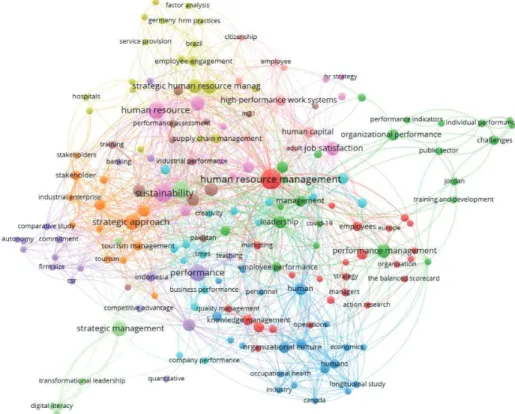
Keywords Occurrence Network Keywords Occurrence Network
Figure 4 The Keyword Co-Occurrence Network Map.
Figure 4 The Keyword Co-Occurrence Network Map.
Figure 4 shows the keyword co-occurrence network map. Based on the figure above, the generation of the keywords co-occurrence map was made based on 982 keywords that found in the 177 papers from the sample database. It also has conducted a limit of a minimum number of occurrences of a keyword to 2 and the number of 174 papers were met the threshold. In result, the VOS viewer software has generated eleven clusters for the keyword occurrence analysis.
The biggest cluster is the red colour with 25 items. The main keywords in this cluster are “human resource management” that has 19 occurrence and 68 link strength. Another keyword in this cluster is “strategic planning” with 5 occurrence and 23 link strength. “Knowledge management”
also is the keyword that has 5 occurrence and 18 link strength. The keyword “entrepreneurship”
has 5 occurrence and 8 link strength. “Employees” is the keyword that has 4 occurrence and 15 link strength. The keywords “quality management” and “marketing” have the same amount which is 3 occurrence and 12 link strength. The keyword “productivity” has 3 occurrence and 8 link strength. “Strategy” is the keyword that has 3 occurrence and 7 link strength. “Employee behaviour” is the keyword that has 3 occurrence and 4 link strength.
Besides, the second cluster is the green cluster with 23 items. The keywords most visible in this cluster are “performance management” which has 8 occurrence and 34 link strength. Another keyword in this cluster is “leadership” that has 7 occurrence and 52 link strength. The keyword
“management” has 6 occurrence and 30 link strength. “Talent management” is the keyword that has 6 occurrence and 23 link strength. The keyword “organizational performance” has 6 occurrence and 14 link strength. “Employee development” is the keyword that has 4 occurrence and 26 link strength. The keyword “employee performance” has 4 occurrence and 15 link strength.
The keyword “challenges” has 4 occurrence and 10 link strength. “Individual performance” is the keyword that has 3 occurrence and 10 link strength. The keyword “performance measurement”
has 3 occurrence and 9 link strength.
Then, the blue colour is the third cluster with 20 items. The main keywords are “human” which has 7 occurrence and 59 link strength. Another keyword in this cluster is “organizational culture”
which has 6 occurrence and 35 link strength. The keywords “humans” and “organization and management” have the same amount which has 4 occurrence and 36 link strength. The keyword
“article” has 4 occurrence and 35 link strength. “Surveys” is the keyword that has 4 occurrence and 29 link strength. The keywords “longitudinal study” and “longitudinal studies” have the same amount which has 2 occurrence and 20 link strength. “Occupational health” is the keyword that has 2 occurrence and 19 link strength. The keyword “canada” has 2 occurrence and 18 link strength. The keyword “industry” has 2 occurrence and 17 link strength.
Moreover, the fourth cluster is the yellow one with 19 items. The main keywords are “strategic human resource management” that has 9 occurrence and 37 link strength. Another keyword in this cluster is “perception” that has 8 occurrence and 54 link strength. The keyword “supply chain management” has 4 occurrence and 19 link strength. “Employee engagement” is the keyword that has 4 occurrence and 7 link strength. The keyword “brazil” has 2 occurrence and 14 link strength. The keywords “resource allocation”, “personnel training” and “natural resources management” have the same amount which has 2 occurrence and 13 link strength. “Industrial development” is the keyword that has 2 occurrence and 11 link strength. The keywords “green human resource management” and “service provision” have the same amount which has 2 occurrence and 10 link strength.
Additionally, the purple one is the fifth cluster with 18 items. The keywords most visible in this cluster are “performance” that has 13 occurrence and 26 link strength. Another keyword in this cluster is “human resources” that has 7 occurrence and 31 link strength. The keyword “indonesia”
has 4 occurrence and 16 link strength. “Working conditions” is the keyword that has 3 occurrence and 15 link strength. The keyword “commitment” has 3 occurrence and 5 link strength. The keyword “competitive advantage” has 3 occurrence and 4 link strength. The keywords “korea”
and “firm size” have the same amount which has 2 occurrence and 17 link strength. The keyword
Chan Ee Teng, Faerozh Madli, Azaze-Azizi Adis, Haslinda Hassan & Umi Wahidah
118 | JAAAB Vol. 7 (December, 2022), ISSN 1675-9869
Then, the sixth cluster is the light blue colour with 16 items. The main keywords in this cluster are “strategic hrm” that has 5 occurrence and 7 link strength. Another keyword in this cluster is
“organizational commitment” that has 4 occurrence and 13 link strength. “Employee involvement”
is the keyword that has 4 occurrence and 9 link strength. The keyword “china” has 3 occurrence and 21 link strength. The keywords “business development” and “motivation” have the same amount which has 3 occurrence and 15 link strength. The keyword “business performance” has 3 occurrence and 14 link strength. The keyword “smes” has 3 occurrence and 12 link strength.
The keywords “hpws” and “decision making” have the same amount which has 3 occurrence and 10 link strength. “High performance work system” is the keyword that has 3 occurrence and 7 link strength.
Furthermore, the seventh cluster is the orange one with 13 items. The main keywords are “strategic approach” that has 11 occurrence and 85 link strength. Another keyword in this cluster is
“competitiveness” that has 6 occurrence and 24 link strength. The keyword “management practice”
has 5 occurrence and 46 link strength. “Stakeholder” is the keyword that has 4 occurrence and 29 link strength. The keyword “tourism management” has 4 occurrence and 27 link strength.
“Slovakia” is the keyword that has 3 occurrence and 23 link strength. The keyword “tourism”
has 3 occurrence and 21 link strength. The keyword “industrial enterprise” has 2 occurrence and 20 link strength. “Social responsibility” is the keyword that has 2 occurrence and 19 link strength. The keyword “environmental management” has 2 occurrence and 18 link strength. The keyword “stakeholders” has 2 occurrence and 17 link strength. “Entrepreneur” is the keyword that has 2 occurrence and 15 link strength. “Malaysia” is the keyword that has 2 occurrence and 11 link strength.
Moreover, the brown colour is the eighth cluster with 13 items. The main keywords are “sustainable development” that has 8 occurrence and 39 link strength. Another keyword in this cluster is
“questionnaire survey” that has 7 occurrence and 49 link strength. The keyword “corporate social responsibility” has 7 occurrence and 30 link strength. “Organizational framework” is the keyword that has 4 occurrence and 28 link strength. The keyword “performance assessment” has 3 occurrence and 24 link strength. “Training” is the keyword that has 3 occurrence and 23 link strength. The keyword “pakistan” has 3 occurrence and 19 link strength. “Industrial performance”
is the keyword that has 3 occurrence and 17 link strength. “Policy implementation” is the keyword that has 2 occurrence and 19 link strength. The keyword “m21” has 2 occurrence and 8 link strength. The keywords “manufacturing” and “balanced scorecard” have the same amount which has 2 occurrence and 7 link strength. The keyword “stability” has 2 occurrence and 4 link strength.
Besides, the light purple is the ninth cluster with 12 items. The keywords most visible in this cluster “sustainability” that has 15 occurrence and 98 link strength. Another keyword in this cluster is “human resource” that has 13 occurrence and 91 link strength. The keyword “resource management” has 9 occurrence and 69 link strength. “Job satisfaction” is the keyword that has 9 occurrence and 24 link strength. The keyword “business” has 6 occurrence and 41 link strength. “Employment” is the keyword that has 4 occurrence and 26 link strength. “Affective
commitment” is the keyword that has 3 occurrence and 2 link strength. The keyword “sustainable human resource management” has 2 occurrence and 16 link strength. The keyword “romania”
has 2 occurrence and 12 link strength. The keyword “job performance” has 2 occurrence and 10 link strength. “Sustainable hrm” is the keyword that has 2 occurrence and 8 link strength. The keyword “hr strategy” has 2 occurrence and 2 link strength.
Then, the tenth cluster is the pink one with 8 items. The main keywords are “high-performance work systems” that has 6 occurrence and 33 link strength. Another keyword in this cluster is
“human capital” that has 6 occurrence and 30 link strength. The keyword “corporate governance”
has 3 occurrence and 9 link strength. “Adult” is the keyword that has 2 occurrence and 18 link strength. The keyword “citizenship” has 2 occurrence and 17 link strength. “Investment” is the keyword that has 2 occurrence and 16 link strength. The keywords “employee” and “manager”
have the same amount which has 2 occurrence and 14 link strength.
Last, the eleventh cluster is the light green colour with 7 items. The main keywords are “innovation”
that has 13 occurrence and 37 link strength. Another keyword in this cluster is “strategic management” that has 10 occurrence and 27 link strength. The keyword “transformational leadership” has 3 occurrence and 16 link strength. “Technology” is the keyword that has 3 occurrence and 5 link strength. The keywords “digital literacy”, “innovative work behaviour” and
“telecommunication industry” have the same amount which has 2 occurrence and 8 link strength.
DISCUSSION
The main objective of this paper was to identify the relationship between strategic management and employee performance. In order to fulfil the objective, three research questions have been created. Then, the strategy and methods that have been used to investigate the paper is systematic review and bibliometric analysis. Besides, by using the keywords strategic management and employee performance, the data will be filtered by following the PRISMA protocol. For the purpose to determine the valuable and accurate papers, the Scopus database that has been used to identify the relevant literature papers. In the Scopus database, the important data will be included and irrelevant data will be excluded. The finalize papers were 177 papers after the filter process. The data that has been included and selected was published years which is 2013-2022 (10 years), open access articles, papers in article form, journal fields, English language paper, subject areas in Business, Management and Accounting, Social Sciences and Economics, Econometrics and Finance and only article in publication stage. After the data was downloaded from the database, the data will be analysed by using the Microsoft Excel and VOS viewer. Then, in order to obtain the best result, the published years and citations have used Microsoft Excel to analyse the data in bar chart and table form while the authors and keywords are used VOS viewer to analyse the
Chan Ee Teng, Faerozh Madli, Azaze-Azizi Adis, Haslinda Hassan & Umi Wahidah
120 | JAAAB Vol. 7 (December, 2022), ISSN 1675-9869
There have faced some limitations when conducted the data analysis in this paper. One of the limitations is this paper is only focus on the Scopus database to obtain the data. There have many databases that can be in the consideration to conduct the systematic literature review and bibliometric analysis in order to obtain the various of sufficient results such as Google Scholar, ScienceDirect, Web of Science, Embase, MEDLINE, CINAHL, etc. But for this paper, the data is only obtained from the single database. So, the results obtained may not be sufficient due to the limited data (Bramer et al., 2017). Then, another limitation is this paper is only focus on the published year, journals, cited authors, citations and keywords analysis while the areas that did not cover are country, abstract, references, databases and subject areas. Besides, this paper also only focused on the topics which is strategic management and employee performance. These two topics that only focus on the paper will limited the documentation and the outcome also would not be satisfied if the researcher wants to obtain the various data and papers outside of the topics.
Although there have some limitations in this paper, the systematic literature review allows the researchers to improve the knowledge in the business fields when there are the gaps in existing the knowledge (Jahan et al., 2016). The researchers that conduct the paper reviews based on the database combinations would be better than only focus on the single database. The database combinations would help the researchers obtain the quality data and also valuable papers.
Then, all the areas analyse including in the discussion of the papers also would be better than focused on the certain areas. The researcher also can get the valuable papers with the additional topics such as strategic management planning, human resource management development, organizational performance perspective, leadership, marketing, etc. These will make the paper more professional and high quality.
FUTURE AGENDA
To conduct the future research, the future researchers should not only focus on single database to perform the paper reviews. The researchers should continue to investigate the relationship between strategic management and employee not only Scopus database but also outside of the database like Web of Science, ScienceDirect, Google Scholar, etc. These databases would help the researchers to obtain the various data and papers to conduct the systematic review papers and get the best and quality outcome (Bramer et al., 2017). Then, the future researchers also should not only focus on the certain areas but also include all the areas analysis of the paper in the future paper. The additional topics can be in the consideration of the future researchers to conduct the paper review not only focus on the two topics strategic management and employee performance but also other topics to include in the future paper. All areas analysis and additional topics included in the paper would make the paper more quality and also will show the researchers’
professional. In overall, this paper reviews hope can help the future researchers to conduct their own high quality paper review in the future.
REFERENCES
Bramer, W. M., Rethlefsen, M. L., Kleijnen, J., & Franco, O. H. (2017). Optimal database combinations for literature searches in systematic reviews: a prospective exploratory study. Systematic Reviews, 6(1).
Bryson, J., & George, B. (2020). Strategic Management in Public Administration. Oxford Research Encyclopedia of Politics.
Dauda, Y. A., Akingbade, W. A., & Akinlabi, H. B. (2010). Strategic Management Practice and Corporate Performance of Selected Small Business Enterprises in Lagos Metropolis. International Journal of Business and Management, 5(11).
Donthu, N., Kumar, S., Mukherjee, D., Pandey, N., & Lim, W. M. (2021). How to conduct a bibliometric analysis: An overview and guidelines. Journal of Business Research, 133, 285–296.
Elkhdr, H.R. (2019). The Relationship Between Strategic Management And Leadership: A Critical Literature Review. International Journal of Scientific & Technology Research 8(2):58-62.
Ganeshkumar, P., & Gopalakrishnan, S. (2013). Systematic reviews and meta-analysis: Understanding the best evidence in primary healthcare. Journal of Family Medicine and Primary Care, 2(1), 9.
Garg, A. X., Hackam, D., & Tonelli, M. (2008). Systematic Review and Meta-analysis: When One Study Is Just not Enough. Clinical Journal of the American Society of Nephrology, 3(1), 253–260.
George, B., Walker, R. M., & Monster, J. (2019). Does Strategic Planning Improve Organizational Performance? A Meta‐Analysis. Public Administration Review, 79(6), 810–819.
Jahan, N., Naveed, S., Zeshan, M., & Tahir, M. A. (2016). How to Conduct a Systematic Review: A Narrative Literature Review. Cureus.
Kamar, K., Novitasari, D., Asbari, M., Winanti, W., & Goestjahjanti, F. S. (2020). Enhancing Employee Performance During the Covid-19 Pandemic: the Role of Readiness for Change Mentality. Jurnal Dinamika Manajemen, 11(2), 154–166.
Kehoe, R. R., & Wright, P. M. (2010). The Impact of High-Performance Human Resource Practices on Employees’ Attitudes and Behaviors. Journal of Management, 39(2), 366–391.
Liberati, A., Altman, D. G., Tetzlaff, J., Mulrow, C., Gotzsche, P. C., Ioannidis, J. P. A., Clarke, M., Devereaux, P. J., Kleijnen, J., & Moher, D. (2009). The PRISMA statement for reporting systematic reviews and meta-analyses of studies that evaluate healthcare interventions: explanation and elaboration.
BMJ, 339(jul21), b2700.
Maier, D., Maier, A., Așchilean, I., Anastasiu, L., & Gavriș, O. (2020). The Relationship between Innovation and Sustainability: A Bibliometric Review of the Literature. Sustainability, 12(10), 4083.
Mkheimer, I. (2018). Insights on Strategic Management Practices in Jordan: A Review of Literature. European Journal of Business and Management, 10, 74.
Nzewi, H. N., Onwuka, E. M., Okoro, O. B., & Anah, S. (2017). Strategic Management Foundations and Employee Performance of Aluminium Companies in Delta State. African Research Review, 11(3), 187.
Sneegas, G., Beckner, S., Brannstrom, C., Jepson, W., Lee, K., & Seghezzo, L. (2021). Using Q-methodology in environmental sustainability research: A bibliometric analysis and systematic review. Ecological Economics, 180, 106864.
Tang, M., Liao, H., Wan, Z., Herrera-Viedma, E., & Rosen, M. (2018). Ten Years of Sustainability (2009 to