*CORRESPONDING AUTHOR | Nurudeen Abdulkadir | [email protected]
© The Authors 2022. Published by Penerbit USIM. This is an open access article under the CC BY 4.0 license.
ISSN: 1823-075X e-ISSN: 2948-5266 Vol. 19, No. 1, June 2022, Pp. 63-85
DOI: https://doi.org/10.33102/jmifr.v19i1.414
The Journal of Muamalat and Islamic Finance Research
Article
Adoption of Islamic Trade Financing Facilities Among SMEs in North-West Nigeria: A Preliminary Investigation
Nurudeen Abdulkadir*1,2, Safeza Mohd Sapian1, Norhazlina Ibrahim1
1 Faculty of Economics and Muamalat, Universiti Sains Islam Malaysia, Bandar Baru Nilai, 71800 Nilai, Negeri Sembilan, Malaysia
2 Central Bank of Nigeria, Jalingo, Taraba State, Nigeria, 660211 Taraba, Nigeria
ABSTRACT - The existence, growth and development of Small and Medium-sized Enterprises (SMEs) depend on trade and commercial activities. Trading activities, especially cross-border trade, have been acknowledged as an important instrument for sustainable economic growth, development, poverty alleviation, inclusiveness and global stability. However, for the smooth flow of trade and commercial activities, SMEs need a specialized form of financing (i.e., trade finance).
North-West Nigeria being a Muslim-majority region, Islamic trade finance should be a better alternative than conventional trade finance.
Thus, this preliminary study aims to examine the significant factors influencing the adoption of Islamic trade financing products among SMEs owner-managers in North-West Nigeria. Besides, the study investigates the moderating effects of age, gender and education on the adoption of Islamic trade financing products among SMEs owner- managers. To achieve this aim, a quantitative survey of 36 randomly selected SMEs was undertaken of which 35 were valid for analysis. A hierarchal multiple regression approach was employed to analyse the data. The results of hypotheses testing revealed that religious obligation and awareness have a direct and significant influence on the adoption of Islamic trade financing products. On the contrary, relative advantage, compatibility, complexity, perceived risk, social influence, and government support were found to be insignificant. Also, age, gender, and education were found to be insignificant moderators in this study.
The results of this preliminary study indicate the need for massive awareness and the importance of promoting the “Islamicity” of Islamic trade financing facilities by Islamic banks in North-West Nigeria.
INTRODUCTION
The financial sector is the main facilitator of international trade transactions; it serves as a bridge between exporters and importers; it provides all the necessary support for a smooth, secure, and stable international trade cycle (World Trade Organization, 2016). International trade growth and development thrive on the support of trade finance wherein banks and other financial institutions play a pivotal role. Trade finance serves two fundamental functions: liquidity provision (i.e., credit support) and risk mitigation. Thus, trade finance is said to be the core of international trade, without which growth and development of the global economy will be hampered (WTO, 2016).
Access to trade finance is one of the major obstacles to the growth, development and success of SMEs in Africa, particularly Nigeria, where the mortality rate of SMEs is very high
ARTICLE HISTORY
Received: 15th February 2021 Revised: 7th April 2022 Accepted: 13th May 2022 Published: 31st May 2022 KEYWORDS
Nigeria, Islamic trade finance, SMEs, pilot study, adoption
64 (International Chamber of Commerce, 2018; African Development Bank, 2017). SMEs constitute more than 80% of business firms in Africa and above 90% in Nigeria (AFDB, 2017;
Gbandi & Amissah, 2014). Most SMEs depend on conventional financial institutions for their trade financing needs, which is exorbitantly expensive and largely unmet (ICC, 2018; Gbandi &
Amissah, 2014; Narteh, 2013). For instance, the unmet trade finance deficit in the African continent only is between USD 90 billion and USD 100 billion per annum (AFDB, 2017). About 58% of SMEs in the continent account for this unmet shortfall (AFDB, 2017). Allowing this trend to continue, will be very detrimental to the socio-economic development of the African continent, especially to the ‘giant of Africa' Nigeria. Equally, the 2030 Agenda for Sustainability Development, adopted globally, cannot be achieved without a financially inclusive economy, catering for the needs of the underprivileged segments of the society.
Islamic finance as a recent innovation in the country stands out to be a viable alternative solution to the unmet trade finance needs of SMEs in Nigeria. Founded on the principles of social justice, equity and social responsibility; Islamic finance in principle proves to be more attuned to the needs and wants of SMEs (World Bank, IDB & IRTI, 2015). Currently, Nigeria has 3 full-fledged Islamic banks (i.e., Jaiz Bank, TAJ Bank & Lotus Bank) offering competitive trade finance products similar to that offered by conventional banks (Central Bank of Nigeria [CBN], n.d.). Example of trade finance products offered by these Islamic banks include bonds &
guarantee, import finance, export finance, agency (Wakalah) letter of credit (LC), and working capital finance (Jaiz Bank, n.d.; Lotus Bank, n.d.; TAJ Bank, n.d.).
Unfortunately, despite the availability of these Islamic trade finance products; majority of SMEs are yet to adopt Islamic finance, rather most SMEs in Nigeria, as well as in other developing countries, use conventional finance products for their trade finance needs (Mohamad Zahid, 2019; Narteh, 2013). To further buttress this fact, the Islamic Financial Services Industry Stability Report (Islamic Financial Services Board [IFSB], 2021) showed that the total Islamic banking assets and market share of Islamic banks in Nigeria as at the 3rd quarter of 2020 was 0.7% of the total domestic banking assets. This trend shows that Islamic finance despite being introduced in Nigeria more than a decade ago, is yet to be accepted in the country. A possible cause of this problem might be a lack of awareness among SMEs of Islamic finance products.
Another probable reason might be the perceived uncertainty that generally accompanies new innovations. The intent of this paper is to present a preliminary investigation conducted on a small sample of the target population of study which will further serve as a guide to the full-scale study. Specifically, the paper presents the results of validity and reliability of the proposed survey instrument, as well as the results of the study hypotheses. Hence, this paper presents the results of a pilot test with regards to the factors influencing the adoption of Islamic trade financing facilities by SMEs in North-West Nigeria.
LITERATURE REVIEW Theoretical Foundation
Several theories and concepts whose foundations originate from Psychology, Economics and Sociology have been utilized by researchers in the field of consumer behaviour and innovation adoption to investigate the motivation behind the acceptance or rejection of an innovation. Among such theories which have gained wide applicability in the innovation adoption literature are: Diffusion of Innovation [DOI]
and Unified Theory of Acceptance and Use of Technology [UTAUT].
Diffusion of Innovation theory (DOI) was first propounded by Rogers in 1962.
DOI has been applied in a wide range of research settings and had proven to be a robust model in predicting the adoption of an innovation (Mahdzan et al., 2017;
Yahaya et al., 2016b; Thambiah et al., 2011). The theory postulates that it is the features of an innovation which affects its adoption rate. Rogers (2003) outlined 5 key features
65 as follows: relative advantage, compatibility, complexity, observability and trialability.
The first three main features are generic and apply to a variety of innovations both tangible and intangible (Tornatzky & Klein, 1982, Rogers, 2003). However, the last two attributes mostly apply to tangible and observable innovations (Rogers, 2003).
The Unified Theory of Acceptance and Use of Technology (UTAUT) is another competing and widely used model of innovation adoption behaviour, particularly in the Information Technology (IT) field. Developed by Venkatesh et al.
(2003). UTAUT was proposed to address the limitations of other competing behavioural/adoption models. Venkatesh et al. (2003) synthesized different constructs deemed to be similar from 8 behavioural/intention theories to form four consolidated constructs that will diminish the weakness found in previous models. To further strengthen the model’s predictive capacity, Venkatesh et al. (2003) incorporated four moderators (Dwivedi et al., 2019). Venkatesh et al. (2003) argued that by unifying similar behavioural theory constructs the dilemma of choosing one behavioural theory in preference to another is resolved. Additionally, UTAUT explanatory power surpassed previous behavioural models in explaining 70% of behavioural intention (BI) and actual usage variance (Venkatesh et al., 2003; Venkatesh et al., 2012).
The UTAUT has four key constructs derived from the synthesis of previous competing models, namely (1) performance expectancy (PE) which is comparable to relative advantage in DOI and perceived usefulness in TAM, (2) effort expectancy (EE) which is like complexity in DOI and perceived ease of use (PEOU) in TAM, (3) social influence (SI) which is comparable to subjective norm in TRA, TPB/DTPB and (4) facilitating conditions (FC) which is partly derived from PBC in TPB/DTPB. Three out of the four core constructs were theorized as direct determinants of behavioural intention (BI) while the fourth construct (i.e., facilitating conditions) was hypothesized to be a direct determinant of actual usage. Furthermore, the theory postulates that the effect of these main constructs will be moderated by gender, age, experience, and voluntariness of use (Venkatesh et al., 2003).
Nowadays, researchers usually apply context-specific theories which can identify applicable predictor variables rather than employing general theories.
Researchers apply these context-specific theories by adding new variables in the original model, removing irrelevant constructs not suitable to the research context, and adding moderating and mediating variables (Venkatesh et al., 2012). Thus, due to the aforesaid rationalisation, the present study added additional constructs deemed relevant to the current research context (i.e., awareness, perceived risk, and religious obligation) and further dropped others considered immaterial to the study context.
Factors Influencing Islamic Banking Adoption
Studies in the field of Islamic banking and finance patronage, selection criteria, attitude and adoption began three decades ago. Two pioneer studies by Erol and El-Bdour (1989) and Erol et al. (1990), which identified bank selection criteria and preferences by individual customers in both conventional and Islamic banks in Jordan, set the stage for the proliferation of similar studies in the Islamic finance patronage literature. Several factors influencing Islamic banking and finance preference were identified by these past studies. Factors such as service quality, security, privacy, bank reputation and staff empathy were identified as influencing Islamic banking and finance preference (Mohammad et al., 2021; Khattak & Rehman 2010; Dusuki &
Abdullah, 2007; Erol & El-Bdour, 1989; Erol et al., 1990). Additionally, religious motivation was also found to be a major motive for selecting Islamic banking and finance products (Mohammad et al., 2021; Naser et al., 1999; Metawa & Almossawi, 1998). These earlier investigations mostly
66 used simple statistics and less sophisticated methodologies to study bank selection criteria and patronage of Islamic banks (Gait & Worthington, 2008).
Nevertheless, studies testing causal inferences, utilizing established behavioural/adoption theories, are now commonly used to examine Islamic banking and finance adoption. Some of the prominent factors influencing behavioural intention studied by prior researchers include relative advantage, compatibility, complexity, awareness perceived risk, social influence, and religiosity. For instance, several studies have validated the significance of constructs from Roger’s Diffusion of Innovation theory, particularly relative advantage and compatibility in influencing the adoption of Islamic banking/finance products (Shaikh et al., 2021; Ayyub et al., 2019; Jamshidi & Hussin, 2018; Latip et al., 2017 Mahdzan et al., 2017; Thambiah et al., 2012).
For example, relative advantage and compatibility were found to have a positive and significant influence on adoption intention in several studies (Shaikh et al., 2021; Ayyub et al., 2019; Ali et al., 2019; Obeid & Kaabachi, 2016). Furthermore, Ali et al. (2019), Jamshidi and Hussin (2018), Thambiah et al. (2012) all confirmed the negative influence of complexity on Islamic banking adoption.
However, few studies have examined the adoption behaviour of business firms towards Islamic banking and finance products (Al Balushi et al., 2019; Badaj & Radi, 2018; Jaffar & Musa, 2014; Gait & Worthington, 2009; 2008). Extant literature in small business financing behaviour has shown that multiple factors influence SME owner- managers financial behaviour and choices. SME owner-managers are influenced by several factors such as their attitudinal beliefs, perceptions, cognitive biases, emotions, religion, social environment, economic factors, political factors, awareness, personal attributes, demographic characteristics and firm characteristics (Bilal et al., 2020;
Bananuka et al., 2019; Rasheed & Siddiqui, 2019; Al Balushi et al., 2019, 2018; Badaj &
Radi, 2018; Jude & Adamou, 2018; Narteh, 2013; McMahon, 2006). Unlike large firms, SMEs are largely characterised by owner-firm intertwinement and therefore are susceptible to a complex array of factors influencing their financial choices.
Understanding the demand-side view of SMEs is key for any meaningful policy intervention by government and for any successful market expansion strategy by Islamic finance institutions. The next subsection explains the study constructs and hypotheses development.
Research Model and Hypotheses Development
The constructs of the conceptual framework for this study were in part adapted from Roger’s (2003) Diffusion of Innovation Theory (DOI), Unified Theory of Acceptance and Use of Technology (UTAUT) by Venkatesh et al. (2003), behavioral finance theories/concepts (Prosad et al., 2015; Shefrin, 2010; Kahneman & Tversky, 1979) and religious (Shariah) principles. The conceptual framework for the proposed study is presented in Figure 1 below:
67 Figure 1: Conceptual Framework
Relative Advantage
Relative advantage, as defined by Rogers (2003), is the extent to which an innovation is perceived to be better than its substitutes. Relative advantage is perceived by potential adopters in terms of economic benefits, social prestige, convenience, and satisfaction (Rogers, 2003). Relative advantage had been tested in many research studies investigating Islamic banking and finance adoption behaviour and was found to be one of the major determinants of adoption (Shaikh et al., 2021; Ayyub et al., 2019; Latip et al., 2017; Mahdzan et al., 2017; Yahaya et al., 2016b). This construct was consistently shown to be positively related to the adoption and use of innovation in different contexts, environments, and cultures (Mahdzan et al., 2017; Yahaya et al., 2016b). For instance, from the review of literature, Shaikh et al. (2021) found that relative advantage is a significant determinant of Islamic home financing adoption behaviour.
Additionally, Ayyub et al. (2020) investigated the adoption of mobile banking among Islamic bank customers in Pakistan and found that perceived usefulness (i.e., relative advantage) was the most significant factor influencing behavioral intention.
Relative advantage is a multi-dimensional concept and encompasses all the perceived benefits and advantages the potential adopters see in an innovation. This research seeks to explore relative advantage in terms of five aspects that comprise financial and non-financial benefits, namely return on investment (ROI), cost of funds, service quality, business support services and convenience. The more Islamic trade finance is perceived by SMEs to be better than its substitutes, the more will be the adoption rate. Therefore, the following hypothesis is proposed:
H1: Relative advantage positively influences the adoption of Islamic trade finance among SMEs owner-managers in North-West Nigeria.
Compatibility
Compatibility is the degree to which an innovation is perceived to be in agreement with the values, beliefs, past experience and needs of potential adopters (Rogers, 2003). The extent to which an innovation is compatible with the values, experiences and needs of the target market, the higher will be the adoption rate. The importance of compatibility in influencing adoption was confirmed in past studies (Shaikh et al., 2021; Hassan & Abbas, 2019; Ali et al., 2019; Mahdzan
68 et al., 2017; Yahaya et al., 2016a). A study by Yahaya et al. (2016a), found a positive influence of compatibility on the adoption of Islamic banking products in Nigeria. Furthermore, a review by Shaikh et al. (2021) revealed that compatibility plays a significant role in the adoption of Islamic home financing in Pakistan. In the context of Islamic trade finance, SMEs owner-managers will be more inclined to patronize products and services that are in consonance with their ethical values, beliefs and experiences. Hence, the following hypothesis will be tested:
H2: Compatibility positively influences the adoption of Islamic trade finance among SMEs owner-managers in North-West Nigeria.
Complexity
Rogers (2003), defined complexity as the degree to which an innovation is perceived as difficult to understand and use. Complexity is closely linked to perceived ease of use in Technology Acceptance Model (TAM). Products that are easy to comprehend and use are more likely to be adopted compared to those perceived to be complex and difficult to understand. Several studies in the field of Islamic banking and finance have examined this construct and it was found to have a negative relationship with adoption behaviour (Ali et al., 2019; Shaikh et al., 2019;
Jamshidi & Hussin, 2018; Thambiah et al., 2013). For example, Jamshidi and Hussin (2018) using an integrated model based on DOI and TRA found that complexity has an indirect negative influence on Islamic credit card adoption through attitude. Additionally, Ali et al. (2019) used an extended DOI model to investigate takaful adoption among individuals in Pakistan. The study findings showed that complexity negatively influences takaful adoption. Therefore, in the same vein, if Islamic trade finance products are perceived by SMEs owner-managers as complex and difficult to understand, then the likelihood of adoption will be low. Therefore, to validate this claim, the following hypothesis will be tested:
H3: Complexity negatively influences the adoption of Islamic trade finance among SMEs owner- managers in North-West Nigeria.
Awareness
Awareness is among significant factors influencing identified innovation adoption.
Logically, individuals tend to prefer such products and services that they are aware of and of which they have a certain level of understanding. Numerous studies have confirmed the positive relationship between awareness and adoption behaviour (Shaikh et al., 2021; Shaikh et al., 2019; Al Balushi et al., 2018 Mahdzan et al., 2017; Islam &
Rahman, 2017; Dalhatu et al., 2015; Thambiah et al., 2013). These studies have confirmed that a positive relationship exists between awareness level and adoption rate.
For instance, Al Balushi et al. (2018) found that positive awareness influences SMEs owner-managers’ intention to adopt Islamic financing alternative. Furthermore, Shaikh et al. (2021) found awareness to have a positive impact on Islamic home finance adoption in Malaysia and Pakistan, respectively. Awareness as underscored by Rogers (2003), Kotler and Armstrong (2001), is the first step towards the adoption of innovation. An increased level of awareness about the positive features of a particular product can positively change people's perception and attitude while low awareness can negatively affect the perception and attitude towards that product.
Moreover, the literature in behavioural finance have highlighted that financial products that are unambiguous, clearly defined, and understood tend to be preferred more than those that are not (Nguyen et al., 2018). Naturally, people dislike vagueness (ambiguity aversion) and therefore seek means of reducing such ambiguity through collecting and synthesizing relevant information. This raises their awareness and knowledge about the product or service in view. People, usually, choose products that they are familiar with as against those that they have little or no knowledge (Nguyen et
69 al., 2018). Hence, it is predicted that SMEs owner-managers’ high level of awareness of Islamic trade finance products will be positively related to their adoption intention.
Consequently, to validate this claim, the following hypothesis is proposed:
H4: Awareness positively influences the adoption of Islamic trade finance among SMEs owner- managers in North-West Nigeria.
Perceived Risk
Perceived risk is the degree of uncertainty and negative consequences associated with the purchase or use of a service or product (Bauer,1960). Risk (i.e. uncertainty) has been identified as a fundamental feature of an innovation (Rogers, 2003). Islamic finance as a new innovation relative to the well-established conventional finance inherently creates hesitation in the minds of potential adopters. Generally, new innovations or products, at the first instance, are viewed with suspicion by potential adopters. Also, intangible products (i.e., service) are perceived to be riskier than tangible products (Laroche et al., 2003).
Additionally, risk and its influence on financial decision and choice have been a key focus of several behavioral finance studies (Nguyen et al., 2018; Kahneman et al., 1991). The perception of risks can affect the financial choice of an SME owner- manager. The fear of loss, bankruptcy, and loss of control in the event of default can deter an SME owner-manager from using a particular financial option. A risk-averse owner-manager will avoid financial options that he perceives to be risky to his personal and organizational success. However, a risk-taking owner-manager with a low perception of risk of the financial option will optin.
A negative relationship between perceived risk and adoption of innovation was established in some previous adoption/behavioural intention studies (Ali et al., 2021;
Charag et al., 2019; Yahaya et al., 2016a; Thambiah et al., 2013). For instance, Ali et al.
(2021) confirmed the indirect influence of perceived risk through trust in the adoption of Islamic Fintech. Likewise, Charag et al. (2019) using an extended TRA found that perceived risk had a negative and significant influence on Islamic banking adoption in Kashmir. Thus, the higher the perceived risk by SMEs owner-managers towards Islamic trade finance, the lower will be the rate of adoption. Therefore, the following hypothesis is proposed:
H5: Perceived risk negatively influences the adoption of Islamic trade finance among SMEs owner-managers in North-West Nigeria.
Social Influence
Social influence refers to the degree of influence that reference groups have on an individual’s decision towards the adoption and use of a product (Fishbein & Ajzen, 1975). A vast number of studies had verified the importance of social influence in influencing adoption behaviour (Shaikh et al., 2021; Abdelrahim, 2020; Maryam et al., 2019; Bananuka et al., 2019; Charag et al., 2019; Badaj & Radi, 2018; Al Balushi et al., 2018; Obeid & Kaabachi, 2016; Abdulkadir et al., 2013). Bananuka et al. (2019), Charag et al. (2019), Abdelrahim (2020), confirmed the positive impact of social influence (i.e., subjective norm) on adoption behaviour towards Islamic banking in Uganda, Kashmir and Libya, respectively.
Social influence has been used synonymously with subjective norm and comprises the opinions of significant others (i.e., consultants, public figures, religious leaders, etc.), other people’s recommendations and peer group influence (Taylor &
Todd, 1995). Moreover, social influence has been highlighted in prior studies as an
70 important factor influencing SMEs financial decision making (Al Balushi et al., 2018;
Badaj & Radi, 2018). This current study will examine social influence based on the three groups identified by Taylor and Todd (1995) (i.e., significant others, external groups & internal groups). The social environment in which an individual lives plays a significant role in shaping one’s attitudes and behaviour. To substantiate this claim, the following hypothesis will be tested:
H6: Social influence positively impacts the adoption of Islamic trade finance among SMEs owner-managers in North-West Nigeria.
Government Support
According to Amin et al. (2011) government support refers to government actions, regulations, policies and political support that favourably influences the decisions of individuals and businesses. Government’s effort in providing a favourable macroeconomic environment, sound policies, necessary infrastructures', legal framework and political support is essential in influencing the adoption of Islamic banking products (Amin et al., 2011). Government support in this context mirrors one facet of facilitating conditions advanced by Venkatesh et al. 2003 and Taylor and Todd (1995). Facilitating condition as explained by previous empirical studies (Venkatesh et al., 2003) refers to the degree to which an individual believes that the necessary environmental and technical support exists to facilitate the adoption of an innovation.
Government support is a crucial environmental factor influencing the adoption behaviour of SMEs.
Previous studies on Islamic finance adoption have examined the relationship between government support and adoption behaviour (Abdelrahim, 2020; Maryam et al., 2019; Charag et al., 2019; Lajuni et al., 2017; Echchabi, & Aziz, 2012; Amin et al., 2011). Some of the studies found a positive relationship between government support and adoption behaviour (Charag et al., 2019; Lajuni et al., 2017; Echchabi, & Aziz, 2012) while others found insignificant effects (Abdelrahim, 2020; Maryam et al., 2019).
Additionally, Amin et al. (2011) found a negative relationship between government support and Islamic finance adoption. Obeid and Kaabachi (2016), suggested that future researchers should include government support to investigate Islamic banking adoption. In the context of SMEs, the government's favourable view towards Islamic finance can have a positive impact on the decision to adopt Islamic trade finance by SMEs owner-managers. To verify this assertion, it is hypothesized that:
H7: Government support positively influences the adoption of Islamic trade finance among SMEs owner-managers in North-West Nigeria.
Religious Obligation
Religious obligation is the extent to which an individual values and adheres to Shariah principles and dictates in the conduct of his affairs (Jaffar & Musa, 2014; Amin et al., 2011). Numerous studies have studied the influence of religion (also known as religiosity, Shariah-compliance and religious obligation) on the adoption of Islamic finance products (Abdelrahim, 2020; Maryam et al., 2019; Bananuka et al., 2019;
Suhartanto, 2019; Kaakeh et al., 2019; Yasin & Hati, 2017; Yasin & Hati, 2017; Obeid
& Kaabachi, 2016; Jaffar & Musa, 2014; Echchabi & Abd Aziz, 2012; Amin et al., 2011). Most of these studies found a positive relationship between religion and adoption of Islamic finance (Maryam et al., 2019; Bananuka et al., 2019; Suhartanto, 2019; Kaakeh et al., 2019; Yasin & Hati, 2017; Obeid & Kaabachi, 2016). For example, Bananuka et al. (2019) used an extended TRA model to examine Islamic banking
71 adoption in Uganda. Results of the study indicated that religiosity and subjective norm were important factors impacting Islamic banking adoption behaviour.
Hence, this study predicts that the more the religious commitment of an SME owner-manager to religious dictates on one hand and the greater his positive perception of Shariah-compliance by Islamic financial institutions, the higher will be the rate of adoption of Islamic trade finance. To validate this claim, the following hypothesis is proposed:
H8: Religious obligation positively influences the adoption of Islamic trade finance among SMEs owner-managers in North-West Nigeria.
Moderator Variables
Gait and Worthington (2009) suggested that future studies in Islamic finance adoption should investigate more complex relationships by introducing moderating and mediating variables. Moderator variables have been shown to play a significant role in explaining and understanding consumer adoption decisions, especially in the field of marketing and technology adoption research (Walsh et al., 2008; Venkatesh et al., 2003). A moderator is a qualitative (e.g., sex, occupation, religion, age) or quantitative (e.g., level of reward) variable that influences the relationship between the independent and dependent variables, either by increasing or decreasing the strength of the relationship, or reversing its direction (Baron & Kenny, 1986).
In recent times, an increasing number of studies in the field of Islamic finance adoption/behavioural intention have underscored the significant role of moderators (Shaikh et al., 2019; Kazaure, 2019; Hoque et al., 2019; Suhartanto, 2019; Ajetunmobi et al., 2018; Yahaya et al., 2016b; Thambiah et al., 2013). For instance, Yahaya et al.
(2014) examined the role of customer involvement on Islamic banking adoption in the North-West region of Nigeria both as an independent variable and a moderator.
Furthermore, Thambiah et al. 2013, employed two demographic variables (religion and region) as moderators within the framework of DOI model proposed by Rogers (2003) to examine the adoption of Islamic retail banking products/services in Malaysia.
Findings showed that both religion and region have a moderating effect on the interaction between Rogers’ perceived attributes of innovation and intention to adopt Islamic retail banking products.
Similarly, in the field of technology adoption, numerous researchers have utilized several demographic characteristics such as age, gender, income level, education and experience as moderator variables (Venkatesh et al., 2003; Farooqi &
Ansari, 2017). Additionally, in marketing research, the use of moderator variables, particularly demographic factors, is prevalent (Ltifi et al., 2016; Berens, Van Riel & Van Bruggen, 2005). However, in the Islamic finance adoption literature, particularly studies on SMEs adoption behaviour, there is a lack of studies investigating the role of moderators. Hence, this study seeks to investigate the moderating role of three (3) demographic characteristics (i.e., age, gender & education) of SME-owner managers on the adoption of Islamic trade finance. Hence, the following hypotheses are proposed:
H9: Age of an SME owner-manager moderate the relationship between the predictor variables in the study and Islamic trade finance adoption.
H10: Gender of an SME owner-manager moderate the relationship between the predictor variables in the study and Islamic trade finance adoption.
H11: Education level of an SME owner-manager moderate the relationship between the predictor variables in the study and Islamic trade finance adoption.
72 METHODOLOGY
Method
The current pilot study was a cross-sectional quantitative survey. A questionnaire was developed based on previous validated instruments and administered to 36 SMEs in North-West Nigeria.
The survey participants were the owner-managers or their representatives responsible for decision-making in each firm. The samples were drawn from two states in North-West Nigeria (i.e., Kano=23, Kaduna=13). The survey instrument was administered to the identified respondents through a Drop-off/Pick-Up (DOPU) method. The questionnaire was administered and collected within a timeframe of three (3) weeks. Prior to the administration of the survey instrument, content validity and reliability assessment were conducted. Furthermore, the data was analyzed in SPSS version 23 using a hierarchical multiple regression approach.
Survey Instrument
The survey instrument was adapted from previous validated instruments in behavioural/adoption studies (Jaffar & Musa, 2014; Venkatesh et al., 2003; Taylor &
Todd, 1995; Moore & Benbasat, 1991). Using measurement items from several validated sources is more appropriate to minimize the bias that could result by using a single source for all measurement items (Mandari, 2017). The survey instrument of the study consisted of 2 sections (A & B). The first section (A) consisted of measurement items for the main constructs of the study (i.e., the independent & dependent variables). The second part (B) were questions on the demographic profile of the respondents. Important demographic information such as designation, age, gender, education, religion, and number of employees were collected in the survey.
A 7-point Likert scale usually used in behavioral/adoption studies was used in section (A). Dawes (2008), Othman (2011) argue that 5-7-point Likert scales are seen to have more validity and reliability than Likert scales with lower points. This present preliminary investigation utilized a 7-point Likert scale as against 5-point Likert scale due to its higher level of accuracy in measuring the perceptions of respondents. A 7- point Likert scale has more variability than a 5-point Likert scale due to the larger options available (Dawes, 2008).
Instrument Reliability and Validity
To ascertain the reliability of the questionnaire items Cronbach’s alpha coefficient test was employed in this study. Cronbach’s alpha test is the most used statistical tool by researchers to measure the internal consistency of items that make up a scale (Sekaran
& Bougie, 2016). SPSS version 23 for windows was used to analyse the data. Prior to the pilot test, a pool of items was generated for each construct. This preliminary questionnaire was given to seven (7) reviewers comprising of academicians, bank practitioners and SME-owner managers to review. These reviewers provided useful inputs that was used to improve the quality of the questionnaire. The rationale for the pre-test was to strengthen the content validity and face validity of the survey instrument by investigating the degree of relevance of each measurement item and its suitability to the construct being measured (Sekaran & Bougie, 2016).
Data Collection and Sampling
A self-administered questionnaire was used to collect data from 36 randomly selected SMEs. A self-administered questionnaire was preferred to due to factors such as cost considerations, nature of population, level of privacy required, and the response rate required. The questionnaires were administered directly to the SME owner-managers and data was collected over a period of three weeks. A proportionate stratified sampling technique was employed. The population of the study is spread across two
73 states (Kano & Kaduna) in the North-West region of the country. Therefore, to ensure that SMEs in each state are included in the sample commensurate to their number, proportionate stratified sampling was used. The population strata consist of 23 (64%) samples from Kano and 13 (36%) samples from Kaduna. Thereafter, simple random sampling was employed to select samples from each stratum.
Sample Size
The pilot study questionnaire consisted of 59 items with a seven-point Likert scale for every item. The Cronbach’s alpha coefficient for the null hypothesis and alternative hypothesis were set at 0.0 and 0.7, respectively. The minimum sample size required for this pilot survey based on a fixed alpha value of 0.05 and a power of 90% is 17. The determination of minimum sample size requirement is based on the formula advanced by Bonett (2002) and the sample size table for Cronbach’s alpha test by Bujang et al.
(2018). However, based on previous researchers’ recommendation, the sample size was increased to 36 (Hertzog, 2008; Johanson & Brooks, 2010; Jaffar & Musa, 2014). For instance, Johanson and Brooks (2010) suggested a minimum of 30 representative participants from the population of interest as sufficient for a pilot study in which the objective is preliminary investigation for scale validation or development. Out of the 36 questionnaires administered, 35 were deemed useable and one questionnaire was discarded due to incomplete responses (more than 70%). A response rate of 97.2%
(35/36) was achieved in the study.
RESULTS
Content and Face Validity
Content and face validity are employed by researchers to ascertain that the measures represent the concept being measured. Thus, content and face validity involve pretesting the measurement items on a group or panel of experts that will pass judgement on the appropriateness of the measures to the construct being measured (Sekaran & Bougie, 2016). The pre-test serves as a useful tool by which the content validity and face validity of the survey instrument is strengthened. In the pre-test stage expert opinions (comprising of academicians and industry practitioners) is sought to ascertain the degree of relevance of each questionnaire item and its suitability to the underlying construct in the survey (Sekaran & Bougie, 2016). In this stage the panel of experts (7 reviewers comprising of academicians, bank practitioners and SME owner- managers) were requested to give their opinion on the representativeness, clarity, and ease of comprehension of the questions. Consequently, based on the comments given by the panel some items were removed, others were added, some reworded, and in some cases, others were replaced with more appropriate items. For example, some items measuring relative advantage (2 items), social influence (1 item) and religiosity (2 items) were removed. Furthermore, some items measuring compatibility (1 item) and adoption intention (2 items) were added. Moreover, item 5 (RO5) measuring religiosity
“I will use Islamic finance products and services due to its Shariah compliance” was replaced and reworded with “I would choose Islamic trade financing products and services because Islamic financing products and services are Shariah-compliant” based on expert comments.
74 Reliability Test
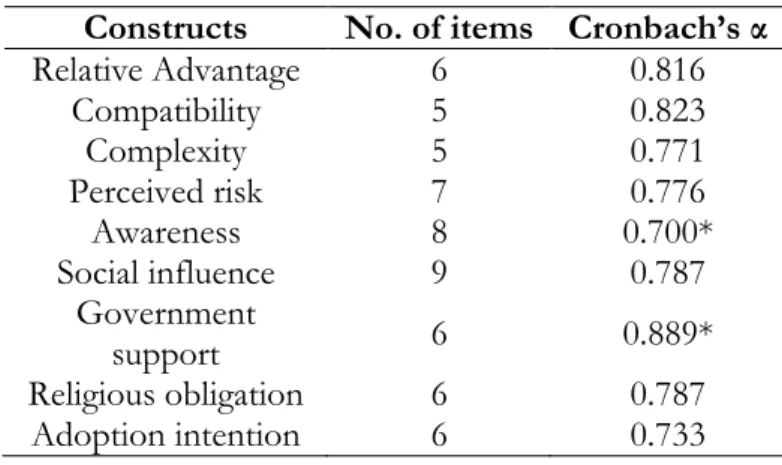
The 35 useable questionnaires were analyzed through SPSS version 23 for frequency analysis, and reliability test. Prior to running the reliability test, the demographic characteristics of the population was analyzed and described through frequency analysis in SPSS. Reliability test was performed through the Cronbach’s alpha test. The Cronbach’s alpha test ascertains the internal consistency of the items measuring the constructs of the study. The result of Cronbach’s alpha test showed that all items were within the threshold of acceptable reliability standards ranging from 0.700* to 0.889*.
As a rule of thumb, a measurement scale is deemed highly reliable when the Cronbach’s alpha value is at least 0.70 or more (Nunally & Bernstein, 1994). However, for early scale development, alpha coefficient above 0.60 are also acceptable (Hair et al., 2014).
The summary of the reliability test result is shown in Table 1. Results from the table show that the Cronbach’s alpha coefficients for the study constructs are within the acceptable range of 0.70 and above. Government Support with six (6) items had the highest alpha coefficient of 0.889 while awareness construct with eight (8) items had the lowest alpha coefficient of 0.700. The scale measuring DOI constructs (i.e., relative advantage, compatibility & complexity) exhibited high reliability (0.816, 0.823
& 0.771, respectively). Similarly, the scale measuring constructs derived from UTAUT (i.e., social influence & government support) showed high reliability too (0.787 &
0.889, respectively). Therefore, having achieved the minimum required standard, all items were retained. The measurement items for all constructs in this study were considered dependable and therefore accepted as true measures of the constructs they represent.
Table 1: Summary of Reliability test for Pilot Study Constructs No. of items Cronbach’s α
Relative Advantage 6 0.816
Compatibility 5 0.823
Complexity 5 0.771
Perceived risk 7 0.776
Awareness 8 0.700*
Social influence 9 0.787
Government
support 6 0.889*
Religious obligation 6 0.787
Adoption intention 6 0.733
Demography of Respondents
The demographic profile of respondents for the pilot test was also captured in the preliminary analysis. Most of the respondents were owner-managers and mostly within the age group of 30-50. Majority were male and relatively educated. Number of employees were mainly within 1-50. Predominantly, the respondents were Muslims and mostly married. Below (Table 2) is the demographic profile of respondents. The demographic profile of the pilot study sample is reflective of the general characteristics of the SME sector in Nigeria. SMEs are majorly micro and small enterprises managed by the owners in most instances. Additionally, it is formally male-dominated and comprises of majorly matured adults (SMEDAN & NBS, 2017).
75 Table 2: Demography of Respondents
Variables Categories Frequency Percentage (%)
Position Owner/Manager
Asst. Mgr.
Staff Consultant CEO
24 3 2 1 5
68.5 8.6 5.7 2.9 14.3
Age 18-29
30-40 41-50 Above 50
4 17 10 4
11.4 48.6 28.6 11.4
Gender Male
Female 28
7 80.0
20.0
Education Postgraduate
Degree/HND Diploma/NCE Professional Certificate Secondary
11 12 9 2 1
31.4 34.3 25.7 5.7
Religion Islam 2.9
Christianity Others
32 2 1
91.4 5.7 2.9
Marital Status Married
Single 23
12 65.7
34.3 Number of Employees Less than 10
10-49 50-199
20 13 2
57.2 37.1 5.7 Regression Analysis and Hypotheses Testing
A two-stage regression approach was used to test the hypothesis advanced. In the first phase, only the main effects were included (i.e., Adoption; eight predictor variables;
and three dummy moderator variables). In the second stage, the interaction terms were added to the regression model sequentially. In the second model, the interaction terms for age (i.e., age*main predictors) were added. Furthermore, in the third model, the interaction terms for gender (i.e., gender*main predictors) were added. Lastly, in the final model, the interaction terms for education (i.e., education* main predictors) were included. Thus, to interpret the results of hypotheses testing for the main effects model (model 1) the R-square, Adjusted R-square, the ANOVA table and the coefficients table were used. Furthermore, to ascertain the significance of the moderating effect of the interaction terms (models 2, 3 & 4) the R-square change from the first model to the subsequent models must be significant (Aguinis, 2004).
76 Table 3: Model Summary
Model R R
Square Adjusted R Square
Std. Error of the Estimate
Change Statistics R Square
Change F
Change df1 df2 Sig. F Change
1 .834a .696 .550 5.021 .696 4.783 11 23 .001
2 .856b .732 .393 5.836 .036 .253 8 15 .972
3 .916c .838 .390 5.850 .106 .988 6 9 .486
4 .929d .863 .419 5.710 .025 1.448 1 8 .263
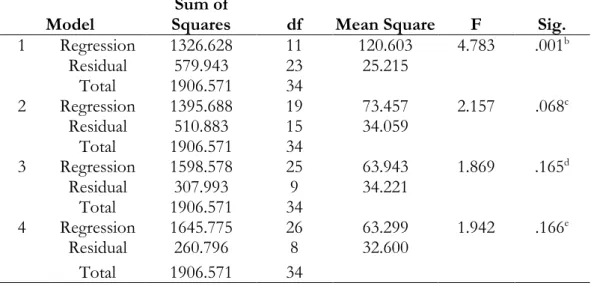
Table 4: ANOVA
Model Sum of
Squares df Mean Square F Sig.
1 Regression 1326.628 11 120.603 4.783 .001b
Residual 579.943 23 25.215
Total 1906.571 34
2 Regression 1395.688 19 73.457 2.157 .068c
Residual 510.883 15 34.059
Total 1906.571 34
3 Regression 1598.578 25 63.943 1.869 .165d
Residual 307.993 9 34.221
Total 1906.571 34
4 Regression 1645.775 26 63.299 1.942 .166e
Residual 260.796 8 32.600
Total 1906.571 34
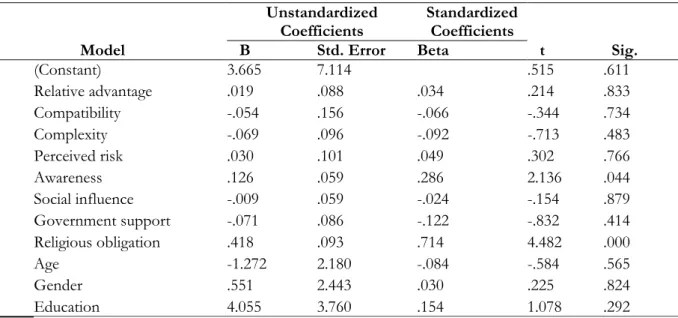
Table 5: Coefficients
Model
Unstandardized
Coefficients Standardized Coefficients
t Sig.
B Std. Error Beta
1 (Constant) 3.665 7.114 .515 .611
Relative advantage .019 .088 .034 .214 .833
Compatibility -.054 .156 -.066 -.344 .734
Complexity -.069 .096 -.092 -.713 .483
Perceived risk .030 .101 .049 .302 .766
Awareness .126 .059 .286 2.136 .044
Social influence -.009 .059 -.024 -.154 .879
Government support -.071 .086 -.122 -.832 .414
Religious obligation .418 .093 .714 4.482 .000
Age -1.272 2.180 -.084 -.584 .565
Gender .551 2.443 .030 .225 .824
Education 4.055 3.760 .154 1.078 .292
a. Dependent Variable: Adoption
From the results obtained above (Tables 3, 4 & 5) only the first model (i.e., model 1) which consists of the main predictors was significant (P <0.05) with an R-square value of 0.696 and an Adjusted R-square of 0.550. This implies that the first model explains 69.6% of the variance in the dependent variable (Adoption). However, R-square values
77 normally overestimate the success of a model. Therefore, to depict the true estimate of the model, the adjusted R-square is normally used. Hence, the adjusted R-square shows that model 1 explains 55% of the variance in adoption intention while the remaining 45% were explained by other factors not included in the research model. The main effect model can be considered as moderate (Hair et al., 2011; Chin, 1998) or even substantial according to the guidelines of Cohen (1988).
Furthermore, to ascertain the unique contribution of each predictor the coefficient table was used. From the coefficient table (Table 5) it could be seen that only religious obligation (t =4.482, P<0.01) and awareness (t=2.136, P<0.05) were significant and explain 55% of the variance in the model. Thus hypotheses 4 (H4) and 8 (H8) were supported in this study. However, Hypotheses 1, 2, 3, 5, 6 and 7 (H1, H2, H3, H5, H6, H7) were not supported in this study.
Furthermore, hypotheses 9, 10 and 11 (H9, H10, H11) were not supported in the study based on the adjusted R-square and R-square change significance. The subsequent models (models 2, 3 & 4) were not significant (P>0.05) and the adjusted R- square of the models showed a decrease in the variance explained by the first model (i.e., from 0.55 to 0.393, 0.390 & 0.419, respectively). Additionally, the R-square change was not significant for all models (P>0.05) that included the interaction terms. Thus, the moderating effect of age, gender and education were not validated in the context of this investigation.
Discussion
The findings of this study showed that out of eight hypothesized predictors, only two were confirmed. Religious obligation was found to be the most important factor influencing the adoption of Islamic trade finance products. The findings corroborate with the results obtained by many past studies (Maryam et al., 2019; Bananuka et al., 2019; Suhartanto, 2019; Kaakeh et al., 2019; Yasin & Hati, 2017; Obeid & Kaabachi, 2016). The result indicates that religious obligation is a very important factor considered by SMEs owner-managers in choosing Islamic finance products. A plausible reason for this finding can be associated with the dominance of Islam in the North-West region of Nigeria. Additionally, awareness was also found to be a significant determinant of Islamic trade finance adoption among SMEs in North-West Nigeria. This result confirms many of the previous studies findings (Shaikh et al., 2021;
Shaikh et al., 2019; Al Balushi et al., 2018 Mahdzan et al., 2017; Islam & Rahman, 2017;
Dalhatu et al., 2015; Thambiah et al., 2013). This indicates that high awareness level is associated with increased rate of adoption of Islamic trade finance. A possible reason for this finding may be associated with the increased visibility and number of banks offering Islamic finance products particularly in the North-West region of Nigeria. This factor might have increased the awareness level of SMEs owner-managers of Islamic banking products.
However, the constructs from DOI (i.e., relative advantage, compatibility, complexity) were found to be insignificant in this study. This contradicts the theoretical expectation of DOI theory and many other similar studies (Shaikh et al., 2021; Ayyub et al., 2019; Ali et al., 2019; Jamshidi & Hussin 2018; Obeid & Kaabachi, 2016;
Thambiah et al., 2012). However, the findings are congruent with the findings of Kirfi et al. (2019) on the insignificance of relative advantage. This finding suggest that SMEs owner-managers do not give much consideration to the relative advantage of Islamic banking products over and above its religious appeal and hence the insignificance of relative advantage. Furthermore, the insignificance of compatibility was confirmed by Teo and Pok (2003). Additionally, Shaikh et al. (2019) found complexity to be insignificant in the adoption of Islamic finance products. This indicates that complexity
78 of Islamic finance products was not considered to be a challenge in adopting Islamic finance products.
Moreover, perceived risk was also found to be insignificant which agrees with the findings of Echchabi and Ayedh (2015). This indicates that the perception of risk of Islamic finance products was low and therefore not given much thought.
Furthermore, social influence was also found to be insignificant which corroborates the findings of Obeid and Kaabachi (2016) and Echchabi and Ayedh (2015). However, the findings contradict the theoretical position of UTAUT. The result indicates that social influence is not significant in influencing SMEs adoption behaviour in North-West Nigeria. Additionally, government support was also not significant in explaining Islamic trade finance adoption. This is congruent with the findings of Amin et al.
(2011). This indicates that SMEs do not see government role in furthering Islamic finance as significant. Finally, the moderating effects of age, gender and education were not confirmed in this study. This finding agrees with the result of Shaikh et al. (2019).
This indicates that there is no significant difference in adoption based on these demographic variables. A possible reason for lack of significance of the moderators can be linked to the limited total sample size and the disproportionate subgroup sample size obtained in the study which may jeopardize the chance of finding any moderating effect (Aguinis, 2004).
CONCLUSION
This preliminary pilot study presents the results of hypothesis testing, validity and reliability of the survey instrument. Content and face validity was achieved based on the feedback of the pre-test panel. This resulted to the rewording, deletion, and addition of items respectively which were subsequently used in the pilot study.
Furthermore, the measurement items for the pilot study were subjected to Cronbach’s alpha test to ascertain their internal consistency. The result of the Cronbach alpha test revealed that all items were within the required benchmark of 0.70 and above.
Therefore, all measurement items were deemed reliable to be used in the main study.
Furthermore, the result of the hypothesis testing showed that only religious obligation and awareness were significantly and positively related to Islamic trade finance adoption. Additionally, the moderating role of age, gender and education were not confirmed in this study.
In summary, this preliminary study ascertained the significant factors influencing the adoption of Islamic trade finance products among SMEs in North- West Nigeria. Furthermore, the study demonstrated the validity and reliability of the research instrument to be used in the main study.
This study has two main limitations. First, the limited sample size of the study may not allow for generalization of findings. Additionally, the limited sample size can adversely affect finding significant results. Future studies could increase the sample size to further test the model. Second, the variables used in the study only explained 55% of the variance in the model. Other studies could investigate other factors that might explain the remaining 45% of variance in the research model.
79 REFERENCES
Abdelrahim, E. M. A. (2020). Behavioural intention of Libyan bank employees towards transformation to the Islamic banking system (Doctoral dissertation). International Islamic University Malaysia
Abdulkadir, N., Galoji, S. I., & Razak, R. B. A. (2013). An investigation into the adoption of mobile banking in Malaysia. American Journal of Economics, 3(3), 153-158. DOI:
10.5923/j.economics.20130303.04
African Development Bank. (2017). Trade finance in Africa: Overcoming challenges. African
Development Bank.
https://www.afdb.org/fileadmin/uploads/afdb/Documents/Publications/Trade_Finance_i n_Africa_Survey_Report.pdf
Aguinis, H. (2004). Regression analysis for categorical moderators. Guilford Press.
Ajetunmobi, A. T., Ibrahim, N., & Hamid, S. A. (2018). A multigroup structural equation modelling approach to moderating the influence of religion on the adoption of Islamic home financing. Int. J. Bus. Econ. Law, 17(1), 16-22.
Al Balushi, Y., Locke, S., & Boulanouar, Z. (2018).) Islamic financial decision-making among SMEs in the Sultanate of Oman: An adaption of the theory of planned behaviour. Journal of Behavioral and Experimental Finance, 20, 30-38. https://doi.org/10.1016/j.jbef.2018.06.001 Al Balushi, Y., Locke, S., & Boulanouar, Z. (2019). Determinants of the decision to adopt
Islamic finance: Evidence from Oman. ISRA International Journal of Islamic Finance, 11(1), 6-26.
https://doi.org/10.1108/IJIF-02-2018-0020
Ali, A. E. E. S. (2013). The challenges of Islamic trade finance in promoting SMEs in IDB
member countries. European scientific Journal.
https://www.researchgate.net/publication/264788193_THE_CHALLENGES_OF_ISLAM IC_TRADE_FINANCE_IN_PROMOTING_SMES_IN_IDB_MEMBER_COUNTRIES Ali, M., Raza, S. A., Puah, C. H., & Amin, H. (2019). Consumer acceptance toward takaful in
Pakistan: An application of diffusion of innovation theory. International Journal of Emerging Markets, 14(4), 620-638. https://doi.org/10.1108/IJOEM-08-2017-0275
Ali, M., Raza, S. A., Khamis, B., Puah, C. H., & Amin, H. (2021). How perceived risk, benefit and trust determine user Fintech adoption: A new dimension for Islamic finance. Foresight-The Journal of Future Studies, Strategic Thinking and Policy, 23(4), 403-420.
Amin, H., Rahim Abdul Rahman, A., Laison Sondoh Jr, S., & Magdalene Chooi Hwa, A. (2011).
Determinants of customers' intention to use Islamic personal financing: The case of Malaysian Islamic banks. Journal of Islamic Accounting and Business Research, 2(1), 22-42.
https://doi.org/10.1108/17590811111129490
Ayyub, S., Xuhui, W., Asif, M., & Ayyub, R. M. (2019). Determinants of intention to use Islamic banking: A comparative analysis of users and non-users of Islamic banking: Evidence from Pakistan. International Journal of Islamic and Middle Eastern Finance and Management, 13(1), 147- 163.
Badaj, F., & Radi, B. (2018). Empirical investigation of SMEs’ perceptions towards PLS financing in Morocco. International Journal of Islamic and Middle Eastern Finance and Management, 11(2), 250-273. https://doi.org/10.1108/IMEFM-05-2017-0133
Bananuka, J., Kaawaase, T. K., Kasera, M., & Nalukenge, I. (2019). Determinants of the intention to adopt Islamic banking in a non-Islamic developing country. ISRA International Journal of Islamic Finance, 11(2), 166-186. https://doi.org/10.1108/IJIF-04-2018-0040
Baron, R. M., & Kenny, D. A. (1986). The moderator–mediator variable distinction in social psychological research: Conceptual, strategic, and statistical considerations. Journal of Personality and Social Psychology, 51(6), 1173-1182. https://doi.org/10.1037/0022- 3514.51.6.1173
Bauer, R. A. (1960). Consumer behavior as risk taking. Chicago, IL, 384-398.
80 Berens, G., Van Riel, C. B., & Van Bruggen, G. H. (2005). Corporate associations and consumer product responses: The moderating role of corporate brand dominance. Journal of Marketing, 69(3), 35-48. https://doi.org/10.1509/jmkg.69.3.35.66357
Bilal, M., Fatima, S., Ishtiaq, M., & Azeem, H. M. (2020). Factors affecting the choice of Islamic banking by SMEs in Pakistan: Implications for Islamic banks' corporate governance. Pakistan Journal of Commerce and Social Sciences, 14(1), 255-272.
Bonett, D. G. (2002). Sample size requirements for estimating intraclass correlations with desired precision. Statistics in medicine, 21(9), 1331-1335. https://doi.org/10.1002/sim.1108
Bujang, M. A., Omar, E. D., & Baharum, N. A. (2018). A review on sample size determination for Cronbach’s alpha test: A simple guide for researchers. The Malaysian Journal of Medical Sciences: MJMS, 25(6), 85-99. https://doi.org/10.21315/mjms2018.25.6.9
Central Bank of Nigeria. (n.d.) Financial Institutions.
https://www.cbn.gov.ng/Supervision/finstitutions.asp
Charag, A. H., Fazili, A. I., & Bashir, I. (2019). Determinants of consumer’s readiness to adopt Islamic banking in Kashmir. Journal of Islamic Marketing, 11(5), 1125-1154.
https://doi.org/10.1108/JIMA-10-2018-0182
Chin, W. W. (1998). The partial least squares approach to structural equation modeling. Modern Methods for Business Research, 295(2), 295-336.
Cohen, J. (1988). Statistical power analysis behavioral sciences. Lawrence Erlbaum Associates.
Dalhatu, U., Binta, D., Abdullah, A., Ibrahim, Y. M., & Abideen, A. A. (2015). Awareness level of North-West Zone of Nigeria retail customers towards Islamic banking. Advanced Science Letters, 21(5), 1460-1463. https://doi.org/10.116/asl.2015.6070
Dusuki, W. A. & Abdullah, I. N. (2007). Why do Malaysian customers patronise Islamic banks?
International Journal of Bank Marketing, 25(3), 142-160.
https://doi.org/10.1108/02652320710739850
Davis, F. D. (1989). Perceived usefulness, perceived ease of use, and user acceptance of information technology. MIS quarterly, 319-340. https://doi.org/10.2307/249008
Dawes, J. (2008). Do data characteristics change according to the number of scale points used?
An experiment using 5-point, 7-point and 10-point scales. International Journal of Market Research, 50(1), 61-104.
Dwivedi, Y. K., Rana, N. P., Jeyaraj, A., Clement, M., & Williams, M. D. (2019). Re-examining the unified theory of acceptance and use of technology (UTAUT): Towards a revised theoretical model. Information Systems Frontiers, 21(3), 719-734. https://doi.org10.1007/s10796- 017-9774-y
Echchabi, A., & Aziz, H. A. (2012). Empirical investigation of customers’ perception and adoption towards Islamic banking services in Morocco. Middle-East Journal of Scientific Research, 12(6), 849-858. DOI: 10.5829/idosi.mejsr.2012.12.6.1942
Echchabi, A., & Ayedh, A. M. (2015). Factors influencing the Yemeni customers' intention to adopt takaful products. Gadjah Mada International Journal of Business, 17(1), 25-45. DOI:
10.22146/gamaijb.25799
Farooqi, R. & Ansari, S. (2017). Moderating effect of demographic variables on attitude towards online shopping: An empirical study using PROCESS. Journal of Business and Management, 19(11), 47-54. DOI: 10.9790/487X-1911014754
Fishbein, M., & Ajzen, I. (1975). Belief, Attitude, intention and behavior: An introduction to theory and research. Reading, MA: Addison-Wesley.
Gait, A., & Worthington, A. C. (2009). Libyan business firm attitudes towards Islamic methods of finance. SSRN 1370752. https://dx.doi.org/10.2139/ssrn.1370752
Gait, A., & Worthington, A. (2008). An empirical survey of individual consumer, business firm and financial institution attitudes towards Islamic methods of finance. International Journal of Social Economics, 35(11), 783-808. https://doi.org/10.1108/03068290810905423