annual report
JAYA TIASA HOLDINGS BERHAD
Company Number : 3751-V
No.1-9, Pusat Suria Permata, Lorong Upper Lanang 10A,
96000 Sibu, Sarawak.
T : 084 213 255 F : 084 213 855 E : [email protected]
JAYA TIASA HOLDINGS BERHAD ANNUAL REPORT 2013
table of CONTENTS
Financial Highlights_2 Corporate Information_4 Directors’ Profile_5 Key Information_10 Corporate Structure_11 Chairman’s Statement_12
Corporate Social Responsibility_18 Statement on Corporate Governance_23 Statement on Risk Management and
Internal Control_34 Audit Committee Report_37
Directors’ Responsibility Statement_41 Financial Statements_42
Analysis of Shareholdings_125
Properties owned by the Group_128
Notice of Annual General Meeting_131
Proxy Form
2013 2012 2011 2010 2009
RM’000 RM’000 RM’000 RM’000 RM’000
2013 2012 2011 2010
RM’000 RM’000 RM’000 RM’000 Revenue
Profit Before Taxation Profit After Taxation Profit Attributable to Equity Holders EBITDA
Equity Attributable to Equity Holders
Net Earnings Per share (sen) Net Assets Per Share Attributable to Equity Holders (RM)
Net Tangible Assets Per Share (RM) Return on Equity (%)
Return on Total Assets (%)
Timber Operations and Reforestation
Oil Palm Operations
33,470
(2,097) (104) 31,269
73,799
150,848 227 224,874
39,530
105,293 61,219 206,042
24,849
17,156 (1,969) 40,036 Others
Gross Dividend (sen)
1,054,098 31,269 22,271
21,138 141,533
1,708,483
2.18
1.76 1.66 1.2 0.7 1.0 32
1,183,684 224,874 170,666
168,739 356,331
1,393,248
20.23
4.97 4.56 12.1 6.4 5.2 38
870,912 206,042 152,706
151,436 304,940
1,248,232
18.20
4.68 4.16 12.1 6.6 6.0 37
746,001 40,036 25,075
24,372 129,554
1,104,037
2.93
4.14 3.53 2.2 1.1 2.0 41
756,530 22,854 14,596
13,882 103,669
1,077,411
1.67
4.04 3.37 1.3 0.7 – 41 Gearing Ratio (%)
FINANCIAL STATISTICS PERFORMANCE
PROFIT/(LOSS) BEFORE TAX BY BUSINESS SEGMENTS
CORPORATE RATIOS
FINANCIAL
HIGHLIGHTS
1.67 2.93 18.20 20.23 2.18
0.00 5.00 10.00 15.00 20.00 25.00
2009 2010 2011 2012 2013
0 500 1,000 1,500 2,000 2,500 3,000
2008 2009 2010 2011 2012
Earnings Per Share (Sen)
Total Assets (RM million)
757 746 871 1,184 1,054
- 200 400 600 800 1,000 1,200 1,400
2009 2010 2011 2012 2013
1,077 1,104 1,248 1,393
- 200 400 600 800 1,000 1,200 1,400 1,800 1,600
2009 2010 2011 2012 2013
Revenue (RM million)
Equity Attributable to Equity Holders (RM million)
75%
24.9%
0.1%
70.2%
29.7%
0.1%
Breakdown of Revenue by Segment 2013: RM1,054 million 2012: RM1,184 million
FY 2013 FY 2012
Timber Operations Oil Palm Operations Others
1,708 2,093 2,157 2,300 2,636 2,961
FINANCIAL HIGHLIGHTS (cont’d)
COMPANY SECRETARY Ms Ngu Ung Huong
MAICSA 7010077 AUDITORS Ernst & Young
Chartered Accountants Room 300-303, 3rd Floor Wisma Bukit Mata Kuching Jalan Tunku Abdul Rahman 93100 Kuching
Tel : 082-243233 Fax : 082-421287 SHARE REGISTRAR
Symphony Share Registrars Sdn Bhd Level 6, Symphony House
Pusat Dagangan Dana 1 Jalan PJU 1A/46 47301 Petaling Jaya
Selangor Darul Ehsan, Malaysia Tel : 03-7841 8000
Fax : 03-7841 8151/52
CORPORATE INFORMATION
PRINCIPAL BANKERS AmBank Berhad
CIMB Bank Berhad Hong Leong Bank Berhad OCBC Bank (Malaysia) Berhad RHB Bank Berhad
REGISTERED OFFICE No.1-9, Pusat Suria Permata Lorong Upper Lanang 10A 96000 Sibu, Sarawak Tel : 084-213255 Fax : 084-213855
E-mail: [email protected] WEBSITE
www.jayatiasa.net
STOCK EXCHANGE LISTING Main Market
Bursa Malaysia Securities Berhad Stock Name: JTIASA
Stock Code: 4383 BOARD OF DIRECTORS
GEN (RTD) TAN SRI ABDUL RAHMAN BIN ABDUL HAMID Independent Non-Executive Chairman
DATO’ SRI TIONG CHIONG HOO Deputy Executive Chairman DATO’ WONG SIE YOUNG Chief Executive Officer
DATO’ SRI DR. TIONG IK KING Non-Independent Non-Executive Director MDM TIONG CHOON
Non-Independent Non-Executive Director
MR TIONG CHIONG HEE
Non-Independent Non-Executive Director MR JOHN LEONG CHUNG LOONG Independent Non-Executive Director DATO’ WONG LEE YUN
Independent Non-Executive Director DATUK TALIB BIN HAJI JAMAL Independent Non-Executive Director
Gen (Rtd) Tan Sri Abdul Rahman Bin Abdul Hamid, aged 74, was appointed to the Board on 27 March 1995. He serves as chairman of the Board and the Audit Committee.
He is a graduate of the Royal Military College, Malaysia and Army Staff College, Camberlay, United Kingdom.
Tan Sri was the Chief of the Malaysian Army and Defence Force between 1992 and 1994 and was the Acting Governor of Penang in 1994. From 1958 to 1994, he served in various capacities and appointments in the Malaysian Armed Forces.
Presently, he is the Chairman of DVM Technology Bhd, an ICT company listed on the ACE Market and AXA Affin Life Insurance Berhad, a joint-venture company of Lembaga Tabung Angkatan Tentera. He is also the Chairman and Director of a few other multinational and private companies incorporated in Malaysia.
Tan Sri has no family relationship with any Director and/or major shareholder of the Company.
Gen (Rtd) Tan Sri Abdul Rahman Bin Abdul Hamid
Independent Non-Executive Chairman
Dato’ Sri Tiong Chiong Hoo
Deputy Executive Chairman
DIRECTORS’
PROFILE
Dato’ Sri Tiong Chiong Hoo, aged 53, was appointed Executive Director on 27 March 1995. He was re-designated as Managing Director on 26 April 1995 and subsequently as Deputy Executive Chairman on 1 January 2013.
He holds a Bachelor of Law and a Bachelor of Economics degrees from Monash University, Australia and is a registered barrister.
Dato’ Sri is a businessman with extensive experience and in-depth knowledge in timber and plantation industries. He is responsible for developing the Group’s corporate/business strategy and attaining the long-term growth objectives.
He is the son of Tan Sri Datuk Sir Tiong Hiew King, a major shareholder of the Company. His uncle Dato’ Sri Dr Tiong Ik King, sister Mdm Tiong Choon and cousin brother Mr Tiong Chiong Hee are also members of the Board.
DIRECTORS’ PROFILE (cont’d)
Dato’ Wong Sie Young, aged 54, was appointed Chief Executive Officer on 1 January 2013. He is the Chairman of the Risk Management Committee.
He graduated with a Bachelor of Science in Electrical Engineering degree from University of Arkansas, USA in 1984.
Dato’ Wong actively oversees the operations of the Company and the Group. He has been working with the Group for 25 years during which time he has acquired extensive experience in the running of the Group’s operations. He joined the Group in 1987 and has been involved in the designing and setting up of all the timber processing plants. When the Group began diversifying into the oil palm business in 2002, he was entrusted to oversee the construction projects at the oil palm estates and was involved in the designing and construction of all the palm oil mills.
He has no family relationship with any Director and/or major shareholder of the Company.
Dato’ Sri Dr Tiong Ik King, aged 63, joined the Board on 27 March 1995. He is a member of the Remuneration Committee and the Nomination Committee.
Dato’ Sri Dr Tiong graduated with a M.B.B.S degree from the National University of Singapore in 1975 and subsequently obtained his M.R.C.P. from the Royal College of Physicians, UK in 1977.
Dato’ Sri Dr Tiong has extensive experience in many industries including media and publishing, information technology, timber, plantation and manufacturing industries.
Currently, he also serves on the Board of Media Chinese International Limited.
Dato’ Sri Dr Tiong is the brother of Tan Sri Datuk Sir Tiong Hiew King, a major shareholder of the Company. His nephews, Dato’ Sri Tiong Chiong Hoo and Mr Tiong Chiong Hee and his niece Mdm Tiong Choon are also members of the Board.
Dato’ Wong Sie Young Chief Executive Officer
Dato’ Sri Dr Tiong Ik King
Non-Independent Non-Executive Director
DIRECTORS’ PROFILE (cont’d)
Mdm Tiong Choon, aged 44, was appointed to the Board on 3 May 1999.
She graduated with a Bachelor of Economics degree from Monash University, Australia. She has been with Rimbunan Hijau Group since 1991 and served in various managerial and senior positions.
Currently, she also serves on the Board of Media Chinese International Limited.
She is the daughter of Tan Sri Datuk Sir Tiong Hiew King, a major shareholder of the Company. Her uncle Dato’ Sri Dr Tiong Ik King, brother Dato’ Sri Tiong Chiong Hoo and cousin brother Mr Tiong Chiong Hee are also members of the Board.
Mr Tiong Chiong Hee, aged 39, was appointed to the Board on 14 May 1999.
He holds a Bachelor of Commerce degree from University of Melbourne, Australia.
He is the Managing Director of Mafrica Corporation Sdn Bhd, a company with operations in logging (both in Malaysia and Overseas), oil palm plantations and aquaculture prawn farming since 1997.
He is the nephew of Tan Sri Datuk Sir Tiong Hiew King, a major shareholder of the Company. His uncle Dato’ Sri Dr Tiong Ik King, cousin brother Dato’ Sri Tiong Chiong Hoo and cousin sister Mdm Tiong Choon are also members of the Board.
Mdm Tiong Choon
Non-Independent Non-Executive Director
Mr Tiong Chiong Hee
Non-Independent Non-Executive Director
DIRECTORS’ PROFILE (cont’d)
Mr John Leong Chung Loong, aged 66, was appointed to the Board on 28 March 2002. He serves as the Chairman of the Remuneration Committee and is a member of the Audit Committee and Nomination Committee.
He holds a Bachelor of Economics degree majoring in Accounting from Sydney University, NSW, Australia.
He is an Approved Company Auditor and a member of several professional bodies, including the Australian Society of Certified Practising Accountants, Malaysian Institute of Accountants, Malaysian Institute of Certified Public Accountants and Malaysian Institute of Taxation (Associate). He started his career as an Accountant in Tractors Malaysia Berhad, Sandakan Branch in 1972 and left in 1973 to join John Liaw & Co as an audit manager. He was a Partner of Liaw, Leong, Wong & Co from 1986 to 1997 and a Partner of Ernst
& Young from 1997 to 2001.
He has no family relationship with any Director and/or major shareholder of the Company.
Dato’ Wong Lee Yun, aged 60, was appointed to the Board on 21 June 2007. She is a member of the Audit Committee.
She is a Certified Public Accountant by profession.
She has extensive experience in investment banking, finance and strategic planning for large investment projects, as well as acquisition of strategic businesses. She was a Corporate Finance Manager at Permata Chartered Merchant Bank and Vice President at Chase Manhattan Bank. From 1991 to 1996, she was Director of Finance and Strategy for the Renong Group of Companies. She became the Chief Executive of Jaya Tiasa Holdings Berhad from 1997 to 2000.
She was also a Director of Sin Chew Media Corporation Bhd from 2004 to early 2008.
Currently, she is a Shareholder cum Executive Director of MyBiz Solutions Sdn Bhd, a company providing Total Spend Management solutions to major corporations in Malaysia. In addition, she holds directorship in several private limited companies.
She has no family relationship with any Director and/or major shareholder of the Company.
Mr John Leong Chung Loong Independent Non-Executive Director
Dato’ Wong Lee Yun
Independent Non-Executive Director
None of the Directors has:
• Any conviction for offences within the past 10 years other than traffic offences.
• Entered into any transaction whether directly or indirectly which has a conflict of interest with the Company.
All the Directors of the Company are Malaysians.
Datuk Talib Bin Haji Jamal, aged 61, was appointed to the Board on 12 November 2007. He is the Chairman of the Nomination Committee and is a member of the Audit Committee and Remuneration Committee.
Datuk Talib holds a Master of Science in Mechanical Engineering from Cranfield Institute of Technology, England, United Kingdom.
Datuk Talib has served in various senior capacities and positions in the Police Diraja Malaysia for more than 30 years. He was the Commissioner of Police, Sarawak from 2004 until his retirement in November 2007. He was the Director of Police Cooperatives for 10 years and the Director of Bank Kerjasama Rakyat for 2 years.
Datuk Talib has no family relationship with any Director and/or major shareholder of the Company.
Datuk Talib Bin Haji Jamal
Independent Non-Executive Director
DIRECTORS’ PROFILE (cont’d)
Timber Products
Jaya Tiasa Plywood Sdn Bhd
Rimbunan Hijau Plywood Sdn Bhd
Jaya Tiasa Timber
Products Sdn Bhd Total Annual Production
Capacity
Plywood 180,000 120,000 120,000 420,000M3
Rotary Veneer 324,000 _ _ 324,000M3
Sawntimber 72,000 26,400 14,400 112,800M3
Blockboard _ 12,000 _ 12,000M3
Film-Overlay Plywood _ 6,000 _ 6,000M3
Sliced-Veneer _ _ 6,000,000 6,000,000M2
Crude Palm Oil JT Oil Palm Development
Sdn Bhd 486,000MT
Maujaya Sdn Bhd 324,000MT
KEY INFORMATION
Forest Concessions
Gross Area: 713,211 hectares (1,760,535 acres) Extraction Quota: 94,500m3 monthly
Main Species: Meranti, Kapor, Keruing, Selangan Batu, Jelutong, Melapi, Mersawa, Nyatoh, Arau, Penyau, Bindang and MLH (mixed light hardwood).
Oil Palm Plantation
Total Land Area: 83,480 hectares
Estimated Plantable Area: 70,900 hectares Planted Area*: 63,574 hectares
Matured Area*: 55,438 hectares
Reforestation
Total Land Area: 235,859 hectares
Estimated Plantable Area: 141,308 hectares Planted Area*: 30,978 hectares
ANNUAL PRODUCTION CAPACITY
Notes: * As at 30 September 2013 M3 – cubic metre
M2 – square metre MT – metric tonnes
Timber Division
Jaya Tiasa Plywood Sdn Bhd 100%
Jaya Tiasa Timber Products
Sdn Bhd 100%
Rimbunan Hijau Plywood Sdn Bhd 100%
Jaras Sdn Bhd
100%
Sericahaya Sdn Bhd
88.9%
Curiah Sdn Bhd
88.9%
Jaya Tiasa Forest Plantation
Sdn Bhd 100%
Oil Palm Division
Simalau Plantation
Sdn Bhd 100%
Hariyama Sdn Bhd
100%
Eastern Eden Sdn Bhd
100%
Poh Zhen Sdn Bhd
100%
Erajaya Synergy Sdn Bhd
100%
JT Oil Palm Development
Sdn Bhd 100%
Maujaya Sdn Bhd 100%
Maxiwealth Holdings
Sdn Bhd 100%
Research and Development
Jaya Tiasa R&D Sdn Bhd
100%
Markeng and Trading
Hak Jaya Sdn Bhd 100%
Kunari Timber Sdn Bhd
100%
Mafrica Trading Sdn Bhd
40%
Guanaco Sdn Bhd 100%
Private Flight Operaons
Jaya Tiasa Aviation Sdn Bhd
100%
Non-Trading or Dormant
Atlantic Timber Holdings Limited
100%
Pacific Timber Holdings Limited
100%
Eastern Timber Ltd
100%
Jaya Tiasa Aquaculture
Sdn Bhd 100%
Mantan Sdn Bhd 100%
Multi Greenview
Sdn Bhd 100%
Atlantic Evergreen Holdings
100%
Western Timber Resources Limited
100%
CORPORATE
STRUCTURE
Dear fellow shareholders,
On behalf of the Board of Directors of Jaya Tiasa Holdings Berhad, I am pleased to
present to you the Annual Report and Audited Financial Statement of the Group for the
Financial Year Ended 30 June 2013.
CHAIRMAN’S STATEMENT
GLOBAL ECONOMY OVERVIEW
Looking back, 2012 has been a weak year for economic growth in most developed countries. In US, an earlier fiscal cliff was merely averted but not resolved as the concerns about the debt ceiling quagmire again threatens to rile global markets.
Unemployment rate albeit improving is still high, and the housing start has been slow. Europe, on the other hand, remains vulnerable and was trapped in vicious cycle of high unemployment, financial fragility, heightened sovereign risks, fiscal austerity and low growth. Fiscal and monetary policies has had mixed success so far in calming financial markets and even less so in strengthening economic growth and job creation.
In Asia, China’s economic growth slowed for a few consecutive quarters amid a transition that has seen the country’s new leadership seeking to rebalance its economy. This had had a negative impact on housing and construction activities.
India fared even worse and has suffered the brunt of economic challenges with high inflation and a sharply weaker Rupee as growth slowed to 5.0% in the fiscal year ended March 2013 from 6.5% in the previous year. Fortunately, these factors have not dented India’s demand for timber.
While emerging economies have benefited from the US Federal Reserve’s quantitative easing, expectation of tapering by the US government is having the opposite effect recently. It is apparent the global economy has yet to shake off the fallout of the 2008-2009 financial crises. According to IMF, global economy growth dropped to 3.1 % in 2012 as compared to 3.9%
the year before, and the trend will probably continue. Geopolitical instability such as the Arab Spring and the Syria conflict added to worries about the global economy over the past year. Such uncertainties may continue to affect global trade and foreign direct investments. The flicker of hope in a global recovery may be dimmed further by consumer deleveraging and flagging demand in emerging markets.
On the domestic front, Malaysia has so far held up relatively well as political risk subsided after the General Election 2013.
GDP growth was registered at 5.6% in 2012 and at 4.2% in 1H13, owing much to government’s commitment on the implementation of projects under the Economic Transformation Program (ETP). Ringgit was stable throughout the past
CHAIRMAN’S STATEMENT (cont’d)
Log Export by Destination 2013
62%
1%
19%
3%
7%
8%
Taiwan China/Hong long India
Japan Asean Korea
GROUP PERFORMANCE REVIEW
In FY2013, demand for our timber products was sustained as total exports sales increased by 7% in US Dollar. Logs contributed 38% of the total Group’s revenue in US Dollar, and this is followed by plywood division at 30%.
While the performance from timber sector has remained stable, our palm oil business encountered major headwinds as FFB and CPO prices fell sharply in the past year. Even though the matured hectares expanded by 28% YoY to 48,005 hectares and FFB production increased by 31% YoY to 664,633 MT, our Oil Palm Sector suffered a pre-tax loss. The average selling price per MT was RM423 and RM2,280 for FFB and CPO respectively, a 28% and 23% YoY contraction from the previous RM590 and RM2,975.
FFB yield was not at the optimum level as more young trees enter maturity. We expect the harvest yields to improve and we will continue to put in the necessary efforts to improve efficiency and productivity. Also, our CPO mill capacity has been increased to 150MT per hour with an additional CPO mill now commissioned at the end of FY2013.
CPO price has stayed in the range of RM2,200-2,400 per MT since the beginning of 2013, and there has been little sign of sustained price upward trend in spite of the normalized CPO inventory in the country. Mixed views from the recent Palm Oil Convention 2013 showed there is no general consensus on how the industry will fare in the year ahead. A growing supply from Indonesia due to an aggressive expansion in cultivation, a moderate growth in oleo-chemical demands, and subdued demand from bio fuels all contributed to a bearish sentiment and a clouded outlook.
FINANCIAL PERFORMANCE
The Group recorded RM1.05 billions in revenue, a 4% slight increase over the annualized revenue of RM1.01 billions in the previous year. Lower selling prices together with higher operating costs for oil palm led to an erosion in profit after tax to RM22.3 million from the annualized profit after tax of RM146.3 millions attained in the preceding year, an 85%
decrease. As a result, earning per share was down to 2.18 sen. Shareholders’ funds improved to RM1,708 million compared to RM1,393 million achieved in the preceding Financial Year, largely due to the issuance of shares. Net tangible assets per share stood at RM1.66 for the Year Ended 30 June 2013.
DIVIDEND
As part of our commitment to enhancing shareholder value, the Board of Directors stayed true to its dividend policy of paying out not less than 20% of its net profit, subject to not compromising the Group’s ability to support its pursuit for long term growth. Notwithstanding the weaker result, the Board of Directors has recommended a gross dividend of 1 sen per share representing about 43% of after tax profit in respect of the Financial Year Ended 30 June 2013 for approval by the shareholders at the forthcoming Annual General Meeting to be held on 28 November 2013.
REVIEW OF OPERATIONS Logging
The logging division contributed about 38% of the total Group’s revenue. Apart from the unfavorable weather conditions as well as the impoundment of the Bakun hydroelectric dam which continued to impede the transportation of logs for processing mills and exports, scarcity of log supply had made our logging operation a bigger challenge. As a result, our log production reduced by 7% in terms of volume compared to the last Financial Year.
Average export price for logs stabilized at USD220 per m3 largely due to the tightening log supply and the continuing sustained demand from India and Taiwan.
CHAIRMAN’S STATEMENT (cont’d)
Plywood Export by Destination 2013
28%
6%
7% 1%
27%
15%
16%
Korea Taiwan Others
Japan
Middle East China / Hong Kong USA
100,000 0 200,000 300,000 400,000 500,000 600,000 800,000 700,000
670,339 696,607
Log Sales (m3)
2012 2013
200,000 0 400,000
2012 2013
600,000 800,000 1,000,000 1,200,000 1,400,000
Log Production (m3)
1,144,629 1,059,710
India remained the largest log export market for the group with sales accounting for 62%
of the Group’s total log export sales in US Dollars. In spite of the economic slowdown and the sharp depreciation of Indian Rupee against USD, heavy dependence on imports in view of the inadequate domestic supply helped sustained demand, especially for Sarawak logs. India is expected to continue to be a key market for the Group’s logs.
Taiwan was our second largest export market after India, amounting to 19% of total logs sales in US Dollars. As forecasted, demand from Taiwan has been on a decline due to continuing shutdown of sawmills. Nonetheless, during the financial year under review, total sales volume to Taiwan was satisfactory.
Logging Outlook and Strategy
Jaya Tiasa has one of the largest timber assets among Malaysian listed companies, and accounted for more than 10% of the logs produced in Sarawak in 2012. With higher export quota, our export sales should increase in the coming financial year as we foresee the market demand for tropical logs to remain robust despite an expected slower global growth, with prices that are likely to be sustained due to supply constraint.
In particular, demand for logs in India is expected to continue to be maintained, driven by their need for affordable timber for building and renovation. Its economy and construction activities are still growing since late-2012, albeit at a slower pace.
To better manage our forest, we will select good quality species with high market value for harvesting. We will export all available logs within the permitted quota and maintain vigilant controls on the cost of production. Increased attention will also be given to logistical planning to ensure that logs extracted are delivered within the shortest time frame possible to preserve their freshness and maintain their quality for premium prices.
Plywood
In FY2013, the plywood division contributed about 30% to the total revenue of the Group.
Plywood export volumes increased by 9% YoY, while the average selling prices fell by 6%. During the year, Taiwan and Korea emerged as our two largest export destinations, accounting to 28% and 27% respectively of total plywood exports of the group in US Dollar. Other major exports markets were China / Hong Kong, Japan, the US and the Middle East.
The market for imported plywood has been challenging ever since the economy downturn.
To maximize our revenue and profit as well as to maintain our existing markets, we had earlier made a strategic decision to produce more high value products.
CHAIRMAN’S STATEMENT (cont’d)
20,000 0 40,000
2012 2013
60,000 80,000 100,000 140,000 120,000 160,000 200,000 180,000
Plywood Sales (m3)
163,203 183,098
20,000 0 40,000
2012 2013
60,000 80,000 100,000 140,000 120,000 160,000 180,000
Plywood Production (m3)
164,548 140,662
The anti-dumping duty ranging from 5% to 38% imposed by South Korean Government in March 2011 for two years has not affected our sales to the country. The plywood sales volume to South Korea was in fact the highest among our markets, while total export value increased by 8% from the previous year.
Taiwan became our leading market for plywood in US Dollar accounting for 28% of the Group’s total sales. Despite the structural change in consumption pattern in Taiwan, we managed to fend off our competitors by selling good quality product with various sizes tailored to the market demand.
Plywood Outlook and Strategy
Demand for plywood is expected to improve gradually in line with economic recovery in our key markets, particularly in Japan. The aggressive policy easing to reflate the Japanese economy has led to higher government spending, monetary easing and structural reforms. Tokyo’s winning bid to host the 2020 Olympics will certainly have positive impact on Japan’s economy. The announced increase in Japan’s consumption tax from 5% currently to 8% by 2014 is anticipated to bring forward housing demand. June housing starts in Japan totaled 83,704 were up by over 15% compared to June 2012. This is an encouraging note for plywood business as it will have a positive effect on the potential plywood demand as well as its selling price.
In tandem with this renewed optimism, the group is adopting a dynamic strategic approach in an increasingly competitive global environment, taking into account the scarcity of resources, the volatility of foreign exchange rates and volatile crude oil prices. The group will strengthen its current measures to maintain and enhance its competitive edge, and these include harnessing its existing production technology towards improving operational efficiency and product quality, and being innovative in producing more value-added products for niche markets to enhance margins. Barring any unforeseen circumstances, the division is projected to have better earnings and profits for the next financial year.
508,701
664,633
0 100,000 200,000 300,000 400,000 500,000 600,000 700,000
0 100,000 200,000 300,000 400,000 500,000 600,000 700,000
37,419 58,545 48,005 62,745
2012 2013
Oil Palm Planted Area/FFB Production
46,708
7,573
59,860
9,606
0 10,000 20,000 30,000 40,000 50,000 60,000
Mill Production Percentage of Prime Age over Planted Ha (62,745 Ha)
0 5000 10000 15000 20000 30000 25000
2787
4% 7%
12%
24%
40%
4195
7720
14918
25255
FY11 FY12 FY13 FY14 FY15
CHAIRMAN’S STATEMENT (cont’d)
24%
64%
12%
Palm Age Profile As At 30 June 2013
Prime Mature Young Mature Immature
Oil Palm
As highlighted earlier, the division’s profit for the year under review has been disappointing. Revenue for the year was RM263 million, a 13% decrease in value despite 31% increase in production volume. The loss before tax of RM2.1 millions was due to lower selling price and higher operating cost stemmed from a larger young mature area which has lower FFB Yields.
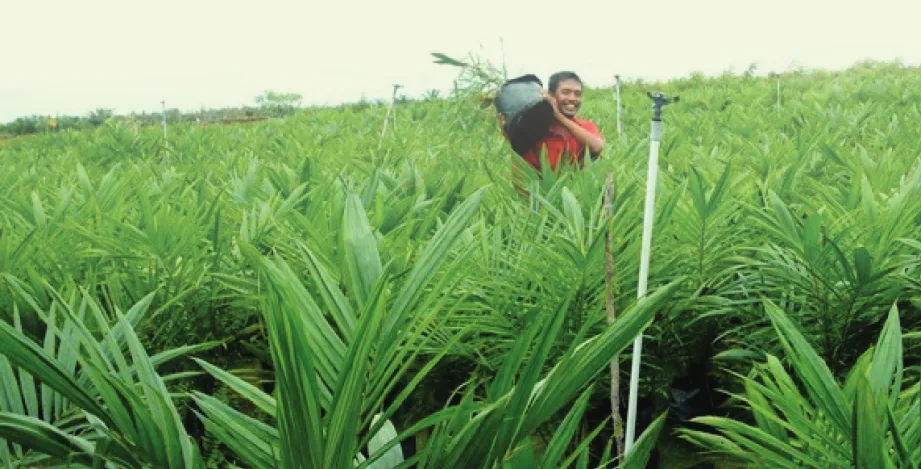
As at 30 June 2013, the group’s estimated plantable areas stood at 70,900 hectares (Ha) spreading over 10 plantations in Sarawak, of which 89% (or 62,745 Ha) are fully planted. With 77% of planted area (or 48,005 Ha) having matured, our FFB production for the year had increased by 31% to 664,633 metric tones (MT) from the previous year’s 508,701 MT annualized amount. The average age of the tree is relatively young with only 12% of planted area (7,720 Ha) are in their prime.
The group’s palm oil mill produced approximately 60,000 MT of CPO and 9,600 MT of palm kernel (PK). Jaya Tiasa currently has two mills in operation with total processing capacity of 150MT per hour. In line with expected rapid growth in crop production in the years ahead, we target additional two mills at an estimated cost of RM165 million, both of which are strategically located near the plantations. Upon full operation, the mills are expected to contribute significantly to profitability. One of them is currently under construction and is scheduled to be completed in April 2014, while the other one is already in the planning stage.
Oil Palm Outlook and Strategy
As at 30 June 2013, the weighted average of our palm age stood at 5.6 years. As shown in the chart, 40% of our planted hectare will enter into prime age in two years time. This is 2.27 times more than the current 7,720 hectare which is at prime age. Thus, we expect our FFB yield (MT) per hectare to significantly improve and consequently reducing our cost of production. Labor shortage continues to be an issue nationwide. In order to cope with this challenging operating environment, we have increased mechanization so we can redeploy limited resources.
With regard to our CPO mill operation, we constantly seek external consultations and send our staffs for training regularly in our attempt to improve productivity and operating efficiency. Also, the additional mills which are strategically located will enable us to achieve higher efficiency and profitability in the vertical integration of the supply chain. We foresee better operating result in the next financial year.
We remain optimistic about the long term prospects for the palm oil industry despite current weakness in CPO price. We will endeavor to lower our cost of production, enhance our harvesting yield and improve productivity so that we are poised to reap the profits in the event CPO prices start to trend upwards.
CHAIRMAN’S STATEMENT (cont’d)
Reforestation
We are currently managing a total of 235,859 Ha of reforestation areas. With fast-growing tree species such as Eucalyptus Deglupta (Kamarere), Eucalyptus Pellita and Kelampayan planted across the plantation areas, the group’s forest planted area has been expanding and will continue to trend up steadily.
Reforestation outlook and strategy
We perceive planted forest as an investment for the future viability of the group and in keeping with the world’s move towards conservation of natural forests. The division is not expected to contribute to earnings in the short term given that the planted forest has a gestation period of 12 to 15 years before it can be ready for commercial harvesting. The challenge of the group is to improvise silvicultural practices and place greater emphasis on stringent quality control over new plantings and its maintenance so as to improve the survival rate and optimum growth of planted trees.
GOING FORWARD
Recent reports by the World Bank and the International Monetary Fund paint a gloomy picture for the global economy. Economists in both multilateral institutions have cut the forecast for growth in most parts of the world. According to the United Nations in its latest issue of the World Economic Situation and Prospects 2013 (WESP), the global economy is expected to grow 2.4% in 2013 and 3.2% in 2014.
In order to remain focused in our objectives to maintain performance and create maximum returns for shareholders, the Group has undertaken various measures to counter the challenges brought about by the uncertainties of the current economic crisis. These, among others, include being selective in our log cutting, producing more high value timber products, increase use of mechanization, and better integration in our supply chain.
Prices for timber products and logs are expected to remain firm in view of the potentially restricted supply of logs, still robust demand from importing countries and anticipated higher demand from Japan driven by its brighter economy outlook. We are optimistic that FY2014 will continue to be a profitable year for the timber segment.
Our palm trees have a relatively young age profile. FFB yield will improve significantly as more trees enter into its prime age. Additional CPO mills will boost our CPO production while ensuring better vertical integration in our palm oil business. In view of this advantage, we believe contribution from palm oil segment will trend upward in the next financial year.
With all these measures and advantages, the Group plans for a steady long-term growth and will ensure we are well prepared in the wake of market recovery.
APPRECIATION
On behalf of the board, I wish to thank my fellow board members, dedicated management team and
employees for your commitment throughout the year. My special thanks to our customers, business associates, the regulatory authorities, financiers and members of the community for your support in the midst of these turbulent times.
Lastly, I wish to express my sincere gratitude to our valued shareholders. Thank you for your trust and confidence in us, and we look forward to performing our best in return to your investment in Jaya Tiasa.
GEN (RTD) TAN SRI ABDUL RAHMAN BIN ABDUL HAMID Chairman
CORPORATE SOCIAL RESPONSIBILITY
Jaya Tiasa recognizes that without being socially and environmentally responsible, it is impossible to have economically sustainable operations in the long term. Corporate Social Responsibility (CSR) and sustainability are important aspects of long-term business success. During the year under review, we continue to maintain our commitment to CSR and sustainability issues by embedding our approach more fully into the day-to-day management of the business. We continue taking responsibility towards stakeholders, protecting the environment, and being a good employer, business partner, and member of the community. Our approach to CSR is primarily conducted in four areas, the so-called pillars: Environment, Workplace, Community and Marketplace.
ENVIRONMENT
Our operations will be permeated by a fully integrated approach, including efficient use of raw materials and energy, protection of the environment, and compliance with the environmental laws and regulations. Because our business activities are closely related to natural resources, we endeavour to never strive for financial success at the expense of future generation. This means that we take responsibility for identifying and minimising the impact on the environment at every step of the process. We have a system in place to ensure that all operations reach the highest environmental standards.
Sustainable Forest Management
In line with our efforts to reduce the impact of harvesting operations on the environment, we implement Reduce Impact Logging (RIL) techniques throughout the life cycle of the operations in order to reduce soil disturbance, and minimise damage to residual stands and effects on wildlife.
Improved Forest Productivity
As we are well aware of the dire consequences of global warming, preserving the environment has always been our top agenda.
The establishment of well-managed forest plantations of the Group aims to conserve biodiversity, protect the environment, and provide sustainable raw material for downstream wood processing in a balanced way. Forests play an important role in moderating climate change. By regenerating forests through reforestation, we hope to contribute towards reducing the effect of global warming. An ongoing forest plantation project of the Group is being carried out in Kapit, Sarawak and we are currently developing a total area of more than 235,000 ha.
Good Agricultural Practice
The Group’s oil palm division continues to monitor procedures and systems to ensure that good agronomic practices are prevalent throughout the plantation. Several practices adopted by the Group include a zero burning technique in land clearing and good agricultural practices in water management, manuring and weeding. In controlling pests, our biological and Integrated Pest Management (IPM) practice which involves light traps and planting of beneficial plants, has vastly reduced dependency on the usage of chemical pesticides.
Annual Dinner Badminton competition
CORPORATE
SOCIAL RESPONSIBILITY
Blood Donation
Receiving Blood Donation Winning Award Christmas Celebration
CORPORATE SOCIAL RESPONSIBILITY (cont’d)
Staff training Staff Welfare
Recycle And Reuse By-Products
By-products from our palm oil mill, such as Mesocarp fibre and palm kernel shells, are also utilised as feedstock for power generation in our palm oil mill. Empty fruit bunches (EFB) are recycled for application in the fields as mulch, whereas palm oil mill effluents (POME) are biologically treated before it is discharged to the watercourse. In addition, we have installed a composting plant at our existing CPO mill to turn oil mill wastes composed mainly of EFB and POME into bio-organic fertilizers.
WORKPLACE
To meet future challenges and remain competitive, we strive to be an attractive employer with the ability to recruit, develop, and retain the best people. Competent employees with great dedication to drive change and go beyond what is required to deliver on Group strategy and performance objectives are crucial to the continued growth of our business. We seek to develop our employees through training and education, respect individual integrity and human rights, offer fair pay and advancement opportunities, and maintain a safe and motivating working environment. As at 30 June, 2013, the Group has a workforce of around 3,850 employees with a diverse mix of backgrounds, experience and expertise across its operations.
Government’s Transformation Programme
We fully support the government’s Transformation Programme (GTP) to raise the living standard of low income households and to achieve the high income nation status by the year 2020. As such, we have successfully implemented the Minimum Wage Order 2012 in January 2013. However, in order to mitigate the higher labour cost following the said implementation, various programmes and innovations have been implemented to increase work efficiency and productivity.
Skills Development
The Group aims to provide a supportive working environment in which all employees receive training relevant to their work to enable them to effectively perform their duties as well as prepare them for career progression. Apart from in-house training, our employees are encouraged to attend the Group’s sponsored external seminars and workshops to keep them updated with the latest developments in the respective subjects and profession. Field training is also organized frequently to upgrade the technical and functional skills of workers at the operating units. The Training and Development Department (TDD) has been active all year round with adequate fund allocated to ensure the Group has people with the required knowledge and skills in key roles to meet the Group’s business goal. We upgraded our Training Center during the year to provide our staff with better training environment and facility. With TDD, each employee’s need for professional development and further training is determined to help employees fulfill their career aspirations in the Group.
Performance Oriented Culture
We make every effort to create a working environment that stimulates employee engagement and nurtures a high performing culture. Regular performance appraisals and evaluations are carried out to enable due rewards for high performers and promote motivation and performance upgrading for the rest. We review compensation and benefits on a regular basis to ensure that our remuneration packages are competitive in the marketplace. In addition to a fixed base salary, we offer both short- and long-term incentives to further motivate staff at every level, and the success of our approach is reflected in the low staff turnover rate.
Work-Life Balance And Healthy Living
Our corporate mantra to be “an employer of choice” is evident in our drive to develop and maintain a balanced, healthy, and conducive work environment for continuous learning and personal growth. Through the Group’s sports and recreation club, we regularly organise recreational events and sports activities aimed at promoting rapport and fostering closer teamwork among employees as well as to encourage work-life balance and healthy living. These include educational trips to the Group’s operations, annual dinners, festive gatherings, sporting competitions, and vacation trips to some of our local tourist attractions. To generate health awareness among staffs, the Group coordinates with different bodies to give different types of health screening services at special rate for our employees. In addition, we invest in workforce welfare by providing quality environment and accompanying facilities and building of quarters, playgrounds, recreational and medical facilities, which cater to the estate and mill workers.
Health And Safety At Work
Occupational safety in the workplace continues to be a non-negotiable priority of the Group. During the year under review, we maintained our commitment to enforce workplace health and safety excellence not just for our employees but also for our contractors, customers and visitors. We are working continuously to reduce the number of work-related accidents and injuries and to prioritize preventive efforts, particularly in the areas where the challenge is greatest. To achieve our goal, a series of in-house training programmes on safety and health have been conducted with the assistance of external experts. Emergency exercises including fire-fighting drills are practised. We ensure that appropriate resources and support are accessible to maintain high standards of safety and cultivate a positive safety culture and awareness. Our Safety & Health Department was active throughout the year under review by conducting frequent quality audits and safety checks at individual sites to ensure that all safety requirements and precautions were strictly observed.
CORPORATE SOCIAL RESPONSIBILITY (cont’d)
Gawai Celebration
Donation to Police Job Fair
CORPORATE SOCIAL RESPONSIBILITY (cont’d)
COMMUNITY
We support communities in many ways. We contribute significant funding and other resources towards enhancing the social well- being of the community through supporting initiatives related to health care, arts and culture, sports, community development, the underprivileged, disability groups, and more.
Giving Back To The Society
We encourage our employees to participate in community and charitable activities. Over the last 12 months, our efforts included charity drives for the autistic society, refuge centre, kidney foundation, and other local society care centres. We also donated to the local police station and battalion in our efforts to help the local police force in their crime prevention efforts. As a highlight to show our support for the benefit of the local community, we donated RM100,000 for the over 700 affected fire victims of Kampung Dato. In addition to this area of focus, our blood donation drives are conducted yearly to meet the continuous need for blood supplies at hospitals and blood banks. Our contributions were not unnoticed as we were proudly awarded as one of the winners for the 4th running year in two categories – Blood Donation Competition 2012 (Group B) and Most Outstanding Performance of Blood Donation 2012 (Group E) organized by the Malaysian Red Crescent, Sibu Chapter.
Supporting Local Communities
The Group strongly believes that its business success can only be sustained when local communities grow and prosper together with the Group. The Group continues to support the local communities associated with its operations, and FY2013 was no exception. We have established a symbiotic relationship with the local communities and make every endeavour to bring about mutual benefits. We have been consistently rendering support by means of monetary terms and in-kind to ensure that the basic needs and expectations of the surrounding communities are attended to. As a highlight, we helped to upgrade the feeder road to Kampung Long Busang covering a total distance of 10km. A group of community leaders from the Kampung later paid a visit to our Group’s Headquarter to personally record their appreciations for our assistances rendered.
Sarawak Grand Timber & SMEs Expo 2013
Rumah Long Busang Leader Visit Staff Orientation
CORPORATE SOCIAL RESPONSIBILITY (cont’d)
MARKETPLACE
We places great importance on high standards of quality in our products and business conduct and is conscious of safeguarding environmental and social values. We are committed to cultivate the best practices in complying with all laws and regulations, and the standards of all certification for the markets we serve.
Environmentally Responsible Products
It is our ongoing policy to ensure that its products and its sources comply with all regulatory criteria and adhere strictly to sustainable forestry and plantation practices. Research shows that competitiveness is strengthened as consumers increasingly choose products they perceive as “ethical” and “environmental-friendly.” We have established strong customer loyalty as we strive to ensure that our manufacturing products are of the highest quality that meets the stringent quality assurance and control, product safety standards, and environmental requirements. A reflection of the Group’s commitment towards this is manifested in its efforts to achieve green certification for its products which include:
• CE Marking
The CE marking certifies that our plywood product has met European Union health, safety, and environmental requirements, which ensure consumer safety. CE marking now provides product access to 27 countries with a population close to 500 million.
• Japanese Agricultural Standards (JAS) certification
The quality of our plywood product meets the specific standards requirements of JAS for use in Japan. The JAS certification issued by the Japanese Ministry of Agriculture, Forestry and Fisheries is based on the law concerning standardization and proper labeling of Agricultural and Forestry products for acceptance into Japan.
• California Air Resources Board (CARB) certification
This certification verifies that our composite wood products (hardwood plywood) are in compliance with strict formaldehyde emission standards as stipulated in the California Code of Regulations.
• Wood Packaging Material Treatment Providers certification
Our wood packaging material has been awarded the certification that aims to reduce the spread of timber pests associated with solid timber packing material. It is issued by the Sarawak Department Agriculture Plant Protection and Quarantine Branch in accordance with International Standards for Phytosanitary Measures, Publication No.15 (ISPM 15) standards.
In the financial year 2013, we continued our sustainability journey by passing the surveillance audits for the above certification. The group is committed to work towards continuous improvement in the quality of its products and services through implementation of feedback from our customers, suppliers, and employees together with internal and external audits. We believe that we have an obligation to go beyond certification and compliance and invest in continued improvements.
Highest Principles Of Integrity
Our investor relations programme aims to establish and maintain open communications with shareholders and investors so as to provide timely information and ensure the best possible transparency. We keep the investment communities well-versed with our key business activities, strategies, and performance through annual general meetings, analyst and press briefings, and road shows. In addition, our corporate website at www.jayatiasa.net provides the latest financial results, statutory announcements, corporate news, and a wide range of information on the Group.
CSR and sustainability are about continuous improvement and we must ensure that this mindset is embedded across the Group. As we progress towards our long-term sustainability goals, the commitments we have made for sustainable operation will continue to benefit the communities in which we operate, both environmentally and socially.
STATEMENT ON CORPORATE GOVERNANCE
INTRODUCTION
The Board of Directors (“the Board”) of Jaya Tiasa Holdings Berhad (“JTH” or the “Company”) is committed to ensuring that the highest standard of corporate governance is practiced throughout the Group as a fundamental part of discharging its responsibilities in managing the business and affairs of the Group to create long-term and sustainable growth in shareholder value.
The Company has in the financial year ended 30 June 2013 complied with the Principles and Recommendations of the Malaysian Code on Corporate Governance 2012 (“the Code”), save for the Recommendation that the tenure of an independent director should not exceed a cumulative term of 9 years.
Pursuant to the Main Market Listing Requirements of Bursa Malaysia Securities Berhad (“Listing Requirements”), the Board is pleased to present the following statement on the application by the Group of the Principles and Recommendations set out in the Code.
1. BOARD OF DIRECTORS
1.1 Roles and ResponsibilitiesThe Board is responsible for the proper stewardship of the Company and its subsidiaries (collectively “Group”).
The Board is to ensure the maximization of shareholders’ value and safeguarding the stakeholders’ interests including securing sustainable long-term financial results and increasing shareholder value, with proper social and environmental considerations.
The Board has the following major responsibilities, which facilitate the discharge of the Board’s stewardship and fiduciary functions in the pursuit of the best interest of the Group:
a. Adopting and reviewing a strategic plan for the Group;
b. Overseeing the conduct of the Group’s business to evaluate whether the business is being properly managed and sustained;
c. Ensuring that effective Risk Management (“RM”) framework is in place and aligned with the Group’s business objectives;
d. Succession planning including training and induction programs;
e. Developing and implementing an investor relations programme for the Company; and f. Reviewing the adequacy and integrity of the Group’s internal control system.
1.2 Functions Reserved for the Board
There is a schedule of significant matters reserved for the collective decision of the Board, including the approval of financial results, annual corporate and business plans, dividend policy, acquisition and disposal of undertakings and properties of a substantial value as well as major investments and strategic decisions.
1.3 Directors’ Code of Ethics and Board Charter
The Directors observe a code of conduct in accordance with the Code of Ethics established by the Companies Commission of Malaysia, which forms an integral part of the Company’s Board Charter.
The Board Charter sets out the roles and responsibilities of the Board and Board Committees, division of responsibilities between the Board, Management, Chairman, CEO and Board Committees as well as processes and procedures for meetings. It serves as a reference and primary induction document providing prospective and existing Board Members insights into their fiduciary and leadership functions.
1.4 Size, Composition and Diversity
As at the date of this statement, the Board has nine (9) members. Two (2) are Executive Directors and seven (7) Non-Executive Directors. Four (4) Directors or 44% of the Board members are Independent Non-Executive Directors.
On 1st January 2013, Dato’ Wong Sie Young was appointed as the Chief Executive Officer (CEO) of the Company.
Dato’ Wong has been with the Group for 25 years during which time he has acquired extensive experience in the running of the Group’s operations. Simultaneously with Dato’ Wong’s appointment, the ex Managing Director Dato’ Sri Tiong Chiong Hoo was re-designated as Deputy Executive Chairman. The re-organisation is to enable Dato’ Sri Tiong Chiong Hoo to delegate the day-to-day operations to the new CEO and focus his time towards developing the Group’s corporate/business strategy and attaining the long-term growth objective.
This is also in line with the Group’s long term plan and policy to develop professional talent that will provide adequate support for growth and continuity. The nine (9) members of the Board are persons of high calibre and integrity, and they possess the appropriate skills, knowledge, experience and core competencies to address key issues relating to the business and affairs of the Group. The Board collectively has sufficient knowledge and expertise to enable effective governance and oversight.
The Group promotes corporate culture that embraces gender diversity when determining composition of employees at all level from a diverse pool of qualified candidates. Although the Board does not endorse quotas, it does commit to having an increasing representation of women in senior positions in the Group and on the Board. The Board through the Nomination Committee will review the proportion of the female to male board members during recruitment and annual assessment of the Directors’ performance taking into consideration the appropriate skills, experience and characteristics required of the Board Members, in the context of the needs of the Group.
Currently, there are two (2) female Directors, namely Mdm Tiong Choon and Dato’ Wong Lee Yun.
The Board has reviewed the size of the Board, and is of the opinion that its current size and composition is appropriate and constitutes an effective Board which is conducive to effective discussion and decision making and that the Board has an appropriate number of Independent Directors. The Board is also satisfied that the current Board composition fairly reflects the interest of the minority shareholders in the Company.
A brief profile of each Director is presented on pages 5 to 9.
1.5 Strategies Promoting Sustainability
Promoting sustainability and enhancing shareholder value are embedded in our business model that takes into account market place, work place, environment and community, details of which are set out in the Corporate Social Responsibility Statement on pages 18 to 22 of this annual report.
1.6 Access to Information and Advice
The Directors have unrestricted access to all information pertaining to the Group’s business and affairs whether as a full Board or in their individual capacity in furtherance of their duties.
The agenda for each Board Meeting together with a full set of board papers are forwarded to each Director for their perusal well in advance of the date of the Board Meeting to facilitate informed decision making.
The Senior Management Staff are invited to attend the Board and Committee Meetings to report on matters relating to their respective areas of responsibility and also to provide detail or clarification on issue(s) that may be raised by any Director.
All the Directors have direct access to the advice and services of the Company Secretary whether as a full Board or in their individual capacity. The Directors also have the liberty to seek external professional advice if so required by them at the Company’s expense.
1.7 Company Secretary
The Secretary is responsible for ensuring that Board procedures are followed, that the applicable rules and regulations for the conduct of the affairs of the Board are complied with and for all matters associated with
STATEMENT ON CORPORATE GOVERNANCE (cont’d)
1.8 Board Committees
The Board has established three (3) Committees, namely, Audit Committee, Nomination Committee and Remuneration Committee to assist the Board in the execution of its duties and responsibilities. The functions and terms of reference of the committees as well as authority delegated by the Board to these Committees are clearly defined and, where applicable, complied with the recommendations of the Code.
The Chairman of the respective Board Committees reports to the Board the outcome of the Committee meetings including salient matters which require the Board’s attention or direction.
a. Audit Committee
The Audit Committee’s principal function is to assist the Board in meeting its responsibilities in ensuring a sound and effective system of internal control and for meeting its external financial reporting obligations.
It has four (4) members, all of whom are independent non-executive directors.
The composition, terms of reference and summary of the Audit Committee and internal audit activities are presented on pages 37 to 40.
b. Nomination Committee
The Nomination Committee is made up entirely of Non-Executive Directors, of whom two-third (2/3) are independent.
The following Directors are members of the Nomination Committee:-
Chairman - Datuk Talib Bin Haji Jamal (Independent Non-Executive Director)
Members - Mr John Leong Chung Loong (Independent Non-Executive Director) - Dato’ Sri Dr. Tiong Ik King (Non-Independent Non-Executive Director) The key terms of reference of the Nomination Committee are: -
o to consider, evaluate and recommend to the Board any new Board appointment;
o to recommend to the Board, Directors to fill the seats on Board Committees;
o to review annually and recommend to the Board with regard to the structure, size, balance and composition (including gender diversity) of the Board and Committees including the required mix of skills and experience, core competencies which non-executive directors should bring to the Board and other qualities to function effectively and efficiently;
o to evaluate on an annual basis, the effectiveness of the Board as a whole, the Board Committees and each Director’s ability to contribute to the effectiveness of the Board and the relevant Board Committees;
o to recommend to the Board whether Directors who are retiring should be put forward for re-election/
re-appointment at annual general meetings; and o to assess independence of Independent Directors.
The Nomination Committee upon its annual review carried out, is satisfied that the size and composition of the Board is optimum and conducive to effective discussion and decision making. There is appropriate mix of skills, experience and core competencies in the composition of the Board and that the Board has an appropriate number of Independent Directors. The Nomination Committee is also satisfied that all the members of the Board are suitably qualified to hold their positions as Directors of the Company in view of their respective academic and professional qualifications, experience, core competencies and qualities.
STATEMENT ON CORPORATE GOVERNANCE (cont’d)
c. Remuneration Committee
The Remuneration Committee is made up entirely of Non-Executive Directors, of whom two-third (2/3) are independent.
The following Directors are members of the Remuneration Committee:-
Chairman - Mr John Leong Chung Loong (Independent Non-Executive Director)
Members - Datuk Talib Bin Haji Jamal (Independent Non-Executive Director) - Dato’ Sri Dr. Tiong Ik King (Non-Independent Non-Executive Director)
The key term of reference of the Remuneration Committee is to recommend to the Board the framework, remuneration package and performance related pay schemes for Executive Directors.
Remuneration packages of both Executive Directors and Non-Executive Directors are a matter to be decided by the Board as a whole with the Director concerned abstaining from deliberations and voting on decisions in respect of his/her individual remuneration.
The Remuneration Committee met twice during the financial year ended 30 June 2013 and recommended to the Board the remuneration package for the Deputy Executive Chairman and Chief Executive Officer in all its form. The meeting was attended by all the members.
1.9 Appointments to the Board
There is in place a formal and transparent procedure for the appointment of new Directors to the Board. The Nomination Committee is responsible for evaluating and recommending to the Board suitable candidates for appointment as new Directors of the company. The Nomination Committee also recommends to the Board, directors for re-election and re-appointment by shareholders at the Annual General Meeting. The Company Secretary will ensure that all appointments are properly made and that legal and regulatory obligations are met.
1.10 Re-appointment and Re-election of Directors
Pursuant to Section 129(6) of the Companies Act, 1965, Directors over seventy (70) years of age are required to retire at every annual general meeting and submit themselves for re-appointment to hold office until the next annual general meeting.
The Company’s Articles of Association requires all Directors appointed by the Board to retire from office and submit themselves for re-election by shareholders at the next Annual General Meeting after their appointment.
All Directors are required to retire from office and submit themselves for re-election by rotation at the Annual General Meeting at least once in every three (3) years.
2. DIRECTORS’ REMUNERATION
The Board will determine the level of remuneration of Board Members, taking into consideration the recommendations of the Remuneration Committee.
The Level and make-up of remuneration should be sufficient to attract and retain the Board members needed to run the Company successfully.
Non-executive Board members are paid a basic fee as ordinary remuneration and they will also be paid additional remuneration based on their responsibilities in the Board and Board committees as well as for their attendances at meetings. The fee which is subject to the approval of the shareholders shall be fixed in sum and not by a commission or on percentage of profits/turnover.
Executive Director(s) are paid as employees of the Company in accordance with their contract of employment with the Company.
STATEMENT ON CORPORATE GOVERNANCE (cont’d)
The Directors have the benefit of the Directors and Officers (D&O) Insurance in respect of liabilities arising from their acts committed in their capacity as D&O of the Company. However, the said insurance policy does not indemnify a Director or officer if he/she is proven to have acted fraudulently, dishonestly, maliciously or in willful breach of any statute or regulation. The premium of the D&O policy is borne by the Company.
During the financial year ended 30 June 2013, the remuneration of the Executive Directors and Non-Executive Directors are as follows:-
Other Benefit
Salary Fees Bonus Emoluments EPF in kind Total
RM RM RM RM RM RM RM
Executive Directors
Dato’ Sri Tiong Chiong Hoo 570,000 55,000 1,040,000 7,500 209,300 15,500 1,897,300 Dato’ Wong Sie Young
(Appointed on 1 January 2013) 150,000 27,500 3,000 19,500 200,000 Non-Executive Directors
Gen (Rtd) Tan Sri Abdul
Rahman Bin Abdul Hamid 66,500 54,000 3,120 13,325 136,945
Dato’ Sri Dr Tiong Ik King 59,000 7,500 66,500
Tiong Choon 55,000 6,000 61,000
Tiong Chiong Hee 55,000 4,500 59,500
John Leong Chung Loong 65,500 7,500 73,000
Dato’ Wong Lee Yun 58,500 126,000 184,500
Datuk Talib Bin Haji Jamal 65,500 7,500 73,000
Total 720,000 507,500 1,040,000 223,500 231,920 28,825 2,751,745
Executive Non-Executive Directors’ remuneration Directors Directors
RM50,001 to RM100,000 – 5
RM100,001 to RM150,000 – 1
RM150,001 to RM200,000 1 1
RM1,850,000 to RM1,900,000 1 –
3. BOARD INDEPENDENCE 3.1 Independence of Directors
The presence of Independent Directors facilitates the exercise of independent evaluation in Board deliberations and decision-making, and thus provides check and balance in the Board.
The Nomination Committee and the Board have upon their annual assessment, concluded that all the four (4) Independent Non-Executive Directors remain independent and they continue to fulfill the definition of independence as set out in the Bursa Malaysia Main Market Listing Requirements.
All the four (4) Independent Non-Executive Directors have provided their respective annual confirmation of
STATEMENT ON CORPORATE GOVERNANCE (cont’d)
Recommendation 3.2 of the Code states that the tenure of an independent director should not exceed a cumulative term of 9 years. However, The Nomination Committee and Board have determined at the annual assessment that Gen (Rtd) Tan Sri Abdul Rahman Bin Abdul Hamid, who has served on the Board for 17 years and John Leong Chung Loong for 11 years, remain objective and independent in expressing their views and in participating in deliberations and decision making of the Board and Board Committees. Their length of service on the Board does not in any way interfere with their exercise of independent judgement and ability to act in the best interests of the Company. Approval has been obtained from shareholders at last year AGM to retain them as Independent Directors. Shareholders’ approval will again be sought at the forthcoming AGM to retain them as Independent Directors of the Company in accordance with Recommendation 3.3 of the Code.
3.2 Positions of Chairman and CEO
There is a clear division of responsibility between the Chairman and the CEO to ensure a balance of power and authority. The positions of the Chairman and the CEO are separately held by two persons. The Chairman, Gen (Rtd) Tan Sri Abdul Rahman Bin Abdul Hamid, an Independent Non-Executive Director, is primarily responsible for ensuring Board effectiveness and conduct. He ensures that each of the agenda items is adequately reviewed and thoroughly deliberated within a reasonable timeframe and that Directors are given the chance to freely express their views. He has never held any executive position in the Group. The CEO is accountable to the Boa