The topic of this research is “Factors Influencing Consumers' Behavioral Intention to Reduce Waste in a Restaurant. This research focuses primarily on the factors that influence consumers' behavioral intention to reduce restaurant waste.
RESEARCH OVERVIEW
- Introduction
- Research Background
- Behavio ral Intention
- Wast e Reduction
- Problem Statement
- Resear ch Question
- Research Objectives
- General Objective
- Specif ic Objectives
- Significance of study
Attitudes and behavior regarding food waste in the food service business have a significant impact on the amount of food waste produced in restaurants (Sakaguchi, 2018). It is necessary for consumers to care about food waste, but policy makers must first understand the factors that influence consumers' behavioral intention to reduce waste in order to apply appropriate and effective strategies.
LITE RATURE REVIEW
- Intro duction
- Review of th e literature
- Dependent variable: Behavioral Intention (BI)
- Independent variable: Subjective Norms (SN)
- Independent variable: Perceived Behavioral Control (PBC)
- Review of Relevant Th eoretical Framework
- Theory of Planned Behavior (TPB) Model…………………..1 3
- Hypothesi s development
- Hypothesis 1: Subjective Norms
- Hypothes is 2: Attitude
- Hypothesis 3: Percei ved Behavioral Control
- Summary of Res earch Variables
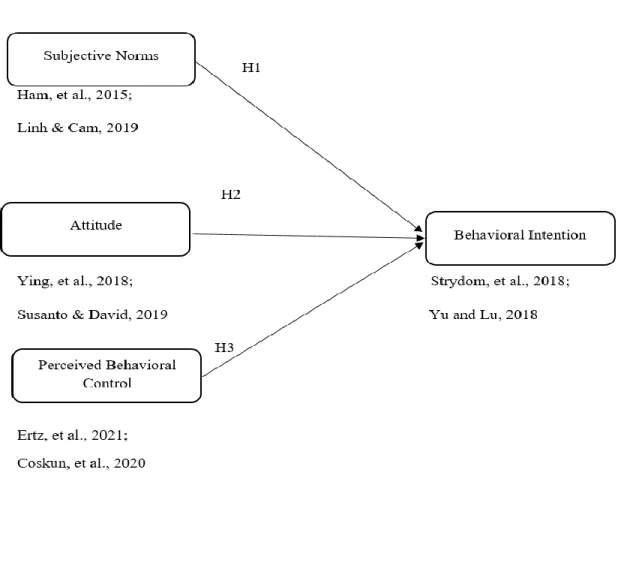
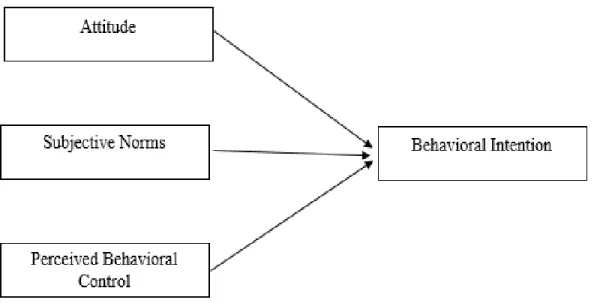
In addition, the research conducted by Chen, et al., (2018) shows that there is a relationship between attitude and behavioral intention. The study's results show that there is a relationship between perceived behavioral control and behavioral intention (Van, et al., 2021).
METHODOLOGY
- Introduction
- Rese arch Design
- Quantitative research
- Data Col lection Method
- Primary Data
- Sampling Design
- Target population
- Sampling Frame and Sampling Location
- Sam pling Element
- Samp ling Technique
- Sampling Size
- Research Instrument
- Ques tionnaire Design
- Pilot test
- Construc t Measurement
- Origin and Mea sure of the Construct
- Scale Measurement
- Data Processing
- Questi onnaire Checking
- Data Editing
- Data Coding
- Data Transcribing
- Da ta Cleaning
- Data Analysis
- Descri ptive Analysis
- Scale Measurement
- Multiple Linear Regression Analysis
- Co nclusion
Data collection is crucial to a research project, as all information collected must be reviewed and understood in order to achieve the best results. On the other hand, the sampling location is the location chosen for the inquiry as well as the location of the target population. Respondents will be directed to the part of the questionnaire that shows the introduction to the research and at the beginning follows the statement on the protection of personal data.
In this study, nominal scale classifies the personal information of the respondents into different groups based on their gender. As a result, in order to undertake an in-depth and comprehensive evaluation of the collected data, this study must use SPSS to identify errors in each response, and the researcher must return to the edited and coded questionnaire to discover errors such as missing values. . According to Sekaran & Bougie (2013), descriptive analysis is a graphic and digital technique to describe or interpret data (Sekaran, 2019). The act of mourning.
In addition, the results of the ANOVA test and the coefficient value will be calculated. For further analysis and interpretation, all the collected data will be loaded into SPSS software version 23. The statistical results of the collected data will be discussed in more detail in the following chapter.
DAT A ANALYSIS
Intr oduction
Descript ive Analysis
- Respondents Demographic Profile and General Information
- Gender
- Age
- Highest Education Level
- Employment Status
- Family Size
- Dine in Frequency
- Purpose of Dining Out
- Central Tendenci es Measurement of Construct
- Subjective Norms
- Perceived Behavioral Control
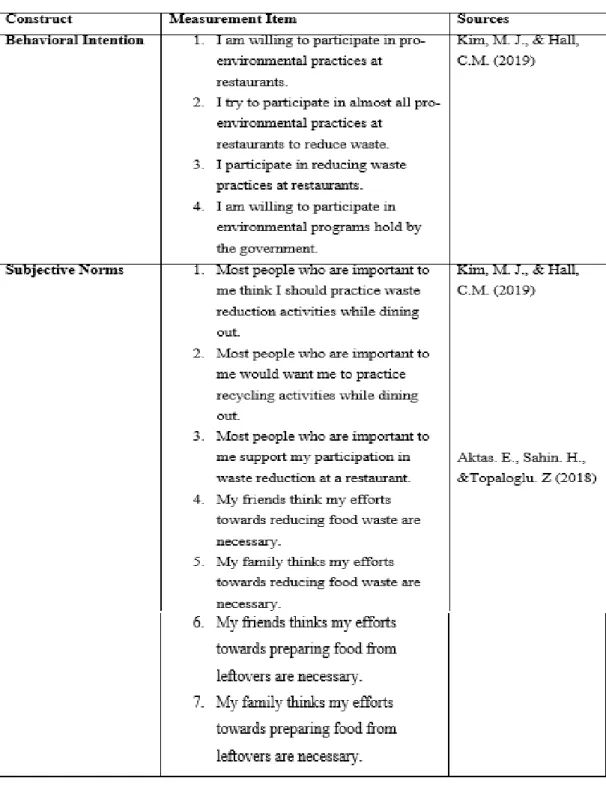
58.1% of respondents fully agree that they are ready to participate in environmental practices in restaurants. In addition, 56.5% of respondents strongly agree with "I participate in reducing waste practices in restaurants" and again no respondents strongly agree with this. 61.9% of the respondents completely agree with the statement "Most of the people who are important to me think that I should practice waste reduction activities when eating out".
Next, 56.5% of the respondents strongly agree with the question that "Most of the people who are important to me support my participation in reducing the amount of waste in the restaurant" and no respondents strongly agree with this. In addition, 51.9% of respondents strongly agree with the third highest statement about the average score, while 0.4% of respondents strongly disagree. 45.0% of respondents strongly agree that "my friends think my efforts to reduce food waste are necessary" and no respondents strongly disagree.
56.5% of respondents strongly agree with the second question, while 0.4% of respondents do not agree with it at all. 61.2% of respondents strongly agree with the question with the third highest mean score, but 0.4% of respondents strongly disagree. The third highest average rating question, "I have enough opportunities to reduce waste while dining in a restaurant", is strongly agreed by 55.0% of respondents and no respondents strongly disagree.

Scal e Measurement
- Reliabi lity Analysis Test
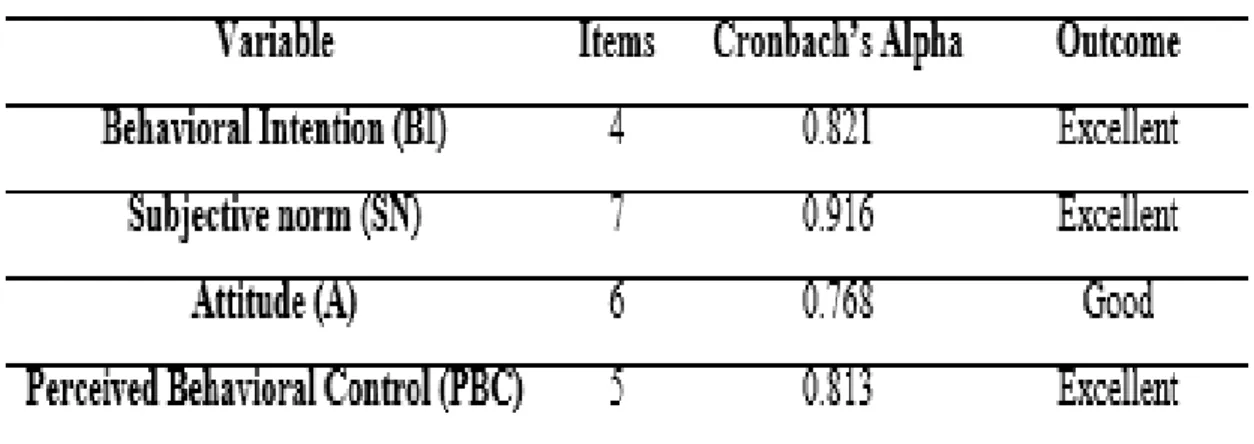
However, Cronbach's Alpha for perceived behavioral control is 0.588 which is close to 0.600, according to Hinton, Brownlow, McMurray & Cozens (2004), they say that an alpha score of 0.5 to 0.75 is usually considered to suggest a fairly reliable scale . while the figure suggests a low reliability scale.
Inferenti al Analysis
- Multiple Regression Analysis
- Hypot hesis Testing
This indicates that the three variables (subjective norms, attitude, and perceived behavioral control) in this study were found to be effective in explaining differences in behavioral intentions to reduce litter in restaurants. The value of unstandardized beta coefficients in this equation showed the gradient of the line between IV and DV. The standardized beta coefficient will be used to determine which factors have the greatest or least impact on BI.
This means that the consumers do not feel that reducing waste while eating out as a beneficial behavior because of their attitude.
Conclusion
DISCUSSION, CONCLUSION AND IMPLICATION
Intr oduction
Summary of Stat istical Analysis
- Desc riptive Analysis
- Respondents Demographic Profile and General
- Central Tendenc ies Measurement of Construct
- S cale Measurement
- Reliability Analysis Test
- Inferentia l Analysis
- Multiple Regression Analysis
Based on the demographic profile of the respondents in Chapter 4, there are 114 male respondents and another 146 are female respondents in the research study. In addition, the majority of respondents, who are 192, have their highest level of education in the bachelor's degree, 46 respondents in the Diploma, 11 respondents in the upper secondary school, 10 respondents in the foundation and only 1 respondent in the Master's. Apart from that, there are 138 respondents in employed status, 74 respondents in student status, 47 respondents in self-employed status and 1 respondent in vacant status.
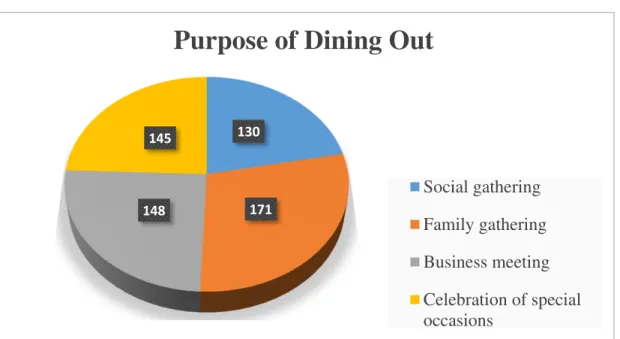
Generally speaking, regarding the number of family members, the majority of the respondents have 4 people or more of family members, 72 of the respondents have 3 people of family members, 29 of the respondents have 1 person of family members and only 19 of the respondents have 2 people of family members. Finally, in terms of dining out, the majority of respondents said they dined out for family gatherings, 148 respondents dined out for business meetings, 145 respondents dined out to celebrate special occasions, and 130 respondents dined out for social gatherings. Under BI, the highest mean score belongs to "I am willing to participate in pro-environmental practices in restaurants." For SN, the first ranker goes to "Most people who are important to me think I should practice waste reduction activities while eating out." Next is the first ranked for A "I feel bad when uneaten food is thrown away." Finally,.
I am convinced that if I want to, I can reduce waste while eating in a restaurant” has the highest mean score under PBC, which is 4.57. Overall, all variables are placed within the range of Poor, Fair and Good. For multiple regression analysis, all the independent variables have a positive relationship with BI, as the P value is lower than 0.05.
Discussion o n Major Findings
- Subjecti ve Norms
- Perceived Behavioral Control
According to the final result, there is a relationship between SN and BI at a significant level of 0.000 (lower than 0.05). Hoai Linh, Thai Cam, and Hai Chi (2019) supported this finding by claiming that SN is related to customers' behavioral intentions to minimize plastic waste. Then, it results from Wajon and Richter (2019) (Richter, 2019) also consistent with the result as they claimed that subjective norms will affect the intention of consumers' behavior as people will be influenced to have greater influence on the behavior of theirs. H2: There is a relationship between consumers' attitude and behavioral intention to reduce waste in a restaurant.
The result shows that there is a relationship between A and BI at a significant level of 0.022 (lower than 0.05). Additionally, the result is consistent with Russell, Young, Unsworth, and Robinson (2017) where consumer behavioral intention increases when individuals have a positive attitude toward a behavior and are more likely to engage in it. The result shows that there is a relationship between PBC and BI at a significant level of 0.005 (less than 0.05).
A study by Hoai Linh, Thai Cam and Hai Chi (2019) shows that PBC has a relationship with consumers' behavioral intention to reduce plastic waste. Moreover, the result of Seng, Masdek, Sharifuddin, and Teng (2021) is consistent with this research, as the more the behavioral intention to self-manage their own action to reduce waste in restaurants, the higher the perceived behavioral control.
Implication of the Study
In addition, parents should take their children to some conversations about the importance of the SDG in reducing waste. This gives them a better understanding of the environmental impact of reducing food waste. Subsequently, the result also shows that the attitude will influence the consumer's behavioral intention to reduce waste in restaurants. In addition, the school or parents can transfer knowledge about environmental awareness to students or their children, which will educate them as consumers and strengthen their ability to protect the environment on their own.
Therefore, individuals with a positive attitude and knowledge are more likely and willing to reduce waste when dining out in a restaurant. Finally, the result of the study indicates that perceived behavioral control has a relationship with behavioral intention. Perceived behavioral control is essential for individuals to change their behavior to reduce waste when eating out.
The fewer barriers to reducing food waste, the more behavioral control people think they have. In other words, making people believe in their ability to waste less food has a big impact on their motivation to reduce food waste. Individuals should be motivated because they have the skills, opportunities and capabilities to engage in waste reduction efforts in a good way.
Limitation of the Study
Recommendations for Future Research
For the follow-up study, we can examine the elements of internal influence, such as the feelings and thoughts of early adult consumers, and add new dimensions based on this research, such as second-order dimensions and variables mediator, to increase the explanatory power of the model. and perfection.
Conclusion
The findings of this study could lead to different approaches to reduce food waste. The determinants of consumer involvement in reducing food waste in restaurants in Poland: an exploratory study. A theoretical framework for explaining the determinants of food waste reduction in residential households: a case study from Mashhad, Iran.
Construction Waste Reduction Behaviors of Contractor Employees: A Comprehensive Theory of the Modeling Approach to Planned Behavior. Waste-reduction behaviors at home, work, and vacation: Influencing behavioral consistency across contexts. Review: Interventions to reduce food waste in the consumption phase – What works and how better interventions can be designed.
Tackling the issue of food waste in restaurants: Options for measurement, reduction and behavior change. Retrieved from The Star: https://www.thestar.com.my/news/nation daily-food-waste- staggering. The following lists are the measurement elements about your behavioral intention to reduce waste in restaurant.