EDITOR-IN-CHIEF Kae Kawanishi
EDITORIAL ASSISTANT Wong Pui May
HONORARY
CONSULTING EDITOR Muna Noor
HONORARY COPY EDITOR Barbara de Waard
LAYOUT & DESIGN Stephanie Goh
COVER IMAGE DESIGN Rionna Muniandy
MALAYSIAN CONSERVATION ALLIANCE FOR TIGERS (MYCAT)
Unit 3, Ground Floor, Jalan SS 23/11, Taman SEA, 47400 Petaling Jaya, Selangor, Malaysia
T: +6.03.7880.3940 F: +6.03.7882.0171
E: [email protected] W: www.malayantiger.net www.citizenactionfortigers.my FB: www.facebook.com/
themalayantiger www.facebook.com/
wildlifecrimehotline
MYCAT TRACKS 10
THANNIVERSARY ISSUE
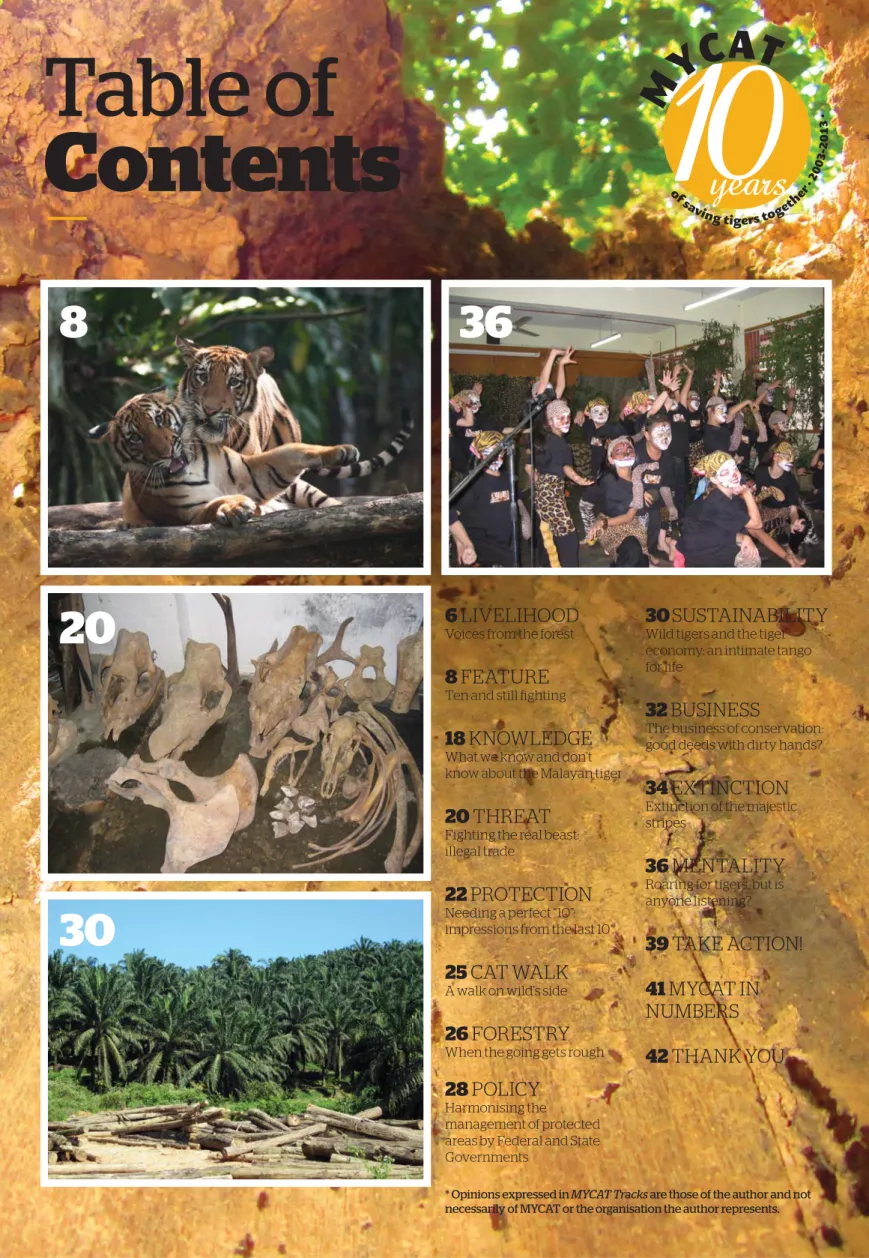
Table of
Contents
6 LIVELIHOOD
Voices from the forest
8 FEATURE
Ten and still fi ghting
18 KNOWLEDGE
What we know and don’t know about the Malayan tiger
20 THREAT
Fighting the real beast:
illegal trade
22 PROTECTION
Needing a perfect “10”:
impressions from the last 10
25 CAT WALK
A walk on wild’s side
26 FORESTRY
When the going gets rough
28 POLICY
Harmonising the
management of protected areas by Federal and State
30 SUSTAINABILITY
Wild tigers and the tiger economy: an intimate tango for life
32 BUSINESS
The business of conservation:
good deeds with dirty hands?
34 EXTINCTION
Extinction of the majestic stripes
36 MENTALITY
Roaring for tigers, but is anyone listening?
39 TAKE ACTION!
41 MYCAT IN NUMBERS 42 THANK YOU
30 20
8 36
2 MYCAT TRACKS VOL. 5 2014
T
he world is full of things to fi ght for and Malaysia’s wildlife is the pick of our lives. By the time I was 10 years old, I knew my contribution to the world would be to study and protect wildlife. It was no coincidence that I came to Malaysia to study tigers in 1997 and met a group of people who shared the same purpose. The spirit of working together to save the tiger brought us together; consequently the MalaysianAfter one million years of reigning over Asia’s forests, tigers everywhere are in trouble. The unimaginable – a world without wild tigers – is quickly becoming reality. Forest by forest, country by country, tigers are killed and sold to satiate greed, ignorance and the traditional belief that consuming tigers will make people as strong as the animals. By the turn of this century, the world had lost 97% of its wild tigers. As Malaysia’s tiger population too had declined from 3,000 to 500 individuals, the nation needed a strategy to save it from imminent extinction.
During the past decade, this tiger conservation strategy was conceived, endorsed and implemented, albeit
unsatisfactorily. Over the same decade, most countries in Indochina lost their tigers to poachers despite all eff orts. In Malaysia, though diminished, the currently estimated 300 wild tigers survived one of the toughest times in modern human history for all wildlife. Their continued existence was a
FOREWORD
Conservation Alliance for Tigers (MYCAT) was born in 2003.
For those with big dreams, the gap between goal and reality can be a torment.
When I feel that I can’t go on, I think about the solidarity of my colleagues and friends, fi ghting alongside. They are the stars that have guided MYCAT. Without these lights, the challenges would have been too daunting and bleak to face.
by Kae Kawanishi General Manager, MYCAT
I don’t know a life without purpose.
Isn’t purpose what makes us human?
2MYCAT TRACKS VOL 5 2014 * Photo credits to friends and supporters of MYCAT.
result of a series of conscious conservation eff orts by many quarters. I declare a small win.
Fieldwork I conducted between 2009 and 2011 to monitor a tiger population in central Malaysia broke my spirit – the tigers were gone. Visions of dead wildlife and carved-up forests deepened my sense of helplessness and have kept me awake many nights. A massacre of forests and wildlife was wrought in a place I had always considered home. I was smothered with anguish at the countless moments of their deaths. It is a grief that I wish I could forget. A few years later, becoming aware of the reason why I had to experience the painful reality of what was happening to wildlife and forests everywhere helped me out of my depression.
With the privilege of knowledge, I had inherited a duty to act.
Dr. George Schaller, whose seminal research on tigers in the 1960s inspired me to become a carnivore ecologist during my undergraduate years, says that conservation has no victories and is a never-ending process.
In the face of such odds, I could not have picked better teammates to fi ght this battle. The fi ght for the Malayan tiger isn’t over yet. Like peace, conservation successes can be achieved at specifi c points in space and time and so we must soldier on. And we will do better with more funds and people on our side.
This special issue of MYCAT TRACKS
commemorates the 10-year journey that MYCAT members have jointly taken towards saving the Malayan tiger. I have asked my colleagues to each write an opinion piece on their respective areas of expertise: looking back – what happened in the recent past;
looking forward – what is likely to happen in the next decade; and fi nally, what needs to happen so that the Malayan tiger will recover and survive into the future. Controversial, disturbing, impolite it may be – I have asked the writers to be honest.
One day, hopefully in the distant future, the tiger will go extinct, most likely before the human will. The day could be sooner if the current trajectory continues without major changes. Their fate is in the hands of mankind. When the Malayan tiger goes extinct and MYCAT’s fellowship becomes a footnote of history, these are the tracks that I want to leave behind for future generations.
When someone asks what people did when wild Malayan tigers were eliminated, this publication will provide some answers.
Yet, some of the hardest battles are fought by people not featured in this publication.
I wish to acknowledge the work done by wildlife rangers. I had the privilege of spending some years in Taman Negara alongside some of the best rangers from the now defunct Tiger Unit in Pahang. Among other great things they taught me about Malaysia, they taught me the way of tigers and the jungle. They worked to save not only wildlife but also my life without expecting appreciation. Subsequently during my tenure in the Wildlife Department, I came to know members of Tiger Units from other states.
Without these tiger rangers, I would not have become the tiger expert that I am today. Without them, Malaysia would have already lost its tigers. Though little recognition, resources and reward were given to these heroes, their purpose remained pure and their ways humble.
Across gender, racial, religious, cultural and national diff erences, the tiger brought us together. We shared a common value. More than being great wildlife rangers, they are great human beings. That is what tigers need. Their spirit lives in me. So the fi ght must go on.
4 MYCAT TRACKS VOL. 5 2014
Former award-winning environmental journalist, ELIZABETH JOHN directs all media and communication work for TRAFFIC in Southeast Asia, reaching out to the region’s millions about wildlife trade and the crises caused by poaching and traffi cking.
She shapes the messaging on the organisation’s work and eff orts to change attitudes towards wildlife use, and designs outreach projects from awareness raising in schools to wildlife crime reporting for journalists. Elizabeth has long been a noisy and persistent advocate for better policy and protection for tigers, and kick-ass prosecution of poachers, and believes lasting solutions to the problems facing the Malayan tiger can be found.
LAVANIADEVI
GOPALAKRISHNAN joined MYCAT as a volunteer for Citizen Action for Tigers (CAT) Walk in 2012, interned with the Secretariat’s Offi ce in 2013 and is now a
Programme Offi cer. She coordinates MYCAT’s citizen conservation programmes, including CAT Walk and outreach. She is now undergoing training to become a CAT Walk leader herself. She loves coordinating CAT Walks and empowering members of the public who are willing to help save wildlife.
She is inspired daily by the folks she works with and by their infectious passion for saving wildlife.
Con tribu tors
ASHLEIGH SEOW is interested in indigenous peoples, their customs, and cosmology. As a Malaysian Nature Society nature guide, he volunteered for Citizen Action for Tigers (CAT) Walk in 2010, and joined MYCAT in 2012 as a Citizen Conservation Specialist to include the indigenous Batek in tiger conservation and to help them preserve their traditional skills and knowledge at Sungai Yu Tiger Corridor. He also conducts the Forest Safety and Confi dence course for CAT Walk leaders. Prior to joining MYCAT, Ashleigh delivered organisational development workshops for the banking and energy sectors and negotiation skills training for companies affl icted by poor communication and troubled working relationships with their stakeholders. He also taught political economy at Murdoch University.
Armed with her determination to make the world a better place for wildlife and with over a decade of experience working on forest and conservation issues, KANITHA KRISHNASAMY believes that Malaysia’s natural resource mismanagement stems from short-sightedness and apathy by the country’s decision-makers.
She manages TRAFFIC Southeast Asia’s programme on species critically threatened by trade, including TRAFFIC’s initiative in the Belum-Temengor Forest Complex – a premier tiger site that is facing tremendous pressure from poaching and trade, unsustainable timber extraction and forest conversion. She is a member of the Forest Stewardship Council (FSC) and Board member for FSC in Malaysia.
GOPALASAMY REUBEN CLEMENTS’ career in tiger conservation began in 2007 when he was appointed Species Conservation Manager of WWF-Malaysia’s Malayan tiger conservation project. In 2010, he co-founded the research group Rimba and became the Principal Investigator of the Kenyir Wildlife Corridor Project, which aimed to develop measures to mitigate the impacts of roads on tigers and other mammals in Kenyir, Terengganu. After receiving his PhD from James Cook University in 2014, he became the Principal Investigator of Project Harimau Selamanya, a 10-year project that focuses on the protection and monitoring of tigers in a core area in Kenyir Wildlife Corridor and Taman Negara.
With support from the Malaysian government, KAE KAWANISHI conducted the fi rst scientifi c research on tiger ecology in Malaysia between 1998 and 2001 in Taman Negara. After receiving her PhD from University of Florida, she worked for the Malaysian Department of Wildlife for three years as a Technical Advisor in research and conservation. During that time, the government founded MYCAT and developed the National Tiger Conservation Action Plan.
During her second fi eld research, she initiated a citizen conservation programme to protect wildlife at Sungai Yu Tiger Corridor in 2010.
Mentored by world-renowned tiger conservation biologists throughout her career, she believes that partnership and inclusion are the key to successful wildlife conservation.
MARK RAYAN DARMARAJ has been working for WWF- Malaysia for the past ten years and is currently the Lead Research Scientist for WWF-Malaysia’s Species Conservation Programme.
He completed his PhD in 2012 at University of Kent, United Kingdom on tiger ecology in the Belum- Temengor Forest Complex. He then became the fi rst Malaysian PhD holder on tiger ecology. He was awarded the Zoological Society of London Thomas Henry Huxley Award for the best PhD thesis of the year in the UK and the Fiona Alexander Prize, another award for the best thesis within the department he studied.
MELVIN GUMAL has a PhD on bat ecology from University of Cambridge and has been involved in conservation in Malaysia since 1988. His initial engagement included working with indigenous communities to create protected areas for orang-utans, for which he recently won the Whitley Award, a prestigious international nature conservation prize. After 15 years working in the civil service with Sarawak Forestry Department, he became the Director of Wildlife Conservation Society-Malaysia Programme (WCS) in 2003.
Together with government agencies, WCS’ work in the Endau-Rompin landscape includes heavy on-the- ground enforcement. The multi- agency enforcement eff ort has been ongoing since 2009 to protect tigers and other wildlife.
NAGULENDRAN
KANGAYATKARASU joined the Government of Malaysia as a Diplomatic and Administrative offi cer in 1995. He has been involved in policy formulation, governance and stakeholder engagement on issues related to the environment, especially focusing on biodiversity.
On these issues, he has represented the Government of Malaysia in numerous international conventions. He assisted with getting the National Tiger Conservation Action Plan adopted by the National Biodiversity and Biotechnology Council in 2009, as well as with the passing of the Wildlife Conservation Act 2010.
He is currently pursuing a PhD at University of Nottingham in the area of Biodiversity Governance, and is a recipient of the Special Excellence Award 2014 from the University.
Like a cat, MUNA NOOR has had many lives, including as Editorial Director for one of Malaysia’s largest English language publishers and Director of Corporate Communications for an investment fi rm. She’s a lover of animals but in particular cats big and small.
She recently left her job to devote more time to personal pursuits including spreading the message of tiger conservation. She is a certifi ed Citizen Action for Tigers (CAT) Walk leader and was awarded MYCAT Volunteer of the Year in 2012. She is currently helping MYCAT as a Communication Strategy Specialist to improve its communications with donors and the public.
WONG PUI MAY joined MYCAT as a Programme Offi cer in 2010, and is now the Coordinator. She communicates with the public, facilitates communication among MYCAT partner NGOs, and coordinates MYCAT joint initiatives, such as a memorandum to the government, press statements and events like the Wild Tiger Run.
She also bridges the communication gap between the government and NGOs. She has attended many meetings among both government and non-government stakeholders where tiger conservation challenges were discussed, and fi nds that similar solutions have been proposed repeatedly. She hopes that Malaysia’s leaders will start listening to our tiger experts before it’s really too late.
SUZALINUR MANJA BIDIN has been with MYCAT since 2007. Tapping into his experience working as a Zoo Educator prior to joining MYCAT, he has co-developed, coordinated and executed MYCAT’s outreach and education programmes at poaching and trading hotspots targeting both urban and rural communities.
As Senior Programme Offi cer, he had previously coordinated a joint capacity-building programme for Taman Negara enforcement staff and currently manages MYCAT’s Wildlife Crime Hotline and Citizen Action for Tigers (CAT) programme.
His talents include graphic design and he is the in-house designer for many MYCAT posters and newsletters.
As a Programme Offi cer with TRAFFIC Southeast Asia, OR OI CHING coordinates all programmes in the Belum-Temengor Forest Complex. She engages with the local communities through education and awareness outreach programmes, as well as reaches out to enforcement agencies through training workshops. After fi ve years of work in wildlife conservation, she has come to understand the sentiments of the general public towards wildlife, especially those of the local communities in Belum- Temengor.
SIVANANTHAN ELAGUPILLAY has been working with the Department of Wildlife and National Parks Peninsular Malaysia for more than 30 years. His PhD was on protected area policy from University of Idaho in 2005. During his lengthy professional life, Siva has held a number of posts, ranging from Head of Wildlife Management to Head of Law Enforcement, but for the most part, has stayed on top of conservation issues related to the tiger and protected areas.
Nationally and internationally, he is known as Malaysia’s tiger expert and has inspired many tiger conservationists across various institutions. For his unmatched contribution to tiger conservation, he was presented with Malaysia’s fi rst-ever Tiger Wallah Award by MYCAT in 2014.
6 MYCAT TRACKS VOL. 5 2014
and ruined the livelihood of the Orang Asli and the animals.
What is important also is our adat (tradition). If we lose our forest, we lose our culture, customs and medicinal plants.
Before the logging and mining and town people came, there were many sorts of medicines and ubi; now many are lost or rare. If oil palm grows where the forest was, our youths will not know the trees and plants, their leaves, branches and fruits.
Our parents’ graves will be destroyed.
A Batek is buried close to where he last lived; our grandparents and ancestors are everywhere in the forest and we know where they lie. But if the forest is logged, we will lose them and we will not be able to remember their graves.
If the logging, oil palm and mining continue, this village will have to move elsewhere, maybe back to the forest in Taman Negara. This is the tempat asal Batek (the place where the Batek people emerged into this world). No other people can make this claim and we will return even if we are later removed. They can block us a thousand times but we will return twice
Voices from the forest
By Arop, Bao, and Cicak *interviewed by Ashleigh Seow
LIVELIHOOD
LOOKING BACK
In the past, things were very good: the forest was big, there were many animals and much ubi (tubules, indigenous people’s staple diet) to gather. In 2000 the Federal Land Development Authority (FELDA) came. The forest was cut and ruined by logging, and oil palm, which was planted in 2004. More people started mining. Things got worse.
During this time, they did not log near our settlement. We need the forest to be close to collect fruit and blowpipe game. We like it here because the forest is still nearby. Next time the logging will be closer to us. We don’t know if they will continue logging and then plant oil palm in place of the forest. We hope not.
After the oil palm and loggers, wildlife became less. Before that there were tigers.
After the rains, we could see their tracks close to the village and in the forest. Once we saw signs of three tigers on a path. Then we started to see many snares in the forest and signs of animals being trapped. The tigers became less common and we saw fewer signs of them. Now we see hardly any tiger sign in the forest and are not disturbed by
the thought of tigers because there are very few, if any. Before, when hunting or foraging, three or more people went together, now one person can walk alone. In one way, we are free of fear and do not need to defend ourselves, but we also miss them and the elephants and gaur too for they have almost gone as well. The monkeys and pigs are many and these now come near to villages for food.
LOOKING AHEAD
In the past, the government did not sell the forest around our settlement, now there is only a small amount of big forest around the Batu ( limestone outcrop), the rest is like belukar (disturbed secondary brush vegetation). We hope the government will stop this logging because it is not good for the forest. We weep for the forest, for the Forest Reserves and Taman Negara, all the way to Kelantan. And for the animals. If there is not enough food, they will come to the villages to raid orchards or, in the case of tigers, to look for dogs or people, which will be bad for all.
They do not want to disturb us and are not to be blamed, for it is poachers and our own government who have damaged the forest
fold. Many of us were born there. Our adat comes from there. Batek berasal sana (we come from there).
WHAT IS NEEDED
The government doesn’t look after the place well. We used to see many intruders in the forest but never saw the authorities patrolling. From Sungai Relau to Kuala Yu [western border of Taman Negara], a year could go by and we would never see patrol units or their tracks in the forest or their boats on the river. We are happy to see visitors coming into the forest and our settlement and want MYCAT to do more. In many places the local villagers do not lay snares anymore because they will be disturbed by MYCAT and also when MYCAT fi nds snares, the authorities will come into the forest later to collect them. We think more patrolling is needed in Ulu Sungai Yu where the poachers have moved to. But the best thing for Batek and all the animals would be if other people stop trying to improve or take things from this place and leave it alone.
“What is important also is our adat (tradition).
If we lose our forest we lose our culture, customs and medicinal plants.”
LIVELIHOOD
© Nazrul Tahir
8 MYCAT TRACKS VOL. 5 2014
Ten and still fi ghting
MYCAT marks a decade of tiger conservation partnership in Malaysia.
What better time to celebrate the triumphs, contemplate the failures and steel ourselves for the incredible challenges that will lie ahead in the eff ort to save the Malayan tiger.
By Muna Noor
FEATURE
© Jake Leong/MYCAT
Tiger Chronology Top 50
2003 2004 2005
“But when the blast of war blows in our ears, Then imitate the action of the tiger;
Stiff en the sinews, summon up the blood, Then lend the eye a terrible aspect;
Now set the teeth and stretch the nostril wide, Hold hard the breath, and bend up every spirit To his full height!”
William Shakespeare
2006
MYCAT established
Research fi nds Malaysia has enough habitat to support 1,500 tigers
Project addressing human-tiger confl ict begins in Jeli, Kelantan
RELA (People’s Volunteer Corp) member charged for killing tiger in Negeri Sembilan
Wildlife Crime Unit set up to intensify anti- wildlife crime eff orts
Rubber tapper killed by tiger in Kelantan
Workshop conducted to develop strategy to save Malayan tigers
80,000 postcards handed to Perak Chief Minister to protect Belum- Temengor
T
he Panthera tigris, or tiger, is the world’s largest cat. It is the object of fear and awe, revered and reviled in one breath and yet for all the tales of its strength and ferocity, there are fewer than 3,200 left in the wild, all of them in Asia.The Malayan tiger or Panthera tigris jacksoni, named after renowned tiger conservationist Peter Jackson, is our tiger.
The last of nine sub-species to be recognised after it was offi cially identifi ed in 2004, it is found only in the Malay Peninsula, not even in Sabah and Sarawak or in neighbouring Sumatra despite our geographical proximity.
This is what makes this beast truly special to Malaysians.
Like many of the world’s tigers, the Malayan tiger once claimed its rightful place as king of the jungle. In the 1950s, there were an estimated 3,000 roaming the dense steamy forests of pre-independence Malaya. Today, only about 300 remain. That’s probably fewer than the children enrolled in your neighbourhood primary school. The odds
are unsettling. Human population growth, development and poaching have pushed Malayan tigers and other wildlife that share its forests to the brink of survival.
Enter MYCAT
If this sounds like an unfair fi ght then MYCAT was created to even up the odds.
“During my PhD research in Taman Negara, I was supported by many people from the Wildlife Department and NGOs who all shared the same goal of saving wildlife in Malaysia, and experienced the same challenges such as lack of resources, and capacity for eff ective protection and scientifi c research. It made sense to put them all together for a greater outcome. Being young and naïve, I did the most logical thing, which was to enter the Malaysian civil service and persuade the government to set up MYCAT,” says Dr. Kae Kawanishi, now the General Manager of MYCAT Secretariat’s Offi ce.
Formed in 2003, MYCAT was created as a platform to bring the government and NGOs
closer together for information exchange and collaboration for tiger conservation. As an alliance, MYCAT was a fi rst, not just here in Malaysia, but in tiger conservation globally.
It includes leading nature and wildlife conservation organisations: Malaysian Nature Society (MNS), TRAFFIC Southeast Asia, Wildlife Conservation Society (WCS)- Malaysia Programme, and WWF-Malaysia.
MYCAT is supported by the Wildlife Department, and has become a symbol of what can be achieved when you put the right people in a room.
2007
From left, Dino, Chris and Melvin
2008
1,175 km2 Royal Belum State Park gazetted
Race Against Time campaign launched to rally support for tigers and better wildlife law
Terengganu State Executive Council agrees to gazette the 150 km2 Sungai Deka corridor as a wildlife reserve
Hunting moratorium on all wildlife passed in Johor
International Trade in Endangered Species Act 2008 passed
Tiger Action Plan published Wildlife
Crime Hotline 019.356.4194 launched
10 MYCAT TRACKS VOL. 5 2014 The nature of a country’s development is demonstrated by the policies it implements. Securing continued existence of the tiger and its habitats, while managing the forests in a sustainable manner, is an indication of Malaysia’s ongoing eff ort to achieve a sustainable society. We believe that the presence of healthy tiger populations in large contiguous forests will signify the balanced progression of the country’s ecology, society, culture and economy and, ultimately, an enhancement of the quality of life of Malaysians, which is the essence of Malaysia’s Vision 2020.
At the beginning of the millennium, there were only about 500 wild tigers left in Malaysia. Over three days in 2006, experts from relevant fi elds, including policy, land-use planning, law enforcement, INTERPOL, customs, forestry, timber certifi cation, park management, tiger biology, wildlife trade, wildlife conservation, Chinese medicine, road building, and environmental education gathered and discussed a national strategy for recovering the Malayan tiger population. We had the best people in the room, fi lled with great energy and hope for the future of the tiger in Malaysia. Based on the discussions, I led and coordinated the drafting of the plan in the subsequent nine months. The draft plan underwent 17 additional meetings and 11 revisions among the MYCAT partners before submission to the Wildlife Department’s Tiger Action Plan Advisory Board. It took an additional 18 months for our common vision to become a national policy document at the end of 2008.
Towards the goal of doubling the country’s tiger population from 500 to 1,000 by the year 2020, the National Tiger Conservation Action Plan lays out 80 detailed actions to be implemented by over 40 stakeholders, ranging from a researcher to the Economic Planning Unit in the Prime Minister’s Department.
Strong leadership, coordination, communication and monitoring are keys to the success of the plan.
Malaysia’s blueprint for saving the tiger
By Kae Kawanishi
“Our visionary plan did not fail. It is still the best one for the Malayan tiger. Despite a number of milestones, however, overall we failed to make the plan a reality.”
These 1,000 tigers were to be conserved in what’s called Central Forest Spine, a network of forest
complexes connected by green linkages.
Together, they would form 51,000 km2 of contiguous forest along the length of Peninsular Malaysia, much like a long green spine.
In the Central Forest Spine, the National Tiger Conservation Action Plan identifi es three priority areas and four priority corridors. The priority areas are Belum-Temengor Complex in the north, Taman Negara National Park in the centre and Endau-Rompin Complex in the south.
While the northernmost corridor along the Gerik-Jeli highway is meant to ensure the contiguity of Belum- Temengor, the southernmost corridor is for Endau-Rompin. Two corridors connect Taman Negara to its adjacent forests – along Sungai Yu (Yu River) to the west of the park and along Kenyir Lake to the north.
MYCAT Secretariat’s Offi ce assists the Ministry of Natural Resources and Environment in monitoring the progress of the implementation annually. Although gradual improvements are made in the number of actions completed, especially in 2013, the overall level of implementation has been unsatisfactory.
This culminated in the continued loss of tigers and natural forests. The loss of biodiversity and natural forests serves as an alarming proof of Malaysia’s unsustainable economic development.
Some Malaysians became richer but the nation became poorer in her natural capital, at the expense of future generations.
Our visionary plan did not fail. It is still the best one for the Malayan tiger. However, despite a number of milestones, overall we failed to make the plan a reality. It is time to evaluate where we are and re-strategise the priority actions for the next decade, towards our common vision for the tiger and Malaysia.
Landscapes and priority areas laid out in the Tiger Action Plan (Source: DWNP 2008).
Marking milestones:
looking back on 10 years
With MYCAT facilitating in 2006, the Wildlife Department organised and hosted the Malayan Tiger Conservation Workshop with the aim of developing a National Tiger Conservation Action Plan for Malaysia. The plan became the nation’s roadmap, detailing the direction and specifi c actions required for its target of doubling the estimated population of Malaysia’s wild tigers to 1,000 by the year 2020. The work formed the basis for a triumphant appearance at the 2010 Tiger Summit in St. Petersburg, Russia.
Dato’ Dr. Dionysius Sharma (aka Dino), CEO and Executive Director of WWF- Malaysia and fellow founding MYCAT member recalls: “While other tiger range countries were talking about doubling the tiger numbers at the Tiger Summit, Malaysia could say that it believed in doubling tiger numbers and it had already published that as a national strategy.” In eff ect, Malaysia was ahead of the game and the world knew it.
“A quick survey of literature related to tiger conservation reveals a startling reality: Malaysia and the Malayan tiger barely get a look in. We need to make more noise for the Malayan tiger, we need for its roar to be heard.”
In addition, MYCAT played a huge part in the successful lobby for the development of Malaysia’s new Wildlife Conservation Act and the International Trade in Endangered Species Act. Some 56,000 people worldwide signed the petition for a better wildlife law.
Successfully passed in 2010, the protection status of wildlife under the new law was given proper accord and stiff er penalties were imposed. “It sent a strong message about how wildlife crime was going to be viewed by the Malaysian Government. So when the law was passed, it was a very proud moment for many Malaysians, including us – the MYCAT partners who had been pushing for it for a long time,” says Dino.
Dr. Melvin Gumal, WCS-Malaysia
Programme Director affi rms: “MYCAT has allowed for more openness among the NGOs;
it has allowed for much more engagement with the public on tigers and their habitats, and it has pushed the Government to be more responsive to queries from NGOs and the public.” Such advances have been critical to the continued existence of the Malayan tiger.
Challenges ahead
In the battle for survival, the Malayan tiger is being attacked on multiple fronts. Initial decline has primarily been attributed to large-scale loss and fragmentation of the tiger’s historical habitat as lowland forests were converted into human settlements and agricultural land. In more recent times, the tiger’s most relentless of enemies has come from the threat of poaching. No one knows this better than Regional Director of TRAFFIC Southeast Asia and a founding member of MYCAT, Dr. Chris R. Shepherd.
“Southeast Asia is a hotspot for illegal wildlife trade in the world. High levels of biodiversity are just getting vacuumed up”, he says with great alarm.
Illegally hunted for their skins, bones, blood and even sexual organs for use in medicine, trophies and talismans and sold at exotic meat restaurants, rapid economic growth in Asia and increasing wealth of its citizens has not only spurred demand for tiger parts, but converted it from one for purported health to the obscene display of wealth. Tigers are being killed to show off and their cubs smuggled out alive as pets for the rich.
Nor is the poaching restricted to just tigers. In a clear demonstration of how the food chain works, the poaching of tiger prey such as sambar, Asia’s largest deer species, and gaur (forest buff alo) is also contributing to the tiger’s decline. An assessment of Butchered tiger found in a man’s refrigerator in Kelantan © DWNP
2009
Multi-agency
enforcement activities, using a new, transparent and effi cient system, starts in Endau-Rompin, Johor
1st Bilateral Meeting between Malaysia and Thailand on Cooperation in Wildlife Law Enforcement held
Tiger caught in a snare near the Gerik- Jeli highway rescued, but later dies
6-year moratorium on hunting sambar and barking deer passed Tiger parts
seized in Thailand found to be from fi ve Malayan tigers
12 MYCAT TRACKS VOL. 5 2014 tiger prey showed the critical status of the sambar, and prompted MYCAT to lobby for an immediate change of the sambar’s legal status, from hunted species to totally protected species. In response, the Malaysian government instituted a six-year hunting moratorium in 2009 as a stop-gap measure.
And yet not many Malaysians would be aware of the struggle for survival that is going on just hours from where they live and work, if it were not for MYCAT’s eff orts. Development and urbanisation have distanced city dwellers from nature. In losing sight of the fundamental role nature plays in our lives, we run the risk of forgetting just how much we depend on it for crucial ecosystem services. If there is fl ooding, erosion, landslides, drought, and heat waves, the answer is to look to the forests. As the famous Malay saying goes, tak kenal maka tak cinta (if you don’t know it, how are you to come to love it).
To that end, MYCAT, in tandem with its partners, has organised countless activities to spread the love for our Malayan tiger
and other wildlife, from holding outreach programmes in schools and night markets next to tiger habitats to organising the Wild Tiger Run, a 10km fun run in the city in support of the Malayan tiger. Face to face, shop to shop, and house to house, MYCAT and its 1,082 volunteers have reached out to 40,645 Malaysians over the years. Yet of all these activities, none has captured the imagination more than the MYCAT CAT Walk. Conducted in the Sungai Yu Tiger Corridor, a critical area connecting the tiger ranges of Taman Negara and the Main Range, volunteers hike through tiger habitats, putting them directly on the ground where illegal trapping, logging and encroachment into the park may be happening. CAT Walk has brought in 550
‘voluntourists’ from 24 countries to Sungai Yu.
“Looking back, what has changed is the fact that people came together wanting to save tigers,” says Dino. “What we have done through recent activities is to allow people to participate in tiger conservation voluntary programmes.
Overall we have done really well in raising the profi le of what is happening to our tigers.”
While MYCAT engages with members of the public, corporations and local communities in tiger conservation, partner NGOs have worked with the authorities to strengthen the protection of tigers in the forests.
And yet any celebration is tempered by the sense that in the ten years of MYCAT’s existence, so much more could have been done. If the International Tiger Summit provided Malaysia the opportunity to demonstrate that it had a head start on tiger conservation, that fi rst mover advantage was lost in subsequent years. On Malaysia Day 2014, the Wildlife Department and MYCAT jointly announced that wild tiger numbers in Malaysia have fallen to as few as 250, eff ectively rendering the species critically endangered in the country.
The global shift
At an international level, there is no greater time than now for the conservation community. Illegal wildlife trade is
recognised today as a threat to global security,
Tiger shot dead by RELA member in Perak;
government called to review RELA fi rearm possession and use
Citizen Action for Tigers (CAT) programme begins in Sungai Yu, Pahang National
Biodiversity Council adopts the Tiger Action Plan
2010
Nine Orang Asli detained for snaring, torturing and killing tiger in Perak, but later acquitted Governments of all
tiger range nations unanimously agree to double global tiger numbers by 2022 Research in
Sungai Yu corridor, Pahang fi nds no tigers or sambar deer
“At the end of the day we’re still losing and it’s no fault of
any of the people who are trying, it’s completely the fault
of the people who aren’t.”
optimism are to blame for MYCAT’s failure to deliver on some of the more fundamental requirements of the [Tiger Action] Plan. “A lot of what I see today in terms of the lack of delivery is very closely linked to the lack of resources. There was the assumption that these resources would come from the government.”
For Chris, shortcomings are happening in spite of the eff orts being made. “At the end of the day, we’re still losing and it’s no fault of any of the people who are trying; it’s completely the fault of the people who aren’t.”
“We have signed on to the Convention on International Trade in Endangered Species of Wild Fauna and Flora (CITES), we’ve signed on to the Convention on Biological Diversity, the Malaysian delegation was at the London Conference on the Illegal Wildlife Trade. We’re party to all of these things,”
emphasises Kanitha Krishnasamy, Senior Programme Offi cer at TRAFFIC Southeast Asia, “Malaysia needs to realise that this is not just a box ticking exercise.”
Meanwhile at the public level, part of the
inertia to act in favour of tigers is down to the lack of perceived fi nancial incentives and economics. “People aren’t making enough money out of having wild tigers in Malaysia,”
says Chris. “Eco-tourism for tigers here isn’t the same as India. You go to a tiger reserve in India, you have a good chance of seeing a tiger. The terrain typical of tropical rainforests does not allow this. Kae herself has never seen a tiger in Malaysia, but one of the things I have always admired about Kae, is that even though she has never seen a tiger, she recognises the importance of it.
It really doesn’t matter to her whether she’s seen one or not. She’s happy just knowing they are there. Not enough people have that attitude.”
It’s a surprising turn of events given the Malaysian propensity for entrepreneurship.
Globally there are many examples of tourism and its related business activities that bank on the power of imagination and open minds.
Kae explains, “It is our ignorance to believe only what we can see and our arrogance to call it ‘primitive’ when other creatures
© Jake Leong/MYCAT
with support being thrown behind its halt by the Obama Administration, British Prime Minister David Cameron and the British royal family.
It is worth at least US$19 billion a year, making it the fourth largest illegal global trade after narcotics, counterfeiting, and human traffi cking. “Globally this is recognised as being a serious problem and governments are putting large amounts of money towards this.
But there’s very little money being put into protecting Malaysia’s tigers,” Chris laments.
Earlier this year, Germany announced
€20 million support to tiger conservation, which was followed by a British government announcement of £4 million to tackle illegal wildlife trade worldwide. Conservation programmes for Malayan tigers are, however, not eligible for either grant because Malaysia is an upper middle income country perceived as being able to fund its own programmes.
Notwithstanding, fi nancial support of MYCAT from the Malaysian government has been scant.
According to Dino, naiveté and false
Reduced to Skin and Bones reports 55-63 dead tigers were seized in Malaysia between 2000 and 2010
Presidential Tiger Summit in St. Petersburg Russia, addressing global concerns on wild tigers, see donors pledging US$300 million
Construction of RM80 million wildlife viaducts along highway near Sungai Yu, Pahang begins
Construction of RM30 million wildlife viaducts along highway near Sungai Deka, Terengganu completed Wildlife
Conservation Act 2010 passed
14 MYCAT TRACKS VOL. 5 2014 perceive much wider environmental cues; I think it’s rather primitive to appreciate only things you can hold and possess.”
As members of the Malaysian public, we are just as complicit in the country’s lack of progress in trying to recover tiger populations. WCS-Malaysia’s Melvin expresses frustration at our collective lack of initiative and calls it “a denial of responsibility”. Chris chimes in: “Awareness levels here in Malaysia need to translate into action. If you know there is a problem, you should do something. You really can’t say it’s terrible the tigers are disappearing but you can’t do anything – because you can.”
Kae is convinced that the Malayan tiger’s survival hinges on the support of a greater mass of Malaysian public. “Malaysia is losing this battle because it’s been fought by a handful of conservation NGOs and government enforcement personnel. Saving tigers means saving Malaysia’s healthy forests. It means sustainable development and a balanced society. Not enough people care,” she says.
To wit, the public’s lack of visibility is matched only by that of the tiger’s. A quick survey of literature related to tiger conservation reveals a startling reality:
Malaysia and the Malayan tiger barely get a look in. “We need to be better in terms of placing ourselves out there at a global level,”
urges Kanitha. We need to make more noise for the Malayan tiger; we need for its roar to be heard. For all these reasons, there is a very real chance that the Malayan tiger could become extinct in our lifetime.
2012
“It would be absolutely ideal if the Prime Minister picked this up and ran with it as something that he wanted to be remembered for, that he’s the one that turned the tide.”
Tiger, tiger burning bright….
Yet in spite of all of it, hope is not yet lost.
“The next ten years will be the deciding decade, for the tiger and for Malaysia. It will have to be the turning point towards a Malaysian society that embraces the diversity of lives in the truest sense”, says Kae.
The good news is that when there is suffi cient prey, tigers are incredibly prodigious and mating occurs throughout the year. Peninsular Malaysia also still retains 38 per cent of the land area as forest
cover and unlike Sumatra, our forests are largely linked. “We still have the habitat for 1,000 tigers,” Chris shares optimistically.
In the Southern Forest Landscape of Endau-Rompin, where WCS-Malaysia has been working hand-in-hand with the authorities, with the support of the royal family and local government for on the ground protection, tigers are making a comeback. “It’s impossible to deny that recovery is happening,”
Melvin says. It is welcome news for his MYCAT partners and provides an excellent case study for a nationwide tiger turnaround.
2011
© Jake Leong/MYCAT
Country’s biggest tiger seizure (22 skulls and 8 skins) made in Kedah.
Culprit sentenced to 24 months jail and RM200,000 fi ne Research in
western Taman Negara Pahang fi nds tiger numbers have plummeted since 1999 Islam, Wildlife
Conservation &
You, a reference book on Islam and conservation released
On Borrowed Time, a 10-minute documentary highlighting poaching and illegal trade in Belum- Temengor debuts
Government announces RM60 million allocation for wildlife viaducts along the Gerik-Jeli highway in Perak
position to negotiate with decision makers.
Globally, WWF can walk into a room with President Obama or the UK Prime Minister and make such negotiations. We need to be at a level where we can do the same with Malaysia’s Prime Minister.”
Which brings us to the Tiger Task Force. Kanitha likens the Tiger Task Force to Malaysia’s National Water Services Commission for water or the Transport Commission for transport – “specifi c bodies that are meant to look at specifi c issues”. For the Tiger Task Force it will be securing the future of Malaysia’s tigers.
“We could have been more eff ective if the government institution was in the coalition as an equal partner,” says Dino. Chris too makes no bones about it: “We really need the government to set up a Tiger Task Force that’s going to lead and coordinate the next leg of the race.” Such a mandate would ensure that things get done and like any other government department, the Tiger Task Force would be audited and made accountable for its results. Issues of jurisdiction would have to fall away and collaboration would have to be fostered to meet goals.
Chris singles out the Prime Minister for the role of Chairperson for the Tiger Task Force. As the leader of a country with the world’s last remaining tigers, its own tiger sub-species, a country in which the tiger appears in our national emblem, nothing could be more meaningful. “It would be absolutely ideal if the Prime Minister picked this up and ran with it as something that he wanted to be remembered for, that he’s the one that turned the tide,” he says hopefully. “[Ten years from now] it would be nice to be able to use the Malaysian government as an example of a government that decided to do something to save the tiger and successfully did it.”
Changing our stripes
Ultimately the success or failure of our nation to save its own tigers will depend on all of us.
Losing the Malayan tiger would symbolise the greatest failure in conservation, not to mention in achieving sustainable development. If we cannot save the most iconic species in the wealth in Malaysia and there are a lot of very
infl uential people that could get on board and champion the same cause that MYCAT is fi ghting for,” exhorts Chris. “Whether they are individuals or corporates, they really should see the value in MYCAT and step up and put some serious money behind it.”
According to Kanitha, the key to this is the perception of MYCAT as being synonymous with Malayan tigers. “MYCAT needs to be more prolifi c, as an alliance it has to be seen as the authority for tigers in Malaysia and ensure it is in a much better Moving forward: The next 10 years
In studying MYCAT’s annual report card and assessing the wins and failures with honesty and pragmatism, for members of the MYCAT coalition, the next ten years have already been mapped out. There are two key areas of focus: funding and the Tiger Task Force.
Malaysia is not a poor nation. India and Nepal through a concerted eff ort have made real strides in saving their tigers and rebuilding tiger populations there. You could argue that Malaysia is in a much better economic place than any of those countries. “There’s incredible
Supportive Malaysian at Wild Tiger Run
While similar studies in other suspected tiger crossing areas revealed nothing, research fi nds tigers crossing in Sungai Deka corridor Terrenganu
Open letter on monoculture
plantations threatening tiger habitat sent to Malaysian Prime Minister Aft er 9 years in operation,
MYCAT receives fi nancial support from the Malaysian Government (Selangor State Govt.) Chief Minister announces
commitment to revitalise Joint Enforcement Taskforce in Belum- Temengor, Perak
16 MYCAT TRACKS VOL. 5 2014
© Loretta Ann Shepherd/MYCAT After four years of the unsatisfactory implementation of the National Tiger Conservation Action Plan, which resulted in further loss of our natural forests and tigers, the need for a game-changing initiative was repeatedly discussed formally and informally among the main stakeholders, including the Ministry of Natural Resources and Environment (MNRE), Wildlife
Department, the Forestry Department and MYCAT, throughout 2012.
The lack of MNRE personnel dedicated to coordinating or monitoring the Tiger Action Plan implementation was identifi ed as the greatest challenge to overcome.
MYCAT for example, has trained or worked with at least ten diff erent MNRE offi cials over the years in monitoring the plan’s implementation. A dedicated team of
Tiger Task Force: Stop me if you’ve heard this one before….
By Wong Pui May
professionals is required to integrate the planning and implementation of activities according to various policies at the federal and state levels.
The Wildlife Department had suggested from the outset that Malaysia should emulate the world leader in tiger conservation, India, who has a National Tiger Conservation Authority that is legally mandated to distribute funds to tiger reserves and monitor the management of such reserves.
In 2013, the top recommendation that emerged from the Mainstreaming Tiger Conservation in Malaysia workshop, organised by the Wildlife Department in collaboration with the Smithsonian Conservation Biology Institute USA and WWF-Malaysia, was to institutionalise the
“Apart from the chronic problem of the lack of resources and commitment, the Tiger Action Plan also suffers from a lack of leadership.”
plan’s implementation by setting up a central coordinating structure. Senior offi cials from MNRE and the Wildlife Department echoed this recommendation in a subsequent meeting with the top management of the Ministry. Taking it a step further, TRAFFIC Southeast Asia and WWF-Malaysia called for our Prime Minister to set up and chair a Tiger Task Force at the end of 2013. To date, these repeated calls by Malaysia’s conservation experts have not been heeded.
Apart from the chronic problem of the lack of resources and commitment, the Tiger Action Plan also suff ers from a lack of leadership. In tiger range countries where the top leader is involved in saving their tigers, populations are recovering.
MYCAT urges the Prime Minister to create and chair a National Tiger Task Force, with adequate representation from State and Federal Government agencies and professional tiger conservationists, in order to monitor the implementation of the plan. This task force would also be able to make executive decisions on policy, allocation of resources, enforcement and land management favourable for tiger conservation.
As tigers are an umbrella species, such a task force will represent so much more, and will benefi t forest and wildlife across the Peninsular. And just maybe, there will also be a benefi t to those who rely directly on the forest for their livelihood – the Orang Asli.
If you are sick, you would see a doctor.
If your car is giving you problems, you would go to the mechanic. The state of our environment and wildlife is in crisis, but why won’t anyone listen to the experts?
The times when tiger, forestry and environment experts keep repeating themselves like broken records need to end. Perhaps it is time for Malaysian citizens to get informed and stand up for what we love, to demand that our natural heritage is protected, and ironically, to live out the essence of our government’s slogan –
“Biodiversity. Our Life, Our Heritage, Our Future”.
2013
189 km2 of forest fl anking the Gerik-Jeli highway that separates Belum and Temengor gazetted as Amanjaya Forest Reserve Green Court
formed to handle environment- related cases
Research fi nds tigers crossing in Belum-Temengor corridor in Perak
A 50% decline in tiger numbers since 2004 recorded in Gunung Basor Forest Reserve, Kelantan
Global tiger report Reduced to Skin and Bones:
Revisited reveals tiger parts equivalent to 36 tigers seized in Malaysia between 2010-2012 Development
halted in the sensitive Sungai Deka corridor, Terengganu
“Kae’s dream is for Malaysians to take ownership of the
struggle to conserve the natural wonders in our backyard. For Malayan tigers this dream needs to find its reality and be scaled up fast”
world, what hope do we have for saving less charismatic wild animals, or plants, or indeed ourselves?
“When the video of A’Famosa’s mistreatment of its captive tiger surfaced three years ago, people rallied round within a day. Some would say it’s a welfare issue, but still it was a tiger and people were willing to act immediately,” Kanitha reminds us, proving that we can mobilise, we just need to do so more often.
So do we care enough to ensure our tigers don’t die out? Poaching has already driven the wild banteng and Javan rhino to extinction in Peninsular Malaysia. We cannot allow our tigers to follow the same tragic fate.
Kae’s dream is for Malaysians to take
ownership of the struggle to conserve the natural wonders in our backyard. “A wild place reminds us of our humble existence on this planet. It has to be protected as a window to experience the great something out there, the love and unity with the universe,” she says wistfully. For Malayan tigers, this dream needs to fi nd its reality and be scaled up fast.
“People need to recognise that this is urgent,”
says Chris.
If we are fortunate, we may be standing at a crossroads. We are the generation that decides. And we have more power than we can imagine. “Malaysians underestimate the power of each individual,” Kanitha asserts.
We have the power to speak up over forest losses in the blind pursuit of development,
over low sentences for tiger poachers and traders. We have the power to hold our governmental agencies accountable for their actions and inertia. We have the power within our own social circle to share and inform, inspire and move people to action, to use our infl uence to raise national concern for tigers and motivation for tiger conservation.
When asked what the Malayan tiger symbolises, the answers from the founding members of the coalition were myriad – national icon, umbrella species, symbol of strength and spirituality. Perhaps Chris sums it up most accurately. “The Malayan tiger symbolises success or failure,” he says. It is profound and causes pause for refl ection. So what will it be, Malaysia?
Wild Tiger Run © Timothy Teoh/MYCAT
© JNPC DWNP PANTHERA WCS-MY Call made for
sambar deer to be totally protected under Wildlife Conservation Act 2010
Memorandum to set up Tiger Task Force sent to Malaysian Prime Minister
Public Service Department approves 66 posts for law enforcement, including creation of the fi rst legal positions in Malaysia’s Wildlife Department
Research in Endau-Rompin, Johor fi nds increasing tiger population 2,500 people
participate in MYCAT’s Wild Tiger Run in Kuala Lumpur
18 MYCAT TRACKS VOL. 5 2014
What we know and don’t know about the
Malayan tiger
By D. Mark Rayan and G. Reuben Clements
KNOWLEDGE
L
ike many other countries, Malaysia’s earliest knowledge documentation on tigers was by ex-hunters such as Arthur Locke who wrote the book Tigers of Terengganu. Interestingly enough, it was based on this piece of literature that we thought Malaysia had as many as 3,000 tigers in the late 1950s. In the 1970s, research on tigers was focused mainly on livestock depredation and it was not until the late 1990s that several studies attempting to assess the status of tigers with the use of camera traps began to emerge and produced the fi rst science-based estimates for tigers – this technology radically changed our understanding of just how many tigers there are in Malaysia.We now know roughly how many tigers there are in three priority tiger sites within the country based on camera trap data from government and NGO researchers.
Unfortunately, we still have no proper understanding of how tigers are faring outside these priority sites. We do know
© WWF-Malaysia/Christopher Wong
that habitat loss and poaching are the main threats to tigers. However, we are still trying to better understand how tigers respond to habitat alteration and other anthropogenic impacts. As we progress to be a developed nation by 2020, it is apparent that our development is proceeding at the expense of biodiversity conservation, as shown by the ever increasing threats of poaching, degradation and loss of natural forest. It seems that a paradigm shift of valuing and viewing biodiversity as natural capital is required if the conservation status of tigers is to be placed high up on the national agenda. Therein lies the challenge in translating biodiversity values and ecosystem services into measurable economic properties, so that the long-term gains of preserving tigers and their habitat can be clearly shown. On refl ection, perhaps the question we need to ask ourselves is this:
how can we use scientifi c evidence to compel decision makers to bring about changes needed for the recovery of the Malayan tiger?
In the past decade, we have seen research fi ndings guiding strategic anti-poaching eff orts, the establishment of wildlife corridors and a forest reserve, halting development in important tiger habitats as well as the establishment of a hunting moratorium on the sambar deer. Evidence-based decision making is happening. However, if the complacency of the nation in reducing loss of natural forest and poaching continues, wild Malayan tigers will no longer persist over the next few decades.
Amidst this bleak scenario is the hopeful promise that if focused interventions were applied over the next decade, there will be a real chance to reverse the decline of wild Malayan tigers. The National Tiger Conservation Action Plan, which was developed in 2008, aims to double Malaysia’s wild tiger population to 1,000 adult individuals by the year 2020. Best evidence now suggests that we may be down to 250-340 tigers in the country and so we
“It seems that a paradigm shift of valuing and viewing biodiversity as natural capital is required, if the conservation status of tigers is to be placed high up on the national agenda.”
KNOWLEDGE
The recent announcement of declining tiger numbers illustrates the need for a robust nationwide tiger survey to be carried out by the government and NGOs, hand in hand. But do we have suffi cient manpower to do this?
At the moment, the sad answer is no.
The Wildlife Department, due to lack of manpower and funds, is unable to regularly monitor tiger populations outside Malaysia’s largest protected area, Taman Negara. In fact, researchers from NGOs have for some time been helping to monitor tigers in other regions such as Belum-Temengor, Kenyir, Sungai Yu and Endau-Rompin. However, the main problem restricting NGOs from recruiting vast teams of tiger researchers to cover more ground is lack of sustainable funding. Indeed, local private companies can do more to support local tiger conservation eff orts. Another reason for the diffi culty in recruiting is the shrinking pool of local graduates who want to pursue a career as a conservation biologist, which can be a
benefi ts and plenty of time away from family and friends. One way to breed a larger pool of local conservation biologists is for academics to infuse more conservation biology topics into their undergraduate curriculum and initiate mammal ecology projects into their graduate research programmes. At the same time, NGO researchers should develop closer ties with academics, who can not only arrange biodiversity conservation talks to inspire and expose undergraduates, but also link up promising biologists with NGOs.
Ultimately, knowledge is power. We need to urgently know how many tigers are left, where they are and how they are doing.
Without this knowledge, it would be diffi cult to continue convincing our political leaders to commit resources to save the Malayan tiger. But alas, we cannot just depend on researchers to save this species. The evidence on show overwhelmingly suggests that we need a concomitant increase in resources for enforcement if we want to prevent our
© WWF-Malaysia/Christopher Wong
20 MYCAT TRACKS VOL. 5 2014
By Kanitha Krishnasamy and Elizabeth John
THREAT
T
his year, illegal wildlife trade dominated the global conservation agenda. Big names in the political, sporting and entertainment scene – plus a prince or two – were moved to action, making influential decisions, elevating the platform for discussion and shaping growing commitment towards ending wildlife trafficking.As heads of nations from the Presidents of the United States, China, Gabon, South Africa, Kenya, Tanzania and Russia to the Prime Ministers of the UK, Thailand and Viet Nam threw their weight behind
Fighting the real beast: illegal trade
this battle, a cloud of silence prevailed in Malaysia. Conservation policies and laws are in place, but the public commitment to fight this crime appears lacking at the highest levels of decision-making in Malaysia. This seeming nonchalance and the systematic removal of tigers from the wild will be the animal’s ultimate ruin.
Tigers are hunted and traded for their skins, bones, blood and even sexual organs for use as medicine, trophies, talismans and exotic meat. In Malaysia, parts of at least 92 tigers have been seized from 2003 to 2013.
© Akira Leyow/TRAFFIC
To a large extent, the discussions have been about whether or not these were Malayan tigers, tigers from outside the country or those from captive-bred populations. When a video released in the UK showing five Malaysian men involved in killing a tiger went viral in 2009, the preoccupation was with finding out who had leaked the video to the British.
Considering that the wild tiger population is at crisis levels here and elsewhere around the world, the concern shouldn’t be about what species of tigers these are or who released the information
on illegal hunting and trade. As important as the answers to these questions may be, the more crucial fact should be that tigers are being hunted and traded illegally in Malaysia, by Malaysians who supply the animal and its parts to the black market.
In February 2012, the Wildlife Department arrested a man in possession of bones, skulls and skins amounting to 22 tigers, nine elephant tusks and deer antlers. He was subsequently jailed 24 months and fined RM 200,000 (USD 67,000). For this crime, he could have been looking at up to 13 years in jail or fines exceeding a million ringgit (USD 300,000).
The trial revealed several interesting finds: he was an odd-job worker and welder in a village who paid RM 70,000 (USD 23,000) in bail on the spot. He maintained that he was not the owner of the wildlife parts, rather that he was keeping it for a Thai national from whom he went to great lengths to pick the items up. However, he failed to provide any further details.
While this man was punished, the masterminds behind this operation escaped.
Who are they? How long have they been in operation? What other criminal activities are they involved in? How are these criminal networks linked? How do they operate and how have they done so without being caught?
Can information on their fi nances and travels held by Bank Negara or the Customs and Immigration Department shed some light on their operations? These questions must be answered if Malaysia intends to end tiger trade.
“Malaysia is very likely to continue losing a
significant part of its tiger population to hunting and trade unless kingpins are caught and convicted.”
THREAT
involved in this illegal trade include armed robbers (who also happen to smuggle tigers and other wildlife), zoo operators, restaurant owners, security personnel and villagers.
Tigers have been found chopped into pieces or tied at the limbs, shot, speared and snared and subsequently hidden in homes, vehicles or restaurants until a prospective buyer is found.
The information shows those involved in this crime aren’t just going after tigers – they are also vacuuming tiger prey such as deer and wild pigs out of forests. This spurred the government to ban the hunting of the sambar and barking deer, but only until 2015. Removing the tiger’s main food source brings serious repercussions, including human-wildlife conflict.
Johor, Kedah, Pahang, Perak and Kelantan have seen the highest number of tiger part seizures. This highlights two major points: the states are either home to Malaysia’s tiger priority sites or notorious gateways for the smuggling of tigers and other wildlife out of the country, or both.
Malaysia has already lost the Javan rhino, the green peafowl and a number of other plants and animals. The banteng is gone from Peninsular Malaysia. A handful of Sumatran rhinos are hanging by a thread in Sabah, with the species likely extinct in Peninsular Malaysia. And in the worst case scenario – if all of the seizures in the past decade are indeed parts of wild Malayan tigers – we have lost about 20% of the estimated tiger population to trade.
Are we in real danger of losing them
© Farid Ibrahim/MYCAT
Based on the path trodden by other keystone wildlife such as rhinos and elephants, the dedication with which smugglers are getting better organised, and the improvement of infrastructure and transportation systems, Malaysia is very likely to continue losing a signifi cant part of its tiger population to hunting and trade.
Unless kingpins are caught and convicted.
Law enforcement efforts have yielded some great seizures and convictions. But to truly beat the odds and keep the species alive in Malaysia, two things must change.
The first is to take wildlife crime seriously and pursue the criminals and syndicates behind it with the determination of a man preparing for battle. The second is to establish a National Tiger Task Force, a body with the clout and the currency to tackle poaching, protect habitats and safeguard prey – a body that won’t get mired in quibbles over jurisdiction, funding or policy direction.
If used well, Malaysia’s strong National Tiger Conservation Action Plan and tough laws, with its hefty penalties, can create a forbidding environment for wildlife criminals. Like Thailand, couple these eff orts with the use of money laundering laws to uncover and shut down the vast tentacles of criminal syndicates. Weed out corruption.
Make intelligence-led investigations a focus.
Equip, train and professionalise ranger and enforcement services.
If Malaysia can do this with vigour, resources and full government support, it may just take back the upper hand from
22 MYCAT TRACKS VOL. 5 2014
By Melvin Gumal
PROTECTION
Needing a
perfect “10”:
impressions from the last 10
need to be aware of poachers and be really careful, her immediate reply was, “Based on my research, poaching is not an issue in Taman Negara at the moment.” At that time, this was true. But fast forward to 2014, and MYCAT’s repeated comments are now “We need to ramp up anti-poaching patrols in Taman Negara and Belum-Temenggor to the levels of those in Endau-Rompin Johor and Pahang.”
In my ideal world, large wild cats like tigers and leopards should be at the densities seen during our early years of independence. It was a time where animals roamed free in our forests, and wildlife came close to our villagers’ door-steps. At that time (through my rose-tinted glasses), our people had much more respect for the laws, for our civil service and politicians. In turn, both the politicians governed and the civil service administered with fairness and justice. Perhaps indeed, this was a time when Malaysians were less ruthless, more patient with each other and more benign to our natural resources. In fact, our natural resources were also shared by a smaller population.
Perhaps also, it was a time when globalisation and complete unabated movement of poachers was non-existent. Perhaps, perhaps perhaps….
W
hen I fi rst started out as head of Wildlife Conservation Society (WCS) in Malaysia back in 2003, tiger conservation was one of the key issues that I knew I would have to deal with. This majestic beast has always captured everyone’s imagination, from children to adults, and with numbers fast dwindling in other parts of the world, it is a species that cannot be ignored. I had heard of MYCAT, the coalition. I had even read about it in the papers, nine months after I had become head of WCS in Malaysia. Finally in my 11th month in offi ce in 2003, I met the woman who was a key fi gure in tiger conservation in Malaysia, Dr. Kae Kawanishi of MYCAT. Prior to this, I had asked my other colleagues, “What do you call this woman?” Their responses were, “Dr. Kay to some, and Dr. Kai to others”.In this cold offi ce in a government compound, where the air- conditioner was blasting, she gave me a fi rm handshake. Strong hand.
Harder stare. Better not get on the wrong side of this woman. Small and very spirited. Single-minded and watching my every move. And during the course of our fi rst conversation, when I indicated that we
But, our reality and the one that I am living in, is NOW. In 2014, I am seeing hoards o