Throughout the entire process of this research, several people have provided their assistance, which has greatly contributed to the successful completion of this research. I would like to dedicate this research article to two persons, they are none other than my parents, sir. Finally, I would also like to dedicate this research paper to my close friends who have helped me emotionally and mentally with their unceasing encouragement.
The main objective of this research paper is to investigate the continuing intentions of Malaysians to use e-wallet as well as the factors influencing these intentions during the national Covid-19 recovery plan. In conclusion, we hope that this research study will provide a comprehensive understanding of the entire scope of this topic. The main objective of this research paper is to examine the factor that influences the user's continuing intentions when using an electronic wallet.
INTRODUCTION
- Introduction
- Research Background
- Problem Statement
- Research Questions
- Research Objectives
- General Objective
- Specific Objectives
- Scope of Study
- Significant of Study
- Chapter Layout
- Summary
In this case, the constant purposes are important, as they are the factors that influence users to continue using a system non-stop. The scope of the research is mentioned to act as a guide as to where this study will be conducted. This study will only be conducted on Malaysians as the initiative that has been taken by the government under the National Recovery Plan was only allowed to be claimed by Malaysians.
This survey will also be conducted among those who have claimed e-tunai or e-penjana to fulfill the purpose of the survey. In the first chapter of the study, the introduction, the research background and the problem statement are discussed. In the second chapter of the study, all keywords of the topic are covered.
LITERATURE REVIEW
- Introduction
- Technology Continuous Theory (TCT)
- Cashless Society
- E-Wallet
- National Recovery Plan
- Review of Variables
- Perceived Usefulness
- Perceived Ease of Use
- Privacy & Security
- Discounts Received/ Incentives
- Trust
- Constant Purposes in using E-wallet
- Proposed Research Framework
- Hypothesis of the study
- Summary
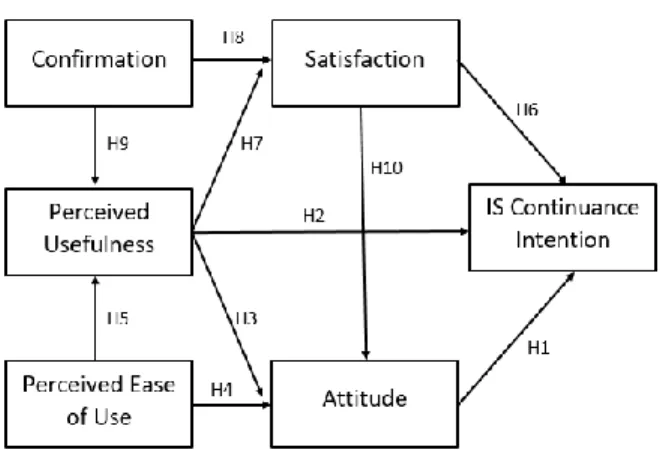
As indicated by Liao et al., TCT provides a strong basis for evaluating users' ongoing intentions to use technology. According to the point of view of the TCT model, the importance of PU is the degree of an individual's belief that the use of a particular application will upgrade his presentation experience (Redzuan et al., 2016). According to Venkatesh et al. 2002) both PEOU and behavioral intentions are significantly and positively related.
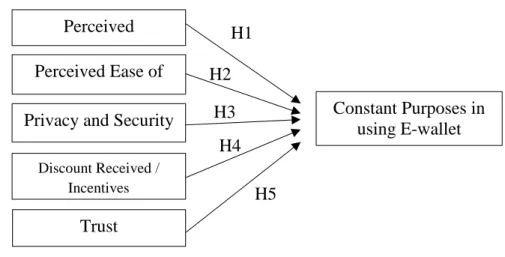
Besides that, TCT models also confirm that both perception of usability and behavioral intentions have a significant relationship (Venkatesh, et al., 2000). Previous studies or theses also showed the constructive result of perceived ease of use in relation to the use of online banking systems (Shaikh, A.A. et al., 2015). H2: There is a relationship between perceived ease of use and the constant purposes of using the E-wallet.
RESEARCH METHODOGY
- Introduction
- Research Design
- Data Collection Method
- Primary Data Collection
- Sampling Design
- Target Population
- Sampling Frame and Sampling Location
- Sampling Element
- Sampling Technique
- Research Instrument
- Questionnaire Design
- Pilot Test
- Construct Measurement
- Origin and Measure of the Construct
- Scale of Measurement
- Data Processing
- Proposed Data Analysis Tools
- Descriptive Analysis
- Reliability Test
- Pearson Correlation Analysis
- Multiple Regression Analysis
- Conclusion
As far as this study is concerned, the questionnaires will be distributed to individuals, hence the sample consists of Malaysians using an e-wallet. In accordance with the non-probability sampling method, the research article used voluntary response sampling to obtain data. Questionnaire is one of the most efficient ways to collect data from the target respondents.
For the research questionnaire all questions are closed questions so that it is easier to record the data and interpret it later. The cover page of the questionnaire is attached to the university's personal data protection statement, to inform that their privacy acceptance is secure. First, part A, the demographic section consists of 4 questions such as age, gender, employment status and their nationality to ensure that only Malaysians are the respondents for the purpose of the research.
During this period of leading a review, the questionnaire is steered to a level for the complete sample population, or in more relaxed cases simply to a residence. In the research questionnaire, section A consists of nominal scale questions such as gender, nationality and employment status. Ratio scales include a true zero in their scale similar to the properties of interval scales, which alludes to ending non-emergence of the characteristic measurement (Lee, Jo Ann, 2016).
As for the research questionnaire, 5-point Likert scale questions are used for the entire section C, which is the dependent and independent variable. The data of the respondents from the questionnaire will start with a descriptive analysis which processes the data, followed by a reliability test which tests the validity of the data and finally an inferential analysis which helps to test the research hypothesis. Descriptive analysis is a type of information study that shows, displays, or summarizes elements in a useful way to the extent that examples can emerge that satisfy each state of the information (Ayush Singh Rawat,.
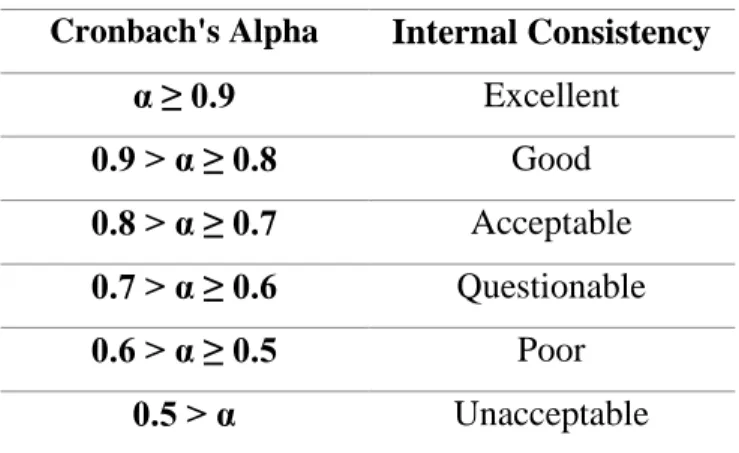
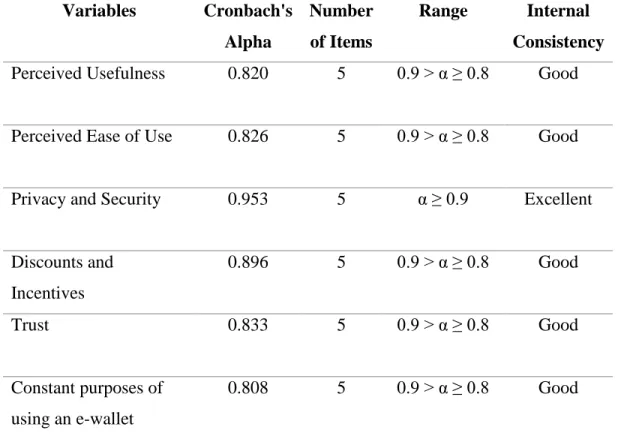
Alpha was created by Lee Cronbach in 1951 to give a measure of the internal consistency of a test or scale; reported as a number somewhere between 0 and 1.
DATA ANALYSIS
Introduction
Descriptive Analysis
- Respondent Demographic Profile and General Information
- Gender
- Age
- Nationality
- Employment Status
- Have you ever heard about e-wallet payment method before?
- What’s the average amount of money you spend every month in your e-
- How frequent did you use e-wallet during the Covid-19 pandemic? . 43
- How frequent did you use e-wallet nowadays?
- Central Tendencies Measurement of Construct
Those who are familiar with the e-wallet constitute the majority of the respondents required for the survey. As shown in Table 4.6 and Figure 4.6, a total of 200 respondents could choose more than one answer to select the e-wallet used. Yes, I am familiar with the e-wallet and have been using it for some time (or have used it before).
The highest number of e-wallet used is Touch'nGo eWallet and the lowest is WeChat Pay MY. Therefore, most of the respondents use the e-wallet 2-5 times a month during the Covid-19 pandemic. Perceived ease of use has the highest mean of 4.4170, followed by perceived usefulness with a mean of 4.1570.
Next, it is followed by constant purposes in the use of e-wallet, discounts and incentives received and privacy and security with the mean of and 4.0660. These results indicated that ease of use has the greatest influence on the constant purposes of using e-wallet, while trust has the lowest influence.
Reliability Analysis
Pearson Correlation Analysis
Multiple Regression Analysis
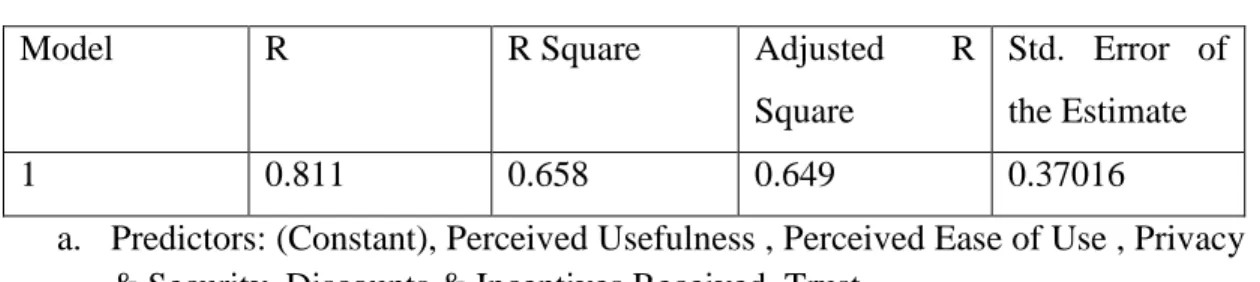
The B value in unstandardized coefficient indicates each 1-unit value increased in independent variables, then. Trust has the largest value among the independent variables which is 0.287 and followed by discounts and incentives received, perceived ease of use, privacy and security, and perceived usefulness. For standardized coefficient, the higher the beta value means greater impact of such independent variables on dependent variables.
Discounts and incentives received consist of the highest value which is 0.308 instead of other independent variables.
Hypothesis Testing
H4: There is a positive relationship between received discounts and incentives and constant intentions to use the e-wallet. Therefore, there is a significant correlation between received discounts and incentives and constant intentions to use the e-wallet.
Discussion of Major Findings
- Perceived usefulness and constant purposes in using e-wallet
- Perceived ease of use and constant purposes in using e-wallet
- Privacy & security and constant purposes in using e-wallet
- Discounts & incentives received and constant purposes in using e-wallet 56
First of all, the respondents of this research already knew about the elements of e-wallet applications, which will make their lives more simple and increase work performance. This is because there is no creation that will bother customers, rather, it reduces hassles and facilitates the interaction. There is a positive relationship between perceived ease of use and constant intentions to use e-wallet.
According to the multiple regression analysis, the perceived ease of use has a significant relationship with the constant goals in using e-wallet, as p 0.01 is less than 0.05 and the t value is 3.378. In short, it is concluded that the perceived ease of use influences the constant purposes of using e-wallets among Malaysians. According to the multiple regression analysis, privacy and security have no significant relationship with the constant purposes of using e-wallet as p 0.052 is more than 0.05 and the t value is 1.954.
In sum, it is concluded that privacy and security have no influence on the ongoing purposes of using e-wallet among Malaysians. These results are consistent with several previous researches by Jin et al., 2020; Trivedi, 2016; Chern et al., 2018, noted that PS has no significant relationship with users' ongoing intention to use specific technologies and services. According to the multiple regression analysis, discounts and incentives received have significant relationship with the constant purposes in using e-wallet as p 0.000 is less than 0.05, and t-value is 5.907.
In short, it is concluded that discounts and incentives received influence the constant intentions to use e-wallet among Malaysians. According to the multiple regression analysis, trust has a significant relationship with the constant purposes of using e-wallet, as p is 0.000 less than 0.05, and t-. In short, it is concluded that trust influences the constant intentions to use e-wallet among Malaysians.
According to Abd Malik and Annuar (2020), a serious level of trust would induce a more remarkable customer recognition of this emergent rate of innovation.
Conclusion
DISCUSSION AND CONCLUSION
- Introduction
- Discussion on the first objective
- Discussion on the second objective
- Discussion on the third objective
- Discussion on the fourth objective
- Implications of the Study
- Limitations of the Study
- Recommendations for Future Research
- Conclusions
Most users spend less than RM50, but there is also an average percentage of users who spend between RM51 and 99. The second aim of the research is to study the factors that influenced the use of the e-wallet by Malaysians during the National Recovery Plan. The third aim of the study is to develop a research model that can determine the factors determining the enduring purpose of a consumer e-wallet.
The fourth objective of the study is to analyze the factors used in the proposed research model. From the outcome of the results, the study concluded that only three factors influenced the constant purposes of using an e-wallet. In the context of the research, the outcome of this research helps to find out which factors can help in the social improvement towards digital payments.
For example, perceived ease of use matters for continued intentions to use an e-wallet. All things considered, this research effectively aimed at the research objective to see the relationship between perceived usefulness, perceived ease of use, privacy and security, discounts and incentives received, and trust and continued intentions in using e-wallet. The effect of perceived usefulness, perceived ease of use, trust and perceived risk towards the use of e-wallets.
Retrieved from https://www.nst.com.my/news/nation national-recovery- plan-monthly-assistance-e-wallet-can-help-boost-economy. 2016, https://www.britannica.com/topic/measurement-scale. 2001), "A Trust model for consumer internet shopping", International Journal of Electronic Commerce, Vol. 2003), “The transitional role of institutional trust in online interorganizational relationships”, Proceedings of the 36th Annual Hawaii International Conference on System Sciences, Big Island, HI, p.
Examining perceived usefulness and perceived ease of use of electronic human resource management (e-HRM) for behavioral purposes.
QUESTIONNAIRE
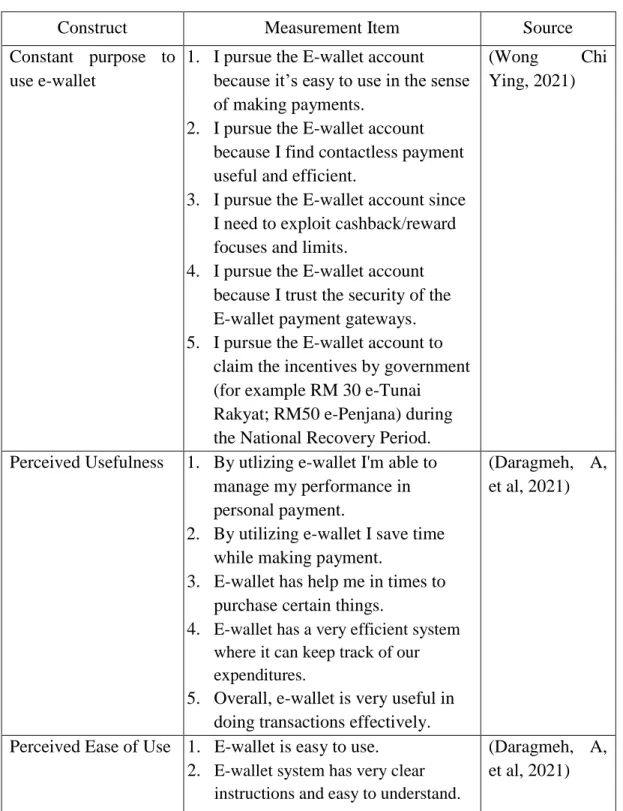
I would recommend a friend to join e-wallet to enjoy their discounts and incentives. I pursue the E-wallet account because it is easy to use in the sense of making payments. I pursue the E-wallet account to claim the incentives from the government (for example RM 30 e-Tunai Rakyat; RM50 e-Penjana) during the national recovery period.
SPSS OUTPUT