ISSN 0127-9386 (Online)
http://dx.doi.org/10.24200/jonus.vol8iss3pp87-108
87
VALUE CREATION FOR SHARIAH-COMPLIANT COMPANIES FROM THE PERSPECTIVE OF MAQASID SHARIAH: A PROPOSED FRAMEWORK
1Nor Aqilah Sutainim, *2Nor Farizal Mohammed, 3Radziah Mahmud & 4Rifqi Muhammad
1,2 Accounting Research Institute, Universiti Teknologi MARA, Shah Alam Campus, 40450 Shah Alam, Selangor, Malaysia.
2,3 Faculty of Accountancy, Universiti Teknologi MARA, Puncak Alam Campus, 42300 Bandar Puncak Alam, Selangor, Malaysia.
4 Faculty of Business & Economics, Universitas Islam Indonesia, Indonesia.
*Corresponding author: [email protected] Received: 15.05.2023 Accepted: 17.08.2023
ABSTRACT
Purpose: Integrated reporting (IR) is to convey the integrated thinking (IT) process in creating value for organisations. Drawing from the framework of Maqasid Shariah, the paper seeks to propose a framework for measuring value creation for Shariah-compliant Companies (ShCCs).
Methodology: Based on the existing literature on the performance of companies, this paper explores the measurements of value creation, which is arguably the consequence of integrated reporting and integrated thinking in an organization that matches the framework of Maqasid Shariah. This issue is examined by looking at the context of ShCCs in Malaysia.
Findings: The findings support the contention by Shariah Enterprise Theory, which is the extension of legitimacy and stakeholders’ theory. The various measurements of value creation can be classified under the broad classification of Abu Zahrah (1997)’s Maqasid Shariah framework.
Contributions: This paper enhances the understanding of value creation from the perspective of Islam, thereby contributing to meeting the initial aim of ShCCs classification, which is to fulfill the need of Muslim stakeholders. Additionally, the proposed framework provides measurements of value creation based on the Maqasid Shariah framework that can be used in future research.
88
Keywords: Maqasid Shariah, value creation, integrated reporting, integrated thinking, Shariah- compliant companies.
Cite as: Sutainim, N. A., Mohammed, N. F., Mahmud, R., & Muhammad, R. (2023). Value creation for Shariah-compliant companies from the perspective of Maqasid Shariah: A proposed framework.
Journal of Nusantara Studies, 8(3), 87-108. http://dx.doi.org/10.24200/jonus.vol8iss3pp87-108
1.0 INTRODUCTION
Value creation beyond financial profit appears to align with Islamic teachings since the primary aim of reporting is to discharge one's obligation to Allah (Ibrahim, 2000). Ibrahim (2000) suggested dual accountability, also known as Islamic accountability, which included both accountability to Allah (hablun min Allah) and individual accountability (hablun min an-nas).
Muslims believe that Allah created all resources and that each individual, as a trustee (khalifah), is responsible to Allah for their acts in utilising those resources (Osman, 2010). As a result, an organisation must be held accountable to God as a khalifah, entrusted with the responsibility of caring for the world's resources, including financial, social, governance, and environmental concerns. The public has a right to know about the effects of a company's operations, its long-term viability, and performance, as well as if the company is run in line with Islamic rules. Maqasid Shariah-based performance has been looked at in the Islamic banks literature, for example, in Tarique et al. (2021). Thus, examining the issue via the lens of Shariah-compliant Companies (ShCCs) is worthwhile as the classification as ShCCs serves the needs of Muslim stakeholders.
Recent development has seen Integrated Reporting (IR) as a form of inventive reporting that has marked another milestone in the financial reporting environment that looks beyond financial profit to translate the value creation within an organization. According to the (IR) framework that was released on 31st December 2013 by International Integrated Reporting Council (IIRC), the aim is to enhance the accountability and stewardship to the stakeholders by emphasizing the six capitals, i.e. financial, manufacturing, intellectual, natural, human and social and explaining their interdependencies in creating values for the business over time. The first revision of the framework was published in 2021 to enable more decision-useful reports for business value creation. The IIRC (2021, p. 10) Integrated Framework describes an integrated report as:
89
“is a concise communication about how an organization’s strategy, governance, performance and prospects, in the context of its external environment, lead to the creation, preservation or erosion of value over the short, medium and long term.”
IR intends to provide useful broad risk evaluation and information on potential firm value creation to capital providers and potential investors with a concise reporting style (Villiers et al., 2014). In order to ensure a good quality of IR, the framework mentioned the use of integrated thinking (IT) that aids the process of preparing or developing IR (Adams, 2017), whereby IT comes first as the process to create value and IR acts as the natural extension (Al- Htaybat & Alberti-Alhtaybat, 2018). Hence, the year 2014 has marked the official starting point of IT as part of IR, which urged the organizations to apply IT as it helps IR to translate value creation over time effectively (IIRC, 2013). Both IR and Islamic reporting appear to demand integrated thinking and a long-term view to promote long-term corporate sustainability. On the other hand, Islamic reporting adds a layer of accountability to Allah. This signifies that Islam accepts Allah's (SWT) Unity and that every business action and commercial activity must adhere to the Shariah concept and value (Haniffa et al., 2002). In line with this purpose, the Islamic capital market is established by classifying companies as ShCCs to serve the needs of Muslim investors and shareholders.
Malaysia is well-known for being a Muslim-majority country with a strong presence in the Islamic capital market. Since 1997, the Malaysian Islamic Capital market, which includes ShCCs, has grown exponentially. As of November 23, 2020, there were 715 ShCCs in circulation, up from 478 when Islamic securities were initially launched in 1997. In 2020, ShCCs accounted for 79 percent of the total number of firms listed on Bursa Malaysia. The Islamic capital market's expanding territory demonstrates that it has become more resilient over time while evolving its range of offerings and rules to keep up with its conventional counterpart. Past studies on Islamic accounting literature, on the other hand, have focused on Islamic financial institutions (Haniffa & Hudaib, 2007; Mohammed et al., 2019) and non-profit organisations (Abdelmawla, 2014). There has been little research on the Islamic perspective on profit-making organisations such as ShCCs. Integrated thinking in ShCCs, according to this study, adds value beyond financial performance. This is because ShCCs are supposed to act according to Islamic principles, and hence, Shariah aspects must be portrayed by ShCCs to convey the genuine picture of Islam.
As a result, both Muslim and non-Muslim stakeholders would gain public trust (Azis et al., 2020). The growing number of Shariah-compliant businesses has prompted Muslim
90
investors to evaluate how they might create value that meets the needs of their stakeholders, particularly Muslims. In that case, the discussion of value creation within the perspective of Maqasid Shariah (the purpose behind the Islamic ruling) is essential for these companies.
The discussion relates to the concept of IR drives IT in organisation, which is the process of creating value in organisations. Hence, it is the aim of this paper to propose a framework for the measurement of value creation for Shariah-compliant companies based on the Maqasid Shariah framework. The findings may contribute to the Islamic accounting and finance literature.
2.0 VALUE CREATION
In a resource-constrained world, value creation involves adding value to the organization or firm to the society and environment. This means that organizations need to look at how they make products and services and how the utilization of resources takes place to create value in a holistic manner (Hall, 2018). Primarily, the goal of an organization is to be able to create high value to attract investors into the business (Hall, 2018). Value creation is synonymous with the culture of placing it as a ticket to signal good performance. Hence, it can be deduced that an organization's value creation can be measured in different forms that are very subjective to interpret.
Previously, value was expressed through shareholder's value or wealth maximization, which moved to shared value and the latest to system value creation through IR. The misconception is that value creation is assumed to be a financially-oriented value like return on assets. However, those quantitative methods alone as a measure can no longer be relevant to express real value creation in the long-term without embedding the elements of sustainability or non-financial aspects (IIRC, 2013). As the technology evolved through time, value creation can now be measured in financial and non-financial measures (Darus et al., 2016; Kaya et al., 2016). Thus, IR is essential for the company to convey the real circumstances as well as to create value for the organization.
Hence, the measurement for value creation often differs from the purpose or outlook of the industry. In financial aspects, an organization usually measures it using shareholders’ value creation (Hall, 2013, 2018). The shareholder value creation is suitable to express economic outcomes or financial performance. According to Hall (2018), five shareholder value creation measures were mostly examined or used in the past studies, namely return on capital employed divided by the cost of equity, market value added (MVA) (Hall, 2013, 2018; Tripathi et al., 2019), a market-adjusted stock return (Hall, 2013, 2018), the market-to-book ratio (Hall, 2018)
91
and Tobin’s Q ratio (Chang & Jo, 2019; Hall, 2018). Hall (2018) stated that the most appropriate measure for shareholders' value creation in the industry to measure and express value creation is Tobin's Q ratio, MVA, and the market-to-book ratio.
In terms of sustainability or beyond financially-oriented output, the value can be interpreted through productivity or innovation as well as brand value (Darus et al., 2016). This is because the fundamentals of value creation is assumed when a movement or dynamic affects the productivity or performance of business or value-added due to innovation, invention, or modification (Moran & Ghoshal, 1999). Kalafut and Low (2001) measured value creation using a value creation index to measure beyond extrinsic economic values
which represent the company's performance. It includes innovation, quality, customer relations, management capabilities, alliances, technology, brand value, employee relations, as well as environmental and community issues. Other studies’ (Darus et al., 2016; Falson, 2019) approach to non-financial value creation usually did not entirely apply all the key drivers but rather merged several drivers or used the available or the most applicable and relevant ones for the industry or sectors studied. For example, certain drivers are merged into one because the drivers have the same issues to tackle. The measurement of the value creation index developed by Kalafut and Low (2001) could be gathered through an annual report (Darus et al., 2016) and database. This gives opportunities for the current study to extract data via the database to collect a large sample of data instead of manually gathering information from annual reports.
Kaya et al. (2016) indicated that IR helps to enhance the value creation of organizations where it is parallel with the recommendation of the IIRC (2013) as the organisation faces the challenges to sustain in the competitive business world. Every organization is exposed to threats or risks to survive (Moolman et al., 2019). Since value creation is appreciated more with the transparency and accountability in providing information to the stakeholders (Adams, 2017; Roman et al., 2019), managers should not concentrate on managing earnings to achieve a short-term goal as it can destroy the portion of market value which can no longer be relevant to express value creation in a long-term (El-deeb & Megeid, 2015). This implies that a financially data-driven value leans towards short-term value. However, organizations tend to manipulate their earnings to attract more investments or accelerate funds to enter into debt covenants and to retain existing and pull in potential customers (Sajid & Afza, 2018). Sajid and Afza (2018) supported that manipulating earnings could destroy the current and subsequent organizations' value. This opportunistic behaviour of the managers was found to negatively moderate the well-established positive relationship of corporate governance and organization value.
92
Another research by El-deeb and Megeid (2015) concluded an association between earning management and investors' sensitivity using the shareholder value creation where it is valid but with a less significant association between the earnings management and the shareholder value creation as a mediator. This is because the value was already compromised or altered. It can no longer reach the investor’s and analyst’s expectations in terms of market value over time. IR should lead to greater connectivity between intangible drivers of value and financial outcomes, including a business's value. Many providers of financial capital highly seek value metrics and the story around these. For example, critical drivers of shareholders of value will depend on second and third-order value drivers related to relevant strategic and operational activities such as serving customers, innovating, ensuring quality and inventory, employee satisfaction and performance. Institutional investors and asset managers look up to corporate communications, reporting and disclosure to help them understand the organisational value.
IR requires an understanding of value beyond the bottom line. Creating returns to investors and funders is an outcome of delivering value creation to other stakeholders and recognizing a broader range of capitals or resources upon which value creation ultimately depends. An organization creates value to shareholders and funders, customers, employees, suppliers, partners, regulators and society. Both aspects of value creation are critical to the survival of any organization as it cannot survive for very long by delivering one without the other. An organization will risk going out of business unless it creates value for others. It could either become irrelevant or lose its social licence to operate.
Value is also created over different time horizons and for different stakeholders through capitals, resources and competencies. Therefore, it is unlikely that value can be created by maximizing one capital while disregarding the others. For example, the maximization of financial capital (e.g., profit) at the expense of human capital (e.g., through inappropriate human resource and supply chain practices) is unlikely to maximize the value for the organization in the long term and leads to a resilient business model. The value an organization creates for others and its ability to create value for itself are closely related and achieved through a wide range of activities, interactions, and relationships, many of which are non- financial.
In the Islamic context, the understanding of value creation seems to get along with the conventional context, especially when it comes to non-financial value creation. Islam is way ahead before IR was implemented in terms of accountability as a human being, as a Khalifah (vicegerent) towards socio economic justice since Islam had always prioritised the
93
public (maslahah). Besides, Maqasid Shariah (the objectives of Shariah) also seems to be in line with the IR Framework whereby the six multi-capitals (financial, manufactured, intellectual, human, social and relationship, natural) which are significant to value creation over a short, medium and long term were already embedded in Maqasid As-Shariah (Muratov, 2019). This is consistent with the claim by Imam Al-Ghazali (d. 1111) as cited by Chapra (2000, p. 118) that Maqasid Shariah or “The objective of the Shari’ah is to promote the well- being of all mankind”. This is because Islam urges its ummah (community) to safeguard faith (din), human self (nafs), intellectual capacity (`aql), posterity (nasl) and wealth property (mal) while serving maslahah. The elements of Maqasid Shariah is widely discussed in Islamic Banks literature reviews (Mergaliyev et al., 2019; Nugraha et al., 2020; Nugraheni, 2018). In order to be in line with Maqasid Shariah, there are four elements of value creation to be evaluated: economic development, contribution to society and social environment, contribution to stakeholders, and education and human resources (Nugraheni, 2018). Thus, every organization, or in this case, ShCCs, should take charge of socio economic justice by being transparent in disclosing or reporting useful and meaningful information on environmental, social governance matters in the investment's decision making and sustainability. This would help in assisting the stakeholders and in a way gaining their trust. Naturally, this helps the organizations or companies create value over a period of time (short-, medium- and long- term).
Thus, it can be deduced that IR is conforming to Islamic accounting principles because it is concerned with the financial elements and non-financial elements like governance, environmental, and social reporting.
The vivid contrast with the conventional is that Islam emphasis on serving the maslahah of stakeholders was due to the accountability to Allah SWT (God) as the first pillar of Islam is “Believe in God”. From the above discussions, it is evident that Shariah supports that the value created for an organization or company depends on the company's ability to create value for others or stakeholders. Hence, it can be synthesised that Shariah value creation seems to be aligned with the conventional value creation as long as it is in accordance with Maqasid Shariah and maslahah concepts.
3.0 INTEGRATED THINKING
According to the IIRC (2013), integrated thinking (IT) can be defined as “the active consideration by an organisation of the relationships between its various operating and financial units and the capitals that the organisation uses or affects which leads to the integrated decision-making and actions that consider the creation of value over the short, medium and
94
long term”. In other words, IT is a process of decision making, management and reporting which is a prerequisite to IR. The idea of value creation is further supported by the concept of integrated thinking (IT).
Generally, firms that adopt the concept of IT will benefit by breaking down the internal silos and reducing duplication (IIRC, 2013). Previously, traditional corporate reporting tended to have redundant information and a lack of details in the other components of reporting due to the strong silos within the firm (Feng et al., 2017). A silo within a department would restrict or limit the delivery of information, which may affect the unsynchronized goals and performance among departments. In the long term, this will jeopardize the firm's state as a whole. In addition, key stakeholders like investors might lose their trust due to information discrepancies. A previous study suggested that the implementation of IT should focus more on the internal practices, which are meant to break down internal silos to avoid redundancy in value creation (Dumay et al., 2019). Furthermore, the IIRC (2013) also stated that IT could be done through a strategic business model by adopting the management of multi-capital approach in managing the business activities "to produce outputs and outcomes that create or destroy value for the organization, its stakeholders, society, and the environment".
Other external advantages that can be enjoyed by the business that adopts IT include having a better vision of its financial performance and value (Knauer & Serafeim, 2014;
Serafeim, 2015). Hence, these promote greater accountability and transparency in terms of information delivery which will attract more investors and improve analysts' forecasts (Serafeim, 2015). The build of trust with the stakeholders can also be gained and having the ability to maintain the reputation due to the informed and data-driven decision making (Adams, 2017; Camilleri, 2018). With this achievement, the interest in capital markets will be improved, reduces legal risk, and promotes transparency and accountability (Villiers et al., 2016).
In order to achieve an ideal description of IT, there are several criteria to be considered.
The core IT tools include lateral integration, temporal integration, materiality, value chain and connectivity (IIRC, 2013). Lateral integration refers to considering the six capitals, namely, financials, manufactured, human, social and relationship, natural and intellectual capitals.
These capitals are critical in the process of value creation. They are interdependent and thus, integrated thinking is needed to connect these capitals and transform them into business strategies to create value (Adams, 2017; Mähönen, 2020; McGuigan et al., 2020). Temporal integration refers to the period over time in creating value as the firms’ goal such as short, medium and long term goals. Materiality is used to identify the critical elements to value creation and to whom it may be useful or meaningful. Value chain refers to how the supply
95
chain activity and partnerships were created or destroyed. On the other hand, connectivity explains that the impact of value created in one part of the organisation may affect another value creation elsewhere. IT involves the interdependence of multi-capitals and sustainability in understanding how value creation is made over time (Kaya et al., 2016). Integrated reporting is the visible part of integrated thinking where it aims to report the integrated thinking process to create value (IIRC, 2013; Mähönen, 2020).
Hence, IT is basically adopted along the way of the preparation process of IR as it revolves around the way of thinking and decision making. Considering that, IT takes place in measuring, monitoring, assessing the progress and adapting the best business model strategy to achieve the firm's goal over the period. This is because a firm's purpose is to create value in short, medium, and long-term. Consequently, IT may also understand the system, such as the external risks, opportunities, key stakeholders' need and materiality. Along the way, IT may aid with the co-design solutions that suit the firm's goals to manage any detected conflicts, different views, creativity, cultures and mindsets. IT ensures that the journey of implementation of IR in creating value must be made holistically. Indeed, IT is the foundation of a good portrayal of IR’s quality (Al-Htaybat & Alberti-Alhtaybat, 2018; Dilling & Caykoylu, 2019).
This is because IR itself focuses on value creation, which contributes to the economic capital markets. Hence, to ensure the process of IR is well managed, the organizations need to incorporate a comprehensive perspective or view at the managerial level known as integrated thinking (IT) (Adams, 2017; Villiers & Dimes, 2020). In other words, the way an organization handles IT is the root that determines whether an organization manages to create value or destroy the value that expresses the level of performance and successfulness of an organization over time.
Due to the rapid change in technology, firms need to adopt IT to keep the business conscious or pace with the constant evolution of business operations. Over time, a resource- constrained world with a greater population would cause greater demand for products or services. Thus, the idea to focus only on maximizing shareholders' wealth is no longer applicable or relevant. This is because millennials are now aware of the environment, the importance of resource management and at the same time keeping the earth clean. Hence, a better outlook or forward-looking decision is needed. This is due to the shortage of resources as the usage of the natural assets is faster and greater than what nature regenerates. In order to prevent unsustainability, modern thinking was developed where the purpose has moved profit to a value creation model. It is critical to have a transparent business model where the company's money positively impacts the three (3) critical dimensions, i.e. economy, society,
96
and environment. This business model is expected to add value or destroy the value.
Sustainable development is crucial to express value creation and this can be achieved by changing the mindset or way of thinking, also known as IT. Therefore, stakeholders and society have to look at how an organization or a firm makes the products or services, money or how it benefited the firm and identify the impact of the 3 critical dimensions for value creation (economy, society and environment). The current framework suggests that IT affects the dynamic behaviour of senior management (including CEO and directors) as well as employees to work on their strategy to create value sustainably (IIRC, 2013).
It is essential to look at Maqasid Shariah based value creation so that the integrated thinking process in ShCCs will work towards fulfilling the interest of Muslim stakeholders, thus benefiting other stakeholders as well. In the Islamic perspective, every human is regarded as a khalifah (vicegerent) who is accountable to Allah (hablun min Allah) and also to individuals (hablun min an-nas) by which the accountability is to contribute towards society or for public benefits (maslahah). This is to establish and achieve socio-economic justice. In line with the latter, Ibrahim (2000) suggested that accountability would be the primary objective of Islamic accounting, now termed the integrated thinking approach. In addition, there are secondary objectives which include the Shariah compliance, assessment and distribution of zakat, equitable and fair distribution of wealth and the creation of cooperative environment and solidarity (Malik, 2016). Similarly, Adnan and Gaffikin (1997) added emphasis on zakat which is to sustain the accountability of human beings to Allah (S.W.T.) through zakat accountability. Thus, examining value creation from the Maqasid Shariah perspective contributes to another perspective of the integrated thinking approach.
4.0 SHARIAH ENTERPRISE THEORY (SET)
SET emerged from the idea of enterprise theory. The concept of enterprise theory is of value- added in business production by means of the performance is determined or based on the contributions made towards the productivity or yield (output flow) to the community or society (Purdy, 1983). Conventionally, this theory posits that an enterprise or in this case, an organization as a social institution emphasizes on the social performance as its output flow rather than revenue or profit. Hence, to fill in the loopholes and fit the discussion of the compliance of Shariah, the idea of SET emerged as an enhanced or modified version of enterprise theory which has the characteristic towards balance in terms of socio-economic justice, trust and honesty (Sudarma et al., 2010). Sudarma et al. (2010) asserted that SET is spiritually or religiously acceptable for Islamic institutions or organizations.
97
SET is also an extension of legitimacy theory and stakeholder theory (Wardani & Sari, 2018). Legitimacy theory is based on social value and stakeholder theory emphasizes the stakeholders' interest. Legitimacy theory explains that the organizations enter into the social contract with the society. In that case, the organizations must meet society's expectations to obtain a licence to operate. Since ShCCs are the Islamic classification, they are expected to create value in line with Shariah principle to get the licence from muslim society to operate under that classification. Since SET prioritizes accountability towards Allah, SET has automatically considered social value and accountability as well as the interest of stakeholders, which are the responsibility to not only the humans but also the environment. In this case, stakeholder theory is extended to include Allah or God as the main stakeholder.
As a company, particularly a Shariah-compliant company (ShCC) has to communicate with the stakeholders as ShCC has the responsibility or obligation towards their performance in terms of disclosure that will eventually, translate the value creation. This shows that the company gives consideration and attention to any social and environmental issues due to its operational or business activities, which may affect business continuity. For example, disclosing their financial and non-financial information environmental, social and governance (ESG) issues, including social responsibilities in the annual report. In this study, SET fits to interpret the ShCCs’ roles and responsibility towards their stakeholders to communicate and disclose the information regarding their level of integration in reporting, governance mechanisms that may influence or affect the value creation. Thus, it is consistent with Maqasid Shariah, where the accountability to Allah (God) made one act as a Khalifah to serve socio- economic justice and Maslahah of stakeholders. Therefore, SET is suitable for describing the research framework in explaining or channeling the relationship between the level of integration in reporting and value creation.
5.0 MAQASID SHARIAH
As Islam is a way of life itself, Maqasid Shariah sets explicit purposes for a Muslim to live in the world and achieve success in life and the hereafter. Maqasid can be defined as wisdom and acts as a means or the purpose perceived by the Shariah Law in every aspect of life covering all types of transactions, including business activities and muamalat. Maqasid Shariah assists human reasoning and judgment (Kamali, 1999). Maqasid Shariah is essential in guiding the formation of rules and regulations in any type of transactions considered new or unfamiliar where there is no existing or past judgement to be referred.
98
The basis determinant factor of the execution of Maqasid Shariah is maslahah (public welfare/interest) (Nugraha et al., 2020; Nugroho et al., 2017). Maslahah is an essential concept where it emphasizes on the importance of accountability as a servant of Allah SWT (God) where the way to show dedication to Allah is by following His orders, i.e. to act as a khalifah (vicegerent) on earth to serve the welfare and public interest including all living or non-living things on this planet. This act helps protect those in need and maintain harmony and world peace while preserving and conserving the environment. The maslahah of stakeholders in wealth management can be divided into managers, employees, communities, regulators, shareholders and the environment (Hasan & Asutay, 2017). The maslahah of shareholders focuses on the socioeconomic needs or goals of the shareholders, that is, to maximize the wealth economically or create value with a sense of integrity and good management of the company. Similarly, ShCCs’ maslahah is also subject to accommodating the stakeholder needs and goals to deliver reliable information in reporting. The maslahah of stakeholders should be taken into account when reporting the business activities, including governance, social, environmental and performance.
Imam Al Ghazali (d.1111) supported the idea of Al-Juwayni’s theory on Maqasid Shariah that maslahah can be divided into necessities (Daruriyat), complements (Hajiyat) and embellishment (Tahsiniyat). However, he further extended the theory by incorporating the five elements of preservations (faith, life, posterity, intellect and wealth). Imam Al-Ghazali (d.1111) stated that Maqasid Shariah is “to promote the well-being of all mankind, which lies in safeguarding their faith (din), their human self (nafs), their intellect (`aql), their posterity (nasl) and their wealth (mal)” (Chapra, 2000). These five elements have to be safeguarded and protected as this helps serve the public interest or well-being of stakeholders (maslahah). This gesture reflects the act of obeying the command of Allah SWT, in order to gain reward or success in life and hereafter. Later, Abu Zahrah (1997) added to Al-Ghazali’s work by embedding justice (Iqamah al-“Adl) and education (Tadhib al-Fard) while maintaining the existing concept of maslahah (Jalb al-Maslahah). According to Said et al. (2018) and Tarique et al. (2021), the theoretical framework of Maqasid Shariah based on Abu Zahrah’s concept can be illustrated as in figure 2 below. Abu Zahrah’s theoretical framework is basically the extended or re-interpreted version of Al-Ghazali’s theoretical framework as the general idea of protecting or preserving the five elements. The classification of value creation based on the Maqasid Shariah framework enables stakeholders to assess the ability of companies to create value based on Islamic concepts.
99
Figure 1: Maqasid Shariah theoretical framework based on Abu Zahrah (1997)’s concept (Tarique et al., 2021)
6.0 PROPOSED VALUE CREATION BASED ON MAQASID SHARIAH FRAMEWORK
The parameters applied for value creation are aligned or conformed to Abu Zahrah (1997) ’s framework of Maqasid Shariah. There are three components or concepts that reflect the Maqasid Shariah-based performance: justice, education, and maslahah (Tarique et al., 2021). These concepts consider the existing conventional method or approach to establish justice and education while incorporating Islamic social performance. In Maqasid Shariah context, past studies mainly focused on the performances of Islamic banks (Mohammed & Taib, 2015; Nugraha et al., 2020; Nugraheni, 2018; Said et al., 2018; Tarique et al., 2021) rather than ShCCs which shows the gap and opportunity to develop measures for non-financial institutions. Islam is a complete way of life that principles apply to non-profit organizations and profit organisations like Islamic banks and ShCCs. This study adopts the elements of Maqasid Shariah-based performances' work done by Tarique et al. (2021) in an Islamic bank context by modifying the dimensions and measurements that suit the nature and setting of ShCCs. The Maqasid Shariah-based performance for Islamic banks can be applied in ShCCs due to its similarities in profit-making operation and fulfilling social accountability in response to being accountable towards God (Allah). Thus, the modified value creation based on the Maqasid Shariah framework by using Abu Zahrah’s framework to be conducted in this study can be illustrated in figure 3.
The main difference between value creation based on the Maqasid Shariah framework and the existing conventional one is compliance with Shariah Law and conforming with the
Maqasid Shariah
Justice Education Maslahah
Protection of Ad-Deen
Protection of Al-Nafs
Protection of Al-‘Aql
Protection
of Al-Nasl Protection of Al-Mal
100
maslahah concept (Ramli et al., 2018). This is to ensure that the goals of an organization in creating value over time must protect the socio-economic welfare of the stakeholders or community as a whole. Based on prior literature on the measurements of various areas of value creation, figure 3 shows a proposed framework for value creation for ShCCs, based on Maqasid Shariah. It starts with the broad classifications of Abu Zahrah (1997)’s Maqasid Shariah Framework, namely, Justice, Education and Maslahah. By referring to Islamic social performance literature, justice means that the operations must be fair; therefore, the business must aim for economic development while also being fair to other stakeholders.
Next, Abu Zahrah (1997)’s Maqasid Shariah framework incorporates education's concept, which is the performance derived in educating individuals as part of social accountability and responsibility. Education's concept promotes acquiring and advancing skills, talent, or knowledge via scholarship and training (Mohammed & Taib, 2015; Nugraheni, 2018; Tarique et al., 2021). According to Tarique et al. (2021), the performance for education and human resource development ratio should be education or training expenses over total expenses instead of income or profit after tax. This is because the primary purpose or nature of the organization is to promote and advertise its products or services and not merely to educate people. Hence, the value of educating individuals should be based on the total expenses apportioned for human resource development expenses.
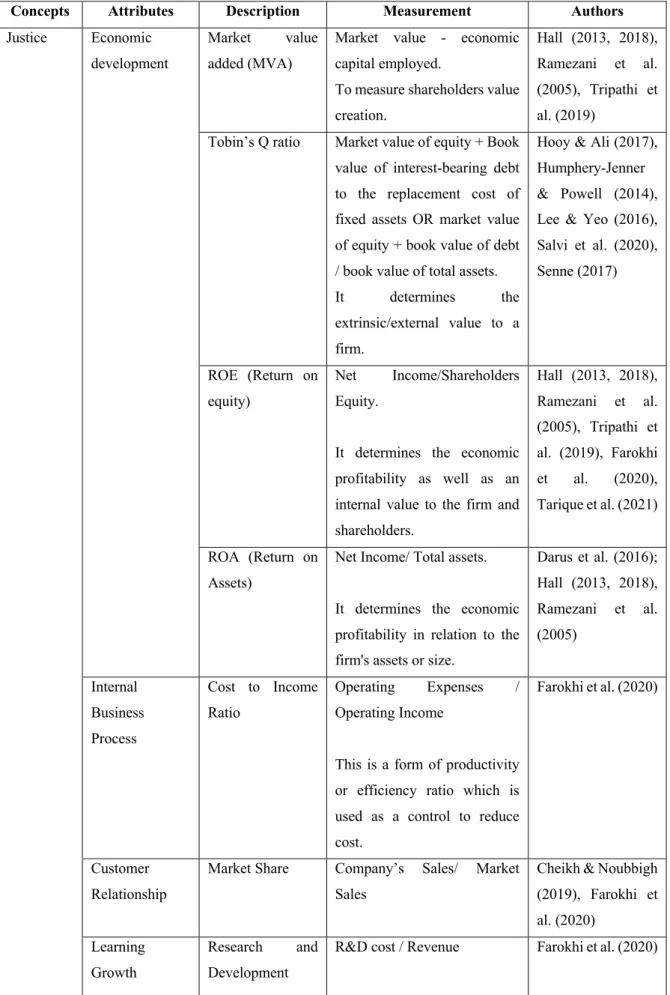
The third classification is maslahah. In this classification, Al-Ghazali broke it down into five further 5 categories: protecting faith, life, posterity, intellect, and wealth (refer to figure 2). Nevertheless, the researchers found that the measurements of Islamic social performance like zakat, donation, infaq and sedekah aim to help achieve those five preservations. Table 1 details the measurements under each classification with the authors’
references.
101
Table 1: Measurements for value creation for ShCCs Maqasid Shariah-based.
Concepts Attributes Description Measurement Authors
Justice Economic development
Market value added (MVA)
Market value - economic capital employed.
To measure shareholders value creation.
Hall (2013, 2018), Ramezani et al.
(2005), Tripathi et al. (2019)
Tobin’s Q ratio Market value of equity + Book value of interest-bearing debt to the replacement cost of fixed assets OR market value of equity + book value of debt / book value of total assets.
It determines the
extrinsic/external value to a firm.
Hooy & Ali (2017), Humphery-Jenner
& Powell (2014), Lee & Yeo (2016), Salvi et al. (2020), Senne (2017)
ROE (Return on equity)
Net Income/Shareholders Equity.
It determines the economic profitability as well as an internal value to the firm and shareholders.
Hall (2013, 2018), Ramezani et al.
(2005), Tripathi et al. (2019), Farokhi et al. (2020), Tarique et al. (2021)
ROA (Return on Assets)
Net Income/ Total assets.
It determines the economic profitability in relation to the firm's assets or size.
Darus et al. (2016);
Hall (2013, 2018), Ramezani et al.
(2005)
Internal Business Process
Cost to Income Ratio
Operating Expenses / Operating Income
This is a form of productivity or efficiency ratio which is used as a control to reduce cost.
Farokhi et al. (2020)
Customer Relationship
Market Share Company’s Sales/ Market Sales
Cheikh & Noubbigh (2019), Farokhi et al. (2020)
Learning Growth
Research and Development
R&D cost / Revenue Farokhi et al. (2020)
102 (R&D)
Expenditure ratio Education Education /
Human
Resource / Training
Human Resources Development
Education and Training Expenses / Total Expenses This ratio represents the Contribution to Human Resources Development.
Mohammed & Taib (2015), Nugraheni (2018), Tarique et al. (2021)
Maslahah Society &
Social Environment (Islamic Social Performance)
Zakat Zakah Distribution / Profit Before Tax
Mohammed & Taib (2015), Nugraheni (2018), Tarique et al. (2021), Ramli et al. (2018), Al- shammari (2013) Sadaqah (Charity) Charity Distribution (if any) /
Profit Before Tax
Waqf Waqf Distribution (if any) / Profit Before Tax
Note: The classifications are based on the concept of Abu Zahrah (1997)’s Maqasid Shariah theoretical framework.
7.0 CONCLUSION
Integrated reporting aims to convey how the interconnected six capitals, namely financial, manufactured, intellectual, nature, human and social relationship, create value over the short, medium and long term. Since those capitals cannot work in a silo, an integrated thinking approach is utilized to integrate those interdependent capitals to form strategies to create value for organizations. Shariah-compliant Companies (ShCCs) are listed companies classified as companies adhering to the principles of Shariah. Discussion on Maqasid Shariah value creation for these ShCCs is essential to drive integrated thinking in ShCCs to work to fulfill Muslim stakeholders, thus giving advantage to other stakeholders.
By matching with the Maqasid Shariah framework, this paper discovers measurements of value creation that fall under the broad classification of Abu Zahrah (1997)’s Maqasid Shariah Framework. Under the justice classification, financial performance measurements fall in economic development, while internal business process, learning growth and research and development are in the stakeholder value creation. The second classification of education consists of measurements of ratios on education and human resource development. The third classification of maslahah is represented by the ratios of zakat, infaq, sadaqah over profit before tax. The findings support the contention of Shariah enterprise theory, as an extension of legitimacy and stakeholder theory.
103
This paper has twofold implications. The first one is the academic contribution. The measurements listed in table 1 can be utilised in future research that examines the relationship with value creation from the Maqasid Shariah perspective. For example, in corporate governance, risk management, internal controls and other factor determining studies. The many measurements of value creation can be reduced to dimension, for example, by using the principal component analysis, or alternatively, the measurements can be aggregated in an index. The second implication of this paper is the practical contribution where the measurements suggested can be used by the monitoring agency such as the securities commission or the stock exchange like Bursa Malaysia to monitor the performance of companies under the Shariah classification. This is essential to create confidence in the eyes of Muslim stakeholders.
The limitation of this paper is that the measurements are based on the financial information available in the financial statements. In this case, non-financial data is ignored.
The financial information has its strength in verifiability and is audited. Nevertheless, future research may explore the value creation obtained from non-financial data either via quantitative or qualitative research. Indeed, this current research provides various opportunities for future research to explore.
ACKNOWLEDGEMENT
This article is funded by the Ministry of Higher Education Malaysia, Accounting Research Institute, HICoE of Universiti Teknologi MARA and Geran Insentif Penyelidikan (GIP):
Integrated Reporting Earnings Quality Board Structure and Value Creation for Shariah- compliant Companies, Grant No., 600-RMC/GIP 5/3 (111/2021).
REFERENCES
Abdelmawla, M. A. (2014). The impacts of zakat knowledge on poverty alleviation in Sudan:
An empirical investigation (1990-2009). Journal of Economic Cooperation and Development, 35(1), 61-84.
Abu Zahrah, M. (1997). Usul al-Fiqh. Dar al-Fikr al-Arabi.
Adams, C. (2017). Understanding integrated reporting. Routledge.
Adnan, M. A., & Gaffikin, M. (1997). The Shari’ah, Islamic banks and accounting concepts and practices. In Accounting, Commerce and Finance: The Islamic Perspective International Conference. University of Western Sydney.
Al-Htaybat, K., & Alberti-Altayebat, L. von. (2018). Integrated thinking leading to integrated
104
reporting: Case study insights from a global player. Accounting, Auditing and Accountability Journal, 31(5), 1435–1460.
Al-Shammari, B. (2013). An investigation of voluntary disclosure by Kuwaiti Shariah- compliant companies. Journal of Economic and Administrative Sciences, 29(1), 21-41.
Azis, N. K., Marzuki, M. M., & Majid, W. Z. N. A. (2020). Fraud prevention in Malaysia : Maqasid al-Shariah perspective. Global Business and Management Research: An International Journal, 12(2), 104–117.
Camilleri, M. A. (2018). Theoretical insights on integrated reporting: The inclusion of non- financial capitals in corporate disclosures. Corporate Communications: An International Journal, 23(4), 567-581.
Chang, S., & Jo, H. (2019). Employee-friendly practices, product market competition, and firm value. Journal of Business Finance and Accounting, 46(1–2), 200–224.
Chapra, M. U. (2000). The future of economics: An Islamic perspective. The Islamic Foundation.
Cheikh, I. B., & Noubbigh, H. (2019). The effect of intellectual capital drivers on performance and value creation: The case of Tunisian non-financial listed companies. Journal of the Knowledge Economy, 10(1), 147–167.
Darus, F., Mad, S., Nejati, M., & Yusoff, R. (2016). When quality matters! CSR disclosure and value creation. International Journal of Economics and Management, 10(S2), 285–302.
Dilling, P. F. A., & Caykoylu, S. (2019). Determinants of companies that disclose high-quality integrated reports. Sustainability (Switzerland), 11(13), 1-31.
Dumay, J., La Torre, M., Bernardi, C., & Guthrie, J. (2019). Integrated reporting and integrated thinking: Practical challenges. In S. Arvidsson (Eds.), Challenges in managing sustainable business (pp. 25-54). Palgrave Macmillan.
El-deeb, M. S., & Megeid, N. S. A. (2015). Impact of earnings management on investor’s sensitivity using shareholder impact of earnings management on investor’s sensitivity using shareholder value creation. Dar Almandumah.
Falson, J. (2019). Analytic hierarchy process: An empirical valuation for intangible assets.
Journal of the Malaysian Institute of Planners, 17(1), 240–249.
Farokhi, S., Roghanian, E., & Samimi, Y. (2020). Quantitative target setting in balanced scorecard method using simultaneous equations system and goal programming.
International Journal of Productivity and Performance Management, 69(9), 2089–2118.
Feng, T., Cummings, L., & Tweedie, D. (2017). Exploring integrated thinking in integrated reporting – An exploratory study in Australia. Journal of Intellectual Capital, 18(2), 330–
105 353.
Hall, J. H. (2013). Toward improved use of value creation measures in financial decision- making. The Journal of Applied Business Research, 29(4), 1175–1188.
Hall, J. H. (2018). Value creation measures: An industry-based study. International Journal of Productivity and Performance Management, 67(2), 426–444.
Haniffa, R., Hudaib, M., & Mirza, A. M. (2002). Accounting policy choice within the Shari’Ah Islami’Iah framework. (Unpublished Paper Number 02/04). Department of Accounting &
MIS, King Fahd University of Petroleum & Minerals.
Haniffa, R., & Hudaib, M. (2007). Exploring the ethical identity of Islamic banks via communication in annual reports. Journal of Business Ethics, 76(1), 97–116.
Hasan, Z., & Asutay, M. (2017). Maslahah in stakeholder management for Islamic financial institutions. Islamic Quarterly, 61(4), 505–537.
Hooy, C. W., & Ali, R. (2017). Does a Muslim CEO matter in Shariah-compliant companies?
Evidence from Malaysia. Pacific Basin Finance Journal, 42(1), 126–141.
Humphery-Jenner, M., & Powell, R. (2014). Firm size, sovereign governance, and value creation: Evidence from the acquirer size effect. Journal of Corporate Finance, 26(1), 57–77.
Ibrahim, S. H. M. (2000). The need for Islamic accounting: Perceptions of its objectives and characteristics of Islamic accounting: Perceptions of Malaysian Muslim accountants and accounting academics. (Unpublished doctoral dissertation). University of Dundee.
IIRC. (2013). The international IR framework. International Integrated Reporting Council.
IIRC. (2021). The international IR framework. International Integrated Reporting Council.
Kalafut, P. C., & Low, J. (2001). The value creation index: Quantifying intangible value.
Strategy & Leadership, 29(5), 9–15.
Kamali, M. (1999). Maqasid Al-Shari’ah: The objectives of Islamic law. Islamic Studies, 38(2), 193–208.
Kaya, C. T., Erguden, A. E., & Sayar, A. Z. (2016). Essence of integrated reporting: A holistic framework for sustainability and value creation. International Journal of Academic Research in Accounting, Finance and Management Sciences, 6(1), 29–34.
Knauer, A., & Serafeim, G. (2014). Attracting long-term investors through integrated thinking and reporting: A clinical study of a biopharmaceutical company. Journal of Applied Corporate Finance, 26(2), 57–64.
Lee, K. W., & Yeo, G. H. H. (2016). The association between integrated reporting and firm valuation. Review of Quantitative Finance and Accounting, 47(4), 1221–1250.
106
Mähönen, J. (2020). Integrated reporting and sustainable corporate governance from European perspective. Accounting, Economics and Law: A Convivium, 10(2), 20180048.
Malik, B. A. (2016). Philanthropy in practice: Role of zakat in the realization of justice and economic growth. International Journal of Zakat, 1(1), 64–77.
McGuigan, N., Haustein, E., Kern, T., & Lorson, P. (2020). Thinking through the integration of corporate reporting: Exploring the interplay between integrative and integrated thinking. Meditari Accountancy Research, 29(4), 775-804.
Mergaliyev, A., Asutay, M., Avdukic, A., & Karbhari, Y. (2019). Higher ethical objective (Maqasid al‑Shari’ah) augmented framework for Islamic banks: Assessing ethical performance and exploring its determinants. Springer.
Mohammed, M. O., & Taib, F. M. (2015). Developing Islamic banking performance measures based on Maqasid al-Shari’ah framework: Cases of 24 selected banks. Journal of Islamic Monetary Economics and Finance, 1(1), 55–77.
Mohammed, N. F., Mohd Fahmi, F., & Ahmad, A. E. (2019). The need for Islamic accounting standards: The Malaysian Islamic financial institutions experience. Journal of Islamic Accounting and Business Research, 10(1), 115–133.
Moolman, J., Oberholzer, M., & Steyn, M. (2019). The effect of integrated reporting on integrated thinking between risk, opportunity and strategy and the disclosure of risks and opportunities. Southern African Business Review, 20(1), 600–627.
Moran, P., & Ghoshal, S. (1999). Markets, firms, and the process of economic development.
Academy of Management Review, 24(3), 390–412.
Muratov, M. (2019). Integrated reporting from an Islamic perspective: Analysis of selected Islamic banks. (Unpublished master dissertation). College of Islamic Studies, Hamad Bin Khalifa University.
Nugraha, E., Nugroho, L., Lindra, C., & Sukiati, W. (2020). Maqashid Sharia implementation in Indonesia and Bahrain. Etikonomi, 19(1), 155–168.
Nugraheni, P. (2018). Sharia supervisory board and social performance of Indonesian Islamic banks. Jurnal Akuntansi Dan Auditing Indonesia, 22(2), 137-147.
Nugroho, L., Husnadi, T. C., Utami, W., & Hidayah, N. (2017). Maslahah and strategy to establish a single state-owned Islamic bank in Indonesia. Tazkia Islamic Finance and Business Review, 10(1), 17–33.
Osman, A. Z. (2010). Accountability of waqf management: Insight frompraxis of nongovernmental organisation (NGO). In The 7th International Conference on the Tawhidi Epistemology: Zakat and Waqf Economy, 6th-7th January (pp. 153-176). Institut
107 Islam Hadhari, Universiti Kebangsaan Malaysia.
Purdy, D. E. (1983). The enterprise theory: An extension. Journal of Business Finance &
Accounting, 10(1), 521–541.
Ramezani, C. A., Soenen, L. A., & Jung, A. R. (2005). Growth, corporate profitability, and shareholder value creation. SSRN.
Ramli, N. M., Ali, N. S. A. M., & Muhammed, N. A. (2018). Integrated reporting based on Maqasid Al-Shariah: A proposed framework for Islamic non-profit organizations.
Advances in Economics, Business and Management Research, 57(November), 63–72.
Roman, A. G., Mocanu, M., & Hoinaru, R. (2019). Disclosure style and its determinants in integrated reports. Sustainability (Switzerland), 11(7), 1–17.
Said, R., Abd Samad, K., Mohd Sidek, N. Z., Ilias, N. F., & Omar, N. (2018). Corporate social responsibility disclosure index of Malaysian Shariah–compliant companies. International Journal of Ethics and Systems, 34(1), 55–69.
Sajid, M., & Afza, T. (2018). Does managerial behavior of managing earnings mitigate the relationship between corporate governance and firm value? Evidence from an emerging market does managerial behavior of managing earnings mitigate the relationship between corporate governance and. Future Business Journal, 4(1), 139–156.
Salvi, A., Vitolla, F., Giakoumelou, A., Raimo, N., & Rubino, M. (2020). Intellectual capital disclosure in integrated reports: The effect on firm value. Technological Forecasting and Social Change, 160(C), 1-8.
Senne, L. (2017). The value creation of integrated reporting: A stakeholder perspective and organisational performance. (Unpublished doctoral dissertation). University of Pretoria.
Serafeim, G. (2015). Integrated reporting and investor clientele. Journal of Applied Corporate Finance, 27(1), 34–51.
Sudarma, M., Triyuwono, I., Ludigdo, U., & Meutia, I. (2010). Qualitative approach to build the concept of social responsibility disclosures based on Shari’ah enterprise theory.
SSRN.
Tarique, K. M., Islam, R., & Mohammed, M. O. (2021). Developing and validating the components of Maqasid al- Shari’ah – Based performance measurement model for Islamic banks. International Journal of Islamic and Middle Eastern Finance and Management, 14(2), 366–390.
Tripathi, M., Kashiramka, S., & Jain, P. K. (2019). Has EVA evolved to outperform conventional earnings measures in determining firm’s value? A case of Indian consumer firms. Asia-Pacific Journal of Accounting & Economics, 00(00), 1–15.
108
Villiers, C. de, Rinaldi, L., & Unerman, J. (2014). Integrated reporting: Insights, gaps and an agenda for future research. Accounting, Auditing and Accountability Journal, 27(7), 1042–1067.
Villiers, C. de., & Dimes, R. (2020). How management control systems enable and constrain integrated thinking. Meditari Accountancy Research, 29(4), 851-872.
Villiers, C. de., Venter, E. R., & Hsiao, P. K. (2016). Integrated reporting: Background, measurement issues, approaches and an agenda for future research. Accounting and Finance, 57(4), 937–959.
Wardani, M. K., & Sari, D. D. (2018). Disclosure of Islamic social reporting in Sharia banks:
Case of Indonesia and Malaysia. Journal of Finance and Islamic Banking, 1(2), 105–120.