Cultivating Awareness on Email Security Threats among School Children via Game-Based Learning Approach (CEG)
by
Nurul Hazwani binti Sahadek (11295)
Dissertation report submitted in partial fulfilment of the requirements for the
Bachelor of Technology (Hons) (Business Information Systems)
MAY2011
Universiti Teknologi PETRONAS Bandar Seri Iskandar
31750 Tronoh Perak Darul Ridzuan
CERTIFICATION OF APPROVAL
Cultivating Awareness on Email Security Threats among School Children via Game-Based Learning Approach (CEG)
Approved by,
by
Nurul Hazwani binti Sahadek
A project dissertation submitted to tbe Business Information Systems Programme
Universiti Teknologi PETRONAS in partial fulfilment of the requirement for tbe
Bachelor of Technology (Hons) (Business Information Systems)
(Ms Mazeyanti bt Mohd Ariffin)
UNIVERSITI TEKNOLOGI PETRONAS TRONOH, PERAK
MAY2011
CERTIFICATION OF ORIGINALITY
This is to certify that I am responsible for the work submitted in this project, that the original work is my own except as specified in the references and acknowledgements, and that the original work contained herein have not been undertaken or done by unspecified sources or persons.
~/
Nurul Hazwani bt Sahadek
ABSTRACT
Internet has brought a huge transformation in many aspects of our life as it is one of the biggest contributors in making the world into global village. The percentage of internet users has increase rapidly across age including children nowadays. Despite giving many benefits to the users, the impressive change of Internet has brought high concern about the threats to safety and security among the users especially for the children nowadays.
High concern rises among global expertises on child's online protection as it can harm the children physically and emotionally. Email security threats are one of the cyber threats problem that child should aware to avoid any incidental causes which lead towards negative impact. However, the level of awareness on this issue among Malaysian children is low. Therefore, this paper proposes an alternative method in cultivating early awareness on email security threats among school children in Malaysia. Child Email Game (CEG) has been developed based on game based learning model by using Adobe Flash Professional CS 5 software. Through this interactive and fun approach, CEG is expected to assist them in identifying the emails security threats accordingly.
ACKNOWLEDGEMENT
In the name of Allah The Most Gracious and The Most Merciful.
First and foremost, praised be to Allah The Almighty as for His blessings, I have successfully completed my Final Year Project (FYP) under the supervision of Ms.
Mazeyanti Mohd Ariffin .I also would like to express my deepest gratitude and appreciation to my supervisor as she has been a great source of reference in fulfilling all the FYP requirements.
Apart from that, my thanks also go to all of my colleagues especially those who are also under the supervision of my supervisor. Their presence and support definitely motivate me to do my very best in completing this project.
Once again, many thanks to all of those mentioned above and also those who are indirectly contribute to the success of this project.
TABLE OF CONTENTS
CERTIFICATION 111
ABSTRACT iv
ACKNOWLEDGEMENT v
CHAPTER I: PROJECT BACKGROUND 1.1 Background of Study
1.2 Problem Statement • 2
1.3 Objectives . 5
1.4 Scope of Study . 5
1.5 Relevancy of the Project. 6
CHAPTER2: LITERATURE REVIEW
2.1 Play & Child Development • 7
2.2 Play & Technology. 9
2.3 Game • II
2.4 Game-Based Learning 14
2.5 Instructional Design Principles 17
2.6 Related Works • 18
CHAPTER3: METHODOLOGY
3 .I Game Development Flowchart 21
CHAPTER4: RESULT AND DISCUSSION
4.1 CEG Prototype . 28
4.2 CEG Testing 39
CHAPTERS: CONCLUSION & RECOMMENDATION 48
REFERENCES 50
LIST OF FIGURES
Figure I Percentages Shares oflnternet Users Figure 2 Incidents Reported in Q3 2008 and Q4 2008
Figure 3 Statistical of Malaysian Children Awareness towards Cyber Threats Figure 4 Parents Actions towards Internet Activity within Their Children Figure 5 General Structure and Flow of the Games
Figure 6 Hospitality GBL
Figure 7 Computer Software GBL Figure 8 Virus Poster
Figure 9 SP AM Poster
Figure 10 Email and SPAM Game Figure II Game Development Flowchart Figure 12 CEG Flowchart
Figure 13 Welcome Page Screen Figure 14 How to Play Screen Figure 15 Did You Know Screen Figure 16 Spam Tutorial Screen Figure 17 Virus Tutorial Screen Figure 18 Phishing Tutorial Screen Figure 19 Level 1 Instruction Figure 20 Level 1 Question
I
3 3 4 14 16 16 20 20 20 21 23 24 24 24 24 25 25 25 25
Figure 21 Let's Try Again Screen 25
Figure 22 Congratulation Screen 25
Figure 23 Level 2 Instruction 26
Figure 24 Level2 question 26
Figure 25 Let's Try Again Screen 26
Figure 26 Congratulation Screen 26
Figure 27 CEG Welcome Page 28
Figure 28 CEG How to Play? Page 29
Figure 29 CEG Did You Know? Page 29
Figure 30 CEG Virus Page 30
Figure 31 CEG Phishing Page 30
Figure 32 CEG Spam Page 31
Figure 33 CEG Levell Page 31
Figure 34 CEG Levell Ql Page 32
Figure 35 CEG Level I Q2 Page 32
Figure 36 CEG Level I Q3 Page 33
Figure 37 CEG Levell Q4 Page 33
Figure 38 CEG Let's Play Again Page 34
Figure 39 CEG Let's Play Level2 Page 34
Figure 40 CEG Level 2 Page 35
Figure 41 CEG Level 2 Q I Page 35
Figure 42 CEG Level 2 Q2 Page Figure 43 CEG Levell Q3 Page Figure 44 CEG Level 2 Q4 Page
Figure 45 CEG Let's Play Again Page 2 Figure 46 End Page
Figure 4 7 CEG Overall Interface Figure 48 CEG Tutorial
Figure 49 CEG Instruction
Figure 50 Children's Feeling When Playing CEG Figure 51 Email Security Threats Issues Awareness Figure 52 Type of Email Recognition
Figure 53 Email Response Figure 54 Reading Notes Result Figure 55 Playing CEG Result
Figure 56: Reading Notes & Playing CEG Result
36 36 37 37 38 39
40 41 42 43 44 44 46 46 47
LIST OF TABLES
Table 1 Theories of Play
Table 2 Multiple Intelligences and Technology Table 3 Game Types
Table 4 The Cross Sector Adoption of Game-Based Leaming Table 5 Instructional Design Principles
Table 6 Comparison between Existing Email Game Table 7 Proposed CEG criteria
8 9 12 16 17 18 19
CHAPTERl
PROJECT BACKGROUND
1.1 BACKGROUND OF STUDY
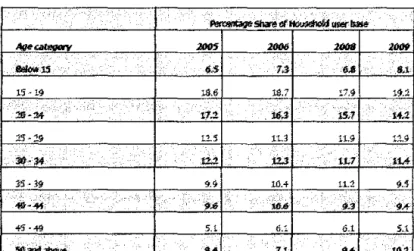
Internet has brought a huge transformation in many aspects of our life as it is one of the biggest contributors in making the world into global village. Because of its flexibility, the use of internet has grown tremendously since it was introduced. Domestic Trade, Cooperative and Consumerism Deputy, Minister Tan Lian Hoe claimed that the rate of internet users in Malaysia has increased rapidly in nine years which achieved the government target through half percent broadband penetration (Nam News Network, 2010). Figure 1 below shows the percentage share of internet users by age.
' '
_ ... - ...
·- ... ,
·.· , '"""' ...
2006 1 .• 2006. .. - .. ,
15 -1<} :l-&.6 W.7 11.~ H.:!
'
,;,.,..
' ', · .. ' I 11.2: . 163,1!1.1 t.f.:Z
15~19 11.5 11.1 :i.:J..9 1-1.9
:lii·U
"'"'
' ;U.3 U.1 '...
35. ~9"
.,.
1Jl.4 11.:2 •.H..,,:.;
· .. · ... ···' . ~
... ,., ... ...
. '. ...
45·49 5.1 6.: 6.1 5.1
Sfl-iarndabov!i
...
7.1 M ...:.Figure 1: Percentage Shares oflnternet Users by Age (Koay, 2010)
Norton, an Internet company disclosed that on average Malaysian children spend more than fifty hours online every month (Joshua, 2010). Therefore, in this challenging world, internet has become a part of kid's natural environment as it provides children with variety of learning opportunities that emerge to enhance problem solving, critical thinking skills, decision making, creativity, language skills, knowledge, research skills, the ability of integrate information social skills and self esteem (Mayesky, 2009).
However, the impressive change of Internet has brought high concern about the threats to safety and security among the users especially for the children nowadays. According to International Telecommunication Union (2010), there are several issues that have been discussed by global expertise on the bad and negative impacts underlying on internet usage among children such as online gaming and addiction, online fraud, pornography, violence, cyber bullying and racism as well as email security threats (Cocca, 2005).
1.2 PROBLEM STATEMENT
Malaysian Communications and Multimedia Commission (2006) defined spam as 'all associated bulk emails' that shares the common aspects such as non-consensual, indiscrirninant, repetitious, illegal as well as unsound content or being forged or altered.
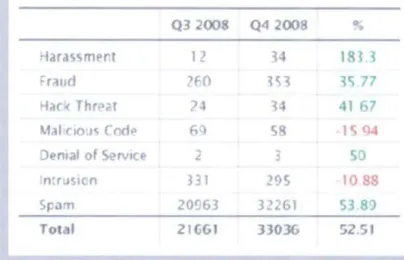
The spam incidents emerge day by day and this issue has been discussed globally by the expertise. Based on Figure 2, MyCERT (2008) reported that spam mark the highest case compared to other incidents and second highest percentage between Quarter 3 and Quarter 4.
Q3 2008 Q4 2008 o•
. ..
Harassmer.r 12 34 183 3
Fraud ](.0 ~51 31\ 77
Hi!Ck ThrPat 24 ~4 41 67
Mal no,,., Cod~> 6() 58 IS Q4 Demal of ServiCe 2 "
'
sontnJSIOn 331 295 1088
Spa!Tl 20!)63 32261 53.89
Total ZIGGJ 33036 ~2.51
Figure 2: Incidents Reported in Q3 2008 and Q4 2008 (MyCERT, 2008)
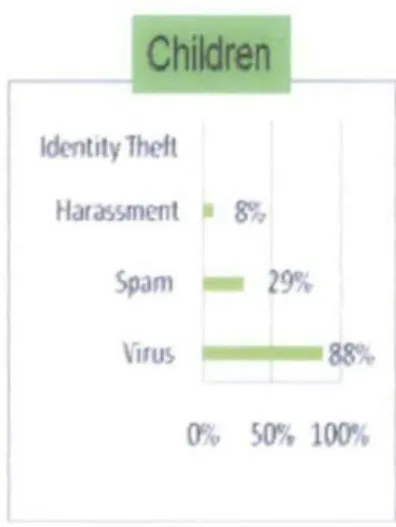
According to the survey done by Mohd Arif Ibrahim (201 0), the level of awareness among Malaysian children about identity theft, harassment and spam is low. Figure 3 shows the statistical of Malaysian children awareness towards cyber threats.
r
l
ldcnt•tylht>lltfara!.~ent
· ~
Spam \iiU~
-
2~hm l
0'~ 5()'1. 1~.
I
Figure 3: Statistical of Malaysian Children A ware ness towards Cyber Threats
(Mohd Arif Ibrahim, 20 I 0)
Based on Cocca (2005), there are three main categories of threats to email security which are viruses, spam and phishing. MyCERT (2008) stated that spam emails were recorded higher with phishing emails as the top categories and Trojan emails go after.
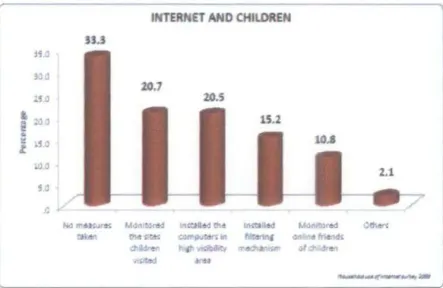
Lack of awareness on this crucial issue may harm children who are the next generation in the future. Figure 4 illustrates Malaysian parents' actions towards their children on the issue of the internet. This problem become more crucial as no measures taken by the parents indicate the higher percentage compared to others.
!OJI
;~ J
t
200j
.1JI-~ 0
33.3
Hdm~n•~
:t" :'111
INTER~ET AND CHILDREN
M~n.::.J.rltd "'"" ~~~-~ ln~H M<lftroll•~ ..:t~w<
~~:~ compy..-.ln
,__.
~nOne II'-."""'""
y, <rl'
h'C'I lvmt:ll;tf l ... ll'do~lOft' .,f~~Figure 4: Parents Actions towards Internet Activity within Their Children (Koay, 201 0)
Therefore, there is a need to nurture early awareness on emails security threats among school children nowadays as they are part of the email users' portion. Thus, Child Email Game (CEO) is proposed to assist them in identifying the emails threats through game- based learning approach.
1.3 OBJECTIVES
1. To identify email security threats issues.
2. To develop a computer game that cultivates early awareness among children on email security threats issues.
1.4 SCOPE OF STUDY
This research project target is to get the understanding on email security threats elements and cultivating early awareness about safer internet environment among children. In parallel with this project, one game-based learning application has been proposed to measure the improvements on children awareness. The main target audiences are the children aged 11 to 13.
According to Baumgarten (2003), during this age, the youngsters become inunersed in internet activities from which they can learn to have fun and gain self-esteem. The growing ability to reason logically provides them the opportunity to engage in strategy -based activities and contests, mathematical understanding allows for more complicated number-based play and more advanced form of scoring. Youngster in this age group has a desire in internet activities.
CEO is designed to meet current situation where the focus point is not on the spam problem only. Blending together with the virus and phishing email issues, the game is
need to identify the characteristics of emails security threats before they can classify them accordingly in order to get higher point.
Game-based learning has been discovered many years before and this medium is believed to provide fun and interesting learning process for the children nowadays.
There are many tools available in the market used to develop a game such as RPG Maker, A Gen 2D Game Engine, Flash, Game Maker and Game Editor. In completion with this project, CEG has been developed by using Adobe Flash Professional CS5 software.
1.5 THE RELEVANCY OF THE PROJECT
The project undertaken is in line with today's issues which is the emerging of email security threats problems. CEG is expected to nurture early awareness about this issue among kids nowadays and give them an overview on the precaution measures that should be practice in the future.
CHAPTER2
LITERATURE REVIEW
2.1 PLAY & CHILD DEVELOPMENT
According to Sully (2007), play is defined as 'freely chosen; personally directed, intrinsically motivated behavior that actively engages the child. Play can be fun or serious.'. Play is actually an essential routine in children's daily life. According to Ginsburg, et a!. (2007), play is a right of every child as it drives towards child development optimization.
Play and children cannot be apart as they are by nature playful. There are some of play theorists throw in their thought in play definition and key concept(s) that indicate play has a crucial role in children's learning. Table 1 below gives general overview on each theorist's definition of play (Mayesky, 2009):
Table I: Theories of play
Theorist Definition of Play Key Concept{$)
Parten (1932) Play is a measure of child's increasing Developmental stages of play: onlooker, solnary, parallel,
social maturity associative, cooperative
Play is assimilation child makes world 3 stages of play: sensorimotor, symbolic and game with Piaget (1962)
adapt to him rule
Smilansky Six criteria of dramatic play: imitative role-play, make
Play aids child's social development believe, verbal make believe, persistence in role play, (1968)
interaction and verbal communication
Vygotsky Play directly supports the development of
Symbolic play promotes abstract thinking (1977) child's cognitive powers
There are many benefits gain by children while playing. According to Mayesky (2009), play can contribute towards physical growth, mental growth, emotional growth and social growth. Based on Ginsburg, et al. (2007) play let the children stimulate their creativity and at the same time develop their imagination, dexterity and physical as well as cognitive and emotional strength. Apart from that, play is essential to healthy brains development as they engage and interact in the world around them. As a result, they able to cultivate new competencies that lead to enhance confidence and the re-saliency they will need to face future challenges (Hurwitz, 2003).
Based on Ginsburg, et al. (2007), play is central to the academic environment as it assist children to adjust to the school surrounding and enhance children's learning readiness, learning behavior and problem solving skills.
CEG is expected to assist children in enhancing their creativity and imagination as they need to capture and digest the entire emails security threats clue before classifying it
accordingly. This would direct towards positive growth of mental and emotional among the children.
2.2 PLAY & TECHNOLOGY
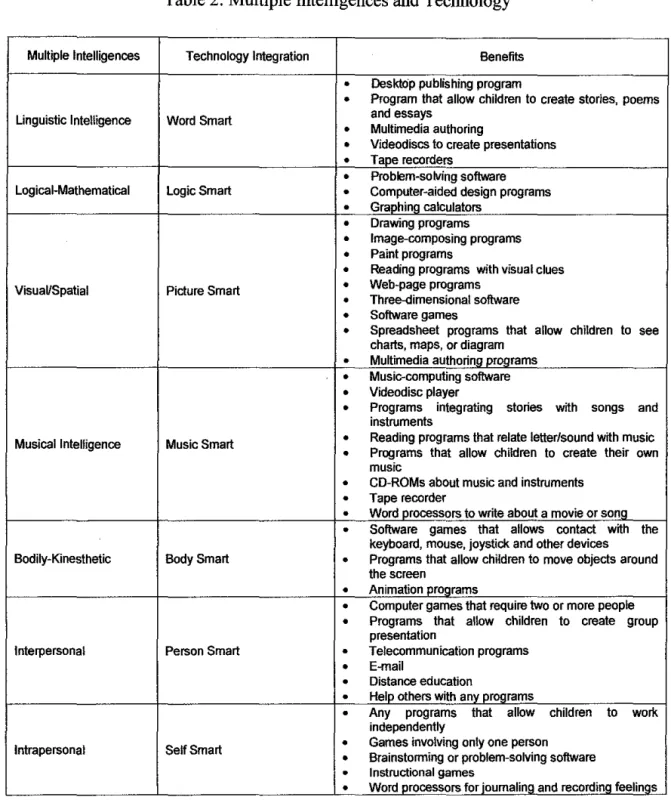
According to Downey, Hayes and O'Neill (2007), there are many key skills that children can develop through collaboration between technology and play such as social skills and problem-solving strategies. Table 2 shows the interrelation between technology and multiple intelligences that give benefits to the children (Mayesky, 2009).
Table 2: Multiple Intelligences and Technology
Multiple Intelligences Technology Integration Benefits
• DesktOp publishing program
• Program that allow children to create stories, poems Linguistic Intelligence Word Smart and essays
• Multimedia authoring
• Videodiscs to create presentations
• Tape recorders
• Problem-solving software Logical-Mathematical Logic Smart • Computer-aided design programs
• Graphing calculators
• Drawing programs
• Image-composing programs
• Paint programs
• Reading programs with visual clues
VisuaVSpatial Picture Smart • Web-page programs
• Three-dimensional software
• Software games
• Spreadsheet programs that allow children to see charts, maps, or diagram
• Multimedia authoring programs
• Music-computing software
• Videodisc player
• Programs integrating stories with songs and instruments
Musical Intelligence Music Smart • Reading programs that relate letter/sound with music
• Programs that allow children to create their own music
• CO-ROMs about music and instruments
• Tape recorder
• Word processors to write about a movie or song
• Software games that allows contact wtth the keyboard, mouse, joystick and other devices Bodily-Kinesthetic Body Smart • Programs that allow children to move objects around
the screen
• Animation programs
• Computer games that require two or more people
• Programs that allow children to create group presentation
Interpersonal Person Smart • Telecommunication programs
• Distance education
• Help others with any programs
• Any programs that allow children to work independently
lntrapersonal SeW Smart • Games involving only one person
• Brainstorming or problem-solving software
• Instructional games
• Word processors for joumaling and recording feelings
Based on the Table 2 above, CEG is believed to encourage the children towards developing their multiple intelligences especially logical-mathematical, visual/spatial and interpersonal skill.
2.3GAME
2.3.1 The Game
Game is a difficult concept to describe. According to Adams (20 10), game is defined as
"a type of play activity, conducted in the context of a pretended reality, in which the participant(s) try to achieve at least one arbitrary, nontrivial goal by acting in accordance with rules". Salen and Zimmerman (2003) illustrated a game as a system in which players engage in simulated conflict, outline by rules that direct towards an experimental effect.
According to Sanford and Williamson (2005), social scientist define games through their psychological while social functions, anthropologists define them according to their historical origin. For businessmen, game is defined through their usage. Oblinger (2006) claimed that games should be thought of as a family of related items because they are different as they are not designed for the same audiences.
2.3.2 Game Types
Based on Grace (2005), there are six main categories of game types which are action, adventure, puzzle, role-playing, simulation and strategy. Table 3 shows the game types and the corresponding description.
Table 3: Game Types
Game Types Description
Action Game that offer intensity of action as the primary attraction where it emphasized on physical challenges, including hand-eye coordination and reaction-time
-
Adventure Game that focus on the main attractions which are exploration and puzzle solving instead of physical challenge
Puzzle Game that offer puzzle solving
Role-playing Game that offer the player an opportunity to immerse themselves in the player character's situation
Simulation Game that attempts to replicate various activities in real life in the fonn of game for various purpose such as training, analysis and prediction
Strategy Game that emphasizes on reasoning and problem-solving
Grace (2005) defined game genre as 'the way the story is told'- The game genre would be drama, crime, fantasy, horror, mystery, science fiction and war espionage_
Based on the game types characteristics described in Table 3 above, CEG can be classified as a simulation game_ According to Narayanasamy et a! (2005), Freedictionary defmes simulation games as games that blend together the elements such as skill, chance and strategy which result in the simulation of a complex structure.
Payne (2005) claimed that simulation games can be participatory, iterative, procedural or situational in nature. For CEG, this game is fall under procedural simulation games because it is designed to expose the children on email security threats issues which required them to respond to the email received by following set of guideline as given in tutorial part.
2.3.3 Game and Education
In the 21'1 century, we will all be living in a future of exponential change as the Information Technology (IT) power is rapidly transform across the time (Prensky, 2006). We can see the immediate tools switching as example iPad nowadays able to replace and enhance walkman functionality.
Sandford ,Ulicsak, Facer, and Rudd (2006) stated that in a recent survey, 36% of primary school teachers and 27% of secondary school teachers said that they had used games to teach. According to Koster (2005), games are a fundamental part of the evolving human experience and the way in which we learn, providing the opportunity to practice and explore in a safe environment, teaching skills like aiming, timing, hunting, strategy and manipulation of power.
If games are experiential, active, problem-based and collaborative then they have the potential to be effective environments for learning, not specifically because they are games but because the exhibit the characteristics of constructivist learning environment (Whitton, 2007).
2.4 GAME-BASED LEARNING
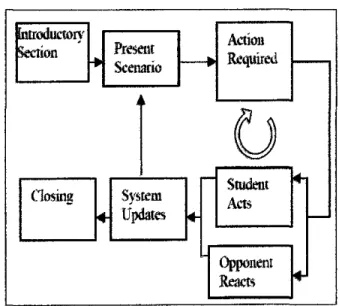
Games have been widely accepted as a good platform to promote learners to actively participate in learning activities (Baid and Lambert, 2010). According to Noor Azli, Nor Azan and Shamsul Bahari (2008), games are much similar like simulation in their fundamental structure and it can be divided into three main parts which are the introduction, the body of the game and the conclusion. Figure 5 below depicts the general structure and flow of the games.
rntroductory
Presetl! Action
Section
..
Scenario----+
Required 1--1 - u
~ Student nosing System Act!
~ Updates ~
r-
Opponent
r.
React~
Figure 5: General Structure and Flow of the Games (Noor Azli, Nor Azan and Shamsul Bahari, 2008)
Game-based learning is often experience-based or exploratory as it relies on experiential, problem-based or exploratory learning approaches (Freitas, 2006). Dickey (20 1 0) claimed researchers have indicated that game-based learning could be the fmest method to generate students' learning motivation.
According to Mitchel (2004), game-based learning approach can stimulate the enjoyment, motivation and engagement of users, aiding recall and information retrieval, and also encourage the development of various social and cognitive skills. Some research has also shown that games have been explored as a pedagogical approach to enhance child's learning enviromnent Based on Tang (2007), game-based learning should have the following characteristics:
• Motivating and engaging but not necessarily entertaining
• Requires participation from learners
• Has clear objectives defined in the game-play and scenarios presented while knowledge can be imparted through storytelling and narrative
• Provide freedom to interact in the game world through a set of defmed actions
• Provides clear defined feedback for every action taken
• Match learners pace and intellectual ability
• Highly scalable so can be used for educating large numbers of learners concurrently
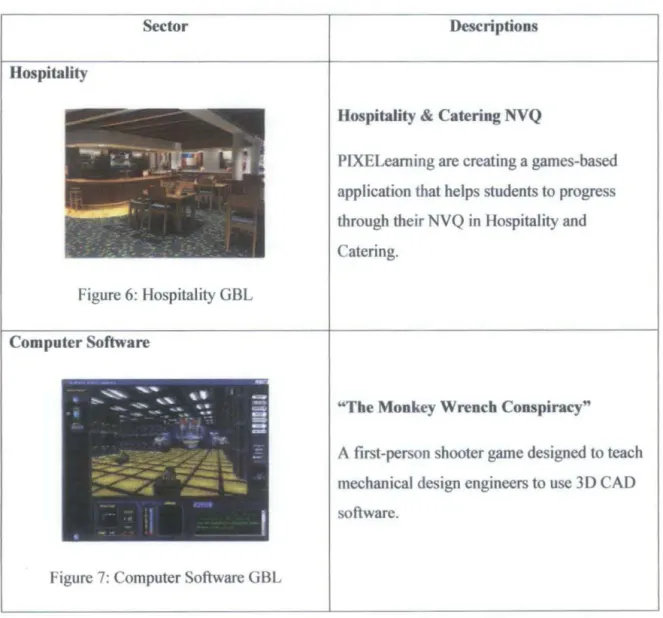
There are many game-based learning examples that are available in the market and it is cross-sector adoptions. Figures below are some of the game-based learning application examples according to the sector respectively (Corti, 2006).
Table 4: The Cross Sector Adoption of Game-Based Learning (GBL)
Sector Hospitality
Figure 6: Hospitality GBL Computer Software
Figure 7: Computer Software GBL
Descriptions
Hospitality & Catering NVQ
PIXELearning are creating a games-based application that helps students to progress through their NVQ in Hospitality and Catering.
"Tbe Monkey Wrench Conspiracy"
A first-person shooter game designed to teach mechanical design engineers to use 30 CAD software.
2.5 INSTRUCTIONAL DESIGN PRINCIPLES
According to Kumaraguru et al. (20 1 0), instructional design principles and methods allow education researchers to examine how people gain knowledge and learn new skills which assist them to develop effective educational materials. There are seven principles involved in designing the online security training which are learning-by- doing, immediate feedback, conceptual-procedural, contiguity, personalization, story- based agent environment and reflection principle. Table 5 summarized the instructional design principles used by Kumaraguru (20 1 0).
Table 5: Instructional Design Principles
Principle Explanation
Learning-by-doing People leam better when they practice the skills they are learning
Immediate feedback Providing immediate feedback during the knowledge acquisition phase results in efficient learning
Conceptual-procedural Conceptual and procedural knowledge influence one another in mutually supportive ways and build in an iterative process
Contiguity Presenting words and pictures contiguously (rather than isolated from one another) enhances learning
To develop an effective educational material, some of instructional design principles have been emphasized in CEG development process such as immediate feedback and contiguity.
2.6 RELATED WORKS
The proposed game objective is to cultivate early awareness about email security threats among children aged 6 to 12. By default, there are a few existing games that are quite similar to the proposed CEG. In this stage, research element is crucial to compare the differences among available resources with the proposed CEG. Table 6 below summarizes the key points of games comparison.
Table 6: Comparison between Existing Email Game
Games Email Quiz Game Spam Swatter Game Emaii&Spam
Safe and unsafe email Legitimate email, spam and Scope
virus Safe mail, spam and cyber bully
Game instructions Read received emails, decide Simply click and drag email Read received emails and safe or unsafe email and then icon into corresponding field respond by click on respond accordingly whether to which are x-ray (to scan mail corresponding button which are open it or delete with attachment), inbox (proper delete (spam). reply (safe mail)
ema•l) and trash (for spam) and report (cyber bully)
Level of exposure on Medium because the game Low due to lack of contiguity Medium as the game email security threats emphasize on learning by doing, between pictures and words emphasize on learning by doing
return immediate feedback and and personalization
reflection principle
Based on the previous comparison, proposed CEG has been developed according to the certain criteria as described in Table 7 below.
Table 7: Proposed CEG criteria
Criteria Description
Scope Legitimate emails, spam, virus and phishing
Game Level 1: Players need to classify the type of email security threats received by reading carefully the instructions email context before simply click to its category accordingly.
Level 2: If the players earn more than m.nimum score. then they can move to next level. At this stage, the players are expected to respond to the email whether they want to reply, report spam, scan or delete the email. A badge will be given to the users if they earn exceed the minimum points.
Level of To develop an effective educational materials, one of the instructional design principles has been exposure on used such as:-
email security
threats • Immediate feedback: Provide feedback through interventions immediately when the player click to corresponding button
• Contiguity: Presenting the ema1l security threats and it's icon contiguously
Cyber Security Awareness for Everyone (CyberSAFE) is a CyberSecurity Malaysia's initiative in educating and enhancing the awareness of the general public on the technological and social issues facing by internet users. Various program conducted by this organization towards the cyber community nowadays in achieving the ultimate goals. CyberSAFE did provide cyber-tips, poster and games that can help to prepare the kids in facing the challenging of cyber world. Internet and email safety is one of the topics covered for the kids. Figure 8, 9 and I 0 are the examples of mediums used to cultivate kid's awareness on email security threats issues.
- ...
GOOD LUOCTO YOUU
Figure 8: Virus Poster Figure 9: SPAM Poster Figure 10: Email and SPAM Game
Although not all child have their own email, but the program conducted by CyberSAFE shown that it is important to nurture early awareness among them as they are the futures of tomorrow. Therefore, CEG is developed parallel with CyberSAFE mission.
CEO is a simulation game that developed by using game-based learning approach.
Taking into account that child are also part of email users, they have the tendency to the email security threats issues exposure. Thus, it is crucial to meet the project objective which is to cultivate early awareness on email security threats issues among children.
The main target would be the children aged 11 until 13. Game has been used as the platform to motivate the children in exploring the email security threats issues through fun medium. ln achieving the objective, contiguity element has been embedded in preparing effective educational materials.
CHAPTER3 METHODOLOGY
3. 1 RESEARCH METHODOLOGY
Game development flowchart has been chosen as a guideline upon completion of CEG development process. According to Vroman (2009), there are six main phases that involved when developing a game which are concept, plan, design, build, test and release. Figure 11 below shows a game development flowchart.
Figure 11 : Game Development Flowchart
3.1.1 Concept
At the early stage, the game concept should be pre-determined in order to get an overview before move into the plan stage. CEO is an educational game that embedded with fun and attractive environment where intrinsically a good platform for children to identify and alert with existing email security threats.
3.1.2 Plan
Research is the most crucial in this stage in order to analyze the game requirements for end user. Related works have been examined and embedded in the literature review part as described in Chapter 2.
3.1.3 Design
For design phase, the CEO flowchart and storyboard has been prepared before proceed to build stage. Considering the concept used in Email Quiz Game, Spam Swatter Game and Email & Spam Game as discussed in chapter two, CEO has been designed to extend the email security threat issues covered in existing and related games. CEG tutorial and game have been inspired from CyberSAFE efforts through tips and posters for the children.
Yes
R.eceive a badge
3.1.3.1 CEG Flowchart
View tutorial
No
No
Visit Welcome Page
Player select game option
Play the game
Yes
Play the game Yes
Level J
No
3.1.3.2 CEG Storyboard
A storyboard of CEG was designed to provide a better visual interpretation of the game to be developed. Below are overviews on how the game should be look alike:
CHILD EMAIL GAME
•
••• • -.r ,.__ ., ----r--
IHOW TO PLAY ? PLAY THE GAME
I - -' - ' -
Figure 13: Welcome Page Screen
CHILD f_,
IIL GAME
INTRODUCTION
P-
DID U KNOW?EMAJLSECURJlYTHREATSCONSISTOF 3 COMPONENTS WHICH ARE
Figure 15: Did You Know Screen
CHILD EMAIL GAME
HOW TO PLAY?
Thi$pme has 2 ~~$.
Q Levell You need to ateconzethe flYqjJs received according tc ermJI security thruu utecorf.
Q Level2. You need to rHPOndto the email received ac.cOf'dlncJy whether you l>ave to reply, report..,.,, ~an Of' delete the email
BUT WAIT Ill
Did you know what is the EMAILSECURJTYTHREATS?
Figure 14: How to Play Screen
CHILD EMAIL GAME
WHAT IS SPAM?
I ,
JunL mall or unwanted email received from unknownHOW TO IDENTIFY SPAM?
L Received from unknown 2. Oalm that you Win a pnz.e
WHEN YOU RECEIVED IT, YOU SHOULD ....
Figure 16: Spam Tutorial Screen
~HILD
EMAIL GAME
WHAT IS VIRUS?
, Mail received from unknown that trick you to open the frle attached
HOW TO IDENTlFYVIRUS?
I 1 An attachment that ends With an .exe, .plf, .bat, or .scr
2. Recervedfrom unknown
SCAN THE EMAIL WHEN YOU RECEIVED fT ••
Figure 17: Virus Tutorial Screen
Level 1
INSTRUCTION
~ad ll'e Mtl t c ... tuov DKide the e'llal ty~
accord ncfy by ~IT' ply dick ilt c.«rl!1oPOI'din&
batton.
Get as ~ CO'T~t ~-as you can w thin
t'>t Ml~ £IV~. Elch corrKt an~wer will £lYe you
h &f'l sc.ore wh te l!l(()l1'tCt an~wer WI• make you low! your po nL
LET'S PlAY
.'V'
Figure 19: Level I Instruction
Levell Example 2
OH NO!®
You are still not able to identify the email serurity threats accordtngly. let's try again II!
LD EMAIL GAME
WHAT IS VIRUS?
, Ma•l that steal your personal
I Information
HOW TO IDENTIFY VIRUS?
I
1. Check spt>llinc and bad cram mar 2. Has sense of urgencyL_
Figure 18: Phishing Tutorial Screen
Level 1 Example 1
To~ ~@ICJTI<I'I.com From: kanm~pnllil.com SUb,IKt: --~gnmenl
Dtar Jehan,
Here s <rry part fOf OtK croup f)(OJt<t. Let me know tf there ll'f
m·stakesy~l
Repds, Konm
Attachments: Asrg~~ment. doc
Figure 20: Level I Question
Levell Example 3
CONGRATULATION!!! Q)
You are able to tdentify the email security threats
accordingly. Now, let's move to the next level! !I
LEVEL 2
INSTRUCTION
floload tne~.,ail carefJI y R~bvdlocon rt>to
COIT61)01'dll>g ICon.
fiUit
...
Slit afPU'
~ aff'OIITSI'!I-.!
,..,..
•
~·
1
~ l£T'SPLAY. 'v"'
Figure 23: Level2 Instruction
Level2 Example 2
OHN0!0
You are unable to respond to the email accordingly.
Let's try again!!!
Figure 25: Let's Try Again Screen
Level 2 Example 1
To Jf'han~gmad com From: John
Sub~L Fr~ ceff!bnty Wlllpaper
Open the a~t to get your fr~
cefebnty wallpaper
Altx"mmts: frt«elf!bntywallpa~. scr
Figure 24: Level 2 question
Level 2 Example 3
CONGRATULATION!!! ©
You are able to respond to the email security threats accordingly. You get your email badge! 0
Figure 26: Congratulation Screen
3.1.4 Build
Based on the storyboard design, CEG has been developed by usmg Adobe Flash Professional CS5 software. Zero knowledge about flash requires the game developer to explore the fundamentals of flash before moving into development stage.
3.1.5 Test
CEG functionality has been testing m the next steps of the game development flowchart.
3.1.6 Release
Upon completing test stage, the game then has been released to the target audience which is children aged ll to 13. In this stage, play testing has been used to measure the awareness level on the email security threats among the players.
CHAPTER4
RESULT AND DISCUSSION
4.1 CEG PROTOTYPE
Figure 27: CEG Welcome Page
The player will visit the welcome page when first starting the game as shown in Figure 27. They can choose whether to explore how to play by clicking on the how to play button or straight away play the game by clicking the lets play the game button.
4.1.1 Tutorial Page
In this section, the player is given the opportunity to explore and identify the tips and tricks in identifying the email security threats.
' I I
p- ROlli '80 PLAY?
Thrs game has two levels:
Level 1 You n~ to categorize the emails tecerved accotcling to emarl security threats category
Level 2 "You oee4 to tesponct to the email teceivect
a<:cot41ogly.
fllfl YOU t.:."'IOW '.'\I IAT IS Tl I [
EMAIL SECVR.ITY Tl-l REA TS/
Figure 28: CEG How to Play? Page
' I I
p - llm 20ll
KIIOUI?Thrs game has two levels:
E- MAIL SECVRilY THREATS has 3 types which ate:
VIRUS
- fJIHAV UJ li1.IWa
~~~ ~ fJom UllknowtJ IIQI trick you lo open the (,le ~
- UIIIKII
~
JIUZn7EJ) l'1I.IIUa KJJIAD,. VOU SJIOI&J) ..•Figure 30: CEG Virus Page
. - fJIHAV .US PIWHIDI9
~ilthlt ~I your ~I ulotTJQtiOIJ
- HOtll 'DO .mEII'IUN PIWRIDI8
1.Chedt (or ~hog ~net ba4 g~mm~r _
2 Seme o( U'¥f~CY: (ora: c:1ntomcr lo Qke 1mme4l.rte ~cifom
- UIHDI \lOU &Be&IW'D PJIJ8RDl8 KJIIAD,. 20lJ SJIOI&'D •..
Figure 31: CEG Phishing Page
Each icon at the bottom of the CEG tutorial page is functional where it link to the respective tutorial page when clicked by the player. Home button will direct the player to the CEG Did You Know? Page.
4.1.2 CEG Levell
- UIHAV BJ SPAitt
JuQk rmtl « u~ em~• I~
~"ron,
u,
know,-11001 'DO mKIRUJ"Jl SPAJII
1. To or CC ftel4 c:o~t I)J mou' or eq~ql to 15 rectplellh 2. ~ cbJm tfqt you Will~ pr11e ot ~rry (ree "'bknpt1011
- UIIIEII 20ll &BeZIW'D WAitt KlltADt. 20ll SIIOlllt'D •••
Figure 32: CEG Spam Page
virus email
Figure 33: CEG Level I Page
To· Juficpeter f? gma~lcom
From : Wollpapu World SlbJecf: Fru w~
Open ttl& crttactnnvrt to get you-fru c:clrbrity
~.
Figure 34: CEG Level 1
Q
1 PageTo : cilrnacfablb@ gmmlcom
From· hassalt_teachuSKTBR@gtncDLCGm
Stbject : Homeworic
Dear Ahmad,
. ~ N:lmit yotr homework VICI e.mcnl CIS I Will
1 not be Cll'"tMid stort•rg next wuk.
Figure 35: CEG Levell Q2 Page
By default, the score is zero at the beginning of the game. For any correct question answered by the player, the score will be increased by 10 points.
From·
SlbJ«t • FREE CAU.ER lUNG TONE
Vis•t th1s ~1M 6 download fru callu nrgtore as much as you MUit • www.cookallerrirgtone.com
Figure 36: CEG Level 1 Q3 Page
Dear 01r wlJed customer,
Please ~e yor pusoml mfomot10n VJG thue ~nl<
www .kelabtlrinar•ebankrclkyat.info If u f01l to do so, yotr accowrt .. n be closed
Figure 37: CEO Level 1 Q4 Page
However, if the answer is wrong, the score will be deducted 5 points. The score is updated along the way the player plays the game.
Figure 38: CEO Let's Play Again Page
Figure 39: CEO Let's Play Level2 Page
For level 1, the player needs to answer 4 questions. If the accwnulated score is lesser than 30, the player is given another chance to play again. Otherwise, the player will continue to the next level.
4.1.3 CEG Level2
In the Level 2, the level of difficulties is increased as the player need to identify the email type first before react to the corresponding email received.
spam
IE,OIT " " " em.a1
~
vlrv1;SCA• VIRUS enw1
REPORt PHI Sfll U
~
.afe emailREPlY E"AJL
Figure 40: CEG Level 2 Page
To: CIZIC f) gmGilcom From : Wollpapu World Sib Jed. fru Wa!lpapu
Open the GttcsctuM.nf to get )'01" fru ulebri ty wollpoper
Figure 41 : CEG Level 2 Q 1 Page
The accumulated score from level 1 will continuously update m the Level 2. As mentioned before, correct answer will get additional 10 marks.
To: harr:rrfelhadd< ~ gmarl.com
From: hofrz•sahockkegmoil.com
StbJect: Mlftl's brr1fldcy
~Harr:r1l
rm pbmrg to ulebrcrte otr mlftl's birthday next week. l.d'5 pbn togcthul :)
Figure 42: CEG Level2 Q2 Page
To: cuegmcnl.ccm. 011e9ft'OII.com. olt~gmc~~l.ccm.
bocl@gmailcom. qi~gmarlcom, L~ gmcnl.~om
.t•~gmarl.com. imaf)g-Lcom.•[email protected].
fozegmarlcom. yon!lgmcul.com. d•~gmoil.com,
pauegmoil.com, f•zf>gmarl.com, nab~giMII.com
From:
StbJect : FREE SCREENS AVER
a~BIIJI.}il Visit www.coolcollemrgtone.com 6 get yotr fru
Figure 43: CEG Level2 Q3 Page
Y01r facebook WJU be expred tomorrow. Update yow-account today at FACEBOO~faubbok.
FCIII to do so. yow-accmm WJD be closed.
Thol!kyou.
Figure 44: CEG Level2 Q4 Page
Figure 45: CEG Let's Play Again Page 2
To earn an email badge, the player need to score higher points more than 70. If not, the player is given opportunity to play again which can boost the motivation to explore email security threats issues carefully.
Figure 46: End Page
4.2 CEG TESTING
CEG Testing has divided into two categories which are Usability Testing and also Effectiveness Testing. Both are important in evaluating the project outcome.
4.2.1 Usability Testing
Usability testing is a technique used to evaluate CEG prototype by testing it with the respective users. The goals are to identifY any usability problems, collect quantitative data and determine the participant's satisfaction with the game. The sample consist of 10 children aged 11 to 13 with various education background.
I
6 'The overall interface is
5
5 ..--····-···----· ··---····. ---·--·---· - - - - -
1:
.,
~ 4
~
v0 3 i
~ '
.,
I..,
E 2 . I '
:>
z 1
1
0
Attractive Neutral Less Attractive
Figure 47: CEG Overall Interface
Referring to the Figure 4 7, 50% of the sample agreed that the overall interface of CEG is attractive. Presenting words and pictures contiguously rather than isolated from one another (contiguity) is one ofthe design principle used to enhance learning process.
The tutorial given is ""l
6
...
---~-~----·--- --- ---- I
5
!
5
"'
.. ..
4:!:!
;;; u
- ...
0..
3.1>
E 2
z ::1
1
Helpful Neutral Not Helpful
·-. --· I
Figure 48: CEO Tutorial
Based on the Figure 48, the result shows that most of the children feel neutral on the tutorial provided. In fact, 2 out of 10 claimed that it is not helpful. Only 3 children fully utilized the contents of tutorial and tips provided during playing the game. There are many assumptions that can be made on why the children found that the tutorial given is not helpful. First, as English is used as a language medium in this game, the children may thought it is difficult to understand especially if they are English illiterate. If this assumption is valid, for the future work, the game should provide two version of language.
9 8
"'
7..
~ 6
:c
!!...
5- ..
0 ~ 4.a E 3
"
z 2
1 0
The instruction given is
Clear Neutral
Figure 49: CEO Instruction
I
Confusing
I
··· I - I
Most of the children agreed the CEO instruction is clear as it is short and understandable. Moreover, the instruction given has contiguity element which help the children while playing the game. However, 10% of the sample claimed that the instruction given is confusing while another 1 0% is neutral.
4.2.2 Effectiveness Testing
Effectiveness testing is used to measure whether CEG is an effective medium that can be used in cultivating early awareness on email security threats issues among the sample tested or not. For the first part, the previous sample has been used to test the CEG effectiveness.
When playing CEG, I feel
5
4 4
c: 4
..
~
l!
:::
v..
3s:;
..
-
0 ,_..
2""
E"
1z
0
I
~------~-·--··-FunNeutral Boring
Figure 50: Children's Feeling When Playing CEG
According to the Figure 50, 40% of the sample tested feels fun and neutral while playing the game. This indicates that CEG has a potential to provide fun learning environment. Only 20% fmd it boring to play CEG. It may because they are never playing game or email security threats topic covered is beyond their interest.
9 8 c 7
., -
3! 6 :;: u 5
- ... -
0..
E 3 4::> 2
z
1 0
I know what the email security threats issues are after playing the CEG
Yes Maybe No
Figure 51: Email Security Threats Issues Awareness
According to the result received, 80% from the sample stated that they gain their early awareness on email security threats issues right after playing the CEG. 20% of them are answered maybe as they know the issues of virus and spam through participating in seminar conducted by Cyber Security teams in their school. However, they did not know about phishing and all these issues are grouped under email security threats.
r;;
41
-
,
:E v
- ..
0- .. e
z ::1
8 7 6 5
4 3 2 1
When playing CEG, I am able to recognize the type of email received
---·--- ·--· ···--·--·- .... oc·----·-··· ... ---·-· - -- --·--·--- -
0 +- ... .
Yes Maybe No
Figure 52: Type of Email Recognition
... -- I
Based on Figure 52, most of the children (70%) are able to recognize the type of email received. Only one child unable to identify well the email pattern and he did answered wrongly 3 questions out of 4 in level I.
8 7
<:
41 6
-
l! 5
:E u 0 4
-
..
3.Sl
E :> 2
z
When playing CEG, I know how to respond to the email received based on its category
--····---- - - - - --- ---
- - - - --- ·---
·---~--- --- --- 2
Yes Mayb<' No
Figure 53: Email Response
Figure 53 shows that the ability of the children on email response. Those who are able to recognize the email type earlier are able to respond accordingly. Some of them chose maybe because they able to identifY the email type but did not meet the minimum score requirement which allow them to move into level 2.
Apart from that, another session has been conducted. The objective of this session is to measure the effectiveness of various medium used to expose the children on email security threats issues such as reading and playing a game. For this part, a total of another 15 children aged 11 to 13 were involved. The 15 children were split into 3 different groups in which each of the group consist of 5 children. The details are as below:
D Group A: Reading email security threats notes 0 Group B: Playing CEG
D Group C: Playing CEG right after reading the notes.
All of them were required to answer the same short paper-based questions ( 5 questions) which regard to the email security threats issues. Comparison on the marks of the paper- based question has been made to analyze the ability of CEG as another mechanism that can be used in exploring the email security threats issues.
Below is t