This leads to the objective of this study to evaluate the difference in terms of general physicochemical, antioxidant properties and consumer acceptance between agarwood tea-based kombucha and green tea-based kombucha. Although the total phenolic content of green tea kombucha was significantly higher (p < 0.05) than agarwood tea kombucha, the latter showed a higher taste acceptance by the panelists.
Background of Study
3 interesting to study the effects of agarwood tea that are included in different types of functional foods. There is still a large research gap in exploring the potential of using agarwood leaves as a tea base in kombucha production.
Objectives
Generally, people consume tea for the health benefits it provides, with green tea having higher antioxidant properties compared to black tea. Black tea contains compounds such as theaflavins, thearubigins and epigallocatechin gallate, while green tea contains catechins and flavonols (Prasanth et al., 2019; . Rasheed, 2019).
Kombucha
Kombucha Fermentation Process
The tea leaves are then removed and approx. 50 – 150 g/L of sugar is added to the hot tea (Greenwalt, Steinkraus and Ledford, 2000). The SCOBY and 10% (v/v) liquid starter are then added to the mixture to start the fermentation process.
Factors Affecting Fermentation of Kombucha
Liquid starter refers to the kombucha obtained from the previous batch of fermentation where the SCOBY was propagated. Once the fermentation period is over, the SCOBY is removed and the kombucha is ready to be consumed raw.
Symbiotic Culture of Bacteria and Yeast (SCOBY)
13 Other chemical compounds found in kombucha are acids (acetic acid, lactic acid, glucuronic acid, citric acid), vitamins (B and C) and enzymes (Massoud et al., 2022). According to Yan et al. 2020), green tea has been found to have a higher free radical scavenging effect compared to black tea.
Commercial Kombucha Trends in Terms of Flavour Preferences Commercial kombucha is becoming more accessible in the market as more
Antioxidant Activity
An experiment conducted by Tay et al. 2014) found that ethanol concentration in solvent extraction was a factor in the final yield of total phenolic content (TPC), DPPH and flavanol gallates from Aquilaria. An increasing ethanol concentration (v/v) resulted in a higher percentage of scavenging activity in the DPPH assay, while an ethanol concentration of up to approximately 60% resulted in the highest yield for total phenolic content.
Anti-inflammatory Activity
This test relies on electron transfer to measure the reducing capacity of an antioxidant (Lamuela-Raventós, 2017). Moreover, the ethanol extract of agarwood leaves also showed laxative effects when tested on low-fiber diet-induced rats (Kakino et al., 2010).
Pineapple (Ananas comosus) and Mint (Mentha)
A study conducted by Wang et al. 2015) showed that the ethanol extract of agarwood has beneficial effects, including improving intestinal peristalsis and gastric emptying and inhibiting gastric ulcers. Mint (Mentha) belongs to the family 'Lamiaceae', which is widely distributed in regions throughout Europe, Asia, Africa, Australia and North America (Salehi et al., 2018).
Agarwood Tea and Green Tea
Preparation and Fermentation of Kombucha
Determination of pH Value
The pH of the kombuchas was determined using a pH meter (FiveEasy Plus pH meter FP20-Std-Kit). The instrument was first calibrated at pH 4.0 and pH 7.0 before measuring the pH values of agarwood tea and green tea kombucha.
Determination of Total Soluble Solids (TSS)
The measurements were performed in triplicate and the lens was cleaned with distilled water before each new measurement.
Determination of Total Titratable Acidity (TTA)
Evaluation of Antioxidant Properties of Agarwood and Green Tea Kombuchas
Determination of Free Radical Scavenging Activity
The kombucha samples of the same volume were then dosed into the empty wells of the first row. A microplate reader (FLUOstar Omega, BMG LABTECH) was used to measure the absorbance of the samples at 517 nm and the results were recorded.
Determination of Total Phenolic Content (TPC)
A final sensory evaluation was performed for the agarwood tea and green tea kombucha by the 9-point hedonic scale test adapted from Gramza-Michałowska et al. The sensory evaluation was conducted in a sensory evaluation room where a total of 30 untrained panelists were recruited from the university campus.
Physicochemical and Antioxidant Properties Between Agarwood Tea Kombucha Formulations 3 and 9
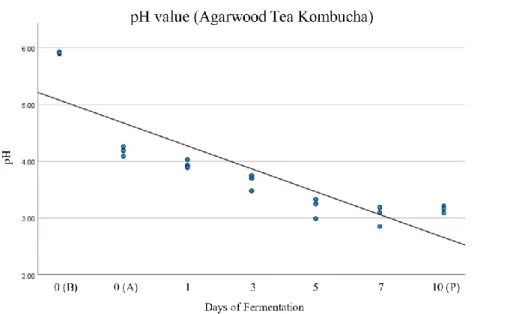
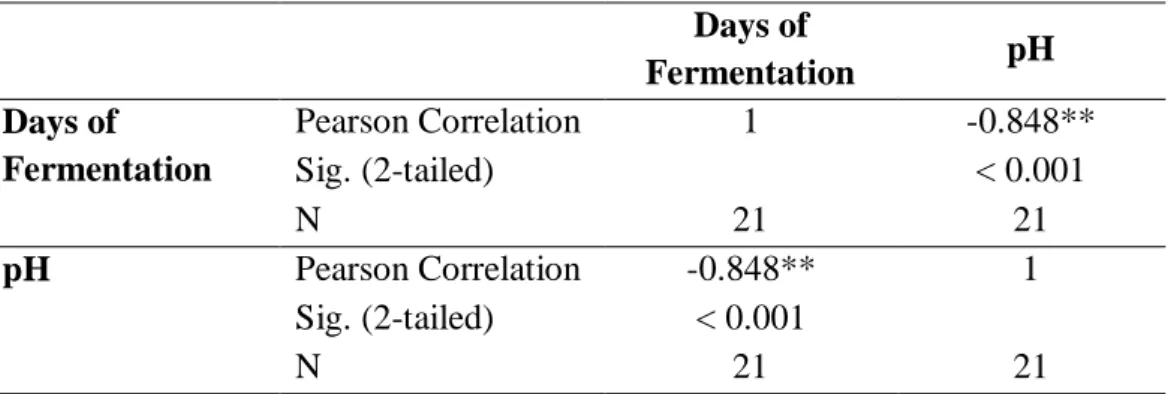
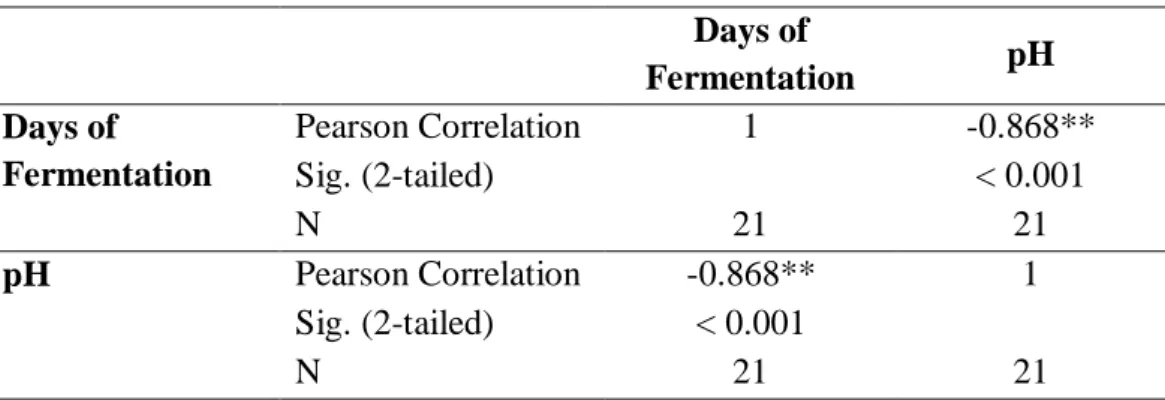
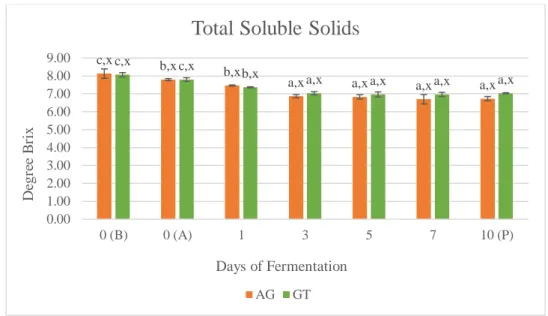
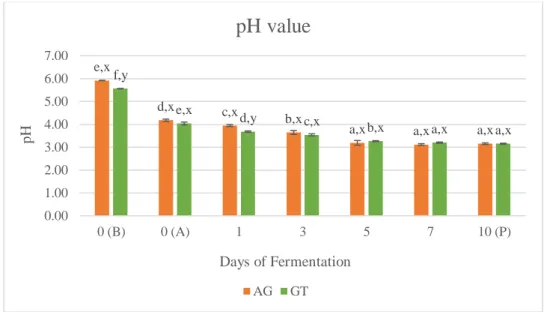
For the agarwood tea kombucha in Table 4.1.1 there was a significantly high negative correlation between the days of fermentation and pH of the kombucha, with r = -0.868, p < 0.001. For the agarwood tea kombucha in Table 4.2.1 there was a significantly high negative correlation between the days of fermentation and TSS of the kombucha, with r = -0.863, p < 0.001. Regarding the green tea kombucha in Table 4.2.2, there was also a significantly high negative correlation between the days of fermentation and TSS of the kombucha, with r.
For the agarwood tea kombucha in Table 4.3.1, there was a significantly high positive correlation between days of fermentation and TTA of the kombucha, with r = 0.886, p < 0.001. Regarding the green tea kombucha in Table 4.3.2, there was also a significantly high positive correlation between the days of fermentation and TTA of the kombucha, with r. The inhibition rates between the agarwood tea and green tea kombucha were also significantly different (p < 0.05) from each other on days 0 - 7.
Physicochemical Properties of Kombucha
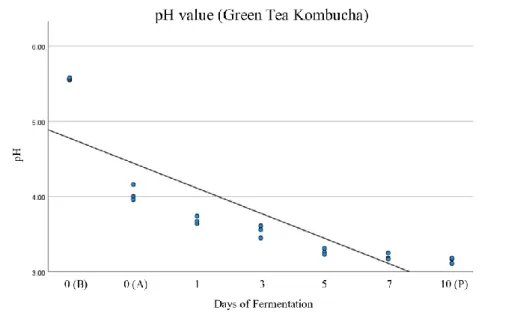
The pH values for both kombuchas dropped from about pH 6.0 to pH 3.2 by day 10 of fermentation. According to a similar study by Quiao-Won and Teves (2018), the pH of their green tea kombucha also dropped from pH 5.0 to about pH 3.0 by day 10 of fermentation. Regarding the pH value of agarwood kombucha, Nurmiati and Wijayanti (2018) found that it decreased from pH 6.5 to 3.0 by day 10 of fermentation.
Therefore, it was expected that the pH of the drink in this study would be slightly higher than those of kombuchas reported in other studies. The increased amount of organic acids will then further lower the pH of the kombucha. However, it was found that the pH values of the experimental kombuchas by day 10 were slightly higher than those at day 7.
Total Soluble Solids (TSS) of Agarwood Tea and Green Tea Kombucha
There was also a significant negative high correlation (p < 0.001) between the Brix values of kombucha and days of fermentation based on the results in Table 4.2.1 and Table 4.2.2, where an increase in the number of days of fermentation resulted in a drop in TSS in kombucha. This is explained by the fact that the microbes have used the sugars during fermentation, thus reducing the amount of TSS in the kombucha. In particular, the decrease in Brix values is due to the degradation of sucrose in tea by invertase that is produced by yeasts (Emiljanowicz and Malinowska-Pańczyk, 2019; Gramza-Michałowska et al., 2016).
For both kombuchas in the experiment, pineapple juice and mint leaves were added on day 7 for secondary fermentation until day 10. This had led to an increase in the kombucha's Brix values, as the pineapple juice itself had a Brix value of 11°Bx . Once added, the juice acted as an additional carbon source for the microbes in the kombucha during secondary fermentation (Muzaifa et al., 2021).
Total Titratable Acidity (TTA) of Agarwood Tea and Green Tea Kombucha
In this case, the difference in TTA between agarwood tea and green tea kombucha was due to the higher concentration of green tea glucuronic acid (Cardoso et al., 2020). Based on the findings of Cardoso et al. 2020), the TTA of their green tea kombucha was about 4.32 g/L by the end of the 10-day fermentation, which consisted of acetic, glucuronic, and lactic acids. This value was lower than the results obtained for agarwood tea kombucha (6.15 g/L) and green tea kombucha (7.40 g/L) in this study for the following reasons.
First, the initial concentration of their kombucha was 12 g/L and they only infused it for 2 minutes at a temperature of 75℃. The shorter infusion time prevents the compounds from tea leaves from being fully extracted, resulting in a lower concentration of organic acids in the kombucha. In this experiment, the initial concentration of kombucha was 14 g/L and it was infused for a longer period of 10 minutes.
Antioxidant Properties of Agarwood Tea and Green Tea Kombucha
Therefore, it supports the results obtained in this study in which green tea kombucha fermentation had shown a lower increase in overall DPPH clearance activity compared to that of agarwood tea kombucha. In addition, the results suggested that green tea kombucha showed higher antioxidant properties than agarwood tea kombucha due to its lower IC50 concentration. In addition to the DPPH assay, the Folin-Ciocalteu (FC) assay was also performed to determine the total phenol content (TPC) of the agarwood tea and green tea kombucha.
There was a significant difference (p < 0.05) in TPC between agarwood tea and green tea kombucha, with green tea kombucha having a significantly higher TPC. In this case, the antioxidant properties between agarwood tea and green tea differ for several reasons. The amount of pure agarwood tea leaves used was therefore less than that of the green tea leaves, which may also have led to the results achieved.
Sensory Evaluation Between Agarwood Tea, Green Tea, and Commercial Kombucha
It was found that the appearance scores for the agarwood tea and green tea kombucha were higher than the flavored and commercial kombucha. In this study, the agarwood tea and green tea kombucha infused with pineapple and mint had a discernible pineapple aroma, which may have influenced the ratings. However, that was not the case, as commercial kombucha was found to be the highest rated, only slightly higher than the agarwood tea kombucha infused with pineapple and mint.
On the other hand, flavored green tea kombucha ranked second lowest for taste. Thus, it can be concluded that the flavored wood tea kombucha was most accepted by the panelists due to its attractive appearance, aroma and taste. It also indicated that wood-flavored tea kombucha was the most preferred, even surpassing commercial kombucha.
Limitations and Recommendations
0 Appendix (Figure 4.1.1): Independent samples t test results for pH value between wood tea and kombucha green tea on day 0 (B). 1 Appendix (Figure 4.1.1): Independent samples of test results for pH value between wood tea and kombucha green tea on day 0 (A). 2 Appendix (Figure 4.1.1): Independent samples of test results for pH value between agarwood tea and kombucha green tea on day 1.
3 Appendix (Figure 4.1.1): Independent samples t test results for pH value between agarwood tea and green tea kombucha on day 3. 4 Appendix (Figure 4.1.1): Independent samples t test results for pH value between agarwood tea and green tea tea and green tea. tea kombucha on day 5. 5 Appendix (Figure 4.1.1): Independent samples t test results for pH value between agarwood tea and green tea kombucha on day 7.
8 Appendix (Figure 4.2.1): Independent samples of test results for Brix value between agarwood tea and kombucha green tea on day 0 (A). 9 Appendix (Figure 4.2.1): Independent samples of test results for Brix value between wood tea and kombucha green tea on day 1.