THE US DOLLAR AS THE GLOBAL CURRENCY AGAINST OTHER MAJOR CURRENCIES DURING THE COVID-19 PANDEMIC
Muhammad Fahmi Bukaria
ABSTRACT
The dominance of the US Dollar in the international economy began with the Bretton Woods system at the end of World War II in 1945. The currencies from other major economic powers such as the Eurozone’s Euro, the Japanese Yen, and the Chinese Yuan could be the best contenders against the US Dollar supremacy in the 21st century. The most popular cryptocurrency – Bitcoin, also eyes the position as a contender for the global currency. The COVID-19 pandemic has disrupted the global economy in 2020. As a result, the reliability and popularity of the US Dollar have been put into another stress test. To measure the status of the US Dollar against other major currencies, the theory of international political economy paired with graph analysis will be used to determine the strength of the US Dollar against other major currencies. This paper also looks at the value of the US Dollar against the cryptocurrency Bitcoin. It is assumed that graph movement is influenced by the market sentiment after receiving news and information that could affect the market.
Keywords: International economy, international political economy, international currency, Dollar global dominance, economic crisis
INTRODUCTION
The US Dollar has been widely accepted as the global currency in most of the 20th and early 21st centuries due to the US relative economic stability, independence of its Federal Reserve, and massive global deposits in US Dollar. US Dollar usage is not only limited to the US economy and interstate transactions, but it is also being used as the domestic currencies of some states facing economic hardship. Cambodia and Timor Leste use the US Dollar in their daily transactions due to the people’s faith in its value and ability to stabilise the economy devastated by war and past instability.
When COVID-19, a respiratory contagious virus, started to spread globally in early 2020, it devastated the global economy as almost all economic activities were put to a halt.
COVID-19 has impacted the US the most, with a quarter of total global cases at the end of 2020. Taking advantage of the weakening US economy amid the pandemic, other major currencies are eyeing the status of the global currency, especially the Renminbi (hereinafter referred by its common name, the Chinese Yuan). Other than the conventional state-issued currencies, cryptocurrencies have also gained a foot in the globalised economy. Bitcoin as the most popular cryptocurrency is also eyeing the status as the alternative to the US Dollar
a Muhammad Fahmi Bukari ([email protected]) is a Master candidate at Department of Southeast Asian Studies, Faculty of Arts and Social Sciences, Universiti Malaya.
in the global payment system. It bypasses the global financial system and is free from control by any sovereign state, making Bitcoin a viable alternative to the US Dollar during the pandemic. However, lack of backing from the state and institutionalised structure to manage its price and value could hinder the development of Bitcoin as one of the possible global currencies in the near future.
The three objectives of this paper are:
• To examine the impact of global COVID-19 pandemic towards the value of the US Dollar.
• To analyse whether any major currencies have overtaken the US Dollar as the global currency during the COVID-19 pandemic.
• To observe whether Bitcoin has become the alternative to the US Dollar during the COVID-19 pandemic.
METHODOLOGY
To explain the status of the US Dollar as the hegemon currency of the global economy, the primary theory used in this paper is the theory of international political economy which assumes that the global economy is shaped by the Bretton Woods system post-World War II in 1945, and post-Bretton Woods since 1973. The secondary theories that can be applied to explain the supremacy of the US Dollar are institutional liberalism and interdependence liberalism.
Table 1: Conceptual framework
CHRONOLOGY
Bretton Woods system
Post-Bretton Woods
Post-Cold War
COVID-19 pandemic
US DOLLAR STATUS
Major global currency pegged with gold
Global major reserve currency
Major reserve currency including in former Soviet
states and former Soviet satellite states
?
International political economy assumes the supremacy of the US in the global economy and financial systems with the US Dollar as the crucial instrument in this delicate system. Two major institutions within this so-called Bretton Woods system are the International Monetary Fund (IMF) and the World Bank, both located in Washington, D.C.
The argument by the theory of international political economy is supported by the quantitative analysis by reading the value of the US Dollar against other major currencies and Bitcoin in the graphs presented. The quantitative analysis of the graphs is conducted to support the theory of international political economy. As a result, this paper will weigh more on the theoretical approach of international political economy to explain the strength of the US Dollar during the COVID-19 pandemic, rather than purely focusing on technical analysis.
Institutional liberalism is based on the theory that international organisations set out the rules as guidelines for states to follow, reducing differences thus conflicts between states. Institutions can provide information, reduce transaction costs, make commitments more credible, establish focal points for coordination, and in general facilitate the operation of reciprocity (Keohane and Martin, 1995). The formation of the IMF and the World Bank which promoted the usage of the US Dollar as the global currency, had led to the institutionalisation of transnational financial networks which not only enhanced the process of globalisation, but also reduced tensions between states that were likely to promote its own domestic currency in the international market.
Interdependence liberalism emphasises the idea that actors within a state could be affected by the actions of actors in other states. It assumes that non-state actors such as transnational corporations (TNCs), non-governmental organisations (NGOs), and individuals have their own interests free from total state control. The currency transactions beyond state borders using domestic currencies could hamper the connectivity of the interdependence of the state actors and non-state actors. In the complex connection of interdependence, a uniformity in the form of a single global currency is crucial to ensure smooth and faster transactions. By this theory, the US Dollar is a primary choice as its value and trustworthiness are uniformed around the world.
US DOLLAR AS A GLOBAL CURRENCY Currency, sovereignty, and hegemony
National currency is an essential identity of a sovereign and independent state which signifies the state’s financial and monetary independence. Not all sovereign states have their own national currency1 which makes a national currency an important source of pride, just as the other symbols of a state such as its flag and anthem.
A strong currency reflects a strong and stable economy, boosting the image and prestige of a state. A state might use another state’s currency for several reasons such as having a small domestic economy, due to economic or political instability, or due to occupation by a foreign military force. Dependency on any foreign currency means that the
economy of a state is at the mercy of monetary policies of hegemonic states. As the US Dollar is accepted worldwide as a global currency, any state that uses the US Dollar or pegs2 its domestic currency value with the US Dollar is at the mercy of the US monetary policy and tied with the economic situation within the US.
However, most states rely on a single global currency for reliability of value and acceptance. The values of domestic currencies often fluctuate, and tight regulations by domestic regulators may cause the payment clearance to take a long time. By using the US Dollar and the American banking system, complications in payment in international trade could be reduced. Furthermore, the price of major commodities that are traded globally such as oil, natural gas, gold, coal, and iron ore are often quoted in US Dollar.
Historically, before the widespread usage of the US Dollar in the global economy, there were other global currencies used worldwide. These included the British Pound, the Maria Theresa Thaler, and the Spanish Dollar. The usage of the Spanish Dollar was popular between the 16th and 19th centuries due to its pure silver content, relatively large coin size, and its uniformity which was accepted globally, even in the Asia Pacific.3 The British Pound was the dominant currency during the height of the British Empire between the 19th and early 20th centuries due to its vast empire and trading networks. However, the US Dollar has become the dominant currency globally ever since the US economy overtook the position of the British Empire in the international system in the early 20th century.
The status of the US Dollar in past crises
Post-World War II saw the formation of the Bretton Woods System in 1944 when the US Dollar became the global currency. Other developing states soon pegged their domestic currencies to the US Dollar to ensure stability of commodity prices, thus stabilising their domestic economies. To cement the US hegemonic position in the Bretton Woods system, the headquarters of both the IMF and the World Bank were, and are, located in Washington, D.C. However, the status and the supremacy of the US Dollar as the global currency has been challenged and threatened by a series of global economic downturns in the last half century.
Despite Soviet Union (the USSR) disfranchising itself from the Bretton Woods System and insulating its financial system from the capitalist financial system, money in the communist states were treated more as a scrip4 rather than an asset of its own.5 In addition, the USSR imposed currency control under which foreign currencies brought in by returning Soviet citizens were forcefully converted into the Soviet Ruble by the rate determined by the Soviet government. As a result, the Soviet Ruble had never been treated as a financial asset like the US Dollar. Thus, the Soviet Ruble had never been a direct threat to the US Dollar supremacy throughout the Cold War.
When the global economy was booming in the 1970s, the gold reserves which backed the value of the US Dollar could not fulfil the demand of the US Dollar, as the demand rate of the US Dollar was faster than the amount of gold the Federal Reserve could buy and keep. This led to the 1973 Nixon Shock when the US Dollar was de-pegged from
the value of gold. Ever since then, the US Dollar value has floated based on the supply and demand of the US Dollar within the global financial system. The value of the US Dollar has remained stable after the 1973 Nixon Shock due to the large percentage of reserves of the US Dollars made by states’ central banks globally. In the year 2020, the US Dollar was still the most preferred foreign reserve currency with central banks’ total foreign reserves amounting to 60.46 percent globally.6
Another stress test for the US Dollar occurred during the global subprime crisis between 2008-2009 caused by overheated property market in the US. Contrary to what happened to the receding US economy, the demand for US Dollar soared even when the short-term Treasury bill rates fell to 0.25 percent. Global markets pursued the US Dollar for safety to protect the value of domestic currencies from depreciating. The Federal Reserve poured USD630 billion dollars to ease the dollar shortage in international money markets (Vasudevan, 2009). After the crisis subsided in 2010, the status of the US Dollar as the global currency stayed intact.
COVID-19: US Dollar’s newest stress test
When the first wave of COVID-19 hit East Asia, Europe, and the US in January 2020, the impact of the pandemic started to spread globally thanks to modern transportation and intricate global trading networks. The speed and scale of how the COVID-19 pandemic spread had caused health emergency, thus shutting down most businesses and outdoor activities, bringing the global economy to a halt. The last time the world had witnessed this scale of pandemic was about a century ago when the Spanish Flu spread all over the globe between the years 1918 to 1920, with casualties ranging from 20 million to 100 million people.
COVID-19, a highly contagious respiratory virus has created a shockwave since December 2019 which caused economic shutdown in almost all economic sectors. Closed shops mean less demand for goods and services. Less flights and train schedules mean less tourist arrivals - a vital source of income in developing and less developing states. Travel restrictions and movement restrictions mean less demand for fuel, causing oil price to plummet, creating an economic downturn in oil producing states.
The impact of the COVID-19 pandemic also hit the financial market as the global economy was brought to a halt. The Dow Jones Industrial Average (DJIA) dropped by 12.9 percent, and the S&P 500 - one of the most popular indicators of economic growth saw a reduction of 12 percent in a single day on March 16, 2020 (Aslam et al., 2020). The plunge in stock bourse indexes should be followed by a plunge in demand for the US Dollar in the global market. Theoretically, the lower the demand for money, the lower the value of money should be. However, the demand for the US Dollar increased as the global central banks rushed to stabilise the value of their domestic currencies amid the pandemic. This will be elaborated in the analysis part of this paper.
US Dollar in Southeast Asia
The usage of the US Dollar in Southeast Asia is predominantly tied to international trade, whereby it is used to settle business transactions across borders. However, there are two specific cases in Southeast Asia where the US Dollar is used in domestic transactions, i.e., in Cambodia and Timor Leste. Both Cambodia and Timor Leste had experienced war and instability in the recent past which caused devastation to their economies. As a result, a single international currency came to the rescue in bringing economic stability and eventually positive economic growth, despite sacrificing their national currencies. COVID- 19 has caused another blow to these fragile economies due to decreasing export revenues and tourist arrivals, making the US Dollar a stable and trusted currency in domestic transactions.
Alongside the US Dollar in everyday transactions, Cambodia has its own national currency which is the Cambodian Riel. The past memory of the Pol Pot regime abolishing Riel, the economic instability after the fall of Pol Pot, and the invasion by Vietnamese forces in 1978 had caused the value of the Riel to plummet. In 1993, the United Nations Transitional Authority in Cambodia (UNTAC) preferred US Dollar as the legal tender in Cambodia to control high inflation of the Riel, and to attract foreign direct investments (FDIs) and foreign aid (Capannelli and Jayant Menon eds., 2009). Cambodians have less faith in the Riel due to the instability of its value, and opt to use the US Dollar which has more stable value. The dollarisation in Cambodia has continued by the influx of tourists’
dollars, positive flow of FDIs, and lack of public trust in the Riel (Sovannroeun & Okuda, 2019). The Cambodian government had tried to promote the usage of the Riel among the Cambodians, however, their faithfulness towards the US Dollar did not die out.
In Timor Leste, the usage of the US Dollar was formalised during the transition period from Indonesian rule to its independence. Before its independence in 2002, Timor Leste had used Indonesian Rupiah which suffered serious devaluation during the 1997 Asian Financial Crisis. The crisis that caused ethnic and religious tensions across Indonesia brought an opportunity to Timor Leste to break away from more than 30 years of authoritarian rule from Jakarta under Suharto. The US Dollar was chosen as the sole legal tender by the United Nations Transition Authority in East Timor (UNTAET) in February 2000. The US Dollar was chosen due to two reasons - it signalled the departure of Timor Leste from Indonesia, politically and economically; and the stable value of the US Dollar was essential for the redevelopment of its war-torn economy. According to Dr Rui A.
Gomes, the Minister of Planning and Finance of Timor Leste in 2017, the US Dollar was preferred in Timor Leste for several reasons which included its high reliance on oil export revenue, its underdeveloped financial system, and near inexistence of national production.
Timor Leste did not have enough resources to set interest rates and defend manageable exchange rate (Amara, 2013). Due to the small domestic economy of Timor Leste that is highly dependent on oil export revenues and remittances, there is no visible plan to replace the US Dollar with an indigenous currency.
The cases of Cambodia and Timor Leste proved that the US Dollar is the preferred option in hard times when it comes to which foreign currency is the most suitable to redevelop a devastated economy.
ANALYSIS
Analysis of the USD against major currencies during the COVID-19 pandemic When an economic crisis hits the global market, it is assumed that the value of the US Dollar will increase, while the value of other major currencies will decrease. The rationale for this is that central banks and investors would buy US Dollars during the crisis as a risk- averting action. As a result, the value of the US Dollar would be strengthened, while the value of other major currencies would be weakened.
Table 2: List of currencies and their ISO4217 codes. CNH is not officially included in the ISO4217 list.
Currency ISO 4217 Code
US Dollar USD
Euro EUR
British Pound GBP
Japanese Yen JPY
Chinese Yuan / Chinese Yuan Offshore* CNY / CNH*
Australian Dollar AUD
New Zealand Dollar NZD
Swiss Franc CHF
In this paper, the list of currencies and their ISO4217 code are used interchangeably. ISO4217 code is commonly used in foreign exchange trading to conduct foreign transactions effectively rather than using the full names of the currencies. It should be noted that the Chinese Yuan and the Chinese Yuan Offshore are the same currency with different players in the financial market.
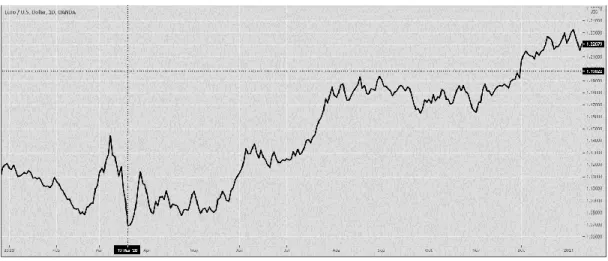
The first analysis is focused on the exchange between the USD and the EUR. These currency pairs are the most traded currencies in the world due to the economic sizes of the US and the Eurozone, in addition to US-Europe close cooperation - not only in trade, but also military (in the form of NATO7), security, social, and culture. When the first wave of
the COVID-19 pandemic hit Europe, the value of EUR fell against the USD. By June 2020, when Europe started to recover and the pandemic in the US was getting worse, the value of the EUR rose while the value of the USD fell.
Graph 1: EUR-USD
Source: OANDA Corporation8
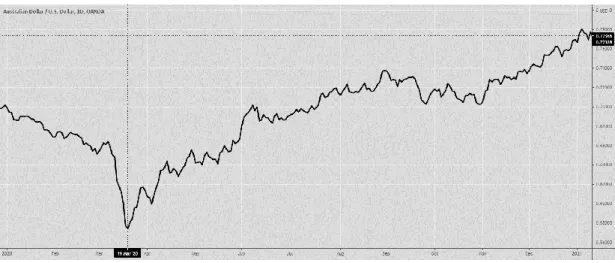
Similar movement could be observed in the pair of the GBP and the USD.
Traditionally a close ally and trade partner, the British economy is interlinked with the US and the rest of Europe. Initially, the GBP fell when economic activities suddenly stopped in the United Kingdom during the first wave of the pandemic. Since May 2020 however, the value of the GBP has however recovered following the footsteps of the rest of Europe.
Graph 2: GBP-USD
Source: OANDA Corporation
The sudden downward spike on 19th March 2020 could be explained by the rise of demand for the USD as central banks tried to stabilise their currencies. Other than central
banks, forex markets might also be driven by investors’ ‘herd behaviour’ which causes high autocorrelation (Aslam et al., 2020). As such, central banks would buy USD assets to strengthen the USD and keep minor currencies competitive; the primary reason for this action is to achieve economic stability rather than profiting from USD assets (Morgan, 2009). To calm the sudden spike of the demand for the USD in the market, the Federal Reserve provided the swap facilities for central banks to buy USD with their respective currencies without the exposure and volatility on the open market (Federal Reserve Bank of St. Louis, 2020). In the end, the trend of the USD in 2020 resembled that of what happened during the 2008-2009 global subprime crisis when the demand for the USD rose despite the US economy receding during the subprime crisis.
The USD is preferable to the EUR as the USD is a relatively safer asset than the EUR in which several Eurozone members - such as Greece, Italy, and Spain, defaulted during the global subprime crisis in 2008-2009. One of the reasons was that the Eurozone members did not have the ability to determine its own interest rate and influence its own monetary policy. All monetary policy decisions in the Eurozone are made collectively by the European Central Bank. The problems occurred with the Euro might be a hindrance for a true supranational global currency as it is not controlled by a single sovereign state.
Graph 3: AUD-USD
Source: OANDA Corporation
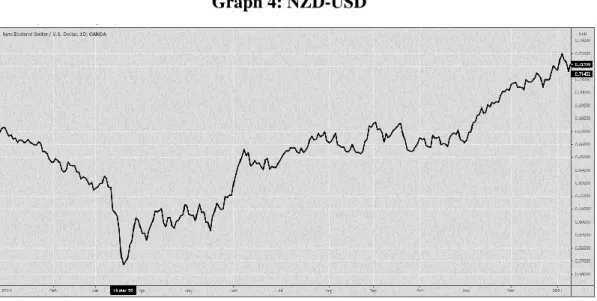
The AUD and NZD are significant currencies in the foreign exchange market due to their strong correlations with commodity prices. Both Australia and New Zealand economies rely on export of commodities such as iron ore, oil, gold, foodstuffs, and dairy products. The AUD and NZD observed similar trend as the EUR and the GBP when demand for global commodities fell during the first wave of the COVID-19 pandemic. As the demand for commodities fell, their prices also fell.
Graph 4: NZD-USD
Source: OANDA Corporation
Since June 2020, the values of the AUD and NZD have strengthened due to increasing demand of commodity exports and when some of their economic activities were reopened. It should be noted that the rise of demand for commodities also correlated with China reallowing most of its economic activities to reopen by mid-2020. China is the largest trading partner of both Australia and New Zealand.
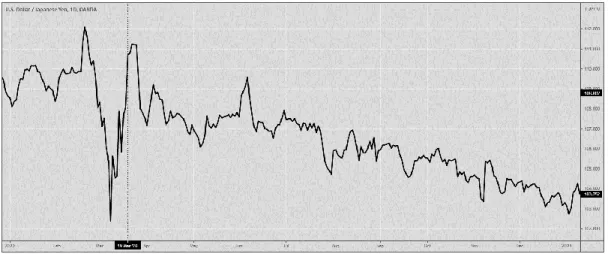
Graph 5: USD-JPY
Source: OANDA Corporation
Graph 6: USD-CHF
Source: OANDA Corporation
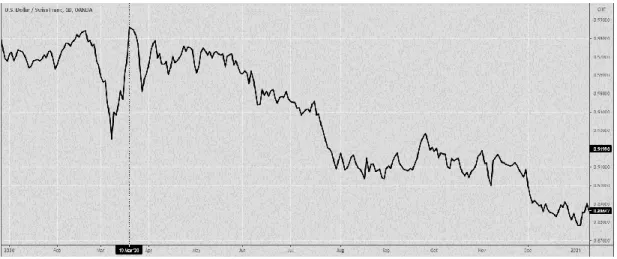
An analysis of Graphs 5 and 6 above shows that against the trend, the Japanese Yen and the Swiss Franc strengthened during the first wave of the COVID-19 pandemic. This was due to their status as ‘safe-haven currencies’, supplemented with reasonable reserves of gold and domestic savings within the Bank of Japan and the Swiss National Bank, respectively. The trend of the strengthening of the Japanese Yen and Swiss Franc could also be observed during the 2008-2009 global subprime crisis when states’ central banks and investors bought the Japanese Yen and Swiss Franc together with the US Dollar. After the Tohoku earthquake and tsunami in 2010, the demand for the Japanese Yen rose significantly due to efforts in rebuilding the affected areas.
Strong Japanese Yen and Swiss Franc make exports more expensive, and in turn, hurt the economies of Japan and Switzerland - both being two of the cities which have the highest costs of living in the world. To counter the strengthening of the Japanese Yen and Swiss Franc, the Bank of Japan and the Swiss National Bank resorted to the negative interest rate policy, whereby instead of offering interests to deposits in central banks and bonds, whoever held Japanese and Swiss bonds would be charged for the bonds held, hence the negative rate. Since the US Dollar had offered interests for its Treasury bills and bonds, the value of the US Dollar against the Japanese Yen and Swiss Franc stabilised later in August 2020.
The Chinese Yuan has a different characteristics when it comes to international trade and finance. Outside the border of mainland China, the Chinese Yuan is formally known as the Chinese Yuan Offshore (CNH), hence its different ISO4217 code. CNH is still the same Yuan issued by the People’s Bank of China (PBoC). The difference is that the value of the CNH is determined by the free market outside mainland China, while the official CNY exchange rate is updated every working day at 9.00am Beijing time (GMT +8) by the PBoC. The market players of the CNH are the central banks and financial institutions outside the jurisdiction of the PBoC beyond mainland China, while the market players of the CNY are the PBoC and the financial institutions within mainland China.
Graph 7: USD-CNH
Source: OANDA Corporation
The reason for the large demand of the USD outside the US is that a large percentage of emerging economies’ foreign savings in US Dollar is not being used in the home economies. Emerging economies have kept the foreign exchange rate competitive by buying USD assets in the market to keep domestic currencies competitive enough for exports. China is the major player in this de facto system (Elwell, 2008). The USD dominance in the global economy might amplify the impact of COVID-19 due to the strengthening of the USD and higher export prices, exacerbated with the lack of foreign cash inflow in certain sectors such as tourism (Adler et al., 2020).
Analysis of USD and CNY during COVID-19 pandemic
Apart from the graph reading to see the value of the USD against the CNY as mentioned above, another key highlight that needs to be focused on is the globalisation of the Chinese Yuan. Since China has recovered earlier than the US, and had opened most of its economic activities up by the mid-2020, the value of the Yuan has strengthened. As the Chinese Yuan strives to become the new global currency, how far has the globalisation of the Yuan occurred during the COVID-19 pandemic?
Graph 8: Shares of USD and CNY as a global currency in trade financial market
Source: SWIFT RMB Tracker, October 2020
Graph 8 above shows that within two years, the share of the USD as the currency in the trade financial market rose from 86.48 percent in 2018 to 86.86 percent in 2020 – an increase of 0.38 percent. By comparison, the share of the CNY in the trade financial market rose from 1.84 percent in 2018 to 1.91 percent in 2020 – an increase of 0.07 percent. Even when COVID-19 hits the US economy hard, the financial market seems to counter the trend since the existing economic activities migrated into online forms. In the financial market, the digitalisation of financial transaction which was initially meant to improve transaction speed and reducing corruption, has now proven useful in the COVID-19 pandemic since face-to-face interactions in the financial market are largely eliminated.
Graph 9 below shows the shares of major currencies used as global payment currency. It shows the percentage of different currencies used to settle business transactions across state borders. The USD showed a reduction from 38.66 percent in 2018 to 38.45 percent in 2020, while the CNY rose from 1.89 percent in 2018 to 1.97 in 2020. The gap of share percentage between the USD and the CNY is still large.
86.48 86.86
1.84 1.91
11.68 11.23
0 20 40 60 80 100
Sep-18 Sep-20
USD CNY Others
Graph 9: Shares of USD and CNY as a global payment currency
Source: SWIFT RMB Tracker, October 2020
Graph 10 shows the location outside mainland China, where the CNY was traded in 2020. About 74.77 percent of the CNY outside the mainland border was in Hong Kong, Special Administrative Region of China. Hong Kong has its own financial system which is better integrated with the rest of the world than mainland China does. Furthermore, Hong Kong applies its own monetary policy separate from the jurisdiction of the People’s Bank of China (PBoC) despite being part of the Chinese sovereign territory.
Graph 10: Top offshore Renminbi (CNY) economies in 2020
Source: SWIFT RMB Tracker, October 2020
38.66 38.45
34.65 36.29
7.26 7.04
3.53 3.43
1.89 1.97
13.01 12.82
0 5 10 15 20 25 30 35 40 45
Sep-18 Sep-20
USD EUR GBP JPY CNY Others
74.77 6.39
3.65 3.03
12.16
Hong Kong UK Singapore US Others
The primary reason why three quarters of the CNY outside China is located in Hong Kong can be explained in a simple way - Hong Kong is the intermediate between mainland China and the rest of the global market. The Hong Kong Monetary Authority (HKMA) has the authority to conduct its own monetary policy. As the Hong Kong financial system is better integrated with the rest of the world than mainland China - with American, British, European, and Chinese banks operating in Hong Kong, business transactions between the world and China often pass-through Hong Kong instead of directly towards mainland China.
The US Dollar should be weakened by massive money outflows when labour- intensive industries moved to China since the 1980s, but this did not happen due to the US Dollar’s status as the global reserve currency (Lin, 2020). However, as in the case of Japan where strong Yen hurts Japanese exports, strong Yuan will also hurt Chinese export competitiveness. Unless China is willing to forgo its export competitiveness for the sake of a globalised Yuan, US Dollar’s position as the prime global currency is safe for now.
Bitcoin in 2020
The idea of a denationalised and decentralised currency was proposed by Friedrich Hayek in the 1970s right after the end of the de facto Bretton Woods system. The experimentation of a global currency free from state control has been hastened by the invention of the internet which could bypass normal state surveillance.
Cryptocurrency is an electronic currency which is not issued nor regulated by any state-owned central banks. Instead, cryptocurrency is issued by solving a complex mathematical algorithm with newly issued crypto coin as a reward. This technique limits the supply of the cryptocurrency available in the market, making it more valuable when the demand is higher. From hundreds of existing cryptocurrencies in the market, Bitcoin is the global leader in cryptocurrency. As one of the leading cryptocurrencies since 2009, shrouded with its mysterious history, Bitcoin initially started out as peer-to-peer anonymous payment method, bypassing the banking system and financial regulation across state borders. As its popularity grew, Bitcoin price ballooned to USD20,0000 in January 2019 before receding to USD5,000 half a year later. Cryptocurrency, especially Bitcoin, has a remarkable place in a globalised economy due to its decentralised nature.
However, due to its decentralised nature, Bitcoin is prone to price instability. It should be remembered that the primary objective of all central banks is ‘price stability’.9 Price fluctuation could be an opportunity for cryptocurrency owners to profit from, but it could cause instability in the economy as fluctuations cause inconsistencies in the price of goods and wages.
Analysis on Bitcoin
Bitcoin price plunged in March 2020 when the first wave of the COVID-19 pandemic started to spread globally. It can be assumed that the action of selling Bitcoin is to get more liquid assets such as the USD, which is more recognisable and acceptable. Based on the
quantitative analysis by Mokni & Ajmi (2021), US Dollar and cryptocurrencies move in parallel directions whether the value is increasing or otherwise.
Graph 11: Bitcoin price in USD
Source: OANDA Corporation
The practicality of using Bitcoin in everyday financial transaction is a major hindrance in making Bitcoin a viable choice as a global currency. According to the UK Financial Conduct Authority (FCA) in June 2020, 47 percent of cryptocurrency owners never used or spent it. Cryptocurrencies are more likely used as a speculative asset, exploiting the ‘herd mentality’ of casual investors. On 21 October 2020, PayPal announced that Bitcoin would be accepted as a payment medium, boosting Bitcoin price to reach USD16,000 by November 2020. After retail investors on Reddit boosted the stock price of ailing game store Gamestop in January 2021, herd mentality shifted to Bitcoin where the price increased until it reached USD60,000 by the end of February 2021.
Since Bitcoin is rarely used in mainstream economy as a common currency, it remains a speculative asset rather than a practical currency. According to the FCA, the cryptocurrency owners treat their crypto assets as if they are gambling or speculating, rather than using it as a payment medium or treat it as cash. The FCA further elaborated that 47 percent of the respondents bought cryptocurrencies ‘as a gamble that could make or lose money’ compared with 31 percent in the 2019 FCA consumer research.
DISCUSSION
Why is the US Dollar still a currency of choice during the COVID-19 pandemic?
There are four major reasons why the US Dollar still reigns as the global currency during the COVID-19 pandemic.
Firstly, the relative stable value due to massive global deposits in US Dollar. Since central banks worldwide keep the bulk of their reserves in US Dollar, combined with the confidence of TNCs in the reliability of the American banking system, there are more US Dollars outside the US borders than within the US itself. Combined with the fluctuation of domestic currencies due to the global economic downturn, international transactions are more convenient with the US Dollar during the COVID-19 pandemic. Foreign savings were used in the US as the US asset market offered a combination of reasonable rates of return, safety, and high liquidity, resulting in high capital inflows into the US (Elwell, 2008). The COVID-19 pandemic has also opened new possibilities of shaping a multipolar monetary system where no single state has a hegemony over the global monetary system.
However, this type of multipolar currency system could lead to economic volatility and lack of cooperation among the major economies (Cristina & Ramona, 2020).
Secondly, the relative independence of the US Federal Reserve in determining monetary policy makes investors and asset owners retain their confidence in US Dollar.
The appointment of the Federal Reserve chairmanship and its Board of Governors are influenced by the sitting US President, but the Federal Reserve is free to act to defend the value the US Dollar and its stability without political interference. It is worth noting that out of seven major currencies10 mentioned in this paper, six are the currencies of democratic states.11
Thirdly, central banks of major states, economies of which depend on export revenues, bought the US Dollar during the pandemic to keep their domestic currencies competitively low for exports against the strengthening US Dollar. The People’s Bank of China (PBoC) reportedly holds USD1.1 trillion worth of US Treasury bonds, which is one of the efforts of the PBoC to keep the value of the Yuan remain competitive, making Chinese exports remain affordable in the global market.
Fourthly, the US Dollar still became the currency of choice to preserve the asset value as the value of minor currencies depreciated. When the developing economies were hit by the COVID-19 pandemic, the value of some domestic currencies depreciated due to lack of currency inflows. Currency depreciation occurs when imports and money outflow are bigger than exports and money inflow. As the demand for commodities plummeted and the number of international tourists dwindled, developing economies defended the value of their domestic currencies and economy by buying assets and bonds in US Dollar, countering the heavy money outflow.
Why does the US Dollar still reign as the global currency instead of the Chinese Yuan?
From the liberal perspective of international political economy, individuals as the most basic unit of society have the rights to complete information in the market and the power to choose the most beneficial action (Gilpin, 1987). Gilpin further observes that according to the Marxist perspective, capitalist international political economy causes uneven growth between developed and developing states, emphasising on the imperialist nature of capitalist states. These colliding views of political economy have shaped the US Dollar–
Chinese Yuan relation, especially when the ‘trade war’ between the US and China heated up in the last five years. The Federal Reserve - the issuer of the US Dollar, has an advantage of relative transparency and information access to its assets and holdings. On the other hand, Chinese authorities point out that the domination of US Dollar is at the expense of developing states in Asia and Africa.
Some of the major reason as to why the US Dollar is preferable than Yuan are- Firstly, states’ central banks continue to maintain the bulk of their reserves in US Dollar instead of in Yuan. The US Dollar is still the most preferable foreign reserve currency with 60.46 percent 12 in the year 2020. If these central banks continue to have the faith and confidence in the US Dollar as a globally accepted currency, the US Dollar will keep its position as the global currency.
Secondly, the movement restrictions and regulations of the Yuan within the global financial market are tighter than of the US Dollar, the Euro, and the Yen. The monetary movement control is intended to prevent massive outflow of the Yuan and inflow of foreign currencies, including the US Dollar, which potentially could weaken the value of the Chinese Yuan. As a result, conducting international transactions in US Dollar is relatively less restrictive than using the Yuan.
Thirdly, the Chinese Yuan is pegged to the ‘currencies basket’.13 It would be perplexing if it is to become a dominant currency when its value is determined by the range of other currencies including the US Dollar. By comparison, the US Dollar and the Euro have a flexible value which is determined by the free market. Currency valuation by the free market is favoured by the Federal Reserve and the European Central Bank as they believe in the efficiency of the ‘invisible hand’.
Chinese Yuan can be a serious contender for the global currency, but the scenario might be realised not due to the strength of Beijing, but instead due to the policy weakness of Washington (Cohen, 2017). As what had happened in the past, it was the demise of the respective empires that ended the dominance of the Spanish Dollar and the British Pound Sterling as global currencies, and not the strength of the enemy’s currency.
Why is the US Dollar preferable than Bitcoin as a reliable asset?
Firstly, the US Dollar has a relatively stable value in comparison with the popular cryptocurrencies such as Bitcoin which has a volatility which might attract casual investors
but could also damage the economy at the same time. For example, Bitcoin swung between USD4,000 and USD16,000 within eight months from March 2020 to November 2020.
Secondly, when the US Dollar is kept as Treasury bills, bonds, and stocks, it will give dividends to the holders; but there is no dividend in Bitcoin deposits. US Dollars deposited are often spent as government expenditures, financing business projects, or given out as loans - all with significant interests and returns. Such returns are almost impossible with Bitcoin savings since cryptocurrency is rarely loaned or spent for profit-making purposes outside of speculative activities. Most of the Bitcoin owned are kept in the cryptocurrency exchange without being spent or being loaned to a third party. According to the UK FCA (2020), 47 percent of cryptocurrency owners never used or spent cryptocurrencies they owned. As a result, the price movement of Bitcoin depends purely on the demand and supply in the cryptocurrency market, in comparison to returns on interest or profit offered by the US Dollar.
Thirdly, the US Dollar is proven to be more liquid and acceptable in global transactions than Bitcoin. There was a selloff of Bitcoin between late February and March 2020 when its price plunged from USD10,000 to USD4,000 when the first wave of the Covid-19 pandemic hit Europe and the US. The plunge could have been caused by Bitcoin sell-offs in exchange of the US Dollar. Ironically, the lower price of Bitcoin showed that the demand for speculative assets is lower in an economic downturn. In conclusion, the position of the US Dollar during the COVID-19 pandemic is still paramount compared to Bitcoin.
CONCLUSION
The global usage of the US Dollar in the 20th and early 21st centuries affirmed the liberalist ideas that free market is most efficient with minimal interference from the states. Of course, sovereign states want market players within its territory to use its domestic currency to protect its economic sovereignty, but not all states are willing to accept the domestic currencies available in the world due to the differences in value, worthiness, and trustfulness.
Even with the rising cases of COVID-19 in the US in 2020, the US Dollar still maintained its status as the global currency. The post-Bretton Woods system embedded within the global financial system has made the US Dollar a crucial currency where the system continued to run the world including amid the COVID-19 pandemic. The relative independence of the Federal Reserve from the US government makes global economies remain faithful to the US Dollar. Less government interference means the decision made by the Federal Reserve is mainly for the interest of the market. Less government interference also makes the movements and transactions of the US Dollar outside US possible.
Furthermore, central banks hoarded assets in the form of US Dollars during the COVID-19 pandemic to defend their domestic currencies, in addition to securing
sustainable interests during the pandemic as the inflow of foreign money decreased. The Federal Reserve opened swap lines to ease the purchase of US Dollar to the select major foreign banks. Swap lines had successfully tamed down the volatility due to limited US Dollar available in the global market.
The COVID-19 pandemic is the chance for the Chinese Yuan to threaten the supremacy of the US Dollar since China’s recovery was earlier than most of the major economies. As China quickly recovered and became the only major economy which experienced positive growth in 2020, the rise of the Chinese Yuan post COVID-19 seems inevitable. However, restrictions and relative control of the PBoC by the Chinese Communist Party have made investors cautious of the Yuan.14 Political interference in monetary policy decisions could lead Yuan asset owners into trouble when they upset the ruling Chinese Communist Party. The best recent example was the attempt of the Chinese government to interfere in giant mobile financial providers such as the Ant Financial (Alibaba) and Tencent (Wechat) since late 2020 to break its monopoly, thus weakening mega corporation’s financial strength and capability.
The Euro is another possible candidate for the future global currency as it is not controlled by a single sovereign state. However, this in itself poses a problem as what had happened during the subprime crisis between 2008-2009, whereby crises in a few Eurozone member states had affected all Eurozone members. As a result, the stability and flexibility of monetary policy of the Euro as a model supranational global currency could be questioned. Japanese Yen, Swiss Franc, Australian Dollar, and New Zealand Dollar are far from being potential candidates of the primary global currency as the values of these currencies still rely on their domestic economies, commodity prices, and exports.
When Bitcoin price plunged during the first wave of the COVID-19 pandemic in March 2020, it showed that Bitcoin was a speculative asset rather than a practical currency.
The Bitcoin selloff in the height of the COVID-19 pandemic signalled that investors still treated the US Dollar as the liquid and practical asset in everyday transactions. When the global economy slowly recovered, the Bitcoin price recovered as well. As a result, Bitcoin can be characterised as a speculative asset which depreciates during an economic downturn, and vice versa.
As a final word, the faith in and the demand for the US Dollar in the global market amid the COVID-19 pandemic proved that post-Bretton Woods system is still the dominant system in international political economy. It should be noted however, that the rise of China as the new global economic power could weaken the hegemony of the US Dollar. However, there is much to be done by interested parties to dethrone the US Dollar as the global currency to mark the beginning of a new order for global political economy.
Notes
1 Notable examples are European states within Eurozone members which use Euro as the legal tender; the European microstates of which domestic economies are too small to sustain a domestic currency such as the
Vatican City, San Marino, and Monaco; and the economies that have been wrecked by economic crises such as Zimbabwe and Venezuela.
2 Pegging is an act of fixing the domestic currency unit with one unit of US Dollar. The objective is to reduce price volatility and achieve economic stability. However, pegging could lead to net money outflow as the central bank need to buy US Dollar to maintain the value of domestic currency.
3 The name of Malaysian Ringgit originated from the Spanish Dollar coin side which is rigged (jagged) to prevent chipping and counterfeiting. The coin rigged side is called ‘ringgit’. When the British authority introduced the Straits Dollar to Malaya and British Borneo in the late 19th century, a dollar was named Ringgit in the Malay language.
4 Scrip is a type of currency being used in a closed system without any actual value outside of its system. The common example is a token used in a specific amusement park which is only accepted within the park and worthless elsewhere.
5 Saving banks (sberkassa) in the Soviet Union did not provide interest and loans like the capitalist financial system. Instead, bulk savings need to be made to buy a high-priced item such as a car. As a result, Soviet Ruble is not an asset which could provide returns, unlike land, property, and savings in the US Dollar.
6 Currency Composition of Official Foreign Exchange Reserve, IMF. Retrieved from https://data.imf.org/?sk=e6a5f467-c14b-4aa8-9f6d-5a09ec4e62a4. (Accessed 14 August 2021).
7 North Atlantic Treaty Organisation.
8 OANDA Corporation is a registered Futures Commission Merchant and Retail Foreign Exchange Dealer
with the Commodity Futures Trading Commission
9 Central banks’ websites state that the primary monetary policy objective of the central bank is to achieve price stability. Sources:
Federalreserve.gov. 2021. Federal Reserve Board - Home. [online] https://www.federalreserve.gov/
(Accessed 14 August 2021).
Bank of England Home. [online] Bankofengland.co.uk. https://www.bankofengland.co.uk/ (Accessed 14 August 2021).
European Central Bank. 2021. Why are stable prices important?. [online] European Central Bank.
https://www.ecb.europa.eu/explainers/tell-me-more/html/stableprices.en.html (Accessed 14 August 2021).
Bank of Japan. 2021. Outline of Monetary Policy: Bank of Japan. [online]
https://www.boj.or.jp/en/mopo/outline/index.htm/ (Accessed 14 August 2021).
People’s Bank of China. 2021. [online] http://www.pbc.gov.cn/en/3688229/3688299/3688302/index.html (Accessed 14 August 2021).
Reserve Bank of Australia. 2021. Monetary Policy. [online] https://www.rba.gov.au/monetary-policy/
(Accessed 14 August 2021).
Reserve Bank of New Zealand. 2021. About Monetary Policy. [online] https://www.rbnz.govt.nz/monetary- policy (Accessed 14 August 2021).
Swiss National Bank. 2021. Swiss National Bank (SNB) - Monetary policy strategy. [online]
https://www.snb.ch/en/iabout/monpol/id/monpol_strat (Accessed 14 August 2021).
10 US Dollar, Euro, Japanese Yen, Renminbi (Chinese Yuan), Australian Dollar, New Zealand Dollar, and Swiss Franc.
11
12Currency Composition of Official Foreign Exchange Reserve, IMF. Retrieved from https://data.imf.org/?sk=e6a5f467-c14b-4aa8-9f6d-5a09ec4e62a4
13 ‘Currencies’ basket’ refers to a monetary policy in which the value of a national currency is determined by a mixture of foreign currencies with flexible percentages for each currency to achieve the monetary goals.
Initially used by Singapore to adjust the value of the Singapore Dollar since Singapore’s domestic economy is too small to sustain an independent monetary policy, currencies’ basket was later adopted by China when it abandoned the Soviet financial system and opened its market to the world in the 1980s.
14 The top position in the People’s Bank of China (PBoC) is the Party Secretary of PBoC, Guo Shuqing.
Currently, he is the member of the 19th Central Committee of the Chinese Communist Party.
REFERENCES
Adler, G., Casas, C., Cubeddu, L., Gopinath, G., et al. (2020, July 20) Dominant currencies and external adjustment. IMF Staff Discussion Note.
https://www.imf.org/en/Publications/Staff-Discussion-
Notes/Issues/2020/07/16/Dominant-Currencies-and-External-Adjustment-48618 Amara, J. (2013, May 20). Adopting a currency in post-conflict environments: The case
of Timor-Leste. United States Institute of Peace. International Network for Economics and Conflict. https://core.ac.uk/download/pdf/36732761.pdf
Aslam, F., Aziz, S., Nguyen, D. K., Mughal, K. S. & Khan, M. (December 2020), On the efficiency of foreign exchange markets in times of the COVID-19
pandemic. Technological forecasting and social change, 161. Science Direct.
https://www.sciencedirect.com/science/article/pii/S0040162520310878
Cohen, B. J. (March 2017). Renminbi internationalization: A conflict of statecrafts (pp. 1- 20). Royal Institute of International Affairs, Chatham House.
https://www.chathamhouse.org/sites/default/files/publications/research/2017-03- 20-renminbi-internationalization-statecraft-cohen.pdf
Cohen, B. (1998). The Geography of Money. Cornell University Press.
Conlon, T., Corbet, S., & McGee, R. J. (December 2020), Are cryptocurrencies a safe haven for equity markets? An international perspective from the COVID-19 pandemic. Research in International Business and Finance, 54. Science Direct https://doi.org/10.1016/j.ribaf.2020.101248
Druck, M. P., Magud, M. N. E., & Mariscal, R. (January 2018). Collateral damage:
Dollar strength and emerging markets’ growth. International Monetary Fund.
https://www.elibrary.imf.org/doc/IMF001/22728-9781498323338/22728- 9781498323338/Other_formats/Source_PDF/22728-9781513550909.pdf
Eichengreen, B. & Flandreau, M. (July 2008). The rise and fall of the dollar, or when did the dollar replace sterling as the leading international currency? (No. w14154).
National Bureau of Economic Research.
https://www.nber.org/system/files/working_papers/w14154/w14154.pdf
Federal Reserve Bank of St. Louis. (2020, October 8). The importance of the Fed's dollar swap lines and FIMA repos: St. Louis Fed. https://www.stlouisfed.org/on-the- economy/2020/october/fed-dollar-swap-lines-fima-repos
Fields, D., & Vernengo, M. (2013). Hegemonic currencies during the crisis: The dollar versus the euro in a Cartalist perspective. Review of International Political Economy, 20(4), 740–759. http://www.jstor.org/stable/42003260
Financial Conduct Authority (2020, June 30), Crypto-asset consumer research 2020.
https://www.fca.org.uk/publication/research/research-note-cryptoasset-consumer- research-2020.pdf
Gilpin, R. (2016). The political economy of international relations. Princeton University Press.
Girón, A. (2012). Crisis, Dollar and Shadow Financial System. Journal of Economic Issues, 46(2), 511–517. http://www.jstor.org/stable/23265031
Gomes, R. (March 2018) Can Timor-Leste have its own currency? Perspectives and challenges. https://www.mof.gov.tl/wp-content/uploads/2018/03/Can-Timor- Leste-Have-Its-Own-Currency_-Perspectives-and-Challenges.pdf
Hellerstein, R. & Ryan, W. A. (February 2011). Cash dollars abroad. FRB of New York Staff Report, 400.
https://citeseerx.ist.psu.edu/viewdoc/download?doi=10.1.1.307.1267&rep=rep1&t ype=pdf
Kavila, W. & Le Roux, P. (2016). Inflation dynamics in a dollarised economy: The case of Zimbabwe. Southern African Business Review, 20(1), 94-117. Ajol.
https://www.ajol.info/index.php/sabr/article/download/134465/124070 Keohane, R. O., & Martin, L. L. (1995). The Promise of Institutionalist
Theory. International Security, 20(1), 39–51. https://doi.org/10.2307/2539214 Lin, J. Y. (2020), China’s economic outlook against the backdrop of the COVID-19
pandemic and US-China tensions. Journal of Chinese Economic and Business Studies, 1-5. https://doi.org/10.1080/14765284.2020.1854024
Manning, R. (2020, June 1). (Rep.). Atlantic Council.
https://www.jstor.org/stable/resrep26007
Marginean, S.C. & Orastean, R. (2020), The challenges of reforming the International Monetary System in the post Covid-19 World. Studies in Business & Economics, 15(3), 61-73. http://eccsf.ulbsibiu.ro/RePEc/blg/journl/15305marginean.pdf Menon, J. (2008). Dealing with multiple currencies: What options for the transitional
economies of Southeast Asia?. Journal of the Asia Pacific economy, 13(2), 131- 146. https://doi.org/10.1080/13547860801923525
Mokni, K. & Ajmi, A. N. (2021). Cryptocurrencies vs. US dollar: Evidence from causality in quantiles analysis. Economic Analysis and Policy, 69, 238-252.
Science Direct. https://doi.org/10.1016/j.eap.2020.12.011
Morgan, J. (2009). How Should We Conceive the Continued Resilience of the U.S.
Dollar as a Reserve Currency? Review of Radical Political Economics, 41(1), 43–
61. https://doi.org/10.1177/0486613408324408
Park, C.Y., Rosenkranz, P. & Tayag, M. C. (July 2020). COVID-19 exposes Asian banks’
vulnerability to US Dollar funding. Asian Development Bank.
https://doi.org/10.22617/brf200198-2
Rosalsky, G. (2019, July 30), 75 years ago the U.S. Dollar became the world's currency.
Will that last? National Public Radio. NPR.
https://www.npr.org/sections/money/2019/07/30/746337868/75-years-ago-the-u- s-dollar-became-the-worlds-currency-will-that-last
SWIFT. (2020, September), RMB tracker monthly reporting and statistics on renminbi (RMB) progress towards becoming an international currency, SWIFT. Retrieved from https://www.swift.com/swift-resource/249446/download
Samreth, S. & Okuda, H. (2019), Economic growth and dollarization in Cambodia. アジ ア研究, 65(1), 61-78.
https://www.jstage.jst.go.jp/article/asianstudies/65/1/65_61/_pdf
Singh, N. P., & Sharma, S. (2018). Cointegration and Causality among Dollar, Oil, Gold and Sensex across Global Financial Crisis. Vision, 22(4), 365–
376. https://doi.org/10.1177/0972262918804336
Tran, H. (2020, September 1). (Rep.). Atlantic Council. doi:10.2307/resrep26003.
UNTAET, (February 2000). Explaining the new currency of East Timor.
https://peacekeeping.un.org/en/mission/past/etimor/untaetPU/currency.pdf Vasudevan, R. (2009). Dollar Hegemony, Financialization, and the Credit Crisis. Review
of Radical Political Economics, 41(3), 291–
304. https://doi.org/10.1177/0486613409335044