EXAMINE COSEQUENCES OF MALAYSIA GEN-Y BEHAVIOUR IN BUYING IMPORTED LUXURY
FASHION APPAREL GOODS
BY
LIM LEE HEONG
A final year project submitted in partial fulfilment of the requirement for the degree of
BACHELOR OF INTERNATIONAL BUSINESS (HONS)
UNIVERSITI TUNKU ABDUL RAHMAN
FACULTY OF ACCOUNTANCY AND MANAGEMENT DEPARTMENT OF INTERNATIONAL BUSINESS
NOVEMBER 2019
ii Copyright @ 2019
ALL RIGHTS RESERVED. No part of this paper may be reproduced, stored in a retrieval system, or transmitted in any form or by any means, graphic, electronic, mechanical, photocopying, recording, scanning, or otherwise, without the prior consent of the authors.
iii
DECLARATION
I hereby declare that:
(1) This undergraduate FYP is the end result of my own work and that due acknowledgement has been given in the references to ALL sources of information be they printed, electronic, or personal.
(2) No portion of this FYP has been submitted in support of any application for any other degree or qualification of this or any other university, or other institutes of learning.
(3) The word count of this research report is 9995
Name of student: Student ID: Signature:
1. Lim Lee Heong 1706536
Date: 25 November 2019
iv
ACKNOWLEDGEMENT
Throughout the process of this research, I have received assistance from few individuals that help in making this research a success. Hereby, I would like to take this opportunity to express my deepest gratitude and appreciation to all of them.
Firstly, I would like to express my deepest gratitude and appreciation to my research supervisor, Ms. Cheah Lee Fong for giving me endless support throughout the process of this research. Ms. Cheah Lee Fong patiently guides me throughout the process. It is with her support, time, supervision, patients, efforts and guidance that enable me to complete the research on time.
Secondly, I also would like to express my appreciation to my second examiner, Ms Rae Hooi for providing me with some recommendations on how to further improve my research writings.
Thirdly, I would like to acknowledge Universiti Tunku Abdul Rahman for giving me the opportunity to gain experience from research and providing me resources for this research. In addition, I would like to thank to all the respondents that helped in completion of the survey questionnaires.
Lastly, I sincerely thank you to any individuals that involved in completion of this research directly and indirectly.
Thank you.
v
DEDICATION
The researchers would like to dedicate this research to my respectable and supportive supervisor, Ms Cheah Lee Fong who has been guiding me throughout the completion of this research since May 2019 until November 2019.
Besides that, the researchers also wish to dedicate this research to my parents for their continual encouragement, motivation and support from parents throughout my degree study. The deepest thank you from me for everything they provided for me throughout my degree study.
Lastly, this is also dedicated to all my dear friends who have been helpful and supportive. Their valuable feedback and guidance are of helpful.
vi
TABLE OF CONTENTS
Page
Copyright Page ... ii
Declaration ... iii
Acknowledgements ... iv
Dedication ... v
Table of Contents ... vi
List of Tables... xi
List of Figures ... xiii
List of Appendices ... xiv
List of Abbreviations ... xv
Preface ... xvi
Abstract ... xvii
CHAPTER 1 INTRODUCTION ... 1
1.0 Introduction ... 1
1.1 Research Background ... 1
1.2 Research Problem ... 3
1.3 Research Objectives ... 4
1.4 Research Questions ... 5
1.5 Research Significance... 5
1.6 Conclusion ... 6
vii
CHAPTER 2 LITERATURE REVIEW ... 7
2.0 Introduction ... 7
2.1 Review of Variables ... 7
2.1.1 Buying Behavior ... 7
2.1.2 Materialism ... 8
2.1.3 Social Value ... 9
2.1.4 Social Influence ... 9
2.1.5 Needs of Uniqueness ... 10
2.1.6 Brand Consciousness ... 11
2.2 Review of Underlying Theories ... 12
2.2.1 Theory of Planned Behaviour ... 12
2.2.2 Theory of Uniqueness ... 13
2.2.3 Social Impact Theory ... 14
2.3 Hypotheses Development ... 14
2.3.1 Relationship between Materialism and Buying Behaviour in Imported Luxury Fashion Apparel Goods ... 14
2.3.2 Relationship between Social Value and Buying Behaviour in Imported Luxury Fashion Apparel Goods ... 15
2.3.3 Relationship between Social Influence and Buying Behaviour in Imported Luxury Fashion Apparel Goods ... 16
2.3.4 Relationship between Needs of Uniqueness and Buying Behaviour in Imported Luxury Fashion Apparel Goods ... 17
2.3.5 Relationship between Brand Consciousness and Buying Behaviour in Imported Luxury Fashion Apparel Goods ... 17
2.4 Proposed Conceptual/ Theoretical Framework ... 18
viii
2.5 Conclusion ... 19
CHAPTER 3 METHODOLOGY ... 20
3.0 Introduction ... 20
3.1 Research Design ... 20
3.1.1 Quantitative Research ... 20
3.1.2 Causal Research ... 21
3.2 Sampling Design ... 21
3.2.1 Target Population ... 22
3.2.2 Sampling Frame and Sampling Location ... 22
3.2.3 Sampling Elements ... 23
3.2.4 Sampling Technique ... 23
3.2.5 Sampling Size ... 24
3.3 Data Collection Methods ... 24
3.3.1 Primary Data ... 25
3.3.2 Secondary Data ... 25
3.4 Research Instrument ... 26
3.4.1 Questionnaire ... 26
3.4.2 Questionnaire Design ... 27
3.4.3 Origin of Construct ... 29
3.5 Construct Measurement ... 29
3.5.1 Scale of Measurement ... 29
3.5.1.1 Nominal Scale... 30
3.5.1.2 Ordinal Scale ... 30
3.5.1.3 Interval Scale ... 30
ix
3.6 Data Processing ... 31
3.6.1 Data Checking ... 31
3.6.2 Data Editing ... 31
3.6.3 Data Coding ... 32
3.6.4 Data Transcribing ... 32
3.6.5 Data Cleaning ... 32
3.7 Data Analysis ... 33
3.7.1 Descriptive Analysis ... 33
3.7.2 Scale Measurement ... 33
3.7.2.1 Reliability Test ... 34
3.7.3 Inferential Analysis ... 35
3.7.3.1 Multiple Regression Analysis ... 35
3.7.3.2 Pearson Correlation Coefficient Analysis ... 36
3.8 Conclusion ... 36
CHAPTER 4 DATA ANALYSIS ... 37
4.0 Introduction ... 37
4.1 Descriptive Analysis ... 37
4.1.1 Screening Questions ... 37
4.1.1.1 Are you Malaysian? ... 38
4.1.1.2 Are you born in Gen-Y? ... 39
x
4.1.2 Respondent Demographic Profile ... 40
4.1.2.1 Gender ... 40
4.1.2.2 Age ... 42
4.1.2.3 Race ... 43
4.1.2.4 Marital Status ... 44
4.1.2.5 Education Level ... 45
4.1.2.6 Occupation ... 46
4.1.2.7 Income Level... 47
4.2 Scale Measurement ... 48
4.2.1 Reliability Analysis ... 48
4.3 Inferential Analysis ... 49
4.3.1 Pearson Correlation Coefficient Analysis ... 49
4.3.2 Multiple Regression Analysis ... 54
4.4 Conclusion ... 55
CHAPTER 5 DISCUSSION, CONCLUSION AND IMPLICATIONS... 56
5.0 Introduction ... 56
5.1 Major Findings ... 56
5.2 Implication of the Study ... 58
5.3 Limitation of the Study ... 60
5.4 Recommendations for Future Research ... 61
5.5 Conclusion ... 62
References ... 63
Appendices ... 70
xi
LIST OF TABLES
Page
Table 3.1: Origin of Construct ... 29
Table 3.2: Rules of Thumb about Cronbach’s Alpha Coefficient Size ... 34
Table 3.3: Rules of Thumb about Correlation Coefficient ... 36
Table 4.1: Are you Malaysian? ... 38
Table 4.2: Are you born in Gen-Y? ... 39
Table 4.3: Gender of Respondents ... 40
Table 4.4: Age of the Respondents... 42
Table 4.5: Race of the Respondents ... 43
Table 4.6: Marital Status of the Respondents ... 44
Table 4.7: Education Level of the Respondents ... 45
Table 4.8: Occupation of the Respondents ... 46
Table 4.9: Income Level of the Respondents ... 47
Table 4.10: Reliability Test of All Variables ... 48
Table 4.11: Pearson Coefficient of Materialism and Buying Behaviour of Malaysia Gen-Y in Imported Luxury Fashion Apparel Goods ... 49
Table 4.12: Pearson Coefficient of Social Value and Buying Behaviour of Malaysia Gen-Y in Imported Luxury Fashion Apparel Goods ... 50
xii
Table 4.13: Pearson Coefficient of Social Influence and Buying Behaviour of
Malaysia Gen-Y in Imported Luxury Fashion Apparel Goods ... 51
Table 4.14: Pearson Coefficient of Needs of Uniqueness and Buying Behaviour of Malaysia Gen-Y in Imported Luxury Fashion Apparel Goods ... 52
Table 4.15: Pearson Coefficient of Brand Consciousness and Buying Behaviour of Malaysia Gen-Y in Imported Luxury Fashion Apparel Goods ... 53
Table 4.16: Model Summary ... 54
Table 4.17: ANOVA of Model ... 55
Table 5.1: Summary of Hypotheses and Results... 56
xiii
LIST OF FIGURES
Page
Figure 2.2: Proposed Conceptual/ Theoretical Framework ... 18
Figure 4.1: Are you Malaysian? ... 38
Figure 4.2: Are you born in Gen-Y? ... 39
Figure 4.3: Gender of the Respondents ... 41
Figure 4.4: Age of the Respondents ... 42
Figure 4.5: Race of the Respondents ... 43
Figure 4.6: Marital Status of the Respondents ... 44
Figure 4.7: Education Level of the Respondents ... 45
Figure 4.8: Occupation of the Respondents ... 46
Figure 4.9: Income Level of the Respondents ... 47
xiv
LIST OF APPENDICES
Page
Appendix 3.1: Questionnaire ... 70
Appendix 4.1: SPSS Output: Reliability Test ... 77
Appendix 4.2: Pearson Correlation Analysis ... 80
Appendix 4.3: Multiple Regression Analysis ... 81
xv
LIST OF ABBREVIATIONS
A Agree
BIN Bachelor of International Business
D Disagree
Gen-Y Generation Y
N Neutral
PBC Perceived Behavioural Control
SA Strongly Agree
SCT Social Impact Theory
SD Strongly Disagree
TPB Theory of Planned Behaviour TRA Theory of Reasoned Action UTAR Universiti Tunku Abdul Rahman
xvi PREFACE
According to the data the numbers of luxury retails store in Malaysia is increasing, so it is belief that the Malaysian are more likely to buy or use imported luxury goods.
Therefore it is important to understand the buying behaviour of the Malaysian Gen-Y in the imported luxury fashion apparel goods.
This research project, unit UKMZ3016 is done by individual from Bachelor of International Business in order to complete their degree program. The title of the research is “Examine Consequences of Malaysia Gen-Y Behaviour in Buying Imported Luxury Fashion Apparel Goods”.
From the past studies, it is found that there are not much findings on the factors that influence buying behaviour of imported luxury fashion apparel goods in Malaysia Gen- Y. So it has prompted me to do a research on this subject that could be helpful for marketers in this industry. Gen-Y are targeted as they have largest purchasing power and population in Malaysia. Thus, Gen-Y are the most potential group of people to study on.
xvii ABSTRACT
This research aims to study the relationship between materialism, social value, social influence, needs of uniqueness, and brand consciousness towards buying behaviour of Malaysia Gen-Y in imported luxury fashion apparel goods. The target respondents in this research are Gen-Y who are aged between 19-39 years old. Besides 200 sets of questionnaire were collected while only 192 sets of questionnaire are valid. Data collected from the survey are analysed using Statistical Package for Social Sciences SPSS version 25. Respondents’ feedback was analysed and presented through descriptive analysis, reliability analysis, Pearson Correlation and Multiple Regression Analysis. The research findings shows that materialism, social value, social influence, needs of uniqueness and brand consciousness have significant relationship with the buying behaviour. Lastly, managerial implications have been discussed to provide insightful information to marketer or company of luxury brand. Last but not least, the limitations associated with thus research were stated and recommendations were developed in order to assist future researcher in managing the limitations.
Page 1 of 81
CHAPTER 1: INTRODUCTION
1.0 Introduction
This research is to identify the factors that affecting Generation Y (Gen-Y) behaviour in buying imported luxury fashion apparel goods. In this chapter it will be started with research background, followed by the research problem, research objectives and research questions. Then, it will be followed by the hypotheses, research significance, chapter layout and conclusion.
1.1 Research Background
Over the years, there is a rapid growing demands of luxury fashion goods and it is classified as one of the fastest moving trends in the emerging market (Narang, 2011).
Through the Department of Statistics Malaysia Official Portal it shows that the median and mean income of Malaysian has increased as compared to the year 2014 hence it also boost the demand and ability of individuals in buying luxury goods. Furthermore the numbers of retail store of luxury brand have also increased dramatically in Malaysia (Soh, Rezaei & Gu, 2017). According to The Sun Daily Business (2019) news, it mentioned that the latest for whole of 2018, the retail sales expanded 3.9% or RM 103.7 billion and the Retail Group Malaysia (RGM) estimated a 4.5% growth rate or RM 108.3 billion sales in the first quarterly of 2019 whereas in the year-end period the sales should rise by 5.8%.
Luxury goods refers to products that purchased and adorned by people to display their wealth, prosperity, success, or social status of a person (Mamat, Noor & Noor, 2016).
Luxury goods are expensive and usually belong to niche market and it is high consumer involvement product (Hollensen, 2011). Luxury goods can be differentiated into two
Page 2 of 81
categories which is soft and hard luxury goods. Examples for soft luxury goods are fashion and clothing, while hard luxury goods are watches and jewellery. But in this research will only focus on soft luxury goods which is fashion apparel goods. There are various luxury brand like Hermès, Chanel and Louis Vuitton. And these brand share some important characteristics which are exorbitant prices, outstanding quality, aesthetic design, brand images and reflections of unique personality (Dunois &
Duquesne, 1993).
Fashion apparel goods can refers to the cloth you wear in terms of attires, garments and clothing that changes according to trend. Apparel goods is an essential item for every individual. Dodd, Clarke, Baron and Houston (2000) said clothes and fashionable apparel are widely consumed goods that represent an individual character and identity.
Moreover, according to The Business of Fashion and McKinsey & Company (2016), it stated that fashion play an important role as it is one of the main’s industry in global economy.
Among consumers of different age groups, Generation Y (Gen-Y) is chosen to focus in this research. Because Gen-Y consumers are more obsessed with fashion (Williams
& Page, 2011) as compared to the older generations. Gen-Y consumers are people who born after Gen-X. In many studies it stated that Gen-Y are born between 1978 and 1994 (Christine, 2000; Kotler & Armstrong, 2010; Solomon, Dann, Dann & Russell-Bennett, 2007). However in Malaysia context it defined Gen-Y as those who born between year 1980 to year 2000 (Country Metres, 2017), and it has about 44 percent of the population in Malaysia and it makes up the largest segment in Malaysia’s population (Department of Statistics Malaysia, 2017). Therefore this generation have the most impact and contribution towards the Malaysia economy as they are more conscious and obsessed with fashion and have a better buying power.
Page 3 of 81
1.2 Research Problem
Fashion is now becoming a worldwide popular fact due to the rapid development in the fashion industry. And according to Okonkwo (2007), the rapid development of the industry had caused the “democratization of luxury good” to occur which mean the number of shoppers for luxury products are increasing from time to time. However the problem that leads Malaysia Gen-Y in buying imported luxury goods are relies on many factors. Therefore, it is important to understanding the factors in order to close the gap.
This research is mainly focus on Gen-Y, because Gen-Y is the major portion in Malaysia’s population, hence indirectly they are the majority which contribute the most towards the economy. And the past research of Williams and Pages (2011) also mentioned that Gen-Y are more obsessed with fashion, therefore Gen-Y is the target population in this research. As Yu, Xiao, Zhang, Nath, Lin, Mak, Yap, Wong, Rho and Eggleton (2015), they foreseen the fashion apparel market in Asia will grow rapidly in the next 5 years by considering the growing population and the awareness of the western fashion industry. Hence this research will look into the consequences of Malaysia Gen-Y behaviour when buying the imported luxury fashion apparel goods.
Moreover, the rise of fashion trend and brand consciousness had improve the consumer’s awareness towards the brand of their apparel goods. As they believed that a brand can represent a person status and image. The researcher also found that Gen-Y also think that the more luxury items they had they more unique they are. In addition, due to globalization Malaysia is now considered as an attractive market because the young adult represent a major in market segment and it same leads to their purchasing power increase (Ali et al., 2015).
Page 4 of 81
1.3 Research Objectives
The core objectives of this study is to examine the consequences of Malaysia Gen-Y behaviour in buying imported luxury fashion apparel goods. Besides, this research is to investigate whether there is any relationship between independent variables (materialism, social value, social influence, needs of uniqueness, brand consciousness) and dependent variable (buying behaviour).
The specific objectives which are relative to the consequences of Malaysia Gen-Y behaviour in buying imported luxury fashion apparel goods are as follows:
I. To examine whether materialism will influences Malaysia Gen-Y’s behaviour in buying imported luxury fashion apparel goods.
II. To examine whether social value will influences Malaysia Gen-Y’s behaviour in buying imported luxury fashion apparel goods.
III. To examine whether social influence will influences Malaysia Gen-Y’s behaviour in buying imported luxury fashion apparel goods.
IV. To examine whether the needs of uniqueness will influences Malaysia Gen-Y’s behaviour in buying imported luxury fashion apparel goods.
V. To examine whether brand consciousness will influences Malaysia Gen-Y’s behaviour in buying imported luxury fashion apparel goods.
Page 5 of 81
1.4 Research Questions
In this research, the following research questions was developed to examine and investigate the consequences of Malaysia Gen-Y behaviour in buying imported luxury fashion apparel goods.
1. What are the consequences of Malaysia Gen-Y behaviour in buying imported luxury fashion apparel goods?
2. What is the relationship between materialism and behaviour in buying imported luxury fashion apparel goods?
3. What is the relationship between social value and behaviour in buying imported luxury apparel goods?
4. What is the relationship between social influence and behaviour in buying imported luxury apparel goods?
5. What is the relationship between needs of uniqueness and behaviour in buying imported luxury apparel goods?
6. What is the relationship between brand consciousness and behaviour in buying imported luxury apparel goods?
1.5 Research Significance
One of the mains of this research is to enhance the understanding on the behaviour of Malaysia Gen-Y in buying imported luxury fashion apparel goods. It can be a reference for others to understand and figured out the behaviour of Malaysia Gen-Y in buying
Page 6 of 81
imported luxury fashion apparel goods. Especially for the marketer to better understand their targeted customer’s behaviour which is Gen-Y in Malaysia. In doing these, the market will create a better and more competitive strategy and plans in order to attract and retain their customers by keep introducing new items, designs and fashion trend.
Moreover, in the future this research can be used and studies about the relationship between Malaysia Gen-Y behaviours in buying imported luxury fashion apparel goods.
Furthermore, nowadays people are more brand consciousness hence they will tend to perceive people that used imported luxury goods based on few reasons such as higher status, higher purchasing power, high income, and fashionable. However, the relationship between the buying behaviour of Malaysia Gen-Y and these consequences is overlooked that people would not understand Malaysia Gen-Y behaviour in buying those imported luxury fashion apparel goods.
On the other hand, this research can ease the connection and relationship of the Malaysia Gen-Y behaviour in buying the imported luxury fashion apparel goods. And it can have a linkage between the economics of Malaysia and the behaviour in buying imported luxury fashion apparel goods. As it can accomplish effective way from the marketing strategy.
1.6 Conclusion
As a conclusion, this chapter has presented a brief introduction on the Malaysia Gen- Y behaviour in buying imported luxury fashion apparel goods and contributed a preliminary understanding of how a research is formed to meet the research objectives and to figure out the problem from the research background. And the research questions is formed, hence it can act as a guideline to develop literature review with relevant theories.
Page 7 of 81
CHAPTER 2: LITERATURE REVIEW
2.0 Introduction
In this chapter, it will have a further discuss on theoretical foundation of Malaysia Gen- Y behaviour in buying imported luxury fashion apparel goods and review of each of the variables will be made. Other than that, it also will include relevant theoretical models hypotheses development and proposed conceptual/ theoretical framework will also be presented in this chapter.
2.1 Review of Variables
2.1.1 Buying Behaviour
Globalization has automatically affecting the behaviour of consumer thinking.
Behaviour can be determined through the theory of planned behaviour, the behaviour of buying or consuming on goods and services can be determined by the intention and attitude of the individual (Ajzen, 1991). Ajzen (1991) also mentioned that when the individual have the intention to commit in certain intention and behaviour, it will transform into an action. Buying behaviour defined as the intention that are interrelated with behaviour (Ajzen, 1991).
According to Kobia and Liu (2016), attitudes, preferences, intentions, and decision of the individuals in market place can reflects their buying behaviour. It is important to study the buying behaviour of consumer as it would affects their
Page 8 of 81
actual buying behaviour (Campbell & Fairhurst, 2016). Hence, the study of Soh et al (2017) comes out with a statement mentioned that Gen-Y purchase intention will influences the buying behaviour of luxury fashion goods. And buying behaviour can no longer to overlooked or take it for granted, due to the rapid changing in environment and society. Moreover, buying behaviour actually is dealing with the issues of what brand to buy, why buying luxury, how often to buy it, when to buy, and where the consumer buy the products (Mooij & Hofstede, 2011).
2.1.2 Materialism
According to Richins and Dawson (1992) defined materialism as a set of centrally held beliefs about the importance of possessions of one’s life. This explanation was agreed by Phau et al (2009), as the materialists will pursue this aspect as a life goal by consume luxury goods over general goods. Thus, the materialists believe that having the luxury goods will improve their happiness (Rahman et al., 2018). According to Handa and Khare (2013), materialists would relate their happiness with the luxury products including fashion clothing which can improve or heighten their social status.
Apart from that, Handa and Khare (2013) also argued that the materialists behaviour grow when the economic development of a country grow, as the buying power has increase and greater the spending on luxury goods. Many studies highlight that materialism has a global relevance and yet from this point of view, researchers attempted to understand the relationship of materialism and imported luxury fashion apparel goods (Rahman et al., 2018). According to Thomas and Wilson (2013), as day goes by the level of materialism across countries is increasing due to the globalization. Moreover, materialism is now a factors that leading a steady demand in the luxury markets (Wong & Ahuvia, 1998).
Page 9 of 81
2.1.3 Social Value
According to Sweeney and Soutar (2001), it defined social value as the utility derived from the product’s ability to improve social self-concept. While Kim et al. (2012) defined social value as the perceived utility of a product based on the item’s ability to enhance one’s social well-being. Furthermore, social values also used to reflect a person interpersonal relations with a sense of belonging and being well respected (Nwankwo, Hamelin, & Khaled, 2014). Whereas Chevalier and Mazzalovo (2012) stated that social value as one of the most highly relevant value in luxury consumption. According to the nature of luxury consumers who always wants to be unique and different from others, they usually forefront of the social trends. The social environment and interpersonal interactions are influencing the consumer behaviour (Sun et al., 2016). Hence buying or using imported luxury brand has become a means of ones to enhancing their social position and status. According to Auf et al. (2016), it mentioned that even the culture between countries are different but the value of luxury brand are about the same.
2.1.4 Social Influence
Social influences is categorized under the social impact theory which proposed by Latane (1981). Social influence defined as customer’s connection with the world (Mamat, Noor and Noor, 2016). Social influence defined as how individual’s behaviour being affected by other people and how they influences others behaviour (Ang et al., 2008). For example, individual sharing their brand experience through various social media platforms or channels. Especially in this era, as the internet grow rapidly and people get influenced easily therefore the social influence might affecting the consumer buying behaviour in imported luxury fashion apparel goods (Nelson & McLoed, 2009).
Page 10 of 81
Besides, Danziger (2007) defined social influence as how consumers’ senses of responsibilities are influenced by others. As people get to exposure the world due to globalization hence they found that imported luxury has become important to them. Thus, social influence is adapted in this research because according to (Soh et al, 2017) Gen-Y consumers from across the world tend to buy luxury in order to have a senses of belongingness and to impose standards by the society.
2.1.5 Needs of Uniqueness
The need of uniqueness are originated from the theory of uniqueness which developed by Snyder and Fromkin (1977). It is defined as an individual pursuit for products or services that are different from other. While Tian et al (2001) defined need of uniqueness as a situation in which a people used certain brands or products to express its uniqueness and value. The needs of uniqueness are consists of three behavioural dimensions, which are creative choice counter conformity, unpopular choice and also avoidance of similarity (Tian et al., 2001).
The needs of uniqueness is a way to let consumer feel accepted and belongs to the society. Besides that, the needs of uniqueness can be fulfilled through buying or consuming luxury goods with the purpose of improving their image and status (Park et al., 2008). Thus individuals that have a high needs of uniqueness usually are anti-conformity, as they do not want an image that can be easily duplicated (Chan et al., 2015). Therefore the needs of uniqueness is adopted in this research, in order to have more understanding on the buying behaviour of the Malaysia Gen-Y consumer of imported luxury fashion apparel goods.
Page 11 of 81
2.1.6 Brand Consciousness
According to Sproles and Kendall (1986), brand consciousness refers to awareness of a well-known brand as a distinct products over other brands. In addition, consumers with high conscious believe that strong brand name with favourable image indicate better quality, thus, they willing to pay higher price for well-known brand name (Shim & Kotsiopulos, 1992). Brand consciousness come from the theory of social comparison theory (SCT). Aaker (1996) defined brand consciousness as the possibility of a consumer to recall a particular products or brand in his/her mind when need to buy goods. From past till now, brand consciousness is important as consumer tends to buy a products which they are aware with as they are highly brand consciousness. And this is supported by Liao and Wang (2009), as they stated that an individuals with strong brand consciousness will tend to buy well-known luxury goods as they used these goods to portray or express themselves. Moreover, Keller (2003) also mentioned that consumer buying behaviour are driven by brand consciousness. Hence, brand consciousness have a big contribute to the buying behaviour of consumer.
Page 12 of 81
2.2 Review of Underlying Theories
2.2.1 Theory of Planned Behaviour
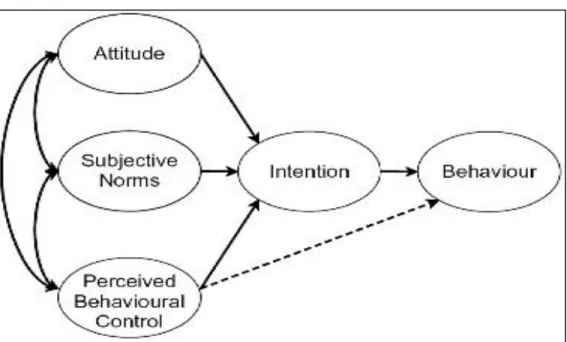
Figure 2.1: Theory of Planned Behaviour
Source: Ajzen, I. (1991). The theory of planned behaviour.
Organizational Behaviour and Human Decision Processes, 50, 179-211.
Figure 2.1 shows the Theory of Planned Behaviour (TPB) developed by Ajzen (1991) which adapt in this research. TPB is the extension of the Theory of Reasoned Action (TRA) with an addition of third determinant which is perceived behavioural control (PBC). TPB provides a way to understand and forecast an individual’s intention to engage in a behaviour by approach to self-regulation.
But it also mentioned that the behaviour is directed by intention and where the intention are also driven by attitude, subjective norms and TBC (Ajzen, 1991).
In this research, this theory is adapted as there are few factors will influence the intention of buying imported luxury fashion apparel goods and at the same time
Page 13 of 81
the intention is leading to affects the behaviour too. These researchers have proved that this theory is appropriate for understanding varied consumer behaviours (Son & Jin, 2013; Ling, 2009; Sanyal et al., 2014).
2.2.2 Theory of Uniqueness
Theory of Uniqueness is formalized by Fromkin and Snyder (1980), it focused on one’s emotional, cognitive, and behavioural responses when receiving information regarding their similarity. Besides, individual naturally motivated themselves to maintain a level of uniqueness just to improving their self-image (Tian et al., 2001). And this statement also supported by Lopez et al (2017), as it stated that in order to maintain the moderate level of uniqueness, individuals will use certain affective and behavioural methods just to maintain the level of uniqueness.
Moreover, needs of uniqueness is fundamentally based on counter conformity, as consumers with high needs of uniqueness tend to deviate from others and being different than others are being recognized to have impact on individual behaviour (Chan et al., 2012). Hence the theory of uniqueness is adapted to this research as the needs of one’s uniqueness would be one of the factors that affecting or influencing the buying behaviour in imported luxury fashion apparel goods of Malaysia Gen-Y. And this theory provide a foundation in the research to understand and predict Gen-Y buying behaviour towards the luxury goods.
Page 14 of 81
2.2.3 Social Impact Theory
Social impact theory (SIT) is another underlying theory that adapted in this research. SIT is proposed by Latane (1981), it used to sates the degree to which a person influenced socially when in a group of people and how an individual influences or is influenced by others. SIT also explained how social influence impact and causes changes in behaviour, attitudes and belief of individuals (Cialdini & Goldstein, 2004). SIT can be divided into three sub-types, which are norms, compliance and conformity (Cialdini and Goldstein, 2004).
Social influence is categorized under this theory as social influences defined as individual’s connection with the world (Mamat, Noor & Noor, 2016). The higher the status of a group and the closer among the members, the more people are being influenced (Soh et al., 2017). Furthermore, in this modern era the social media is growing rapidly, therefore it will influences individuals buying behaviour for luxury product (Nelson & McLoed, 29009). In this research, this theory is adapted one of our model comes from SIT, and social influence would be a significant factors that affecting the buying behaviour in imported luxury fashion apparel goods of Malaysia Gen-Y.
2.3 Hypotheses Development
2.3.1 Relationship between Materialism and Buying Behaviour in Imported Luxury Fashion Apparel Goods
According to Chan et al. (2015), materialism has an impact on consumer buying behaviour as material possession can represent their status. Hence their research results proved that materialism have a direct and positive relationship influence
Page 15 of 81
on buying behaviour in imported luxury goods. Besides, Fitzmaurice (2008) mentioned that highly materialistic individuals thinks that having luxury goods is a way to benefit their well-being. According to Handa and Khare (2013) research has emphasized upon the relationship between materialism and purchasing behaviour.
However other than positive relation between materialism and buying behaviour, there are also a number of cross-cultural studies proved that it is negatively related (Rahman et al., 2018). As there is tendency that people view materialism as negative trait (Sangkhawasi & Johri, 2007). In contrast, there is a relationship between materialism and buying behaviour in imported luxury apparel goods.
Thus it come out with the hypothesis as below.
H1: There is a significant relationship between materialism and buying behaviour in imported luxury fashion apparel goods.
2.3.2 Relationship between Social Value and Buying Behaviour in Imported Luxury Fashion Apparel Goods
According to Eastman et al. (1999), it said that status or value seeking behaviour is directly related to their luxury purchase behaviour. Individuals buying behaviour is influenced as the they concerns about what others think of them and how others will act towards them based on the brand they used (Sun et al., 2016).
Moreover, luxury goods able to provides additional value for a person so it consider to have an impact on the buying behaviour as nowadays people are concerns with their value in the market (Auf, Salleh & Yusoff, 2016). The consumption of luxury goods is a well-known behaviour as it have the value.
Furthermore, Auf et al. (2016) also mentioned that the consumer behaviour will continue even if they are from different culture or countries because the luxury
Page 16 of 81
value they consume is the same. Hence the results of the research about the relationship between social value and buying behaviour is valid and due to the social value of luxury goods it motivates consumers to buy the goods and more relevant to consumers in Asia. Thus, the hypothesis is formed.
H2: There is a significant relationship between social value and buying behaviour in imported luxury fashion apparel goods.
2.3.3 Relationship between Social Influence and Buying Behaviour in Imported Luxury Fashion Apparel Goods
In various studies it stated that consumers usually make decision to buy luxury goods as they are influences by others (Shukla, 2011). Because the consumers buy a luxury products are mainly aimed to signify wealth, social status (Roy, Jain,
& Matta, 2018). And Wiedmann et al. (2009) have empirically supported that there is a positive effect of social influence on the consumers buying behaviour in imported luxury goods. Moreover, in the research it labels social influences as one of the factors that stimulating consumers’ intention and behaviour to buy luxury goods.
Besides, the previous study of Zhang and Kim (2013) have found that there is a direct effect between social influence and the buying behaviour. Thereby, Joy et al. (2018) postulate that social influence have an effect on the luxury consumption and this statement also supported by Jain et al (2015).
H3: There is a significant relationship between social influence and buying behaviour in imported luxury fashion apparel goods.
Page 17 of 81
2.3.4 Relationship between Needs of Uniqueness and Buying Behaviour in Imported Luxury Fashion Apparel Goods
Needs of uniqueness construct is originated from the theory of needs for uniqueness. Through the research literature of Chan et al. (2015), they have the results of need for uniqueness has direct and positive relationship on consumers buying behaviour in luxury goods. According to the research results of Soh et al.
(2017), it support that Gen-Y consumers who have strong need of uniqueness personality have the behaviour of buying luxury more often in order to gain uniqueness or even making themselves stand out as fashion leader. Besides, Park et al. (2008) indicated that needs of uniqueness has impact among Korean Gen- Y on buying the luxury fashion goods and the Korea Gen-Y consumer tend to consume expensive imported goods in order to express their uniqueness.
Therefore the hypothesis between needs of uniqueness and buying behaviour is formed in this research as the researcher believe that there would be a positive relationship between these two variables.
H4: There is a significant relationship between needs of uniqueness and buying behaviour in imported luxury fashion apparel goods.
2.3.5 Relationship between Brand Consciousness and Buying Behaviour in Imported Luxury Fashion Apparel Goods
Brand consciousness refers to the awareness of the consumers towards certain of brand and product. Consumers that are brand conscious tend to buy and consume branded fashion goods as they believe the brand name will enhance their social class (Chiu & Leng, 2016). Moreover, the studies done by Giovannini et al. (2015) mentioned that brand consciousness had a positive impact on consumer behaviour in buying luxury fashion goods. At the same research, it also found
Page 18 of 81
that Gen-Y consumer that are high brand conscious are more likely to buy the luxury fashions goods as they seen brand as a symbols of status.
Furthermore the results of Chiu and Leng (2016) demonstrated that high brand conscious consumer have higher intention to buy luxury fashion goods. It also can be conclude that band consciousness has a positive influence on consumer buying behaviour in luxury fashion goods. Therefore, it can be hypothesized that brand consciousness have a positive relationship with the buying behaviour in imported luxury fashion goods.
H5: There is a significant relationship between brand consciousness and buying behaviour in imported luxury fashion apparel goods.
2.4 Proposed Conceptual/ Theoretical Framework
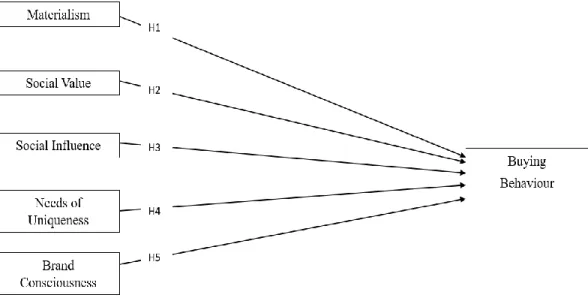
Figure 2.2: Proposed Conceptual/ Theoretical Framework
Source: Developed for the research.
Page 19 of 81
Figure 3.1 illustrates the proposed conceptual or theoretical framework that serves as the basis of this research. It is used to examine and investigate the relationship between the six variables which include five independent variables and one dependent variable.
In this proposed model, there are five hypotheses to test the relationship between the variables which are discussed in the hypotheses development. Buying behaviour is the dependent variable in this research and it is adapted from the theory of planned behaviour by Azjen (1991). Social influence and social value are adapted from the social impact theory. While needs of uniqueness is adapted from the theory of uniqueness and brand consciousness is adapted from the social comparison theory.
2.5 Conclusion
In Chapter 2, it explores literature review of previous researches with the aim to support and minimize the gaps due to research inadequacy. It also provides some relevant issues and review of literature background in order to have a better understanding of this research.
Page 20 of 81
CHAPTER 3: METHODOLOGY
3.0 Introduction
Chapter 3 will presents the research methodology description that includes research design, data collection methods, sampling design, measurement scales and method of data analysis are all details explained in this chapter.
3.1 Research Design
The theoretical perspectives most often associated with quantitative researches is phenomenology (Gray, 2013). As for this research, only quantitative methods and causal research will be used.
3.1.1 Quantitative Research
In the most basic terms, quantitative research are concerned with collecting data and analysis data that is structured and can be represented numerically (Goertzen, 2017). A quantitative research are mostly focus on quantification when collection and analysis data, and usually using a deductive approach (Saunders, Lewis, &
Thornhill, 2016). And it often seen as a more objective method as it takes a larger sample and numerical data. Moreover, quantitative research method also use to tests causal relationships and the results are generally more generalizable to the population as it use of numbers and statistics (Bryman & Bell, 2015).
Page 21 of 81
In this research, qualitative research method has been used to investigate the consequences of Malaysia Gen-Y behaviour in buying imported luxury fashion apparel goods. This method is the most suitable method as it uses statistical analysis to analyse the required information.
3.1.2 Causal Research
This causal research establishes the cause and effect relationship between variables, by testing the hypotheses in order to get a conclusive understanding of a problem (Saunders, Lewis, & Thornhill, 2016). Causal research can used to study how the independent variables affecting the dependent variables. Therefore causal research is more appropriate to use in this research in order to examine the relationship between the independent variables (materialism, needs of uniqueness, social value, social influence, brand consciousness) and dependent variable (buying behaviour) among Malaysia Gen-Y.
3.2 Sampling Design
Sampling is a process in selecting a subset or smaller segment of individuals that fairly represent the larger population (Bryman & Bell, 2015). Besides that, Zikmund, Babin, Carr, and Griffin (2013), permits the researcher to draw an inference about a population based on a sample. And sampling design is the framework that serves as the fundamental foundation of choosing survey sample. It allows the researcher to define the target population, sampling location, sampling frame, sampling element, sampling techniques and sampling size.
Page 22 of 81
3.2.1 Target Population
It is important to decide and define the suitable population that will be tested (Saunders et al., 2016). The target respondents of this study were Gen-Y consumer in Malaysia. This is because Gen-Y consumers are the major segments in Malaysia population and most of them are working adults which have the abilities and buying power towards the imported luxury fashion apparel goods.
The total amount of target population in Malaysia for this research is 200 respondents.
3.2.2 Sampling Frame and Sampling Location
A sampling frame is a list of the actual cases from which sample will be drawn.
The sampling frame must be representative of the population (Zikmund et al., 2013). In this study, it does not include sampling frame as the non-probability method is applied because it is hard and impossible to get data and information of a huge numbers of Malaysia Gen-Y.
Besides, target population in this study is Malaysia Gen-Y hence specific location or places will not be chosen to conduct this survey as they are all from Malaysia regardless of state. However, this survey will be distributed through online to the respondents which come from various states and cities in Malaysia or overseas.
As long as they are Malaysian and born in Gen-Y they are qualified to participate in the survey.
Page 23 of 81
3.2.3 Sampling Elements
The sampling elements in this study is focus on the respondents who are born between year 1980 and 2000 that aged between 19 and 39 years old. For those who could not fulfil the necessary requirement, they are not entitled to participate in this research. Furthermore, the questionnaire involve different ranges such as gender, marital status, education levels, and monthly income. These information helps the researchers to obtain different insights from the respondent with different background in order to allow the research to be more reliable.
3.2.4 Sampling Technique
According to Zikmund et al (2013), there are two major sampling techniques that can be used to analyse the sample which are probability and non-probability sampling. Probability sampling of each case being selected from the population is known and is usually equal in all cases. While non-probability sampling of each case being selected from the total population is not known and it will face difficulties in answer research questions but you may still be able to generalize from non-probability samples about the population (Saunder et al., 2015).
Moreover probability sampling technique include of simple random sampling, systematic sampling, stratified random sampling, cluster sampling and multi- stage. Whereas non-probability sampling include of quota sampling, purposive sampling, snowball sampling, self-selection sampling and convenience sampling.
In this research, non-probability sampling technique is chosen and among all the non-probability sampling methods purposive sampling is applied in this research.
As this method is a strategy in which particular settings persons or events are selected deliberately to obtain important information that other choices cannot get (Maxwell, 1996). Besides, it also allows to use own judgment when select
Page 24 of 81
cases that will best enable to answer the research questions and meet the research objectives. This technique are considered as the most affordable and effective way as it allows the researchers to collect and obtain data from the whole population within a shorter time frame.
3.2.5 Sampling Size
Sampling size is the numbers of units or observation selected from the population being studied (Zikmund et al., 2013). Sample size is important to form the representativeness of the sample for generalizability (Sekaran & Bougie, 2016).
Also the appropriate sample size will increase the validity and reliability of the studies.
Roscoe (1975) proposes rules of thumbs for determining sample size with stating that the sample size larger than 30 and less than 500 are appropriate for most research. Thus in this research, the expected sample size is 250 respondent to lower the chances of error in generalizing the population, thereby increasing the accuracy of the result.
3.3 Data Collection Methods
Data collection can be defined as a process of collecting data to tackle those critical evaluation question that the author had identified earlier in the evaluation process. It is important as it will affect the final results of the research report. Data collection is a process that gather data on the variable of interest, create a systematic fashion that enables individual to answer the research question, test hypothesis, and finally evaluate the outcome. Data collection is one of the important components to all fields of research
Page 25 of 81
study. And the data collection has been classified into two major methods which are primary data and secondary data.
3.3.1 Primary Data
Primary research is a first-hand data, new research, carried out to answer specific issues or questions. Primary data is used as the researchers are collecting information for particular purposes (Primary data and secondary data, 2015).
Besides, primary data can be gathered through a variety of approaches such as observation method, interview method, questionnaire, survey methods and through schedules (Saunder et al., 2016).
In this research the primary sources of data have been collected by using Google form questionnaires method. The questionnaire is adapted from relevant research journals and are not developing by own to secure the accuracy of questions. The objective of the questionnaire is to acquire information from the Malaysia Gen- Y behaviour in buying imported luxury fashion apparel goods.
The questionnaire consists of fixed- alternative questions with 5-likert scale. This survey method is chosen is due to its rapidness and effectiveness to gather data information, easy way and it abilities to reach large number of people in the market.
3.3.2 Secondary Data
Secondary data include both raw data and published summaries (Saunders et al., 2016). Also secondary data refers to the second-hand information which is previously collected by first person. Some examples for secondary data may
Page 26 of 81
include textbook, magazine, newspaper article, journals, handbooks and more.
Secondary data tends to be readily available and inexpensive to obtain. However, some of the information might be outdated and does not match the present research objectives.
In this research study, the secondary data that be used are included academic and professional journals that available in the libraries and internet. The online data are obtain from e-database such as UTAR library, Google Scholar, Emerald, EBSCOhost, and Elsevier. The data from well-known organization that could be found in market research report is more reliable and trustable.
3.4 Research Instrument
3.4.1 Questionnaire
Questionnaire consists of a range of questions relating to the research topic that are developed either in printed or electronic form which respondent record their answer (Sekaran & Bougie, 2016). Also questionnaire are generally designed to collect large numbers of quantitative data, and are generally less expensive and less time consuming as compared to interviews and observation.
The questionnaire of this research is designed and developed by adaptation from relevant research journals. Moreover, this questionnaire are checked and modified under the direction of supervisor before distributing to the target respondents. Besides, the questionnaire of this research is in Google form and it will be more convenient, less expensive, more efficient, and no geographical barrier as compared to the other research instruments.
Page 27 of 81
Furthermore, the questionnaire is designed and presented in a simple and unbiased manner whereby the target respondents can understand and complete the questionnaire. It is a structured questionnaire where fixed- alternative question are given. With these fixed-alternative questions which are known as close ended questions. It will require less interviewing skills, less time consuming and easier for respondent to answer the questions (Zikmund et al., 2013). And the brief introduction and purpose of conducting this research are attached at the cover page of the questionnaire.
3.4.2 Questionnaire Design
Firstly, two filter question is asked at the beginning of the questionnaire which is
“Are you Malaysian” and “Are you born in Gen-Y (between year 1980 and 2000)”. This is to screen out respondent who are not qualified to answer the following questions. This questionnaire is separated into three sections, which are Section A, B and C.
Section A
This section is demographic profile which consists of the respondent’s demographic data and general information. It has seven nominal and ordinal types of items which are gender, age, race, marital status, education level, occupation, and income level. Respondents are required to choose only one response from multiples alternatives.
Section B
This section is designed specifically to examine whether the buying behaviour of Malaysia Gen-Y in imported luxury fashion apparel goods will be influenced by the five independent variables. The first variable is materialism, five items are
Page 28 of 81
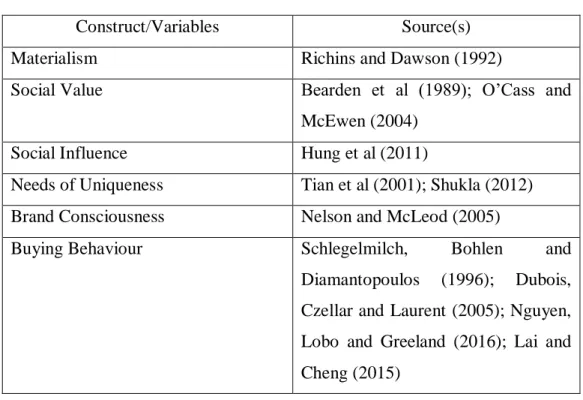
adapted from Richins and Dawson (1992) and used to measure the variable. Next the social value have four items to measure the variable and are adapted from Bearden et al (1989); O’Cass and McEwen (2004). Social influence have five items to measure and adapted from Hung et al (2011). Needs of uniqueness have four items and adapted from Tian et al (2001); Shukla (2012). And lastly the last independent variable is brand consciousness, this variable have five items to measure and are adapted from Nelson and McLeod (2005).
Section C
This section is the measurement of the dependent variables in this research which are the purchase intention and buying behaviour. Firstly the purchase intention is measured with four items adapted from Lee et al (2013). While the buying behaviour is measured with four items adapted from Schlegelmilch, Bohlen and Diamantopoulos (1996); Dubois, Czellar and Laurent (2005); Nguyen, Lobo and Greeland (2016); Lai and Cheng (2015).
Page 29 of 81
3.4.3 Origin of Construct
Table 3.1: Origin of Construct
3.5 Construct Measurement
3.5.1 Scale of Measurement
According to Hair et al. (2007), scale measurement is a measurement tool that can be used to measure a question with a predetermined number of outcomes.
Also, a scale is used to distinguish the interest of the variables to the study (Sekaran & Bougie, 2016). There are four types of scale measurement which commonly used in doing research such as nominal, ordinal, interval and ratio
Construct/Variables Source(s)
Materialism Richins and Dawson (1992)
Social Value Bearden et al (1989); O’Cass and
McEwen (2004)
Social Influence Hung et al (2011)
Needs of Uniqueness Tian et al (2001); Shukla (2012)
Brand Consciousness Nelson and McLeod (2005)
Buying Behaviour Schlegelmilch, Bohlen and
Diamantopoulos (1996); Dubois, Czellar and Laurent (2005); Nguyen, Lobo and Greeland (2016); Lai and Cheng (2015)
Page 30 of 81
scales. In this research, only nominal, ordinal and interval scales are used in the survey questionnaire.
3.5.1.1 Nominal Scale
For this research, nominal scale will be used for 3 questions in Part A which are gender, race, marital status, and occupation. And before the questionnaire start, it will have two screening questions “Are you Malaysian” and “Are you born in Gen-Y”. And these screening questions also consider as nominal scale. As these questions only indicates Yes or No, and does not contain ranking or quantitative value.
3.5.1.2 Ordinal Scale
Ordinal scale is a quantitative scale which shows that the items can be measured and arranged based on grade. According to Zikmund et al (2013), ordinal scale also allows things to be arranged based on how much of some concept they possible. In this research, ordinal scale has been developed in section A which are age, education level and income level.
3.5.1.3 Interval Scale
In this research the questionnaires in section B and C uses the interval scale where the scales provided are five-point Likert scale from 1 to 5 which indicate Strongly Disagree, Disagree, Neutral, Agree and Strongly Agree. The purpose of using interval scale is to measure the dependent variables and the independent variables.
And it indicates the extent to which the respondent agrees or disagrees with the variable mentioned in questionnaire.
Page 31 of 81
3.6 Data Processing
Data processing is the process whereby the quantitative data collected from the respondents will undergo a series of procedures to convert into information content that can be easily controlled and understood by the researcher before they take and used the data in statically analysis. Data processing is important as it is to ensure the data collected is reliable and consistent. The data processing includes checking, editing, coding, transcribing and cleaning of data.
3.6.1 Data Checking
Usually the researcher will start with the questionnaire checking. It involve of revision on the questions relevance and appropriateness. This is to ensure the quality of the items of questionnaires and the data collected from the questionnaire. All the collected data are checked carefully and repeatedly in order to find mistake or error made. This is done so that the reliability of the tests and the quality are maintained.
3.6.2 Data Editing
According to Zikmund et al (2013), data editing process will be carried out to review and examine the data omissions, reliability and legibility in order to turn them into more complete and understandable. Besides, this process involves editing and correcting errors found in the questionnaires. In this research, the questionnaire uses Google form, all of the questions are required to be answered by the respondents, thus there is no or little changes that has been made. As it is to increase the accuracy and consistency of the data, the raw data will be edited first if there is any error.
Page 32 of 81
3.6.3 Data Coding
Data coding is the code of identity assignation in order to symbolize specific responses to specific questions. Besides, the data analysis software which is Statistical Package for Social Sciences (SPSS) version 25.0 is used in this research. It requires the numerical data as an input so that it could analyzing the information. Hence, each response will be differentiated by different numbers and the number will assigned to every data so that the data is clearer to the researcher.
For example, in section A, 1 is coded as “male” while 2 is coded as “female”.
And in section B and C of the questionnaire, the level of agreeability from
“strongly disagree” to “strongly agree” is decoded from 1 to 5.
3.6.4 Data Transcribing
After the checking, editing and coding of data are done, the data collected will be transcribed by the researcher into the computer. In this research, the data will be keyed-into Statistical Package of Social Science (SPSS) software version 25.0 to conduct the data analysis.
3.6.5 Data Cleaning
Data cleaning is the process where the data ad input accuracy are being verified from the questionnaire to SPSS software. By using SPSS, any ambiguous and unreliable data will be detected. The SPSS software is used to check and ensure the consistency of the data collected.
Page 33 of 81
3.7 Data Analysis
Data analysis is a process of systematically applying statistical techniques to describe, illustrate and evaluate data. The aim of this process is to produce useful information that can be used to produce inductive inferences and conclusions. In this research, SPSS version 25.0 is used and several statistical tests and analyses are carried out by using the software, which includes descriptive analysis, scale measurement and inferential analysis.
3.7.1 Descriptive Analysis
Descriptive data analysis is the elementary transformation of data in a way that describes the basic characteristics such as central tendency, distribution and variability (Zikmund et al., 2013). The most common descriptive techniques are central tendency such as mean, median and mode, range, variance and standard deviation.
3.7.2 Scale Measurement
In this research, scale measurement are used to measure the variables especially in section B and C. Moreover, the researchers have used nominal scale, ordinal scale and interval scale throughout the design of the questionnaire in this research.
Page 34 of 81
3.7.2.1 Reliability Test
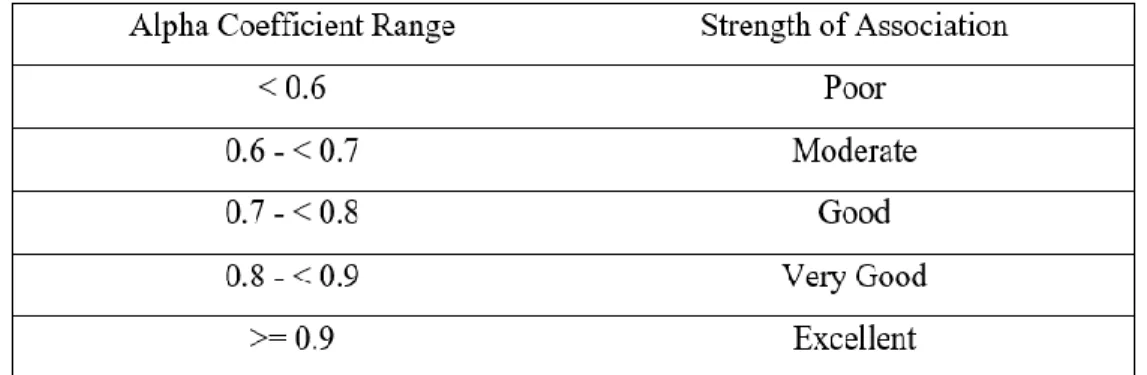
Reliability refers to which a measure is free from error and therefore produces stable and consistent result (Zikmund et al., 2013). Reliability analysis is one that determines the degree of validity, consistency of the questionnaire after repeated testing is conducted. Based on Sauders et al (2009), reliability is an indicator of measure the internal consistency. In order to measure internal consistency of multiple item scales, Cronbach’s alpha method are used.
Table 3.2 Rules of Thumb about Cronbach’s Alpha Coefficient Size
Source: Hair, J. F., Money, A. H., Samouel, P., & Page, M. (2007).
Research methods for business. West Sussex, England: John Wiley and Sons.
Page 35 of 81
3.7.3 Inferential Analysis
Inferential analysis is a group of statistical techniques and procedures used in confirmatory data to draw conclusions about a population from quantitative data collected from a sample (Sekaran, 2016).
3.7.3.1 Multiple Regression Analysis
Multiple regressions analysis is an equation or method using two or more independent variables on a single dependent variable where all the variables is interval or ratio scale (Saunders et al, 2009).
The multiple regression equation is as follow:
Y = a + b1X1 + b2X2 + b3X3+…
While Y = Dependent variable X = Independent variables a = Constant Value / Y-intercept b = Unstandardized coefficient
Page 36 of 81
3.7.3.2 Pearson Correlation Coefficient Analysis
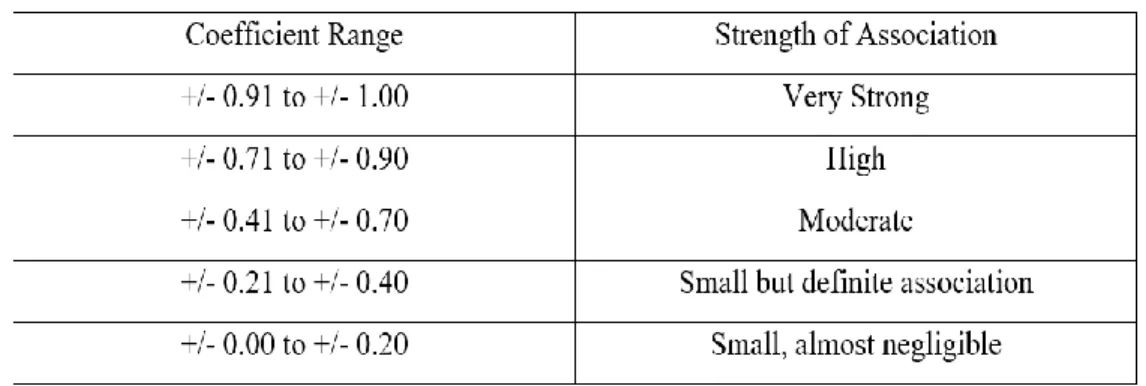
Pearson correlation coefficient is a technique to measure the strengths and the direction of between the variables and it is used to measure how those data related. Pearson correlation coefficient also can define how strong the relationship between the dependent variable and independent variable. The range of coefficient value is between -1.0 and +1.0. If the coefficient value is in negative range, it means the relationship between two variables is negatively correlated. Meanwhile, when the coefficient value is positive range, it means the relationship between two variables is positively correlated (Zikmund et al., 2013).
Table 3.3: Rules of Thumb about Correlation Coefficient
Source: Hair, J. F., Money, A. H., Samouel, P., & Page, M. (2007).
Research methods for business. West Sussex, England: John Wiley and Sons.
3.8 Conclusion
In this chapter, the research methodologies being used for this research are research design, data collection method, sampling design, research instruments, construct measurement, data processing and data analysis. The proposed conceptual or theoretical framework is formulated.
Page 37 of 81
CHAPTER 4: DATA ANALYSIS
4.0 Introduction
In this chapter, it will presents graphical and table forms results that include descriptive analyses describing the demographic data of 200 respondents. But only 192 respondents are qualified and valid for the research, scale measurement of Cronbach’s Alpha and also inferential analyses consisting of Pearson Correlation Coefficient and Multiple Regression. Results will be obtained and generated using SPSS software version 25.0.
4.1 Descriptive Analysis
4.1.1 Screening Questions
In this research there are two screening questions been asked before started the questionnaire. The questions were “Are you Malaysian?” and “Are you born in Gen-Y?”.
Page 38 of 81
4.1.1.1 Are you Malaysian?
Table 4.1: Are you Malaysian?
Source: Developed for the research.
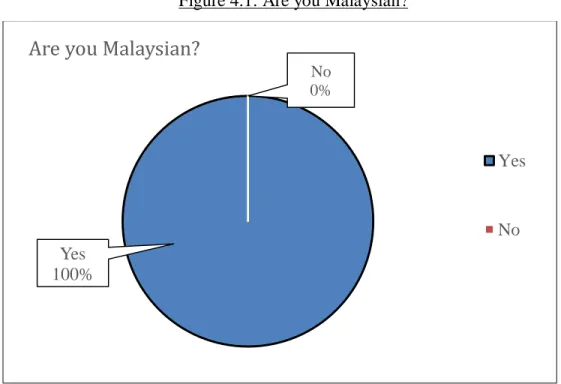
Figure 4.1: Are you Malaysian?
Source: Developed for the research.
Table 4.1 and Figure 4.1 show the frequency and percentage of the respondents based on whether they are Malaysian or not. In a total of 200 respondents, all of them are Malaysian.
Yes 100%
No 0%
Are you Malaysian?
Yes
No
Page 39 of 81
4.1.1.2 Are you born in Gen-Y?
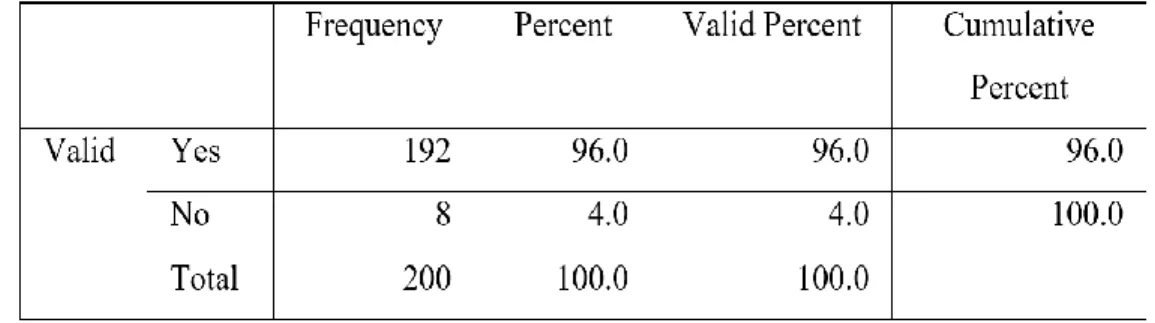
Table 4.2: Are you born in Gen-Y?
Source: Developed for the research.
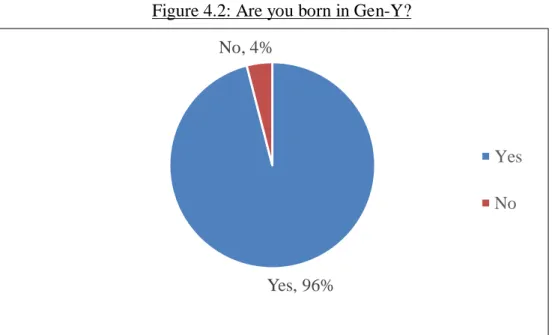
Figure 4.2: Are you born in Gen-Y?
Source: Developed for the research.
Table 4.2 and Figure 4.2 show the frequency and percentage of the respondents based on whether the respondents are born in Gen-Y. In total of 200 respondents, 192 of them are born in Gen-Y and 8 of them are not. Respondents that born in Gen-Y consists of 96% while the respondents are not born in Gen-Y make up the remaining 4%.
Yes, 96%
No, 4%
Yes No