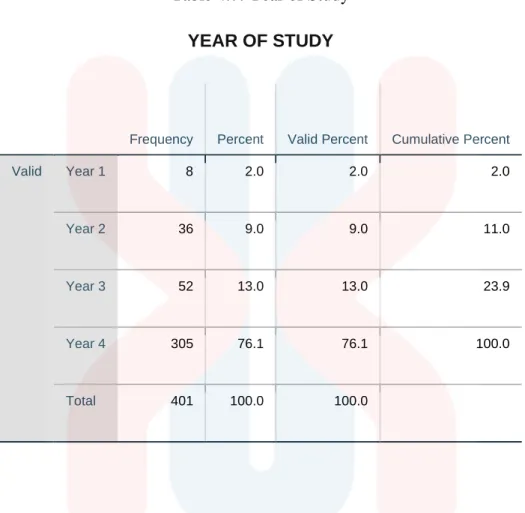
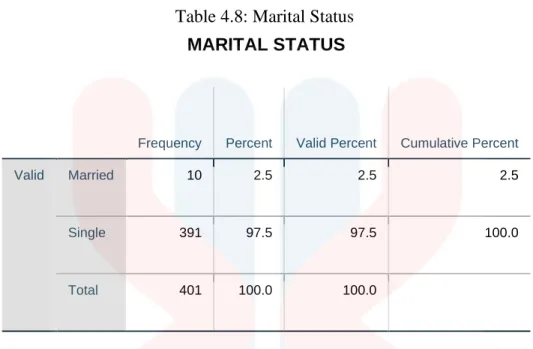
The emergence of the Covid-19 pandemic has brought new changes in various aspects, especially in the learning process in Malaysia (Mahalingam & jamaludin, 2021). Thus, the lack of support and encouragement from parents is the cause of the lack of motivation of students to continue learning online.
Research Objectives 5-6
Ferrante, Ferro & Pontarollo, 2017).The distance between two adjacent attributes is called an interval, and intervals are usually equal. H3: There is a significant relationship between factors regarding motivation and academic performance of undergraduate students during the covid-19 pandemic.
Significance of Study 6-7
Academic Achievement 7
Chzin and Surat (2021) mentioned that a student's academic achievement is something that is achieved at the level of progress through individual effort and persistence towards mastering the knowledge or skills he has learned based on the point value he has accumulated.
Pandemic 8
Teaching Method 8
Motivation 8
Perceived Social Support 9
Financial Stability 9
Referring to previous studies, online teaching and learning is constantly evolving and playing an important role in education in Malaysia (Gunawan et al. 2020). In this epidemic era, the field of education has begun to shift to online teaching and learning using a range of existing technologies.
Underpinning Theory 11-12
Students’ Academic Achievement 13-14
Working memory (the simultaneous storage and manipulation of information; Peng et al., 2018), reasoning (the ability to solve novel and complex problems; Sternberg, Kaufman, & Grigorenko, 2008), and executive functions are important for academic performance (cognitive and social-emotional processes, which underlie goal-directed behaviors such as flexible thinking, self-control, and self-regulation; Best & Miller, 2010). According to Abdelrahman et al. 2020), achieving excellent academic performance is based on the student's academic intrinsic motivation, which is essential in the learning process and human life activities.
Conceptual Framework 24-25
The research recognizes that online learning provides a learning environment that is separate from face-to-face or classroom learning contexts. The research technique will be a collection of knowledge and the most recent data that researchers can use for the survey.
Research Design 27
Research Instrument 28
This study will be divided into five sections, A, B, C, D and E, with a questionnaire as the research instrument. Regarding alternatives, the Likert scale will be provided to allow respondents to identify the strength of their positive-to-negative feelings about the question or statement.
Measurement scale 28
Data Collection Methods 28
Study Population 29
Sample Size 29
Sampling Techniques 30-31
Questionnaire Design 32-34
This study area consists of a demographic profile of respondents, an independent variable that focuses on the factors that influence the academic performance of undergraduate students during a pandemic. The question consists of a demographic profile of the respondents, an independent variable that focuses on the factors that affect academic performance during COVID-19, and a dependent variable that is the student's academic performance. According to Junyong (2017), a pilot study is the initial phase of the complete research process and is often a smaller study that helps with the design and modification of the main study.
Then, the purpose of the pilot study was to increase the likelihood that the main study would be successful by assessing the variability of participant recruitment and retention procedures, testing the face and content validity of the questions, and evaluating the usability of the technology used. to administer the questionnaire. The main objective of the pilot project was to assess the feasibility of recruiting study participants, as well as the technical and navigational elements of the online survey procedure and the instrument itself. The questions constructed are based on the objectives in the study conducted to obtain accurate and precise information.
Interval Scale 36-37
Next, Sections B, C, D and E covered the questions regarding the factors influencing academic performance, and an interval variable used for dependent and independent variables based on the framework used in previous studies. A nominal scale is a measurement system used to categorize events or things into discrete groups (Sunyoto, 2019). A 5-point Likert scale used in the research, ranging from strongly disagree (1), disagree (2), neutral (3), agree (4) and strongly agree (5) was designed to investigate how strongly the statements agree or disagree.
The ratio scale is one of two types of continuous scale available, the other being the interval scale. It is both an extension of the interval scale and the height of the measurement scale types (Kusaeri & Suprananto, 2018). The ratio scale differs from the interval scale only in that the ratio scale already has a value of zero.
Procedure for Data Analysis 38
Data Process and Data Analysis 38
Description Analysis 38-39
Summary / Conclusion 42
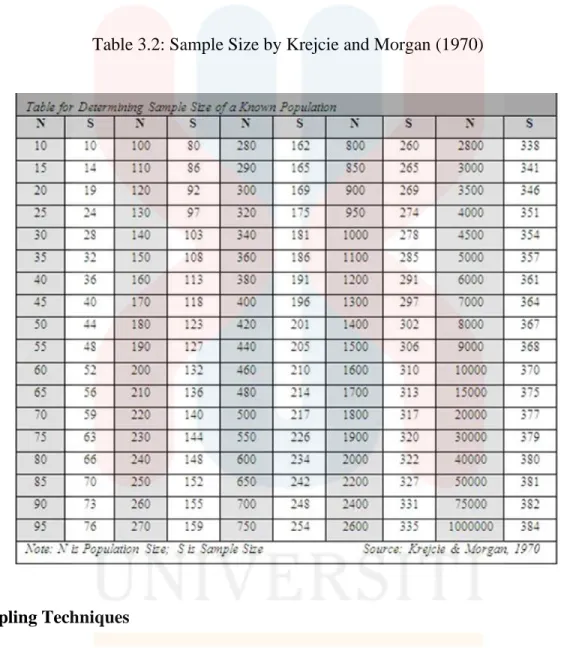
Researchers decided to use the published table of (Krejcie & Morgan, 1970) for the population and sample of the study. Researchers used primary data by distributing questionnaires so that respondents could obtain more accurate information about the relationship between learning methods and students' academic performance during the pandemic. Then, obtain the required results of the study on the relationship between financial stability and students' academic performance during a pandemic.
The data in this study were analyzed using descriptive analysis, reliability testing, Pearson correlation coefficient and multiple linear regression. All these techniques will be used to analyze the data collected, and Chapter 4 will discuss them in more detail. In addition, this section also discusses the analysis in relation to the questions asked in the questionnaire.
Preliminary Analysis 43
Pilot Test 43-44
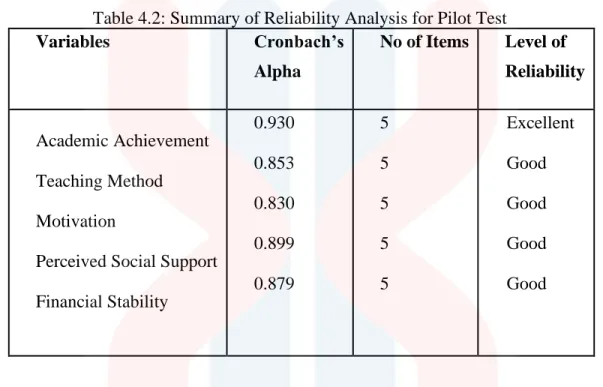
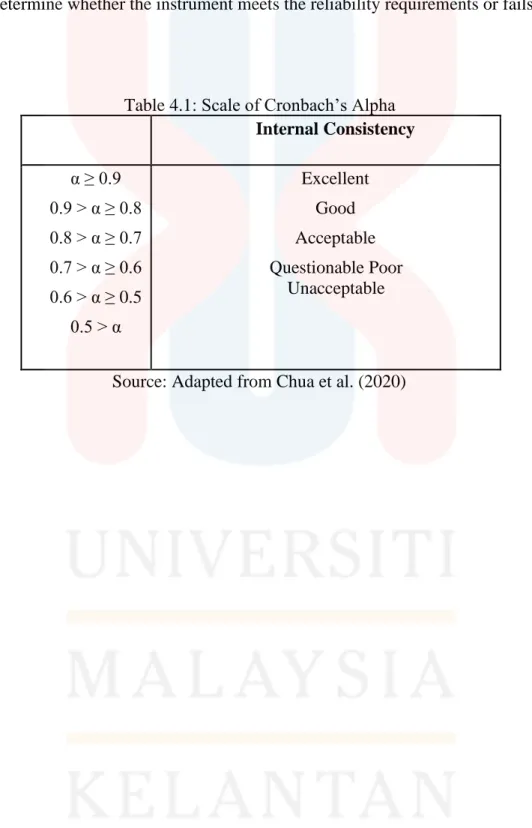
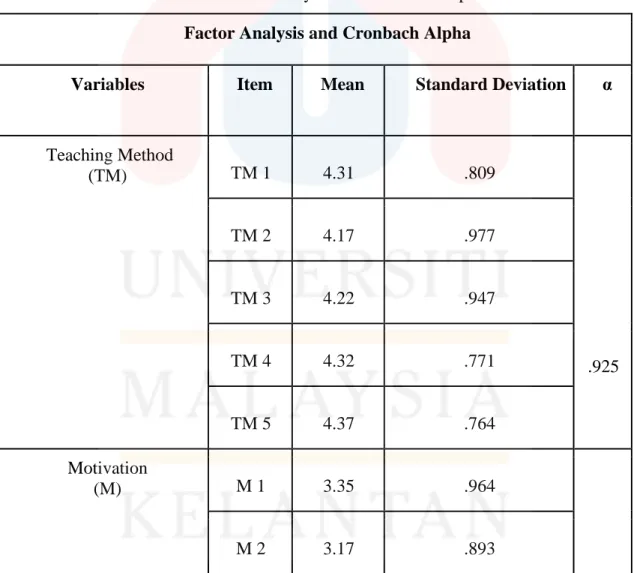
This section also covers demographic information and data that were analyzed through descriptive statistics in Statistical Package for Social Science (SPSS) version 26 software. It is also important to remember that the hypotheses described in Chapter 2 are formulated either as a rejection or an assumption. The calculated value of Cronbach's Alpha of the variables is higher than 0.6, which ranges from 0.612 to 0.897.
Therefore, it indicated that the measurements for all variables for the pilot test are reliable in this study. Therefore, after receiving Cronbach's Alpha value, the researcher conducted the actual study to administer the questionnaire in the field.
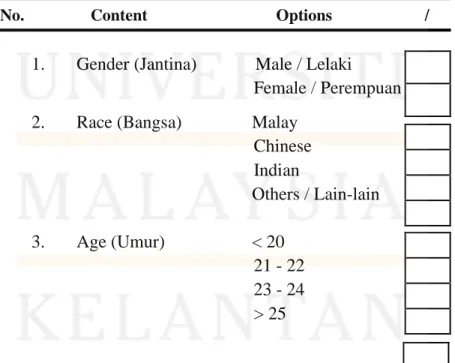
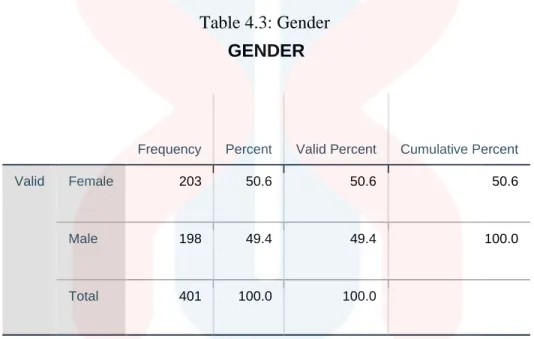
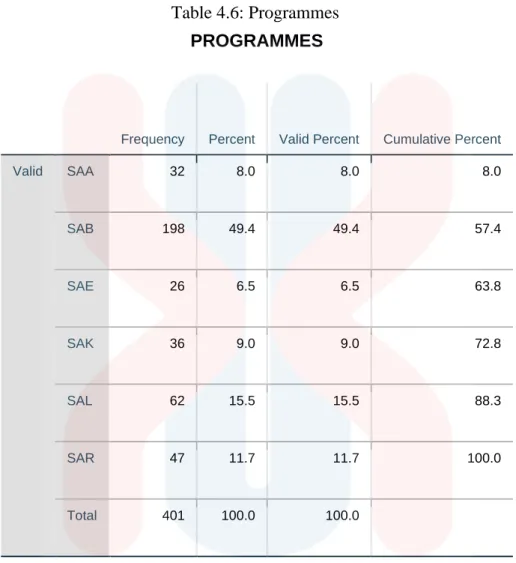
Demographic Profile of Respondents 46-55
As a result, it suggests that students were unable to concentrate on online learning during the Covid-19 pandemic and their motivation was lower than before. My siblings respected me by not making noise when learning online during the Covid-19 pandemic. It reveals that students' families supported them while they were on online learning during the Covid-19 pandemic, which will help them stay motivated when the stressful phase comes.
Consequently, it reveals that during the Covid-19 pandemic, students may be able to save money because approximately 78 percent of respondents agree. Students are really intrigued by online learning because their spending power was unaffected by the Covid-19 pandemic. As a result, it appears that most students were able to complete their assignments throughout the Covid-19 pandemic.
Normality Test 62-68
Hypothesis 1 69
H0: There is no relationship between teaching methods and students' academic performance during a pandemic. H1: There is a relationship between teaching method and students' academic performance during pandemic. So, there is a significant relationship between teaching method and students' academic performance during pandemic.
The value of correlation, r is 0.793, indicates a strong relationship between teaching method and the academic performance of undergraduate students during a pandemic.
Hypothesis 2 69
Thus, there is significant relationship motivation and students' academic performance during a pandemic. The value of the correlation, r is 0.789, indicates a strong relationship between motivation and students' academic performance during a pandemic.
Hypothesis 3 70
Hypothesis 4 71
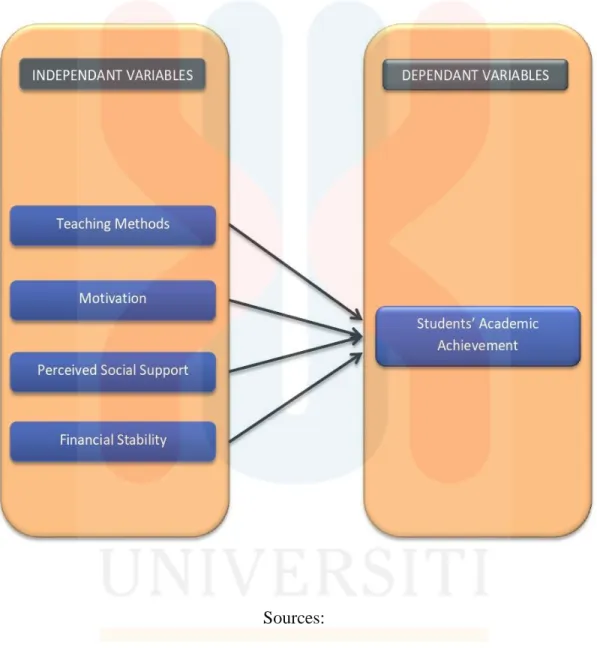
TM H2: There is a significant relationship between teaching method factors and academic performance of undergraduate students during the covid-19 pandemic. H4: There is a significant relationship between perceived social support factors and academic performance of undergraduate students during the covid-19 pandemic. H5: There is a significant relationship between financial stability factors and academic performance of undergraduate students during the covid-19 pandemic.
The result shows that there is a significant relationship between the teaching method factor and the academic achievement of graduate students during the Covid-19 pandemic. The result shows that there is a significant relationship between the motivation factor and academic achievement of graduate students during the Covid-19 pandemic. I'm able to focus on online learning during the Covid-19 pandemic
I was interested in online learning during the Covid-19 pandemic. This question is focused on the dependent variables that are academic performance of undergraduate students during the Covid-19 pandemic.
Summary / Conclusion 71
DISCUSSION AND CONCLUSION
Key Findings 72-82
The final results of the study revealed that it is consistent with the results of some researchers such as Friadi et al., 2015; Gbongli et al., 2019; Karim et al., 2020; Liu & Tai, 2016; Nag & Gilitwala, 2019; Trivedi, 2017, who states that TM and M have been found to be positively associated with academic achievement of university students during the pandemic. Finally, this study also found that FSs tend to be more or less attractive to university students' academic achievement during the pandemic. A considerable number of meta-analyses and empirical studies have shown that motivation is a moderate to strong predictor of academic achievement (Kriegbaum et al., 2018).
The latest study did show a decrease in students' academic motivation during the COVID-19 pandemic, as younger students showed a greater decrease in motivation (Pasion et al., 2020). In the latest research conducted in the midst of the COVID-19 pandemic, most students were unwilling to continue their studies using online learning methods (Chung et al., 2020). In particular, social support has been shown to be an effective factor in reducing students' psychological pressure during COVID-19 (Li et al., 2021).
Summary/Conclusion 92
Saya berasa selesa melakukan tugasan dalam talian semasa pandemik Covid-19/ Saya berasa selesa melakukan tugasan dalam talian semasa pandemik Covid-19. Saya mudah berkomunikasi dengan rakan dalam pembelajaran dalam talian semasa pandemik Covid-19/ Saya dapat meningkatkan prestasi pembelajaran saya semasa pandemik Covid-19/ Saya dapat meningkatkan prestasi pembelajaran saya semasa pandemik Covid-19.
Adik-beradik saya membantu saya semasa saya belajar dalam talian semasa pandemik Covid-19. Kehidupan saya stabil dari segi kewangan semasa pandemik Covid-19/ Kehidupan saya stabil dari segi kewangan semasa pandemik Covid-19. Saya berjaya mengekalkan prestasi akademik yang baik semasa pandemik Covid-19/ Saya berjaya mengekalkan prestasi akademik yang baik semasa pandemik Covid-19.