Improper maintenance management and practices can affect maintenance performance levels and building productivity. Writing this dissertation was one of the most important academic challenges the author faced.
Background of study
2 This case study focuses on maintenance practice for the company in dealing with the maintenance management in public project. Each of the companies have their own policies and work culture that need to be added for improvement.
Problem Statement
Therefore, it is important for the industry to improve the implementation of effective maintenance management and practices along the functionality of the building and infrastructure. Therefore, this study examines the factors that influence the implementation and effectiveness of maintenance practice.
Research objective
Scope of study
Overview of Maintenance Practices
Issues and challenges in selecting maintenance strategies
According to previous research cited by Ali et al. 2016), most maintenance staff do not clearly understand the operational framework of the maintenance process as they too rely on technology. Normally the team is busy to perform emergency breakdown maintenance compared to preventive maintenance.
Factor that contribute to the effective maintenance management and practice
In order for the manager to choose the most appropriate maintenance strategy, the most important part is the allocation of maintenance resources. In addition, problems faced in maintenance work must be differentiated and visibly shifted to ensure the best maintenance strategies are implemented.
Research Design
Study purpose
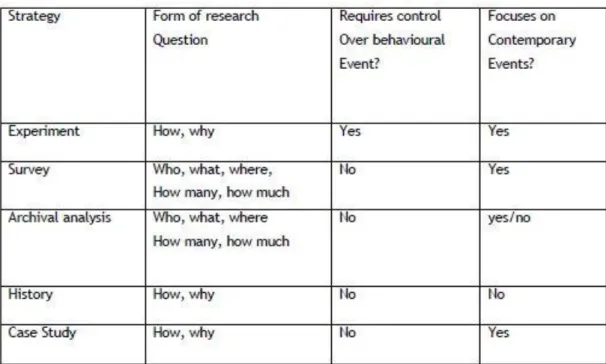
Research strategy
Population of the Study
Data Collection
Preparation and distribution of questionnaire
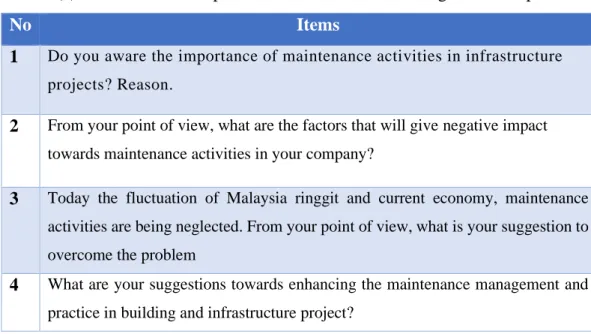
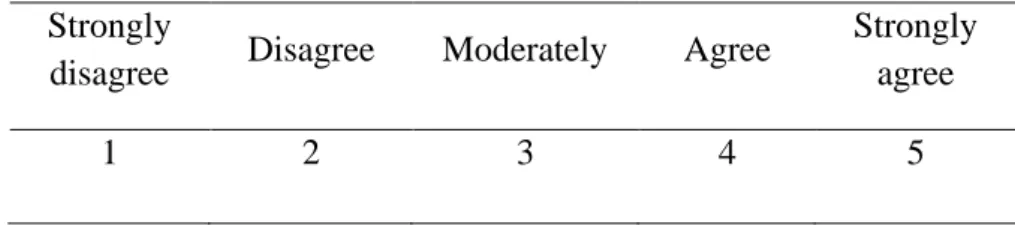
The second part of the questionnaire contains the main part of this research, requesting information on the factors involved in the implementation of effective maintenance management and practice in the infrastructure project at their company. The severity of the maintenance management and practice factors according to the respondents' opinion was selected through the Likert scale as shown in the table below. Respondents are expected to answer these questions based on their opinions and suggestions on the matter.
2 From your point of view, what factors will have a negative impact on maintenance activities in your company? 4 What are your suggestions for improving maintenance management and practice in construction and infrastructure projects?
Data Analysis
Average index (AVI)
Relative Importance Index (RII)
Statistical package for the social sciences (SPSS)
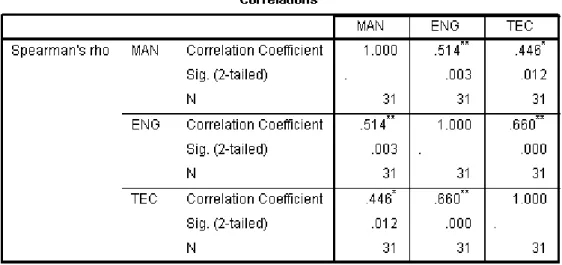
A perfect spearman correlation is either +1 or -1 while 0 values will occur when there are no repeated data values. Reliability test is measured by using the Cronbach's Coefficient Alpha to get the consistency of particular data. Validity of an assessment is the degree to which it measures what it is supposed to measure.
According to Agyekum, 2012; Jin, 2003; Garson, 2002 cited by Syuhaidah, (2016) stated that the validity of research is based on the number of sources used as reference and the absence of logical fallacies in inference from the data. It is not necessary that the validity of measurements is always similar as it is in reliability. Validity depends on the measurement measuring what it was designed to measure and not something else.
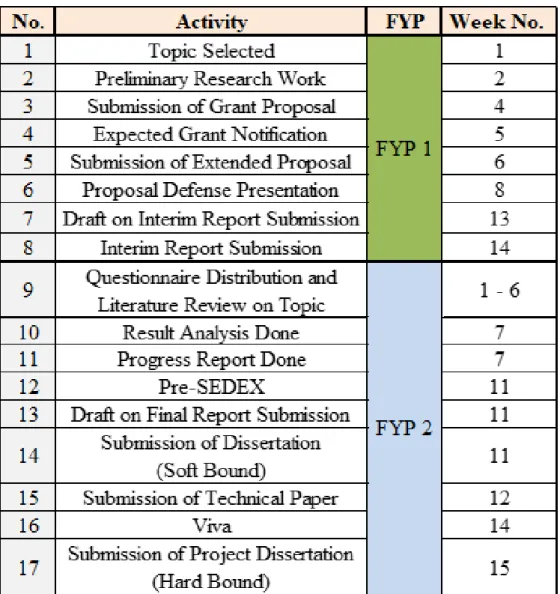
Key Milestone of FYP 1 and FYP 2
Gantt Chart of planning in activities on the project
Introduction
Analysis of respond rate
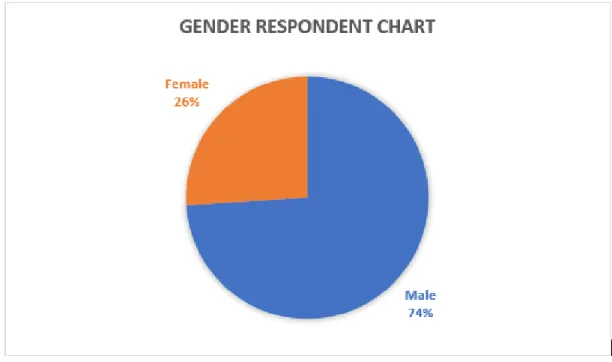
- Distribution of respondents by gender
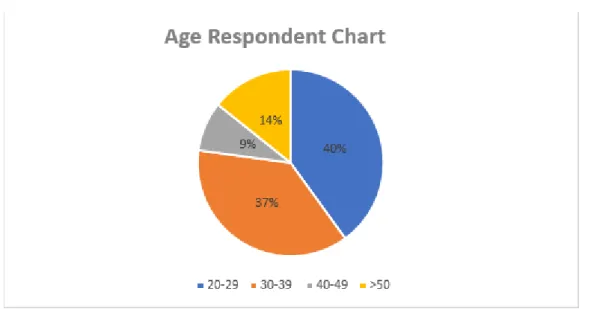
- Distribution of Respondents by Age
- Distribution of Respondents by Academic Qualification
- Distribution of Respondents by Designation in Company
- Distribution of Respondents by working Duration
About 23% of the respondents were said to be the most experienced industrial workers of all (over 40). According to the table, most of the respondents graduated with a diploma (48%), followed by a diploma with 31.4% (frequency = 11), a certificate with 11.4%. The survey forms were distributed among the respondents at the target level, i.e. manager, construction engineer and maintenance technician.
Out of the total of 35 respondents, five (5) managers representing 14.3% of the population, fifteen (15) site engineers corresponding to 43% and fifteen (15) technicians contributing 43% managed to pass the researcher to be achieved. . Based on Table 4.2 and Figure 4.2.5 below, both illustrate the distribution of respondents by working hours or known as years of experience in those maintenance activities in tabular and graphical form. The second highest number is more than 10 years of experience, which gives 11 respondents, equivalent to 31% of the population.
Finally, nine (9.26%) respondents indicated a maximum of 10 years of experience.
Correlation between contractor practitioners’ perspective
Reliability test was used to analyze internal consistency (reliability) of the set of survey question. The function of selection in Cronbach's alpha is basically to determine the reliability of the scale. This test was an assessment of the extent to which the questionnaires measure what they are supposed to measure.
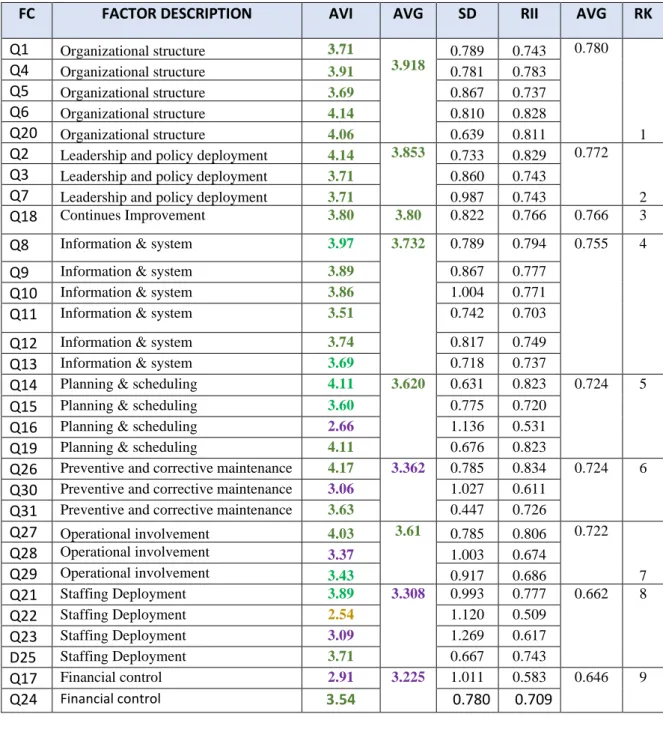
From Table 4.3(b), the Cronbach's alpha is 0.921 indicating an excellent level of internal consistency for the set of question design in factors of effective maintenance management and practice with value of 0.959 validation. The results show that the choice of questionnaires is reliable and valid on the subject studies in the research.
Contribute factors of effective maintenance for overall respondents Group
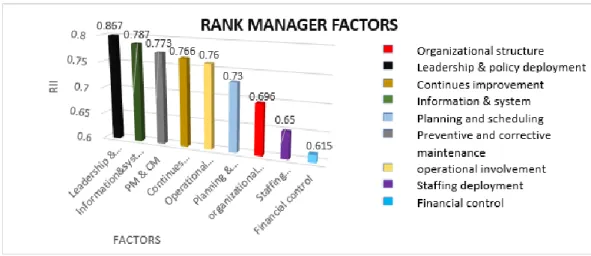
Contribute factors of effective maintenance: Manager’s Perspective
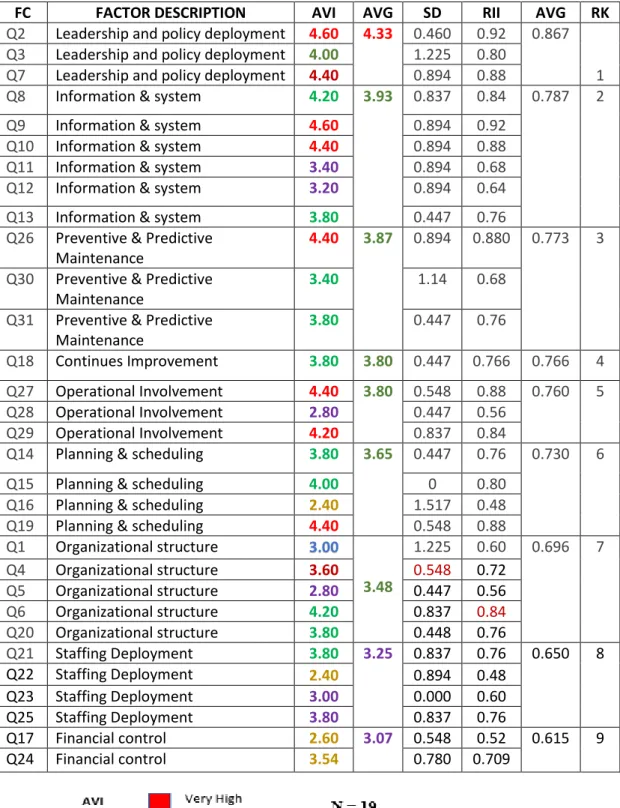
33 The result obtained from the manager's point of view based on project case studies is presented in table 4.4(b). The results were analyzed and ranked based on the highest average index (AVI) and relative importance index (RII). It is found that all variables are essential, but their level of significant changes.
Leadership and policy deployment have classified on the very high impact of contribution to the effective maintenance management and practice while the others are categorized as high and medium classes of consistency. The outcome demonstrates that Cronbach's alpha is 0.723, which shows a good level of consistency set of question design in factors of effectiveness maintenance management and practice with value of 0.850 validation.
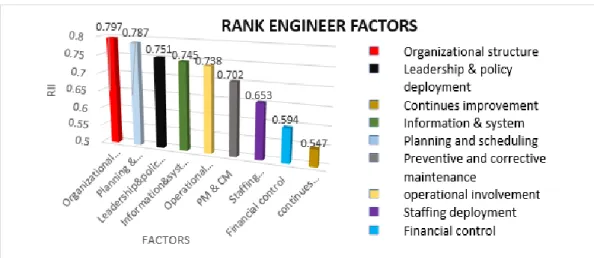
Contribute factors of effective maintenance: Engineer’s Perspective
35 Information obtained on the engineer's perspective on selected factors that contribute to effective maintenance management and practice is presented in Table 4.4 (c). Depending on the results of the AVI, it turns out that the factors are classified into high and medium classes, which the respondent agrees with all the factors. The result shows that Cronbach's alpha is 0.811, which indicates a good level of consistency of the set of questions in the factors of management and maintenance practice of effectiveness with a validation value of 0.9.
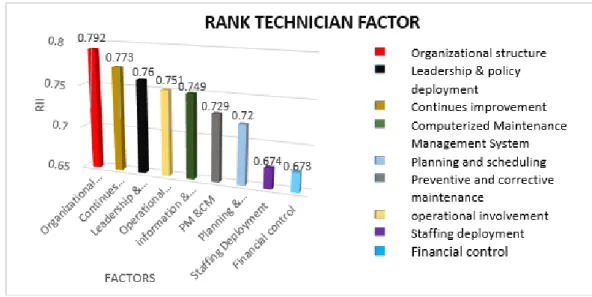
Contribute factors of effective maintenance: Technician’s Perspective
37 Information obtained from a technician's perspective on selected factors contributing to effective management and maintenance practices is presented in Table 4.4 (d). Where it can be seen, the selected factors from the technical aspect of the organizational structure (RII=0.797) are in first place, followed by continuous improvement (RII=0.773), management and implementation of policies (RII=0.76), operational involvement (RII=0.751) . ), information and system (RII= 0.749), preventive and corrective maintenance (RII=0.729), planning and scheduling (RII=0.72), personnel allocation (RII=0.674) and finally financial control (RII=0.673). The outcome proves that Cronbach's alpha is 0.972, which indicates a good level of consistency of the set of questions design in the factors of maintenance management effectiveness and practice with a validation value of 0.986.
Discussion of Result
In maintenance activities, planning and scheduling is listed as one of the important factors affecting the successful implementation of effective maintenance management in the infrastructure project. 40 Based on the structured question of planning and scheduling factor, they agreed that one of the successful factors is when the management always monitors the schedule for daily, weekly and monthly. In addition, comprehensive data is one of the platforms for maintenance personnel to analyze the history of equipment at a glance (Mainkar & Rathod, 2017).
According to the result, most of the maintenance workers do not know how to use the tools in the maintenance system, although the company has already implemented a computerized system (CMMS) in the maintenance work. In essence, the information system is one of the media that minimizes the time in making maintenance decisions. It enables users to take action and individually assess factors according to the state of the case.
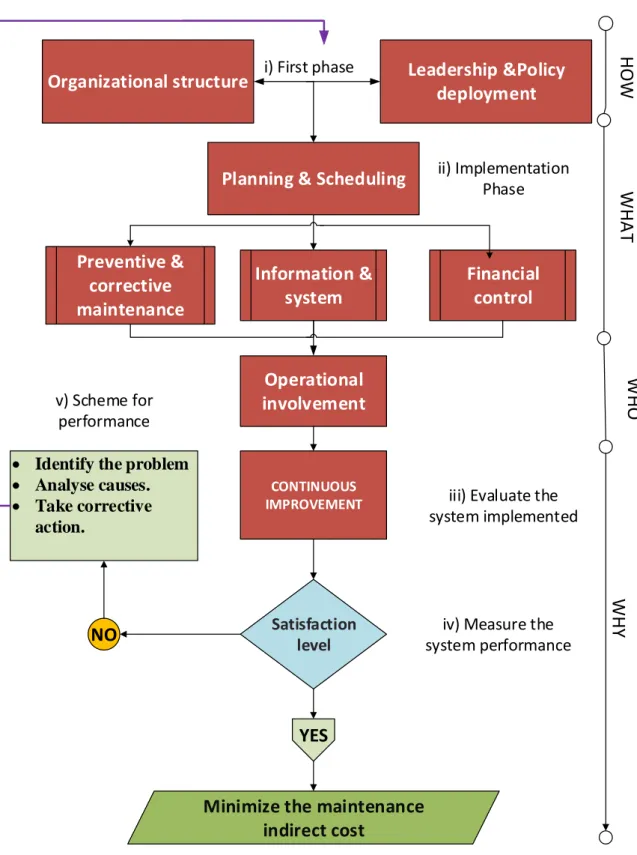
The three elements are carried out by operational involvement to achieve the objective of the framework.
Conclusion
Recommendation
Maximizing Resource Efficiency of Highway Infrastructure Maintenance Inspection and Scheduling for Efficient City Logistics Operations. Challenges and prospects of applying asset management principles to highway maintenance: A case study from the UK. I am a final year final semester Bachelor of Engineering (Hons) Civil Engineering student from Universiti Teknologi PETRONAS (UTP).
In partial fulfillment of the requirements of this degree, I am required to complete the Final Year Project (FYP). 17 Delay of maintenance work due to budget constraints The management level ensures continuous improvement work. From your point of view, what are the factors that will have a negative impact on the maintenance activities in your company.
What are your suggestions for improving the maintenance management and practice in building and infrastructure project.
Relative Importance Index
Spearman coefficient
Cronbach’s Alpha Coefficient
From the diagram, it appears that the majority of respondents are on their 5-13 years of work experience with the average age between 20-39 years. Based on the research, Organizational structure factor was identified as the most first selection factors that contribute to effective maintenance management practices in infrastructure projects. Furthermore, research found that about 60% (21) and 23% (8) of respondents agreed and strongly agreed with question 20 which maintenance staff are clear about the department's goals and objectives.
This statement also endorsed by the resolution document (2015), management must provide a clear multi-year vision of maintenance execution so that staff have clear goals reflected in their objectives. b) Planning and scheduling. In addition, from the staff's perspective, they claimed that some of the schedule work is not within a proper time frame which causes the poor quality of the work. This shows that the lack of organized processes and standardized procedures can significantly limit a maintenance operation from meeting its objectives for serving the needs of the organization.
Despite the number of respondents who disagree with this factor, most of them still consider leadership and policy implementation to be one of the influential factors. From the interview, one of the respondents mentioned that management is essential as they are the leader of the structure that can control and monitor the performance of the employees. The knowledge, experience and motivation of operators and maintainers contribute significantly to the safety and efficiency of the production process.
To satisfy this, the framework design should be developed based on organization's operation which can improve the activity and production of the company. These parts represent as head of the structure that plays an important role in giving a clear vision and strategic decision that influences the other factors to be successful.