By presenting this thesis/project paper in partial fulfillment of the requirements for a postgraduate degree from Universiti Utara Malaysia (UUM), I agree that the library of this university may make it freely available for inspection. I further agree that permission to reproduce this thesis/project paper in any way, in whole or in part, for academic purposes may be granted by my supervisor(s) or, in their absence, by the Director of the Postgraduate Studies Unit, College of Business, where I did my thesis/project assignment. It is understood that any copying, publication or use of this thesis/project paper parts for financial gain is not permitted without my written permission.
Due to advancements in technology and social media, the popularity of social media influencers has grown and more and more businesses and advertisers are using them to increase revenue and sales. This study aims to add to this field of study by examining the influence of social media influencers on purchase intention of beauty products and by gaining a better knowledge of which attributes significantly influence purchase intention in Malaysia. Based on the literature review, a framework was developed that highlighted the characteristics of social media influencers that can influence the purchase intention of beauty products.
Using these contributions, managers can consciously choose the qualities to look for in social media influencers.
- Introduction
- Background of Study
- Problem Statement
- Research Questions
- Research Objectives
- Scope of the Study
- Significance of the Study
- Theoretical Contributions
- Managerial Contribution
- Definition of Key Terms
- Organization of the Study
The emergence of social media and the average length of time its users have changed marketing (Chaffey, 2021). Social media influencers gather a significant number of devoted fans eager to share their message with others due to their popularity. Numerous studies show that social media influencers are effective strategies to influence consumer buying behavior (Jin, Muqaddam and Ryu, 2019).
Apart from the inconsistency of previous research findings, there is a lack of empirical studies investigating the impact of social media influencer endorsements on local beauty products in Malaysia. This research aims to determine the impact of social media influencers on Malaysians' purchase intention of beauty products. This study examines how social media influencer attributes such as trustworthiness, knowledge, likeability, and similarity influence purchase intentions.
In addition to conflicting findings from previous studies, there is little empirical research examining the impact of social media influencer endorsement on purchase intentions.
- Introduction
- Purchase Intention
- Definition of Purchase Intention
- Influence of Social Media Influencers on Purchase Intention
- Trustworthiness
- Definition of Trustworthiness
- Relationship between Trustworthiness and Purchase Intention
- Expertise
- Definition of Expertise
- Relationship between Expertise and Purchase Intention
- Likeability
- Definition of Likeability
- Relationship between Likeability and Purchase Intention
- Similarity
- Definition of Similarity
- Relationship between Similarity and Purchase Intention
- Gaps in Literature
- Chapter Summary
Social media influencers are vital to marketing objectives due to their huge following and recognition in specific areas or industries (De Veirman et al., 2017). While social media influencers influence customers' purchasing decisions, their originality and ability to express brand messages are equally crucial factors (Peetz et al., 2004). A previous study has shown that social media influencers can influence consumers' intention to engage in certain behaviors (Taillon et al., 2020; Chetioui et al., 2020; Wiedman and Mettenheim, 2019).
Retailers hire social media influencers to advertise their products and businesses, according to (Taillon et al., 2020). Furthermore, they found that message quality affects how people view the credibility of information (Xiao et al., 2018). One tends to buy from people they like, compared to the other way around (Argyris et al., 2021).
Previous research has also shown that source similarity has little effect on consumer purchase intent (Taillon et al., 2019).
- Introduction
- Theoretical Framework
- Hypothesis Development
- Trustworthiness and Purchase Intention
- Expertise and Purchase Intention
- Likeability and Purchase Intention
- Similarity and Purchase Intention
- Research Design
- Measurement of Variables
- Trustworthiness
- Expertise
- Likeability
- Similarity
- Data Collection
- Primary Sources
- Secondary Sources
- Questionnaires Design
- Pre-Test and Pilot Testing
- Sampling
- Population
- Sampling Technique
- Sample Size
- Data Collection Procedures
- The technique of Data Analysis: SPSS Data Analysis
- Data Processing
- Normality Test
- Descriptive Analysis
- Pearson-Correlation Coefficient Analysis
- Multiple Regression Analysis
- Chapter Summary
Primary data is data that the researcher obtained directly from the key factors for the objective of the study. Consequently, the researcher gave both Malay and English versions of the questions to the respondents for better understanding. These data will improve the researcher's understanding of the problem and provide a basis for comparing the data obtained.
Before the researcher conducted the pilot test, the questionnaire was modified based on all feedback and recommendations. The researcher decides to pre-test the questionnaire with 30 participants to ensure the reliability of the scale, language and question order and the ability of the respondents to understand the meaning of the questions. In addition, the purpose of the study is related to beauty products and the researcher will focus more on female millennials who follow beauty influencers on social media sites.
Nevertheless, the researcher will use a non-probability sample for this study, and convenience sampling is one such sample (Saunders et al., 2012). The researcher intends these two sampling approaches to remove bias and generate more precise results. The researcher used the Statistical Package for the Social Sciences version 28 (SPSS) software to analyze the data in this study. The researcher will conduct descriptive analysis, Pearson correlation coefficient test, multiple regression test and inferential analysis in this study.
Meanwhile, the researcher will also use Pearson's correlation to determine the relationship between the independent and dependent variables. The organization and overall generated data is necessary before the researcher analyzes the collected data. Data transcription is to enter coded data into computers, and the researcher uses the Statistical Package for the Social Sciences version 28 (SPSS) to analyze the obtained data.
In this chapter, the researcher intends to provide a more in-depth explanation and description of the study's research technique or approach. In addition, this study used a sampling strategy, and the researcher chose convenience sampling to maximize the generalizability of the study's findings.
- Introduction
- Respondents Analysis
- Reliability Test
- Data Screening
- Missing Data
- Outliers Analysis
- Normality Test
- Descriptive Analysis of Respondents' Profile
- Respondents' Profile
- Respondents: Social Media Usage
- Respondents' How Often They Use Social Media
- Respondents: Use Social Media as A Tool to Find Products
- How Many Influencer Respondents follow Influencers
- Bought Product Recommended by Social Media Influencer
- Descriptive Analysis of the Constructs
- Analysis of The Pearson Product-Moment Correlation Coefficient
- Multiple Regression Analysis
- Hypothesis Testing Summary
- Conclusion
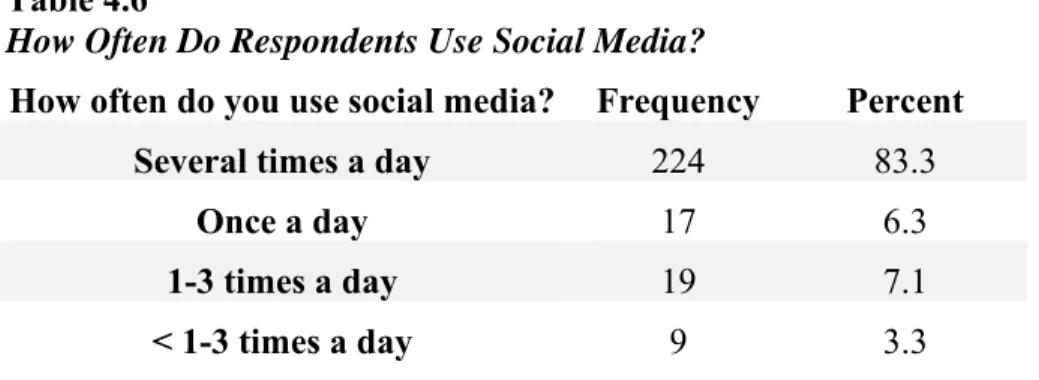
It showed that the reliability and consistency of the data in this study was not compromised. The result shows that all 269 respondents or 100% have a social media platform and use it in their daily life. Most respondents browse social media several times a day, a total of 224 respondents or 83.3%, followed by those who browse once a day with 17 respondents or 6.3%.
Nineteen respondents, or 7.1%, browse social media only one to three times a day, while nine respondents, or 3.3%, browse social media less than one to three times a day. With 254 respondents (94.4 percent), the majority of respondents use social media to search for information about items or brands. Social media as a tool to find products Do you use social media to search for information about products/brands?
According to the survey, 100% of respondents followed at least one social media influencer on their social media platform. From Table 4.4.4 below, most respondents follow at least one to nine social media influencers, which is 173 respondents or 64.4%. From Table 4.4.5 below, 185 respondents or 68.8% agree that they have purchased at least one product recommended by social media influencers.
According to data, 84 respondents or 31.2% did not buy products recommended by social media influencers. A product recommended by a social media influencer. Have you ever purchased a beauty product recommended by a social media influencer? It shows that increased trust in social media influencers would result in higher customer purchase intention.
It shows that the expertise of social media influencers can influence consumers' intention to purchase beauty products. The relationship between social media influencers and intention to purchase beauty products is positive in terms of credibility, expertise, likeability, and likeability.
Introduction
Summary of Findings
Discussion
- The influence of influencer trustworthiness on purchase intention
- The influence of influencer expertise on purchase intention
- The influence of influencer likeability on purchase intention
- The influence of influencer similarity on purchase intention
Previous research predicted that social media influencer expertise, which includes the influencer's experience, skill, knowledge, and qualification, would influence customers' purchase intention. According to these numbers, millennials believe that the social media influencers they follow can adequately showcase the product offered, but they don't assume these influencers are experts in using the product. This study suggested that liking a social media influencer has a substantial effect on Malaysian customers' purchase intentions.
In this study, liking social media influencers was the most significant predictor of customer purchase intentions. This finding is consistent with previous studies that found a favorable relationship between likability and customer purchase intention (Adnan, Jan, & Alam, 2017), demonstrating that an easily identifiable social media influencer can influence users' purchase intentions for marketed fashion products. Descriptive analysis of liking showed that item L5 (My favorite social media influencer is a nice person) has the highest mean and standard deviation.
Item L3 (My favorite social media influencer is an honest person) had the lowest mean score (3.89) and standard deviation (0.819). According to these statistics, millennials believe that the social media influencers they follow are beautiful individuals who enjoy looking at them, but are not sure if they are genuine. The final hypothesis was to determine the relationship between social media influencer similarity and purchase intention.
According to the research, similarity among social media influencers had a favorable and significant effect on purchase intentions. It indicates that consumers who identify social media influencers with similar lifestyle or age are more likely to have their purchase intentions influenced. The descriptive similarity analysis revealed that item S1 (My favorite social media influencer thinks like me) had the highest mean and standard deviation.
According to these numbers, millennials believe that the social media influencers they follow share common traits that can increase people's trust in beauty products. If a social media influencer resembles the customer in terms of psychological or physical characteristics, the consumer is more likely to purchase the beauty product that the social media influencer is advocating.
Implication of Study
- Practical Implication
- Theoretical Implication
Limitations and Future Research
Conclusion
The mechanism by which social media influencers persuade consumers: The role of consumer desire to imitate. Social media influencers as human brands that connect with followers and deliver positive marketing results by fulfilling needs. The effect of influential social media on purchase intention and the mediating effect of customer attitude.
Influencer Marketing: How Message Value and Credibility Influence Consumer Trust in Brand Content on Social Media. I am conducting a study to examine the influence of social media influencers on purchase intentions of beauty products. I would love to know more about a beauty product endorsed by my favorite social media influencer.