ISSN 0127-9386 (Online)
http://dx.doi.org/10.24200/jonus.vol8iss3pp351-381
351
INFLUENCE OF FAMILY OWNERSHIP, BOARD AND TOP MANAGEMENT CHARACTERISTICS ON THE QUALITY OF WEBSITE CORPORATE SOCIAL
RESPONSIBILITY DISCLOSURE IN INDONESIA
*1Indah Melati, 2Farah Aida Ahmad Nadzri, 3Roshayani Arshad, 4Ramesh Nair & 5Ancella Anitawati Hermawan
1 Department of Accounting, Faculty of Economics and Business, Universitas Indonesia, Depok, Indonesia.
2,3,4 Accounting Research Institute, Universiti Teknologi MARA, 40450 Shah Alam, Malaysia.
5 Department of Accounting, Faculty of Economics and Business, Universitas Indonesia, Depok, Indonesia.
*Corresponding author: [email protected] Received: 15.05.2023 Accepted: 17.08.2023
ABSTRACT
Background and Purpose: This study aims to investigate the effect of family ownership, board characteristics (board foreign experience and board accounting expertise), and top management characteristics (management education level) on the quality of website Corporate Social Responsibility (CSR) disclosure via corporate website among the top companies listed in the Indonesia Stock Exchange (IDX). This study adds to the body of literature by examining the moderating effect of family ownership towards the relationship between board characteristics and website CSR disclosure, which is useful for investors who might have concerns on the level of CSR disclosure as a gauge of firm ethics, particularly in respect to family-owned firms.
Methodology: Sample of this study consisted of 100 non-financial companies listed in Indonesia Stock Exchange (IDX) for the year of 2019. To test the study’s hypothesis, multiple linear regression analysis was applied.
352
Findings: Empirical results from this study have shown that family ownership is negatively related to the quality of website CSR disclosure. Board foreign experience has a positive effect on CSR disclosure practices in their respective corporate websites. Meanwhile, top management education level was found to have a negative and statistically significant relationship with the quality of voluntary website CSR disclosure. Lastly, this study demonstrated that family ownership moderates the relationship between board accounting expertise and the quality of CSR disclosure on corporate websites.
Contributions: This study contributes to the literature on CSR disclosure by introducing a set of index measuring the quality of voluntary website CSR disclosure, which captures not only the variety, but also the richness of CSR information. The moderating role of family ownership on such relationships, which is rarely investigated in the context of developing countries, was also explored by this study.
Keywords: CSR disclosure, voluntary disclosure, family ownership, board characteristics, top management.
Cite as: Melati, I., Arshad, R., Ahmad Nadzri, F. A., Nair, R., & Hermawan, A. A. (2023). Influence of family ownership, board and top management characteristics on the quality of website corporate social responsibility disclosure in Indonesia. Journal of Nusantara Studies, 8(3), 351-381.
http://dx.doi.org/10.24200/jonus.vol8iss3pp351-381
1.0 INTRODUCTION
This study focuses on practices of voluntary Corporate Social Responsibility (CSR) disclosure on corporate websites. The use of corporate websites as an website disclosure channel for companies may effectively help companies to show their commitment to CSR, also enhancing company identity and reputation. Website CSR disclosure offers some advantages which improves the limitation of annual reports and sustainability reports in disclosing CSR activities.
These advantages include more timely information (Ahmed et al., 2018); enhancing global accessibility (Ahmed et al., 2018; Kiliç, 2016), as well as promoting greater understandability of information (Abdi et al., 2018; Sandhu & Singh, 2019). The use of corporate websites as a communication medium for public disclosure would potentially contribute towards good governance, specifically in transparency (Nel & Baard, 2019). Company’s inclination towards website CSR disclosures may increase from year to year as they try to keep up with current market trends (Chong et al., 2016), however considerable variations in disclosure on their corporate websites can still be found across different companies (Abdelsalam & Street, 2007;
Sandhu & Singh, 2019). Website disclosure studies were still dominated by financial
353
information, while there is a lack of studies focusing specifically on website CSR disclosure.
Website CSR disclosure studies are mostly done within the context of developed countries (Chong & Rahman, 2020; Everaert et al., 2019; Matuszak & Różańska, 2019), whereas the number of website CSR disclosure studies which comes from the perspective of an emerging market were still limited (Abdi et al., 2018; Djajadikerta & Trireksani, 2012).
Indonesia was chosen as the focal point of this study because this country offers interesting insight in comprehending the practices of website CSR disclosure from the perspective of emerging markets in the Asia region. As the biggest country in the South East Asia region, Indonesia faces many issues related to social and environmental aspect, such as poverty alleviation, health and safety of the environment, pollution, natural disaster, social and political insecurity, as well as deforestation (Djajadikerta & Trireksani, 2012). Secondly, Indonesia’s current government already has an agenda in improving the country’s investment climate and strengthening economic growth, which are aimed to attract both domestic and foreign investments. Yu and Zheng (2020) suggested that CSR reporting is an effective strategy to minimize information asymmetry, which can help companies to improve their environmental and social information, which would subsequently attract foreign and local institutional shareholders. Thirdly, multiple Indonesian regulatory bodies have placed major stress on the importance of CSR disclosure for the public. In 2017, the Indonesian financial service authority or Otoritas Jasa Keuangan (OJK) issued a regulation, i.e. OJK regulation No.51/POJK.03/2017, which requires all listed companies to provide sustainability reports which can either be separated from the annual report or become part of the annual report. OJK had also required these listed companies to provide CSR information via their corporate website through OJK regulation No.8/POJK.04/2015. Looking at both regulations from OJK, it can be seen that although they have both been issued as a requirement, the implementation and enforcement of these regulations were still low (Adityawarman & Khudri, 2018). Chowdhury et al. (2021) suggested that, unlike developed countries whose society has been conscious enough with the importance of being aware of CSR information provided by companies, companies in developing countries face relatively less pressure from stakeholders when it comes to CSR disclosure. Prior studies suggested that practices of CSR disclosure, even as they are being presented in annual reports, are still low in Indonesia (Hermawan & Gunardi, 2019; Ramadhini et al., 2020; Wuryan Andayani, 2018).
This study hence focuses on the role of family ownership, board characteristics (board foreign experience & board accounting expertise), as well as top management characteristics (management education level) on the quality of voluntary website CSR disclosure among large
354
non-financial companies listed in the Indonesia Stock Exchange (IDX). At the moment, website CSR disclosure is voluntary in nature. Hence, the quality of disclosure is mostly influenced by values, preference, as well as motives of the controlling shareholders and board (Alshirah et al., 2020; Basuony et al., 2018). Family as controlling shareholders, the board, as well as the top management in this particular, enjoy full discretion in deciding the extent to which CSR information should be disclosed. Family has more extensive access to information, which might discourage CSR disclosure to the public. On the other hand, effective board characteristics (board foreign experience & board accounting expertise) may support transparency. As such, an investigation on the effect of family ownership and effective board characteristics towards the quality of website CSR disclosure may help to understand the motives and variation of quality within website CSR disclosure among companies in Indonesia.
This paper contributes to CSR disclosure literature by going further than prior studies.
First, this study examines voluntary website CSR disclosure by developing and using an enhanced disclosure index which captures the variety (quantitative aspect) and richness (qualitative aspect) of data through textual analysis on substantive words of CSR information on corporate websites. Second, this study provides new empirical evidence in different institutional contexts, which is the emerging markets. Most extant literature regarding CSR disclosure was dominated by studies in developed countries. In this regard, emerging markets are different from developed markets in many aspects. For example, when discussing governance mechanisms and ownership structure, determinants of voluntary disclosures for developing markets and emerging markets might not be the same (Elgammal et al., 2018).
Consequently, the effect of family ownership and board characteristics on the quality of voluntary CSR disclosure on corporate websites may provide different results in emerging markets.
Furthermore, this study goes further from prior studies by examining the role of family ownership as a moderating variable that may affect the relationship between board characteristics and voluntary CSR disclosure on corporate websites. Indonesian firms are highly concentrated and dominated by families (Claessens et al., 2000; Kumala & Siregar, 2020). When a family becomes a majority shareholder in a company, the family would have a right to elect and appoint members of the board, which would then empower and influence them in making decisions for the company. In this regard, family ownership may affect the effectiveness of the board of directors to disclose more CSR information on their corporate website.
355 2.0 LITERATURE REVIEW
Agency theory is an underlying theory chosen for this study, which is able to explain the relationship between family ownership and CSR disclosure (Kumala & Siregar, 2020;
Martínez-Ferrero et al., 2018). In developing countries, such as Indonesia, family firms are less likely to make voluntary disclosures to the public (Akhtaruddin et al., 2009; Ali et al., 2007).
Some prior studies explained that, as controlling shareholders, families have incentive to take resources out of companies, which may lead to them being less transparent to the public (Akhtaruddin et al., 2009). Few other studies have also highlighted the substitutive relation between presence of family owners and public disclosure (Sandhu & Singh, 2019). When a family has substantial ownership, the family tends to monitor management and have more active involvement in the company’s management. Consequently, family ownership would lower information asymmetry between shareholders and management, as the demand for information from non-family shareholders to monitor management tends to be low (Al-Akra
& Hutchinson, 2013).
Resource dependence theory (RDT) is used to explain certain characteristics of effective boards which would potentially improve the quality of voluntary website CSR disclosure). According to Bolourian et al. (2021), although agency theory is often applied to explain the role of board attributes which focuses more on the monitoring aspect, this theory is not able to sufficiently explain why and/or how social aims should be considered in corporate strategic goals through effective boards. RDT suggests that specific attributes of board of directors may effectively help companies to align their strategies with expectation from their society or stakeholders in order to uncertainty and secure legitimacy (Al-Mamun & Seamer, 2020; Hillman et al., 2009; Pfeffer & Salancik, 1978). Talented boards are considered to have the ability and capacity to see opportunities, generate critical resources, and manage complexity related with strategy formulation to facilitate companies in the acquisition of external resources which are critical for their success (Chen et al., 2013). This study focuses on the role of competency owned by board members, namely board foreign experience and board accounting expertise in enhancing the quality of voluntary CSR disclosure on corporate websites.
3.0 HYPOTHESES DEVELOPMENT 3.1 Family Ownership
In the context of CSR disclosure, controlling families are viewed as a self-interested and parochial party. Therefore, they would likely have no willingness to protect, develop and invest
356
in their communities and economies (Morck & Yeung, 2004). Kim et al. (2017) suggested that controlling families tend to be less responsive to stakeholder requests, hence reducing the need for the company to have CSR reporting. As controlling shareholders, family owners have wide access to various information about the company that can be acquired privately. With such access, they have disincentives to make extensive CSR disclosure to the public (Chen et al., 2008; Hajawiyah et al., 2019). Adding to this, a lack of effective regulation, weak corporate governance and subsequent legitimacy in developing markets had led family firms to have little motivation to act in a socially acceptable manner. Instead, these family firms tend to keep their financial resources from CSR activities (Biswas et al., 2019).
Empirically, the relationship between family ownership and CSR engagement had been found to have mixed results. Rudyanto and Siregar (2018) found no differences in the quality of sustainability reports between family-owned companies and non-family owned companies in Indonesia. The argument used by Rudyanto and Siregar (2018) was that controlling families may have moral responsibility awareness, however the shareholders would still be disinterested to engage deeper in matters relating to sustainability. Meanwhile, El Ghoul et al. (2016), also Biswas et al. (2019) showed that the quality of CSR disclosure by non-family-companies has been consistently higher than those by family firms. El Ghoul et al. (2016) added that Asian countries have weak institutions that lead to severe agency problems in family affiliated companies. Hence, family affiliated companies in Asian countries tend to exhibit lower CSR engagement as compared to their counterparts from developed countries. Based on these arguments, this study develops its first hypothesis as follows:
H1. Family ownership is negatively related with the quality of voluntary website CSR disclosure
3.2 Board Foreign Experience
The presence of board members with foreign experience is a valuable source for companies to enhance their CSR activities. This is important for these companies to get past the lack of norms, weak legal systems, weak corporate governance systems and lack of experience in the development of CSR practices for emerging markets (Garanina & Aray, 2021). Board members with foreign experience are viewed to have better exposure to CSR practices through their experiences of working or studying abroad, especially in developed countries such as European countries, the United Kingdom and the United States, which implements strict CSR practices and disclosures (Huafang & Jianguo, 2007; Lau et al., 2016). Knowledge, networks and
357
connections derived from foreign experience may help companies to become more socially responsible and fasten the adoption for new environmental innovation, leading towards better quality of disclosure to the public when it comes to CSR activities (Garanina & Aray, 2021;
Lau et al., 2016). Based on these explanations, this study proposes that presence of directors with foreign experience on the board (BOC) is likely to assist firms in extending their practices of website corporate disclosure. This study hypothesizes that:
H2: Level of board foreign experience owned by board members is positively related with the quality of voluntary website CSR disclosure.
3.3 Board Accounting Expertise
Expertise in accounting or finance areas is considered as competencies which would help companies, not only to resist rationalizing in misreport but also to shift the board towards focusing more on the companies’ long-term strategies. These strategies include economic, social and environmental issues (Sun & Rakhman, 2013). Guo et al. (2021) who examined the role of accounting expertise of Chief Finance Officer (CFO) on CSR disclosure suggested that companies should take serious action on sustainability activities. This included disclosure as an important strategy to minimize risks, enhance brands, attract the best talent, and drive top- line growth. Guo et al. (2021) added that accounting expertise is important attributes for CFOs to manage, measure, and report sustainability information as expected by shareholders and other stakeholders. Instead of examining accounting expertise in the top management, this study focuses more on the role of accounting expertise on BOC within its corporate website disclosure. Presence of accounting expertise on BOC may improve the capability of BOC to monitor and advise companies to be involved more actively in CSR activities and disclose more CSR issues in the future. Based on these arguments, this study develops its third hypothesis as follows:
H3. Presence of accounting expertise on board is positively related with the quality of voluntary website CSR disclosure.
3.4 Management Education Level
In relation to CSR, management with well-educated members are more likely to undertake and provide CSR disclosures website. Liu et al. (2018) suggested that higher educated management tend to have greater adaptation and care about food safety, environmental protection, and other
358
social problems. Further, educational level is viewed as a means of determining the moral and ethical approach of individuals. As such, well-educated top management tend to be better aware of the importance and significance of disclosing social and environmental activities (Malik et al., 2020). Highly educated top management tend to be receptive and responsive for new things, such as website CSR disclosure, as long as it becomes a crucial part of strategy in modern corporations (Li et al., 2019). Their critical thinking skills and knowledge in ethical standards may lead them towards promoting higher levels of CSR disclosure to their lower educated counterparts. Therefore, regarding to the role of management education, this study hypothesizes as follows:
H4. Level of education obtained by members of top management is positively related with the quality of voluntary website CSR disclosure.
3.5 Moderating Role of Family Ownership on the Relationship between Board Characteristics and the Quality of Voluntary CSR Disclosure on Corporate Websites The prevalence of family control is likely to moderate the monitoring effectiveness of corporate boards (Alshirah et al., 2020; Bansal et al., 2018; Jaggi et al., 2009). Domination and control owned by controlling families would likely restrict the effectiveness of the board of directors, which would then influence the board’s decision (Alshirah et al., 2020). The professionalism and effectiveness of board members is likely to be compromised in the situation where controlling families have power to appoint and discharge board members.
The lack of interest on CSR practices and disclosure may likely lead controlling families to influence business decision by reducing the board’s capabilities and resources to enhance CSR performance and disclosures (Cuadrado-Ballesteros et al., 2015). Presence of board foreign experience and board accounting expertise may enhance board capabilities and effectiveness in monitoring management, which includes the enhancement in CSR disclosure.
However, the effectiveness of the board could be strongly influenced by the desires and interest of family members who are likely to reduce CSR disclosures instead of taking other stakeholders’ interest into account (Chen & Jaggi, 2000).
The moderating effect of family ownership on the relationship between BOC and corporate disclosure has been examined by few prior studies. Using RDT point of view, Bansal et al. (2018) showed that the presence of family ownership reduced the positive effect of independent directors on increasing CSR disclosure. Presence of family ownership would likely reduce independent directors’ concern towards reputation risks which are related to
359
misleading and low information disclosure by the management (Bansal et al., 2018). Alshirah et al. (2020) also demonstrated that the relationship between board of directors and corporate risk disclosure is moderated by family ownership. Presence of family ownership would likely influence the advisory role of board of directors over disclosure decisions (Alshirah et al., 2020). Based on these arguments, this study hypothesizes that:
H5a. Family ownership weakens the positive relationship between board foreign experience and the quality of voluntary website CSR disclosure.
H5b. Family ownership weakens the positive relationship between board accounting expertise and the quality of voluntary website CSR disclosure.
Figure 1: Research Framework
4.0 METHODOLOGY 4.1 Sample
The sample consists of the top 30 percent of companies listed in the Indonesia Stock Exchange (IDX). The reason to choose these top companies is because voluntary web-based CSR disclosure is still a new phenomenon in Indonesia, hence it is only being picked up by major players in the industry. This study excludes finance and banking companies in its sample
H5a and H5b
H1 BOC
Characteristics BO C foreign experience (BOCFEX) BO C accounting expertise (BOCACC)
Management Characteristics
Ma nagement education level (MEDU)
Dependent Variable:
voluntary website CSR disclosure index (VWCSR)
Control variables:
Assets (SIZE), profitability (PROFIT), Industry (IND) Family
Ownership H2 and H3
H4
360
because the industry has different regulatory requirements as compared to other companies listed in IDX. Further, this study focuses on top companies which have been listed in IDX for over five years. Hence, companies which were listed for less than five years are dropped from being selected as a sample. The reason is because in measuring the quality of website disclosure, this study considers historical data that were saved on the company website for a period of more than five years. In addition, several companies are dropped from the sample due to missing data related to the variables of interests in this study.
A summary of the sample selection process is shown in Table 1, leaving a total observation of 100 firm-years. The number of observations are considered to be sufficient and appropriate because the sample size is larger than 30 and less than 500 (Sekaran & Bougie, 2016). Further, some empirical studies which had used secondary data were found to have a sample size of around 100 observations, for example Rudyanto and Siregar (2018), also Kumala and Siregar (2020).
Table 1: Sample selection of procedure
Summary of Sample Selection
Top 30% companies in the IDX which composes 93.5% of total market capitalization 175 Subtract
Financial and banking companies 35
New companies (listed in the IDX less than 5 years) 28
Companies with missing data (financial, board profile, website) 12
Final Samples 100
The sample used in this study is cross-sectional with the unit of analysis being companies’
website level. Data for financial information, board profiles, ownership and market data are collected from companies’ annual reports for the year 2019. Meanwhile, data for voluntary CSR disclosure on company websites was collected for 2 months from November 2020 until December 2020.
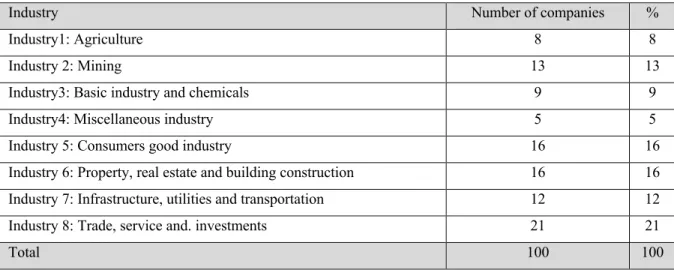
Table 2 exhibits the frequencies and percentages for sample distribution by eight Industries (excluding finance) based on the classification of Jakarta Stock Industrial Classification (JASICA) which have been used by IDX since 1996.
361
Table 2: Sample distribution by industry type
Industry Number of companies %
Industry1: Agriculture 8 8
Industry 2: Mining 13 13
Industry3: Basic industry and chemicals 9 9
Industry4: Miscellaneous industry 5 5
Industry 5: Consumers good industry 16 16
Industry 6: Property, real estate and building construction 16 16
Industry 7: Infrastructure, utilities and transportation 12 12
Industry 8: Trade, service and. investments 21 21
Total 100 100
4.2 Model Estimation
In testing the hypotheses, this study conducts hierarchical regression analysis which enters independent variables in the regression model in a sequential way. The hierarchical regression model starts from variables of family ownership (FAM), followed by variables of BOC characteristics (BOCFEX) and then variables of management education (MEDU). Specifically, to test H1, this study uses Equation 1 as below:
𝑉𝑊𝐶𝑆𝑅 = 𝛽!+ 𝛽"𝐹𝐴𝑀 + 𝛽#𝑆𝐼𝑍𝐸 + 𝛽$𝑃𝑅𝑂𝐹𝐼𝑇 + 𝛽%𝐼𝑁𝐷 + 𝑒 Expectation H1: 𝛽" < 0
For testing H2 and H3, Equation 2 is used:
𝑉𝑊𝐶𝑆𝑅 = 𝛽! + 𝛽"𝐹𝐴𝑀 + 𝛽#𝐵𝑂𝐶𝐹𝐸𝑋 + 𝛽$𝐵𝑂𝐶𝐴𝐶𝐶 + 𝛽%𝑆𝐼𝑍𝐸 + 𝛽'𝑃𝑅𝑂𝐹𝐼𝑇 +𝛽(𝐼𝑁𝐷 + 𝑒
Expectation H2 and H3: 𝛽# > 0, 𝛽$ > 0 Next is Equation 3 to test H4 of this study:
𝑉𝑊𝐶𝑆𝑅 = 𝛽!+ 𝛽"𝐹𝐴𝑀 + 𝛽#𝐵𝑂𝐶𝐹𝐸𝑋 + 𝛽$𝐵𝑂𝐶𝐴𝐶𝐶 + 𝛽%𝑀𝐸𝐷𝑈 + 𝛽'𝑆𝐼𝑍𝐸 + 𝛽(𝑃𝑅𝑂𝐹𝐼𝑇 + 𝛽)𝐼𝑁𝐷 + 𝑒
Expectation H4: 𝛽% > 0
362
Finally, moderating effect of family ownership in the relationship between BOC characteristics and VWCSR (H5) is tested using Equation 4:
𝑉𝑊𝐶𝑆𝑅 = 𝛽!+ 𝛽"𝐹𝐴𝑀 + 𝛽#𝐵𝑂𝐶𝐹𝐸𝑋 + 𝛽$𝐵𝑂𝐶𝐴𝐶𝐶 + 𝛽%𝐵𝑂𝐶𝐹𝐸𝑋 ∗ 𝐹𝐴𝑀 + 𝛽' 𝐵𝑂𝐶𝐴𝐶𝐶 ∗ 𝐹𝐴𝑀 + 𝛽(𝑆𝐼𝑍𝐸 + 𝛽)𝑃𝑅𝑂𝐹𝐼𝑇 + 𝛽*𝐼𝑁𝐷 + 𝑒
Expectation H5: 𝛽% < 0, 𝛽' < 0 where:
VWCSR = total score of voluntary website CSR disclosure index FAM = family ownership
BOCFEX = board foreign experience BOCACC = board accounting experts MEDU = management education level SIZE = firm size
PROFIT = profitability
IND = industry type (extractive industry versus non-extractive industry)
4.3 Dependent Variable - Website Corporate Social Responsibility Disclosure Index 4.3.1 Construction of the voluntary website CSR (VWCSR) disclosure index
VWCSR disclosure index was developed by focusing on two dimensions, namely dimension of content information and dimension of presentation format features. This index was compiled on the basis of existing literature by Boubaker et al. (2011); Bouten et al. (2011); Everaert et al. (2019); Michelon et al. (2015). It was also developed on the basis of widely acknowledged standardization of the Global Reporting Initiative (GRI) reporting framework. Items developed in this disclosure index were then cross-checked with OJK regulation No.8/POJK.04/2015 to ensure that the items are voluntary disclosures which are not listed in the OJK regulation. Next, some items which were found to be irrelevant and unsuitable with the Indonesian context were excluded in the index.
The content information of VWCSR disclosure index is composed of a comprehensive list containing nine items. The items listed in the disclosure index include the presence of sustainability reporting on companies’ websites and various specific CSR information, such as economic performance; fair business practices; energy and water in production process;
363
emissions and waste; labor practice; human rights; support for community programs; as well as product responsibility.
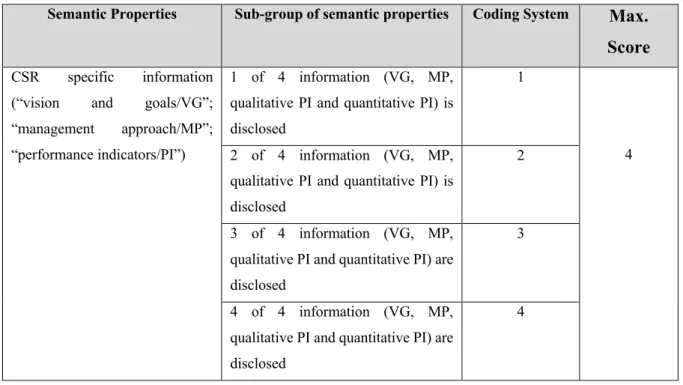
To assess the level of comprehensive CSR disclosure on the corporate website, content items which have been developed are scored using the VWCSR disclosure index. This study applies two types of scores, namely binary score, and ordinal score. Binary score is used to check the presence of respective items, while ordinal score is applied to capture the comprehensiveness of CSR disclosures. Method of scoring for ordinal score follows coding structure developed by Bouten et al. (2011) and Michelon et al. (2015). The coding structure for specific CSR information is based on the presence of vision and goals (VG), management approach (MA) and performance indicators (PI) in content items. Vision and goals (VG) cover stated aims, commitments or values of companies to engage in CSR activities. Management approach (MA) focuses on the information about CSR activities which have been adopted by companies as manifestation of CSR vision and goals. Performance indicator reflects actual CSR achievement presented with qualitative or and quantitative measures of CSR performance.
The scoring system is presented in Table 3. Maximum score for each content item is 4, which indicates that a content item is disclosed with complete information covering information about VG, MP, qualitative PI and quantitative PI.
Total score for content information dimension is counted by summing the scores for all of the nine items. Referring to Table 3, one item has a maximum score for 1 while the maximum score for the rest of eight items is 4. Therefore, the full score for the content dimension of VWCSR disclosure index is 33 (1x1+8x4 = 33). Minimum score for the content dimension of VWCSR disclosure index is 0 (1x0+8x0 =0).
364
Table 3: Scoring Systems of Content
Semantic Properties Sub-group of semantic properties Coding System Max.
Score
CSR specific information (“vision and goals/VG”;
“management approach/MP”;
“performance indicators/PI”)
1 of 4 information (VG, MP, qualitative PI and quantitative PI) is disclosed
1
2 of 4 information (VG, MP, 4 qualitative PI and quantitative PI) is disclosed
2
3 of 4 information (VG, MP, qualitative PI and quantitative PI) are disclosed
3
4 of 4 information (VG, MP, qualitative PI and quantitative PI) are disclosed
4
Another dimension of VWCSR disclosure index is the dimension of presentation format features, which are specific advantages that are offered merely by the corporate website and add more value to the disclosed information (Boubaker et al., 2011). Presentation format feature has six content items which are based on three categories, namely convenience/user friendly (3 items), technology (1 item) and timeliness (2 items). Each dimension item for presentation format features is computed using binary score. Each item takes a value of 1 if it is available on the corporate website and 0 if it was found otherwise. The full score for dimension of presentation format features is calculated by summing all scores of each item with maximum value of 6 (1x6=6).
4.3.2 Reliability and validity of VWCSR disclosure index
Reliability and validity of the measurement for this disclosure index are important aspects in the coding procedure in order to conclude valid outcomes and minimize subjective issues (Abdi et al., 2018). Marston and Shrives (1991) suggested that the disclosure index is considered to be valid if the disclosure index measures what this study had intended. Hail (2002) added that validity of index measurement can be assessed by testing the significance of correlation between the disclosure index and its components. Test results of Pearson correlation are presented in Table 4, which demonstrated that the correlations between VWCSR disclosure index and its components are statistically significant.
365
Table 4: Correlation between VWCSR disclosure index and its items
Variables Correlation
VWCSR 1.000
Sustainability Report 0.299***
Economic Performance 0.654***
Fair Business Practices 0.485***
Energy and water in production process 0.711***
Emission and waste 0.762***
Labor practices 0.769***
Human rights 0.585***
Support for community programs 0.602***
Product responsibility 0.632***
Notes: *,** and *** indicate significance at 10, 5, and 1% levels.
4.4 Independent Variables
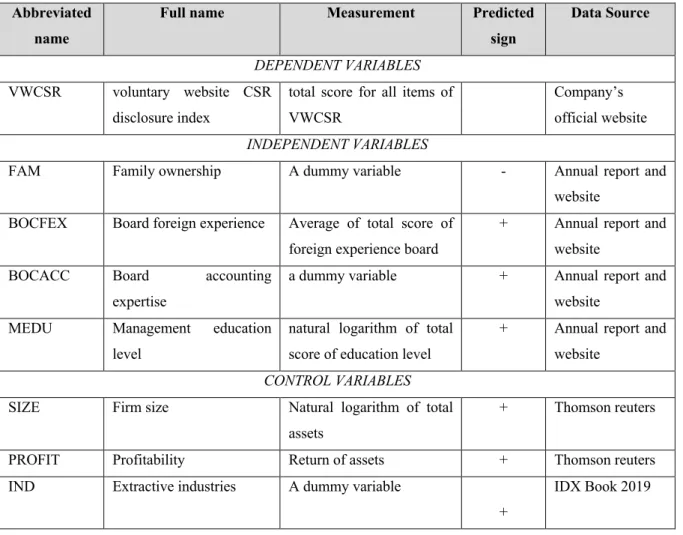
Table 5 presents the definition for all variables used in this study. Adapting the study of Rudyanto and Siregar (2018), this study measures a proxy of family ownership (FAM) using a dummy variable which valued at 1 if a company is owned by an individual or a company whose ownership is more than 50 percent, and is not a public company, a financial institution, or owned by the government. This dummy variable is valued at 0 if the company is found otherwise. Variable of board foreign experience (BOCFEX) is measured by average total score of foreign experience acquired by each member of the top management. Score of foreign experience has a value in the range from 0 to 2. The value 0 indicates that a member of top management has no experience in the study or working abroad. Meanwhile, the value of 1 refers to the foreign experience owned by a member of top management as being either studying abroad or working abroad. If the member has foreign experience in both study and working experience, then the score accumulated for this particular member will be 2.
Variable of board accounting expertise (BOCACC) refers to a dummy variable with the value of 1 if there is at least one member of BOC has expertise in accounting (either from education background, professional certificate or working experience), and the value of 0 is placed if it is found to be otherwise. Next, the variable of management education level (MEDU) is counted based on the natural logarithm of the ratio of total score of education level/ degree of all members at the top management to the number of top management members. The score of 1 is given if the highest education level is secondary school, 2 if the highest education level
366
is college, 3 if the member has undergraduate degree, 4 if the member has master, and 5 if the highest education level is doctorate studies.
Table 5: Variable measurement
Abbreviated name
Full name Measurement Predicted
sign
Data Source
DEPENDENT VARIABLES VWCSR voluntary website CSR
disclosure index
total score for all items of VWCSR
Company’s official website INDEPENDENT VARIABLES
FAM Family ownership A dummy variable - Annual report and
website BOCFEX Board foreign experience Average of total score of
foreign experience board
+ Annual report and website
BOCACC Board accounting
expertise
a dummy variable + Annual report and website
MEDU Management education level
natural logarithm of total score of education level
+ Annual report and website
CONTROL VARIABLES SIZE Firm size Natural logarithm of total
assets
+ Thomson reuters
PROFIT Profitability Return of assets + Thomson reuters
IND Extractive industries A dummy variable
+
IDX Book 2019
4.5 Control Variables
Consistent with previous studies of Samaha et al. (2012), Basuony et al. (2018), as well as Sandhu and Singh (2019), this study uses control variables of firm size, profitability and industry type in the research model.
5.0 ANALYSIS AND DISCUSSION 5.1 Descriptive Statistics
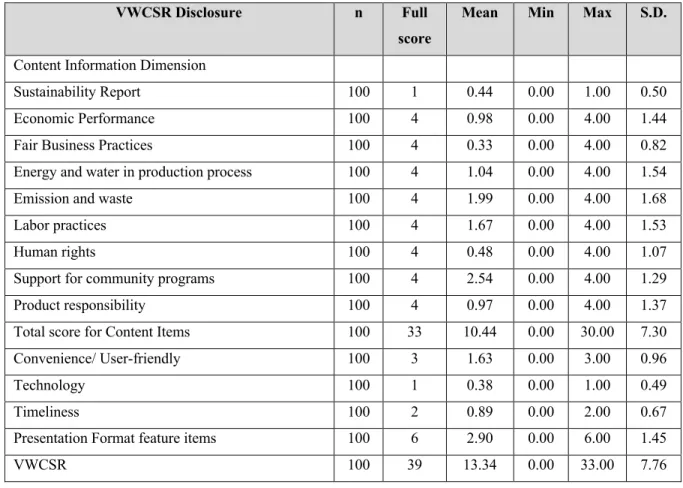
Table 6 shows the descriptive statistics for VWCSR disclosure index in the sample companies’
websites in 2020. VWCSR disclosure index has two dimensions, which are content information and presentation format features. Content information dimension consists of nine items, which are computed as shown in Table 6. It can be seen that VWCSR disclosure index has a maximum score of 33.00, which is below the full score of 39. This indicates that none of the companies
367
in the sample has a full score of VWCSR disclosure index. Content items have a full score of 33, while the full score for presentation format feature items is 6. Further, the score for content items and presentation format are found to vary among companies analyzed in the study. On average, content items in the sample have a mean value of 10.44, with a maximum score 30.00 and a minimum score of 0.00. Similar patterns which vary among companies are also shown by presentation format feature items, with a mean score of 2.90, maximum score of 6.00 and minimum score of 0.00.
In further detail, the highest score for content items was found on support for community programs (mean of 2.54), followed by disclosure on emission and waste (mean of 1.99) and labor practices (mean of 1.67). On the other hand, it was noticeable that very few companies in the sample provided information on fair business practice (mean of 0.33) and human rights (mean of 0.48). A potential explanation for this low disclosure may be explored around an assumption that stakeholders in Indonesia have low attention and demand for information on fair business practices and human rights. These results are consistent with Djajadikerta and Trireksani (2012), as well as Prabowo et al. (2017) who had conducted studies of CSR disclosure practices in Indonesia. Djajadikerta and Trireksani (2012) showed that the most recurring CSR theme disclosed by Indonesian companies is community, which is followed by labor practices and environment. Showing slightly different findings, Prabowo et al. (2017) found that the most recurring theme of CSR disclosure made by banking companies is community and environment. With regards to the dimension of presentation format features, it was discovered that companies in the sample of this study tend to focus on the convenience of their corporate websites, while technology and timeliness are relatively less provided in the corporate website. This result was found to be consistent with Sandhu and Singh (2019), who found that the website of Indian companies lag far behind with regards to timeliness dimension.
Minimum exposure on timeliness dimension in website presentation and format of French companies was also found by Boubaker et al. (2011). The authors suggested that even though the internet offers an advantage to update information without delay, very few French companies were willing to take advantage.
368
Table 6: Descriptive Statistics of VWCSR disclosure Index
VWCSR Disclosure n Full
score
Mean Min Max S.D.
Content Information Dimension
Sustainability Report 100 1 0.44 0.00 1.00 0.50
Economic Performance 100 4 0.98 0.00 4.00 1.44
Fair Business Practices 100 4 0.33 0.00 4.00 0.82
Energy and water in production process 100 4 1.04 0.00 4.00 1.54
Emission and waste 100 4 1.99 0.00 4.00 1.68
Labor practices 100 4 1.67 0.00 4.00 1.53
Human rights 100 4 0.48 0.00 4.00 1.07
Support for community programs 100 4 2.54 0.00 4.00 1.29
Product responsibility 100 4 0.97 0.00 4.00 1.37
Total score for Content Items 100 33 10.44 0.00 30.00 7.30
Convenience/ User-friendly 100 3 1.63 0.00 3.00 0.96
Technology 100 1 0.38 0.00 1.00 0.49
Timeliness 100 2 0.89 0.00 2.00 0.67
Presentation Format feature items 100 6 2.90 0.00 6.00 1.45
VWCSR 100 39 13.34 0.00 33.00 7.76
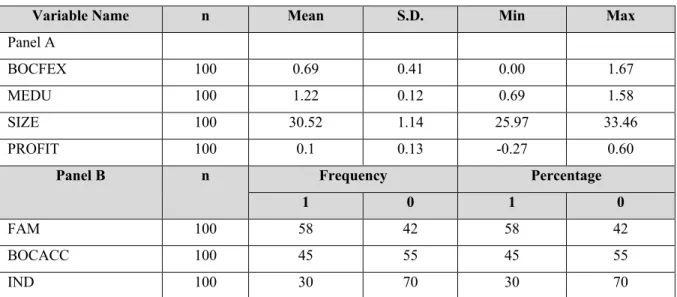
Table 7 provides descriptive statistics for independent variables and control variables. Panel A presents descriptive statistics of continuous variables, including board foreign experience, management education level, firm size, and profitability. Meanwhile, panel B demonstrates the frequency of dichotomous variables, such as family ownership, board accounting expertise and industry type. Board foreign experience (BOCFEX) ranges from 0.00 to 1.67, with an average of 0.69. These results indicated that on average, there are more than half of BOC members who have experience studying or working abroad. This is consistent with Oxelheim et al. (2013) and Wen et al. (2020), who found that board foreign experience is a board attribute which characterizes most Nordic and Chinese companies. The average level of education owned by top management (MEDU) is 3.387 (exponential of 1.22), with a minimum of 1.99 (exponential of 0.69) and a maximum of 4.85 (exponential of 1.58). These results implied that the top management members of Indonesian companies have a level of education in between undergraduate and masters level. This is similar to the findings of Li et al. (2016) and Liu et al.
(2018) for Chinese and Taiwan companies, respectively.
Panel B in Table 7 shows that 58 percent of companies in the sample of study are family firms, while the rest are non-family companies. This result is consistent with Kumala and
369
Siregar (2020), who showed that 51.47 percent of companies in the sample of their study are family-owned companies. This indicated that family-owned companies are dominant among listed companies in Indonesia. Further, it was found that 45 percent of companies in the sample of this study appointed accounting experts as BOC members, while the other companies have no accounting experts sitting as members in BOC. This result is consistent with Huang et al.
(2016), who found that close to 50 percent of its study samples in Chinese listed firms have accounting expertise as board members.
Table 7: Descriptive statistics for all variables
Variable Name n Mean S.D. Min Max
Panel A
BOCFEX 100 0.69 0.41 0.00 1.67
MEDU 100 1.22 0.12 0.69 1.58
SIZE 100 30.52 1.14 25.97 33.46
PROFIT 100 0.1 0.13 -0.27 0.60
Panel B n Frequency Percentage
1 0 1 0
FAM 100 58 42 58 42
BOCACC 100 45 55 45 55
IND 100 30 70 30 70
Notes: BOCFEX refers to average of total score of foreign experience of each members in top management, MEDU refers to natural logarithm of the ratio of total score of education level/ degree of for all top management to the number of top management members, FAM refers to a dummy variable with value of 1 if it is a family company and 0 otherwise, BOCACC refers a dummy variable with the value of 1 if there is at least one member of BOD has expertise in accounting and the value of 0 if it is otherwise, SIZE refers to natural logarithm of total assets, PROFIT refers to return of assets, IND refers to a dummy variable with value of 1 if a company is extractive industries (agriculture or mining industry), and 0 otherwise.
5.2 Diagnostic Tests
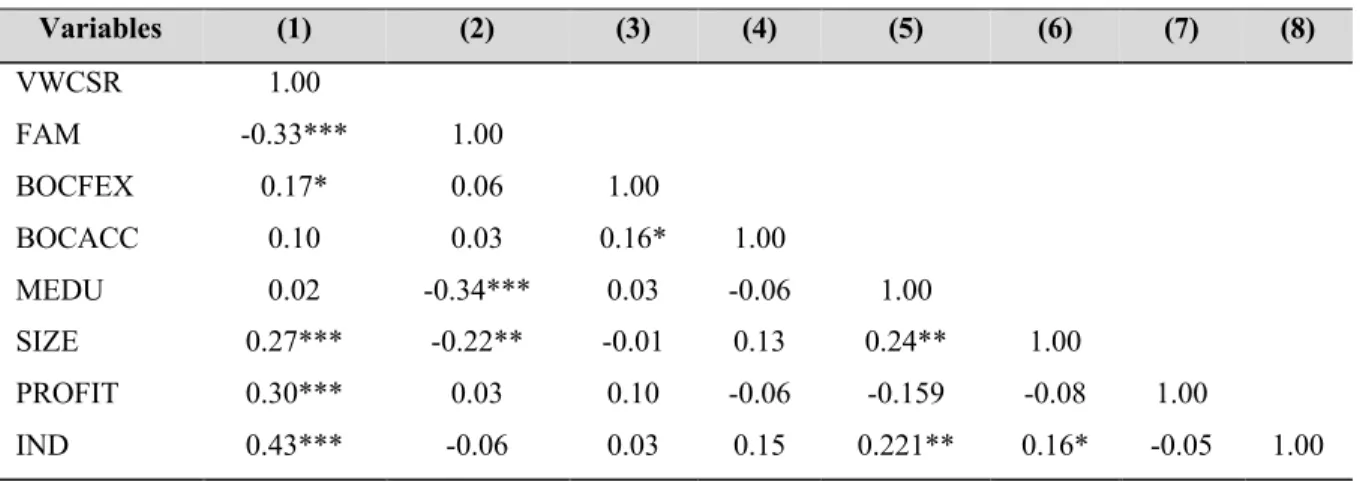
Pearson correlation coefficients among independent variables are presented in Table 8. All variables were found to have a correlation value of less than 0.437, which indicated that multicollinearity problem was not present as none of the variables correlates above 0.80.
Similar result for no multicollinearity problem was also shown in VIF, with its value ranging from 1.05 to 1.28. The VIF value is much lower than 10 and mean VIF of all independent variables in one regression is only 1.13. Further, the presence of heteroscedasticity problem is checked using Breusch-Pagan. The Breusch- Pagan / Cook-Weisberg test showed insignificant
370
p-value (0.1963>0.05), suggesting that heteroscedasticity does not exist in the data of this study.
Table 8: Correlation matrix of study variables
Variables (1) (2) (3) (4) (5) (6) (7) (8)
VWCSR 1.00
FAM -0.33*** 1.00
BOCFEX 0.17* 0.06 1.00
BOCACC 0.10 0.03 0.16* 1.00
MEDU 0.02 -0.34*** 0.03 -0.06 1.00
SIZE 0.27*** -0.22** -0.01 0.13 0.24** 1.00
PROFIT 0.30*** 0.03 0.10 -0.06 -0.159 -0.08 1.00
IND 0.43*** -0.06 0.03 0.15 0.221** 0.16* -0.05 1.00
*** p<0.01, ** p<0.05, * p<0.1
5.3 Regression Results
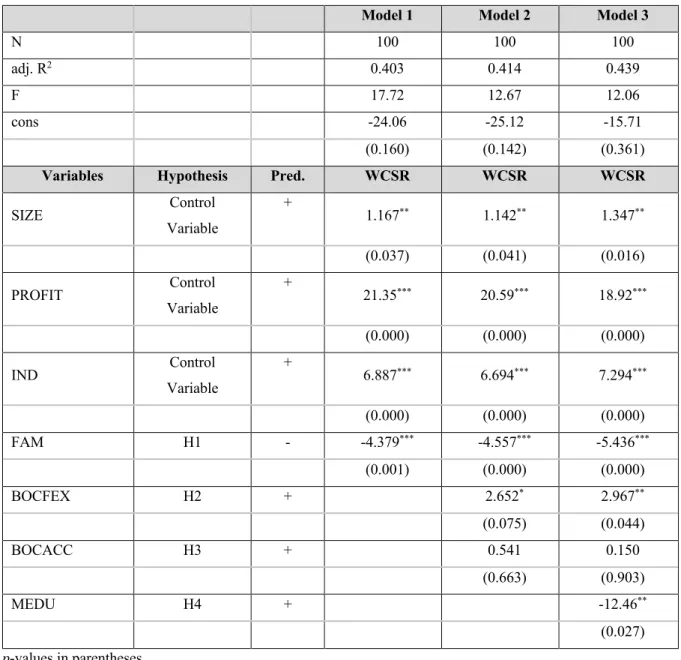
Table 9 presents results of hierarchical regression for H1, H2, H3 and H4. Model 1 only uses family ownership (FAM) as an independent variable. Next, in Model 2, the variables of BOC foreign experience (BOCFEX) and BOC accounting expertise (BOCACC) were added in the model. It was found that all models were significant at p-value of 0.00 with F-statistics of 17.72, 12.67 and 12.06 for Model 1, Model 2 and Model 3, respectively. Adjusted R2 of the three models were in the range of 40.3 percent to 43.9 percent, indicating that the total variation of the quality of VWCSR disclosure can be explained by all variables in Models 1, 2, and 3 within the range of 40.3 percent to 43.9 percent. Further, it was also shown that the adjusted R2 increased from 40.3 percent (Model 1) to 41.4 percent (Model 2), when the variables of BOCFEX and BOCACC were added in the model. The result indicated that the addition of these two variables of BOC characteristics improve the power of explanation of the model, with regards to the variation of VWCSR. Moreover, in Model 3, it was found that adjusted R2 increased even higher when the variable of top management education level (MEDU) was added. This asserts that the inclusion of the MEDU variable in the model improves the power of the model to explain the variation of VWCSR.
H1 predicted that family-owned companies tend to have less motivation to engage in VWCSR. The results supported H1, as the coefficients on FAM for all three models in Table 9 were negative and statistically significant at p-value of 0.00. This indicated that the presence of family-owned control discouraged corporate transparency through lower practices in
371
website CSR disclosure. Family-owned companies tend to act in the best interest of the controlling families rather than the interest of stakeholders. Controlling families seem to be less responsive to stakeholder requests and have no willingness to protect, develop and invest in their communities and economies (Kim et al., 2017; Morck & Yeung, 2004). The results were also consistent with El Ghoul et al. (2016) and Biswas et al. (2019), who found that CSR reporting levels for family-owned companies are significantly lower than non-family owned companies.
H2 purported that BOCFEX and BOCACC are positively related with the quality of VWCSR. The results exhibited in Table 9 discovered that coefficients on BOCFEX are positive and significant in the two models (Model 2 and 3), with p-value at <0.1 for Model 2 and p- value at <0.05 for Model 3. These findings were in line with Lau et al. (2016), Al-Mamun and Seamer (2020), also Garanina and Aray (2021). These results supported the RDT argument that board foreign experience is a valuable resource for companies to enhance CSR disclosure practices. The plausible explanation for this is that board members with high foreign experience are likely to use their knowledge, networks and connections which have been derived from overseas to align companies’ strategies with the interest of stakeholders/society (Garanina &
Aray, 2021).
H3 posited that the presence of accounting expertise in the board (BOCACC) is related with the quality of VWCSR. These results asserted that coefficients on BOCACC are positive but statistically insignificant for the two models. H3 was not supported, and these results were inconsistent with Naheed et al. (2021), who provided evidence that companies with more accounting experts on the board are more likely to be involved with CSR disclosure activity.
However, the positive coefficient of BOCACC still supported RDT, which suggested that presence of accounting expertise on board is potential resources for companies to promote a better working environment by encouraging more CSR disclosure, especially VWCSR to the public, thereby reducing problems of information asymmetry.
H4 presumed a positive relationship between education level of top management and VWCSR practices. Regression results of Model 3 in Table 9 asserted the coefficient of MEDU is negative and statistically significant. Surprisingly, this result is contradictory from H4 and inconsistent with Liu et al. (2018), Li et al. (2019), and Malik et al. (2020). A plausible explanation for this result is that in the context of Indonesia, educated members of top management play a substitutive effect in getting stakeholders’ confidence, hence it reduces the need for enhancing disclosure to the public. Darmadi (2013) suggested that within an Indonesian context, recruitment of highly-educated top management is viewed as superior
372
strategies to get investor’s confidence. From the RDT perspective, it can be argued that instead of enhancing transparency, educated top management tend to merely play a role as resources to get stakeholders’ confidence.
Table 9: Hierarchical regression results
Model 1 Model 2 Model 3
N 100 100 100
adj. R2 0.403 0.414 0.439
F 17.72 12.67 12.06
cons -24.06 -25.12 -15.71
(0.160) (0.142) (0.361)
Variables Hypothesis Pred. WCSR WCSR WCSR
SIZE Control
Variable
+ 1.167** 1.142** 1.347**
(0.037) (0.041) (0.016)
PROFIT Control
Variable
+ 21.35*** 20.59*** 18.92***
(0.000) (0.000) (0.000)
IND Control
Variable
+ 6.887*** 6.694*** 7.294***
(0.000) (0.000) (0.000)
FAM H1 - -4.379*** -4.557*** -5.436***
(0.001) (0.000) (0.000)
BOCFEX H2 + 2.652* 2.967**
(0.075) (0.044)
BOCACC H3 + 0.541 0.150
(0.663) (0.903)
MEDU H4 + -12.46**
(0.027) p-values in parentheses
* p < 0.10, ** p < 0.05, *** p < 0.01
This study predicted that family ownership moderated the relationship between BOC’s characteristics and the quality of VWCSR. Results of the moderating effect of family ownership is presented in Table 10, showing that the R2 value of this relationship is 0.433, which is increased from 0.414 in Model 2. This indicated that family ownership moderates the relationship between BOC and the quality of VWCSR disclosure. This result is consistent with
373
Alshirah et al. (2020), which showed a dramatic increase of R2 from 0.344 to 0.400 for moderating the model of family ownership for the relationship between board of directors and the level of corporate risk disclosure.
Further, as reported in Table 10, the findings showed that the interaction between family ownership and BOC accounting expertise (BOCACC*FAM) has a negative and statistically significant effect on the quality of VWCSR disclosure at 5 percent level. However, the direct relationship between the BOC accounting expertise (BOCACC) and the VWCSR as shown in the Table 10 is positive and statistically significant at 10 percent level. The results indicated that family ownership moderates the relationship between BOC accounting expertise and VWCSR. Thus, H5b was supported. Directly, presence of BOC accounting expertise is effective to enhance corporate transparency through VWCSR, however families are more likely to influence the BOC to lessen CSR practices and disclosure as the activities are considered a cost for firms. These results were similar to Jaggi et al. (2009) and Cuadrado- Ballesteros et al. (2015), which confirmed that the monitoring effectiveness of corporate boards could be weakened in family firms. However, the results were inconsistent with Alshirah et al.
(2020), which provided evidence in Jordanian listed companies that the presence of dominant families might strongly strengthen the effectiveness of the board of directors in enhancing the level of risk disclosure.
The moderating variables between family ownership and BOC foreign experience (BOCFEX*FAM) were found to have a positive and insignificant effect on the quality of VWSCR disclosure. This result indicated that there was no evidence showing that family ownership moderates the positive effect of BOC foreign experience on the quality of VWCSR disclosure (VWCSR). Thus, H5a was not supported. Summary of results can be seen in Table 11.
374
Table 10: The moderating effect of family ownership
Model 4
N 100
adj. R2 0.433
F 10.47
_cons -19.95
(0.239)
Variables Hypothesis Pred. WCSR
SIZE Control Variables + 0.963*
(0.083)
PROFIT Control Variables + 19.95***
(0.000)
IND Control Variables + 6.724***
(0.000)
FAM - -4.269*
(0.086)
BOCFEX + 1.258
(0.560)
BOCACC + 3.586*
(0.059)
BOCFEX * FAM H5a - 2.879
(0.327)
BOCACC * FAM H5b - -5.304**
(0.034) p-values in parentheses
* p < 0.10, ** p < 0.05, *** p < 0.01
Table 11: Summary of results
Variable Name Variable Code Hypothesis Pred. Results
Family Ownership FAM H1 - supported
BOC foreign experience BOCFEX H2 + supported
BOC accounting expertise BOCACC H3 + Not
supported
Management education level MEDU H4 + Not supported
Interaction BOCFEX and FAM BOCFEX * FAM H5a - Not supported
Interaction BOCACC and FAM BOCACC * FAM H5b - supported
375 6.0 CONCLUSION
This study extended previous research on corporate website disclosure practices by examining the role of family ownership, board characteristics and top management education in improving the quality of voluntary website CSR disclosure. This study may provide a better understanding of the decision of the internet as a media chosen to publish corporate information in the Indonesian context, where the current OJK regulation about website corporate disclosure has not captured the quality of CSR disclosure. The findings from this study are expected to be useful for management which is eager to meet actual and potential investor’s informational needs, especially information about CSR activities and performance. This study may also be useful for investors who are concerned, and consider CSR activities and performance as valuable information in assessing company value. Stakeholders can also benefit this study to monitor CSR practices and disclosures of listed companies in Indonesia.
This study provided empirical evidence that family-controlled companies were more likely to have lower quality of voluntary website CSR disclosure as compared to non-family owned companies, indicating that the presence of a controlling family in a company would potentially reduce the quality of voluntary website CSR disclosure. This finding implied that controlling families in emerging countries, like in Indonesia, tend to have no motivation to make extensive CSR disclosure.
Regarding board characteristics, this study found that the level of the board foreign experience is positively and statistically related with the quality of voluntary website CSR disclosure. This result confirmed resource dependency theory by highlighting that the board foreign experience is an important resource which can help companies to improve the quality of voluntary website CSR disclosure. The board accounting expertise is found to be insignificantly related with the quality of voluntary website CSR disclosure.
In contrast with this study’s expectation, this study found that the relationship between top management education level and the quality of voluntary website CSR disclosure is negative and statistically significant. This result highlighted the substitutive role of top management education level and corporate transparency, in this particular reflected from the quality of voluntary website CSR disclosure. From resource dependence theory, the result can be interpreted that recruiting top management with higher education is a strategy for companies to reduce pressures from stakeholders for the enhancement of CSR disclosure.
Further, this study provided evidence of the moderating effect of family ownership on the relationship between the board accounting expertise and the quality of voluntary website CSR disclosure. Meanwhile, it was not statistically proved that family ownership moderates
376
the positive effect of the board foreign experience on the quality of voluntary website CSR disclosure.
This study comes with its own limitations. First, the data used in the study is cross- sectional. Second, the use of a disclosure index in measuring the quality of voluntary website CSR disclosure on corporate websites may suffer from subjective biases of authors. Third, corporate websites provide dynamic information which changes frequently. Consequently, the website information collected in this study may only be relevant for the time period during which the website was accessed. Future studies may explore the influence of other elements of corporate governance, such as audit committee characteristics and external auditors on the quality of voluntary website CSR disclosure index.
ACKNOWLEDGEMENT
This article is funded by the Universiti Teknologi MARA, Shah Alam, Malaysia, Grant No.
600-RMC/DANA 5/3 BESTARI (TD) (010/2022) and Accounting Research Institute (HICoE) and Ministry of Higher Education, Malaysia.
REFERENCES
Abdelsalam, O. H., & Street, D. L. (2007). Corporate governance and the timeliness of corporate internet reporting by U.K. listed companies. Journal of International Accounting, Auditing and Taxation, 16(2), 111–130.
Abdi, H., Kacem, H., & Omri, M. A. B. (2018). Determinants of web-based disclosure in the Middle East. Journal of Financial Reporting and Accounting, 16(3), 464–489.
Adityawarman, A., & Khudri, T. B. Y. (2018). The impact of internet financial reporting practices on the company’s market value: A study of listed manufacturing companies in Indonesia. Advances in Economics, Business and Management Research, 55(1), 48–53.
Ahmed, A. H., Mardini, G. H., Burton, B. M., & Dunne, T. M. (2018). Is internet reporting useful? Evidence from Egypt. Journal of Applied Accounting Research, 19(4), 574–591.
Akhtaruddin, M., Hossain, M., Hossain, M., & Yao, L. (2009). Corporate governance and voluntary disclosure in corporate annual reports of Malaysian listed firms. Journal of Applied Management Accounting Research, 7(1), 1-20.
Al-Akra, M., & Hutchinson, P. (2013). Family firm disclosure and accounting regulation reform in the Middle East: The case of Jordan. Research in Accounting Regulation, 25(1), 101–107.
Al-Mamun, A., & Seamer, M. (2020). Board of director attributes and CSR engagement in
377
emerging economy firms: Evidence from across Asia. Emerging Markets Review, 46(1), 1-52.
Ali, A., Chen, T. Y., & Radhakrishnan, S. (2007). Corporate disclosures by family firms.
Journal of Accounting and Economics, 44(1–2), 238–286.
Alshirah, M. H., Abdul Rahman, A., & Mustapa, I. R. (2020). Board of directors’
characteristics and corporate risk disclosure: The moderating role of family ownership.
EuroMed Journal of Business, 15(2), 219-252.
Bansal, S., Lopez-Perez, M., & Rod