INTERNATIONALIZATION EFFORTS AMONG MALAYSIAN PRIVATE UNIVERSITIES
Santhi Ramanathan
Faculty of Economics & Administration University Malaya, Kuala Lumpur
Email: [email protected] Abstract
Over the last several decades, globalization and internationalization have changed the landscape and method of acquiring and sharing the knowledge at the higher education level worldwide.
Along with this, international activities of most universities have expanded in volume, scope and complexity. In many ways the Malaysian higher education system particularly private higher education mirrors the global higher education system. Many studies were conducted at various levels (institutional, national and international) in order to cultivate a reliable framework for Malaysian higher education especially the university education system to realign their structure and mission towards international standards. In the context of the Malaysian private higher education sector, the private universities role is considered vital in adapting to internationalization policies and strategies. This study addresses the concern whether Malaysian Private Universities (MPUs) have internationalized as much as they have declared through their international strategic intents or mission statements. In addressing the above issue, cluster analysis was adapted as to explore MPU’s status on the internationalization continuum. This research provides a better understanding on the performance of the Malaysian private universities that embrace internationalization.
Keywords: Internationalization, globalization, private universities, performance,
Introduction
Internationalization implies the integration of international dimensions in all aspects of an institution, namely, governance, teaching, learning, staff, students and research and thus, it is crucial in achieving international academic standards (Knight, 2004). According to Knight, this motivation relates to the rationale to achieve a strong world-wide reputation or “brand” name as an international high-quality institution. This rationale is found to have an impact on institutional assessment systems at the international as well as at the national level (Jang, 2009). Two of the cases cited by Jang are discussed here. Firstly, is the issue of institutions using the data of the higher number of international students, study abroad participants, and international activities as validation for educational quality. Secondly, is the case of Latin America where internationalization is being adapted and the programs are found to be detached from the strategies aimed at quality improvement. In consistent with Jang’s concern, Birnbaum (2007) argued that the vast adaptation of internationalization among higher education providers world-wide triggered by globalization and the lack of uniformity in terms of ranking systems have caused many institutions of higher learning across the globe to claim either that they have the plan to become a world-class university by a certain date or that they have already achieved this status. Birnbaum (2007)
highlighted Malaysia as one of the countries that has institutions of higher learning which often claim to be world class which contradict with the report produced by the World Bank (2007) stating
“Malaysian universities have yet to achieve world class status” (p: 25). The issues above clearly reflects the narrow understanding of the concept ‘world class’ (Altbach, 2004) which is often assessed based on the institution’s internationalization efforts in terms of quantity and not a quality perspective of international dimensions. “Even though the impact of external and internal changes on the daily practices and the performance of academe cannot easily be examined , and even though the battle on the definition and measurement of ‘quality’ of academic work is part of the ongoing change in higher education, we should not loose sight of the fact that they ultimate criteria”
(Enders, 2004, p: 376). Thus, the scope of the internationalization-performance assessment literature needs to be extended with a more empirical investigation with appropriate indicators particularly to be applicable in the emerging private university sector . In the context of Malaysia, there is a greater demand to address the issue above and fill the gap since there is lack of exposure and participation of local private universities in local (Malaysian Business, January, 2003;
StarEducation, June, 2008), Asian or world rankings which could be due to the absence of a unified- cum- transparent performance assessment system for higher education (World Bank, 2007).
In the internationalization-performance literature, the issue of the absence of a comprehensive set of indicators and data sources for evaluating the extent of an institution’s internationalization is always the primary obstacle for researchers (Haywards, 2000). Many sophisticated models have been developed (Davis, 1992; Manning, 1998; Mestenhauser, 2002; Knight, 1997, 2004; Ayoubi, 2006; Ayoubi and Massoud, 2007; Horn, Hendel and Fry, 2007) and yet the great diversity of contexts, perceptions, rationales and priorities affecting institutional views and practices tend to limit the models’ role play in describing how internationalization can be implemented at the institutional level in different context and in extracting its success factors (Courts, 2004; Childress, 2009). Courts comments that there are only few studies that describe how internationalization can be successfully implemented at the institutional level. Consistent with this comment, Childress (2009) claims that there is a greater lack of knowledge about how universities and colleges develop and monitor internationalization plans. Similarly, although the issue of Malaysian universities’
competitive position internationally has been clarified by the World Bank (2007), the issues and recommendations provided are limited in guiding the private higher education sector in their internationalization efforts. There is no exclusive model or framework provided as to guide to private higher education sector, specifically, the private university sector, which is a fairly new and competitive sector (Kasim, Malaysian Business, 2003), largely driven by global needs (Gill, 2005) and probably remain the main site for growth in international education (Marginson & McBurnie, 2004; Akiba, 2008).
Private higher education is an emerging industry and there is likely to be a constant need for effective management if institutions are to thrive and maximize the potential contribution that they can make (Schofield, 1996). Based on various sources, namely the data produced by MOHE (2007-2009), information on universities’ website and from other sources (Gill, 2005; Marginson
& McBurnie, 2004; Akiba, 2008), it was found that Malaysian private universities (MPUs) embrace internationalization massively especially in terms of international student and faculty recruitment compared to public universities.
Up to this point, there is an issue to be addressed pertaining to MPUs’ internationalization efforts which is the concern whether MPUs have indeed internationalized as they have declared through their international strategic intent or mission statements. Since internationalization of an emerging higher education market can be viewed as occurring on a continuum (Bartell, 2003), it is thus, relevant if not necessary, for internationalization efforts within these MPUs to be scrutinized based on the continuum. This concern raises the question: What is the current status of MPUs on the internationalization continuum? This could be possibly answered through either clustering (Ayoubi et al., 2007) or ranking (Horn et al, 2007) the institutions based on their internationalization strategies. Unfortunately, the existing performance evaluation models using clustering or ranking, is not able to provide generalizable results because it is totally dependent upon the variables used as the basis for the similarity measure (Hair et al, 2006). There are two common issues to be addressed in adapting these methods. The first is that the variables used in the analysis must have strong conceptual support (Hair et al, p: 560-561). Second is the lack of accessibility to information that needs to be used in the analysis which is very often not declared by institutions for commercial sensitivity reasons (Ayoubi et al, 2007). The diversity of contexts and perceptions of internationalization often limits any study to have variables with strong conceptual support and are at the time accessible. In the same time accessible. In the context of MPUs, it is extremely common to face university administrators who decline to provide information for commercial sensitivity reasons. Thus, it appears that there is no definite model that is appropriate foe clustering MPUs on the internationalization continuum. Therefore, a combination of indicators from Ayoubi et al, (2007) and Horn et al, (2007) which is tested in this study could possibly contribute to a new model which may be appropriate for a comprehensive assessment of internationalization efforts.
This study is an attempt to contribute, given these gaps in the body of the internationalization of higher education literature, focusing specifically on MPUs and assessing them on the internationalization continuum which may drive them to strive towards a progressive and successful internationalization in order to reach international academic standards.
Literature Review
Forest and Altbach (2006) mentioned that higher education is an increasingly complex phenomenon throughout the world, characterized by worldwide growth in demand and the provision of access, diversification and privatization, increasing global interaction and interconnectedness, and the growing use of technology. In studying the global challenges and national responses to higher education in the 21st century, Altbach and Peterson (1999) have identified several themes which include privatization and internationalization of higher education as a worldwide phenomenon of considerable importance.
The term internationalization of higher education or universities has become more popular among scholars, policy makers and institutional leaders mainly due to the increasing pressures for universities worldwide to adapt to the rapidly changing internal and external environment. The characterization of internationalization through the definitions, models or frameworks proposed by various scholars (Davies, 1992; Harari, 1992; Arum, 1992, Knight, 1994; de Wit, 2002; Zha, 2003; Knight, 2004) seems to have discovered a number of limitations (too vague and/or too specific) in exemplifying the actual process of internationalization (Reedstrom, 2005). According to Manning (1998), the above scenario is unavoidable for the following reasons: i) the great
diversity of context, perception and rationale which affects institutional views and practice; ii) institutions are themselves micro-cultures with divergent voices and heterogeneous interests which have so far attracted little systematic research interest; iii) the relationship between the descriptive and the prescriptive components of models for internationalization is often unclear.
Many scholars who have addressed such limitations tend to contribute an updated version and some struggles to do so due to the greater diversity, complexity and confusion of views and practices which were stressed earlier. Knight’s internationalization model (1994) indicates that institution proceed through six phases of developing and implementing an internationalization strategy. This model considers the internationalization process as a continuous cycle, not a linear or static process (Manning, 1998; Zha, 2003). Knight’s framework provides a wider knowledge on how institutions develop and implement internationalization strategies and illustrates the transition from planning to operationalization phases. Although Knight conceptualized internationalization in a very different way, whether the internationalization cycle can be reflexive or not was an issue among some scholars (Zha, 2003; Childress, 2009). According to Childress (2009), Knight’s framework may not be reflexive and that institutions may not necessarily proceed sequentially through the internationalization phases as indicated by Knight. In this context, Knight has addressed that the international dimension relates to all aspects of education and the role that it plays in society is a critical point. Thus, Knight (2004) has provided an updated conceptual framework which analyses approaches of internationalization using a bottom-up (institutional) and a top-down a (national/sector) approach. Ayoubi (2006) proposed three major phases of the internationalization process in universities which to some extent reflect the phases highlighted in Knight’s (1994) and Manning’s (1998) models. Ayoubi’s three phases are setting up the design of internationalization (design or planning), selecting the best ways to activate the design with real actions (implementation or operationalization) and lastly evaluating the process above (evaluation).
Based on an empirical assessment of organizational effectiveness with regard to internationalization, numerous facilitating factors and obstacles have been found from the 2003 International Association of Universities (IAU) Survey Report. The following are the obstacles that hinder the successful and sustainable implementation of internationalization:
(i) Lack of policy/strategy to facilities the process (ii) Lack of financial support
(iii) Administrative inertia or difficulties (iv) Competing priorities
(v) Issues of non-recognition of work done abroad (vi) Lack of reliable and comprehensive information (vii) Lack of opportunities
(viii) Lack of understanding of what is involved
(ix) Insufficiently trained or qualified staff to guide the process
In many Asian countries, private higher education has shown tremendous growth even in countries where historically the higher education sector comprised of only public institutions under tight central control, such as Malaysia (Altbach, 1999; Future Policy Scenario, 2001; Pang and Lim, 2003). In comparative terms, private higher education is most powerful in Asia (Altbach, 1999). However, in terms of quality assurance, Altbach highlighted the issue of lacking of measures of educational product or accountability as well as transparency in the higher education.
This issue had become a major concern in the higher education domain as most of the universities in East Asia are bound by global standards or international benchmarks dominated by the Western academic paradigm (Mok, 2007). In the context of developing countries particularly, the challenge to catch-up with world-class institutions for both public and private institution, has been mainly focused on balancing international academic standards with national needs and local identity and culture. Thus, it is not surprising that internationalization has penetrated well into the higher education system in most of the developing countries. In line with internationalization trend, a number of scholars (Daniel, 2006; Birnbaum, 2007; Jang, 2009) have raised their concern on the role and impact of internationalization on the institutional performance and quality assessment system. Daniel (2006) commented that the cross-border higher education will not help developing countries unless it is accessible, available, affordable, relevant and acceptable quality. Daniel also pinpointed that many developing countries lack of quality assurance mechanisms and yet according to Birnbaum (2007) many institutions of higher learning across developing nations often claim to be world-class. This phenomenon is probably due to the diversity between the institutions’
vast internationalization efforts and their rationale which makes the strategies often detached from institutional assessment system (Zha, 2003; Jang, 2009). This issue indicates a need for a clear assessment on higher education system as well as on the institutional process of integrating international dimensions especially in the context of Malaysia.
Within the Asia-Pacific region, Malaysia is categorized as intermediate nation with inadequate domestic capacity and active in both import and export of higher education (Marginson
& McBurnie, 2004). However, in the South-East Asian region, Malaysia is identified as one of the most developed and experienced nation in the same context (Lee & Healy, 2006). In consistent with this information, Webway (2006) stated that Malaysia has been known as one of the pioneers in the development of transnational educational programs (cited in Akiba, 2008). According to Lee
& Healy (2006), although Thailand, Singapore and Malaysia have national objectives to become educational hubs in this region, the strategy is more developed in Singapore and Malaysia where active government support and incentives have been given to overseas providers as well as to local private providers.
The World Bank (2007) has recognized three significant trends with regards to the university sector in Malaysia. Firstly, Malaysia has successfully invested in universities and other institutions of higher learning. Secondly, Malaysia is attempting to transform its universities into dynamic and responsive institutions which can hold their place internationally. Thirdly, most Malaysian universities have excellent infrastructure, and sophisticated technology to support the teaching and research missions of the institutions. However, based on the assessment and benchmarking done against international standards, the report revealed that Malaysian universities have yet to achieve “world-class” status. Governance, finance, a unified higher education system, quality issues, graduate employability, disjoint research and innovation system and lastly the weak university-industry linkages were among factors pinpointed as hindering Malaysian universities development prospects (p.25).
Malaysia has taken various efforts to ensure universities’ function and achievements are streamlined with the national policy as well as with global standards. Malaysia’s latest policy changes are the establishment of the Malaysian Qualification Agency (MQA) replacing the National Accreditation Board (LAN) and the Quality Assurance Division (QAD) in 2005;
categorization of public universities based on the functions and performance which embarked in 2006; and the launching of Accelerated Program for Excellence (APEX) and “MOHE COE” in , confidence of the stakeholders, and pushing the boundaries to make the country’s higher education comparable with the best in the world. The clustering or categorizing the public universities into
‘research university’, ‘comprehensive university’ and focused university’ has been another MOHE’s attempt to find the potential universities for further improvement. In the context of private higher educational institutions, with too many institutions which are different from one another, the MOHE’s system of upgrading the institutions from private college to university college and then to full-university status has made the Malaysian private university (MPU) sector a huge cluster to date.
Although the exercises of ranking, clustering and upgrading the Malaysian universities have been the main agenda for MOHE for thr past few years, those exercises are least concentrated on the private sector that functions in highly competitive environment. The exposure and participation of public universities in local, Asian or world rankings have made these institutions to be more aware of ranking systems and the importance of various international dimensions compared to private universities. As for many newly established private colleges and universities, during the early of 21st century, they were not happy with the issues of ranking, which for them was the statement reveled by Kasim from the Education Ministry’s private education department on the issue of ranking exercise on private institutions and found that the participation level was not satisfactory which made them opt for the rating system. Kasim has pointed out that “we have to be fair as our industry is fairly new”. Consistently, the response rate of MPUs toward the national policy is found to be very low based on the fact that only two private universities have submitted proposals to come under the APEX (Nordin, StarEducation, June 2998). The absence of unified assessment system, lack of transparency and accessibility on quality assurance assessments and report are among the factors addressed by the World Bank (2007) to be offering very little in terms of steps for improvement in quality of education.
In the context of Malaysian private universities (MPUs), the clustering, categorizing or ranking universities exercises are considered lacking in terms of implementation due to the absence of unified higher education system (World Bank, 2007). The private university sector is an emerging industry in Malaysia, especially in the internationalization massively especially in the internationalization domain (Marginson, 2004; Akiba, 2008). Malaysian Private Universities embrace internationalization massively especially in terms of international student and faculty recruitment compared to public universities (MOHE, 2007). In this respect, appropriate internationalization strategies may help private universities to capture the international dimension of higher education progressively and successfully. Thus, the main agenda of current study is the concernwhether MPUs have indeed internationalization continuum. In searching for a simple model which could assess MPUs position on the internationalization continuum, Ayoubi’s (2007) model of clustering and Horn’s et al., (2007) framework for ranking universities based on various internationalization indicators were found to br useful in constructing a framework and model which matches the MPUs current practices. Ayoubi’s model seems to be simple and the indicators proposed for the assessment were found available and accessible in the context of MPUs except for international financial indicators which was substituted with international graduated to be used in current study. Horn’s et al., model was found not as Ayoubi’s in terms of complex set of indicators to be adapted in the current study which were found available and accessible in the
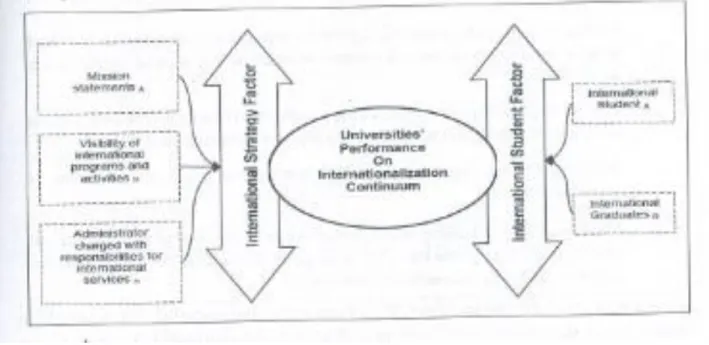
context of MPUs. Thus, five internationalization indicators or variables were integrated in a single framework (Figure 1) which was used in the current study to cluster the MPUs. These variables are conceptually supported and available in the context of MPUs which had made possible for the researcher to conduct cluster analysis on MPUs.
Figure 1: Conceptual Framework for Assessment of Universities on the Internationalization Continuum , Ayoubi & Massoud (2007), ʜ Horn, Hendel & Fry (2007), Integrated I the current syudy
Methodology
Cluster analysis was utilized in this study to partition 30 Malaysian private universities into various groups which are not tied up with any number of targeted groups. The partitioning was done based on the similarity of the universities using two variables: the international strategy factor with three attributes and the international student factor with two attributes as shown in Figure 1. In terms of coding manual for attributes under internalization strategy factor, the numerical estimation scores for mission statements (Table 1) from Ayoubi et al (2007) and the five-category coding system on international activities and administrator (Table 2 & 3) from Horn et al., (2007) were adpted.
Table 1: Numerical estimation Score for Mission Statements:
Score Score Interpretation
1 2
3 4 5
No words or concepts mentioned about international, global,. .
The following word “international, global, overseas, worldwide . . .” or words which have the same meaning are mentioned
Either one of the following concepts mentioned: international partnership agreement with overseas universities, overseas student recruitment, overseas staff exchange, overseas academic cooperation, joint degrees
Where two or more of the previous two concept are mentioned
Score Score Interpretation Direct statement of being world class or internationalized
Adapted from Ayoubi & Massoud (2007), The Strategy of Internationalization in Universities, International Journal of Educational Management, 21(4), pp. 329-349.
Table 2: Numerical estimation Score for the Level of Visibility of International Programs and Activities
Score Score Interpretation
1
2
3
4
5
No visibility (i.e., there was no information related to international issues, programs, or activities)
Minimal visibility (i.e., something highlighted that had an international flavor—such as an international conference on campus—but with no indication of its relevance to the institution)
Focused emphasis (i.e., something highlighted that was of particular relevance, such as an option for non-English translation or admission for international students) Broad topical link (i.e., leading titled international programs, resources, or opportunities)
Multitopic link (i.e., heading titled international programs, statements of international emphasis, and at least one other link to language translation, immigration policies, and/or guidelines for international applications)
Adapted from Horn, Hendel and Fry (2007), Ranking the International Dimension of Top
Universities in the United States, Journal of Studies in International Education, 11, pp.
330-357
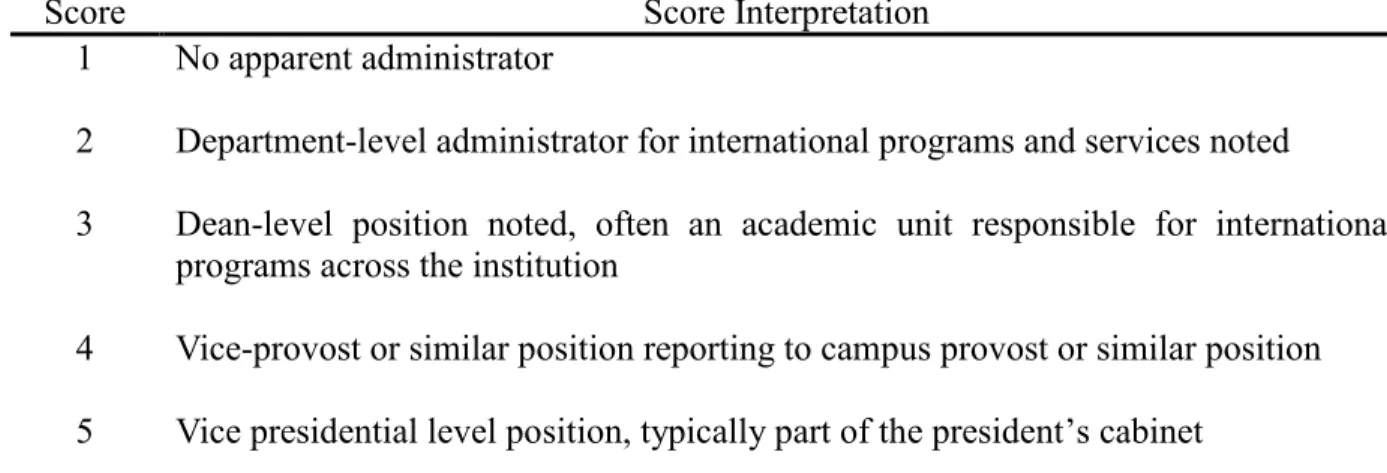
Table 3: Numerical estimation Score for the Presence of a Campus Administrator in charge of Responsibilities for International Programs and Service
Score Score Interpretation 1
2 3
4 5
No apparent administrator
Department-level administrator for international programs and services noted
Dean-level position noted, often an academic unit responsible for international programs across the institution
Vice-provost or similar position reporting to campus provost or similar position Vice presidential level position, typically part of the president’s cabinet
Adapted from Horn, Hendel and Fry (2007), Ranking the International Dimension of Top
Universities in the United States, Journal of Studies in International Education, 11, pp.
330-357
As for the international student factor, there was no coding system under Ayoubi’s framework.
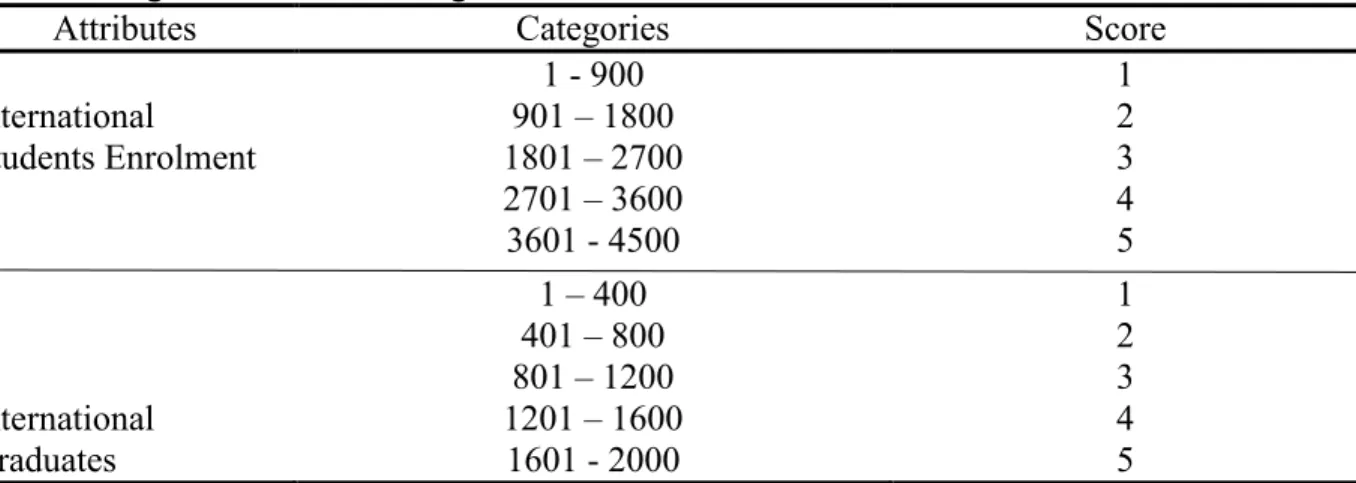
Ayoubi used the factor analysis technique to generate variables with new values or factor scores to be used for clustering. In the context of the current study, however, factor analysis is not applicable due the small sample sizes. Thus, to be consistent with the strategy factor in terms of coding, the data obtained for the international students and graduates were categorized and coded based on a five-category coding system, as shown in Table 4 below. In the current study, all the local private universities in Malaysia were selected for analysis except for six universities. The MPUs were selected based on the list provided by the Ministry of Higher Education (MOHE) which was updated until the year 2008.
Table 4: Categorization and Coding for International Students and Graduate
Attributes Categories Score
International
Students Enrolment
1 - 900 901 – 1800 1801 – 2700 2701 – 3600
3601 - 4500
1 2 3 4 5
International Graduates
1 – 400 401 – 800 801 – 1200 1201 – 1600
1601 - 2000
1 2 3 4 5
The data used for cluster analysis are mainly from secondary sources and the data for this study were drawn from two different sources as shown in Table 5 below.
Table 5: Factor, Attributes and Data Sources for Cluster Analysis
Factor Attributes Data Sources International
Strategy Intent
Mission statements
The level of visibility of international programs and activities
The presence and level of a campus administrator in charge of responsibilities for international programs and services
Institution’s home page on website
International Student Factor
Number of International Students Number of International Graduates
Center for Data & Information Department of Higher Education, Ministry of Higher
Education, Malaysia
Based on the coding schedules adapted from Ayoubi et al., (2007) and Horn et al., (2007), content analysis was performed on the mission and vision statement, the level of visibility of international programs and activities and the presence as well as the level of a campus administrator charged for international programs and services of 30 Malaysian private universities. Based on the numerical estimation scores and tabulating for the above three attributes, the mean value of strategies was extracted in order to form a single factor labeled as international strategy factor.
Based on a reliability test performed, the Cronbach Alpha was 0.69 which is almost at the minimum threshold for an internal reliability test (Chua, 2007). Based on the coding schedule developed for the international students and graduated, the data obtained from MOHE for the above two attributes were tabulated. The mean value of international student and international graduates was extracted in order form a single factor labeled as international student factor.
The international strategy factor and international student factor constructed above were then used to perform a cluster analysis which is considered the most important technique in achieving the objective of this study. Chua (2007) recommended the cluster analysis with hierarchical methods or procedures to be adapted for the study which has fewer than 250 cases. Thus, in the current study, cluster analysis with a hierarchical cluster analysis solution, a one way ANOVA was performed in order to lead the analysis for the profiling stage. The profiling stage involves describing the characteristic of each cluster based on relevant dimensions. The data analysis approaches described above were conducted using the Statistical Package for Social Science (SPSS) version 17. The above approaches strategy and achievement which may contribute an understanding of the status of a university on the internationalization continuum.
Findings and Discussion
This section presents the result generated using the cluster analysis approach which enabled the researcher to explore the cluster solutions and their characteristics in order to locate them appropriately on the internationalization continuum. In cluster analysis with a hierarchical cluster
procedure, the formations of clusters or cluster solutions are shown using the average linkage approach via the Agglomeration schedule, the vertical icicle diagram and the dendrogram graph.
The definition or explanation for those based on Hair et al. (2006) and Chua (2009) are discussed below.
Agglomeration Clustering Schedule
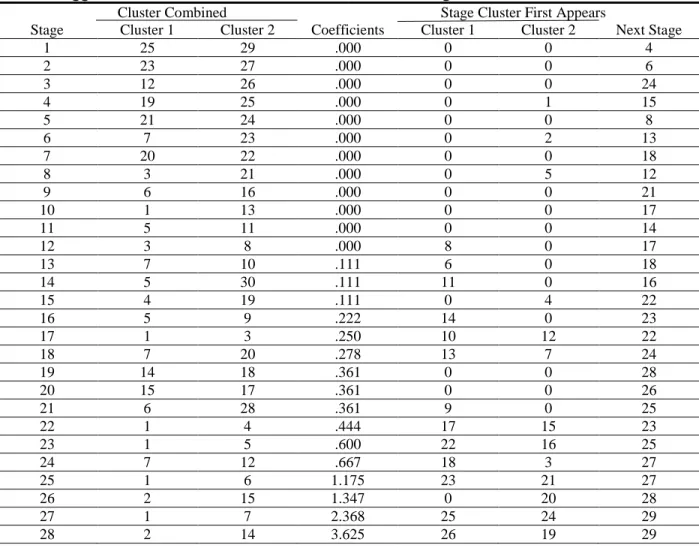
Average linkage refers to hierarchical clustering algorithm that represents similarity as the average distance from all objects in one cluster to all objects in another cluster. Distance measures are most often used as a measure of similarity, with higher values representing greater dissimilarity. In the Agglomerative schedule, at each stage of the agglomeration, the clusters with the smallest maximum distance are combined. The Agglomeration schedule shown in Table 6 indicates the existence of four cluster. The four cluster are detected based on the difference in terms of Agglomeration coefficients values observed at the last four stages: between stage 26 and 27, between 27 and 28 and between 28 and 29 which are relatively larger than the difference that exist between any other pairs of stages.
Table 6: Agglomeration Coefficient for Hierarchical Clustering Process
Cluster Combined Stage Cluster First Appears
Stage Cluster 1 Cluster 2 Coefficients Cluster 1 Cluster 2 Next Stage
1 25 29 .000 0 0 4
2 23 27 .000 0 0 6
3 12 26 .000 0 0 24
4 19 25 .000 0 1 15
5 21 24 .000 0 0 8
6 7 23 .000 0 2 13
7 20 22 .000 0 0 18
8 3 21 .000 0 5 12
9 6 16 .000 0 0 21
10 1 13 .000 0 0 17
11 5 11 .000 0 0 14
12 3 8 .000 8 0 17
13 7 10 .111 6 0 18
14 5 30 .111 11 0 16
15 4 19 .111 0 4 22
16 5 9 .222 14 0 23
17 1 3 .250 10 12 22
18 7 20 .278 13 7 24
19 14 18 .361 0 0 28
20 15 17 .361 0 0 26
21 6 28 .361 9 0 25
22 1 4 .444 17 15 23
23 1 5 .600 22 16 25
24 7 12 .667 18 3 27
25 1 6 1.175 23 21 27
26 2 15 1.347 0 20 28
27 1 7 2.368 25 24 29
28 2 14 3.625 26 19 29
29 1 2 6.845 27 28 0
Vertical Icicle of Clustering
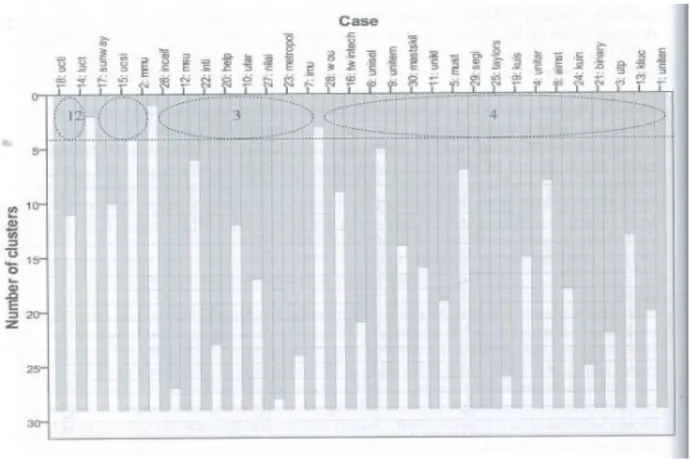
Besides the Agglomeration schedule, the result as shown in Figure 2 in the vertical icicle also indicates the existence of four clusters. The vertical icicle diagram is a graphical representation of clusters. The separate objects are shown horizontally across the top of the diagram, and the hierarchical lustering process is depicted in combinations of clusters vertically. This diagram is similar to an inverted Dendrogram and aids in determining the appropriate number of cluster in the solution.
Figure 2: Vertical Icicle for Hierarchical Clustering Process
Dendrogram of Clustering
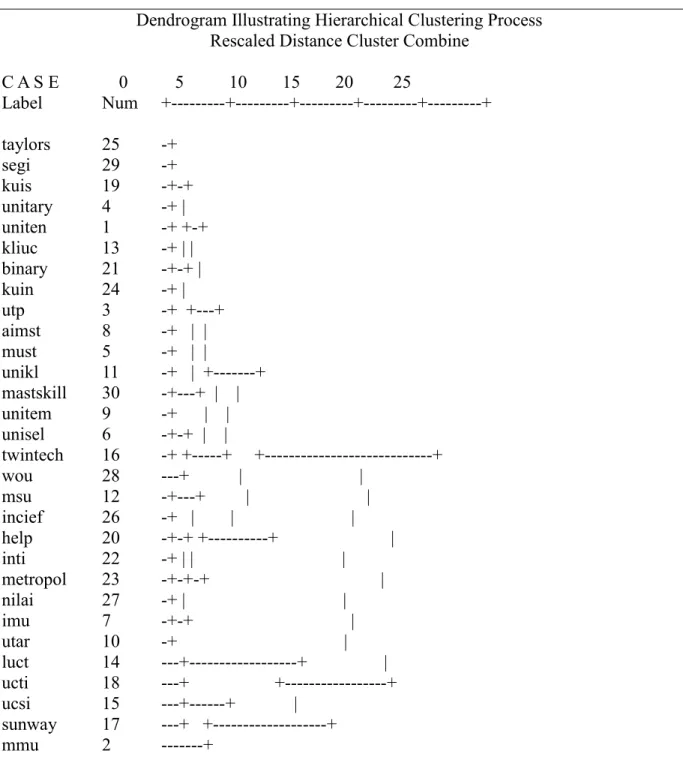
The Dendrogram is another popular graphical method representing the result of a hierarchical procedure in which each object is arrayed on one axis, and the other axis portrays the step in the hierarchical procedure. Starting with each object represented as a separate cluster, the dendrogram shown graphically how the cluster are combined at each step of the procedure until all are contained in a single cluster. The result of the Dendrogram (Figure 3) shows the existence of four clusters and is consistent with the results reflected by both the Agglomeration schedule and the vertical Icicle. The solid vertical line shows the four main lines connected to four different clusters.
Figure 3: Dendrogram Illustrating Hierarchical Clustering Process
Dendrogram Illustrating Hierarchical Clustering Process Rescaled Distance Cluster Combine
C A S E 0 5 10 15 20 25
Label Num +---+---+---+---+---+
taylors 25 -+
segi 29 -+
kuis 19 -+-+
unitary 4 -+ |
uniten 1 -+ +-+
kliuc 13 -+ | | binary 21 -+-+ |
kuin 24 -+ |
utp 3 -+ +---+
aimst 8 -+ | | must 5 -+ | |
unikl 11 -+ | +---+
mastskill 30 -+---+ | | unitem 9 -+ | | unisel 6 -+-+ | |
twintech 16 -+ +---+ +---+
wou 28 ---+ | | msu 12 -+---+ | | incief 26 -+ | | | help 20 -+-+ +---+ | inti 22 -+ | | | metropol 23 -+-+-+ | nilai 27 -+ | | imu 7 -+-+ | utar 10 -+ | luct 14 ---+---+ | ucti 18 ---+ +---+
ucsi 15 ---+---+ | sunway 17 ---+ +---+
mmu 2 ---+
Cluster Memberships
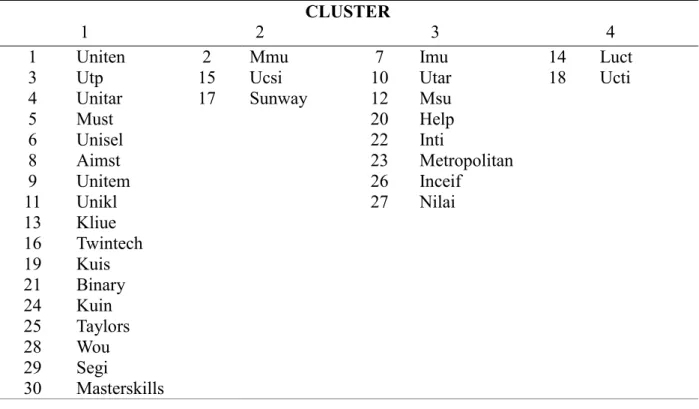
Based on the four cluster solutions identified through the cluster analysis procedures, cluster membership were generated using the same approach and cases were arranged according to the respective clusters as shown in Table 7.
Table 7: Universities and Clusters
CLUSTER
1 2 3 4
1 3 4 5 6 8 9 11 13 16 19 21 24 25 28 29 30
Uniten Utp Unitar Must Unisel Aimst Unitem Unikl Kliue Twintech Kuis Binary Kuin Taylors Wou Segi
Masterskills 2 15 17
Mmu Ucsi Sunway
7 10 12 20 22 23 26 27
Imu Utar Msu Help Inti
Metropolitan Inceif
Nilai
14 18
Luct Ucti
As shown in the above results, 17 institutions fall under the 1st cluster, 3 institutions under the 2nd cluster, followed by 8 institutions under the 3rd cluster and finally 2 institutions under the 4th cluster.
In order to describe the characteristics of each cluster, the one-way ANOVA was generated and the result are presented in the following section. This analysis is performed on 4 clusters listed above based on two dimensions, namely, international strategy factor and the international student factor.
Cluster Characteristics
The results of the one-way ANOVA as in Table 8 indicate that the four clusters are significantly different [F (3, 26) = 31.332, p< .001] and the international student dimension [F (3, 26) = 52.383, p< .001]. In interpreting the result of the one way ANOVA, Levene’s test for homogeneity of variances can be assumed. Having obtained a significant F-ratio with the homogeneity assumption, the analysis can be advanced further to determine where the significance lies using the Turkey HSD test.
Table 8: The Result of One-way ANOVA on Four Clusters Sum of
Squares
Df Mean Square F Sig.
Mean International
Strategy
Between Groups 16.084 3 5.361 31.332 .000
Within Groups 4.449 26 .171
Total 20.533 29
Mean International Student Factor
Between Groups 19.599 3 6.533 52.383 .000
Within Groups 3.243 26 .125
Total 22.842 29
*significant at p < 0.001
*Based on nonparametric technique of Kruskal-Wallis test, the p < 0.05
Table 9:
The Results of Turkey’s HSD for Pair-Wise Comparison of Differences in International Strategy and International Student Factor among the Four Clusters.
Variable Significant Differences of mean
value International
Strategy Factor 1 2 3 4
N 17 3 8 2
Mean 2.33 3.22 3.71 4.50
1 X
2
* X
3
* NS
4
*
* NS X International
Student Factor 1 2 3 4
17 3 8 2
0.91 2.50 1.00 3.75
X *
X NS
* X
*
*
* X
*Significant at p<0.05
Based on the results in Table 9, cluster 1 scored the lowest scale both in terms of strategy implementation and the result from implementation which is from the international student enrolment and graduates perspectives (M=2.33 and M=0.91 respectively). Cluster 2, which consist of 3 institutions, scored slightly higher (M=3.22) for the international strategy factor but found to be lower than the 3rd and 4th clusters. However, in terms of international student factors, cluster 2 scored higher (M=2.5) than cluster 3. Cluster 3 leads cluster 1 and 2 in terms of the international strategy factor (M=3.71) but has a lower score for the international student factor which comprises international student enrolment and international graduates (M=1.00). Lastly, cluster 4 seems to be outstanding in both the international strategy factor and the international student factor (M=4.5 and M=3.75 respectively). However, only 2 institutions out of 30 showed these characteristics.
Internationalization Continuum
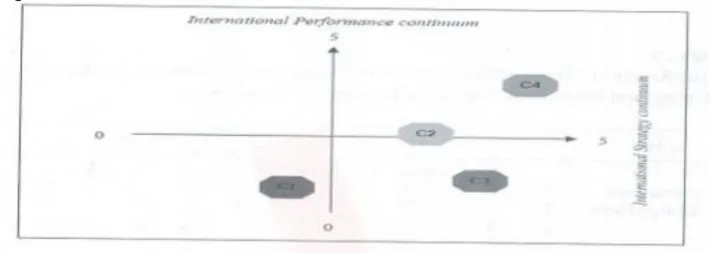
Since the main aim of this study is to view the position of MPUs on the internationalization continuum, the findings from the cluster analysis as shown in the previous section can possibly be transformed and exemplified on two continuums, namely, the international strategy continuum and the international performance continuum. By doing so, as proposed by Bartell (2003), internationalization can be viewed as occurring on a continuum which may provide an overview of the current status and their direction of the MPU sector. Thus, the four clusters obtained from the previous analysis are located appropriately by considering both the international strategy continuum and the international performance continuum, as shown in Figure 4 below.
Figure 4: Universities on Internationalization Continuum
The vertical line represents the international performance continuum which is explained by student factors, and the horizontal line represents the international strategy continuum which is explained by strategy factors. At the strategy continuum, approximately 44 percent of Malaysian private universities in comparison with other universities. Thus, it can be concluded that this group of universities is pro-active in international student businesses which encompass clusters 2, 3 and 4.
However, this number is apparently invisible at the higher side of the international performance continuum. From the pro-active group, it is found that only 16 percent of the Malaysian private universities (cluster 4) fall on the higher side of the international performance continuum. Ayoubi et al (2007) categorize this group as “international winner”. By considering the pro-active group, 23 percent of the universities (cluster 2) are at the higher side of the international performance continuum and at the lower side of international strategy continuum. Ayoubi names this group as
“international actors”.
Conclusion
The growing trend of internationalization and private providers of higher education are two emerging issues around the world (Altbach et al., 1999; Knight, 2004; Yonezawa, 2007). Together with these issues, the issue of university sustainability and global competitiveness is becoming popular among many scholars of higher education worldwide (Altbach, 2003; Shattock, 2003;
Comm & Mathasel, 2003; Clark, 2004; Mok, 2005; Sohail et al., 2006; Deem et al., 2008;
Mohrman, 2008; Gamage et al., 2008; Hazelkorn, 2008). In Malaysia, the higher education reforms governing both public and private institutions have taken place tremendously for the past 10 years. Privatization, liberalization, diversification and internationalization are among the trends that have emerged in the Malaysian higher education system and changed the role of private higher education nationally and globally (Tan, 2002; Gill, 2005; Sivalingam, 2006; Ramanathan & Raman, 2009).
Today, Malaysia, with massive internationalization, is attempting to become a ragional hub for higher education and also transform its universities into dynamic and responsive institutions which can hold their place internationally (World Bank, 2007). Since these attempts have been recognized as significant trends of the higher education system in Malaysia, the dual system of public and private institutions of higher learning (Gill, 2005) has to be assessed constantly and
considered attempt to assess and explore the performance of MPUs on the internationalization continuum.
The integration of indicators from Ayoubi et al, (2007) and Horn et al., (2007) which were tested using cluster analysis in the current study have contributed to the development of a new framework and a simple assessment model of MPUs on the internationalization continuum. In analyzing the overall status of MPUs on the internationalization continuum, a number of commendable points can be derived. Firstly, 13 universities which accounted for 44 percent of Malaysian private universities (n=30) were found to be pro-active on internationalization strategies.
These universities represented three clusters which were more concerned with internationalization activities in comparison with other universities. Secondly, the analysis showed only 5 universities which accounted for approximately 17 percent of the local private universities to have commendable presence on the international performance continuum measured by international student factor. The third point referred to it the diversity between universities within the private university system and the factors underlying this diversity. These three points can be elaborated further based on Figure 5 below.
Government policies for internationalization
Diversity within the higher education system
Revenue-generating approach versus capacity-building approach of internationalization
Dilemma or challenges facing MPUs
Internal and external diversity of MPUs on internationalization continuum Figure 5: Diversity within the Malaysian Private University Sector
Government policies for internationalization
Diversity within the higher education system
Revenue-generating approach versus capacity-building approach of internationalization
Dilemma or challenges facing MPUs
Internal and external diversity of MPUs on internationalization continuum
As shown in figure 5, an undeniable factor for the growth of the private university sector is the government policy of opening the ‘doors’ for private providers to be part of the higher education system accompanied by motivation toward internationalization (Gill, 2005). This motivation could be the main factor for nearly 44 percent of local private university to be pro-active on the international strategy continuum. The revenue-generating approach and capacity-building approaches are also important factors that drive universities towards internationalization (OECD, 2004). The revenue-generating approach generally results in a significant growth of fee-paying student mobility and in strong involvement in cross-border education through revenue generating programs and institutions mobility (Knight, 2004; OECD, 2004). Based on OECD (2004) policy brief, compared to domestic students, foreign students generate additional income for institutions which are encouraged to become entrepreneurial in the international education market. These
approach and characters could be the driving factors for nearly17 percent of the Malaysian private universities to have a commendable presence on the international performance continuum. This point is further supported by Gill (2005) who has commented that Malaysia has individual providers with sufficient maturity and ambition to export by referring to two private universities which had appeared in the 17 percent of universities group in the current study.
The capacity-building approach is a quick way to build an emerging country’s capacity by encouraging foreign institutions, programs and academic staff to come and operate for profit ventures (OECD, 2004). For instance, an international presence with a positive image of the institutions worldwide would result in increasing revenue by attracting students and thus achieving the target number (Akiba, 2008). However, this may lead to high competition and pressures among local universities in terms of reputation and branding. This could be one of the reasons why the private universities with substantial international performance continuum. As both Clusters 1 and 3 had almost the same level of scores on the international performance continuum. As both Clusters 1 and 3 had almost the same level of scores on the international performance continuum, the following factors could be the challenges for those clusters to rise on the internationalization continuum. These include the demand for Western degrees that are marketable, the challenge of research capacity building, recognition of Malaysia local degrees in other countries, competition from Singapore and Dubai each claiming to be he regional education center (Akiba, 2008).
An important issue to be highlighted with regard to Cluster 3 in the current study seems to be related to the competitive and growing institutions in the local market. Most of these universities are currently undergoing major expansion and reshuffle and this could be another reason for “why they do say, but do not do” (Ayoubi et al, 2007). For instance, University Tunku Abdul Rahman (UTAR) is currently engaged with expansion into a new and huge campus in Kampar, Perak;
MSU’s expansion of a new campus at a prime location in Malaysia and INTI’s restructuring under the Laureate International Universities. Apparently this justification is consistent with Elango’s (1998) point of view. According to Elango, under the domestic market growth rate, firms operating in a growing market will be able to grow and make profits much more easily than a firm in a mature or declining market. However, such firms will be characterized by a lack of growth internationally because with the assumption that all other factors remain equal, the type of firms stated above will prefer the activity of fine-tuning their local operations to maximize profits rather than embarking on riskier foreign market adventures.
Besides the factors discussed above, branding of Malaysia as an education hub in other countries could be another relevant issue to be highlighted. According to Akiba (2008), Malaysia as a destination for transnational education is not well recognized in many countries, especially the non-Muslim countries. Since Malaysia is still new in cross-border or transnational education, the branding of Malaysian education is still fluid, thus affecting the recruitment of new students.
(Akiba, 2008). However, if the expansion of the local universities with their existing strategy intent are guided with proper internal (institutional) and external policies (government support, incentives and funding), particularly, those in Clusters 1, 2, and 3 as seen in the current study, the existing internationalization intent can be more focused and strengthened in future.
Based on the discussion above, it can be concluded that different institutions do have different strategies and outcomes in the context of internationalization which is consistent with the
results and conclusion made by Tham and Kam (2008) based on their case studies of four universities in Malaysia. The diversity among Clusters 1, 2, 3 and 4 is basically due to the imperfection of the higher education market and the institutional behaviors triggered by competition for reputation (Van Vught, 2008). Based on Birnbaum’s (1983) typology of forms of diversity (cited in van Vught, 2008), the above diversity is a form of external diversity which is referred to as the differences between higher education institutions in various aspects. Zha (2003) had proposed to analyze the diversity and/or homogeneity of rationales for internationalization and assess the potentials of thus diversity to lead to a weakened or strengthened position for the international dimension. In this respect, Van Vught (2008) argued that diversity contributes to positive performance of the higher education system in terms of broadening educational horizons, opportunities for innovation and meets the needs of labor market. Van Vught’s proposal to develop typologies of higher education institutions in an environment where the higher education systems are highly has a significant relevance to the contribution of the current study. “In these typologies (or classification) the diversity of institutional missions and profiles should be made transparent, offering the different stakeholders a better understanding of the specific ambitions and the performances of the various types of higher education institutions”, (van Vught, 2008, pp: 172).
Thus, the cluster analysis conducted on MPUs in the current study may have contributed to a university assessment system in the context of internationalization in terms of the diversity of institutional missions, strategies and international students. The findings from the current analysis may also have provided a better understanding of the potential of private universities’ in fulfilling the government’s goal of achieving 100,000 international students by year 2010 (Akiba, 2008).
Along with this conclusion, it is deemed that the first objective of the study which is to explore the current status of Malaysian private universities on the internationalization continuum is met.
The cluster analysis used in this study has contributed to the body of knowledge in terms of clustering Malaysian private universities which may be the first of its kind in the domain of the Malaysian private higher education literature. In terms of contribution to the existing models, more indicators were used and tested which may help the future researcher expand the scope of investigation by using Ayoubi’s model. In expanding the scope of investigation, again Horn’s framework or indicators which has already been verified in the current study can be used. From the findings perspective, this study has some implication in terms of the need for micro view analysis.
REFERENCES
Ahmad Saat (2007), Internationalization of Higher Education: Preparation, Policy, Implementation and Recognition. Paper presented at INCUE07, Shah Alam, Malaysia, Retrieved from http://myais.fsktm.um.edu.my/3064/
Akiba, H. (2008). The Changing Face of Transnational Education in Malaysia: A Case Study of International Offshore University Programs. Doctoral dissertation, University of Minnesota.
Altbach, P. J. (2003). The Costs and Benefits of World-Class Universities. International Higher Education of quarterly publication, 33, 5-8, The Boston College: CIHE. Available at http://www.bc.edu/bc_org/avp/soe/cihe/newsletter
Altbach, P.G & Knight, J. (2006). The Internationalization of Higher Education: Motivations and Realities. The NEA Almanac of Higher Education.
Altbach, P.G. (1999), Private higher education: Themes and variations in comparative perspective.
Quarterly Review of Comparative Education, 111 (3), 311-323.
Altbach, P.G. (2004). Globalization and the University: Myths and Realities in an unequal world.
Tertiary Education and Management, 1,1-20.
Andersson, S. (2004). Internationalization in different industrial context. Journal of Business Venturing, 19, 851-875.
Ayoubi, R.M. & Massoud, H.K. (2007). The strategy of internationalization in Universities:
quantitative evaluation of the intent and implementation in UK universities. International Journal of Educational Management, 21 (4), 329-349.
Bartell, M. (2003). Internationalization of universities: A university culture-based framework.
Higher Education, 45, 43-70.
Big plans afoot. (2008, June 8). The StarEducation,10.
Birnbaum, R. (2007). No World-Class University Left Behind. International Higher Education of quarterly publication, 47, The Boston College: CIHE. Available at http://www.bc.edu/bc_org/avp/soe/cihe/newsletter/Number47/p7_Birnbaum.htm
Boateng, A. & Glaister, K.W. (2002). Performance of international joint ventures: evidence for West Africa. International Business Review, 11, 523-541.
Boter, H. & Holmquist, C. (1996). Characteristics and internationalization processes in small firms.
Journal of Business Venturing, 11, 471-487.
Bourke, A. (2000). A Model of the Determinants of International Trade in Higher Education. The Service Industries Journal, 20 (1), 110-138.
Chan, W.W.Y. & Dimmock, C. (2008). The internationalization of universities: Globalist, internationalist and translocalist models. Journal of Research in International Education, 7(2), 184-204.
Childress, L.K. (2009). International Plans for Higher Education Institutions. Journal of Studies in International Education, OnlineFirst, 1-21, doi:10.1177/1028315308329804
Chua, Y.P. (2006). Asas Statistik Penyelidikan. Malaysia: McGraw-Hill
Chua, Y.P. (2008). Asas Statistik Penyelidikan: Analisis Data Skala Ordinal dan Skala Nominal.
Malaysia: McGraw-Hill.
Chua, Y.P. (2008). Statistik Penyelidikan Lanjutan: Ujian Univarat dan Multivariat. Malaysia:
McGraw-Hill.
Clark, B.R. (2004). Sustaining Change in Universities: Continuities in case studies and concepts.
UK: Open University Press.
Courts, A.D. (2004). Internationalizing an Institution: An emerging model of effective leadership, infrastructure and cultural factors. Doctoral dissertation, University of Malaya.
Deem, R., Mok, K.H. & Lucas, L. (2008). Tranforming higher education in whose image?
Exploring the concept of the ‘world-class’ university in Europe and Asia. Higher Education Policy, 21, 83-97.
Doing it his way, with team support. (2008, June 8). The Star Online. Available at http://www.thestar.com.my
Enders, J. (2004). Higher Education, internationalization, and the nation-state: recent developments and challenges to governance theory. Higher Education, 47, 361-382.
Fielden, J. (1996). Is Internationalization Manageable? Commonwealth Higher Education Service (CHEMS), Paper No. 23.
Future Projects (2001). In Search of the New Economy: Encouraging private competitors a fill the demand for skills. The Future Project: Policy for Higher Education in a Changing World, available at www.futureproject.org
Hair, J. F., Black, W. C., Babin, B. J ., Anderson, R.E. & Tatham, R.L. (2006). Multivariate Data Analysis. USA: Pearson Prentice Hall
Hazelkorn, E. (2008). Learning to lie with league tables and ranking: The experience of institutional leaders. Higher Education Policy, 21, 193-215.
Hitt, M.A., Fracklin, V. & Zhu, H. (2006). Culture, institutions and international strategy. Journal of International Management, 12, 222-234.
Horn, A.S., Hendel, D.D. & Fry, G.W. (2007). Ranking the international dimension of top Research Universities in the United States. Journal of Studies in International Education, 11, 330- 358.
Horta, H (2009). Global and national prominent universities: internalization, competitiveness and the role of the Stage. Springer: Higher Educ, 58, 387-405.
Haris, A.R. (2005). Challenges for Educational Sector. Paper presented/discussed at Conference on Progress and Challenges in Human Development in Malaysia: Ideas for the Ninth Malaysia Plan, 11-12 July, Malaysia.
Institute of International Education (1999). Higher Education in the 21st Century: Global Challenges and National Response. In Altbach, P.G. & Peterson, P.M. (Eds) Introduction, pp. 1-2, Boston College & Institute of International Education.
Institute of International Education (1999). Higher Education in the 21st Century: Global Challenges and National Response. In Altbach, P.G. & Davis, T.M. (Eds) Global Challenge and National Response: Notes for an International Dialoque on Higher Education, 3-10, Boston College &Institute of International Education.
International Association of Universities (2003). Internalization of Higher Education: Practices and Priorities: 2003 IAU Survey Report. Retrieved from http://www.unesco.org/iau/internationalization/pdf/Internationalisation-en.pdf
International Association of Universities (2005). IAU 2005 Internalization Survey: Preliminary findings report. Paris, France.
Irene, T.A.L. (2003). Internationalizing Higher Education: A Case Study of a Midwest Comprehensive University. Doctoral dissertation, University of Northern lowa.
Jang, J. (2009). Analysis of the Relationship between Internationalization and the Quality of Higher Education. Doctoral Dissertation, University of Minnesota.
Knight, J. (2003). Update Definition of Internationalization and the Quality of Higher Education of quarterly publication, 33, 2-3, The Boston College: CIHE. Available at http://www.bc.edu/bc_org/soe/cihe/newsletter
Knight, J. (2004). Internationalization remodeled: Definition, approaches, and rationales. Journal of Studies in International Education, 8, 5-31.
Knight, J. (2004). New Rationales Driving Internationalization. International Higher Education of quarterly publication, 34, 3-5, The Boston College: CIHE. Available at http://www.bc_org/avp/soe/cihe/newsletter
Knight, J. (2006). Higher education crossing borders: A guide to the implications of the general agreement on trade in services (GATS) for cross-border education. A report prepared for the Commonwealth of Learning and UNESCO, France: COL/UNESCO.
Lee, M.N.N. (1998). Corporation and Privatization of Malaysian Higher Education. Penang:
School of Education, University of Science Malaysia.
Lee, M.N.N. (1999). Private Higher Education in Malaysia. Monograph Series No. 2, Malaysia:
University of Science Malaysia.
Lee, M.N.N. (2000). International Linkages in Malaysia Private Higher Education. The Boston College Center for International Higher Education, retrieved from http://www.bc.edu/bc_org/avp/soe/cihe/newsletter/News30/tect009.htm
Maas, J.L. (2001). Investing in Private Higher Education in Developing Countries: Recent Experiences of the International Finance Corporation. Institute of Economics Affairs, Blackwell Publishers, 30-37.
Manning, K. (1998). Internationalizing universities: A strategic framework. Paper presented at 21st Annual Conference, July 1998, Auckland, New Zealand, retrieved from http://www.herdsa.org.au?wp-contect/uploads/confrerence/1998/
Marginson, S. (2004). National and Global competition in higher education. The Australian Education Researcher, 31(2), 1-28.
Marginson, S. and van der Wende, M. (2007). To rank or to be ranked: The impact of global rankings in higher education. Journal of Studies in International Education. 11(3/4), 306- 329.
Menon, K. (2001). Private Colleges-Virtual Universities: A Malaysian Experience in increasing capacity in Higher Education. Proceeding of an International Conference of The University of the 21sy Century, 17-19 March, Muscat: Ministry of Higher Education &
UNESCO.
Meriam, Ismail. (2002). Tahap Inovasi di Kalangan Institut Pendidikan Swasta (IPTS) di Malaysia yang Bertaraf Universiti dan Bukan Universiti serta Bersaiz Kecil, Sederhana dan Besar;
Satu Keperluan Kajian, University Putra Malaysia.
Ministry of Education Malaysia (2004). The Development of Education. National Report of Malaysia, 31 July, by Ministry of Education, Malaysia.
Ministry of Higher Education Malaysia (2004). Current update of higher education in Malaysia.
Paper presented by Ahmad Nazri Sulaiman, Senior Principal Assistant Director, Ministry of Higher Education, Malaysia.
Ministry of Higher Education. (2007). National higher education action plan: 2007-2010. Malaysia Putrajaya.
Ministry of Higher Education. (2007). Statistic on Private Higher Education Institution in Malaysia.
Available at www.mohw.gov.my
Mohamad, M. (2007). Challenges to Making Malaysia a World Leader in Higher Education.
Speech by Chairman, UTSB Board of Director, retrieved from mmu.edu.my/ 10th MMU/graphic/challenges to making Malaysia a world leader in higher education.
Mohrman, K. (2008). The Emerging Global Model with Chinese characteristics. Higher Education Policy, 21, 29-48.
Mohrman, K., Ma, W., & Baker, D. (2008). The Research University in transition: The Emerging Global Model. Higher Education Policy, 21: 5-27.
Mok, K.H. & Chan, Y. (2008). International Benchmarking with the Best Universities: Policy and Practice in Mainland China and Taiwan. Higher Education Policy, 21, 469-486.
Mok, K.H. (2005). The quest for world class University: Quality assurance and international benchmarking in Hong Kong. Quality Assurance in Education, 13(4), 277-304.
Mok, K.H. (2007). Questing for Internationalization of universities in Asia: Critical reflections.
Journal of Studies in International Education, 11, 433-454.
Morshidi, S. & Kaur, S. (2007). The Internationalisation of Higher Education: Realities and Implications. Institut Penyelidikan Pendidikan Tinggi Negara: Updates on Global Higher Education, No.14.
National Higher Education Research Institute (2007). The Futures of Higher Education in Malaysia. Malaysia: University of Science Malaysia.
Navarrpo, M. (2004). Analysis of Factors Affecting Participation of Faculty and Choice of Strategies for the Internationalization of the Undergraduate Agricultural Curriculum: The Case in Two Land Grant Universities. Doctoral Dissertation, Texas A&M University.
Nelson, J.M (2007). Fast-Growing Nations, Globalization and Social Policy. Malaysian: Penerbit Universiti Kebangsaan Malaysia.
OECD (2004). Internationalization and Trade in Higher Education: Opportunities and challenges.
In Marginson, S. & McBurnie, G. (Authors) Cross-border post-secondary education in the Asia-Pacific region, 137-204.
OECD (2004). Internationalization of higher education. Policy brief available at www.oecd.org/publicatons/Pol_brief
Private Education Steaming Ahead. (2003, January 16). Malaysian Business: Supplement Edition, News Straits Times Press, 2.
Ramanathan, S. & Halimah, A. (2009). Exploring the Readiness of Malaysian Private Universities towards World-Class University. Proceedings of the 12th International Business Information Management Conference, IBIMA, 29-30 June, Kuala Lumpur, Malaysia.
Ramathan, A. & Raman, M. (2009). Globalizing Malaysian Private Higher Education: An Exploratory Perspective. Journal of the World Universities Forum, 2(6), 46-65.
Reedstrom, A. (2005). Dickinson College meets the world: The integration of internationalization into institutional culture. Doctoral dissertation, University of Pennsylvania.
RP universities get low rankings; La Salle, UST dropped out of Top 500. (2008, June 16). GMA NEWS.TV: GMA Network Inc. Available at http://www/gmanews.tv
Said, H (2008). Malaysian Higher Education: Meeting Future Challenges. Speech at Konvesyen Pendidikan Neasional (KOSPEN 2008), 2-4 June, Universiti Pendidikan Sultan Idris, Malaysia.
Salleh, A. (2001). Peranan Institusi Pendidikan Tinggi Swasta dalam Meningkatkan Tahap Akses kepada Pendidikan Tinggi: Matlamat Dasar & Cabaran. Department of Private Education, Malaysia.
Shattock, M. (2003). Managing Successful Universities. UK: Open University Press.
Sing, G. (2008). Internationalization in Private Higher Education: Choice or Must? Paper presented at National Private Higher Education Conference, 19 November, Kuala Lumpur, Malaysia.
Sivalingam, G. (2006). Privatization of higher education in Malaysia. The Forum on Public Policy, 1-27.
Tan, A.M. (2002). Malaysian Private higher Education: Globalization, Privatization, Transformation & Marketplaces. Retrieved from http://www.studymalaysia.com
Tham, S.Y. & Kam, A.J.Y. (2008). Internationalising higher education: comparing the challenges of different higher education institutions in Malaysia. Asia Pacific Journal of Education, 28 (4), 353-367.
The World Bank (2007). Malaysia and the Knowledge Economy: Building a world-class higher education system. The World Bank: Human Development Sector Reports, East Asia and the Pacific Region.
UNESCO & SEAMOD RIHED (2006). Higher Education in South-East Asia. In Lee, M.N.N. &
Healy, S. (Authors) Higher Education in South-East Asia: An overview, 1-12. Thailand:
UNESCO Asia and Pacific Regional Bureau for Education.
UNESCO & SEAMOD RIHED (2006). Higher Education in South-East Asia. In Morshidi, S.
(Author) Malaysia, 101-136. Thailand: UNESCO Asia and Pacific Regional Bureau for Education.
UNESCO (1995). Private Higher Education in Asia and the Pacific. In Nuraizah, A.H. (Author)