The study examines the short- and long-term implications of Japan's ODA for fifteen recipient Asian countries1 for the period between 1972 and 2008, especially in the commercial and economic dimensions. The indicator of generosity (i.e. the ratio of Japanese bilateral aid to GNI) was 0.20% in 2010 (only Greece, Italy and Korea were below Japan)2. Therefore, one can expect that these changes will have an impact on the nature of the relationship between Japan's development assistance and its trade.
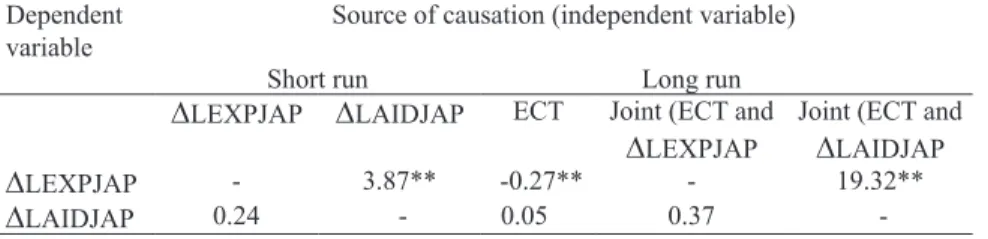
An important related issue that has also not been empirically investigated in previous research is the impact of other donors' ODA on Japan's exports. Thus, the ODA of other donors (eg DAC countries excluding Japan) may have a positive or negative impact on Japan's exports. Also, in both the short and long run, Japan's ODA has a positive effect on its exports and not the other way around.
They also argue that in order to maintain the stock of "goodwill", the donor must keep a constant flow of untied aid to the recipient. The study uses the gravity model of international trade (gravity model afterwards) to analyze, among other things, the impact of Japan's ODA on its exports to the recipients. In our empirical framework (ie, the gravity model) of this study, we control for two types of heterogeneous factors.
Thus, ODA variables (both Japan's disbursed aid and other major donors' (DAC) disbursed aid) are also included in the gravity model.
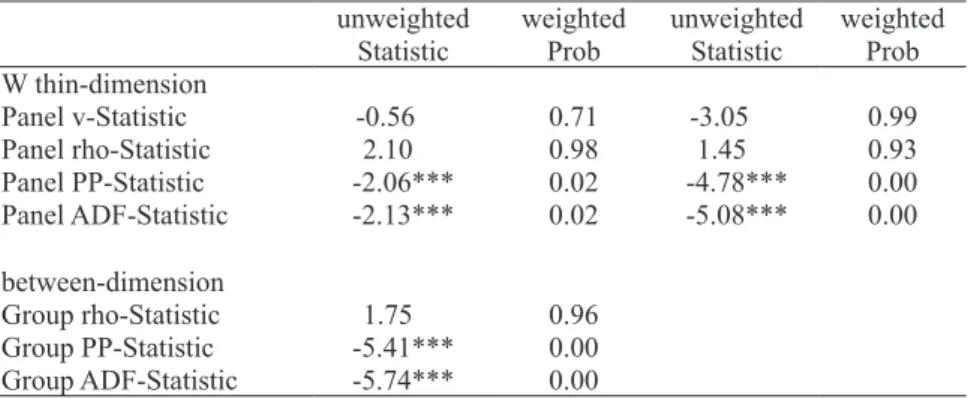
Econometric Methodology and Estimation Results 1 Unit Root Test
For Japan's export variable, the test statistic indicates that the variable is statistically significant at the 1% level and is therefore stationary. In the table, the estimated coefficients for the interaction terms of Japan's ODA with pre- and post-1992 dummies are almost the same and highly significant in the three techniques. This indicates that the long-run effects of Japan's ODA on Japan's exports are different between before and after 1992.
The estimation techniques suggest that the elasticities of Japan's ODA to its exports range between 0.18-0.20 and statistically significant at the 5% level. Thus, the estimates of the three techniques show that the elasticities of Japan's ODA to its exports range between 0.33-0.39 and statistically significant at the 1 percent level15. All three techniques suggest that the ODA elasticities of DAC on Japan's exports range between 0.34-0.37 and statistically significant at the 5% level.
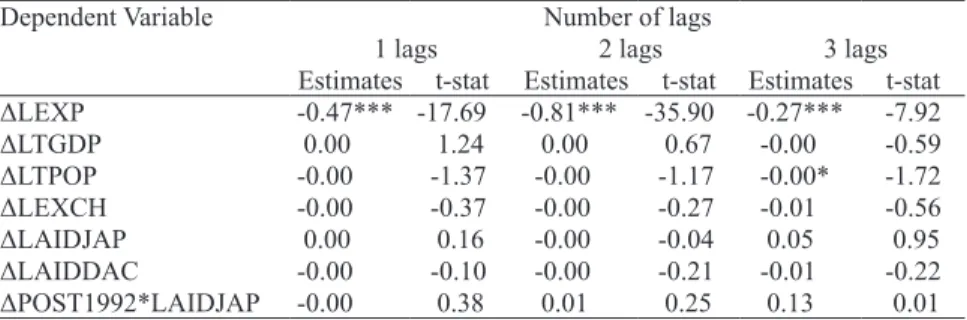
For the three error correction models with the first difference of Japanese exports as the dependent variable, the estimated coefficients of the lags of the equilibrium residuals are negative and statistically significant at the 1% level. Table (6) shows the estimated results of the panel causality tests between Japan's exports and ODA. The average short-term and long-term returns of Japan's ODA and other donors are calculated based on.
The estimated coefficients of the interaction terms of Japan's ODA with pre- and post-1992 dummies are almost similar and highly significant in all three techniques. This finding shows that the long-run effects of Japan's ODA on its exports are different between the periods before and after 1992. The three estimated coefficients of the techniques suggest that, in the long run, for every 10% increase in Japan's ODA to countries Asian countries, the expected growth is between 3.1% and 3.6% of Japan's exports to these countries.
In dollar terms, the estimated return for each US dollar of Japan's official development assistance ranges between $2.03 and $2.55. The previous estimated results show that there is strong evidence of long-run effects of Japan's ODA on its exports to Asian countries. For the short-run impact of Japan's ODA on its exports, the estimated coefficients show that a 10% increase in its ODA increases Japan's exports by 1.6% in techniques (1) and (2) and by 1.4% in technique (3 ).
These estimates are statistically significant at the 1% level. In dollar terms, the estimated return of US$1 of Japan's ODA spent varies between US$1.30-US$1.50. That is, an appreciation of the Japanese Yen relative to Asian currencies reduces Japan's exports to these countries.
Conclusion
Therefore, a higher total GDP means a higher Japanese income, which in turn indicates a higher level of its output (ie, more goods available for export); and/or the higher income of Asian countries, which in turn means a high demand for imported goods. Another consequence is that Japan's official development assistance raises the level of Asian countries' exports to a new and higher sustainable level in the long run. The above findings may be useful to Japanese development agencies and NGOs in lobbying for more ODA and promoting development in poor countries.
Therefore, the findings are important for those who have significant interests in understanding the impact of Japan's ODA on its economy. It also serves Japan's development agencies, NGOs and ODA lobby groups in campaigning and lobbying for increased ODA to promote development in poor countries. Our study's estimated results show that ODA from the other DAC countries improves Japan's exports to its recipient countries (i.e., positive impact).
It is possible that in the long run, Japan may have benefited from ODA-driven Asian development, in which the ODA of other DAC countries played an important role. Our findings are consistent with recent case studies (studies on German and Swiss ODA), which conclude that in both the short and long run, Japan's ODA contributes to its export growth rather than the other way around. We excluded in our analysis many African, Latin American, and Asian countries that are recipients of Japan's ODA.
The reason for this was that we needed to estimate data with an appropriate sample size (i.e. an appropriate time series and cross-sectional dimensions) for the econometric methodology and wanted to concentrate on Japan's most important trading partners (which happened to be the Asian countries). Despite this, we strongly recommend an expansion of this research by including most, if not all, countries that are recipients of Japan's ODA with the aim of examining both the short- and long-term effects of Japan's ODA on the recipient countries' exports. 3 The survey estimated that only 18% of Japanese people were willing to pay higher taxes in order to increase Japan's foreign aid to developing countries, which is the lowest among the countries surveyed (Public Opinion on Global Issues, 2012: 15).
9 It is important to mention that we estimated the unrestricted version of both models 3, 6 (i.e., models that do not equate the coefficients of GDPs and POPs for trading partners) and found that both unrestricted and restricted models yield the same estimates for the coefficients of the main variables of interest (ie, Japan's ODA and DAC's ODA). 15 The derivation of the t-statistics for the sum of coefficients on LAIDJAP and Post1992* LAIDJAP is not reported here, but available upon request. 1997) "Aid and Donor Exports: The Case of EU Countries", in: Essays on North-South Trade.