Democratization and National Integration:
Malay Muslim Community in Southern Thailand
W.K. Che Man*
Abstract: The present People’s Constitution of Thailand has moved the nation, to a certain degree, towards decentralization and self-government. Did this process of democratization help the process of national integration? It is argued that the participation of Malay Muslims of Southern Thailand in the Thai political system, nationally and locally, which leads to their gradual integration, has been partly due to the democratization process. In this case, democratization does not actually hinder the Thai government’s integration efforts; it facilitates the process of national integration.
Democracy is a form of government in which political power is regularly exercised by the people, and will ultimately lead to the establishment of “… a society of free and equal citizens; a society in which the worth of each individual is recognized and cherished; a society unmarked by special privilege of birth, wealth, or status.”1 Though a man-made system and hence could not be at par with a revealed system such as Islam, ideas inherent in democracy are to a degree in accord with the principles and values of Islam.
What is the impact of democratization on the process of national integration? National integration is defined as the process whereby all institutions such as social, educational, and recreational are made available to all members of the state, regardless of race, religion, and root, with the objective of forming a unified society within the jurisdiction of a unified nation-state. For Karl Deutsch, integration is
“a relationship among units in which they are mutually interdependent
∗Dr. W.K. Che Man is Associate Professor in the Department of Political Science, International Islamic University Malaysia. E-mail:[email protected] Vol. 11, No. 1, 1 - 26
-
2 INTELLECTUAL DISCOURSE, VOL 11, NO 1, 2003
and jointly produce system properties which they would separately lack.”2 Going by the definition, then, it is reasonable to assume that democratization, which requires some measure of decentralization, may facilitate national integration. This study examines the relationship between the process of democratization in Thailand and Thai government’s efforts at integrating the Malay Muslim minority community.
Malay Muslims in the South
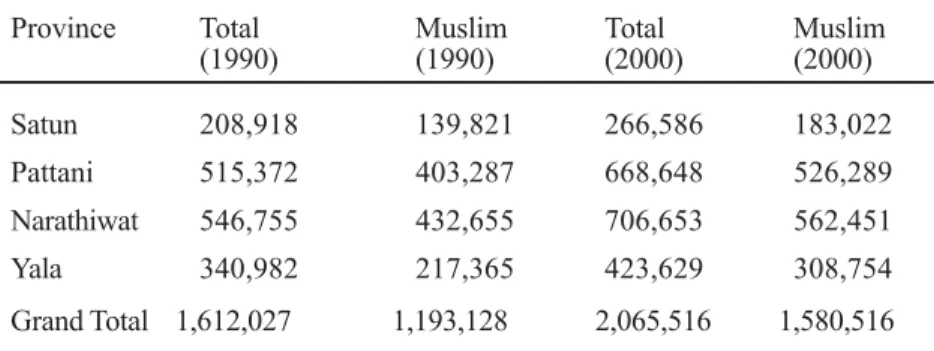
Malay Muslims are found in the four southern border provinces of Thailand. Table 1 shows their population for the years 1990 and 2000.
Table 1: Population of the Four Southern Border Provinces, 1990 & 2000
Province Total Muslim Total Muslim
(1990) (1990) (2000) (2000)
Satun 208,918 139,821 266,586 183,022
Pattani 515,372 403,287 668,648 526,289
Narathiwat 546,755 432,655 706,653 562,451
Yala 340,982 217,365 423,629 308,754
Grand Total 1,612,027 1,193,128 2,065,516 1,580,516 Source: National Statistical Office, Office of the Prime Minister, Bangkok, 1990 &
2000.
The Malay Muslim community, unlike other minority groups such as the Lan Na people in the north and the ethnic Lao community in the northeast, has somewhat strong resistance to national integration. There are essential elements of incompatibility between Malay Muslims and Thai Buddhists, which cannot be easily reconciled by the process of development and modernization. These incompatibilities include the historical reality of the existence of independent Malay kingdom of Patani (c.1457-1902) and the differences in culture, ethnicity, and religion, which are frequently used as “political and cultural markers”
to reinforce their claim to sub-national uniqueness.
The Malay Muslim community became an integral part of Thai nation-state because of the accident of colonial political history that forced the kingdom of Patani to be incorporated into it. The Malay
community, therefore, remains attached to specific geographical areas, the present five southern border provinces of Thailand. Certain groups of Malay Muslims even perceive separation as not only having a socio- historical logic, but also as being practical possibility, if they can obtain support from sympathetic states and organizations or if Thai central ruling institutions are weak or disintegrated.
One of the main reasons that makes the integration of ethnic minority community difficult has been the persistence of ethnicity. The broad process of modernization - the spread of market economy, increase of literacy and improved social communication - does not lead to a cultural diffusion that produces a homogeneous culture within a given territory.
As Clifford Geertz argued, modernization “does not do away with ethnocentrism, it merely modernizes it.”3 Indeed, modernization proves to be less helpful in lessening ethnocentrism. But, does democratization provide a positive explanation to ethnic tensions and national integration? This study attempts to answer this question.
Thailand’s Road to Democracy
Unlike most of the countries in Southeast Asia, Thailand had never been directly colonized. Like most of them, however, it could not escape the impact of Western influence. The Western principles and ideas have been effectively penetrating Thailand since the reign of King Chulalongkorn.4 The country’s first major political and military reforms took place in this period. But the road to democracy and political development did not actually begin until military leaders and civilian bureaucrats jointly staged the June 1932 revolution, which replaced centuries-old system of absolute king with constitutional monarchy.
The 1932 revolution, however, failed to provide a strong foundation for democracy. The two factions within the People’s Party that executed the revolution had their major political differences. The military faction, led by Phibun Songkhram, saw the institution of the armed forces, particularly the army, as the agent of modernization, and therefore playing a major role in nation-building. The civilian group led by Pridi Phanomyong favoured a mass party that derives its power from the people and viewed it as a prerequisite for promoting democratic environment. The civilians eventually conceded and helped lay the foundation for the military domination of Thai politics. Military coup d’etat became a regular feature of Thai Politics. Between 1932 to 1991,
-
4 INTELLECTUAL DISCOURSE, VOL 11, NO 1, 2003
Thailand witnessed 17 military coups and the promulgation of 15 constitutions. The coups were the mechanism for the military leaders to alternate in power, and the constitutions were the instruments used by the regime to secure legitimacy and remain in power. Political parties that emerged and elections that were held during the various military governments were not necessarily a sign of democracy in progress, but were commonly regarded as a measure by which the incumbent government sought to strengthen its position.
The strongest military domination in Thai politics occurred during the 1958-1973 period. This period was dominated by a five-year rule under the martial law of General Sarit Thanarat and a decade of arbitrary government of General Thanom Kitikhachorn. Although the two regimes seemed to stress on economic development and were able to provide the country with sound infrastructure, both were characterized as authoritarian, repressive, and corrupt. Therefore, there was a rising demand from the people for a genuine constitutional government. It reached its climax in 1973 when the National Student Centre of Thailand (NSCT) staged the massive student demonstration that toppled Thanom’s government and ended the era of military authoritarianism.
A caretaker government, headed by Sanya Thammasak, was established after the fall of Thanom’s regime. In 1975, a general election was held and M.R. Kukrit Pramoj became Prime Minister to head an elected civilian government. His government, however, lasted for ten months. The 1976 general election put Kukrit’s elder brother, M.R.
Seni Pramoj, as Prime Minister. Seni’s government was overthrown by the military after only six months in power. These two elected governments (1975-1976) were unable to solve national problems and internal conflicts through democratic and parliamentary processes.
Thailand’s constitutional governments known as “semi-democratic rule” were installed under the premierships of General Kriangsak Chammanan (1977-1980) and General Prem Tinsulanond (1980-1988).
The 1988 general election saw the emergence of an elected government led by Chartchai Choonhawan, a former general and a businessman.
Nevertheless, some critics characterized Chartchai’s government as
“plutocracy,” and when his second cabinet faced serious political crises, the military took the opportunity to stage a coup in February 1991.5
The 1992 people’s protest of the military rule, the bloodiest in the recent Thai history, was another indication that the Thai people were in no mood to tolerate the military’s strong hold on politics and power.
They appeared to have a strong determination to move towards democracy and political reform. Indeed, after the coup d’etat of 1991 and the people’s protest of 1992, all governments, under the premierships of Anand Panyarachun, Chuan Leekphai, Banharn Silapaarcha, or Chavalit Yongchaiyut, seemed to have agreed that it is time for Thailand to make a genuine political reform. The first step in this direction was the promulgation of a democratic constitution.
The People’s Constitution
The 16th Constitution of the Kingdom of Thailand, enacted on October 11, 1997, is generally regarded as more democratic than the 15 constitutions promulgated since the 1932 revolution. For the first time in the history of Thai politics, people were directly or indirectly involved in the process of Constitution making. Hence, it is known as the People’s Constitution. Its provisions deal with fundamental issues and problems that are essential for the promotion and establishment of a democratic government and society.
The Constitution was drafted by a Constituent Assembly formed in 1997. The Assembly consisted of ninety-nine members, knowledgeable and experienced in politics, political science, administration, or law.
The Constituent Assembly, through various mechanisms and committees, assessed the opinions of the Thai people concerning provisions and structure of the Constitution. It took the Constituent Assembly 231 days to complete its laborious task. In fact, the Thai people felt that this Constitution was truly of their making, and they expected to fully benefit from it. On August 15,1997, the draft constitution was submitted to the National Assembly for further consideration and approval.6 It was then presented to the King for His Royal assent. It was promulgated as the Constitution of the Kingdom of Thailand 1997 and was published in the Government Gazette, replacing the Constitution of 1991.
Some Provisions of the People’s Constitution
The 1997 Constitution contains many principal democratic principles and values not found in earlier constitutions. They include, for example,
-
6 INTELLECTUAL DISCOURSE, VOL 11, NO 1, 2003
such principles as: 1) promoting and protecting rights and liberties of the people; 2) providing for public participation in the governance; 3) inspecting the exercise of State power; and 4) improving political structure and local government to achieve more efficiency and stability.
These provisions are not theoretical in nature as were the case in previous constitutions, but are meant to be practiced in every sense of the word.
This Constitution comprises 335 sections and are divided into 12 chapters. Some of these provisions may be termed “conventional” in the sense that they are commonly found in any constitutions of a democratic country. Some of these “conventional” provisions include:
(1) declaration of Thailand as a democratic “government with the King as Head of the State” (section 2); the protection of “the human dignity, right and liberty of the people” (section 4); and, (3) assurance that “a person shall enjoy academic freedom” (section 42).
There are also provisions that may be termed “unconventional” in that these are less common and intended to realize certain objectives.
These provisions include, among others: the “duty” of every individual
“to exercise his or her right to vote in an election” (Section 68); the right of a person with at least a Bachelor’s degree “to be a candidate in an election to the House of Representatives” (Section 107); and, ineligibility of a person who is a member or office-holder of a political party “to be a candidate in an election to the Senate” (Section 126).7
Section 68 is meant to curtail election frauds and malpractices. The assumption is that the higher the turn-out rate, the more difficult it would be for vote-buying or other forms of electoral malpractices.
Section 107 (3) is to ensure that members of the National Assembly are educated and knowledgeable to be able to make reasonable choices.
Whereas, the main aim of section 126 (1) is to uphold the impartiality of members of the Senate and thus to ensure that members vote on a non-partisan basis.
There are at least forty sections of the provisions pertaining to the rights and liberties of the people recognized by this Constitution. They cover various major aspects of the subject. In addition, the National Human Rights Commission provided by the Constitution has the power and duty to examine and report acts that violate human rights and propose appropriate remedial measures.
As for the purpose of giving the Thai people the opportunity to participate in the process of governance, the Constitution provides many channels. Political institutions, such as a political party and the National Assembly are among them. The present Constitution provides the Thai people with more flexible rules to form a political party than the previous constitutions. In the general election held in January 2001, for example, thirty-seven political parties nominated candidates for public offices. Twenty-eight of them were new parties contesting in the election for the first time.
The National Assembly consists of the House of Representatives with five hundred and the Senate with two hundred elected members.
For the first time in the history of Thailand, members of both Houses are elected directly by the people. Previously, the incumbent Prime Minister appointed members of the Senate, and high-ranking military and civilian officials dominated it. The present change, from appointed to elected senators, is intended not only to inject another democratic principle into the system of governance, but also to increase the channels for public participation.
In the election of senators, the area of a province (changwat) is regarded as one constituency. The number of senators from each province is determined by the ratio of the number of inhabitants of the respective province in reference to the division of the number of inhabitants throughout the country by two hundred, the number of members of the Senate. At present, the ratio is about 310,000 inhabitants per senator.
The election of members of the House of Representatives is, also for the first time, divided into two categories: election on constituency basis and on party-list basis. Hence, for the five hundred members of the House of Representatives, four hundred of them are elected on constituency basis and the remaining one hundred on party-list basis.
In the election on a constituency basis, each constituency represents one member of the Lower House. Presently, the ratio is about 155,000 inhabitants per member of the Lower House.
In the election on the party-list basis, each political party may prepare one list which contains, in numerical order, names of not more than one hundred candidates. The number of candidates elected on the list will be determined by the proportion of votes received by the party-
-
8 INTELLECTUAL DISCOURSE, VOL 11, NO 1, 2003
list of each political party from the total votes cast throughout the country. However, no candidate listed therein is elected if the party- list of any political party receive votes of less than five percent of the total number of votes throughout the country.
Another channel of participation in the governing process provided by the new Constitution is that the people are given the right to lodge a complaint to the Senate in order to request it to pass a resolution removing from office the persons such as Prime Minister, Minister, members of the Upper and Lower Houses, and President of the Supreme Court of Justice for gross misconduct. However, such a request needs at least fifty thousand qualified voters’ signatures and clearly itemized circumstances in which such persons have allegedly committed the illegal act.
Other provisions emphasized by the People’s Constitution are the inspection of the exercise of State power. The main objective is to ensure transparency and honesty among those who hold important political and administrative positions in the government and those members of the legislative body. The essential institutions and independent organs established for the purpose include the Senate, the National Counter Corruption Commission (NCCC), the Constitutional Court (CC), and the Administrative Court (AC). The methods of achieving it are declaration of accounts showing particulars of assets and liabilities of the said position holders and the removal from office of the one who is found guilty of corruption and malfeasance.
There were two well-known cases that were prosecuted by both the NCCC and the CC in relation to false declaration of assets and liabilities of the position holders. The first was the case of the then Minister of the Interior under the Chuan government, Major General (retired) Sanan Kachornprasat, who was found guilty as charged by both the NCCC and the CC. The guilty verdict immediately disqualified General Sanan from holding his portfolio as the Interior Minister of Thailand. The second was the case of the present Prime Minister, Dr.
Thaksin Shinawat, who was found not guilty by the final judgment of the CC. Although the verdict was by a very narrow margin, eight to seven, it did not affect his position as Prime Minister.
Lastly, the focus of the provisions of this Constitution is also on
decentralization and local government. Section 284, for example, elaborates that “All local government organizations shall enjoy autonomy in laying down policies for their governance, administration, personnel administration, finance and shall have powers and duties particularly on their own part.” In comparison with the previous constitutions, the People’s Constitution takes the opposite direction in the matter. It departs from highly centralized governments in the past to virtual local self-government in the future. However, the promotion of self-government must be subject to section 1 of the Constitution that declares, “Thailand is one and indivisible Kingdom.”
In the final analysis, there are several reasons why the majority of the Thai people see the present Constitution as the People’s Constitution.
First, it is considered as made by the people and meant for the people.
Second, it is regarded as the most democratic constitution ever promulgated in the Kingdom to date. Third, it is looked upon as the basis for political and social change that could bring stability, development, and prosperity to the nation.
Thai Integration Efforts and Malay Muslim Resistance Since the beginning of the 20th century, King Chulalongkorn had gradually incorporated into Siam8 the Malay kingdom of Patani, which was then divided into seven states, namely, Patani, Saiburi, Nongchik, Yaring, Yala, Raman, and Ra-ngae. This Malay sultanate was at the time claimed by Siam or Thailand as its tributary state that required the sending of “Flowers of Gold and Silver” (Bunga Mas dan Perak) to the Thai king every two and a half years.
The first step towards the concerted efforts of Thai integration was to replace the Malay Muslim rulers (sultan and raja) with Thai governors and high-level Malay administrators with Thai bureaucrats appointed by the newly created Ministry of Interior in Bangkok. The sultans and rajas of the seven states regarded Bangkok’s attempts as political encroachment and refused to concede their power as Malay rulers. Collectively, they ordered their subordinates to boycott all meetings and transactions with Thai authorities and directed the newly assigned Thai bureaucrats in the Malay Muslim areas not to perform their official duties. Joining the Malay rulers and the aristocrats in resisting Thai integration efforts were the Malay Muslim religious leaders
INTELLECTUAL DISCOURSE. VOL 11. NO 1, 2003
10
(cuJamii:» who believed that the Muslims' submission to an infidel regime without resistance was not permissible in Islam.
m addition, the Malay nobility appealed to the British Governor of the Straits Settlements in Singapore for British intervention on the matter. Unfortunately, Britain chose to ignore the Patani political tragedy. Failure to obtain help from Britain, among others, contributed to the success of Thai initial integration of the Patani region. The Malay rulers were deposed, and all political, social, and administrative
functions of the seven Malay states were gradually transferred to the Thai authorities and bureaucrats.
The second effective integration measure taken by Bangkok was the replacement of the shari cab and cidat (Islamic and customary) laws with Thai laws, except in matters concerning marriage and inheritance. This measure stirred the feelings of Malay Muslims in general, for every religiously-committed Muslim regards the shari cab and cidat laws as "the axis of his whole existence."9 Thus, some of those who had the means, chose to leave the region and settled in neighbouring Malay states such as Kelantan, Kedah, Perlis, and Terengganu. Some even migrated to Saudi Arabia and other Muslim countries.
The third major step towards the integration of the Malay Muslim community was the promulgation of Thai Compulsory Primary Education Act in 1921. The Muslims viewed the Act as an attempt to stamp out their culture and religion. To them, it was important that their young children exposed to no other teachings than that of Islam.
In reaction to the Act, former Malay nobility and some religious leaders ordered the Muslim villagers of Ban Namsai, Mayo district, Pattani province not to pay taxes to the Thai government. to Serious protest demonstrations took place in 1922 and substantial Thai forces were deployed to restore law and order in the country.
In 1923, the Thai government reassessed its authoritarian policy towards Patani in an effort to lessen conflicts in the area. It was perceived that there was a real threat of losing Patani to Britain if policies for political and cultural integration of the Malay Muslims were carried out indiscriminately. New guidelines for dealing with the Muslims were issued to redress some of the government regulations and practices that appeared inconsistent with Islam and Malay culture.
Taxation of the Malay villagers was also reduced. More importantly, the government’s approach of cultivating political loyalties was through democratization and political participation, particularly after the country promulgated its constitutional monarchy in 1932.
The Malay Muslims correspondingly matched this less vigorous pursuit of political and cultural integration by the Thai authority from 1923-38 with a less forceful resistance. In fact, it gradually created a sense of national solidarity among the Malay Muslims. Some Muslim leaders believed that they could gain concessions from the Thai government and maintain their Muslim identity by participating in the existing system, while others sought to buy time until their bargaining power increased. The Patani leaders were also aware that they could no longer depend on the support of their Malay Muslim “brothers” in the northern states of Malaya such as Kedah, Kelantan, Perlis, and Trengganu. This was due to the political control exercised by the British over them. Moreover, Tengku Abdul Kadir Qamaruddin (the deposed ruler of Patani), who, since 1915, had been the central figure in rallying support for Patani resistance, died in 1933.
Under the ultra-nationalist government of Phibun Songkhram from 1938-44, the relative peaceful situation in the Patani area and the increased sense of national loyalty among the Patani people ended. In 1939 the Phibun government promulgated the Thai Custom Decree in an attempt to change the cultural practices of the minority communities and to refashion the social habits of the entire population. Under this decree, the Malay Muslims were forbidden to wear traditional Malay dress, to use the Malay language, and to practice certain aspects of Islam.11
This policy of forced integration resulted in a widespread resentment among the Patani Muslims. Tengku Mahmud Mahyuddin, the youngest son of Tengku Abdul Kadir, carried on his father’s struggle by organizing a movement in Malaya. It was known as Gabungan Melayu Patani Raya (GAMPAR) or the Association of Malays of Greater Patani.
GAMPAR’s main objective was to strive for irredentism of Patani with the Malay states in the Peninsula. At about the same time, Haji Sulong bin Abdul Kadir, a renowned religious teacher, also organized the Patani People’s Movement (PPM) in Patani. Both GAMPAR and PPM have been regarded as the founding organizations, which initiated the Patani Muslims to organize a movement that has persisted to the present day.
-
12 INTELLECTUAL DISCOURSE, VOL 11, NO 1, 2003
The compulsory education policy initiated in 1921 and the forced cultural integration programme of 1939 failed to substantially promote the spread of Thai education and culture among Malay Muslims.
Realizing this failure, the Bangkok government under Field Marshal Sarit Thanarat initiated in 1961 a programme of “educational improvement” in the Muslim provinces of Narathiwat, Pattani, Satun, and Yala. The main objective was to transform the traditional Muslim religious schools (pondok) to government-controlled private Islamic schools.
Historically, pondok had played an important role in Islamic education before the Patani region was incorporated into Thailand. In fact, Patani was considered as the most important area in the Malay Peninsula for religious education and scholarship in the late nineteenth and early twentieth centuries.12 Pondok was once the most popular educational institution in the region. They provided the Muslims with knowledge of Islam, which every Muslim is required to learn. The pondok produced religious scholars who were influential and respected within the Patani Muslim society.
With Sarit’s educational improvement programme, all pondoks were required to register and teach a standard government-designed curriculum with Thai language as the medium of instruction. Religious subjects were allowed, but they had to conform to the requirements of the Education Ministry. In 1971, there were a total of 535 pondok in the region. One hundred and nine pondoks failed to comply with the government policy and ceased to exist.13
The replacement of traditional pondok with private Islamic schools had a major impact on Muslim education in the four provinces. Most Islamic schools have been unable to raise the standard of their secular curriculum comparable to that of Thai public schools. In religious subjects, they have lost much of their academic strength. Moreover, students have to pay school fees for both secular and religious education, which in many cases cost more than that charged by the public schools.
The government accelerated its efforts to increase the number of public schools in the Malay Muslim provinces. Private Islamic schools decreased from 535 to 426 in 1971 and to 189 in 1991. In contrast, there were 1,218 Thai public schools in the area, a university, a teacher- training college, and a number of vocational schools.14 Nearly every
village has a primary school and every district has a secondary school.
The decline in number of private Islamic schools in the four southern border provinces was expected. Some of them were unable to meet the requirement of the ever-increasing number of rules set by the Thai government. Others have lost essential characteristics as centres of religious scholarship. Many owners of Islamic schools had difficulties in obtaining funds needed to cover the expenses of operating a school.
However, there are several large Islamic schools, which were successfully upgraded to a foundation in order to secure government financial assistance, though it means more assertion of control by the government.
In sum, the transformation of traditional pondoks to private Islamic schools can be viewed as the final stage of Bangkok’s efforts to neutralize the role of pondok, which has been seen as an obstacle to the process of national integration. With the introduction of a secular curriculum and Thai teachers in the existing Islamic schools, Thai values and culture have been diffused into the Malay Muslim community.
Although Islamic religious schools in the region continue to persist, they may not be able to provide the “cultural fortification” and religious scholarship for the Malay Muslims as the pondok once did.
In addition to its educational programme, the Sarit government started the so-called “Self-Help Settlement Project” to redress the population imbalance between Thai Buddhists and Malay Muslims in the Patani region. Under this project, Thai Buddhists from outside the area were encouraged to migrate to the four Muslim provinces by providing each family with 7-10 acres of land to settle. The Thai government’s target is to make the Malay Muslims a minority population within their own provinces.
The Malay Muslims met each step of vigorous pursuit of political and cultural integration mentioned-above with different forms of resistance, both violent and peaceful. One thing for sure, each time the Thai central government lessened its efforts of political and cultural suppression and moved towards a certain degree of democratization, such as holding elections and allowing political participation, Thai Muslim response was less resistant and indicated a sense of national belonging among the Muslims. Until today, however, resistance of various forms against the Thai authorities remains. The more serious
14 INTELLECTUAL DISCOURSE, VOL 11, NO 1, 2003
one is in the fonD of an organized liberation movement.
History of the Malay Muslim Resistance Movement
Since the establishment of GAMPAR in Malaya by Tengku Mahmud Mayuddin and of PPM in Patani by Haji Sulong Abdul Kadir after the Second World War, several Malay Muslim-organized liberation fronts have emerged in the region. Unlike GAMPAR, their main objective was no longer to fight for irredentism with the Malay states of Malaya, which were at the time under the political control of Britain, but to obtain an independent status for Pat ani.
Perhaps, Islam and nationalism played a pivotal role in making the Patani religious-oriented nationalists and xenophobes to fight for full independence. For them, the primary concern of Islam is that Muslims must strive for the betterment of life, particularly when they are in an underprivileged position. Therefore, those who are fighting for freedom or self-determination are regarded as striving in the cause of Islam. In addition, some Western political ideas and codes of law are viewed as inconsistent with the sharlah. Thus, their struggle is also to preserve Islam by re-establishing a community based on the sharlcah, which they consider to be a divine commandment that cannot be disobeyed.ls
There are at least eight Malay Muslim resistance groups cmently active in the five southern border provinces of Thailand. They are:
Barisan Islam Pembebasan Patani (Islamic Liberation Front of Patani- BIPP); Barisan Revolusi Nasional (National Liberation Front-BRN);
Patani United Liberation Organization (PULa); Barisan Revolusi Nasional-Kongres (National Revolutionary Front-Congress-BRN-K);
Gerakan Mujahidin Pat ani (Pat ani Mujahidin Movement-GMP);
Gerakan Ulama Patani (patani Ulama Movement-GUP); and Gerakan Mujahidin Islam Patani (patani Islamic Mujahidin Movement-GMIP).
In 1991, a united front called Barisan Bersatu Kemerdekaan Patani (United Fronts for Patani Independence-Bersatu) was formed to serve as an umbrella organization for the fIrst six fronts mentioned above. In recent years, Bersatu has repeatedly been accused by the Thai government for many violent incidents that took place in the Muslim provinces.
Although the fronts differ in many ways -ideology, strategy, and membership composition -they all view the Thai government as a
colonial power and stress armed struggle to achieve independence.
From 1970-1975, the fronts' guerrilla operations were very active.
Muslim villagers who lived within their spheres of influence in the provinces of Narathiwat, Patani, and Ya1a were directly or indirectly involved in the activities of the fronts. The villagers were reminded by the fronts of their obligation to be involved in the struggle and they cited the iJadlth narrated by Abl Sa'ld al-Khudrl, that says, "The best of the believers is he who fights in the cause of Allah with his wealth and his life."'6
During the period of Malay Muslim active resistance (1968-75), the Thai government launched a series of military operations, involving military, police, and voluntary forces. According to the government statistics, the results were as follows: 385 clashes with Muslim resistance groups; 329 Muslims dead; 165 surrendered to Thai authorities; 1208 arrested; 1546 weapons of different types confiscated; 250 camps destroyed. 17
The Thai government has used different schemes, both by force and persuasion, to neutralize the Muslim separatist activities. The responsibility of counter-insurgency seems to rest mainly in the hands of the Fourth Army Region and the Administrative Centre for the Administration of Southern Border Provinces. IS Apart from the usual armed counter-insurgency, the two institutions have attempted to persuade the Muslim separatists to surrender to the Thai authorities by using two main approaches: direct negotiation and individual persuasion.
The direct negotiation approach has been somewhat successful in that there have been groups of Patani Muslims surrendering to the Thai authorities from time to time. However, most of those who surrendered were not actually members of the fronts; many of them were common criminals or those who were dismissed by the fronts. In the case of the individual persuasion approach, the authorities usually rely on Muslim officials and leaders to persuade members and leaders of the fronts to return to the fold of the authorities. The persuasion method seems to be less successful. This is because the fronts believe that the Muslim government officials and leaders have no actual power to keep the promises they made and that they play such roles only for their own personal gains.
-
16 INTELLECTUAL DISCOURSE, VOL 11, NO 1, 2003
Nevertheless, the Malay Muslim resistance movement has not shown very impressive records. This is due to the fact that the strengths of fronts seem to depend more upon ethnicity and religious motivation than upon the principles of effective organization. Secondly, the fronts have been unable to develop their international contacts effectively.
Thirdly, the resistance movement of the Malay Muslims in Southern Thailand has carried out a struggle against all odds. Thailand has not only been a strong state but also a state with lengthy experience in dealing with minority communities. Although the Malay Muslim movement in the Patani region has not been able to pose a serious threat to the Thai government, it continues to persist. This is because the movement is motivated by ethnicity, religion, and history, which cannot simply be removed by improving the socio-economic condition of the people.
Democratization and Malay Muslim Participation
In 1980, the newly appointed Prime Minister of Thailand, General Prem Tinsulanond, initiated a democratically-inclined policy known as
“Politics Leading Military” in an attempt to cope with armed insurgencies in the country, particularly the threat of the Communist Party of Thailand (CPT). The order No. 66/23 issued to provide the policy guidelines is as follows:
1. Politics must lead military in an effort to fight against the Communists and other armed insurgencies.
2. Policy of Politics Leading Military must be employed indiscriminately to avoid the people’s war.
3. Armed counter-insurgencies must be changed to peaceful methods.
In 1981, Lt. Gen. Han Linanond, Commander of the Fourth Army Region, extended the new policy to the five southern border provinces by issuing order No. 751/2524 that formed a policy called “Peaceful South” designed specifically to coordinate various government agencies to work for peace and stability in the area. In order to implement this policy effectively, the Administrative Centre for Administration of Southern Border Provinces was created. At the same time, a joint force known as “Civilian-Police-Military 43” (CPM 43)19 was organized to function as a security force against separatist activities in the Muslim
provinces.
The government of Chartchai Chunhawan upgraded the policy of Peaceful South and implemented it from 1988 to 1993. The essence of the policy was to promote social harmony by allowing religious and cultural practices of the Muslims more freely. Likewise, the Chuan Leekphai’s cabinet continued the policy to 1998 and in addition stressed economic development in the Muslim community.
Moreover, Gen. Chavalit Yongchaiyut, who saw the Muslim problem in the south as serious and should be treated with attention, formulated a policy to be directly executed by the Fourth Army Region. Using the Malay name, Harapan Baru (New Aspiration), Chavalit’s policy attempted to implement the following objectives:
1. To develop quality of life of the people in the Muslim provinces and to raise their democratic consciousness and confidence to enable them to live in harmony locally and nationally;
2. To promote unity among the different ethnic groups and to reduce suspicions and distrust between government officials and the local people; and
3. To preserve local culture and to encourage the people to participate in resolving local problems.
To be in line with the intention of the People’s Constitution, the Office of the National Security Council formulated the latest national security policies for the Southern Border Provinces to be used as the framework and guidance to tackle problems of the region. The main objectives of the policy, which are to be implemented during the years 1999 to 2003, are as follows:
i. To develop the potential of the people and of the society both in public and private sectors and to create awareness and readiness for adaptation based on identity and way of life of the people within the area;
ii. To develop the participation of all parties in the five provinces by allowing the people to take part in development and problem solving in order to avoid conflict and to bring about peace and stability.20
However, the Thai government needs an efficient and integrated
-
18 INTELLECTUAL DISCOURSE, VOL 11, NO 1, 2003
administration. In order to translate policy into practice, it must have clear implementation assignments, supportive implementation plans, implementation priority, mobilization of thoughts, and coordination of all parties in the area. The success of this current policy depends also on the degree of cooperation between the Muslims and the government agencies. The public sector must act as a core mechanism of the policy implementation and must attract the people to participate in problem solving. This would help the government to lessen the security problems, particularly separatist problem, and thus creating a more stable and prosperous society as intended.21
In sum, all the above mentioned policies are inclined towards democratization and cultural diversity and it is a continuous effort to integrate the Malay Muslim community and to encourage Muslims to participate in the Thai political system. Thus, it is hoped that the Muslim separatist movement would be defeated through peaceful means.
Political Participation of the Malay Muslims
With the Thai government policy of democratization, many Malay Muslim leaders in the four provinces have chosen to work for changes within the existing Thai system as opposed to take action aimed at independence or separation. Some of them have decided to participate in the political activities of the country. They believe that they could gain certain political concessions and bargaining powers, while maintaining the identity of the Muslim community. Their decision to participate in Thai political system and elections is also based on their previous experience in the national parliamentary election in1976. In this general election, Muslim candidates from Democratic Party won all 8 parliamentary seats allocated to the four Muslim provinces of Patani (3), Narathiwat (3), Yala (1) and Satun (1).
The historic winning of Muslim candidates in this parliamentary election was due to two main events. First, the murder of five Muslim youths, allegedly by Thai soldiers, in December 1975, sparked the largest demonstration in the history of the area. Thousands of Muslims gathered at the Patani Central Mosque each day for 45 consecutive days. At least 25 Muslims were killed and some 40 injured during the demonstration, again allegedly by Thai armed forces.22 Second, it was the general political awareness of the Muslims during the three-year
(1973-1976) interlude of democracy after the fall of Thanom-Prphat’s military regime.
Since the Muslim candidates in the four provinces captured all parliamentary seats and they were all from the Democratic Party, the coalition government headed by the Democratic Party appointed a Muslim MP for Narathiwat province, Sidik Sharif, as Deputy Minister of Education.23 The appointment of a Muslim minister was made for the first time in the recent history of Thailand.
After the October 6, 1976 coup d’etat, Malay Muslims were discouraged by political instability of the country. When the general elections were held in 1979, they participated in it with less enthusiasm and vigour while the non-Muslims competed with an expectation to regain some of their lost seats in the area. As a result, non-Muslim candidates won only three out of nine parliamentary seats in their four provinces.
After the implementation of the policy of “Politics Leading Military”
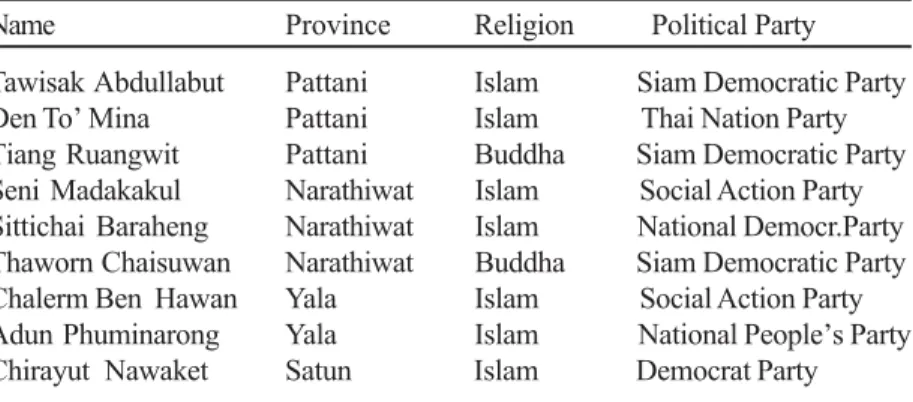
in 1981, which increased the level of democratization in the Muslim area, the Muslims in general were once more willing to participate in the 1983 national election with enthusiasm and optimism. Unlike the 1976 election, this time the Muslim candidates for Parliamentary seats did not have similar political direction in the sense that they joined different political parties and competed among themselves. The result of the election is shown in Table 2. Although the Malay Muslims won seven out of nine parliamentary seats in the four provinces, they failed to gain any important political position in the government headed by Prem Tinsulanond. This was because they were not united as a single political force, but rather scattered over six different political parties.
The above political lesson caused Muslim politicians find a way to unite and weld Muslim population in the four provinces into a stronger political force. On March 8 and May 6, 1986, two meetings among Muslim politicians and Muslim leaders in the area were held. The meetings decided to form a Muslim political affiliation known as Wahdah (Unity). A 12-member committee was created to run the newly formed political group, and Den To’mina, MP for Pattani, was elected its chairman. The committee members and other Muslim leaders agreed on the following six objectives of Wahdah:
1. To forge unity among Muslims in Thailand;
-
20 INTELLECTUAL DISCOURSE, VOL 11, NO 1, 2003
2. To preserve the rights and interests of Muslims;
3. To develop Muslim community in political, economic, educational, and social aspects;
4. To implant correct political consciousness among Muslims;
5. To introduce Islamic system and to make Muslims understand and practice it; and
6. To promote and develop a democratic system.24
Table 2: Winners of the 1983 General Election in the Four Southern Provinces
Tawisak Abdullabut Pattani Islam Siam Democratic Party Den To’ Mina Pattani Islam Thai Nation Party Tiang Ruangwit Pattani Buddha Siam Democratic Party Seni Madakakul Narathiwat Islam Social Action Party Sittichai Baraheng Narathiwat Islam National Democr.Party Thaworn Chaisuwan Narathiwat Buddha Siam Democratic Party Chalerm Ben Hawan Yala Islam Social Action Party Adun Phuminarong Yala Islam National People’s Party Chirayut Nawaket Satun Islam Democrat Party Source: Che Ma Che Omar Chapakia, “Thai Politics and Reaction of Muslim Society in Southern Thailand 1932-1994” (Ph.D. thesis, Department of History, University of Malaya, 1997), 297.
On May 8, 1986, leaders of Wahdah met and discussed the matters concerning the general election scheduled on the July 27, 1986. One of the important decisions made in this meeting was that the Wahdah’s candidates must choose Democratic Party as their official political party in the coming 1986 election.25 The Wahdah’s choice for Democratic Party caused three of its committee members to withdraw from it. The three were MPs of other political parties.
In the 1986 general election, Wahdah placed eight candidates to contest under the Democratic Party for nine parliamentary seats in the Muslim provinces. Five of its candidates including two non-Muslims won the election; those three MPs who withdrew from Wahdah were re-elected in their respective provinces; and a veteran Muslim politician, Adun Phuminarong won in Yala. These four Muslim winners, however, contested under four different political parties. When Wahdah realized
Name Province Religion Political Party
that the head of Democratic Party, Phichai Rattakun, failed to submit any names of its MPs to be appointed to one of the political positions in the government, it decided to withdraw its MPs from the Democratic Party. The Wahdah’s MPs together with former Secretary General of the Democratic Party, Vira Musikaphong, formed a new political party called People’s Party (Pak Prachachon).
In facing the general election of March 22, 1992, the Wahdah group joined the newly formed New Aspiration Party (Pak Kwanwang Mai), headed by General Chavalit Yungchaiyut. This decision was made because leaders of Wahdah saw Chavalit as one of the Thai politicians who were willing to work for the development of the Muslim community in the south. The Wahdah group was able to capture seven out of ten parliamentary seats in the four provinces. Muslims who were not in the Wahdah group won the rest of the seats. Since the New Aspiration Party failed to be part of the coalition government after the 1992 general election, the Wahdah MPs, who were members of the New Aspiration Party, also became the opposition.
In the general election held on September 13, 1992, the Wahdah MPs and its newcomers under the ticket of New Aspiration Party faced a strong competition from Muslim candidates who were members and supporters of the Democratic Party. The outcome of the election in the four Muslim provinces was that the Wahdah group won six parliamentary seats, while the Muslim candidates from the Democratic Party won the remaining four seats. The Democratic Party headed by Chuan Leekphai won 69 of the total 376 seats in the Parliament. Since it won more seats than the rest of political parties contested in this election, the Democratic Party was given the opportunity to form and lead a coalition government. This time the New Aspiration Party was included in the government headed by Chuan Leekphai.
Den To’ Mina, a Wahdah MP from the New Aspiration Party was appointed Deputy Minister of Interior, while Dr. Surin Pitsuwan, a Muslim MP for Nakornsrithamrat province from the Democratic Party, was given a post of Deputy Minister of Foreign Affairs. Another Muslim MP from Yala belonging to the Wahdah group, Wan Mohammad Noor Matha, was appointed Deputy Speaker of Parliament. Both Wan Mohammad and Surin were later promoted to Speaker of Parliament and Minister of Foreign Affairs, respectively. For the first time in the modern history of Thailand, Muslims held the said two important
-
22 INTELLECTUAL DISCOURSE, VOL 11, NO 1, 2003
political positions. The Malay Muslims also dominated politics at the local level. During the 1991-1995 periods, for example, 76 out of 86 members of Provincial Assembly in the three southern most provinces were Muslims.
The latest general election was held on January 6, 2001 under the provisions of the People’s Constitution. Out of 13 constituencies in the four provinces, Muslims won twelve seats. Non-Muslims won only one seat in Yala province.
Among the twelve Muslim MPs, six were from the Wahdah group.
In the present cabinet headed by Prime Minister Taksin Shinawat of the Thairakthai Party, Wan Mohammad Noor Matha, former Speaker and one of the Wahdah leaders, was given the portfolio of Minister of Communication and later Minister of Interior.
In addition to the parliamentary seats, the People’s Constitution required that the qualified voters of each province elect their members to the Senate. The first senatorial election was held on March 4, 2000.
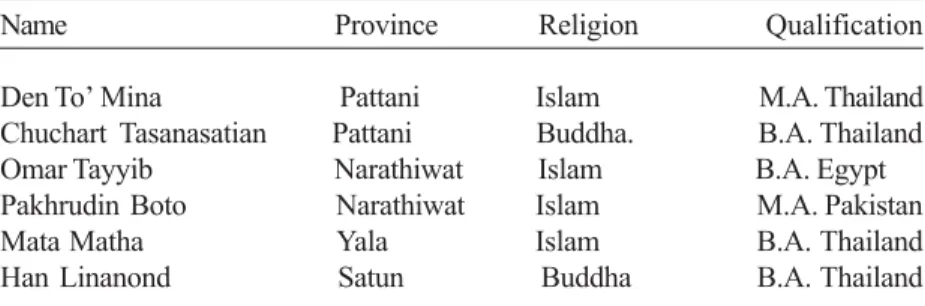
The results of the election in the four Muslim provinces are shown in Table 4. As expected, four Muslim Malay leaders, Den To’ Mina, Omar Tayyib, Pakhrudin Boto, and Mata Matha were elected. The other two seats were captured by Buddhist candidates.
Table 4: Elected Senators in the Four Southern Province for a Six-Year Term, 2000- 2006
Name Province Religion Qualification
Den To’ Mina Pattani Islam M.A. Thailand Chuchart Tasanasatian Pattani Buddha. B.A. Thailand Omar Tayyib Narathiwat Islam B.A. Egypt Pakhrudin Boto Narathiwat Islam M.A. Pakistan Mata Matha Yala Islam B.A. Thailand Han Linanond Satun Buddha B.A. Thailand Source: Week-end Matichon, March 7, 2000, pp. 9-10.
The above account of Muslim participation in the existing Thai political system suggests that a majority of the Malay Muslims in the four southern border provinces are willing to be politically integrated into the Thai nation-state. It is also a clear that a majority of the
central authorities and Thai people accept Muslim political participation.
In other words, there exists mutual reciprocity, although both sides remain cautious. Moreover, Muslim politicians at national and local levels have been able, in their different capacities, to contribute to the development of the Muslim community. If this political participation of the Malay Muslims continues, it could facilitate directly or indirectly the process of national integration.
Conclusion
The history of Thailand’s national integration efforts towards the Malay Muslims in the southern border area indicates that when the central government applied policies of integration that were more authoritarian in nature, such as forced cultural assimilation policy during 1923-1938 and compulsory Thai primary education act of 1921, the results were less successful. On the contrary, when the integration policies were more democratically oriented, such as the government’s approach of cultivating political loyalties through democratization and political participation after the 1932 revolution, the effects were more fruitful.
As the road of Thai democracy was slowly being built, various minority communities, particularly in the northern and the north-eastern regions, have gradually been integrated into the Thai nation-state. The Malay Muslim community, however, has remained partially integrated.
This is partly due to two reasons. First, the Thai government integration policies towards Malay Muslims before 1981 were essentially based on suppression and forced assimilation. Second, ethnic consciousness and solidarity among the Malay Muslims persist because the area of the four southern border provinces coincides with well-defined boundaries of communal culture, religion, language, and historical origin.
Beginning 1981, the central government changed its integration policies in the area from coercion and assimilation to cooperation and decentralization. This change was the turning point. The majority of the Malay Muslims began to response positively to the government policies and programs. Many Muslim leaders agreed to work for change within the Thai system by participating in national and local elections.
They were able to gain certain political and bargaining powers, which enabled them in different capacities, to help and develop their
-
24 INTELLECTUAL DISCOURSE, VOL 11, NO 1, 2003
community.
Moreover, many members of the Muslim separatist groups were attracted to the government’s amnesty programs, and some of them surrendered and returned to the fold of the law. Several separatist fronts also began to shift their position from armed struggle to political negotiation.
With the promulgation of the People’s Constitution in 1997, minority communities were gaining more political power and privileges, particularly under Section 284 of the Constitution mentioned earlier.
This means that those minority groups, including the Malay Muslims, who seek to gain political concessions and bargaining powers from the Thai government, would be more willing to participate and to be integrated into the Thai nation-state.
In the case of the Malay Muslims in Southern Thailand, their participation within the system, which leads to their gradual integration, has been partly due to the democratization process. In the case of Malay Muslims, democratization does not actually hinder the government integration efforts. Instead, one could safely say that democratization has facilitated the process of national integration.
Notes
1. Encyclopedia International, vol. 5, 1968, 522.
2. Karl W. Deutsch, The Analysis of the International Relations (London: Prentice- Hall International, 1988), 212.
3. Clifford Geertz, ed., Old Societies and New States (New York: The Free Press, 1963), 154.
4. All Thai names are spelled in accordance with Thai pronunciation.
5. W.K. Che Man, “Thailand” in Norma Mahmood ed., Rethinking Political Development in Southeast Asia (Kuala Lumpur: University of Malaya Press, 1994), 135-145.
6. Public Relations Committee of the Constituent Assembly, Initial Draft of the People’s Constitution (Bangkok: Public Relations Committee of the Constituent Assembly, 1997), 20-23 (in Thai).
7. Council of State, Constitution of the Kingdom of Thailand (Bangkok: Office of
2S
the ColUlcil of State, 1997).
8. Siam was the fonnername of Thailand lUltil1939 and also from 1946 to 1949.
In 1939, and again in 1949, it was changed to Thailand, a name which carries a notion of Thai nationalism and irredentism.
9. Clifford Geertz, Islam Observed: Religious Development in Morocco and Indonesia (Chicago: University of Chicago Press, 1968), 111.
10. Pattani is the present southern province of Thailand while Patani refers to the fonDer autonomous Malay Muslim state.
II. W.K. Che Man, Muslim Separatism: The Moros of South em Philippines and the Malays of South em Thailand(Singapore: Oxford University Press, 1990), 62- 66.
12. Robert Winzeler, "The Social Organization of Islam in Kelantan" in William R.
RofT ed., Kelantan: Religion, Society andPoliticsin a Malay State (Kuala Lumpm-:
Oxford University Press, 1974),266.
13. Songkhram Choenphiban, "Assimilation Policy of Muslims in the Fom Southern Provinces" (M.A. Thesis, Chulalongkom University, 1975), 117 (in Thai}:
14. Education Region II, Education Statistics: Private Islamic Religious Schools (Yala: Education Region II, 1991) (in Thai).
15. Alexander Cudsi and Ali Dessouki, ed., Islam and Power (London: Croom Helm, 1981),5-11.
16. Zakaria Mu1:lyl aI-DIn Y~yaal-Nawawl, Riyid al-$iliiJJn(Beirut: Mu>assasah ManBhiI al-<IrIan, n.d.), 585.
17. Manas Megarat, "The Failme of Subjugating Terrorists of the Three Southern Provinces" (Research Document for Police Officer Course, Ymgor Police Station, 1977).
18. The Administrative Center for Administration of, Southern Border Provinces was abolished on May 1,2002.
19. The joint force known as "Civilian-Police-Military 43" (CPM 43) was also abolished on May I, 2002.
20. Office of the National Sectnity CoWlcil of Thailand, "National Sectnity Policy for the Southern Border Provinces, 1999-2003" (Bangkok: Office of the National Sectnity CoWlcil of Thailand, 1999),85-90.
21. Ibid.
26 INTELLECTUAL DISCOURSE, VOL 11, NO 1, 2003
22.
W.K. Che Man, Muslim Separatism, 101.
23. In Thailand, Deputy Minister is regarded as a full cabinet member.24.
Che Ma Che Omar Chapakia, "Thai Politics and Reaction of Muslim Society in Southern Thailand 1932-1994" (ph.D. Dissertation, University of Malaya, 1997),302.
25. The present Constitution of Thailand requires every candidate for election of members of the House of Representatives to be a member of political party. No independent candidate is allowed to contest in the national election.