The NTP 2019-2030 consists of five policy directions and 23 strategies that take into account future trends that will affect the transport sector. I am confident that with the cooperation of all parties we will be able to successfully overcome the challenges of the transport sector.
EXECUTIVE
SUMMARY
The National Transport Policy (NTP) was developed through close collaboration between the government and the private sector. Despite the challenges caused by global events such as the 2008 global economic crisis, Malaysia remains on track to realize its dream of becoming a high-income nation.
MALAYSIA HAS CONSTRUCTED OVER
Malaysia has built more than 200,000 km of roads, more than 2,900 km of railways and 18 ports and 22 airports, which form the backbone of Malaysia's growth as a key player in the Southeast Asian and global markets. As the country continues to develop, it is vital to ensure that it has an overarching transport policy that can support our ambitions to be a high-income country by 2025 based on its strong and sustainable growth.
ROADS
Since September 2016, over 150 members from government, academia and private sector representatives gathered in a series of workshops, focus group discussions and meetings. Since its independence in 1957, Malaysia has experienced rapid growth from a rural, agrarian state to a modern, industrialized nation.
RAILS PORTS18
Developing a sustainable transport sector that accelerates economic growth and supports the well-being of the rakyat. 5 policies and 23 strategies have been developed. Strengthen governance to create an enabling environment for the transportation sector. Optimize, build and maintain transportation infrastructure, services and networks for efficiency. Enhance security, integration, connectivity and accessibility for a seamless journey.
THE VISION OF THE NTP 2019-2030 IS ANCHORED ON THE PRINCIPLES OF SUSTAINABLE TRANSPORT
- Growing and increasingly ageing population Trend 2: Increasing urbanisation
- Advances in real time information and digitalisation Trend 4: Expansion of e-commerce market
- Shift towards environmentally sustainable transport
- Move towards bigger vessels, consolidation and containerisation Trend 7: Increasing passenger travel and impact of Low Cost Carriers
- Proliferation of new technology
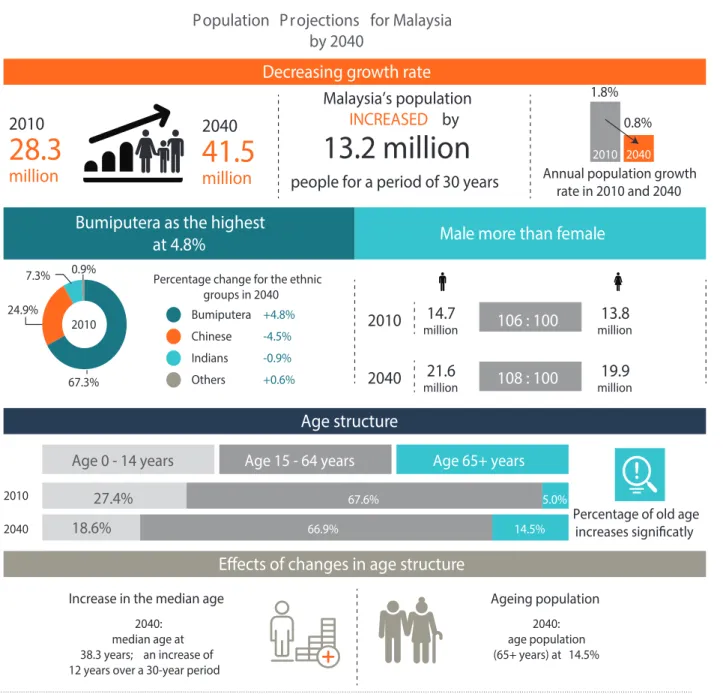
- A growing and increasingly ageing population
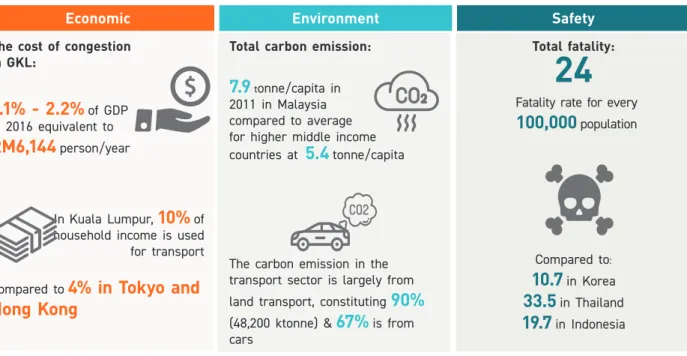
It is estimated that nearly 100,000 vessels pass through the strait each year, making it the world's busiest strait, carrying around 25% of the world's traded goods. However, the rapid growth of mobility over the past years will continue to increase in the future and, if left unchecked, will cause large economic losses in productivity and pollution, as shown in Figure 2.

Decreasing growth rate
Coupled with rising affluence and mobility trends, it is estimated that Malaysians will make an estimated 131 million daily trips by 2030, a significant increase from the 40 million trips in 2010.
Age structure
Effects of changes in age structureBumiputera as the highest
14 years Age 15 - 64 years Age 65+ years
Increasing urbanisation
Advances in real time information and digitalisation Advances in mobile and information technologies
Shared mobility services will become more common with the
Expansion of e-commerce market
Examples of these are modern ports, airports and potentially railways, as well as connected means of transport such as ships, planes, rolling stock and potentially new technologies such as autonomous vehicles. Examples of these are highways, railways and related means of transport such as trucks and rolling stock.
Developing
The spread of e-commerce and online shopping platforms can replace a significant portion of these trips. Future planning needs to take into account this growth in commercial traffic – especially last-mile delivery to congested urban areas – as well as the proliferation of new technologies and business models, such as autonomous deliveries and consolidated deliveries.
Growth High
It is estimated that one in five trips made by households in Malaysia is related to shopping. The demand for a green supply chain will become prominent as environmental aspects gain importance in the transportation sector.
In 2015, transport accounted for approximately
It is estimated that the world use of oil and other liquid fuels will increase from 95 million barrels per day (b/d) in 2015 to 104 million barrels per day in 2030, with the transport sector accounting for 60% of the increase ( International Energy Outlook 2017). Cities have a role in leading the sustainable transport agenda and must drive transformative change in transport.
90% of usage
The transport sector cannot continue to develop according to a business-as-usual scenario, because it implies a continued strong dependence on oil with a low share of renewable energy. Many cities around the world have successfully embraced sustainable mobility and offer best practices and lessons we can learn from.
Behavioral change measures should be taken to optimize mobility patterns and these should be accompanied by effective planning and technology design aimed at providing not only integrated transport, but also interactive.
45.2% Of energy demand consumed
Kiloton Oil Equivalent
Move towards bigger vessels, consolidation and containerisation
The move to larger vessels poses a threat to ports, a risk that also applies to key ports in Malaysia such as Port Klang and Pelabuhan Tanjung Pelepas. It is also expected that in a decade 90% of the general cargo segment such as steel, forest products as well as bulk cargo such as malt and fertilizers will be containerized.
2013-2033 4.1% KLIA
KK INTERNATIONAL AIRPORT 5.5%
Increasing passenger travel and the impact of Low Cost Carriers
The proliferation of new technologies such as machine learning, cloud networking and the Internet of Things – where devices and sensor devices are becoming increasingly networked and data is available in real-time and bi-directionally – will require a complete rethinking of the current transport regulatory and planning framework. Fully autonomous cargo vessels offer advantages such as reduced crew requirements – leading to increased cargo space.
NATIONAL TRANSPORT POLICY
5 POLICY THRUSTS
23 STRATEGIES
4 MAIN SECTORS
POLICY VISION
TO DEVELOP A SUSTAINABLE TRANSPORT SECTOR THAT ACCELERATES ECONOMIC GROWTH AND SUPPORTS THE
WELL-BEING OF THE RAKYAT IN LINE WITH AN ADVANCED NATION STATUS
Since September 2016, more than 150 members from government, academia and the private sector have been involved in a series of focus group discussions, technical meetings and workshops. While the policy guidelines and strategies will remain unchanged throughout the policy timeframe, the various measures will be continuously refined and supplemented to adapt to changing circumstances and address new challenges.
THE NTP 2019-2030 WILL PROVIDE THE STRATEGIC DIRECTION FOR A SUSTAINABLE TRANSPORT SECTOR
Policy Action 1: Strengthen governance to create an enabling environment for the transport sector S1.1: Strengthen coordination between agencies and industry players. S1.2: Strengthen competence development in the transport sector and make the sector an attractive career opportunity.
5 Policy Thrusts and 23 Strategies
S2.1: Implement smarter and more efficient use of existing infrastructure and in the development of new infrastructure S2.2: Increase the utilization of rail service for passengers and goods. S2.3: Upgrade hinterland connectivity to gateways and connect corridors for improved economic distribution S2.4: Strengthen the maintenance regime of transport infrastructure.
1 STRENGTHEN GOVERNANCE
POLICY THRUST
The introduction of new and disruptive technologies, coupled with increasingly shorter phases from design to deployment, requires institutions and governance that are both robust and adaptable to support an efficient and integrated transport service. Build local human capital development by addressing capacity building and training gaps, in support of an efficient and integrated transport service.
MEASURE OF SUCCESS
ENCOURAGE SKILLS DEVELOPMENT IN THE TRANSPORT SECTOR AND MAKE THE SECTOR AN ATTRACTIVE CAREER OPTION. In addition, the current legislative framework must be prepared to embrace new technologies and disruptive business models to ensure that the development of the transport sector can cope with the current trend.
In addition, the current regulatory framework needs to be prepared to
Review the current regulatory framework and guidelines to ensure they are still relevant and adaptable to current and future requirements. Ensure that the future regulatory framework governing transport is robust and able to adapt quickly to accommodate new technologies and trends.
Provide a common database that can be used as a reference
Provide a common database that can be used as a reference point by respective agencies for evidence-based planning. Shorten clearance time and reduce the steps required for cargo clearance to attract importers and exporters.
To shorten the clearance time and reduce steps
This can divert the energy of importers and exporters in dealing with the cargo clearance process. Strengthen trade activities and be at par with other advanced countries in terms of cargo clearance efficiency.
OPTIMISE, BUILD AND
POLICY
Evidence suggests that there is potential to significantly optimize the use of existing transport infrastructure, particularly with ports, airports, railway stations and park and ride facilities. Optimize existing infrastructure and assets, as well as accelerate the use of automation through the adoption of technology and digitization in transportation.
Optimise existing infrastructure and assets through adoption of
Further utilization of technology has the potential to solve some of the problems faced, as well as provide sufficient data to enable more accurate mapping of future demand to allow optimal infrastructure build-out. Similarly, there is additional capacity on the existing KTM Komuter and intercity train services which has the potential to be utilised.
Enhance road-rail intermodal connectivity to promote modal
Current rail freight movement is only 30% of total rail capacity, and less than 5% of land freight is transported by rail. Inland connectivity at seaports and airports is often cited as a major concern in the movement of goods, leading to increased costs and delays in the movement of goods.
Improve road development for better connectivity
The maintenance regime of all assets and infrastructure needs to be strengthened to ensure flawless, safe and efficient operation. Most of the delays and associated costs can be attributed to inadequate maintenance of the transport infrastructure.
Ensure that all assets are in the best condition for
New global trends in air cargo are bringing massive impact to the transport sector and thus ensuring appropriate infrastructure in place while maintaining safety has become an increasingly difficult task. As such, the current regulatory framework needs further investigation as the effect of increased regulations could dramatically increase the cost of doing business in addition to affecting transit times, damaging the value of airfreight as a fast way to transport goods.
ENHANCE SAFETY,
3 POLICY THRUST
This drive calls for greater inclusion, creating user-friendly and personalized services to care for the physically challenged, the elderly, women and children, as well as those in rural and remote areas. Inadequate facilities and services for vulnerable groups (eg the elderly, the physically challenged, those living in rural and remote areas).
In addition, more attention will need to be paid to first- and last-mile connectivity to ensure higher use of public transport services. Prioritize the movement of vulnerable users (e.g. pedestrians, active and non-motorized users) in pedestrian areas and within public transport interchanges.
ADVANCE TOWARDS
There is a need for additional standards and regulations related to environmental protection in the transport sector, for example there is an absence of standards related to green logistics and green transport terminals. Move towards a more systematic, holistic and sustainable practice of prioritizing active mobility and public transport modes.
Malaysia has set a higher goal of reducing it GHG
Prioritize the public transport network as a fundamental structure in mapping sustainable space and transport growth in urbanized areas. Align the long-term planning of urban centers and the public transport network with the National Transport Policy, the National Urbanization Policy and the National Housing Policy.
Minimise the impact to the environment resulting from the pollution created by
DEVELOP EFFECTIVE COMMUNICATION, EDUCATION AND PUBLIC INFORMATION (CEPA) TO CREATE BEHAVIORAL CHANGE IN OUR SUSTAINABLE TRANSPORTATION PRACTICES. Gain a wide range of experiences with and gain a fundamental understanding of the importance of sustainable transport practices.
EXPAND GLOBAL FOOTPRINT
SERVICES
This drive strives to promote Malaysia's transport service providers to expand their business, export their services and penetrate the regional and global market. Develop domestic logistics by strengthening transport service providers to enable them to compete at an international level, especially in the ASEAN region.
Ensure industry players/
CREATE AN ENVIRONMENT THAT MAKES IT EASY FOR LOCAL OPERATORS IN THE TRANSPORT INDUSTRY TO BECOME REGIONAL OR GLOBAL PLAYERS. In addition, global transport industries will put additional pressure on local operators to increase their competitiveness on a regional or global level.
FACILITATE REGIONAL COOPERATION AND AGREEMENTS THAT IMPROVE THE TRANSPORTATION INDUSTRY The ASEAN Economic Community (AEC) aims to create a single economic entity with seamless cross-border travel and trade for both goods and passengers. Develop sufficient capacity and capabilities in transport-related agencies and institutions to ensure that they can implement initiatives to improve Malaysia's position in global indices.
Malaysia is commited to improve its position in global indices in order to
Effective implementation of the strategies and action plans outlined in this policy will address a number of long-standing concerns and enhance this sector's potential for developing a robust transport sector. The success of this policy depends on close cooperation and collaboration between various agencies responsible for transportation planning, regulation and operations, to systematically implement the policies, strategies and action plans outlined in this document.
CONCLUSION
The NTP 2019-2030 sets the policy direction for the transport sector to strengthen its role in supporting economic expansion and providing a good quality of life for all Malaysians through the provision of a sustainable, connected, accessible and modern transport system. It is only through the dedication, commitment and support of all stakeholders that this policy's aspiration to develop a sustainable transportation system that accelerates economic growth and supports the well-being of the rakyat, consistent with an advanced nation status, will become a reality .