Journal of Oil Palm Research Vol. 35 (2) June 2023 p. 193-216 DOI: https://doi.org/10.21894/jopr.2023.0028
INTRODUCTION
As with most of the economic sectors, the Malaysian oil palm industry started to gain back momentum amid transitioning of COVID-19 pandemic to endemic in April 2022. In particular, the escalation of Russian-Ukraine war and the prolonged labour shortage issue have led to low stock of palm oil and temporary export restriction by Indonesia in the first half of 2022. As a result, palm oil price was pushed to a record high, surpassing RM8000.00 per tonne. Overall, the oil palm industry performed better in 2022 than 2021 in terms of crude palm oil (CPO) production (up by 1.9%), exports (up by 1.8%) and export revenue (up by 27.1%). As
the industry experienced an increase in demand, palm oil products fetched higher trading prices globally. Local price of CPO fetched the highest at RM6873.00 t-1 in May 2022, up by 15.4% on average. Although fresh fruit bunches (FFB) yield increased only slightly (up by 0.1%), efforts towards addressing FFB harvesting had increased CPO production and palm oil export, thus stabilising CPO price in the second half of 2022.
Challenges facing the oil palm industry continue, demanding effective and yet innovative solutions.
Major issues such as sustainability, deforestation, ecosystem degradation and oil quality could make a dent in the industry’s performance (Naidu et al., 2022). R&D must therefore associate with the whole palm oil supply chain in order for the industry to maintain and continuously grow. While the upstream initiatives targeting yield improvement through appropriate strategies (such as sustainable agricultural practices, breeding and conservation,
OIL PALM ECONOMIC PERFORMANCE IN MALAYSIA AND R&D PROGRESS IN 2022
GHULAM KADIR AHMAD PARVEEZ1*; OMAR ABD RASID1; MOHD NAJIB AHMAD1; HUMAIRA MAT TAIB1; MOHD AZWAN MOHD BAKRI1; SITTI RAHMA ABDUL HAFID1; TUAN NOOR MAZNEE TUAN ISMAIL1; SOH KHEANG LOH1; MEILINA ONG ABDULLAH1; KALSOM ZAKARIA1 and ZAINAB IDRIS1
ABSTRACT
The oil palm industry saw a marginal improvement in crude palm oil production in 2022 from 18.12 (2021) to 18.45 million tonnes and overall export volume by 1.8% to 24.72 million tonnes. Export value reached a new record high of RM137.89 billion due to extraordinary hike in palm oil prices. Despite this, upstream efforts remained technologically-driven in maximising oil yield per hectare, managing nutrient cycle, soil fertility, pests and diseases and ecological services. Particularly, planting materials were improved by widening the oil palm gene pool. The unrelenting labour shortage issue intensified adoption of sensor- and vision-based mechanisation technologies for fruit bunches harvesting. In the biomass and bioenergy context, synergistically interfacing supply chains to address logistic issues was key to broader adoption.
Integrating engineered nanomaterial, diversely-orientated carbon layering and specialty chemicals from biowastes/byproducts into current palm oil processing not only could ensure that the industry continues to play an important role in the global value chain for food, feed, fibre, fuel and chemicals but also portray multiple industrial symbiosis approaches. Similarly, intensifying businesses and performance of oleo-based industries, such as bio-lubricants, and nutritional research for quality and contamination monitoring, are prioritised in the interest of achieving circular economy.
Keyword: biology, biotechnology, engineering, palm oil, sustainability, value addition.
Received: 26 May 2023; Accepted: 24 June 2023; Published online: 28 June 2023.
1 Malaysian Palm Oil Board,
6 Persiaran Institusi, Bandar Baru Bangi, 43000 Kajang, Selangor, Malaysia.
* Corresponding author e-mail: [email protected]
AR TICLE IN PRESS
AR TICLE IN PRESS
increased use of mechanisation, etc.) should be emphasised, the whole of oil palm cultivation should withstand scrutiny in certification for social and environmental integrity, e.g., through the mandatory implementation of Malaysian Sustainable Palm Oil (MSPO). Advanced and innovative engineering and bioprocessing technologies adoption for cost- effective palm oil milling and refining, progressive oil quality control programme in preserving natural phytonutrients in palm for human health benefits, projecting by-products’ energy sources for livestock feed and dietary essential, advancing bio-wastes valorisations into wealth and value-adding basic oleochemicals into specialty derivatives are among the key elements for applied research consideration and formulation.
Globally, the adoption of the Sustainable Development Goals is increasing in pace for a sustainable future. Areas such as digital revolution, economic decarbonisation and circular economy are of central role in building a low-carbon nation.
To this end, the industry’s adoption of IR4.0, which is characterised by an increase in automation and smart technologies throughout the whole palm oil supply chain should be seriously planned and executed, with pioneer demonstration put in place to showcase and facilitate mechanisation and automation in reducing heavy labour reliance of the industry. This article reviews the performance of the oil palm industry in 2022 and highlights R&D outcomes and innovations in key areas pertaining to the industry. The deliberation in this review serves as a basis to chart strategies for a sustainable palm oil industry.
PERFORMANCE OF THE MALAYSIAN OIL PALM INDUSTRY
The year 2022 witnessed a global shortage of oil and fat supplies which were mainly attributed to the geopolitical conflict between Russia and Ukraine that disrupted the global supply of sunflower oil.
Since soybean oil supply from Argentina was also disrupted by drought, demand for oils and fats has shifted towards Indonesian and Malaysian palm oil and caused prices of all major vegetable oils to rise.
The sharp increase in palm oil demand has caused disruption to the local supply of palm oil in Indonesia which then forced Indonesian government to restrict and ban its palm oil for export market. This situation contributed to the high demand for Malaysian palm oil. However, due to improved labour situation in oil palm plantations and low imports of palm oil from other palm oil producing countries, Malaysia managed to increase marginally its palm oil supply to the global market. This situation has caused the prices and export revenue of Malaysian palm oil products to skyrocket to a record high in palm oil history.
Planted Area
Malaysia’s overall oil palm planted area declined slightly by 1.1%, from 5.74 million hectares in 2021 to 5.67 million hectares in 2022.
The reduction was mainly attributed to the fact that the planted area in Peninsular Malaysia and Sabah has dropped by 2.4% or 2.54 million hectares and 1.0% or 1.50 million hectares, respectively (Table 1). The reduction in the planted area was due to the improvement of MPOB renewal licensing procedures for independent smallholders since 2019. This effort was also in line with MSPO implementation.
The nationwide MSPO implementation has resulted in a reduced total oil palm planted area for 2022 as compared to 2021. The organised and independent smallholders own only 11.8%
and 14.4% of the total planted area of oil palm, respectively (Table 2). The overall planted area from both organised and independent smallholders for 2022 recorded a 3.5% shrinkage as compared to the previous year. The matured oil palm area recorded for 2022 was 5.13 million hectares or 90.4% of the total planted area. In Peninsular Malaysia and Sabah, planted areas decreased by 2.4% and 1.0%, to 2.61 million hectares and 1.50 million hectares, respectively, compared to the previous year. Meanwhile, oil palm cultivation in Sarawak expanded by 1.0% to 16.2 million hectares. In terms of land ownership, oil palm plantations comprised around 4.19 million hectares or 73.8% of the total planted area.
TABLE 1. MALAYSIAN OIL PALM AREA AS IN DECEMBER 2022 AND 2021 (MILLION HECTARES)
Planted area Mature area
2022 2021 Difference (%%) 2022 2021 Difference (%)
Peninsular Malaysia 2.54 2.61 -2.44 2.31 2.36 -2.22
Sabah 1.51 1.52 -1.02 1.33 1.33 -0.38
Sarawak 1.62 1.61 +1.00 1.49 1.45 +2.80
Malaysia 5.67 5.74 (1.10) 5.13 5.14 (0.33)
Source: MPOB (2022).
AR TICLE IN PRESS
AR TICLE IN PRESS
Status of Palm Oil Processing Sector
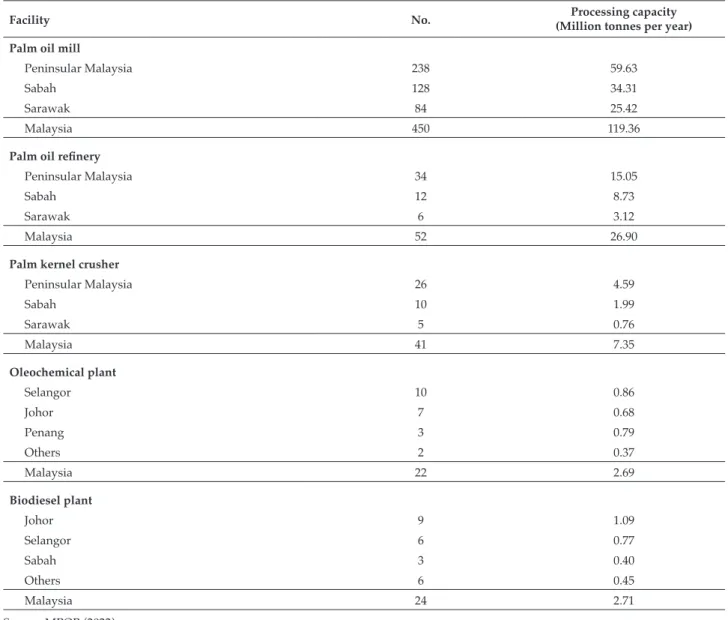
In 2022, Malaysia had a total of 450 palm oil mills with a combined annual processing capacity of 119.36 million tonnes of FFB. Slightly more than 50.0% of the mills were in Peninsular Malaysia with a capacity to process up to 59.63 million tonnes (Table 3). Meanwhile, 28.4% and 18.7% were located in Sabah and Sarawak with a total processing capacity of 34.31 million tonnes and 25.42 million tonnes, respectively. In total, the milling capacity utilisation rate increased by 0.70%, from 77.56% in 2021 to 78.13% due to the higher volume of FFB processed in 2022 as against 2021.
In the refining sector, 52 palm oil refineries with a combined processing capacity of 26.90 million tonnes of CPO and crude palm kernel oil (CPKO) were in operation in 2022. The 34 refineries located in Peninsular Malaysia have a processing capacity of up to 15.05 million tonnes. Meanwhile, 12 and six refineries located in Sabah and Sarawak have processing capacity up to 8.73 million tonnes and 3.12 million tonnes, respectively. The overall refining capacity utilisation rate in Malaysia showed an increase of 1.60% from 56.85% in 2021 to 57.78%, in line with the increasing demand for processed palm oil from export markets.
There were 41 palm kernel crushers operating in Malaysia in 2022, with a total processing capacity of 7.35 million tonnes. During the year, 60.30%
of palm kernel crushers operated in Peninsular Malaysia with a total processing capacity of 4.59 million tonnes, while the other 24.40% and 12.20%
were located in Sabah and Sarawak with a total capacity of 1.99 million tonnes and 0.76 million tonnes, respectively. The palm kernel crushing capacity utilisation rate declined by 2.00%, from 62.74% in 2021 to 61.48% in 2022, because of lower market demand for palm kernel oil (PKO) from importing countries.
A total of 22 oleochemical and 24 biodiesel plants were in operation in 2022 with processing capacities of 2.69 million tonnes and 2.71 million tonnes, respectively. The majority of these facilities were in Selangor and Johor. There were 10 oleochemical and six biodiesel plants in Selangor and seven oleochemical and nine biodiesel plants in Johor.
CPO Production
Malaysian CPO production in 2022 climbed by 1.9% to 18.45 million tonnes, compared to 18.12 million tonnes in 2021, as a result of a 3.4%
increase in FFB processed to 93.65 million tonnes, compared to 90.53 million tonnes in 2021, as well as a 0.1% improvement in FFB yield performance to 15.49 t ha–1. Monthly CPO production had a mixed performance. Comparing the first quarter of 2021, the first quarter of 2022 had higher production.
However, CPO production was lower in the second quarter of 2022 and then increased in the third and fourth quarters compared to the same period in 2021. The maximum CPO production in 2022 was 1.81 million tonnes in October, while the lowest was 1.14 million tonnes in February. This normal seasonal trend of Malaysian palm oil production was mainly attributed to the seasonal weather pattern of Malaysia. The fruiting season normally peaks in September to October every year due to seasonal cycles and declines in February due to low fruit formation, short month period and palm oil mill closure due to Chinese New Year celebration (Oettli et al., 2018). On regional comparison, Peninsular Malaysia and Sarawak’s CPO production improved by 3.2% to 10.16 million tonnes and 2.5% to 4.01 million tonnes, respectively in 2022, compared to 9.85 million tonnes and 3.85 million tonnes, respectively, in 2021, mainly due to the improvement in FFB yields in both regions. Meanwhile, Sabah’s CPO production decreased in 2022, falling 1.7% to 4.29 million tonnes from 4.36 million tonnes (Table 4) mainly attributed to the decline in FFB yield.
The FFB yield for 2022 increased by 0.1%
(15.49 t ha–1) compared to 2021 (15.47 t ha–1) (Table 5) as some estates managed to reduce dependence on foreign workers and adopted mechanisation (The Star, 2022; New Straits Times, 2022; 2023). Compared to 2021, Peninsular Malaysia and Sarawak recorded 1.0% and 1.4%
increase in FFB yield to 16.41 t ha–1 and 14.13 t ha–1 in 2022, respectively, while Sabah declined by 2.4%
to 15.39 t ha–1. The decline in FFB yield in Sabah was mainly due to the unfavourable weather condition that affected the FFB production in the state. The highest FFB yield recorded in 2022 was 1.54 t ha–1 in October, 5.5% higher than the highest
TABLE 2. OIL PALM PLANTED AREA BY CATEGORY IN 2022 (million hectares)
2022 2021
Hectarage % Hectarage %
Independent Smallholders 0.82 14.4 0.86 15.1
Organised Smallholders 0.67 11.8 0.67 11.7
Private and Government State Agency Estate 4.19 73.8 4.20 73.2
Total 5.67 100 5.73 100
Source: MPOB (2022).
AR TICLE IN PRESS
AR TICLE IN PRESS
TABLE 3. NUMBER OF PALM OIL PROCESSING FACILITIES AND THEIR CAPACITIES IN MALAYSIA
Facility No. Processing capacity
(Million tonnes per year) Palm oil mill
Peninsular Malaysia 238 59.63
Sabah 128 34.31
Sarawak 84 25.42
Malaysia 450 119.36
Palm oil refinery
Peninsular Malaysia 34 15.05
Sabah 12 8.73
Sarawak 6 3.12
Malaysia 52 26.90
Palm kernel crusher
Peninsular Malaysia 26 4.59
Sabah 10 1.99
Sarawak 5 0.76
Malaysia 41 7.35
Oleochemical plant
Selangor 10 0.86
Johor 7 0.68
Penang 3 0.79
Others 2 0.37
Malaysia 22 2.69
Biodiesel plant
Johor 9 1.09
Selangor 6 0.77
Sabah 3 0.40
Others 6 0.45
Malaysia 24 2.71
Source: MPOB (2022).
TABLE 4. MALAYSIAN CRUDE PALM OIL (CPO) PRODUCTION (million tonnes)
2022 2021 Difference
Volume %
Peninsular Malaysia 10.16 9.85 +0.31 +3.2
Sabah 4.29 4.36 -0.07 -1.7
Sarawak 4.01 3.91 +0.10 +2.5
Malaysia 18.45 18.12 +0.33 +1.9
Source: MPOB (2022).
FFB yield recorded in 2021, which was 1.46 t ha–1 in October 2021. Meanwhile, the lowest FFB yield was 0.99 t ha–1 in February, up 2.1% from 0.97 t ha–1 in February 2021. As mentioned earlier, this trend follows the normal seasonal fruiting of Malaysian oil palms.
The national oil extraction rate (OER) in 2022 was lower by 1.50% to 19.70% compared to 20.01%
in 2021 (Table 6), mainly attributed to lower ripe
FFB processed by palm oil mills (in December 2022, 33.00% of mills reported lower ripe FFB processed compared to 28.00% in December 2021). The monthly OER recorded a lower performance in 2022 as against 2021, except for January 2022 at 19.68%
over 19.02% in January 2021, while the performance was the same in April of both years. The highest OER achieved in 2022 was in May at 19.98% due to a higher quantity of ripe FFB input, because of
AR TICLE IN PRESS
AR TICLE IN PRESS
favourable weather conditions. Meanwhile, the lowest OER performance was recorded in February 2022 at 19.39% due to a lower volume of ripe FFB processed by palm oil mills. Overall, Malaysia recorded lower OER performance in 2022 by 1.30%, 1.50% and 2.10% (Table 6) as against the previous year.
Supply and Demand
The overall exports of palm oil and other palm- based products (POPP) in 2022 amounted to 24.72 million tonnes, an increase of 1.8% compared to 2021 (24.28 million tonnes) (Table 7). The increase was primarily due to the rise in export of CPO, processed palm oil, processed PKO and finished products. Palm oil accounted for 57.9% of the total exports of POPP.
The increase in palm oil exports was attributable to the increased demand from the United Arab Emirates, Saudi Arabia, Japan, Bangladesh, and
Egypt, which outweighed the decrease in demand from India, the European Union, and China.
Despite the marginal improvement in export volume, the total export revenue for palm products surged by 27.1% in 2022 to RM137.89 billion from RM108.51 billion in 2021 due to higher export prices for POPP. In 2022, palm oil and PKO export revenues increased by 27.7% and 14.2%, to RM82.49 billion and RM7.62 billion, respectively. In addition, all other palm-based products, such as palm kernel cake (PKC), palm-based oleochemicals, etc., also recorded a significant growth between 23.0% and 38.0%.
Imports of Malaysian oil palm products decreased by 8.5% from 1.50 million tonnes in 2021 to 1.38 million tonnes in 2022. Palm oil accounted for 82.8% of the total Malaysian imports of palm oil products in 2022, followed by PKO (14.2%) and palm kernel (3.1%) (Table 8). Imports of palm oil decreased by 3.2%, from 1.18 million tonnes in 2021
TABLE 5. AVERAGE FFB YIELD FOR MALAYSIAN OIL PALM ESTATES (t ha–1)
2022 2021 Difference
Volume %
Peninsular Malaysia 16.41 16.24 +0.17 +1.0
Sabah 15.39 15.77 -0.38 -2.4
Sarawak 14.13 13.94 +0.19 +1.4
Malaysia 15.49 14.47 +1.02 +0.1
Source: MPOB (2022).
TABLE 6. MALAYSIAN OIL EXTRACTION RATE (OER) (%)
2022 2021 Difference
Volume %
Peninsular Malaysia 19.57 19.83 -0.26 -1.3
Sabah 20.25 20.55 -0.30 -1.5
Sarawak 19.47 19.88 -0.41 -2.1
Malaysia 19.70 20.01 -0.31 -1.5
Source: MPOB (2022).
TABLE 7. MALAYSIAN EXPORT OF PALM OIL AND OIL PALM PRODUCTS
Volume (million tonnes) Value in RM million (USD million)
2022 2021 Difference (%) 2022 2021 Difference (%)
Palm oil 15.72 15.56 +1.0 82.49(18.73) 64.61(15.59) +27.70(+20.20)
Palm kernel oil 1.04 1.08 -3.6 7.62(1.73) 6.67(1.61) +14.20(+7.60)
Palm-based oleochemicals 3.04 3.25 -6.5 33.61(7.63) 26.80(6.46) +25.40(+18.07)
Other palm-based products 2.78 2.09 +0.2 12.46(2.83) 9.04(2.18) +37.90(+29.80)
Palm kernel cake 2.14 2.30 -6.5 1.71(0.33) 1.39(0.34) +22.60(+15.80)
Total 24.72 24.28 +1.8 137.89(31.32) 108.52(26.18) +27.10(+19.60)
Note: Values in parentheses represent prices in US Dollar equivalent.
Source: MPOB (2022); Department of Statistics, Malaysia (2022).
AR TICLE IN PRESS
AR TICLE IN PRESS
to 1.14 million tonnes in 2022, because of increased CPO production by 1.9%, from 18.12 million tonnes in 2021 to 18.45 million tonnes in 2022. In addition, the decline in palm oil imports in 2022 was also due to the more stringent Indonesian palm oil export policy as the country represented 95.9% of the total Malaysian palm oil imports in 2022.
TABLE 8. MALAYSIAN IMPORT OF OIL PALM PRODUCTS (million tonnes)
Volume
2022 2021 Difference (%)
Palm oil 1.14 1.18 -3.2%
Palm kernel 0.20 0.27 -28.7%
Palm kernel oil 0.04 0.05 -20.2%
Total 1.38 1.50 -8.5%
Source: MPOB (2022).
The 2022 palm oil ending stocks increased by 2.20 million tonnes, or 36.5%, compared to 1.61 million tonnes in December 2021. This was primarily ascribed to higher palm oil opening stocks and higher CPO production by 0.34 million tonnes or 1.9%. In December 2022, all three regions recorded an increase in palm oil stocks, with Sabah recorded the highest stock at 53.3%, followed by Sarawak at 47.1% and Peninsular Malaysia at 27.2% (Table 9).
TABLE 9. MALAYSIAN PALM OIL CLOSING STOCKS AS IN DECEMBER 2022 and 2021 (million tonnes)
2022 2021 Difference Volume % Peninsular Malaysia 1.45 1.14 +0.31 +27.2
Sabah 0.46 0.30 +0.16 +53.3
Sarawak 0.25 0.17 +0.08 +47.1
Malaysia 2.19 1.61 +0.55 +34.2
Source: MPOB (2022).
Compared to 2021, all major palm products were extensively traded in 2022 (Table 10). In 2022, the local CPO price increased by 15.4%, or RM680.50 t-1, to RM5087.50 t-1 compared to RM4407.00 t-1 in 2021.
The highest CPO price for 2022 was reported in May at RM6873.00 t-1, while the lowest price was in October at RM3682.00 t-1. The increased CPO price during that period was impacted by higher soybean oil prices, firmer Brent crude oil prices, and a weaker Ringgit versus the US Dollar, as well as the Ukraine and Russia war, the restriction on Indonesian palm oil exports, the drought in Argentina, and the reduction of India’s import tariff (Medina, 2022;
Parveez, 2023; Vasu, 2023).
In 2022, export prices of refined, bleached, and deodorised (RBD) palm oil, RBD palm olein, and RBD palm stearin increased by 7.3%, 8.1%, and 4.9%, respectively, to RM4973.50 t-1, RM5006.00 t-1, and RM4559.50 t-1, while the price of palm fatty acid distillate (PFAD) increased by 1.9% to RM4313.00 t-1.
In the lauric-based market, the palm kernel price improved by 12.4% (RM3118.00t-1) compared to RM2773.00t-1 in 2021, mainly attributed to higher domestic CPKO prices. The CPKO price in 2022 climbed by 11.5% to RM6327.00t-1 compared to RM5674.50t-1 in the previous year. The highest CPKO price in 2022 was in line with higher PKO price in the global market by USD81 or 5.3% (USD1598 t-1), which coincided with a higher price in coconut oil by USD3 or 0.2% (USD1621 t-1).
FFB price at 1.0% OER in 2022 had grown by 15.3% to RM55.52 from RM48.14 in 2021, corresponding to a significant increase in CPO and palm kernel prices. According to the national OER, the FFB price in 2022 was comparable to RM1094.00 t-1, a 14.6% increase over the RM955.00 t-1 reported in 2021.
R&D FOCUS AREAS IN 2022
Enhancement of Sustainable Oil Palm Plantation towards Yield Improvement
While the country has targeted economic revival after COVID-19 pandemic, the upstream oil palm
TABLE 10. MALAYSIAN PRICE OF OIL PALM PRODUCTS (RM t-1/ USD t-1)
2022 2021 Difference
Price %
Crude palm oil 5,087.50(1155.38) 4407.00(1063.05) +680.50(+92.33) +15.40(+8.7)
RBD palm oil 4,973.50(1129.49) 4,635.50(1118.17) +338.00(+11.32) +7.30(+1.0)
RBD palm olein 5,006.001136.87) 4,632.50(1117.45) +373.50(+19.42) +8.10(+1.7)
RBD palm stearin 4,559.50(1038.47) 4,343.00(1047.62) +216.50(-12.14) +5.00(-1.2) Palm fatty acid distillate 4313.00(979.49) 4233.00(1021.08) +80.00(-41.45) +1.90(-4.1)
Palm kernel 3,118.00(708.11) 2773.00(668.08) +345.00(+39.2) +12.40(+5.9)
Crude palm kernel oil 6,327.00(1436.88) 5674.50(1368.80) +652.50(+68.08) +11.50(+5.0)
FFB at 1% OER 55.52(12.61) 48.14(11.61) +7.38(+1.0) +15.30(+8.6)
Note: Values in parentheses represent prices in USD equivalent.
Source: MPOB (2022).
AR TICLE IN PRESS
AR TICLE IN PRESS
sector continued to focus on improving oil palm yield. Climatically, Malaysia has one of the best conditions in ASEAN for optimal oil palm growth.
The oil palm yield in Malaysia is about 3.64 t ha–1 year–1 (Afandi et al., 2022), although the estimated average maximum and lowest are about 18.50 t ha–1 year–1 and 3.00 t ha–1 year–1, respectively. As there is a lack of spatial and digital data for referencing and decision-making in oil palm plantation management, a digital technology platform, i.e., Oil Palm Resource Information System (OPRIS) using ArcGIS software has been developed to record and store geodatabase inside mobile devices (Nordiana et al., 2022). The system contains an administrative boundary, base map, infrastructure layer, water bodies and river networking, soil type, topographic, agricultural climatic information and land use. In Sumatra, Indonesia, in order to find the spatial distinction in yields, the input used and output prices, a designed additive regression model with nonlinear spatial properties called geosplines was employed (Kibrom et al., 2022).
The variations in ecology and biodiversity during oil palm growth period could help minimise the effects of land conversion (Parveez et al., 2022), especially in peat areas cleared and converted into oil palm, pulpwood plants and sago palm (Metroxylon sagu Rottb.). Permanently lowering the water table of peatlands through drainage for oil palm growth would risk losing organic carbon stock such as methane (CH4), compared to uninterrupted peatlands which frequently act as carbon sinks.
Maintaining soil moisture content in peatlands cultivated with oil palm is often more difficult and costly than in secondary forests due to drainage and peat compaction (Ngau et al., 2022). Based on mapping via geographical information system, such management is essential as soil moisture content is highly correlated with the trunk diameters of oil palm.
While efforts on yield improvement are being intensified, several important sustainability strategies, such as assessing wildlife inhabitants, which are in danger from future habitat damage, are required for proper land-use planning.
Combining projections of future deforestation based on endangered areas and logging businesses with species density information is anticipated to address biodiversity declines (Voigt et al., 2022).
In preserving biodiversity, more environmentally- friendly management strategies, such as the before- after control-impact (BACI) method, are required to support high-level-inside-plantation biodiversity and increase ecosystem service transfer, perhaps increasing oil palm efficiency (Pashkevich et al., 2022). One of the species investigated is spider, where abundance and richness in canopy cover and ground differ quite significantly in mature oil palm plantations. Dominant species in the canopy include
orb-web builders, cob-web builders and cursorial (running) hunters while those on the ground are cursorial hunters. In addition, the debated human- elephant conflict commonly occurring in the states of Pahang, Sabah and Terengganu can be mitigated by installing beehive-fence. Subsequently, eight months after the fitting, the number of elephant infringements in Ladang Jernih had decreased from 31 to only 16 times (Abdul Malek et al., 2022).
As the amount of greenhouse gas (GHG) released from oil palm growing on peats in literature was estimated mainly based on very limited sources, there is a large variation which needs to be rectified (Alcock et al., 2022). Estimation of oil palm peat decomposition - CO2 and N2O emission factors (EF) - based on process-based modelling has been explored over a 30-year plantation in Central Kalimantan, Indonesia (Swails et al., 2022). It was found that the modelled peat onsite CO2-C EF (7.7 ± 0.4 Mg C ha−1 yr−1)in the first ten years was lesser than the IPCC standard (11 Mg C ha−1 yr−1) and reduced further to 3.0 ± 0.2 and 1.8 ± 0.3 Mg C ha−1 yr−1 for the subsequent second and third decades of the rotation, respectively.
On the contrary, the modelled N2O-N EF (3.5 ± 0.3 kg N ha−1 yr−1) was more than the standard (1.2 kg N ha−1 yr−1), and amplified further to 4.7-4.6 ± 0.5 kg N ha−1 yr−1 in the next decades.
Through re-analysis of systems-wide life cycle GHG emissions estimated amongst various vegetable oils, Alcock et al. (2022) concluded that oil palm contributes huge carbon storage opportunities, if more effective sustainability practices are adopted, e.g., proper land use management system and methane capture at mills for energy use. In assessing the performance of each agricultural system, their carbon storage potential should be fairly compared for a better insight into the relative impacts and competitive edge.
The bunch production and oil quality are very much affected by CO2 enrichment when the oil palm is growing. The rising atmospheric CO2 implications and impact have been assessed using FACE technique (Amanina et al., 2022). On the other hand, the properties of water flow and movement on oil palm have been examined by Pradiko et al.
(2022). A daily stand transpiration of a 14-year- old oil palm is estimated to be about 0.82-1.66 mm day–1. This information can be used to model water necessities and preservation in oil palm plantations.
Besides, the dynamics of soil organic carbon in peatlands are particularly crucial for enhancing soil fertility and accelerating carbon sequestration.
The total root respiration and heterotrophic decay of soil organic matter can be quantified as soil CO2 flux via various methods, but the closed chamber method is the most prevalent (Ching et al., 2022) featuring “instantaneous” monitoring. As soil CO2 fluxes vary between different management zones,
AR TICLE IN PRESS
AR TICLE IN PRESS
the findings reveal that sustainable crop production can be practiced considerably, by leveraging the associated weaknesses and strengths of current practices.
Oil palm growing and yield depend on passable water supply and consistently disseminated rainfall. Oil palm cultivation in regions with long dry seasons or irregular distribution of rainfall could be effective if an acceptable source of water is obtainable for irrigation. Drip irrigation combined with a fertigation system has been proven as the most effective system to increase oil palm yield because it can efficiently lessen nutrient losses and upsurge nutrient uptake (Afandi et al., 2022). Oil palms also require a large quantity of nutrients to withstand high yields. Fertiliser accounts for
>30% of the sum charge of palm oil production and approximately 60% of the total maintenance cost of matured planting. Fertiliser contributions, therefore, establish an imperative investment cost.
An efficient fertiliser rate at 0.84 N, 0.68 P2O5, and 2.40 K2O was the most appropriate fertiliser proportion to keep ideal palm growth, both vegetative biomass and nutrient status. Mature oil palms supplied with comprehensive NPK fertiliser (N1P1K1 and N2P2K2) amplified 17.3% of FFB yield from 22.9 t ha-1 year-1 to 27.0 t ha-1 in the control plot. The results highlighted the optimistic retort of palm growing and foliar nutrient status with N enriching during this study period (Ariffin et al., 2022). Biofertilisers, in combination with consortium microbes, as an alternative to chemical fertilisers help regulate nutrients and microbial activities in soil. Such biofertiliser combined with 30% chemical fertiliser showed better growth at the oil palm nursery stage (Keni et al., 2022).
Proper control of pests and diseases could enhance oil palm yield, e.g., through satellite imagery (Nuthammachot and Stratoulias, 2022), haplotype network (Badrulisham et al., 2022), deep learning neural network (Najib et al., 2022), agricultural drone (Masri et al., 2022), etc.
Besides, several anticoagulant rodenticides baits (coumatetralyl, chlorophacinone, flocoumafen and brodifacoum) below 5% threshold level are operative in controlling rat attacks in the infested area (Noh et al., 2022). The dominant pest species identified are Rattus tiomanicus, Rattus rattus diardii and Rattus argentiventer (Nasir et al., 2022). Besides, disease conquest by fungal control agents has been found equivalent to the chemical counterparts (Muhammad et al., 2022; Sundram et al., 2022).
Fungicides such as hexaconazole are effective in treating upper and basal stem rot Ganoderma diseases in oil palm (Nur-Rashyeda et al., 2022).
The infected palms continue to survive and actively produce fruit bunches. In addition, integrating rhizomatous plants, such as galangal (A. galanga), Java turmeric (C. xanthorrhiza), or ginger (Z.
officinale) with oil palms can reduce the disease incidences as well (Suwandi et al., 2022). Close monitoring of pathogens in the field is possible with the development of more sensitive real-time PCR assays (Zainol Hilmi et al., 2022).
Overall, oil palm yield is the most essential target for sustainable development which can be achieved via proper management of several factors such as environment, climate change, carbon stock, peat ecosystem, pest and disease, nutrient management, etc. Adoption of good agricultural practices could ultimately contribute towards oil palm yield increment in relation to the sustainability of the oil palm industry.
Mechanisation and Automation towards Maximising Productivity
Imported labour in the Malaysian oil palm plantations has become scarcer and more rampant in the post-COVID-19 pandemic transition, which has seriously impacted productivity. In order to alleviate the situation, promising technologies in oil palm mechanisation and automation that could improve field productivity and reduce labour requirements must be adopted extensively.
In addition, the anticipated technologies should be further revolutionised with advanced digital systems to cope with many complex challenges in the existing agricultural tasks such as FFB harvesting and other field activities.
Agricultural robotics, Internet of Things (IoT), big data, artificial intelligence and cloud computing are of recent interest in finding solutions to overcome labour shortages and field productivity issues (Abbasi et al., 2022). The incorporation of these advanced systems enables precision farming and data analytics that could lead to cost- effective field operations (Rejeb et al., 2022) and thus, reduction in labour requirements. System advancement is possible because of dynamic improvement associated with sensors, high-end computer processors and algorithms control (Raikwar et al., 2022). Besides, the improved system could extend towards safer and greener agriculture processes (Mahroof et al., 2021).
An example of improvised system is the land- based agricultural robotics in replacing several tasks carried out by tractors. It takes care of soil compaction effect, gives access to small or narrow areas, reduces operation costs, etc. One of the latest trends is applying multiple robots for a specific task (Ju et al., 2022), where larger farming areas could be covered in a shorter time during field maintenance like weedicide, chemical application and harvesting. Swarm robotic applications adapted with various sensors and algorithms are an effective method for controlling and navigating the field. However, these technologies are still in
AR TICLE IN PRESS
AR TICLE IN PRESS
their infancy for commercial adoption (Albiero et al., 2022). Several heterogeneous issues impeding their applications have been identified, which require clear directives catering for multi-mission requirements in agriculture. The robots need to be more equipped with other decision-based systems to support farm analysis. Artificial intelligence and farm digitalisation are key for effective robotics applications in agriculture.
Vision systems with deep learning and big data could revolutionise farming practices. As demonstrated, such technology could provide valuable information for the harvesting process and yield prediction besides others like infection detection and state of health examination (Palacios et al., 2022). A deep learning process that offers multi- layered information for iteration could produce the required solutions. The artificial intelligence system based on vision and deep learning shows better results than the traditional vision inspection system for grain yield estimation (Dhanya et al., 2022). The study by Shiddiq et al. (2022) on accommodating vision and artificial intelligent design to detect oil palm FFB ripeness in a controlled environment indicated 80% prediction accuracy. The setup could be replicated for under-canopy fruit detection. The colour spectrum could be easily recognised even with a monocular-based vision system. The vision- based system could be easily made with inexpensive sensors and employed in a real scenario (Bellocchio et al., 2022). The vision system and deep learning process could provide vital information to chart strategies and resource allocation for more cost- effective agricultural practices.
The sensor-based system will be more practical if it can be integrated with IoT as a communication means to enhance farm monitoring capacity and productivity (Subeesh and Mehta, 2021). Farm digitalisation will interrelate sensors, computing processes, machines and monitoring systems.
IoT has also been proposed as a digitised-based solution in agriculture for a financially constrained farmer in accessing mechanisation and automation technologies. Thus, a more affordable contractual approach to assist farmers could be realised. Farm support services should also be extended to small- and medium-sized farmers (Gil et al., 2023) for new business opportunities.
Biotechnology Tools for Future Planting Materials The oil palm sector faces several major issues, including fluctuating prices, labour scarcity, ageing tree populations, and pests and diseases that significantly reduce crop productivity. A practical way to address these issues is to produce new cultivars with improved yield, a variety of high- value traits and more tolerant to changes in climate conditions. Future improvements in commercial
yields will partly depend on oil palm breeding programmes that develop higher yielding planting materials with improved water uptake and nutrient usage efficiency. Additionally, palms that are more resistant to diseases as well as have an overall architecture that facilitates harvesting of FFB are also targeted in breeding programmes across the industry.
The current planting materials are based on a narrow genetic base. Recently, a study on advanced oil palm breeding populations was carried out to evaluate the level of genetic variation using amplified fragment length polymorphism (AFLP) markers. Results confirmed the need to incorporate new genetic resources to increase genetic diversity, and with it enhance the crop capacity to withstand environmental challenges (Ithnin et al., 2022).
The risk associated with the dependence on a small genetic base and the need to broaden it for effective selection is fully acknowledged by the oil palm industry. New genetic resources were sought through a series of prospection in Africa and South America, leading to the assembly of the world’s largest oil palm germplasm collection at MPOB. The richness, in terms of the scale of the genetic variation of these E. guineensis and E. oleifera germplasm accessions was quantified based on their phenotypic characters and genetic make-up. Using multivariate analyses, most of the important traits in E. oleifera and MPOB-Cameroon oil palm germplasms were shown to display a wide range of variation (Tun Mohd Salim et al., 2022; Yaakub et al., 2022). Variables that contribute most to the variation were identified and could be utilised to help determine the population of interest for regeneration and selective breeding for oil palm enhancement programs. In addition to phenotypic data, evaluation of the genetic variation of the accessions was also performed using molecular tools. The phenotypic and molecular- based diversity patterns could subsequently be integrated for systematic formulation of strategies for breeding and conservation. Similarly, genomic characterisation of single nucleotide polymorphisms (SNPs) in E. oleifera germplasm assembled in Brazil demonstrated genotypic divergence between populations (Leāo et al., 2022). It can be concluded that the germplasm has specialised genetic structures and there is good genetic variability within its populations, as observed within the Malaysian oleifera collection.
Potential new genes could be obtained through the exploitation and introgression of germplasm with advanced breeding materials. Generally, these germplasms have a good variability for bunch quality and vegetative traits, thus providing the necessary flexibility to develop new and improved planting materials, some of which can cater for niche markets. This was clearly demonstrated by
AR TICLE IN PRESS
AR TICLE IN PRESS
the evaluation of several progenies involving the introgressed MPOB germplasms with Algemene Vereniging van Rubberplanters ter Oostkust van Sumatra (AVROS) pisifera (Bakar et al., 2022; Nor Azwani et al., 2020). More specifically, the evaluation of the germplasm introgressed progenies has also led to the identification of potentially Ganoderma tolerant materials (Mohd Din et al., 2022). Generally, linking of markers to traits of interest and pilling up favourable alleles in the next generation could improve breeding efficiency. To assist with the use of markers in breeding, Rosli et al. (2022) described the establishment of the Oil Palm SSR Resource Database (OPSRI), a highly structured database that can facilitate the development of SSR based molecular markers. Signalling the increase in the repertoire of DNA markers available to the oil palm community, the establishment of intron polymorphism (IP) markers was also reported, in particular for the enhancement of fatty acid composition. A total of 13 fatty acid composition associated IP markers were found within E. guineensis, which have potential for improving palm oil composition (Li et al., 2022). Recently, a study identified SNP variation in an expansin gene (EgExp4) that was associated with height. This marker may be useful for genetic improvement and selection of semi-dwarf new oil palm varieties (Somyong et al., 2022). The importance of the genetic variability with E. guineensis was further demonstrated in an interesting study involving a set of diverse E. guineensis progenies. The study indicated that genetic factors determined the foliar contents of K, Mg and Ca, and not by the environment where the progenies were planted, although more research is required to determine if different fertiliser amounts are necessary for optimal production in these progenies (Dassou et al., 2022).
In addition to the DNA-based molecular tools described above, other omics resources are also available to assist in the crop improvement. The integration of various omics technologies has seen tremendous progress in recent years. The development of trustworthy screening techniques and platforms has enabled different omics data sets to be integrated for a better quantification of physiological trait expression in field conditions, which is crucial for the understanding of the inheritance of complex traits (Masura et al., 2017;
Ramli et al., 2020; Yang et al., 2021). Using hybrid populations, work to understand the fruit exocarp colour was carried out by detecting expressed sequence tag (EST)-simple sequence repeat (SSR) markers. In widening the use of omics in oil palm research, a number of research articles reported the use of transcriptome data to better understand selected traits. A comparison of immature/
mature differentially expressed genes (DEGs)
revealed the regulatory role of the anthocyanin biosynthesis pathway (ABP) in nigrescent fruit colour. Additionally, SSR primer motifs that could differentiate the two fruit colour traits, namely nigrescence and virescence, of the Nigerian hybrids were identified (Suraninpong and Nuanlong, 2022).
Work to elucidate the function of phytohormone biosynthesis and signalling genes during pollination and fertilisation was also reported. Results showed that energy metabolism and hormone signal transduction related genes were highly expressed during pollination and fertilisation (Yang et al., 2022). The sexual differentiation in oil palm was also studied by characterising miRNAs and differentially expressed genes in male and female inflorescences. A number of genes and miRNA- mRNA target modules that have a developmental regulatory role were identified (Tregear et al., 2022).
Furthermore, the transcriptome analysis identified programmed cell death (PCD) and PCD-related genes, predominantly up-regulated in seedless palm tree stigmas and styles compared to tenera and pisifera fruit forms. PCD may be linked to seedless phenotype formation in oil palm, as it causes pollen tube lethality and double fertilisation failure (Htwe et al., 2022).
Proteomics and metabolomics have also been used in oil palm research with the goal of creating methods for precise tracking of profiles of clonal and transgenic palms and for a range of crucial traits, such as oil quality and yield (Ramli et al., 2020). Tahir et al. (2022) used the metabolomics technology to evaluate the effects on clonal palms grown in different environmental conditions. The abundance of primary and secondary metabolites showed the effect of the environment on the palm biosynthetic and metabolism pathways.
Similarly, proteomics analysis to investigate bioactive peptides from oil palm mesocarps has led to the identification of peptides with various bioactivities that have potential applications such as plant protection against fungus (Lau et al., 2022).
A comparative proteomics study to investigate proteome variation among Ganoderma species revealed a number of proteins that are potentially responsible for the variation in pathogenicity between the two studied species (Dzulkafli et al., 2022). Simultaneous evaluation of transcript and protein levels in infected seedlings highlighted the possible defence strategy of the symptomatic seedlings (Daim et al., 2022).
The clustered regularly interspaced short palindromic repeat (CRISPR)-associated protein 9 (Cas9) genome editing system is another biotechnology tool that could complement the oil palm breeding programme. Results so far have shown that an efficient level of gene editing with CRISPR/Cas9 is possible in oil palm by optimising DNA delivery and using efficient gRNAs (Bahariah
AR TICLE IN PRESS
AR TICLE IN PRESS
et al., 2023; Yeap et al., 2021). Work now is on the way to develop strategy to select more efficient gRNAs for oil palm (Jamaludin et al., 2022).
Sustainable Development for Smallholders
In recent years, a negative attitude towards palm oil has been clearly exhibited especially when the European Union (EU) decided to ban palm oil imports. To address the issue, it is important for the palm oil industry players to introduce sustainable agriculture practice among oil palm smallholders (Abas et al., 2021). In Malaysia, through mandatory implementation of MSPO in 2020, the palm oil industry has been enforced to achieve sustainable agriculture practice. As of December 2022, 87.7%
of the total independent smallholders have been certified under MSPO, covering 187 215 smallholders with a planted area of 709 088.03 hectares.
The attribute of smallholders, which are self- reliant and manage their own farms individually, has become a major drawback that influences the low participation in MSPO (Parthiban et al., 2021).
An empirical study revealed that the majority of smallholders who were already certified have a moderate level of compliance towards MSPO and share a similar non-compliance issue on the clauses related to traceability (Parthiban et al., 2021). This is due to the improper farm record and lack of awareness on the importance of record keeping.
The FFB production record is another concern which is one of the important criteria in MSPO.
Palm Fruit Dealers (DF) who receive FFB from smallholders were expected to keep the transaction record and share a copy with the smallholders.
DF was able to keep a record of the FFB price, weighing ticket number, transportation details and time of transaction. Recent studies revealed that DF is committed to keep a record of the daily FFB transaction of smallholders and submitted to MPOB when requested (Parthiban et al., 2022). An effective traceability system from DF can provide complete traceability of the entire supply chain of oil palm. In such a way, it is crucial for smallholders to reach an understanding of the benefits of getting MSPO certification (Bok et al., 2022). Hence, the lack of initiatives taken by the smallholders to comply with the compulsory certification becomes a great challenge, especially to the extension agents.
As food security becomes a major concern globally, smallholders are urged to practice crop integration in their oil palm smallholding. In order to reduce heavy reliance on imported feed products, crop integration is essential and should be encouraged to improve sustainability and efficiency in crop management. By practising crop integration, oil palm growers can generate additional income and optimise their land use,
instead of planting oil palm alone. One of the potential crops for integration with oil palm is forage sorghum, which is similar to wheat, maize, and paddy (Norkaspi and Raja Zulkifli, 2022).
Sorghum is suitable to be used as animal feed. Thus, by using sorghum as a supplementary element to fodder resources, smallholders can contribute to reducing cost of animal feed. As feed import quantity and value are also expected to increase significantly, introducing new livestock feeds such as sorghum can induce healthy competition in livestock industry. A recent study disclosed that a total of RM1317 ha-1 can be generated through integration of forage sorghum with oil palm (Norkaspi and Raja Zulkifli, 2022). In another study, the growth of sago palm in peat soil was evaluated (Zurilawati et al., 2022). Although the applied compound fertiliser did not affect the sago palm growth, proper fertiliser management by smallholders is required for sago to be cultivated in shallow peat land as raw material for potential utilisation in the food and non-food industries, biomass, and poultry industry.
Recovering from the pandemic, smallholders are not only struggling to understand and adhere to the MSPO certification scheme but also need to face the great price increase in agricultural inputs and difficulties in obtaining farm workers. A recent study showed that workers in the palm oil industry possess a higher intention to quit their job since there are a lot of opportunities being offered by other industries such as services, manufacturing, and construction (Amran et al., 2021). The motivational factor that influences the workers to turn away from working in the palm oil industry is to look for a better livelihood and achieve their individual needs. Nevertheless, smallholders still show high interest in planting oil palm. They usually hire third parties, namely contractors, DF, or business partners to look after their farm. An empirical study among 375 respondents of the replanting assistance scheme recipients showed that most of them agreed that the increase in FFB selling price have a great influence on their decision to carry out replanting (Mohd Noor Izuddin et al., 2022). Family members and preparation for a long-term investment have also affected their choice.
Biomass and Bioenergy Innovations
While an abundance of biomass resources and by-products has been generated by the palm oil industry, many advanced biomass conversion technologies for energy and non-energy applications featuring value addition have been developed.
However, most of the development is difficult to be commercialised due to several issues: economics feasibility, quality and market compatibility (Loh et al., 2022; Terry et al., 2022). Key challenges faced
AR TICLE IN PRESS
AR TICLE IN PRESS
so far are related to high investment, feedstock and supply chain management, which require urgent attention. As such, traditional handling of oil palm biomass should be disruptively transformed into a more appealing digitalised manner that can be cascaded from existing pools for cost-effective integration, to meet more stringent global demand on sustainability.
In doing so, several researchers now look into embracing chemical engineering knowledge for advancing industrial biomass business operations (e.g., bioenergy and biochemicals), from the perspective of (i) reaction, (ii) separation, and (iii) process systems (Terry et al., 2022). These 3 aspects focusing on design, intensification, consolidation, operation, modelling, control, etc. are part and parcel of managing an industrial process/plant to maximise outputs. Improvements made at the system level, i.e., industrial symbiosis and process/product modelling are worth exploring for embracing and aligning with future digital interfaces (Ayodele et al., 2022; Terry et al., 2022). The use of digital tools for strengthening biomass business models in terms of techno-economic performance, system prediction and supply chain consolidation could lead to overall sustainable development in pursuit of circular economy (Gilbertson and Vikesland, 2022).
For sustainable palm oil establishment, it is possible to nourish end-of-life resources from the biological or technical cycle, as natural and renewable biomaterial feedstock to foster the inspired nanocircular economy (Gilbertson and Vikesland, 2022). The potential of engineered nanomaterial transforming from biomass is huge as every bit of our life is associated with it, e.g., food, clothing, computer and transportation, etc.
Harvesting nanocellulose from oil palm biomass through environmental nanotechnology can be one such activity with a huge opportunity, as multiple advanced materials can be created compared with the limited conventional method of disposal and use (Lim et al., 2022). Nevertheless, as mentioned above, its production must withstand extensive scrutiny to create a competitive and feasible industrial symbiosis.
Being versatile with diverse application potential, oil palm biomass has been recently associated with graphene manufacturing.
Graphene refers to monolayer of carbon (graphite) with neat hexagonal geometry plus thermal and electrochemical flexibilities, due to its available π-electrons (double bonds). As opposed to graphene, graphite is a stack of a large number of layers of graphene, thus making it inflexible.
As graphene is naturally hydrophobic (water repellent), converting it to graphene oxide or reduced graphene oxide could equip it with various oxygen-containing functionalities, making it a hydrophilic (water affinity) alternative to graphene
for various applications such as semiconductor, carbon electrode, etc.
Oil palm biomass, high in carbon content, could be mined for graphene manufacturing. The many reactive functionalities present in lignin (aromatic- rich compounds) and cellulose are highly required for oxidative/reductive conversion into graphene oxide and its reduced materials. In one example, the composite graphene oxide anodes from lignin of empty fruit bunches (via carbonisation followed by chemical oxidation) are incorporated in a microbial fuel cell to produce electricity and remove heavy metal from the simulated wastewater (Yaqoob et al., 2021). The employed sap of oil palm trunk is also a carbon source for microbial rejuvenation in fuel cell.
Lignin and hemicellulose from oil palm biomass are to be separated to unpack cellulose before producing multilayer graphene material (Zhou et al., 2022). High quality graphene (single-crystalline nanoscale product) can be produced with pure lignin due to the anticipated aromaticity (Kumari and Samadder, 2022). In this context, palm kernel shell, which is high in lignin (~50 wt.%, dwb), is pyrolysed and then catalytically (ZnCl2) fabricated via chemical vapour deposition process at 900°C in an inert environment to produce bio-graphene- like structure (Azahar et al., 2022).By manipulating the pyrolysis conditions (temperature and residence time), different proportions of cellulose, hemicellulose and lignin can be decomposed, hence the amount of volatile CH4 and CO2 released can be controlled in preparation of biomass precursor, which can then undergo further exfoliation to enhance its functionality, layering and interlayer spacing. Instead of forming monolayer sheets, graphene deriving from biomass shows a much diverse orientation of carbons. As such, alignment through several processes (exfoliation, carbonation or graphitisation) is essential in order to rearrange the biomass molecules into layered (single or multiple) structures (Kumari and Samadder, 2022).
These extra processing steps could add cost to graphene production from oil palm biomass.
Biomass or palm-based by-products such as PKC have been much anticipated as a substitute for corn and soy meal in chicken feed as a means to stabilise prices (Azizi et al., 2021). Currently, the costs of chicken and chicken feed have drastically increased due to various global issues, including bird flu incidents and Russia-Ukraine confrontation (FAO, 2022; OECD, 2022). Studies have shown that PKC, CPO, and palm oil mill effluent (POME) exhibit substantial nutrients for laying hens and broiler chickens, with no significant impact on performance or egg quality (Herliatika et al., 2022).
Eggshell thickness was marginally reduced, and the performance of laying hens was unaffected by the addition of lignocellulolytic enzymes to POME in order to increase the nutrient levels and quality
AR TICLE IN PRESS
AR TICLE IN PRESS
(Herliatika et al., 2022; Saminathan et al., 2020). The inclusion of 10% PKC in the diet of 40-week-old laying hens is recommended in order to lower feed costs without compromising layer performance (Herliatika et al., 2022). Addition of CPO in laying diets increases the absorption of oil-soluble vitamins and provides high caloric levels, while eggs quality can be enhanced with carotenoid-enriched CPO (Longe and Adekoya, 2021; Saminathan et al., 2020). Addition of treated or dehydrated POME up to 15% in the diet improved the laying hen’s performance and egg production (Saminathan et al., 2020). Overall, these palm-based biomass materials are potential energy substitutes in chicken feed in countries producing palm oil (Azizi et al., 2021;
Hakim et al., 2022; Saminathan et al., 2022).
Palm Oil Nutrition Research
Palm oil is full of nutritional value as it contains tocotrienols, the most potent vitamin E. Palm tocotrienol is widely used as a health supplement due to its scientifically proven health benefits. It has been found to exhibit anti-cancer properties (Constantinou et al., 2020; Fontana et al., 2022;
Ranasinghe et al., 2022,), improve wound healing (Shahrim et al., 2022), neuroprotective effects (Zhao, 2022), treat fatty liver patients with/without steatohepatitis (Nawawi et al., 2022), increase overall health, reduce cardiovascular disease risk, lower cholesterol levels and has anti-inflammatory mechanisms that help in diverse diseases (Radzun et al., 2022; Ranasinghe et al., 2022; Zainal et al., 2022).
Based on the collective evidence and benefits of tocotrienols over the years, MPOB made a submission to the Ministry of Health to include tocotrienol claims under the Malaysian Food Act 1983. The tocotrienol rich fraction (TRF) can now be claimed as an antioxidant that may help reduce oxidative stress and improve cognitive function (Ministry of Health Malaysia, 2022a). These claims have been approved and are awaiting gazettement by the Ministry of Health Malaysia in the Regulation of Food Act 1985 (Ministry of Health Malaysia, 2022a). There must be at least 10 mg of TRF per 100 mL of liquid or solid food to make functional claims on product labels.
This will increase consumer awareness and market for palm tocotrienols, as well as raise understanding of their health benefits. At the same time, MPOB has also submitted a new declaration function for trans fatty acids under Regulation 18C, Food Regulations 1985 to the Ministry of Health Malaysia that has been approved and gazettement is underway. The independent declaration for free of trans fatty acid claim requires edible fat and oil to have a trans fatty acids content of not more than 0.5 g per 100 mL, whilst trans fatty acids for other food is 0.1 g per 100 mL for both liquid and solid food (Ministry of Health Malaysia, 2022b).
Palm oil is also rich in carotenoids, a pro- vitamin A that is vital as vitamin A supplement.
Malnutrition is still quite common among children, especially for those living in rural Malaysia.
According to Tan et al. (2022), there is a high incidence of malnutrition and vitamin A deficiency among schoolchildren in rural areas and those under 10 years old. Furthermore, it was found that Orang Asli school children had greater rates of malnutrition, vitamin A deficiency, anaemia, iron deficiency, iron deficiency anaemia, and increased inflammation compared to non-Orang Asli children. Furthermore, malnourished children had lower levels of retinol, retinal-binding protein, alpha-carotene, ferritin, and haemoglobin. It was discovered that among children attending Orang Asli schools, stunting was also associated with iron deficiency anaemia (Tan et al., 2022). In order to address malnutrition among Orang Asli school children, a dual intervention involving nutritional supplementation and anthelminthic treatment through a double-blinded and randomised control trial was conducted (Tan et al., 2023). Malnutrition can increase an individual’s susceptibility to parasitic infections such as soil-transmitted helminth disease. Red palm oil-enriched biscuits were distributed to the experimental schools.
Compared to other studies, the results showed the overall reinfection rate of A. Lumbricoides and hookworm at six months were low, and red palm oil may have beneficial effects in conferring protection against reinfection and play an essential role in enhancing immune response.
Other nutritional studies focused on carotenes and water-soluble palm fruit extract (WSPFE).
Meganathan et al. (2022) showed that natural carotenes with mixed isomers confer protection against oxidative stress induced in age-related macular degeneration (AMD) by modulating the key gene implicated in AMD. These findings indicated that carotenes should be explored further as a nutraceutical supplement for managing AMD.
Besides, WSPFE has been found to have potential neuroprotective effects. Leow et al. (2021) discussed the great potential of WSPFE for functional application, supplementation and pharmaceutical products since it has inhibitory effects against cholinesterase inhibitors that are responsible for Alzheimer’s disease.
Loganathan et al. (2022) investigated the chronic effects of diets enriched with palm olein, cocoa butter, or extra virgin olive oil with oleic acid at the sn-2 position. The randomised controlled trial found that all three diets resulted in similar lipid profiles and measures of homeostatic model assessment. The study suggested that the healthfulness of a food cannot be predicted solely by its nutrient group but rather by the overall macronutrient composition of the diet. Additionally,