ANALYTICAL STUDY ON SIMPLY SUPPORTED RECTANGULAR SLAB WITH OPENING
DANIEL LEE KIM TEE
UNIVERSITI MALAYSIA SARAWAK
2003
TA
L477
2003 633
ANALYTICAL STUDY ON SIMPLY SUPPORTED RECTANGULAR SLAB WITH OPENING
DANIEL LEE KIM TEE
CIVIL ENGINEERING PROGRAM FACULTY OF ENGINEERING UNIVERSITY MALAYSIA SARA W AK
2003
A 33
477
Universiti Malaysia Sarawak
Kota Samarahan
fk
BORANG PENYERAHAN TESIS
Judul: A VI ott 'j~; c:.c;1 \ ~-fV1d2j OV) Slc.. t2 I"J t+~ Qre.",1 1 "d .
SESI PENGAJIAN:
Saya DAN I eL L E-~ 1<-, "1 -; I:: G..
(HURUF BESAR)
mengaku membenarkan tesis ini disimpan di Pusat Khidmat Maklumat Akademik, Universiti Malaysia Sarawak dengan syarat-syarat kegunaan seperti berikut:
I. Hakmilik kertas projek adalah di bawah nama penulis melainkan penulisan sebagai projek bersama dan dibiayai oleh UNIMAS, hakmiliknya adaIah kepunyaan UNlMAS.
2. Naskhah salinan di dalam bentuk kertas atau mikro hanya boleh dibuat dengan kebenaran bertuJis daripada penulis.
3. Pusat Khidmat Maklumat Akademik, UNlMAS dibenarkan membuat salinan untuk pengajian mereka.
4. Kertas projek hanya boleh diterbitkan dengan kebenaran penulis. Bayaran royalti adalah mengikut kadar yang dipersetujui kelak.
5. * Saya membenarkanltidalt lftelftheRaFi.an Perpustakaan membuat salinan kertas projek ini sebagai bahan pertukaran di antara institusi pengajian tinggi.
6. ** Sila tandakan (3 )
c=J
SULIT (Mengandungi maklumat yang berdrujah kcselamatan atau kepentingan Malaysia seperti yang termaktub di daIam AKTA RAHSlA RASMI 1972).Ie=] TERHAD (Mengandungi maklumat TERHAD yang telah ditentukan oleh organisasil badan di mana penyelidikan dijaJankan).
CZJ
TIDAK TERHADAlamat tetap: t-1 Af\ . Lc
+.,
~ ~,
&'I~t~i'l1') 1"'jc;.ol CONlM,a;,,(',c,1 Ctl'l-t(€.
~. ~ cI..u-
j£h'.1"ama Penyelia )
"1%'000 Iv,i,..;, 'vJot~
Tarikh:
CATATAN * Potoog yang tidak berkelUUUL
** Jika Kertas Projek ini SULIT atau TERHAD, lila IaDIplrkan surat daripada pihak berkuasaJ orpnisasi berkenaan dengan lIIenyer1akan sekali tempoh kertas projek. InI perlu dikelaskan sebagai SULIT atau TERHAD.
Pk&'2000
ANALYTICAL STUDY ON SIMPLY SUPPORTED RECTANGULAR SLAB WITH OPENING
P,KHIDMA T MAKLUMA T AKADEMIK
11111111111
riimi
11111 1111110000118388
DANIEL LEE KIM TEE
SUBMITTED IN PARTIAL FULFILLMENT OF THE REQUIREMENT FOR THE BACHELOR OF ENGINEERING (CIVIL ENGINEERING) 2003
CIVIL ENGINEERING PROGRAM
FACULTY OF ENGINEERING
UNIVERSITY MALAYSIA SARA W AK
APPROVAL SHEET
This Final Year Project Report entitled "ANALYTICAL STIJDY ON SIMPLY SUPPORTED RECTANGULAR SLAB WITH OPENING" prepared and submitted by DANIEL LEE KIM TEE in partial fulfillment of the requirement for the Bachelor of Engineering (Civil) is hereby accepted.
Dr. NG CHEE KROON
Project Supervisor
Civil Engineering Program Faculty of Engineering, UNIMAS
Date: I q
I
":>1
0 ?:>DANIEL LEE KIM TEE Author
Civil Engineering Program Faculty of Engineering, UNIMAS
ACKNOWLDEGEMENT
lowe much to my Final Year Project supervisor, Dr Ng Chee Khoon for his valuable time in guiding me from the commence to the end of this project. My thanks also go to UNIMAS lectures who guided me in the process of pursuing engineering knowledge and skills along my Bachelor degree course. The engineering knowledge and skills I gained have been fully utilized in the preparation of this project.
Finally, lowe many thanks to my family for their constant support and encouragement.
I
ABSTRACT
Reinforced concrete slabs are used to provide flat, useful surfaces and commonly appear in floors, roofs and deck of bridge. Many slabs exist in more complex cases that do not meet the constraints of elasticity-based method as a result of shape, support conditions or the presence of openings. Then elasticity-based method is not applicable in the analysis of slab with opening. But limit analysis or plastic analysis is an alternative to treat this problem. So yield line analysis that based on limit analysis has been introduced to analyze the slab with opening.
This project involves analytical study on simply supported rectangular slabs with opening by using yield line analysis based on limit analysis. Yield line analysis is utilized to determine the internal and external work done on slab. By equating internal and external work done, relation between applied loading per unit area and ultimate resisting load can be obtained. The procedures stated above applicable to both cases either for ordinary rectangular slab and rectangular slab with opening. Then the effect on load carrying capacity of slab at different dimensions with varying size of opening can be observed.
For the purpose of time saving and accuracy, MathCAD program has been utilized in this project to assist in obtaining values of load carrying capacity at various ratios of slab and opening dimension.
ii
ABSTRAK
Papan konkrit yang diperkuatkan digunakan untuk membekalkan permukaan yang rata dan berguna. 1a biasa digunakan pada lantai, bumbung dan lantai jambatan ..
Kebanyakan papan konkrit muneul dalam kes yang lebih komples dan tidak dapat memenuhi syarat-syarat penggunaan teori elastik atas sebab bentuk, keadaan penyokong atau kehadiran kekosongan pada papan. Jadi analisa elastik tidak sesuaidipergunakan pada papan konkrit yang mempunyai kekosongan. Akan tetapi analisa keplastikan merupakan satu alternatif untuk mengatasi masalah ini. Jadi teori garis lentur yang berasaskan analisa keplastikan telah dipergunakan untuk menganalisa papan konkrit yang kehadiran kekosongan.
Projek ini merangkumi pembelajaran seeara analisa mengenai papan konkrit yang disokong seeara riogkas dengan kehadiran kekosongan. Teori garis lentur telah digunakan untuk memperolehi kerja dalaman dan luaran pada papan konkrit. Dengan mempersamakan kerja dalaman dan luaran, satu perhubungan antara beban ditanggung pada satu unit luasan dan beban maksimum yang dapat dirintang dapat diperolehi.
Prosidul yang dieatatkan seperti di atas dapat dipergunakan pada papan konkrit biasa dan papan konkrit yang mempunyai kekosongan. Jadi kesan pada keupayaan menanggung beban papan konkrit pada dimensi papan konkrit dan kekosongan yang berlainan dapat diperhatikan.
·m
JL I
Untuk menjimatkan masa dan memperolehi hasil yang tepat, program MathCAD telah digunakan untuk menolong mendapatkan nilai-nilai keupayaan menanggung beban pada dimensi papan konkrit dan kekosongan yang berlainan.
I
. IV
I
,...
TABLE OF CONTENT
ACKNOWLEOOEMENT
ABSTRACT ii
ABSTRAK iii
TABLE OF CONTENT v
UST OF FIGURE viii
LIST OF TABLE ix
LIST OF APPENDIX ix
LIST OF NOTATION x
CHAPTER ONE: INTRODUCTION
1.1 GENERAL 1
1.2 SIMPLY SUPPORTED RECTANGULAR SLAB 1
1.3 LIMIT ANALYSIS VS ELASTIC ANALYSIS 3
1.4 OBJECTIVE 3
v
I
CHAPTER TWO : LITERATURE REVIEW
2.1 GENERAL 4
2.2 ANALYSIS AND DESIGN OF A RECTANGULAR 5 SLAB '
2.3 YIELD LINE ANALYSIS 12
2.4 WORK DONE ON YIELD LINE 19
CHAPTER THREE: METHODLOGY
3.1 GENERAL 21
3.2 DESIGN OF A RECTANGULAR SLAB 22
3.3 YIELD LINE ANALYSIS 24
3.4 CASE STUDY ON YIELD LINE ANA YSIS 37
CHAPTER FOUR : RESULT AND DISCUSSION
4.1 GENERAL 41
4.2 RESULT 41
4.3 DISCUSSION 44
VI
1
I
CHAPTER FIVE : CONCLUSION AND RECOMMEDA TION
5.1 CONCLUSION 49
5.2 RECOMMEDATION 50
REFERENCE
51APPENDIX A
52APPENDIXB
61APPENDIXC
70VIl
_ __ _~ l______~______~____________________________~
LIST OF FIGURES
Fig 1.1 Deflected shape of unifonnly loaded one-way slab. 2
Fig 1.2 Two-way slab on simple edge supports. 2
Fig 2.1 Distribution of two-way action of rectangular slab that
supported by beams. 5
Fig 2.2 Location of maximum moment. 6
Fig 2.3 Cracking pattern of slab under load. 12
Fig 2.4 The exact location of negative and positive yield lines. 14 Fig 2.5 Yield line at general angle to reinforcement. 16
Fig 2.6 Yield line pattern for square slab. 17
Fig 2.7 Virtual displacement for square slab. 19
Fig 3.1 Arrangement of steel reinforcement in a slab. 22 Fig 3.2 Yield line forms on ordinary rectangular slab. 25
Fig 3.3 Virtual displacement by diagonal yield line
Fig 3.4 Existence of yield lines on a slab with an opening. 32 Fig 3.5 Panel "1" comprised of one rectangle and two triangles. 32 Fig 3.6 Panel "3" comprised of one rectangle and two triangles. 34 Fig 3.7 Virtual displacement by diagonal yield line. 35 Fig 3.8 Yield line pattern on an ordinary slab. 37 Fig 3.9 Yield line pattern for a slab with opening. 37 Fig 4.1 Effect on 3m x 3m slab load carrying capacity with
46 varying size of opening.
VlU
Fig 4.2 Effect on slab with opening load carried capacity with
varying ratio ofLy / Lx 47
Fig 4,3 Total load carried by slabs of various size of opening. 48
LIST OF TABLES
Table 3.1 Trial and error for finding most appropriate '"a". 30 Table 3.2 Values of w with ratios varied from Ly / Lx = 1.0 to
Ly/Lx=2.0. 31
LIST OF APPENDIX
Appendix A Analysis and design of 3m X 3m slab. 52 Appendix B Yield line analysis using MathCad worksheet. 61 Appendix C Results obtained by yield line analysis. 70
IX
LIST OF NOTATIONS
As
=
Area of steel~. = Area of steel required
As.prov. = Area of steel provided b = Width of slab
b' = Distance of an opening from the edge of the slab d = Effective depth
d' = Effective depth for compression reinforcement feu ::; Concrete characteristic strength
fy
=
Steel reinforcement characteristic strength fs = Estimated design service stress~ = Dead load K = Design constant
K' = Reference for design constant t
=
Length of the yield lineLx =
Length on the shorter span of the slab Ly = Length on the longer span of the slabLox
= Length of an opening in shorter span direction L.,y=
Length of an opening in longer span direction m = Moment of resistantm'
=
Negative moment IllN=
Moment on neutral axis m = Moment on short spanx
my = Moment on long span mT = Moment on Taxis Mult. = Ultimate moment
~ = Imposed load
v = Nominal design shear stress
Vc = Design ultimate shear stress V = Maximum shear at support w = Ultimate loading per unit area
Wult = Ultimate loading Z =Leverarm
e =
Rotation in the yield line~
=
Deflection on slabClsx
=
Moment coefficient in short span asy = Moment coefficient in long spanPl> = Ratio of moments after and before redistribution
Ym = Partial safety factor
Xl
CHAPTERl
INTRODUCTION
1.1 GENERAL
Reinforced concrete slabs are among the most common structural elements. In reinforced concrete construction slabs are used to provide flat, useful surfaces. A reinforced concrete slab is a broad, flat plate, usually horizontal, with top and bottom surfaces parallel or nearly so. They can be used in floors, roofs and walls of buildings and as well as the deck of bridges. Generally slabs may be divided into two categories: beam less slabs and slabs supported on beams located on all sides of each panel or known as simply supported slab. Beamless slabs are described by generic terms flat plates and flat slabs.
1.2 SIMPLY SUPPORTED RECTANGULAR SLAB
A rectangular slab transfers loadings to its adjacent supports. The under loading simply supported rectangular slab will have one of the structural actions in major: one-way spanning and two-way spanning.
One-way spanning slab can be distinguished from two-way spanning slab by its cylindrical bending shape when loaded. Consider a rectangular slab that shown in Fig 1.1 that is simply supported along its two opposite long edges and free of any support along the two opposite short edges. If a uniformly distributed load is applied to the surface of the slab, the deflected shape will be as shown by solid lines. Curvatures, consequently bending moments, are the same in all strips s spanning in the short 'on between supported edges, whereas there is no curvature, hence no bending moment, in the long strips I parallel to the supported edges.
Fig 1.1 Deflected shape of uniformly loaded one-way slab.
Two-way spanning slab that shown in Fig 1.2 will bend into a dished surface when loaded. This means that at any point the slab is curved in both principal directions, and since bending moments are proportional to curvatures, moments also exist in both directions. It is convenient to think the two-way slab consisting of two sets of parallel strips, in each of the two directions, intersecting each other. Evidently, part of the load is carried by one set and transmitted to one pair of edge supports, and the remainder by the other.
(a)
ig
1.2 Two-way slab on simple edge supports: (a) bending of center strip of slab; (b) gnd model of slab.2
1.3 LIMIT ANALYSIS VS ELASTIC ANALYSIS
Practically, many slabs exist in more complex cases that do not meet the constraints of elasticity-based method as a result of shape, support conditions, the presence of openings or loading condition. For example, slab panel shape can be triangular, circular or trapezoidal. Slabs also can be supported on two or three edges only. Besides slabs can be carrying concentrated loads or uniform loads. Slabs can have large opening. Then the elasticity-based method could not be utilized due to the restrictions. But limit analysis or plastic analysis provides a powerful and versatile tool for treating this problem.
Slabs typically have tensile steel ratios much lower than the balanced fracture value and consequently have large rotation capacity. Therefore it can be safely assumed that the necessary ductility is present. Yield line theory is one of the practical methods that have been developed and being utilized in this project for the plastic analysis of slabs.
1.4 OBJECTIVE
This project aims at studying simply supported rectangular slabs with opening by using yield line analysis. The studies and analysis carried out by utilizing the application of yield line analysis that based on limit analysis. Limit analysis is practically used to overcome the barrier of elastic analysis that restricting its application on the slabs with opening.
3
CHAPTER 2
LITERATURE REVIEW
1.1 GENERAL
Most concrete slabs are designed for moments found by methods that are based upon elastic theory. The actual proportioning of members is done by strength methods, with the recognition that inelastic section and member response would result upon overloading. Factored loads are used in the elastic analysis to find moments in slab, for example, after which the critical slab section is designed with the knowledge that the steel would be well into the yield range and the concrete stress distribution very nonlinear before final collapse. Although it can be shown to be both safe and conservative, this is clear that there is existence of an inconsistent approach or contradiction to the total analysis-design process.
Thus limit or plastic analysis of reinforced concrete was introduced. Limit analysis does not only eliminates the inconsistency of combining elastic analysis with inelastic design but also accounts for the reserve strength characteristic of most reinforced concrete structures and permits, within limits, an arbitrary readjustment of moments found by elastic analysis to arrive at design moment that permit more practical reinforcing arrangement.
Kong and Evans (1975) stressed that there are three important aims in reinforced concrete design. They have suggested that;
1. The structure must be safe, for society demands security in the structure it inhabits.
2. The structure must fulfill its intended purpose during its intended life span.
4
3. The structure must be economical with regards to the first cost and to maintenance costs; indeed, most decisions are implicitly or explicitly economic decision.
2.2 ANALYSIS AND DESIGN OF A RECTANGULAR SLAB 2.2.1 Slab Action
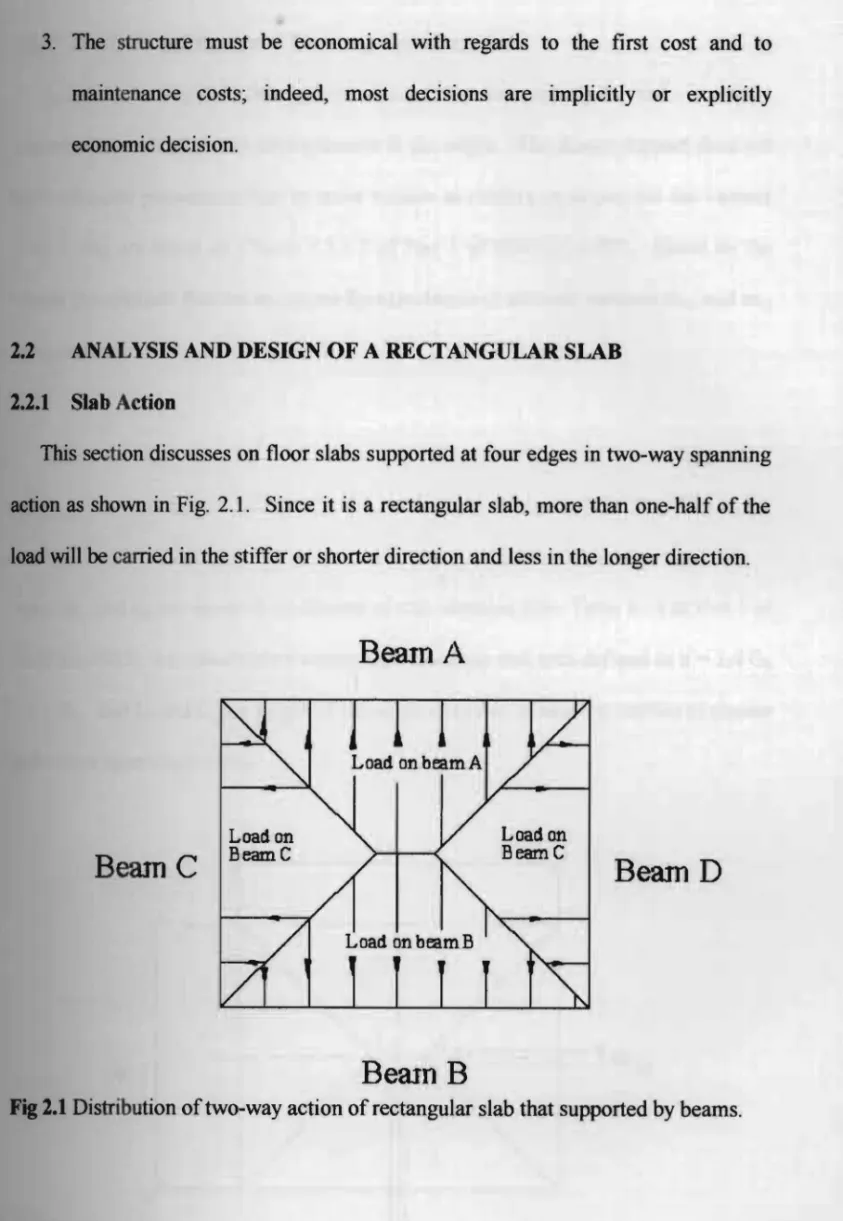
This section discusses on floor slabs supported at four edges in two-way spanning action as shown in Fig. 2.1. Since it is a rectangular slab, more than one-half of the load will be carried in the stiffer or shorter direction and less in the longer direction.
Beatn A
Beam C Beam D
Load on
BeamC
Load on
BeamC
Bearn B
Fig 2.1 Distnbution of two-way action of rectangular slab that supported by beams.
5
Ul ADalysis and Design of Two-way Spanning Slab
Referring to Fig 2.1, taking into account that the rectangular slab is simply 8UppOrted at each edge and discontinuous at the edges. The design support does not have adequate provision either to resist torsion at comers or to prevent the comers from lifting are based on Clause 3.5.3.3 of Part 1 of BS8110 (1985). Based on the clause, it is defined that the equations for calculation of ultimate moment msx and mxy are given as~
_ T 2
msx - Usx n .LJx. (2.1)
msy = Usy n Ly2 (2.2)
where Osx: and
«sy
are moment coefficient of slab obtained from Table 3.14 of Part 1 of 8S8110 (1985); n is the ultimate expressed in load per unit area defined as n = 1.4 Gk+ 1.6~; and
Lx
and Ly are length of the edges in action in which it implies to shorter and longer span respectively.Lx
Ly
/ /
/ /
,..1.2 Location of maximum moment.
6
The equation is given as;
per unit area (N / mm
I mm
Referring to Fig 2.2, tension reinforcement can be designed based on Clause 3.4.4.4 of Part 1 of BS811 0 (1985). The design of tension reinforcement of a slab is similar to design formulae for a rectangular beam. The following equations are based on simplified stress diagram in Figure 3.3 of Part 1 ofBS811O (1985).
Take K' as a reference for design constant in which it is expressed as;
K' = 0.156 if redistribution does not exceed 10% or
K' = 0.402 (Pb -0.4) - 0.18(~b -O.4i if redistribution exceeds 10%
(2.3)
where K is the design constant, M is the ultimate moment per unit area, b is the width of the slab, d is the effective depth,
i::u
is the concrete strength expressed in Newton2).
K< K', compression reinforcement is not required then,
Leverann,Z
=
d [0.5 + v (0.25 - K/0.9)]< 0.95d
Therefore the steel required for reinforcement is stated as follow;
As = -0.87fyZ - M (2.4)
A.
is the area of steel reinforcement; fy is the strength of steel reinforcement in2; Z is the lever arm.
7
Similarly,
l.l.3
dooe when
IfK> K', compression reinforcement doubly reinforcement is required,
Leverarm,Z = d [0.5 +v (0.25 - K/0.9)]
<0.95d
Therefore the total required steel reinforcement area is defined as;
As'
=
(K - K' ) feu b d 20.87fy(d-d') (2.5)
where d is the effective depth for tension reinforcement and d' is the effective depth for compression reinforcement.
Then total steel area if compression reinforcement is required is;
As
=
M + As'0.87fyZ (2.6)
Sbear Reinforcement
When shear stresses based on a normal loads is not critical, shear reinforcement resisting shearing force is not required. The application of shear reinforcement is a thick slab is heavily loaded and the thickness exceeds 200mm.
Cbeckingfor shear reinforcement is based on Clause 3.5.5 of Part 1 ofBS811O(l985).
Nominal
design shear stress is defined as;v=
v
bd (2.7)
V is the shear force due to design ultimate load or concentrated load.
8