DRIVER FATIGUE ACCIDENT PREVENTION USING EYE BLINK SENSOR
By:
SITI ROSMA AZIZAN
FINAL PROJECT REPORT
Submitted to the Department of Electrical & Electronic Engineering In Partial Fulfillment of the Requirements
for the Degree
Bachelor of Engineering (Hons) Electrical & Electronic Engineering
Universiti Teknologi PETRONAS Bandar Seri Iskandar
31750 Tronoh Perak Darul Ridzuan
Copyright 2013 by
SITI ROSMA AZIZAN, 2013
CERTIFICATION OF APPROVAL
Driver Fatigue Accident Prevention using Eye Blink Sensor
By:
Siti Rosma Azizan
A project dissertation submitted to the Department of Electrical & Electronic Engineering
Universiti Teknologi PETRONAS In partial fulfilment of the requirement for the
Bachelor of Engineering (Hons) (Electrical & Electronic Engineering)
Approved:
__________________________
Dr Noohul Basheer Zain Ali Project Supervisor
UNIVERSITI TEKNOLOGI PETRONAS TRONOH, PERAK
MAY 2013
CERTIFICATION OF ORIGINALITY
This is to certify that I am responsible for the work submitted in this project, that the original work is my own except as specified in the references and acknowledgements, and that the original work contained herein have not been undertaken or done by unspecified sources or persons.
__________________________
SITI ROSMA AZIZAN
i
ABSTRACT
This paper proposes a way to detect the level of fatigue among drivers through detection of eye blinks. Fatigue or tiredness is one of the main factors that cause road accidents. Drivers who are not fit to drive a car due to fatigue may lose focus and make poor judgments while driving and consequently cause road accidents. By detecting parameters such as the duration of eye closure and reopening during blinks, drivers will realize whether they are in a fatigue condition or not. This project is done by performing data collection through previous researches. The algorithms will be modified and implemented to validate the system. A camera will be used to locate the face and narrow the scope further down to the eye region. After extracting the eye region, the algorithm will be used to detect the duration of each eye blinks in order to detect fatigue.
ii
ACKNOWLEDGEMENTS
First and foremost, I would like to express my greatest gratitude to Allah S.W.T, for His blessings and guidance throughout the process of completing this final year project. Also, my deepest gratitude goes to Dr Noohul Basheer Zain Ali for the opportunity to be under his supervision. It was a precious opportunity and experience to work with such great expertise. Without his support and guidance, I will not have been able to progress with this project and face all the challenges that have surfaced.
I would also like to express my appreciation towards Universiti Teknologi Petronas (UTP) and Electrical and Electronic Engineering Department for preparing me with adequate knowledge and skills to be applied in this project. Also, I would like to thank all my family and friends for their constant and continuous support and help in doing this project. Last but not least, I would like to thank my parents for equipping me for this world and giving me the best that they could have evengiven. Without them, I would not have achieved all that I have today.
iii Table of Contents
ABSTRACT ... i
ACKNOWLEDGEMENTS ... ii
CHAPTER 1 ... 1
INTRODUCTION ... 1
1.1 Background Study ... 1
1.2 Problem Statement... 1
1.3 Objectives & Scope of Study ... 2
1.4 The Relevancy of the Project ... 2
1.5 Feasibility of the Project ... 3
CHAPTER 2 ... 4
LITERATURE REVIEW ... 4
2.1 Fatigue ... 4
2.2 Drowsy Driving ... 4
2.3 Devices to Detect Fatigue Level ... 5
CHAPTER 3 ... 9
METHODOLOGY ... 9
3.1 Research Methodology and Project Activities ... 9
3.2 Key Milestones ... 12
3.3 Tools ... 12
3.4 Gantt Chart ... 14
CHAPTER 4 ... 16
RESULT AND DISCUSSION ... 16
4.1 Data Gathering and Analysis ... 16
4.2 Experimentation & Modeling ... 17
CHAPTER 5 ... 21
CONCLUSION ... 21
CHAPTER 6 ... 22
REFERENCES ... 22
iv Table of Figures
Figure 1: General View of the Helmet with Cameras ... 6
Figure 2: Example of Block Diagram for Blink Detection ... 8
Figure 3: Methodology for Research Project ... 9
Figure 4: TrackEye v2.0 ... 12
Figure 5: Face Detection ... 17
Figure 6: Eye Detection ... 17
Figure 7: Cascade of Classifiers... 18
Figure 8: Fuzzy Logic Function Editor ... 19
Figure 9: Fuzzy Logic Rule Editor ... 20
1
CHAPTER 1 INTRODUCTION
This section will discuss on the basic information that is related to the issue, which is the phenomena of drivers driving in a fatigue condition. This section will focus on the causes and effects of this condition and how to overcome this problem. This topics included in this section are background study, problem statement, objectives and scope of study, the relevancy and feasibility of the project.
1.1 Background Study
Traffic accidents are caused by various factors such as condition of the road, weather, and behavior of drivers, impairment, distraction and many more. Based on statistics, fatigue driving is one of the main causes of accidents. Driving in a fatigue condition may result in many terrible consequences since it affects the driver’s judgments and concentration. Therefore, detecting the level of fatigue in drivers is vital in order to prevent road accidents. Once detected, stimulation is needed to simply wake the driver up and make him gain his consciousness and full attention back to the road.
Many devices that are already available in the market have proven to be useful in detecting fatigue and weariness among drivers. In order to do so, there should be a significant detail on the driver that can indicate the level of fatigue. Slow movement of eyelids during blinking is one of the obvious signs of tiredness and can be used to monitor fatigue level. The opening and closure of the eyes can be detected using infrared cameras and a soft alarm can be linked to stimulate the drivers.
1.2 Problem Statement
Drowsy or fatigue driving is a condition where drivers are exhausted and tired but still continue driving their vehicles. Driving in a fatigue condition can affect the attention span of drivers. This might cause drivers to accidentally doze off during driving, thus causing road accidents affecting the driver and also the vehicles around.
2
A device is needed to detect a significant feature of the driver to indicate the level of fatigue and further wake the driver.
1.3 Objectives & Scope of Study
The objectives and scope of study will set the aim and target of this research from the beginning. These objectives will help to guide the author in the process of completion of the project. A successful project is one which achieved all the desired goals which have been decided at the beginning of the project.
1.3.1 Objectives
This project focuses on three main objectives, which are:
a) To detect the fatigue using eye blinks
b) To regain consciousness and full attention of drivers c) To reduce road accidents caused by fatigue
1.3.2 Scope of Study
This project aims to experimentally detect the drowsiness of drivers based on the eye blinks that indicate fatigue. With this device, road accidents can be reduced in a way that drivers are alerted when they are sleepy and need some break from driving. This project is
a) To perform data collection through experiments b) To design and implement the algorithm using software c) To test the performance of the algorithm on human subjects
1.4 The Relevancy of the Project
This project is relevant to the implementation since human errors hold a large percentage in the causes of road accidents. Since fatigue drivers contribute to the percentage of road accidents, many researches are conducted to implement safe driving systems in order to reduce road accidents. Detecting the driver’s alertness and drowsiness is an efficient way to prevent road accidents. With this invention,
3
drivers who are dozing off will be alerted by a simulating alarm to regulate consciousness, attention and concentration of the drivers. This will help to reduce the number of road accidents. This project is an active topic that is still being enhanced and improved by researches and can be applied in many areas such as detecting the attention-level of students in classrooms and lectures. This is also relevant to the author’s field of study since it requires the author to apply and combine the knowledge of electronics, programming and algorithms.
1.5 Feasibility of the Project
This project will be completed according to the stipulated time frame given. The author is given two semesters to complete this project. The first semester is allocated for planning and research on the project itself. During the second semester, the author needs to design the project, implement and test the algorithms and techniques that have been decided on the previous semester. This will be the semester where the outcome of this project is visible.
4
CHAPTER 2
LITERATURE REVIEW
This section discusses on the previous findings and current knowledge related the topic. These findings include the theoretical and methodological elements of this topic. This section covers published papers by accredited scholars and researches.
Literature review helps in gathering information on the background and the development of the technology related to the topic.
2.1 Fatigue
“Fatigue” according to the Merriam-Webster Dictionary [9] is defined as “weariness or exhaustion from labor, exertion, or stress” or “the temporary loss of power to respond that is induced in a sensory receptor or motor end organ by continued stimulation”. This feeling of tiredness and sleepiness can be caused many factors such as stress, sleeping disorders, extra hours at work, family obligations and many more. Sleeping is a vital part of human beings. The urge to fall sleep becomes greater when someone is forced to restrain the feeling of sleepiness [10].
Based on a study on eye blinks in a normal and fatigue state [17], it is shown that eye blink parameters are divided into blink duration which includes closing time of eyelids and the reopening time. At an average record, the blink duration of a normal individual is 202.24ms while the blink duration of a fatigue individual increases by about 50ms. At the same time, the closing time and the reopening time of a fatigue individual are also longer compared to a normal alert individual. These parameters are used to detect the fatigue level among drivers.
2.2 Drowsy Driving
According to the National Sleep Foundation’s Sleep in America poll on 2005 [11], about 60% of American citizens have had the experience of driving while feeling sleepy, while another 37% have admitted to falling asleep on while driving. This worrying figure is clear evidence that fatigue and drowsiness are affecting drivers nowadays. The society is fed with precautions to not drive under the influence of drugs or alcohol as this can lead to road accidents. However, people do not realize
5
that fatigue can also contribute to road accidents. This is because fatigue or tiredness will reduce the reaction time, concentration and attentiveness of someone who is performing activities that are attention-based, in this case, driving a motor vehicle.
This will further lead to poor, slower judgment and decision-making [12].
2.3 Devices to Detect Fatigue Level
Studies have been conducted to decide on the best significant parameter to detect the level of drowsiness and fatigue. Some of the proposed factors are physiological variables, driving performance measures and eye blinking [1]. Devices that are available in the market now focus on the same aim which is to ensure that the drivers do not fall asleep while driving. However inventors are creative enough to come up with various types of devices to suit the comfort and convenience of driver. An example is “Nap Zapper” [13] which is a device that is placed behind the driver’s ear like an earpiece. This device will monitor the angle of the driver’s head while driving. If the driver is dozing off, the head will tilt forward and this earpiece will alert the driver by giving off alarm signals. Then again, this device is detecting drivers who have fallen asleep rather than those who are still in process of falling asleep.
Most of other studies focus mainly on the movements of the eyes. Since the eye activity is closely related to the level of drowsiness, therefore it generates the idea of producing a device to detect fatigue among drivers. Level of fatigue among drivers can be detected by observing the opening and closure of eyelids during blinking [2].
Fatigue detection requires a few sequences of process such as face detection, eye movements and blink patterns using eyelids detection. Firstly, the entire face will be detected wholly by the camera. Next, the frame will narrow down to the eye region.
Once the eye’s corners location is detected, the state of the eyes and the eyelids will be analyzed. Some properties that are considered are the distance between the two eyelids and the parallel alignment of the two eyes [3].
Many early studies have been done in order to focus on certain parts of the facial expression. Studies by Poggio and Brunelli have shown that there are various techniques for facial recognition using computers. The two main focuses are feature- based matching and template-based matching. Feature-based matching or geometric
6
matching limits on specific facial features such as eyes, nose and mouth while template-based matching compares the actual image with a template that signifies the entire face [4].
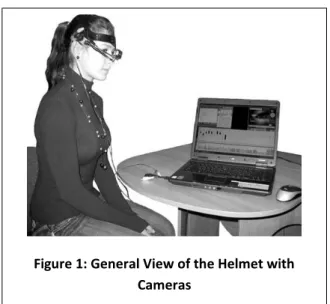
There are a few researches that have been done to solve this problem. Devices have been invented to detect fatigue level using eye blinks. Some existing devices require users to wear a specific spectacle frame [5] that has no physical contact with the users and a special helmet [6]. Both devices have been mounted with cameras to detect eye blinks. These devices are inconvenient since the users have to wear them all the time in order to detect eye blinks. Furthermore, if the users are aware that they are being tested, the psychological influence will cause abnormalities to the blinking pattern.
Another device is invented which is physically-free from the user himself. This device includes an infrared (IR) pan-tilt camera that is located in front of the user to detect the eyes [7]. Since there is no physical contact between the user and the device, therefore the user will not be concentrating too much on the test and the result will be under normal environment and circumstance. However, this approach uses an expensive hardware which is not affordable for all users.
Figure 1: General View of the Helmet with Cameras
7
In the process of detecting the blinking of the eyes, the entire face is commonly detected and subsequently the eye region [8]. This process takes a longer time because the face is made up of different features, not only eyes, but also mouth, nose and so on. Algorithms such as Haar function [14] and Viola-Jones [15] technique have been used to detect the movements of eyelids because they are more accurate in differentiating different environments.
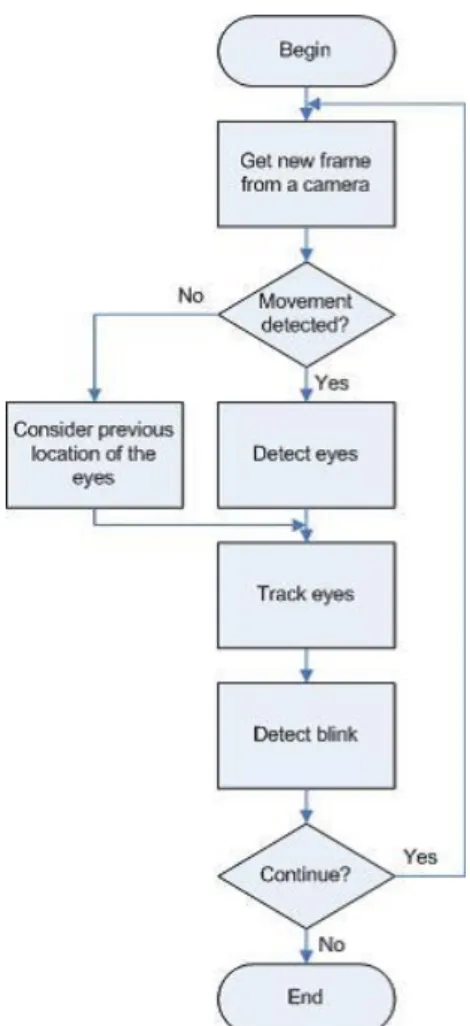
Figure 2 below explains about a basic block diagram in a blink detection process [16]. The process starts with detecting the eyes on a new frame or after a certain movement detected. Each frame focuses on limiting to the areas that detects the presence of eyes, despite the various colors, shapes and sizes. The eyes are detected using algorithms such as Viola-Jones theory [15]. Next, the process of eye tracking functions as an enhancement to the system performance using two different frames.
The blinks will then be detected by comparing the current and previous frames for each of the eyes.
8
There are various softwares that can support the coding that will be used to run the system. For instance, an “eye detection and tracking system” was developed using OpenCV which utilizes the webcam to capture the input [18]. OpenCV provides an easier way to detect faces and eyes with the help of its library of codes. Apart from this software, MATLAB can also be used for the formulation of the algorithms. A system to detect face and eye has also been created using MATLAB which is based on segmentation and the use of image processing toolboxes in the program [19].
Figure 2: Example of Block Diagram for Blink Detection
9
CHAPTER 3 METHODOLOGY
This section covers the tasks, processes and tools related to the completion of this project. It is the analysis of each stage that will be faced in order to implement this project.
3.1 Research Methodology and Project Activities
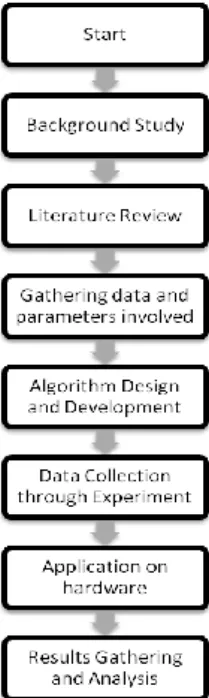
Generally, research methodology refers to a set of procedures that are used to carry out a certain research. In order to complete this project systematically within the stipulated time, there are some methodologies and activities that need to be planned.
Figure 3: Methodology for Research Project
10
3.1.1 Background Study
Before beginning any research or project, the basic information that concerns the topic is needed to ensure that the author completely understands the project. In this case, this stage helps the author to understand about the relationship between fatigue and driving a motored vehicle. It is proven that driving in a fatigue condition can lead to undesirable road accidents. Therefore, the author should come up with a device that is efficient and practical in order to detect the fatigue level of drivers and alert them when they are falling asleep or too tired to drive.
3.1.2 Literature Review
This method involves the study of the previous papers and projects pertaining to the topic. This topic observes the relationship between fatigue and handling a vehicle.
The statistics of road accidents caused by drowsy driving is also recorded. Other than that, a thorough observation was done on the existing devices that are used to detect the level of fatigue among drivers. Different parameters have been used to achieve this such as eye blinks and the position of the head while driving. By focusing on one parameter, which is detecting eye blinks, helps to narrow down the perspective of this project.
3.1.3 Data Gathering and Analysis
In this stage, it has been found that one of the best ways to detect eye blinks is by using algorithms. Therefore, several of current algorithms that are related to this project are reviewed to help develop this project. Also, data on human blinks are also analyzed. A human blink is made up of closure of eyelids and reopening of eyelids.
Human blinks are categorized into two, which are voluntary blinks and involuntary blinks. Voluntary blinks happen when one eye is closed while another one remains open. Involuntary blinks are the normal blinks where usually both the left and right side of the eyes are closed at the same time. Based on researches on human eye blinks, it has been identified that the average human blink duration takes about 202.24ms while the blink duration of a fatigue individual takes about 258.57ms.
Usually, in order to detect the eyes, the entire face needs to be detected first before narrowing down to the eye region. However, this step will reduce the performance and the speed of the system. Therefore, this project is aimed to directly localize the
11
eye region instead of the whole face. This method helps to speed up the performance and be more precise. This system will detect the eyes and localize on the eye region.
Next, it will detect the eye closure as a parameter to determine fatigue, and further on detect the eye blinks.
3.1.4 Algorithm Design and Testing
After defining the feature extraction method and feature classification, the algorithm design and development should be carried out to suit the specifications. This system will be tested out using the algorithm and the result will be collected through experiments related to the project. Cascades of boosted classifiers which are based on Haar-like features are used in the process of localizing the eye region. This method helps to detect the eye region in a faster manner. As for the blink detection, signal processing methods such as frame differencing and image threshold are very important in detecting the closure of the eyes. Frame differencing refers to the dissimilarity in two consequent frames while observing a real-time image. If there is a change in the pixels of the two frames, it shows that there is a change in the two images. Applying this method to the project, two consecutive frames of the eye region will be observed to see if there are any changes in the eye closure. If there is not much difference between the images, the processing will proceed only on the eye region. On the other hand, image threshold is the process of digesting and interpreting the image that has been obtained. This step involves methods such as conversion of images into grayscale and binary image for further processing.
3.1.5 Application on Hardware and Result Gathering
Once the system is working, it will be tested out on test subjects to ensure its functionality and practicality. The results are gathered and analyzed. A normal laptop with a webcam will be used as hardware for this project. If the need arises, another USB camera will be used to compare the accuracy of the camera in terms of frame per second (fps). The normal USB cameras are used because project intends to use a less costly hardware to make it more affordable. In order to compensate for this, the algorithm that is used to detect the eyes are improved by using cascaded classifiers and the software is also enhanced for it to be able to process the image in real time.
12
3.2 Key Milestones
A few key milestones for this research project are vital in to ensure that all objectives of this project are achieved. The main aim of this project is to detect fatigue level using blinking rates. Algorithms are used to detect the face and eyes of the test subjects. Therefore, the first key milestone is to review all of the current algorithms that are being used today to detect eye blinks. The second key milestone is to complete the review of algorithms. This can be done by studying the research papers, reports and findings of all the previous studies. The third key milestone is to implement the algorithm in the software to ensure that they are compatible. The last key milestone is to test out the program to ensure its functionality.
3.3 Tools
A few tools have been used to detect the face and further extract the eye region.
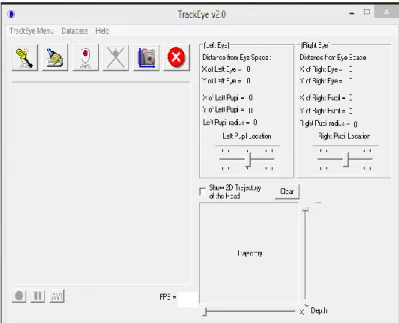
3.3.1 TrackEye v2.0
- This software is used to localize the face and later on focus on the eye region.
It is able to detect the left eye and the right eye together with the pupils.
However, it is not efficient enough to detect the eye blinks.
Figure 4: TrackEye v2.0
13
3.3.2 Microsoft Visual Studio 2012
- Functions as a base to formulate the algorithm and system to detect eye blinks and relate it to the camera.
- Includes a code editor which various programming languages including C/C++
3.3.3 Built-in web camera
- Used as a tool to capture images of the driver’s face before narrowing it down to the eye region and the eyelids.
3.3.4 Open Source Computer Vision Library (OpenCV)
- A library of programming functions in different programming languages such as C++
- Focuses on real-time image processing to capture the rapid eye blinks of human eyes
3.3.5 MATLAB
- Used as one of the means to implement algorithm for eye blink detection system
- Compatible for various programming languages such as C, C++, Java
14
3.4 Gantt Chart
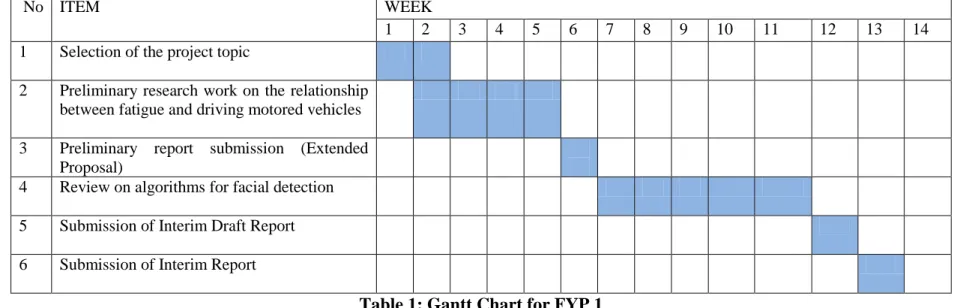
No ITEM WEEK
1 2 3 4 5 6 7 8 9 10 11 12 13 14
1 Selection of the project topic
2 Preliminary research work on the relationship between fatigue and driving motored vehicles 3 Preliminary report submission (Extended
Proposal)
4 Review on algorithms for facial detection 5 Submission of Interim Draft Report 6 Submission of Interim Report
Table 1: Gantt Chart for FYP 1
15
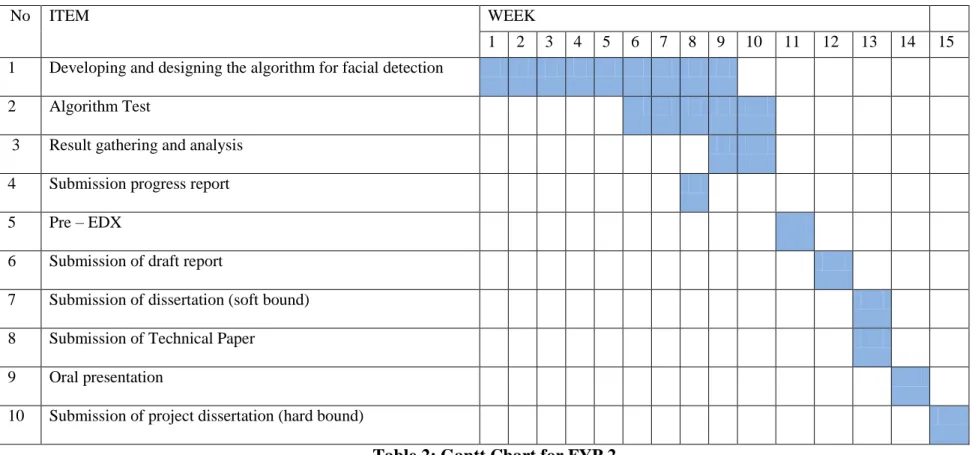
No ITEM WEEK
1 2 3 4 5 6 7 8 9 10 11 12 13 14 15
1 Developing and designing the algorithm for facial detection 2 Algorithm Test
3 Result gathering and analysis 4 Submission progress report
5 Pre – EDX
6 Submission of draft report
7 Submission of dissertation (soft bound) 8 Submission of Technical Paper
9 Oral presentation
10 Submission of project dissertation (hard bound)
Table 2: Gantt Chart for FYP 2
16
CHAPTER 4
RESULT AND DISCUSSION
4.1 Data Gathering and Analysis
In earlier stages of this project, it has been planned to utilize Microsoft Visual Studio to formulate the algorithm for the system. The remaining of FYP 1 time period and the first two weeks of FYP 2 are spent on working on the coding for the system. A few attempts to run the code using Microsoft Visual Studio have been done and the result is not very convincing. Due to time constraint issue, the coding cannot be completed and compiled fully. Furthermore, the laboratories in this institution are not familiar with this software, thus making it harder to proceed. Therefore, the author has opted to another alternative, which is using MATLAB as a platform to carry out the algorithms to detect eye blinks.
Using MATLAB, there a few toolboxes that have been stored in the software itself to ease the process of compiling the codes. For example, Fuzzy Logic Toolbox in MATLAB can be used to demonstrate systems with logic rules and apply these rules to the fuzzy system. Instead of being restraint to binary sets of outputs (0 or 1; true or false), fuzzy logic provides a broader range of logic which develops from approximation. As for this eye blink detection system, fuzzy logic helps to widen the fatigue level of drivers. Instead of being rigid to just sleepy and not sleepy, fuzzy logic enables the author to categorize the fatigue level to a few stages, such as normal, drowsy, very drowsy and asleep.
17
4.2 Experimentation & Modeling
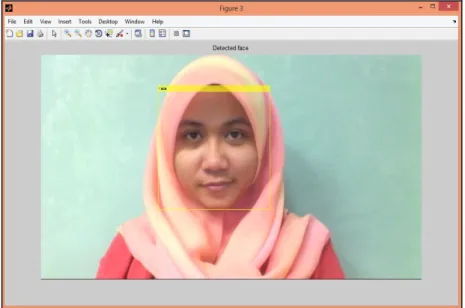
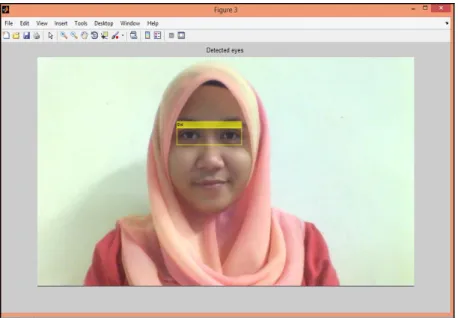
There are two types of input that can be used, which are real-time images and input video. Using a set of coding, the system is able to link the built-in web camera with the system in order to capture real-time images of drivers. The real-time images are captured frame by frame, making it possible to detect any changes in the eye region from one frame to the consequent frame. These are a few examples of real-time face and eye detection.
Figure 5: Face Detection
Figure 6: Eye Detection
18
These facial features are detected using MATLAB’s Computer Vision System Toolbox which uses Viola-Jones algorithm cascade object detector.
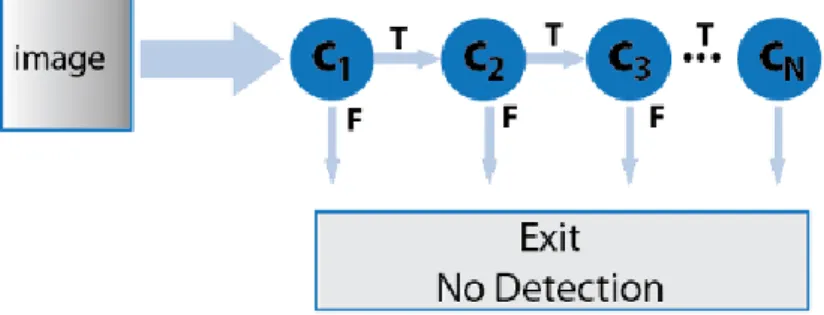
Figure 7: Cascade of Classifiers
Each model in this toolbox is able to detect specific type of object. Features are extracted from known images and are fed into Viola-Jones cascade object detector algorithm. This detector also includes Haar-like features. The cascade of classifiers is used to process the image region efficiently to locate the target object, in this case, the eye region. The complexity of the binary classifiers increases as the stage of cascade proceeds further on. This enables the algorithm to eliminate the unwanted areas which do not contain the eye region. The detector will immediately reject the region if the eye region is not found at any stage in the cascade of classifiers.
Consequently, the processing will also be halted.
Another type of input that can be used is input video. Video is prerecorded firsthandedly before being fed into the system. The same concept is used except that it is not in real time.
19
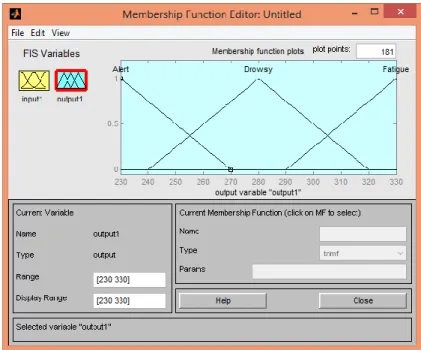
Fuzzy Logic Toolbox in MATLAB enables the user to design fuzzy inference systems and define the rules for all logic, regardless of AND, OR and NOT. In this project, the range of fatigue level is used to test the alertness of drivers according to the blink duration of the drivers. Fatigue levels are classified into three which are alert, drowsy and fatigue. These levels or categories can be altered according to the condition of the eyes.
Figure 8: Fuzzy Logic Function Editor
20
A set of rules are set to ensure that the system is able to detect the accurate level of fatigue. For example, if the blinking duration is 230ms, it is considered as alert, while blinking duration of 280ms is considered as drowsy and blinking duration of 330ms is considered as fatigue. If fuzzy logic is not used, any readings in between these set points will not be considered. These set of rules can also be established with the use of the toolbox in MATLAB.
Figure 9: Fuzzy Logic Rule Editor
21
CHAPTER 5 CONCLUSION
This paper is focused on monitoring the level of fatigue among drivers by detecting the rate of eye blinks. A web camera based system is used to detect the eye region.
The opening and closure of the eyes will be identified. The blink duration of the drivers is observed, including the closing time and the reopening time. Involuntary and voluntary blinks will be differentiated using algorithm to monitor the level of fatigue. Therefore, drivers can regain their consciousness and avoid car accidents.
For future work, the speed of the system can be improved. The speed of MATLAB alone is not enough to perform the process of eye tracking for real-time recognition.
Therefore, other programming languages such as C or C++ can be used alongside with Microsoft Visual Studio.
22
CHAPTER 6 REFERENCES
[1] M. S. Bhuiyan, "Driver Assistance Systems to Rate Drowsiness: A Preliminary Study," New Advances in Intelligent Decision Technologies, Studies in Computational Intelligence Series Vol. 199, ISBN 9783642009082, Springer, pp. 415-425, 2009
[2] A.J. Stern, D. Boyer, D. Schroeder, “Blink Rate: A Possible Measure of Fatigue. Human factors,” The Journal of the Human Factors and Ergonomics Society, vol. 36, no. 2, pp. 285-297, June 1994.
[3] M. Eriksson, & N.P. Papanikotopoulos, “Eye-tracking for Detection of Driver Fatigue”, Proceedings of the 1997 IEEE Conference on Intelligent Transportation Systems, Boston, 9-12 November, pp. 314-319, 9-12 November 1997.
[4] R. Brunelli and T. Poggio, “Face Recognition: Features versus Templates,”
IEEE Transactions on Pattern Analysis and Machine Intelligence, Vol. 15, No. 10, pp. 1042–1052, 1993.
[5] M. Bologna, R. Agostino, B. Gregori, D. Belvisi, D. Ottaviani, C. Colosimo, G. Fabbrini and A. Berardelli, “Voluntary, spontaneous and reflex blinking in patients with clinically probable progressive supranuclear palsy”, Oxford University Press, vol. 132, n 2, 2009, pp.502-510.
[6] D. A. Usanov, N. M. Romanova, A. V. Skripal’, A. Yu. Vagarin, A. P. Rytik, and M. A. Samokhina, “A Method for Assessment of the Psycophysiological State”, RF Patent No. 2337607, 2008.
[7] Y. Kurylyak, F. Lamonaca G. Mirabelli, O. Boumbarov, S. Panev, “The Infrared Camera-Based System to Evaluate the Human Sleepiness”, Proc.
IEEE International Workshop on Medical Measurements and Applications, MeMeA2011, pp. 253-256, May 2011.
23
[8] A. Cristiani, M. Porta, D. Gandini, G.M. Bertolotti, N. Serbedzija, “Driver drowsiness identification by means of passive techniques for eye detection and tracking,” Proc. 4th IEEE International Conference on Self-Adaptive and Self-Organizing Systems, pp.142-146, 2010.
[9] “Fatigue – Definition and More from the Free Merriam-Webster Dictionary”.
Internet: http://www.merriam-webster.com/dictionary/fatigue [Feb. 16, 2013]
[10] NCSDR/NHTSA Expert Panel on Driver Fatigue & Sleepiness; Drowsy Driving and Automobile Crashes, Report HS 808 707, 1998.
[11] National Sleep Foundation. “Facts and Stats: Drowsy Driving – Stay Alert, Arrive Alive”. Internet: http://drowsydriving.org/about/facts-and-stats/ [Feb 16, 2013]
[12] The Royal Society For The Prevention of Accidents; Driver Fatigue and Road Accidents, A literature Review and Position Paper, 2001.
[13] “Nap Zapper”. Internet: http://napzapper.com/ [Feb 17, 2013]
[14] C. Papageorgiou, M. Oren, and T. Poggio, “A General Framework for Object Detection,” International Conference on Computer Vision, 1998.
[15] P. Viola, and M. J. Jones, “Rapid Object Detection using a Boosted Cascade of Simple Features,” Proc. IEEE CVPR, 2001.
[16] Kurylyak, Y.; Lamonaca, F.; Mirabelli, G.; , "Detection of the eye blinks for human's fatigue monitoring," Medical Measurements and Applications Proceedings (MeMeA), 2012 IEEE International Symposium on , vol., no., pp.1-4, 18-19 May 2012.
[17] P. P. Caffier, U. Erdmann, P. Ullsperger, “Experimental evaluation of eye- blink parameters as a drowsiness measure”, Federal Institute for Occupational Safety and Health, pp.319-325, March 2003.
[18] Nash, D. (2012, Dec 21). “Eye Detection and Tracking.” Retrieved January 3, 2013, from http://opencv-code.com/tutorials/eye-detection-and-tracking/
24
[19] UCAK, M. (2007, Jan 19). “Face & eye detection”. Retrieved May 13, 2013, from http://www.mathworks.com/matlabcentral/fileexchange/13716-face- eye-detection