Integrated Talent Management System for Customer Service Workforce
by
Rabiatul Adawiyah binti Ahmad
Dissertation submitted in partial fulfilment of the requirements for the
Bachelor of Technology (Hons) (Business Information System)
JANUARY 2011
Universiti Teknologi PETRONAS Bandar Seri Iskandar
31750 Tronoh Perak Darul Ridzuan
CERTIFICATION OF APPROVAL
Integrated Talent Management System for Customer Service Workforce
(Dr. Alan Giffin Downe) Senior Lecturer,
by
Rabiatul Adawiyah binti Ahmad
A project dissertation submitted to the Business Information System Programme
Universiti Teknologi PETRONAS in partial fulfilment of the requirement for the
BACHELOR OF TECHNOLOGY (Hons) (BUSINESS INFORMATION SYSTEM)
Department of Management & Humanities.
UNIVERSITI TEKNOLOGI PETRONAS TRONOH, PERAK
January 2011
CERTIFICATION OF ORIGINALITY
This is to certify that I am responsible for the work submitted in this project, that the original work is my own except as specified in the references and acknowledgements, and that the original work contained herein have not been undertaken or done by unspecified sources or persons.
RABIATUL ADAWIYAH BINTI AHMAD, BUSINESS INFORMATION SYSTEM, UNIVERSITI TEKNOLOGI PETRONAS.
ABSTRACT
Call center agents performance nowadays becomes one of the key success factors that determine the call center business goals. Not all call centers aware those agents' personal attributes also contribute to the organization image and performances. As a result, organizations often miss an opportunity to gain competitive advantage in their business process. Thus, the objective of this project is to model, design and develop an integrated web based application that can assess and record agents' personal development and work attributes while at the same time allowing supervisors to communicate about work performances. Each organization has its own business objectives that need to be met where can only be met through a comprehensive ways that effectively manages an organization's talent. This concern should be focus more on customer service industry because they consist of agents that deliver service to customer along the time.
This project discussed on human resource management constraints which in terms of call center agents' personal development attributes and performances in call center. Therefore, this project had proposed one solution by providing an integrated web based application to assess agents' personal development and at the same time enhance internal communication levels called Integrated Talent Management System. Not only that, this report also discussed benefits on Talent Management System to customer service organization and existing criteria on current Talent Management System. Some characteristics and function have been identified to build and enhance the problem. There is also a section that talks on current customer service industry environment. There are two types of methodology for this project which are system methodology and research methodology. Incremental model is the most appropriate methodology approach for this project. Observation, informal interview and document reviews method are the key activities have been used to implement User Needs Assessment as well as to gather information. Gantt chart has been created whereby to assist and monitor the project timeline and key milestone.
There is also a section that describe on the tools that will be used in order to develop this project.
There is a discussion that discussed on the current practice of performance appraisal assessment and inbound reporting structure environment for this project Industry Partner. Functional modeling Diagrams had been developed to make the requirements looks clearer. Testing analysis has been conducted to get feedback from the user. Several recommendations and future works plans had been discussed too. Therefore, by having an integrated talent management system, the
author hope project objective can be achieved where it can assess and record agents' personal development and work attributes while at the same time allowing supervisors to communicate about work performance. Thus, an organization can have proper human resource management that will result in ease for the organization to achieve its business goals.
ACKNOWLEDGEMENT
First and foremost, thank God for this opportunity and seeing me through some truly difficult times especially through the journey of this project. I would like to express my warmest gratitude and appreciation to all parties who have contributed towards the success of my final year project.
This special thanks and appreciation also dedicated to my supervisor, Dr. Alan Giffin Downe for his continued support, guidance and contribution to the success of the project. With the full cooperation from the various people above, I have successfully achieved the project objective. I would like to express my full appreciation towards General Manager of SRG Asia Pacific Sdn Bhd, Mr. Byron Fernandez because has given me an opportunity to be at his company and feel the real situation in gathering user requirement. Thanks to Ms Sabrina Haris (Assistant HR Manager, SRG Asia Pacific) for her information regarding personal development attributes and many more. My thanks also go to my parents for their moral supports to me. My acknowledgement would be incomplete without giving credits to UTP, especially CIS Department who has equipped students with essential skills for self-learning. Its well-grounded graduate philosophy has proven to be useful. Finally my appreciation goes to my fellow friends who helped me throughout this project.
TABLE OF CONTENTS
CERTIFICATION ... l1' ABSTRACT ... HI'
ACKNOWLEDGEMENT ... v
LIST OF FIGURES... i'l<: LIST OF TABLES ... , 'I' ABBREVIATIONS AND NOMENCLATURES ... ~~ CHAPTER! INTRODUCTION ... ! Ll Background of Study ... , ... , .. , ... J 1.2 Problem Statement ... ,, .. , ... ,, ... , ... ,,, .. , .. ,,,,,,,,,, ... ,,, .. , .2
L2 J Problem Identification ... ____ , ... , , , , , , , , , 2
L2.2 Significant of the project.. ... , ... , ... .4
1J Objective ... , .... , ... .4
L4 ScopeofStudy... ____ ···--- ... A L5 Relevancy ofthe Project. ... , ... , .... , ... 5
L6 Feasibility of the Project within the Scope and Time Frame ... 6
L7 Industry Partner. ... , ... 6
CHAPTER2 LITERATURE REVIEW ... 7
2J Introduction ... , .. , .. , ... , ... , ... , ... 7
2.2 Customer Relationship Management (CRM) ... 8
2.3 Customer Service Industry ... , ... , ... 8 2.4 How Talent Management System benefits Customer
Service Organizations ... , ... , .. , .. , .. , ... J 0 2.5 Previous Implementation .. , , ... , ... , ... 1 0
2.5.1 Analysis on Oracle Human Resource Management
System (HRMS) ... 11
2.5.2 Analysis on Taleo Talent Management System .... .12
2.6 Characteristics oflntegrated Talent Management System (ITMS) ... 13
CHAPTER3 METHODOLOGY ... 15
3.1 System Methodology ... .15
3 .1.1 Planning Phase ... .16
3 .1.2 Analysis Phase ... 16
3 .1.3 Design Phase ... .18
3 .1.4 Implementation Phase ... 19
3.2 Research Methodology ... .21
3.2 1 Observation ... 22
3.2.2 Informal Interview ... 22
3.2.3 Document Reviews Method ... 23
3.3 Project Gantt chart ... 24
3.4 Tools ... 25
3.5 Key Milestone ... 28
CHAPTER4 RESULT AND DISCUSSION ... 29
4.1 Current Performance Appraisal practice ... .29
4.2 SRG Asia Pacific Call Center Environment ... 31
4.3 Personal Development Attributes ... .33
4.4 Functional Modeling Diagrams ... 34
4.5 Data Flow Diagram ... .38
4.6 Application Interfaces ... .39
4.7 Project Testing ... 39
CHAPTERS
CHAPTER6
REFERENCES APPENDIX 1 APPENDIX2 APPENDIX 3
4.7.1 Project Testing ... 39
4.7.2 Analysis of the Project Evaluation ... .40
4.7.2.1 Ease ofUse ... 41
4.7.2.2 Educational content of the application.42 4.7.2.3 Presentation/organization content ... 43
4.7.2.4 User Interaction ... 44
4.7.2.5 Technical Presentation ... .45
4.7.2.6 Average Rating for each Criterion ... .46
RECOMMENDATIONS ...⢠48
CONCLUSION ...â¢....â¢... 49
0 ⢠⢠⢠0 ⢠⢠0 . 0 0 ⢠⢠⢠⢠⢠0 ⢠⢠⢠⢠0 ⢠⢠0 . 0 ⢠⢠⢠⢠⢠0 0 ⢠⢠0 ⢠⢠⢠0 0 0 ⢠⢠0 0 0 ⢠⢠⢠⢠⢠⢠⢠⢠⢠⢠0 . 0 . 0 0 ⢠⢠⢠⢠0 . 0 ⢠⢠⢠⢠⢠51
0 0 . 0 . 0 0 ⢠⢠⢠0 0 ⢠⢠⢠⢠⢠0 ⢠⢠⢠⢠⢠0 . 0 ⢠⢠⢠⢠⢠⢠0 0 . 0 0 ⢠⢠0 0 0 . 0 . 0 0 0 . 0 . 0 ⢠⢠⢠⢠0 0 . 0 . 0 ⢠⢠⢠0 0 0 0 . 0 ⢠⢠⢠⢠⢠55
⢠⢠⢠⢠⢠⢠0 0 ⢠⢠⢠⢠⢠0 ⢠⢠0 â¢â¢ ⢠⢠0 0 ⢠⢠⢠0 0 ⢠⢠⢠⢠⢠⢠⢠0 . 0 0 0 ⢠⢠0 0 0 . 0 0 ⢠⢠0 0 ⢠⢠⢠0 ⢠⢠⢠⢠⢠0 ⢠⢠⢠⢠⢠⢠0 ⢠⢠⢠0 . 0.63
⢠⢠⢠⢠⢠⢠⢠⢠⢠0 ⢠⢠0 ⢠⢠⢠⢠⢠⢠0 . 0 . 0 ⢠⢠⢠0 0 0 0 ⢠⢠0 ⢠⢠0 ⢠⢠⢠⢠⢠0 0 ⢠⢠⢠0 ⢠⢠0 ⢠⢠⢠0 0 0 . 0 ⢠⢠⢠⢠⢠0 ⢠⢠⢠⢠0 ⢠⢠0 0 ⢠⢠⢠64
LIST OF FIGURES
Figure 1: Framework for contact center information systems design ... .3
Figure 2: Call Center Systems Model... ... 9
Figure 3: Oracle HRMS Modules ... 12
Figure 4: Taleo TMS elements ... 13
Figure 5: Holistic view ofHR modules ... 13
Figure 6: Incremental Model. ... 16
Figure 7: Main form ofFileZilla Client... ... 26
Figure 8: Staffs' KPI evaluation ... .31
Figure 9: SRG AP Call Center Environment.. ... .32
Figure 10: ITMS Activity Diagram ... .35
Figure 11: ITMS Use Case Diagram ... .37
Figure 12: ITMS Data Flow Diagram ... 38
Figure 13: Ease of use graph ... ..41
Figure 14: Educational content of the application graph ... .42
Figure 15: Presentation/organization content graph ... 43
Figure 16: User interaction graph ... .44
Figure 17: Technical presentation graph ... 45
Figure 18: Average ratings for each criterion graph ... .46
Figure 19: ITMS main page ... 55
Figure 20: HRM login page ... 55
Figure 21: HRM main page ... .56
Figure 22: Notify all team leader page ... .56
Figure 23: Team leader login page ... 57
Figure 24: Team leader main page ... 57
Figure 25: Team leader profile's page ... 58
Figure 26: My agent list page ... .58
Figure 27: Agents' KPI page ... .59
Figure 28: Personal development attributes result page ... .59
Figure 29: Contact agent page ... 60
Figure 30: Contact HRM page ... 60
Figure 31: Specific agents' login page ... 61
Figure 32: Agents' profile page ... 61
Figure 33: Contact team leader page ... 62
LISF OF TABLES
Table 1: ITMS Project Gantt chart ... .24Table 2: ITMS key milestone ... 28
ABBREVIATION AND NOMENCLATURES
KPI
Key Performance IndicatorHR
Human ResourceHRM
Human Resource ManagementSRGAP
SRG Asia PacificGUI
Graphic User InterfaceBPO
Business Process OutsourcingCRM
Customer Relationship ManagementHRMS
Human Resource Management SystemTMS
Talent Management SystemHCM
Human Capital ManagementITMS
Integrated Talent Management SystemIS
Information SystemCSP
Customer Service ProfessionalQA
Quality AssurancePSB
Performance Score BookCEO
Chief Executive OfficerKBS
Knowledge Based SystemCHAPTER I INTRODUCTION
1.1 Background of StudyCustomer service workforce like call center is a centralized office of a company that answers incoming telephone calls from customers or that makes outgoing telephone calls to customers [1]. It provides services to customers' in order to operate its business. There is no inventory of fmished goods that can be used to buffer production and yet maintain superior service level in current market demand.
In call center, it has several types of employees'. Employee is someone hired by an employer under a contract of employment to perform work on a regular basis at the employer's behest [2]. Usually, call center will divide its employees into two major groups which are management and agents staffs where in each group will consist of many types of small groups again. Management staffs will deals on handling the human resource management, training and development, financial matters and system networking. Otherwise, call center agents groups are divided into inbound and outbound. These agents work in 24 hours and 7 days environments.
In organization, employees' performance is one of the significant measurements that contribute to the organization development. Organizations typically evaluate their employees using Key Performance Indicator (KPI) measurement. KPI usually assessed once a year to define and measure employees' work progress. It same goes to call center agents. It is crucial for a call center companies to assess
their agent's talent so that they can perform better to deliver high quality services to customers.
1.2 Problem Statement
Call centers have more agents than managers where there are significant gaps in agents' personal development and work attributes that can be resulting in decrement of work effectiveness.
1.2.1 Problem Identification
Some companies have developed systems to perform Human Resource (HR) functions, but frequently different systems are not interoperable, sometimes there are only assess employees' performances and take for granted of their personal development aspect. If the employee has not achieved the company's desired targets according within designated timeframes as well as lacking of systems integration can result in
decreased productivity and revenue, lost profit, unmotivated employees, work delays and many more. In addition, employees' might have
diversity of tasks at one time that will reduce their works efficiency.
This problem is particularly prevalent in high-performance customer contact environments such as helpdesks, telemarketing centers and call center service providers. Call center agents are the major labors that run the service for call center. These agents act as a representative that brings an image for the company. There are the labors that will face customers 24/7 basis. How are their communication, integrity, customer focus, analysis and problem solving skills? Does company assess their agents with these attributes?
There is an article shows that contact centers in United States and United Kingdom had employed 3% of their working population [3]. In addition, this sector has a growth rate of more than 8% a year [4] [5] [6]
[7] [8] [9]. Thus, since customer contact workforces consist of large number of employees that have different working time, it might be a challenge for an organization to make sure their labors' performance and provide them with training and development needs. Most of call center nowadays only assess their agents performance based on quality, productivity and attendance only. They do not really aware that internal attributes must be strengthen first in order to produce good quality agents.
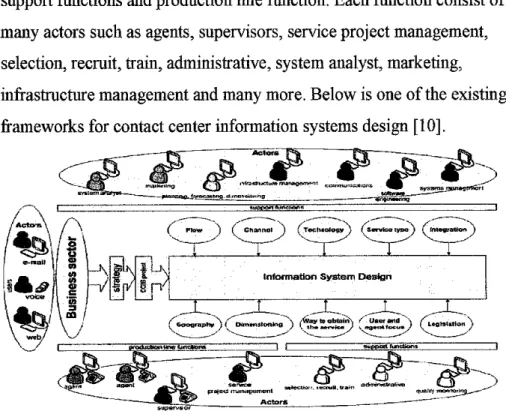
Most of contact centers will divide their organization structure into support functions and production line function. Each function consist of many actors such as agents, supervisors, service project management, selection, recruit, train, administrative, system analyst, marketing, infrastructure management and many more. Below is one of the existing frameworks for contact center information systems design [1 0].
Figure 1: Framework for contact center information systems design.
N. what we can see from the above figure, we can summarize that performances which include personal attributes of each actors will determine whether an organization can achieve its target and business goals.
1.2.2 Significance of the Project
A web based application that is capable of processing a wide array of agents' personal details and assessing their personal development
attributes to ensure agents' performance provision. It also integrates with agents' Key Performance Indicator (KPI) so that the assessment result would be more superior. By having such this application, contact center organization can have agents' not only exception in terms of work performance but in personal development as well. Plus, organizational performance and goal attainment can be maximized.
1.3 Objective
To model, design and develop an integrated web based application that can assess and record agents' personal development and work attributes while at the same time allowing supervisors to communicate about work performance.
1.4 Scope of Study 1) Clients
Clients or also called end user for this application consist of Human Resource Management (HRM) staff and inbound call center staffs (team leader and call center agents). It is important to study clients' requirement to ensure the project application meets their expectation. The actual
problems scenario needs to be gathered from them to produce project that has high quality value.
2) Personal Development attributes
Personal development attributes are main input for this application. The selection of the attributes had been discussed and agreed with HRM assistance manager and inbound call center manager in SRG Asia Pacific (SRG AP). The attributes are key indicator whether agents' success in their personal development attribute or not.
3) Interface Design for end-user
Graphic User Interface (GUI) enables user to feel easier. Furthermore, GUI provides user friendliness that can make user understand more on the system's interface.
1.5 Relevancy of the Project
This project is relevant to customer service workforce industry because its focus on the agents' personal development attributes where many contact center organization take for granted on it. When people talk about contact center agents', they usually curious on how the agents' delivering services. The key measurement that always been used to monitor the agents' performance is their KPI. However, how about their personal attributes? Is that worth for an organization having an agent that success in their KPI but weak in their personal attitudes? How far HR department in contact center aware of its' agents' personal weaknesses? Therefore, by having this application, contact center organization can develop its' agents' quality plus enhance the communication
among HRM staff, team leader and agents. Furthermore, the relevancy of this project has been agreed by General Manager in this project industry partner.
1.6 Feasibility of the Project within the Scope and Time Frame
32 weeks is given for the author in order to develop a complete prototype for this project where it is approximately 8 months. Since this project also cooperated with an Industry Partner, therefore, there are some adjustment occurred during the development process. This happened because of the changed on the user's requirement, preferences and tastes.
1. 7 Industry Partner
This project work closely with one industry partner called "SRG Asia Pacific Sdn Bhd (SRG AP)". SRG is a mid-sized company which specializes in Business Process Outsourcing (BPO) and call center service delivery for other companies. This project wills prototype a system scoped on "customer service environment". SRG AP had allowed the author to develop and test the
application in a real-life corporate setting. Thus, most all of the information and input for this project is from SRG AP.
2.1 Introduction
CHAPTER2
LITERA TIJRE REVIEW
When people heard about word "integrated", they might think of "combine",
"put together", "mix" and many more. However, do people realize that by developing an integrated system, they will gain a lot of benefits from it? An integrated system is pertinent for companies that consist of many employees, less efficient, hard to access the information like call center organizations'.
Moreover, an integration system allows company to save ingoing maintenance and operation costs by continuously monitoring system [ 11].
Today' s changing business landscape demands that HR aligns its processes, practices and strategies with business objectives. This demand can only be met by a comprehensive solution that effectively manages an organization's human capital management. There are several challenges that always occur in HR such as [12]:
⢠Heightened competition for skilled workers.
⢠Acknowledgement of the high cost turnover.
⢠Importance of succession planning.
⢠Offshoring and outsourcing trends.
2.2 Customer Relationship Management (CRM)
In order to retain an existence customer, an organization should sustain and enhance their Customer Relationship Management (CRM) with customers. CRM consists of managing all elements of a customer's relationship with an
organization to create and maintain customer loyalty and retention and
organization's profitability [13]. By delivering an exceptional CRM with high quality of product to customers, it will tend them to stay longer, buy more and create favorable word of mouth effects that may further benefit the organization [14]. CRM is pertinent element especially for customer service industry because this industry do not have any inventory that we can measure and touch with our hand. It's all about how they handle and deliver their services to satisfy their customers. Thus, it is crucial to also explicitly focus on human resource element of the company provider's capacity [14]. There's a lot of article approved that managing the human resource element is part of CRM activities and it is a significance key to meet business performance objectives[15][16][17][18][19].
For example, there is a natural conflict between high worker productivity and high levels of customer service predominantly in the service sector [20].
2.3 Customer Service Industry
In customer service industry, managing and delivering service level is known to be a crucial element ofCRM. Based on Scoop Business article; New Zealand's contact center industry recorded 4% growth in 2010, taking the country's total number of seats from 28,730 to 29,000[21]. In addition, 12% of the contact centers' outsourced their services. It shows that this industry has grown up around the world [21].
According to Computerworld, Malaysia has shown the strongest growth rate compared to others. Call centre industry growth rate in Malaysia is 17%
compared to only 15% for the ASEAN region. The growth rate in Singapore is 8%; India is 10% while Thailand is 15%.
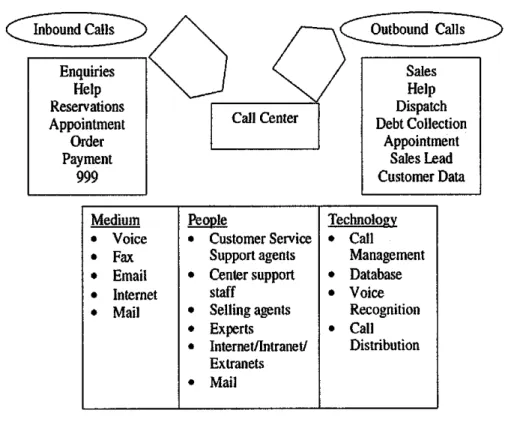
Normally, there are two types of calls in call center which are outbound and inbound [1]. Inbound calls are calls that are initiated by the customer to ask for help, report for product problems or obtain information. Outbound calls are different from inbotmd calls where the agent will call any selected customers mostly with the aim to sell a product or a service to that customer. Below is the sample of call center system model [22].
Enquiries
~
SalesHelp Help
Reservations Dispatch
Appointment Call Center Debt Collection
Order Appointment
Payment Sales Lead
999 Customer Data
Medium People Technology
â¢
Voiceâ¢
Customer Serviceâ¢
Callâ¢
Fax Support agents Managementâ¢
Emailâ¢
Center supportâ¢
Databaseâ¢
Internet staffâ¢
Voiceâ¢
Mailâ¢
Selling agents Recognitionâ¢
Expertsâ¢
Callâ¢
lnternetllntranetl Distribution Extranetsâ¢
MailFigure 2: Call Center Systems Model
From day to day, call centers always compete within their selfto convey the best service for their customers. Technology strategy of growing significance is the enablement of the multi-channel contact centre [21]. Thus, call center agent's performances are the key contribution for the company business goals.
2.4 How Talent Management System benefits customer service organizations TMS framework is an enterprise-level, sustainable solution with immediate and long term benefits across the organization. There are some advantages that furnish HR to meet current and future challenges:
⢠Improved decision-making capabilities, more accurate information sources in real time from the HR core [23].
⢠Provide a consolidated view of all employee data and used extensively throughout the suite to guide and inform decision making and planning [24].
⢠Well understood and important segment within Human Capital Management.
2.5 Previous Implementation
Different organization will have different problems and management style. Thus, they will have different desired function in their systems too. When people heard about "Human Resource Management", they always relate it with Human Resource Management System (HRMS). The other system that people usually think when we talk about HR is Talent Management System (TMS). Therefore, the author has done analysis on these two common systems.
2.5.1 Analysis on Oracle Human Resource Management System (HRMS) Currently, HRMS become a common system that usually used to
develop, manage and improve employee benefits, HR and administration functions so the employer can focus on their core business value.
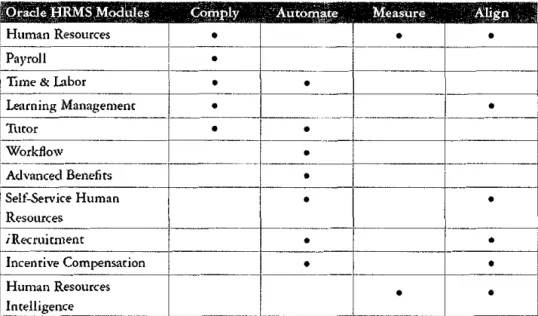
Organizations' nowadays used HRMS as one of technology tool to monitor and streamline their human resource tasks. Oracle HRMS also one of the existing system that delivers a comprehensive platform and functionalities that helps an organization execute all four human capital management strategies[25]:
⢠Comply:
Managing core HR data and process, payroll, benefits and legislative/regulatory compliance.⢠Automate:
Saving cost and time with inclusive, workflow-driven employee and manager self-service.⢠Measure:
Providing metrics and analytical tools to stakeholder to convey information and determine the value ofHR program investments.⢠Align: Offering flexible programs designed to increase workforce value through a broad range of development.
Basically, Oracle HRMS centralize human resource information by providing a centralized data repository for all people-management
activities throughout the organization. Oracle HRMS offers the flexibility to choose modules that support organization unique Human Capital Management (HCM) strategy [25]. Based on the author's opinion, it will be waste and consume cost for an organization if they have all the
modules of the system but did not align with the business goals. An organization needs to identify and evaluate their organization objectives before subscribe the modules.
Self-Sef\â¢ice Human Resources
iRecruicment
Human Resources
â¢
⢠â¢
â¢
â¢
â¢
â¢
Figure 3: Oracle HRMS Modules
2.5.2 Analysis on current Taleo Talent Management System
â¢
â¢
â¢
â¢
Taleo's Talent Management solutions provide up-to-date insights into employees and candidates so that managers can see that employee that is empowering their organization and better understand how to recruit, retain and mobilize their employee for organization goals.
In Taleo's TMS, it emphasized several elements which are on sourcing and recruiting, onboarding, performance reviews and goals and
succession planning. Each of an element consists of their key activities to make sure the process achieve its target.
Figure 4: Taleo lMS elements
2.6 Characteristics of Integrated Talent Management System (ITMS) IlMS is a system that purposely assessing contact center agents' personal development attributes. HRM is a department that responsible to manage employees' in any organization. There are several modules that exist in HR.
metrics [23]. Currently, the author had focused on enhancing internal
communication, evaluating performance and developing contact center agents' personal attributes.
Figure 5: Holistic view ofHR modules.
In order to reduce HR workloads and increase the organizations effectiveness,
"Un- Integrated" strategic HR system need to be addressed [24]. In addition, we can say that by adding an "integration" feature in a system can bring an
advantage to organization [24]. Based on knowledge management concept, an organization can streamline their current business process. Moreover, some performance key activities might be done manually, therefore, by developing this system; it can improve human resource process flow as well.
3.1 System Methodology
CHAPTER3 METHODOLOGY
This project adopts an incrementallifecycle model. Incremental model is an evolution of waterfall model. The product is designed, implemented, integrated and tested as a series of incremental builds (26]. This model usually used in many commercial software companies. Since several ITMS application requirements are well define and consists of several ftmctions, thus, this
approach is really suitable for it. In incremental development, it would break up the work into smaller pieces, schedule, develop over time and integrate it as they have been completed. The author had divided into three iterations which are HRM, team leader and call center agents. Each of them has different access level. However, there are ftmctionalities that can be accessed by the same user.
Each iteration passes through requirement analysis, design, implementation and testing phases.
There are several advantages of using this model [26]:
⢠Generates prototype or working software quickly and early during the beginning of the software life cycle.
⢠Flexible and less cost to change scope and requirements since it is divided into several small iterations.
⢠Easier to test and debug.
⢠Easier to manage risk because risky part are identifies and handled during its small iterations.
Requirements
I-+
Design ~ lmpltiMntation ~ T ...analysis
[ .
Require~ents
analys1sH
. . DesignH~·-- H
T .... l
[ Requireon.ents analys1s
H
DotignH
1oop1otn1o1a11eH T ....
[ .
Require~eniS
analys1sH
. . DesignFigure 6: Incremental Model
Below are some of the key activities for each phase [27]:
3.1.1 Planning Phase
l
Planning phase is an initiation time of each system development. There is one activity in this phase:
⢠Requirement Analysis:
It consists of determining the needs and conditions to meet for a new or altered product. In this activity, the author had analyzed common challenges faced by the customer semce industry. Based on the analysis, the most challenge that they faced is sustaining the caB center agents' personal development performances.
3.1.2 Analysis Phase
Analysis phase usually answer the questions of "who, what, where and when" on the system. It involves several activities such as:
Analysis Strategy:
It consists of an analysis of current system (as-is system) that they had practiced as well as identify problems on it. It also a strategy to design new system (to-be system).
It is crucial for the author to analyze the existing system process since it deals with an Industry Partner. There are several things that need to be considered such as who is the user for this system, what are the existing systems process flows, database types and many more.
The author had designed Functional Model where it describes a business processes and the interaction an Information System (IS) with its environment. There are two types of model in this model which are activity diagram and use cases diagram. Data flow diagram has been created after done thorough analysis on the user requirement and system flow.
⢠Requirement Gathering:
The author used an observation, document review and informal interview method to ensure, observe, understand and gather information from this project Industry Partner.
The author had spent almost a month and stayed at Industry Partner to collect real user requirement and discuss face to face on the problem faced by them.
3.1.3 Design Phase
Design phase will answer "how" question about the system. This phase must be traceable to the analysis model and should be developed iteratively. There are four activities such as:
⢠Architecture Design:
It describes what type of software and network infrastructure will be used.
When evolving analysis into design models, it is important to review the analysis models then add system environment information. Thus, the author had reviewed use case diagram and activity diagram and identified any missing classes and many more.
⢠Interface Design:
It deals on the user interaction with the system through designing and developing user interfaces. There are some criteria that the author looks into consideration such as process flow of user interface design, common used principle and techniques for navigation, input and output design.
The author had identified that there are three types of user for this application. There are contact center agents, team leaders and HRM staff.
⢠Database and File Specification:
It will describe what and where data will be stored. In this project, the author had selected webhosting server as storage to store all the files. FileZilla Client has been used to upload files into public domain server.
⢠Program Design:
It will describe what type of application and tools that the author will use in order to develop this system.
The author had chosen Adobe Dreamweaver CS5 to design user interface for this application.
- . Photoscape and Adobe Photoshop are used to edit images and effects for this project application.
3.1.4 Implementation Phase
This final phase touched about the action part of the system. There are several activities such as:
⢠System Construction:
This is the time to test the codified coding. There are four principles that the author had practiced[28]:
a) Preparation Principles
⢠Analyze and understand of the problem that she tried to solve.
⢠Understand basic design principles and concepts.
⢠Select a programming langnage that meets the needs of the software to be built and the environment in which it will operate.
⢠Pick a programming environment that provides tools that will make her work easier.
b) Coding Principles
⢠Constrain algorithm by following structured programming practice
c) Validation Principles
⢠Conduct a code walkthrough when appropriate.
⢠Perform unit tests and correct errors uncovered.
d) Testing Principles
⢠All tests should be traceable to requirements
⢠Tests should be planned.
⢠Installation:
This is the time where replacing the new system into the old system.
⢠Support Plan:
This is the time where the project will have a formal and informal post-implementation review as well as identifY which part on the system that needs to be changed.
3.2 Research Methodology
Research methodology is a set of procedures or methods used to conduct research. In order to understand who users are and what they are doing should be critical activity. This research methodology is important to gather information such as users' preferences, opinions and suggestions. One of the research methods used to obtain user and task information is User Needs Assessment. A user needs assessment usually done to understand [29]:
⢠What user's goals?
⢠What they are trying to achieve?
⢠What users actually do to achieve those goals?
⢠How users are influenced by their physical environment?
⢠What personal, social and cultural characteristics the users bring to the tasks?
User needs assessment IS done for development oriented researches and designers [30]. Therefore, there are various tools to collect information for this
method. In this project, the author had used observation and informal interview approaches to gather user requirement information.
3.2.1 Observation
Observation method involves hmnan or mechanical observation of what people actually do. It is an important aspect of many action research studies. Information is collected by observing real life process work. The author had an opportunity to stay at SRG AP almost a month which during her semester break as well. From that duration, she had observed htmdreds types of agents' culture. In addition, the author have been exposed with their current software and hardware used such as Oracle server and several existing applications.
3.2.2 Informal Interview
Informal interview have been used in this research to gain a general understanding of the requirements from several clients in this project Industry partner. The reason to choose infonnal interviews approach for this project because it is flexible, simple, unstructured and time saving when preparing for the interview. It makes an ease for clients to give opinions and say something freely without following any specific guidelines. Moreover, it allows spontaneity to the interviews. The author has the freedom to change some questions or the sequence of the questions according to the responses or reactions from the interviewees.
The author had interviewed several peoples that work on the performance appraisal and personal development attributes especially HRM peoples, inbound call center manager. Moreover, she had met and discussed with
the Industry Partner General Manager to gather information on the current systems and servers.
3.2.3 Document Reviews Method
Document reviews could be reviewing the printed documents or electronic documents (softcopy or hardcopy materials). For example, reviewing sample of documents that related with this project
background, reports from the web or written information. The reviewing process is where and when the sticky notes were placed, writes on or even attached to other reading materials to make the reviewing process more comprehensive and easier references. There are also real
documents from Industry Partner to make these reviews more inclusive.
The findings from this method can be used and analyzed later.
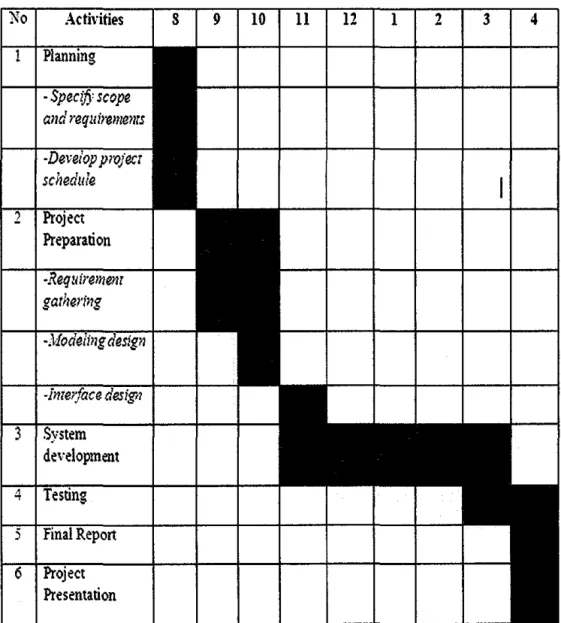
3.3 Project Gantt chart
Below is the current ITMS project Gantt chart. The purpose of the Gantt chart is to break large project activities into a series of smaller tasks in an organized way.
There are 6 main activities that need to obtain within 9 months of the project time line.
Acth·ities
·scope and requiremems
pro jeer schedule
Presentation
9 10 11 12 1 2 3 4
Table 1: ITMS Project Gantt chart
3.4 Tools
A program or application that software developers use to create, debug, maintain or support other programs and application is called Programming tool or
Software Development tool [31]. It can be equipment, hardware, software and many more. There are six tools had been used for the system development which are:
⢠Personal Computer (PC)
The author had used her PC during the system development. She has performed most all of the SDLC tasks using this PC. It includes during planning, analysis, design as well as implementation phases activities.
⢠Adobe Dreamweaver CS5
Almost hundred percent of the system interfaces has been developed using this software. This software enables the author to design, develop and build standards-based web based application. The author had designed in visual and direct code basis with powerful Cascading Style Sheets (CSS) inspection tools. This software have several features such as industry leading web development environment, intelligent coding assistance, integrate Flash Video (FL V) content, support for leading technologies, integrated Content Management System (CMS) support, comprehensive CSS support and many more[34]
⢠FileZilla FTP Client
Files that had been designed and developed need to be transferred or uploaded into storage called server in order to execute it. FileZilla is a powerful open source FTP/SFTP client. This software is the path for the author to transfer
the developed files into the actual server. FileZilla is small but strong FTP client with many features. It includes a site manager to store all connection details and logins as well as an Explorer style interface that shows the local and remote folders which can be customized independently. There are several features ofFileZilla such as [35]:
Easy to use
Cross-platform (operates on Windows, Linux and many more) Available in many languages
Supports resume and transfer of large files more than 4GB Drag and drop support
Filename filters
⢠'-" 0:\llo<l<"~OI>~
:. j: ;,'I"""' ~ .. O<l~On<l]
.;.;;,.,
LocoiOI>k
<ooD;IB<d<"p01>0) to"IOi>k
J,E· cnor""'
;iF:{M«I>~ro<db .. , CODr""
'""''floo!lfilo
L>rtmoollled
Dl,.d/, .. ll<~ototJio
r··~·~--~ . "'
Hll·"''"'' :-\b ·~'""'~'I
-irl'""'~''i' -itl«t -i:b"'"' -itl ~"'llo;_ll;p
~:-~~obli<.)MI _ ...
fl~nomo I MIClU< foi .. YI>< lO>tiOOdiR<O Ptmt<l>IOO> O...tlt;r,.
~~==:.::::::·:·:::·--
f,l.::-
"W~,;~:.:~~;~::=~~;:-:=;tl<~).bfo folo foiO" lnoJ/lOlll-'lt1... ~155 011!51
Dâ¢"''"''' f;IOfoiO" <loii!Bil~>~t .. om l'U51
elnrm '''"''"" 'llr.'Bilt:lt5 .. , um fll~>â¢
(:!""' fâ¢Iâ¢Folâ¢" """OUU><~ .â¢
e:JI.,d<r RIO!old" OJI/lBIH4h .. 1155 !6HI8
!i!IJ>ltmm l54 l11A(Wl. 1/llllln.:llOI"-. " " "
~'"'"'0.\ml ~lSI câ¢ro~ofll .⢠OIW."Ul:1~4... IIUSI
l.ioll~l!l~l """ ChromoHl .⢠'16/lOUI'lM. "''' 06H~
'f!l>IY'â¢Â·"' ~~u tmâ¢dln~ ... mmou~l~ â¢. oo« m951
.,
i I
- . " ________ j
Figure 7: Main form ofFileZilla Client
⢠Photoscape
The author had used this tool to edit some of the images of this project. This tool is very easy to view, edit, combine, color, rename, resize and many more.
⢠Adobe Photoshop CS5
The impact of this tool is more extra detail in photo editing where it achieves superior results in fewer steps when noise removed, grain added, lens
distortions corrected and sharpened. Header and footer images are some of the examples that had been edited using this tool. Moreover, it is an
intelligent image editing and enhancement and creative tools and content.
⢠Webhosting
Webhosting is a service that allocates space for customers to showcase their websites on computer servers that are connected to the Internet 24/7 basis.
The author had selected one server to locate her project files so those users easily assess it. There are several features of the server which are control panel, multi-domain hosting, mySQL databases, email protection, traffic statistics and 24/7 technical support. Server is crucial to store all the data and make the files assessable for others.
3.5 Key Milestone
Key Milestone is a project indicator that always monitors our project progress. It is a milestone at the end of a stage that marks the completion of a work package or phase, typically marked by a high level event such as completion, endorsement or signing of a deliverable, output or any crucial meeting [33].
Based on the project Gantt chart, this project is still within its timeframe.
No Activities 1 Planning
2
Preparation
gathering
-Interface design
development 4
5 Final Report 6 Project
Presentation
9 10 11 12
Table 2: ITMS key milestone
1 2 3 4
CHAPTER4
RESULT AND DISCUSSION
Understand the user requirement cannot be done while we constructing and testing the application. The requirement must be understood up front- frrst in the high-level project phase. The Analysis phase is where the project lifecycle begins. It is a situation where the author need to broken a large project down into smaller components. It is a part where the author needs to identify the overall direction that the project will take through the creation of the project strategy.
In the Analysis phase, gathering requirements is one of the main key activities. It is usually more than simply asking the users what they need and writing their answers down. For this project, the author used Interview technique to gather requirements from this project Industry Partner (SRG Asia Pasific) staffs which consist of manager, executives and clerk.
4.1 Current Performance Appraisal practice
As for now, the author gathered information on SRG AP current Performance Appraisal working flow. Performance Appraisal is essential in any organization in order to evaluate staffs' performances. Different organization will have different way to evaluate their staff performances. When people talk about performance appraisal, the other elements that organizations usually include into it is Key Performance Indicator (KPI). KPI help an organization define and measure progress toward organizational goals.
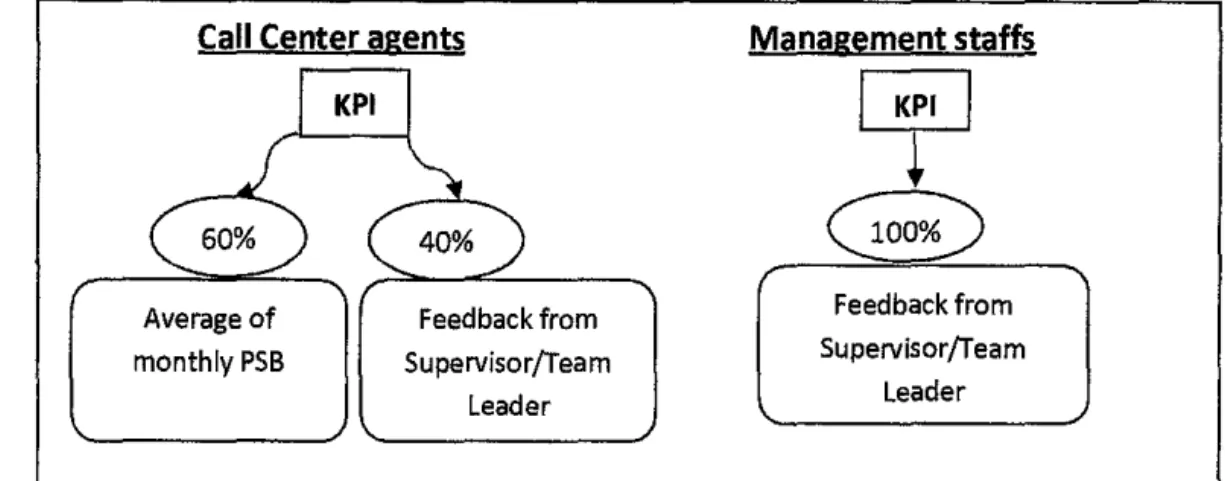
In SRG AP, staffs' KPI will be assessed once in a year. They divide their staffs into two groups which are Call Center and Corporate (Management staffs). Each group will have different style of assessment. Call Center group consists of Customer Service Professional (CSP) agents, Quality Assurance (QA) and team leader. They will be accessed with different weightage which are 60% of it using monthly Performance Score Book (PSB) and 40% based on their Supervisor or Department Team Leader feedback. At the end of the year, Team Leader or Supervisor will access their agents' performance and rank it with several core values. The 60% of the weightage is the average of monthly's PSB. PSB is a score book that automatically generated by their system called "Blue Pumpkin".
Every agent will be tracked and ranked on their team quality, productivity and attendance. At the end of the month, every staff will get their score book performance.
Meanwhile, corporate level consists of several departments which are Hmnan Resource (HR), Administration and Finance, IT and Training and Development.
KPI for all staffs in these departments will be accessed I 00% using a form called
"Performance Appraisal". This form will be filled by the staffs supervisor once a year. Below is the figure that summarizes on the staffs KPI weightage for both levels.
Call Center agents KPI
Average of monthly PSB
Feedback from Supervisor/Team
leader
Management staffs
GV CfJ
Feedback from Supervisor/Team
Leader
Figure 8: Staffs' KPI evaluation
4.2 SRG Asia Pasific Call Center Environment
The author had analyzed on SRG AP call center environment during her requirement gathering phase. She had used informal interview technique by interviewing SRG AP HR Leader. In SRG AP, they divide their call center environment into two which are inbound and outbound. Basically, they implement 80:20 basis which are 80% on inbound, 20% on outbound.
The author had focused on inbound scope since 80% of their core business on it.
Based on the interview output, there are almost 400 call center agents work in under inbound services. In inbound services, SRG AP offered Prepaid and Broadband services to customers'. All of their call center agents' work in shift basis.
The other input that the author get from her interview are the reporting structure in inbound group. There are five types of peoples involve in inbound reporting structure which are call center agents, team leaders, executives, senior executives, Chief Executive Officer (CEO). Below is a diagram that summarize SRG AP call center environment including the inbound reporting structure.
Outbound
Tl Tl
SRG Asia Pacific Sdn
Call Center
CEO
+
~
Senior
Executives'
~ +
Call center agents'
INBOUND
Tl
Tl Tl Tl Tl Tl
Management
Human Resource
Fi2ure 9: SRG AP Call Center Environment
Tl Tl Tl
4.3 Personal Development Attributes
Employee personal development is crucial in an organization. Many researchers have shown that growth and development are amongst the top motivational issues for employees today. Thus, the personal development issue must be tackled as a strategic issue to increase organization performance.
In contact center environment, there are four significance attributes that need to be assessed for the contact center agents such as Integrity, Customer Focus, Analysis and Problem Solving and Communication
⢠Integrity
It demonstrates commitment by adhering to company stated values, policies and procedures. Does the right thing, conducts business in an ethical manner in accordance with our conduct guidelines.
⢠Customer Focus
It demonstrates knowledge of products. Strive to exceed customer expectations.
⢠Analysis and Problem Solving
It demonstrates the ability to gather information, to critically evaluate options, seeking alternative perspectives to identifY root causes and develop solutions.
⢠Communication
It communicates accurately and honestly in an open, candid and respectful manner. Organizes and expresses ideas and information clearly, usmg appropriate and efficient methods of conveying the information.
4.4 Functional Modeling Diagrams
After the author had done a lot of analysis on the system requirements, the designed for the proposed system starts. The purpose of designing the proposed system is to document and understand requirements obtained during the analysis phase. Moreover, it also designed to make things clear on the functional or external behavior of the system. There are two types of models used in this project which are; Activity diagram and Uses case diagram.
⢠Activity Diagram
An activity diagram will depict how a business system operates. Besides, it illustrates the processes that are performed and how objects or data move among them. Below is an activity diagram for this project.
AGENT TEAM LEADER HRM
~ z ~
⢠⢠â¢
login
I
LoginJ I[
LoginView Personal View Personal View Personal
Development Development Development
Attributes Result Attributes Result Attributes Result
.. ⢠â¢
r
My Profile[
My Profile View Team LeaderProfile
⢠r
~I Contact Team Leader j
H
Contact HRMContact Team leader )
.r
1 y
My Agentsr
~I Contact HRM
View Agents' Profile
~ I [
Contact Agents⢠l
I
View Agents' Profile[
Contact Agents⢠I
Notify Team Leaders'Evaluate Agent
.. l
View Agents' KPI
l
â¢
Evaluate Personal Development
attributes marks
.,
'<-.d)
Figure 10: ITMS Activity Diagram
⢠Use Case Diagram
Use Case Diagram represents how a business system interacts with its environment. It define the requirements of the system being modeled and hence are used to write test scripts for the modeled system. Below is the project use case diagram.
t 0 I * â¢
A
Team ⢠Leaders
*
â¢
View My Profile
Contact Team Leader
View Agents' Profile
Contact HRM
View Personal Development Attributes marks
View Team Leaders' Profile
Calculate evaluation marks
Notify Team Leaders
*
â¢
â¢
Integrated Talent Management System (ITMS)
Figure 11: ITMS Use Case Diagram
5K
I
Agents
â¢
0
A
II
I~""
uman I Resource⢠Management
â¢
4.5 Data Flow Diagram
Data flow diagram is a graphical representation of the flow of data between processes. In other words, it shows what goes in, how it is changed and what comes out. In this project, it shows the flow activities for all users involved.
Below is the ITMS data flow diagram.
HRM
(nnf,lfl n
~'orif1
Lacking Area~
ViewProflle
Team leader
\
Agents
t.â¢.·.t·â¢.â¢.
Pcr~ona!
Alftitllili"
Figure 12: ITMS Data Flow Diagram
Personal Development Attributes
4.6 Application Interfaces
Application Interfaces or also known as GUI allows the user to select from menus and icons or using either mouse or keystroke commands. It is the platform where the user will interact with in order to get and insert data. The author had made a few of interfaces for this project. Basically, there are three types of users for this application which are call center agent, team leader and HRM employee.
All of the interfaces are made based on this project activity diagram and it is attached at the back ofthis report (Appendix I).
4.7 Project Testing
Application usually needs to be tested in order to verify and validate whether it meets the business and technical requirement or works as expected [36].
Moreover, it is a process of exercising a program with the specific intent of finding errors prior to delivery to the end user [28]. Testing usually will produce errors, requirements conformance, performance and indication of quality. It also gives the developer more ideas what kind of improvements need to be added.
Since the methodology of this project is incremental model, the testing part has been done after the requirement analysis, design and implementation phases.
4.7.1 Project Evaluation
The author had tested this application with one group of committee event at university level which consists of the event secretary, head of public relation department and nine working committees. Public relation department is a unit where they are required to deal with a lot of clients.
Thus, communication skills, problem solving, integrity and task focus are practiced. There are eleven users involved. The secretary of this event
had taken a HRM position on the aetna! project application. Meanwhile, the head of the public relation had taken a team leader position and the other nine working committees act as the agents. The users need to rate each of the criteria with one to five ratings. The user had tested this application for several times in order to test the application performances.
All the users had used their own PC (with Internet connection) to access the application. The analysis has been done after receiving the feedbacks from the users.
A system evaluation form (Appendix 2) had been prepared for the user to ask and see their feedback after using the application. There are five criteria have been asked in the evaluation forms which are ease of use, educational content of the application, presentation/organization content, user interaction and technical presentation. Each of the criteria has several sub criteria which produced more detail feedbacks.
4.7.2 Analysis of the Project Evaluation
Thorough analysis has been done for each of the evaluation criteria.
Since the users had tested for a few times, the author had analyzed the result and took the average rating for each criterion.
4.7.2.1 Ease of Use
Number of User
11 10 9 8 7 6 5 4 3 2 1 0
1 2 3
Ease of Use
4 5 Rating
⢠a- Ease to understand basic controls, major features organization
Figure 13: Ease of use graph
Based on the graph above, there are six users rate this criterion with four and the other five users' rate with five. Based on the interview's feedback, even they are not the actual HRM, team leader and agents; they feel comfortable and ease to understand the flow of the project application. On top of that, they also like the contact functions among team leader and agents where it can increase the relationship level between HRM, team leader and agents.
4.7.2.2 Educational content of the application
Educational content of the application
~-MrMVMr ---, 11
10
'r---
9
s -1--- ---- --
7 -1---,-~
5- f - - - - St - - - -
4
3- l - - - - 2t - - - -
1
0 -1----.----..r-
1 2 4 5 Ratâ¢na
⢠a· Oepth lnfprmatfpn
b· Breadth/râ¢nce of lnforr1'atlon
Figure 14: Educational content of the application graph There are ten users agreed that this application has depth information and only three of them said that the information depth is normal. Most all of the agent users satisfied with the profile information about them.
Moreover, all of the users agreed that it has range of information where agents can only view their own profile, team leader can views their own profile plus their supervised
agents, HRM can views all the employees' profiles. This access level is really excellent implementation because it allows only certain people have the authority to view the personal information.
4.7.2.3 Presentation/organization content
Presentation/organization content
Num.,.roru-
11 - - - - 10
9 8 7 6
s
4 3 2 1 0
1 2 5
- - -
r I
l ⢠i' â¢
I
. I '"
4 5
⢠a· Presents material In an orcanlzed manner
⢠b-Provides easy to use on screen mstrucbons
⢠c· Provâ¢des
consistent. ease to use help screens
⢠d· Uses real·life problem~
and/or authentic scentrios RAiling
Figure 15: Presentation/organization content graph
There are nine users strongly agreed that the content of this application is organized and uses real-life problems scenarios. In profile section, the information is organized which consist of employees' information, educational background and past experiences. These data had given the team leader an idea before evaluating their agents. This project used real call center scenario which add its value. This shows that agents' personal development really need to be assessed and enhanced in order to produce well rounded agents. Screen help and instructions
functionalities are the other parts that provide an ease for the user to use it. The user had been agreed that images button helped them in viewing information.
4. 7 .2.4 User Interaction
I
NumtNrofUser 11 - 10
9 8 7 6 5 4 3 2 1 0
1 2
U ser Interaction
4 5 Rating
⢠â¢Â· Helps user rerT'ember information
⢠b· Eue of user Interaction
c· Provides 1ppropriate feedback to user responses
⢠d· Allow/encouraces user to apply knowledce/skills to real life situations
Figure 16: User interaction graph
All users strongly agreed that this project encourages them to apply knowledge and skills to real life situations. Since communication is one of the at