Redesigning Course Management Systems through Applying Andragogy and Pedagogy Learning Theory
by
Muhammad Zuhair Bin Che Mohamad Aluan 11084
Dissertation submitted in partial fulfillment of the requirements for the
Bachelor of Technology (Hons) BUSINESS INFORMATION SYSTEMS
JANUARY 2011
(Ms Diana Wong Mei Leng) FYP Supervisor
Dio,. Wong M•leng
Lectur• .
Cemputer and lntbr:ntatien Sc1ences unlversiti Teknolegol"ET~ONNI
University Technology ofPETRONAS Bandar Seri Iskandar
31750Tronoh Perak Darul Ridzuan
ABSTRACT
Nowadays, students in hi,gher educational institutions need to compete with each other to become the best among the best. In order to be the best, they need to become an excellent student in their study. The objectives of this project are to study higher education students' information seeking behavior in virtual learning environment, conduct a research to understand the principles of pedagogy and andragogy learning style and then all the information will be combined and analyzed together to redesign the Course Management System throu~ applying the pedagogy and andragogy learning theory to make it more suitable and effective learning environment for adult learners.
The design and learning principles of CMS assume pedagogical learning for all learners, including higher education students. Pedagogical learning defines instructor controlled environment Sometimes, there are parts or situations that require andragogical concepts to make the CMS more effective. A study on technical feasibility, schedule feasibility, economic feasibility and operational feasibility has been done to determine the scope of study. This project will be using Moodie, a free and open-source e-learning software platform and the development of the system is expected to be completed within two (2) semesters. For the methodology of this project, Instructional Design (ID) will be used. It is a system approach to designing systems that meet the learners' needs. The ADDIE model for instructional design (ISD) consists of five-phase generic model which are analysis, design, development, implementation and evaluation. Each step has an outcome that feeds the next step in the sequence and one of the advantages of using ADDIE model is to ensure the effectiveness of the pro,gram using processes with specific, measurable outcomes. After a few studies have been done, the principles of andragogy and pedagogy learning style have been carried out Pedagogy is an art of teaching children while andragogy is the style of adult learning. There are various CMS that offer various features that will support pedagogy and andragogy style. So, some of the features will be combined together to redesign the Course Management System (CMS) that support both pedagogy and andragogy learnin,g theories.
iii
ACKNOWLEDGEMENT
As the beginning, I would like to express my great gratitude to Allah S.W.T and to all those who have in any way made possible for me to complete my final year project. In particular, I would like to record thousand of special thanks to my supervisor Ms Diana Wong Mei Leng who most of all consistently provided support and lots of advices. Her ideas were bright, helpful and her criticisms were constructive and her approach absolutely methodical, her patience is very much appreciated and her friendship and thoughts were most valuable. Sincere thanks also extended to other lecturers and my friends especially Wan Muhammad Nasrullah, Lokman Hakim, Zulhilmi Roslan, Syed Akmal and Najmi Pasarudin that have given me support and brilliant ideas. Finally, not forget to say thank you to my family for their invaluable supports and encouragement,
iv
TABLE OF CONTENTS
CERTIFICATION ii
ABSTRACT . iii
ACKNOWLEDGEMENT iv
TABLE OF CONTENTS v
LIST OF FIGURES vii
LIST OF TABLES viii
ABBREVIATIONS AND NOMENCLATURES ix
CHAPTER 1:
CHAPTER2:
INTRODUCTION
1.1 Background of Study . 1.2 Problem Statement 1.3 Objectives
1.4 Relevancy of the Project 1.5 Scope of Study
LITERATURE REVIEW
2.1 Section 1 ~Principles of Pedagogy and Andragogy Learning Theories
1
1 3 3
3 4
5
7 2.2 Section 2 - Pedagogy Learning Style for Children;
Andragogy Learning Style for Adults 8 2.3 Section 3 -Studies on Course Management
Systems 12
2.4 Section 4 - Studies on Various CMS . 15 2.5 Section 5- E-Learning Principles of Design. 26
v
CHAPTER3:
CHAPTER4:
CHAPTERS:
REFERENCES
2.6 Section 6 - Questionnaire
METHODOLOGY/PROJECT WORK 3.1
3.2
About Methodology Why ADDIE?
RESULTS AND DISCUSSION
4.1 Questionnaire (Before Development Phase) 4.2 Recommendation on How the CMS should be
redesigned 4.3 Interface Design
4.4 Questionnaire (After Development Phase) 4.5 Result of the Questionnaire
.
4.6 Functional Model: Use Case Diagram 4.7 Functional Model: Flow Diagram
4.8 System Architecture and Development Tools 4.9 Experimentation/Modeling
4.10 Current Adult Learning Process
4.11 Current Adult Learning Process in Current CMS 4.12 Improved CMS Learning Process for Adult 4.13 Features in CMS
CONCLUSION AND RECOMMENDATIONS 5.1
5.2
Conclusion Recommendation
vi
27
31 31 33
39 39
54 56 60 66 67 68 70 71 73 74 75 76
79 79 80
81
APPENDICES 86 APPENDIX 1 ~Survey Question for University Students 86 APPENDIX 2 - Survey Question for Distance Learner 93
APPENDIX 3 - Survey Results 102
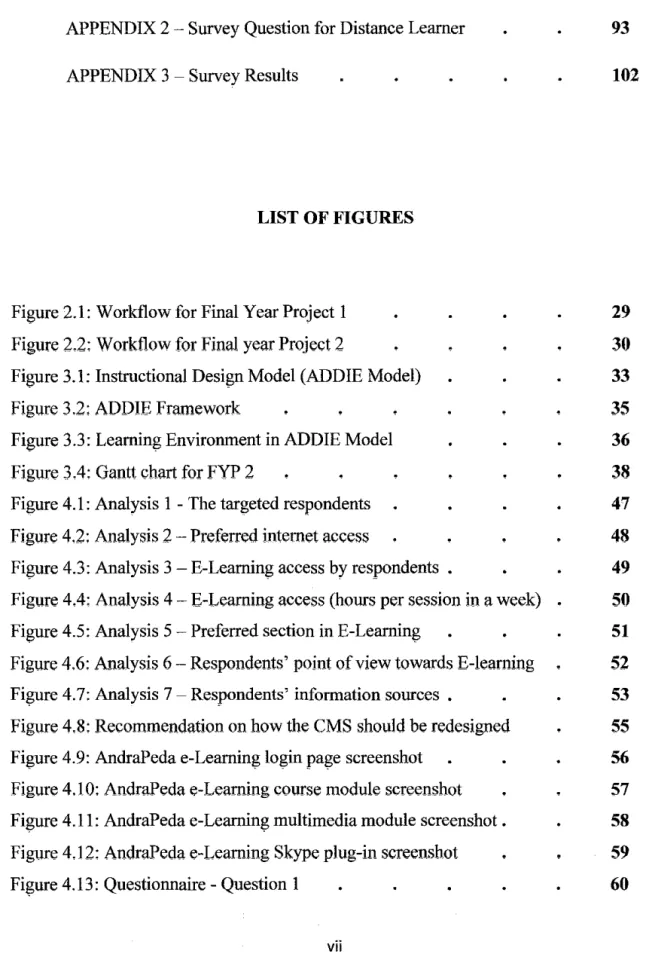
LIST OF FIGURES
Figure 2.1: Workflow for Final Year Project l 29 Figure
22:
Workflow for Final year Project 2 30 Figure 3.1: Instructional Design Model (ADDIE Model) 33Figure 3.2: ADDIE Framework 35
Figure 3.3: Learning Environment in ADDIE Model 36
Figure 3.4: Gantt chart for FYP 2 38
Figure 4.1: Analysis 1 - The targeted respondents 47 Figure 4.2: Analysis 2-Preferred internet access 48 Figure 4.3: Analysis 3- E-Learning access by respondents . 49 Figure 4.4; Analysis 4-E-Learning access (hours per session in a week) 50 Figure 4.5: Analysis 5- Preferred section in E-Leaming 51 Figure 4.6: Analysis 6-Respondents' point of view towards E-learning 52 Figure 4.7: Analysis 7- Respondents' information sources . 53 Figure 4.8: Recommendation on how the CMS should be redesigned 55 Figure 4.9: AndraPeda e-Learning login page screenshot 56 Figure 4.10; AndraPeda e-Learning course module screenshot 57 Figure 4.11: AndraPeda e-Leaming multimedia module screenshot. 58 Figure 4.12: AndraPeda e-Learning Skype plug-in screenshot 59
Figure 4.13: Questionnaire- Question 1 60
vii
Figure 4.14: Questionnaire - Question 2 Figure 4.15: Questionnaire- Question 3 Figure 4.16: Questionnaire- Question 4 Figure 4.17: Questionnaire - Question 5 Figure 4.18: Questionnaire- Question 6
Figure 4.19: Functional Model- Use Case Diagram.
Figure 4.20: Functional Model- Flow Diagram
Figure 4.21: Functional Model- Flow for Assignment Diagram Figure 4.22: Moodie system architecture
Figure 4.23: Current adult learning process
Figure 4.24: Current adult learning process in current CMS . Figure 4.25: Improved CMS learning process for adult
LIST OF TABLES
Table 3.1: Final year Project key Milestone . Table 4.1: AndraPeda e-Learning homepage parts Table 4.2: Pedagogy features in current CMS (Moodie)
Table 4.3: Andragogical features that support adult learning (Moodie)
viii
61 62 63 64
65 67 68 69 70 73 74
75
37
57 76 77