100 Malaysian Journal of Tropical Geography, 2021, 47(1&2): 100-122
A REVIEW OF BIODIVERSITY LOSS AND CLIMATE CHANGE: POLICY MEASURES AND ADAPTATION STRATEGIES IN NIGERIA.
Gasu M.B1, Gasu G.N2, Ntemuse U. E3 & Ebehikhalu Nicholas4
1 Department of Urban and Regional Planning, Osun State University, Osogbo, Nigeria.
2 Faculty of Law, Yaounde University II, Soa, Cameroon
3 Department of Botany, Obafemi Awolowo University, Ile-Ife, Nigeria.
4 Department of Geography and Environmental Management, University of Abuja, Nigeria.
Corresponding email: [email protected]
ABSTRACT
Climate change which has become a global concern has occupied the centre stage of all human discussions today, can be traced to the advent of massive industrialization in the late 19th Century and early 20th Century, during which enormous quantities of greenhouse gases were emitted into the atmosphere. This Phenomenon has greatly affected the distribution and extinction of species of flora and fauna ecosystems as well as man and his environment. The earth’s surface is full of diversity of plants and animals, currently estimated at about 1.8 million yet greatly threatened by biodiversity loss, erosion and depletion of genes, and the extinction of global species which constitute an important concern to national and international authorities. In this paper, we examined the rational and regime for the conservation of biodiversity and adaptation strategies for Nigeria in particular and Africa in general. We also considered deeply the problem of climate change, value and loss of biodiversity, the effect of climate change on species extinction and the relationship between climate change and loss of biodiversity in a bid to proffering sustainable measures to curtail its menace on this only life sustaining planet.
Keywords: Biodiversity loss, climate change, conservation, adaptation strategies and international policy measures.
101 INTRODUCTION
Biodiversity which is the short form of Biological Diversity is defined in Article 2 of the Convention on Biological Diversity of 1992 as: “the variability among living organisms from all sources including inter alia, terrestrial, marine and other aquatic ecosystems and the ecological complexes of which they are part; which includes diversity within species, between species and of ecosystems (UNEP 2002;
MEA 2005)”. United Nations Environmental Programme UNEP (2010) cited in Falola and Adeyemi (2016) defined biodiversity as the diversity of life forms on the surface of the earth which includes all organisms, species, and population, the genetic variation among these and their complex assemblages of communities and ecosystems. Biodiversity thus encompasses all of the variability among the building blocks of life: genetic diversity different life form species diversity and the interrelationships of life (ecosystem diversity) (Hunter et al., 2002; Mukherjee 2002).
Until fairly recently, conservation efforts were focused on what was otherwise called “wildlife’. It was in the late 1970s that many biologists became concerned that the focus on wildlife was too narrow. That concern over the fate of cute or ferocious mammals or beautiful birds missed the larger issue of loss in the overall richness of life on the planet. Biodiversity as a concept allows us to recognize and value the great diversity and variability of life. By focusing on biodiversity, scientists hope to build political will concerning life. The concept of biodiversity demands equal concern for both ant and anteater, rhinoceros beetle and rhinoceros (Hunter et al., 2002).
The conservation of the threatened biodiversity is so crucial especially when looking from the traditional econometric approach; according to Wilson (1988) weighing the market price and tourists dollars will always underestimate the true value of biodiversity. Furthermore, Salami (2011), noted that the rich biodiversity in Nigerian rain forest has been subjected to heavy logging and agricultural clearance throughout the 20th century and now, the area covered by rainforest is rapidly shrinking. Wildlife is rapidly declining due to habitat loss and increased pressure from hunters, poachers and bush burning. Animals that have disappeared in recent times include the cheetah, the pygmy hippopotamus, the giraffe, the black rhinoceros and giant eland with about 10-12 species of primates including the white throated guenon species of primates and sclater’s guenons under threat. Similarly, an estimated 484 plants species in 112 families are threatened with extension due habitat destruction and deforestation (Salami.
2011). It was at the backdrop of these that this research was conceived to examine the value and loss of biodiversity, the rational and regime for the conservation of biodiversity and adaptation strategies for Nigeria, and the relationship between climate change and loss of biodiversity with a view to proffering sustainable measures to curtail its menace on this only life sustaining planet.
102 THEORETICAL BACKGROUND TO THE STUDY
The importance of Biodiversity
The term biodiversity gained prominence for the first time in 1986 when it was used in the title of American National Forum on Biodiversity (Mangelsdorf et al., 2015). This conference as well as subsequent initiatives marked a conceptual turning point in nature conservation politics. As observed earlier conservation efforts targeted nature or wilderness and later endangered species and the focus eventually shifted to the preservation and promotion of biodiversity (Takacs, 1996; Morar et al., 2015). Similarly, Falola and Adeyemi (2016) observed that the United Nations (UN) report, Our Common Future was a milestone that placed biodiversity on the world political agenda (WCE, 1987). The report details how biodiversity can benefit mankind in terms of species, ecosystem and genetic diversity and how the living and non-living parts of our environment are essential to the development of the human society. Furthermore, Falola and Adeyemi (2016) noted that our common future of the United Nations conference on Environment and Development (UNCED) came up with a comprehensive strategy for Sustainable Development-meeting current needs while ensuring that a healthy and viable world is left for future generations which emphasizes a strong support for preserving biodiversity through the Convention on Biological Diversity (CBD) and Agenda 21 (UNEP 1992). Mangelsdorf et al., (2015) observed further that Biodiversity emerged as an environmental issue par excellence at the environment conference in Rio de Janeiro in 1992, when the final document “Agenda 21”
emphasized the socio-cultural significance of biodiversity next to its ecological and economic meaning.
The true value of biodiversity is not known but the ecosystem services conservatively estimates it at doubled the global gross national product - that is some US 33 trillion- which is returned annually to human societies all over the planet (Costanza et al., 1997). Falola and Adeyemi (2016) posited that The Millennium Ecosystem Assessment services assessed the status of 24 global ecosystem services in 2005 and reported that for the last 50 years, almost two- thirds were found to be in a state of decline, five remained steady while four were improving in spite of protected areas having more than doubled during the last quarter of the century (MEA, 2005; NRE, 2009). Estimates show that in terms of life form on the planet, there are 5 to 30 million different species with at best working estimate of 8 to 14 million of which only 1.8 million have been identified (MEA, 2005).
The Tropical rain forest constitutes 6 percent of the earth and is home to 80- 90 percent of the entire species in the world (Salami, 2011). The World Resources Institute (2003), noted that forests in Nigeria originally covered about 45% of the Nigerian landmass some 8,000 years ago but FAO (2010), observed that only 9.9% or about 9,041,000 ha of Nigeria is now forest. Salami (2011) observed further that of this 4.2% (382,000 ha) is classified as mature forest, the most bio- diverse and carbon-dense form of forest with additional 382,000 ha of planted forest. It was further observed that between 1990 and 2010 Nigeria lost 47.5% of
103 its forest cover or about 8,193,000 ha at an average annual rate of 2.38% or 409,650 ha per year (Salami, 2011).
Despite the non availability of data, Nigeria is highly bio-diverse and home to 500 viral species, 55 bacteria, a few protozoa, 848 species of algae, 200 lower plants, 5,103 higher plants, 247 mammalian species, 839 avian species, 648 fish species, 109 amphibians species, 77 molluscs, 10 annelids, 304 insects species, 134 zooplankton and 135 reptilian species have been identified and documented (Adedoyin, 1995). Nigeria’s forests contain 1,085 million metric tons of carbon in living forest biomass. Similarly, the World Conservation Monitoring Centre of biodiversity observed that Nigeria is rich with about 1417 known species of amphibians, birds, mammals and reptiles of which 1.2% are endemic, meaning they exist in no other country and 3.5% are threatened (Salami, 2011). Rhett (2011) noted that Nigeria is home to 4715 species of vascular plants, of which 4.3% are endemic while only 3.6% are protected (Badejo, 2011). IUCN (2004) observed that Nigeria is protected under IUCN categories I-V.
The importance of Biodiversity to mankind has a wide scope which includes;
use values which are direct and indirect. Direct use values such as food, fibres, forest products, pharmaceuticals and other chemicals and opportunity for education and recreation. Species in this category include timber, fuel wood, nuts, fruits, honey, mushroom, medicinal herbs, bush meat, wild life, forage, spices, resin gum, industrial raw materials, income as well as conserving the environment for sustainable agriculture. The indirect use values include the services provided by biodiversity and the natural ecosystem upon which we depend for water purification and food, climate control, the regulation of air quality, photosynthesis, pollution, pest control soil maintenance and disposal of waste. Researchers have noted that, biodiversity create and maintain soil fertility, help to regulate the often devastating impact of storms, floods and fires as well as providing shelter, jobs, security and cultural relevance (Okali, 2004; Akpan and Ofiong, 2007; UNEP, 2011 and Salami, 2011). Option value is the discounted present value of the potential biodiversity that leads to the development of new goods such as pharmaceuticals as illustrated in Table 1.
Besides the use values there are also the non-use values which include aesthetic, intrinsic, ethically spiritual, existence and bequest values. Existence value is the satisfactions some individuals derive from knowing that certain species or ecosystem exist even though they may never spend money to visit them. Bequest value captures the argument to leave a natural legacy for future generations (Clark & Downes, 1995; Okali 2004).
Threats to the loss of Biodiversity
The international Union for the Conservation of Nature (IUCN) observed that 1 out of 8 birds, 1 out of 4 conifers, 1 out of 3 amphibians and 6 out of 7 marine turtles are all threatened with extinction, while 75% of genetic diversity of agricultural crops have been lost (IUCN, 2010). Similarly, MEA (2005) noted that humans have increased the rate at which biological species go into extinction by as much as 1,000 times over background rates typical over the planet’s history.
104 Table 1: Common Medicine Derived from Plants
Medicine Origin Use
Neostigmine Calabar bean (Africa) Treatment of glaucoma and basis for synthetic insecticides
Turbocurarine Curare vine (South America) Surgical muscle relaxant; treatment of muscle disorders; and poison for arrow tips.
Vincristine, vinblastine Rosyperiwinkle (Madagascar) Treatment of pediatric leukemia and Hodgkin’s disease
Bromelain Pineapple (South America) Treatment and control tissue inflammation.
Taxol Pacific yew (North America) Anticancer agent
Novacaine, cocaine Coca plant South America) Local anesthetic and basis for many other anesthetics
Cortisone Wild yam Central America) Hormone used in many drugs L-dopa (levodopa) Velvet bean (tropical Asia) Treatment of Parkinson’s disease
Reserpine Indian snakeroot (Malaysia) Treatment of reduce high blood pressure Source: www.scilinks.org
Research shows that presently, 10-30% of mammals, birds and amphibian species are threatened with extinction (MEA, 2005; NRE, 2009). Purvis and Hector (2000) cited in Falola and Adeyemi (2016) documented that a new species of large mammals is still being discovered roughly every three years and an average day sees the informal description of around 300 new species across the whole range of life.
Globally, NRE (2009) identified the main reason for biodiversity loss and ecosystem services reduction in order of significance to include i) change in land use; ii) fragmentation and isolation; iii) habitat change; iv) invasive species; v) over-exploitation, and vi) pollution. Similarly, MEA (2005) identified the primary agents leading to biodiversity loss as human contributory factors which include;
habitat change, climate change, invasive species, over-exploitation, and pollution (Falola and Adeyemi, 2016). Badejo (2011) identified threats to biodiversity conservation in Nigeria to include; habitat alteration, increase in human population, climate change, chemical pollution, nonviable population of species, over-harvesting and commercial land use. Generally, threats to protected areas amongst others include; agriculture and overgrazing, illegal forestry operations, wildlife and plant poaching, encroachment by human settlements, mining, fire, pollution, climate change and invasive species.
Virtually, all the earth’s ecosystems have been dramatically transformed through human actions as ecosystems continue to be converted for agricultural and other uses especially urban centers. The current loss in Biodiversity and the related changes in the environment are now faster than ever before in human history and there is no sign of this process slowing down. Many animals and plants population have declined in number, geographical spread and species extinction has become part of the earth’s natural history. Human activities have increased the extinction rate by at least 100 times compared to the natural rate.
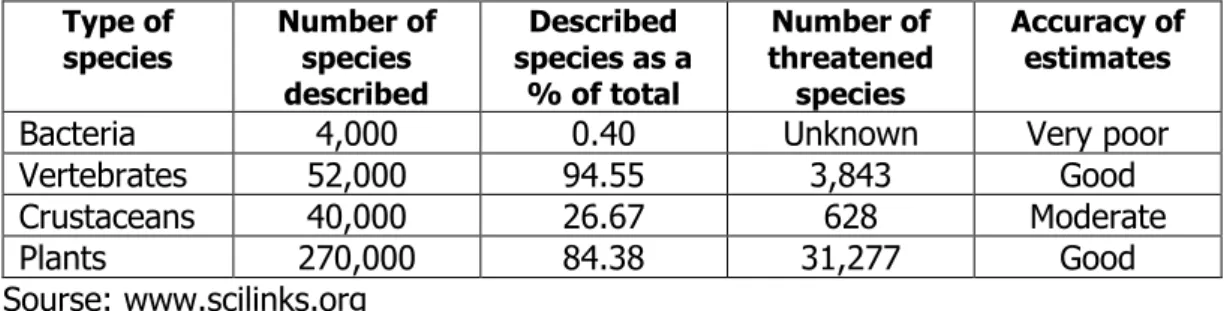
According to IUCN (2010) about 62% of worlds cycads are threatened with extinction and therefore making it the most threatened species of plant in the world. At the same time our knowledge on the estimated population of biodiversity remains very limited as illustrated in the Table 2.
Table 2: Estimates of Knowledge on the Earth’s Species Type of
species Number of species described
Described species as a
% of total
Number of threatened species
Accuracy of estimates
Bacteria 4,000 0.40 Unknown Very poor
Vertebrates 52,000 94.55 3,843 Good
Crustaceans 40,000 26.67 628 Moderate
Plants 270,000 84.38 31,277 Good
Sourse: www.scilinks.org
At least two-thirds of all land-dwelling species inhabit the tropical rain forests that are being rapidly destroyed. The Amazon rain forest, the world’s richest collection of biodiversity, lost 36,371 square kilometers between 1995 and 1997,
106 as the rain forest are being destroyed, so are the species that inhabit these areas.
Estimates of species loss vary, and it would be impossible to know the precise figures, but they range from 4,004 to 17,500 species per year. Some researchers observed that in the year 2000 we lost more than 1 million species (Wilson 1988;
Kubasek & Silverman 2000). In Africa the situation has not been different with the greatest losses occurring in the tropical forests where most of the various species reside. In Madagascar the Philippines and Haiti, approximately 20% of the bird and mammal species are threatened. However in Mauritius, almost 40% of birds and mammals are classified as threatened (WWF 1998; Kubasek & Silverman 2000). The threat to biodiversity loss is global and enormous as illustrated in Table 3.
Table 3: Species Known to Be Threatened or Extinct Worldwide
Types of species
Number threatened (all categories of
risk)
Number extinct (since-1800)
% of species that may be threatened
Mammals 1,130 87 26
Birds 1,183 131 12
Reptiles 296 22 3.3
Amphibians 146 5 3.1
Fishes 751 92 3.7
Insects 555 73 0.054
Other crustaceans 555 73 1.03
Mollusks and worms 944 303 1.3
Plants 30,827 400 0.054
Source: Africa Environment Outlook (UNEP, 2002)
In Nigeria several species of fauna and flora which the nation is naturally endowed with have been rendered extinct or are in danger of extinction as a consequence of economic growth and development (Uwoh, 2007; Gasu and Fadare, 2005). Gasu and Fadare (2005) observed that the United Nations Environment Programme (UNEP) in 2002 reported that out of the 81 threatened birds’ species in West Africa, 9 were in Nigeria while Cote d’Ivoire had the highest number of 12 with Togo and Guinea Bissau having none. The report also shows that out of a total of 172 mammals threatened in the sub region, Nigeria had the highest (25) in number, followed by Cote d’Ivoire with 17 while Cape Verde recorded the least number three. The UNEP report stated further that a total of 158 plants species are threatened in Nigeria closely followed by Ghana and Cote d’Ivoire, with 138 and 134 respectively (UNEP, 2002; Gasu and Fadare, 2005).
The 2005 Millennium Ecosystem Assessment estimates that by the end of this century, climate change will be the main cause of biodiversity loss. But as climate changes, the value of biodiversity and agriculture will increase. The Intergovernmental Panel on Climate Change (IPCC, 2007) reports that a significant number of species will be at risk of extinction as the global mean temperature increases. Of particular concerns are relatives of major crops
surviving in the wild. For example, research by the Consultative Group on International Agricultural Research based on distribution models of wild relatives of three staple crops that sustain the poor - peanuts, cowpea and potato - suggests that by 2055, between 16 and 22 percent of wild species will be threatened by extinction (IPPC, 2007).
Climate change also threatens fishery, an important source of income and nutrition for the 200 million poor people with more than 98 percent from developing countries. Impacts of climate change will affect fish diversity and availability in particular. Here, what climate change will bring include higher water temperatures, rising sea levels, melting glaciers, changes in ocean salinity and acidity, more cyclones in some areas, less rainfall in others, thus shifting patterns and abundance of fish stocks. The species of fish which will be able to adapt to the changed aquatic conditions will survive but that which will not be able to do so will face extinction (IPPC, 2007).
Causes of biodiversity of loss /extinction
There are many causes of mass extinction threatening many species which include; climate change, global warming, over exploitation of plant and animal species, habitat loss and fragmentation, pollution of soil, water and atmosphere, industrial, agricultural and forestry activities. Habitats destruction is the primary cause of biodiversity loss and results from the expansion of human populations and activities. Among terrestrial ecosystems, expansion of agriculture and commercial logging has led to the destruction of forest, while overgrazing and conversion to agricultural crop land has significantly altered natural habitats. In aquatic ecosystems, dams have destroyed large sections of freshwater habitat while coastal development is responsible for destroying reefs and near shore marine habitats (Guruswamy & Hendricks, 2001). There are other direct causes to the loss of biodiversity which include invasion by introduced species, over exploitation of biological resources, industrial agriculture and forestry, pollution and potentially global climate change. The introduction of predators, competitors, and pathogens into isolated ecosystems poses a serious threat to the survival of native species (Badejo, 2011 and MEA, 2005).
According to Badejo (2011) a global assessment of forest stocks by the UN Food and Agricultural Organisation (FAO) shows continuing loss of primary forest since 2005 despite gains in the extent of protected areas. FAO Global Forest Resources Assessment (2010) reveals some 13 million hectares of forest were cleared between 2000 and 2010, down from around 16 million hectares per year during the 1990s. The loss of primary forest is mostly attributed to logging estimated at 4.2 million hectares per year in the 1990s (FAO, 2010). The assessment reveals further that Nigeria is the fourth leading country and the first in Africa having the highest annual forest loss. The current level of demand for forest products has outstripped the sustainable level of supply and this situation may deteriorate further unless concrete steps are taken to manage the forests in a sustainable way (Badejo, 2011). The average rate of deforestation in Nigeria is approximately 3.5% per annum which translates to an average of 350,000 ha to 400,000 ha of forest every year (Oyebo, 2002). Oriola (2009) noted that the
108 northern fringes of the forest has been degraded to secondary forest through pressure on the land due to high population density, shifting cultivation and annual bush burning, changing the forest to derived savanna.
Greenhouse Gases (GHG)
Scientists have observed that GHGs emissions during the pre-industrial Holocene were constant with Carbon dioxide (CO2) significantly lower during the ice age than over the last years. As illustrated in Table 4, from year 1000 up to the year 1750, CO2 abundances were within the range 280+-20parts per million (ppm) by volume but during the industrial era, it rose from 387 ppm in 1999 to 399 ppm in 2005. Ogbol (2012) observed that the concentration of CO2 rose by about 36% or 100ppm over the pre-industrial levels. He observed further, that the first 50ppm increase was in about 200 years from the start of the industrial revolution to around 1973 while the next 50 ppm increase was in about 33 years from 1973 to 2006 (Carbon Information Centre, 2005). More recent data show that the concentration is increasing at a higher rate, for instance the 1960s average increase was only 37% of what was in 2000 through 2007 (Tans, 2008).
Table: 4 GHGs Emission from pre-industrial era to 2005.
Gas Pre-
Industrial Increases
since 1750 1998
level 2005
Level Radiative forcing Carbon dioxide 280 ppm 107 ppm 387 ppm 399 ppm 1.46
Methane 700 ppm 1045 ppm 1745ppb 1774 ppb 0.48
Nitrous Oxide 270 ppb 44 ppb 314 ppb 319 ppm 0.15
CFC-12 0 - 533 ppt - 0.17
Source: Radiative forcing Report 1994, IPCC, TAR, 2001); IPCC, 2007);
Adapted from Ogbol, 2012).
Ogbol (2012) noted further, that GHGs show similar increases in both amount and rate of increase. For instance methane (CH4) concentration increased from 700 ppb in the pre-industrial era to 1745 ppb in 1998 and 1774 ppb in 2005.
Furthermore, the results showed an accelerating rise in CH4 and N2O into the 20th Century. The peak abundance are much higher than the ranges over the last half- million years of glacial-interglacial cycles, and the increases are attributed to anthropogenic sources from industrial, transportation, residential, commercial and agricultural sectors (United States Environmental Protection Agency, 2009; Ogbol, 2012). When GHGs are ranked by their contribution to the greenhouse effect, CO2
and oxygen balance in the atmosphere is in favour of CO2 there by leading to rise in global warming. The global release of Carbon in the atmosphere has presently exceeded 122 billion metric tons at the rate of 1.6 billion metric tons per year (Mckane et al., 1995; American Petroleum Institute, 2004).
The effect of climate change on the loss of biodiversity
According to Salami (2011), trees act as a major storage depot of carbon, since they absorb carbon dioxide from the atmosphere, which is then used to produce carbohydrates, fats, and proteins that make up trees. Research has shown that a mature tropical tree absorbs approximately 12kg of carbon dioxide per year and ejects enough oxygen for a family of four for one year. Therefore, when deforestation occurs, many of the trees are burnt or they are allowed to rot, which results in releasing the carbon that is stored in them as carbon dioxide which in turn leads to greater concentrations of carbon dioxide in the atmosphere (Putatunda, 2011).
Climate change is the consequence of the release of greenhouse gases into the atmosphere by inconsiderable activities of man on the environment, which in turn create the enhanced greenhouse effect by an increase in the earth’s average temperature. Climate change is mainly caused by the presence in the atmosphere of CO2, CFCs, CH4 and N2O. These pollutants trap long wave radiation emitted by the earth’s surface and prevent it from escaping into the outer atmosphere thereby causing the earth to warm (the greenhouse effect) (Singh, 1991). The United Nations Frameworks Convention on Climate Change (UNFCCC) defines climate change as “a change of climate which is attributed directly or indirectly to human activity that alters the composition of the global atmosphere and which is in addition to natural climate variability observed over a considerable time period (UNEP, 2007).
A global changing climate threatens species and ecosystems. Many plant and animal species are unlikely to survive climate change, for some species on earth there will be no where on the planet to live, for instance the Tiger Moth has declined by 44% in the last 30years which scientists believe is linked to climate change. The distribution of species (biogeography) is largely determined by climate, as well as the distribution of ecosystem and plant vegetation zones (Biomes). Climate change may simply shift these distributions but, for a number of reasons, plants and animals may not be able to adjust. Many scientists fear that by the end of the 21st century 25% of existing species will be lost (http//www.globalchange.unich.edu/global/change2/current/lecturers/
diversity/biodiversity; Uwoh, 2007).
The Intergovernmental Panel on Climate Change (IPCC), has predicted that human-caused increases of greenhouse gases in the atmosphere are likely to commit the planet to a global temperature rise of some 1 to 30C (2-50f) during the next century with an associated rise in sea level of 1-2m. Each 10C rise in temperature will displace the limits of tolerance of land species some 125 km towards the poles, at 150m vertically on the mountain. Many species will not be able to redistribute themselves fast enough to keep up with the projected changes, and considerable alteration in ecosystem structure and function are likely (Hunter et al., 2002).
In the US rising sea level generating floods has been predicted to cover the entire habitat in the next century with at least 80 species already threatened by extinction. Many of the world’s Islands will be completely subjugated by the ocean. Even protected areas will be placed under stress as environmental
110 conditions deteriorate and suitable habitat for these species cannot be found in the disturbed land surrounding (Hunter et al., 2002).
Policy measures for the conservation of biodiversity
It has been heralded that the global consciousness for the conservation of biodiversity is enshrined in the Convention of Biodiversity (CBD) which was initially signed by 154 nations at the UNCED in Rio de Janeiro in June 1992. Biodiversity conservation requires adequate assessment which entails: measurement and evaluation for planning or designing effective conservation and/sustainable utilization methods. It should however, be noted that measurement is mostly carried out as an estimation of species richness in a defined area to determine;
the number of genes, population, species or taxa; evenness using the Simpson’s and Shannon’s diversity indices and differences- similarity and differences among some alleles, population and species or taxa (Falola and Adeyemi, 2016).
Furthermore, Falola and Adeyemi (2016) observed that the larger the size of the area, he higher the number of species that may be found within that specified area. This species - area relationship is mathematically represented as:
Log S = Log C + Z Log A: where S is the number of species, A is the area, while Z and C are constants known as the Arrhenius relationship.
This mathematical expression can be used to explain most (over 50%) of the variation in species richness between different areas with slope of the relationship z ranging from 0 to 0.5 (most commonly 0.25 to 0.30). This implies that 90%
reduction in the habitat of an area owing to physical development will result in the loss of approximately 50% of the species that live in that habitat, while a loss of 90% of the habitat will lead to the extinction of 75% of the species in that area.
The constant z varies widely, depending on factors such as island versus constants, latitude and the range of sizes of areas, Gaston and Spicer (2004) cited in Falola and Adeyemi (2016).
Conservation occurs in protected areas which are areas specifically dedicated for the protection and management of biological diversity and associated cultural resources managed through legal and other effective managed resources areas such as; protected watersheds, natural parks (e.g Yankari game reserve in Nigeria), strict Adoptive Reserves and sacred forest groves (e.g Osun Osgbo grove a UNESCO world heritage site in Nigeria).
The need to conserve nature and to further prevent it from its present roller coaster slide into the cold winter of oblivion is a categorical imperative. This need cannot be over emphasized if the survival of man and other species on earth is to be guaranteed as life on earth is supported by communities of plants, animals and micro organisms interacting with each other within the ecosystems and with the physical environment. Biodiversity sustain life on earth by maintaining atmospheric quality, protecting water-sheds and generating and maintaining soils.
The extinction of one species can result to the extinction of another.
The most widely accepted definition of the concept of conservation of biodiversity is that put forward by the International Union for the Conservation of Nature and Natural Resources (IUCN) and its famous document called World Conservation Strategy as:
“The management or human use of the biosphere so that it may yield the greatest sustainable benefits while maintaining its potential to meet the needs and aspiration of future generations”.
The Nigeria Conservation Foundation has also stated the quest for biodiversity Conservation when it stated inter alia:
“Nature Conservation is the most important challenge of the present century. Nothing affects the quality of our lives quite like the welfare and state of nature and no future can be quite so bleak as one in which the living resources, such as plants and wildlife, which are very essential for human survival and development, are increasingly being destroyed or depleted by human carelessness. Put in another form, we all rely on nature for food, energy, clothing, shelter, mineral, drugs and more. And we rely on millions of animals and plants species to keep the system that provide those needs in running order. Yet despite this obvious fact, we are destroying the natural world, biting the hand that fed us, so to speak”
(NEST, 1991).
As a result of massive extinction of biodiversity, legal/policy protection is thus imperative both at the global and national levels to ensure continuous existence in this only life sustaining planet. One of the products of IUCN was the international treaty commonly referred to as CITES, that is Convention on International Trade in Endangered Species of Wild fauna and flora which is usually regarded by some as “perhaps the most successful of all international treaties concerned with the conservation of wildlife” (Heppes & Mc Fadden, 1987). The Convention is designed to prohibit the international trafficking in wildlife species, and products that are endangered. Species are listed in appendices, I, II and III (Kubasek and Silverman, 2000). Appendix I species are endangered, and trade in these species will be authorized under only the most extra ordinary circumstances. Appendix II contains those species that are not threatened with extinction but may become so if traded. Appendix III consists of species that a nation protects within its jurisdiction and is seeking the cooperation of other nations to protect those species from exploitation. In the USA, CITES is implemented through the Endangered Species Act which is regarded by many as the most stringent environmental statute in the World (Kubasek & Silverman, 2000).
Under the CITES a paper trail is established for all allowable trade in protected species, and any trade without proper documentation is considered illegal under the treaty (Guruswamy & Hendricks, 2001). This treaty still exhibits loopholes as species are still being traded as a result of inability of parties to file reservations against the listing of species. The CITES was signed on March 3, 1973 and came into force July 1, 1975.
In Nigeria on the protection of trade in Biodiversity we have the Endangered Species (Control of International Trade and Traffic) Act 1985 (Cap. E9 LFN, 2004) to domesticate the CITES. It is “An Act to provide for the conservation and management of Nigeria’s Wildlife and the protection of some of her endangered species from extinction as a result of over exploitation, as required under certain
112 international treaties to which Nigeria is a signatory” (Uwoh, 2008). The Act has been heralded as a significant landmark in giving legislative effect to the government’s wildlife conservation policy by effectively prohibiting and regulating specific activities relating to wildlife in the country (Okorodudu-Fubara, 1998).
Another landmark treaty to tackle environmental issues and especially Biodiversity was the United Nations Conference on Environment and Development (UNCED). The treaty provided a 5 fold resultant effect including the United Nations Framework Convention on Climate Change (UNFCCC), the Rio declaration, Agenda 21 and the Convention on Biodiversity Conservation (CBD) to ensure sustainable development and, survival on this planet. The CBD was one of the most ambitious of nature conservation treaties that was signed in Rio de Janeiro by representatives of 150 States with about 30,000 other participants in June 1992 and it came into force on December 29, 2003. By 2005, the CBD was ratified by 188 national governments and the European Union (Puppim de Oliveira et al., 2014). Similarly, by 2015 more than 200 states had endorsed the convention on Biological Diversity (Mangelsdorf et al., 2015).
The convention on biodiversity recognizes the sovereignty of each nation over its biodiversity and therefore, confers the responsibility to conserve it on each signatory of the convention. Therefore, each member country is expected to domesticate the convention and draw its local plan of action. In Nigeria, National Biodiversity Strategy and Action Plan (NBSAP) ensures the local implementation of all CBD programmes as it supports climate adaptation policies and programmes that affect Biodiversity, conservation including agriculture, forestry and livelihood.
The 5th National Biodiversity Report (NBR, 2014) identifies tourism as one of the areas in which biodiversity is valued and appreciated by Nigerians making it one of the crucial instrument that can be used to promote biological diversity. It stated in the report clearly that biodiversity should be integrated fully into the mainstream of Nigerian tourism development (NBR, 2014) and that the value of biodiversity have a great role to play in environmental education and design of
major tourism and plans for Nigeria (Falola and Adeyemi, 2016).
The principal focus of the CBD is the conservation of biodiversity and the sustainable use of species. In 2002, the parties to the CBD agreed on a target to achieve a ‘significant reduction of the current rate of biodiversity loss at global, regional and national levels as a contribution to poverty alleviation and to the benefit of all life on earth by 2010. This target is unrealistic because of climate change and land use change which have exacerbated these losses. According to Falola and Adeyemi (2016) recently, the 193 parties signatories to the CBD adopted Decision X/22 at the tenth meeting of the CBD conference of parties in Achi/Nayoga, Japan which endorsed the “plan of Action on the Sub-National Government Cities and other Local Authorities for biodiversity (2010/2020)”. This plan of action supports and recognizes the critical roles that local governments play in reducing biodiversity loss and improving ecosystem; management (Puppim de Oliveira et al., 2014).
Other conventions on Biodiversity Conservation include:-
- The 1972 UNESCO Convention Concerning the Protection of the World Cultural and Natural Heritage (World Heritage Convention) signed in Paris Nov 16, 1972 and came into force Dec. 17, 1975).
- The 1971 Convention on Wetlands of International Importance especially as waterfowl habitat (Ramsar Convention) signed at Ramsar, Iran 1971 entered into force Dec 21, 1975.
- The 1979 Convention on the Conservation of Migratory species of wild Animals (Bonn Convention) Concluded at Bonn June 23, 1979 and entered into force Nov 1, 1983.
- The 1946 Whaling Convention signed in Washington Dec.2, 1946 and entered into force Nov. 12, 1948.
- The Brundtland Report of the WCED 1987 that epitomized the correlation between poverty and the environment, poverty pollutes the environment creating environmental stress in different ways.
- The United Nations 17 point Agenda on Sustainable Development Goals (SDGs) in September, 2015 for fifteen years period, 2015-2030 with focus on the sustainable use of earth’s resources referred to as the 2030 Agenda for Sustainable Development.
Adapting to Climate Change: The role of biodiversity
During the course of human history, societies have often needed to cope with managing the impacts of adverse weather events and changing climatic conditions. The pace of global climate change is now so rapid that additional measures will be required to reduce the adverse impacts of projected global climate change in the near and long term. Vulnerability to climate change has been exacerbated by other stresses such as loss of biodiversity, damage to ecosystem and land degradation. Adaptation is an increasingly important part of the development agenda. Since climate change is a long term effect, checking the causes for the loss of biodiversity will also mean checking the short term effects of climate change. Many banks including the World Bank are already contributing to improved biodiversity protection and conservation programmes.
In Nigeria, Lord Lugard, the first Governor-General in Nigeria set the target for reservation of 25% of the national territory as reserve but only 11% was achieved (Lowe, 2000) but only 5.1% exist today as the rest has been seriously encroached upon (Badejo, 2011). Similarly, Badejo (2011) outline that conservation of biodiversity in Nigeria generally has adopted two forms: in-situ and ex-situ conservation. He explained that in-situ conservation involves the maintenance and regeneration of biodiversity communities in their area of origin and examples include: permanent sample plots, Strict Nature Reserve, Game Reserve, National Parks and Forest Reserve which were gazetted as forest/game reserves (Table 5).
114 Table 5: In-situ conservation areas in Nigeria
S\N Conservation
Areas Number
Available % of country land area
1 Permanent Sample Plots 15 0.001
2 Strict Nature Reserves 9 0.01
3 Game Reserves 26 2.36
4 National Parks 6 2.29
5 Regenerated Plots 10 0.002
6 Biosphere Reserve 1 0.0001
7 Proposed Game Reserve 14 0.43
Total 81 5.1
Source: FEPA (1992) in Badejo, (2011).
In-situ conservation was actually supposed to ensure their adequate protection but unfortunately, the various conservation plots have been tampered with especially through illegal felling and encroachment aided by the unethical behavior of some forestry staff. The only well-known method of in-situ conservation in Nigeria has been through traditional laws, taboos, and practices in conserving the forest, which was achieved through the creation of sacred forest (Juju Shrine or sacred Groves), bad bush/evil forest and dedication of some tree species (as gods and evil spirits) to deities for rural communities places of worship (Badejo, 2011). Table 5 illustrate that only about 5.1% of the national territory actually exists as in-situ conservation areas as opposed to the 11% gazetted originally.
Similarly, Ex-situ conservation involves maintaining the genetic resources outside the area of origin or occurrence. Badejo (2011) identified the methods for ex-situ conservation to include, seed storage, pollen storage, establishment of gene-banks and the use of tissue and meristem noted that the methods are appropriate for species that are heavily exploited and those occurring outside constituted gazette forest reserves. Teaching techniques like cryopreservation is undertaken through the establishment of botanical gardens, arboretum and herbaria (FEPA, 1992). Table 6 shows ex-situ conservation in Nigeria.
Table 6: Ex-situ Conservations Families in Nigeria
S/N Family Number Available
1 Zoological 12
2 Botanical garden 2
3 Herbarium 10
4 Germplasm/seed bank 10
5 Gene bank 2
6 Microbial culture collections 60
Total 110
Source: FEPA, 1992 in Badejo, 2011.
Adaptation to climate change: the role of agricultural landscapes
Climate Change (CC) and rainfall patterns are expected to have significant impacts on agricultural productivity especially in the arid and semi arid regions. CC is projected to result to a 50% reduction in crop yield for rain fed agricultural crops by 2020 which will affect food security and exacerbate malnutrition in the country.
Ogbol (2012) opined that local food supplies are projected to be negatively affected by decreasing fisheries resources in large lakes like Lake Chad due to rising water temperatures. Nigeria does not yet have established institutional and legal framework, nor systematic approaches and policies targeted at combating, mitigating and adapting to the impact of climate change.
Similarly, more than 2/3rd of Nigeria is prone to desertification and climate change is predicted to worsen the incidence of drought and desertification which is estimated to advance at the rate of 0.6-1 kilometers a year and millions of people are likely to be turned into refugees in States such as Borno, Sokoto, Jigawa, Zamfara, Kebbi, Kaduna, Kano, Bauchi, Adamawa, Niger, and other States (Olugunorisa, 2012). It has equally been reported that the desert belt has moved now to New Bussa, Kaduna, Jos and Sheleng while the Savannah interface between desert and forest has now been observed to be along Oyo to Osun, Kogi and Benue States (Nwachukwu, 2000; Falola and Adeyemi, 2016). It has been observed that Sokoto is already loosing up to 11.43% of its total land area and the desert today covers about 35% of Nigeria’s land mass (Nwachukwu, 2000) while deforestation is taking place at 3.5 percent per annum (FAO 2010; Falola and Adeyemi, 2016).
Eighty percent of farmers in Nigeria depend on rain-fed agriculture. The agricultural production system in Nigeria is already affected by the variability in timing and amount of rainfall, frequent outbreak of crop pests and diseases and heat stresses which could likely lead to food shortages and farmers are likely to lose their livelihood. To adapt to cc, a suite of World Bank projects are helping countries to adapt agricultural practices to cope with changing climate patterns, often building on traditional knowledge and management practice (World Bank, 2008).
Adaptation to climate change: the role of marine and coastal areas Climate change will have significant impacts on coastal environments and fisheries. Mangroves and other coastal wetlands are especially vulnerable to climate change and rising sea levels. The loss of mangroves in turn make coastal communities vulnerable to extreme weather events such as tsunamis and cyclones, like the great 2004 tsunami that hit hard on Southwest Asia and the 2008 Cyclone Nargis that hit Southern Mymmar. Coastal wetlands such as mangrove forests, coral reefs and coastal floodplains serve as buffers and reduce the impact of storms and help people adapt to sea-level rise (Wetlands International, 2007). These climatic factors affect the elements that influence the number and distribution of marine fish species by reducing food availability, fragmenting and destroying breeding habits and changing the presence and species composition of competitors and predators.
116 The protection, restoration of natural habitats and establishment of biologically diverse ecosystems may constitute important adaptation measures.
Restoration of degraded mangroves in the Mekong Delta in Vietnam has improved management of coastal forest, improving coastal protection and safeguarding important nursery grounds for local fisheries. In response to CC many countries are likely to invest in more infrastructures for coastal defenses and flood control to reduce the vulnerability for human settlements. These strategies may lead to further threats to biodiversity if new development leads to destruction of natural habitats through creation of dams, sea walls and flood canals (World Bank, 2008).
Adapting to indigenous people’s knowledge to climate change
In Brazil, Colombia and Nicaragua, many territories of indigenous groups have exhibited better conservation strategies than the adjacent agricultural lands. A climate change agenda fully involving indigenous peoples has many more benefits than if only government and/or the private sector are involved. Indigenous people are a source of knowledge for solution that will be needed to avoid or ameliorate these effects. For instance ancestral territories often provide excellent examples of a landscape design that can resists the negative effects of climate change. There are different varieties of programmes that support indigenous people and 109 banks have supported these people with programmes such as; Indigenous peoples and protected areas co-management, titling and demarcation of indigenous lands, indigenous life plans, establishment of indigenous conservation areas, indigenous community management zones plans, indigenous community mapping and conservation, community sustainable livelihood and, capacity building and training (World Bank, 2008).
CC is likely to have a strong impact on Nigeria and IPPC (2007) predicted that Nigeria and other sub-Saharan African countries are highly vulnerable to the impact of climate change because of multiple stresses and low adaptive capacity (IPPC, 2007). Indigenous people have played a key role in climate change mitigation and adaptation. According to Badejo (2011) in Cross Rivers State, Nigeria a collaborative strategy has been put in place involving all the stakeholders such as the local communities, the forest department and the timber industry. The strategy is aimed at assuring the conservation and national utilization of the state of forest resources through improved protection and management and the sustainable exploration of forest resources. One of the successful means of adaptation of indigenous peoples knowledge in Nigeria to conservation has been through traditional laws, taboos and practices in conserving the forest, which was achieved through the creation of sacred forests such as juju, obanje, shrines or sacred groves, bad bush/evil forest and dedication of some tree species (as gods and evil spirit) to deities and places of worship by rural communities. It was prohibited by taboos and local laws to enter and farm, hunt or collect non-timber resources but today most of those groves and forest have been seriously encroached on by various land uses, speculators with some cleared for construction purposes (Badejo, 2011).
CONCLUSION AND RECOMMENDATIONS
The creation of environmental consciousness, awareness and education starting with environmental clubs from primary schools to tertiary institutions to drive home the multifaceted value of biodiversity, sustainable utilization and conservation is a necessity. To reduce the pressure on biodiversity, there is need to promote the use of alternative energy sources especially renewable energy such as bio-fuels, solar and wind. Another very important issue is that of good forest governance which will be able to stem corruption especially amongst the forestry officials which is the root cause of illegal logging and poaching. Farmers have to adopt more resistant species, modern water management techniques such as irrigation and water shed management. The emergence of global institutions such as the World Bank and the numerous Non-Governmental Organizations (NGOs), and national laws having as priority the precautionary and preventive approach to environmental protection and conservation for sustainable development for the present and future generations is another commendable step. Undoubtedly, since 1972 the UN under the auspices of multilateral treaties have been the main source of obligations in relation to marine pollution, wildlife and plant conservation, protection of the atmosphere and the protection of international water courses all geared towards safe and sustainable environment for mankind.
Global institutions of course are inevitable machineries through which national governments respond to environmental issues. At the national level, each man and woman and indigenous people must be on the alert to silence these environmental challenges. In line with this, each country is expected to prepare a National Adaptation Plan Action (NAPA) which identifies priorities and adaptation strategies and projects to be undertaken in the country following commonly agreed methodologies. Developed countries pledged to support this programme with the sum of $200 million but as at 2009 only $100 million was made available.
It should however, be noted that finances have always been the major impediment militating against the smooth implementation of most climate change projects but currently there are so many climate change financial facilities for the developing world which Nigeria is yet to take advantage of due to lack of either institutional and legal framework or systematic policies and approaches. This study therefore, strongly recommend that the institutional and policy framework should be put in place to enable the nation benefit from emissions trading, Clean Development Mechanism (CDM) which culminated to the National framework to facilitate poor nations benefit from CDM whose funding in 2009 stood at $2 billion, joint implementation (JI) which allows annex 1 countries to trade allowances known as emission reduction units (ERUs), Special Direct Climate Change Fund (SDCCF) created in Cop7 specially to support adaptation projects in developing countries. Others include Adapted Fund From “Adaptation Level of 2 percent on all CDM transactions”, World Bank Carbon Finance, Prototype Carbon Fund (PCF) by World Bank to pioneer the market for project-based GHGs emission reduction with initial capital of $180m, Community Development Carbon Fund (CDCF) for projects in poor areas of developing world by International Trading
118 Association, Umbrella Carbon Facility with funds from International Bank for Reconstruction and Development (IBRD), Carbon Partnership Facility (CPF) designed to finance emission reductions and support their purchase over periods after 2012, Forest Carbon Partnership Facility (FCPF), Bio-Carbon Fund, UNDP- :DG Carbon Facility and IFC Carbon Facility valued at $260 million just to mention but a few (Ogbol, 2012).
Man from the cave to the present computer age where the world has become a global village, has always adapted to different conditions thus we must conserve all forms of biodiversity to ensure safe co-existence with our co-tenants in this only life sustaining planet. We must conserve our forests which serve as a carbon sink to contain the carbon dioxide in the atmosphere to guarantee mankind of clean air at all times. Therefore, we must aggressively engage in the tree planting (afforestation) exercise and in-situ and ex-situ conservation strategies to remedy this planet earth from destruction by GHGs. Equally there is need for the implementation of the following Agenda 21, the UN Millennium Development Goals, the World summit on sustainable Development and the 2030 Agenda for Sustainable Development in order to involve all stakeholders in sustainable development and sustainable utilization of biodiversity. The recent signing of climate change law and the Bill for the creation of the Climate Change Commission and the Desertification Commission by the Federal Government of Nigeria are other landmarks steps in the right direction in the struggle for environmental restoration.
REFERENCES
Adedoyin, S.O. (1995). Nigerian forest resource Assessment Report Prepared for WWW for nature, Ref. \no. 9F0086/002 90p.
Akpan, P.I., Ofiong, M.O. (2007). Effective resource management in Nigeria: A panacea for sustainable development. http://sssm.com/abstracts=1447875.
American Petroleum Institute (2004). Compendium of greenhouse gas emission methodologies for the oil and gas industry. American Petroleum Institute Washington DC 2005. https://www.wrapair.org/.../2004- 02_API_compendium_of_Emission_meth.
Badejo, S.O. (2011). Balancing forest resources utilization and conservation for sustainable development: The Nigerian Experience. A keynote address presented at 4th Annual Conference on the Environmemt Organised by the Institute of Ecology and Environmental Studies, Obafemi Awolowo University Ile-Ife, 28-30th June, 2011, pp 11a-22.
Candell, J. G., Le Quere, C., Raupach, M. R., Field C. B., Bulthenhuis, E. T., Clais, P., Cornway, T. J., Gillett, N. P., Houghton, R. A., Marland, G. (2007). “CO2
Carbon growth from Economic Activity, Carbon Intensity and Efficiency of Natural Sinks” Proc. National Acad. of Sc. USA.
http/www.pnas.org/cgi/reprint/0723704v1.pdf.
Carbon Dioxide Information Centre, (2005). Monthly Average Carbon Dioxide
Concentration Maunalon Observatory
http/cdiac.ornl.gov/trends/co2/graphics/mlo145e_thrudc04.pdf.
Costanza, R., D’Arge, R.., De Groot, R., Fabes, S., Grano, M., Hannon, B., Limburg, K., Naeem, S., O’Neil, R., Pareulo, J., Raskin, R., Sultan, P., Van der Belt, M. (1997), The Value of the World’s ecosystem services and natural capital. “Nature” vol.387, pp. 253-260.
Clark, D., Downes, D. (2002). What Price Biodiversity cited in Hunter et al. International Environmental Law & Policy good Ed.
Falola, O., Adeyemi, F. C. (2016). Biodiversity. In Layi Egunjobi (Ed) Contemporary Concepts in Physical Planning Volume II, Department of Urban and Regional Planning, University of Ibadan, Gbolagade Commercial Press Ibadan, Nigeria.
FAO. (2010). Global Forest Resources Assessment (2005 and 2010) and the state of the World’s Forests.
FEPA. (1992). Guidelines and Standards for Environmental Protection Agency press, Lagos.
Gasu, M.B., Fadare. S.O. (2005). “Globalisation and Environmental Conservation in Nigeria”; Proceedings of the Faculty of Environmental Design and Management, Conference Centre, Obafemi Awolowo University, Ile-Ife, Nigeria.
Guruswamy. L., Brent, R. S. (1997). International Environmental Law in a Nutshell West Group Publishers, USA pp 297-301.
http://www.bookrag.com/research/the emergence of biodiversity.
http://www.cause.of-less-of-biodiversity.html.
http://www.globalchange.unich.edu/global/change2/current/lecturers/diversity/bio diversity.
Hunter, D., Salzman, J., Zaelk, D. (2002). International Environmental Law and Policy, 2nd Ed. University Casebook Series, NewYork.
IPCC, (2001). Intergovernmental on Climate Change: Impacts and adaptation {Canziani, O; IPCC 2000. Special Report on Emission Scenarios L. N.
Nakicenovic and R. Swart (eds) Cambridge University Press.
IPCC, (2001). Climate Change: Impact, Adaptation and Vulnerability.
IUCN, (2004). The IUCN Red list of threatened species.
https://www.iucn.org/downloads/cycad_factsheet_final pdf.
Kubasek, H. N., Silverman, G. S. (2000). Environmental Law 3rd Ed. Prentice Hall, New Jessey.
Lowe, R.G. (2000). Forestry in Nigeria: Past, Present and the Future. “The Nigerian Field” vol. 65, pp. 58-71.
Mangelsdorf, M. Pregering, M., Kuni, V. (2015). Biodiversity, Gender and intersectionality, Freiburger Zertschrift fur Geschlechterstudien, vol. 22/2 pp.
5-15. Budrich Unipress 10. 3224/fzy.vzziz.
Mchane, R.B., Rastetter, E.B., Melillo, J. M., Sharer, G. R., Hopkinson, C. S., Fernandes, D. N. (1995). “Effects of Global Change on Carbon Storage in Tropical Forest of South America” “Global Bio-geographical Cycle” vol, 9, No.3, pp. 329-350.
120 Mengistu, D.A., Salami, A.T. (2007). Application of remote sensing and GIS in landuse/land cover mapping and change detection in a part of South Western Nigeria, “African Journal of Environmental Science and Technology (AJEST)”,Vol.1 No. 5, pp. 099-109.
MEA, (2005). Ecosystems and Human Well-being: A Framework for Assessment.
UNEP, World Resource Institute.
Ministry of Natural Resources and Environment (NRE) (2009), Measuring Biodiversity in the landscape Guideline for Planners, decision-makers and Practitioners, Putrajaya NRE.
Morar, N., Toadvine, T., Bohannam, B. J. M. (2015). Biodiversity at twenty-five years: Revolution of Red Herring? “Ethics, Policy and Environment” Vol. 18 No.1, pp. 16-29. http://dx.doi.org/10.1080/2155008.2015.1018380.
Mukherjee, R. (2002). Environmental Management and Awareness issues:
Sterling publishers Pvt Ltd, New Delhi pp 55-72.
National Biodiversity Report, (2014). Nigeria. Fifth National Biodiversity report.
Retrieved from http/www.cbd.int/doc/world/ng.nr-05-en.pdf (Accessed on October 2015).
Nature, (2004).Feeling the heat: Climate change and biodiversity loss, Nature publishing group.
NEST (1991), Nigeria’s Threatened Environment: A National Profile NEST Publication, Ibadan. P. 182.
Nwachukwu, I. (2000). Nigeria Environment in 21st century, Nigerian Conservation Foundation NCF 20th Anniversary lecture series No.2, NCF.
Ogbol, K. C. (2012). An overview of Climate Change. Causes, Processes and Manifestations. Climate Change. Challenges for Physical Planning in Nigeria. The Nigerian Institute of Town Planners (NITP)/The Town Planners Registration Council of Nigeria (TOPREC) Mandatory Countinuing Professional Development Programme (MCPDP).
Okali, D.U.U. (2004). “Biodiversity and Poverty Alleviation” in S. L. Edu Memorial lecture, Nigerian Conservation Foundation.
Okorodudu-Fubara, M.T. (1998). 2222 Law of Environmental Protection; Materials and Text Caltop publication (Nigeria) Ltd, Ibadan.
Ologunorisa, T. E. (2012). Climate Change Impact. Vulnerability and Adaptation in Nigeria. The Nigeria Institute of Tow n Planners (NITP)/The Town Planners Registration Council of Nigeria (TOPREC) Mandatory Continuing Professional Development Programme (MCPDP).
Oriola, E. O. (2009). Irrigation Agriculture: An option for achieving the millennium development goals in Nigeria. “Journal of Geography and Regional Planning”
Vol. 2No. 7, pp. 176-181.
Oyebo, M.A. (2002). Prospect for private forestry, People and Environment.
Proceedings of the National Workshop organized by FAN consult and Edo State Chapter of FAN, pg150.
Pupplin de Oliviera, J. A., Shih, W., Moreno-Penaranda, R. and Philips, A. (2014).
Integrating Biodiversity with local and City Planning, the Experience of the Studies in the Development of Local Biodiversity Strategies and Action Plans- LBSAPs Tokyo, United Nations University-IAS.
Putatunda, R. (2011). Causes and Effects of Deforestation.
http://www.buzzle.com/article/causes-and-effect-of-deforestation.html buzzle.com.
Purvis, A., Hector, A. (2000). Getting the measure of Biodiversity: Nature 405:
212-219.
Rhett, A.B. (2010). Loss of old growth forest continues. Mongabay.com October 06, 2010.http://rainforests.mongabay.com.
Salami, A.T. (2011). Forest: Nature at your service: A lead paper presented at 4th Annual Conference on the Environment Organized by the Institute of Ecology and Environmental Studies, Obafemi Awolowo University Ile-Ife, 28-30th June, 2011, pp23-37.
Singh, G. (1991). Global Environmental Change and International Law, Cambridge Printing Works, New Delhi.
Tans, P. (2008). “Annual CO2 mole fraction increase (ppm)” for 1959-2007.
National Oceanic and Atmospheric Earth System Research Laboratory, Global Monitoring Division, NOAA news online.
The Endangered Species (Control of International Trade and Traffic) Act 1985.
(Now Cap E9 LFN, 2004).
Tokacs, D. (1996). The Idea of Biodiversity. Philosophies of Paradise. Baltimore.
John Hopkins University Press.
UNEP, (2002). “Africa Environment Outlook, Past, Present and Future Perspective”, Earth print Limited, England.
UNEP, (2002), Handbook of Environmental Law UNEP Publication, Hertfordshire, UK.
UNEP, (2007). Global Environmental Outlook GEO4 Environment for Development.
UNEP Publication by Progress Press Ltd., Malta. P. 379.
UNFCC AWG-KP Submissions, (2009). http://tiny.cc/halfway1.
USEPA, (2009). U.S. Environmental Protection Agency Washington DC, EPA/6000/R-09/072, 2009.U.S. EPA 2011 Status Report: Advances in inhalation Dosimetry for gases with lower Respiratory Track and Systemic collection and use of Exposure Data from human milk Bio monitoring in United States.
United Nations, (2015). Transforming our World: The 2030 Agenda for Sustainable Development. United Nations.
United Nations Environment Programme, (1992). Convention on Biodiversity, Nairobi UNEP Environmental Law and Institute Programme Activity Centre.
United Nations Programme, (2010). What is Biodiversity? Come with us on a
journey. Available at
www.unep.org/wed/2010english/PDF/BIODIVERSITY,FACTSHEET.pdf.
United States National Academics, (2005). “Understanding and Responding to Climate Change-Highlights of National Academies Report” (PDF).
http//dels.nas.edu/dels/rpt.briefs.climate-changer-final.pdf.
Uwoh, N. (2007). International Regime on the Control of specie Extinction, and Loss of Biodiversity Being a Seminar Paper presented to the Environmental law class OAU 2007, (Unpublished).
WCED, (1987). Our Common Future, New York, Oxford University Press.
122 Wetlands International (2007): Wetlands International Headquarters. Horapark 9,
6717 LZ Ede. The Netherlands httpwww.wetlands.org.
Wilson, E. (1988). “The Current State of Biological Diversity: In Biodiversity ed.
Edward O. Wilson (Washington DC, National Press Academy Press.
World Bank, (2008). Portfolio: The International Bank for Reconstruction &
Development The World Bank 1818 H Street Nov. Washington, DC 20433.
USA.
World Research Institute. Washington.
WWW. //Scilinks.org.
WW F (1998), WWF’s work on climate change, sustainability, habitats and species like the Panda and Tiger. WWF.