Riders and Restaurants Booking System
by
Muhammad Isyraf Bin Ismail 17002785
A report submitted in partial fulfilment of The requirements for the
Bachelor of Technology (Hons) Information Technology
JANUARY 2022
Universiti Teknologi PETRONAS 32610 Bandar Seri Iskandar Perak Darul Ridzuan
CERTIFICATION OF APPROVAL
Riders and Restaurants Booking System
By
Muhammad Isyraf bin Ismail 17002785
A project dissertation submitted to the Information Technology Programme
Universiti Teknologi PETRONAS In partial fulfilment of the requirement for the
BACHELOR OF TECHNOLOGY (Hons) (Information Communication & Technology)
Approved by,
(Dr Helmi Md Rais)
CERTIFICATION OF ORIGINALITY
This is to certify that I am responsible for the work submitted in this project, that the original work is my own except as specified in the references and acknowledgment, and that the original work contained herein have not been undertaken or done by unspecified sources of persons.
MUHAMMAD ISYRAF BIN ISMAIL
ABSTRACT
Global 2020 COVID-19 epidemic showed the advantages of food delivery (FD) in facilitating access to prepared meals and allowing food providers to continue operating.
However, reports of consumer and restaurant boycotts have been made against online food delivery. Consumer interest in food delivery applications such as Food Panda and Grab Food has increased significantly over the last several years. The unique peer-to-peer commercial interchange facilitated by these apps has been connected to major economic growth, allowing consumers to conveniently purchase food of their choice.
However, due to the complexity of their operating surroundings and the profit-sharing agreement between the corporation and the restaurant owner, restaurant owners frequently struggle to profit from their sales. To address these issues, The project will study crowd feedback in the ecosystems of current delivery apps in this project. The project will propose a case study that focuses on the ecosystem of food delivery apps. The project will evaluate the relationship between food delivery apps, restaurant owners, and riders using qualitative analytic methods in order to ascertain the challenges that exist and the features that should be included to the suggested apps.
Additionally, the project suggests and assess an automated technique for constructing a brief model of these issues. the analysis is a first step toward developing a comprehensive understanding of consumer needs in food delivery app ecosystems. The goal is to give restaurant owners and riders with methodical recommendations that will assist them in maximising service profits while mitigating end-user complaints and optimising the end-user experience.
ACKNOWLEDGEMENT
I'd want to take this time to thank everyone who contributed to and was involved in the completion of my Final Year Project (FYP). First and foremost, I'd want to convey my heartfelt appreciation to my supervisor, Dr. Helmi bin M. Rais, for his invaluable advice and support throughout my FYP. He has greatly contributed and aided me in generating ideas for creating this study.
Without the love and support of my family, especially my parents, Ismail bin Ismail and Rozalwani binti Nor Abdul Rahim, this report would not have been possible. I'd want to express my gratitude for their kindness, support, encouragement, and prayers. They've been incredible supports and motivators for me during the session.
Finally, I would like to thank all of my peers who have supported my studies and replied to my project with recommendations and criticism that have helped me better the end of the interim report.
Table of Contents
CERTIFICATION OF ORIGINALITY ... 3
ABSTRACT ... 4
ACKNOWLEDGEMENT ... 5
List of Figures ... 7
List of Tables ... 7
CHAPTER 1 INTRODUCTION ... 8
1.1 Background of Study ... 8
1.2 Problem Statement ... 9
1.3 Objective ...10
1.4 Scope of Study ...10
1.4.1 Purpose of Study ...11
1.4.2 Duration ...11
1.4.3 Geographical Location Covered ...11
1.4.4 Target Users ...11
1.4.5 Limitation ...11
CHAPTER 2 LITERATURE REVIEW AND THEORY ...12
2.1 Literature Review ...12
2.2 Online Ordering System ...13
2.3 Online Restaurant Reservation System ... 14
2.4 Rider Delivery Range Using Artificial Intelligence ...15
2.4 Existing System ... 16
2.5 Comparison Between Similar Systems ...18
CHAPTER 3 METHODOLOGY ...19
3.1 Research Methodology ...19
3.2 Project Activity ...20
3.2.1 Requirement Gathering ...20
3.2.2 Design the Requirement ...21
3.2.3 Construction / Iteration ...21
3.2.4 Deployment ...22
3.2.5 Testing ...23
3.2.6 Feedback & Report ...23
3.3 Time Frame for the Project Development ...24
3.4 Key Milestone ...26
3.5 Tools ...26
3.5.1 Frontend ...26
3.5.2 Backend ...27
3.5.3 Hardware ...27
CHAPTER 4 RESULT AND DISCUSSION ...27
4.1 Data Gathering and Analysis ...27
4.2 Prototype ...36
CHAPTER 5 CONCLUSION AND FUTURE WORK ...44
4.1 Recommendation for Future Work...44
REFERENCE ... 45
APPENDICES ... 46
List of Figures
Figure 1: Mobile Applications: Architecture, Design and Development ...14Figure 2: Artificial intelligence in service delivery systems ...15
Figure 3: Food Panda logo ... 16
Figure 4: Grab Food logo ... 17
Figure 5: Meal Time logo ... 18
Figure 6: Agile SDLC methodology ... 19
Figure 7: Software Development Life Cycle (SDLC) ... 20
Figure 8: User Sign in ... 28
Figure 9: Add and Create Restaurant ... 29
Figure 10: Customer Make Booking ... 30
Figure 11: First section of survey Google Form ... 31
Figure 12: Meal Time Dashboard ... 43
Figure 13: Customer Reservation Confirmation ... 43
List of Tables
Table 1: Comparison ...18Table 2: Gantt Chart for FYP I ...24
Table 3: Gantt Chart for FYP II ... 25
Table 4: Milestone for FYPI & FYPII ... 25
Table 5: Login Page ... 36
Table 6: Owner Menu Page... 37
Table 7: Reservation Page ... 38
Table 8: Rider Recruit Page ... 39
CHAPTER 1 INTRODUCTION
1.1 Background of Study
E-global commerce's development is being fueled by a combination of economic growth and increased online penetration. There has been a growth in the use of online services by consumers in recent years as their discretionary income rises and electronic payment systems become more reliable.
Meal Time System will structure and actualize an online food delivery system much the same as current available apps with much more feature added like restaurant reservation system, rider booking and the profit will fully take by the restaurant owner. This project works is aimed to eliminated 3rd party involvement in the profit gaining and developing an efficient food ordering system that can be used in the food & beverage (F&B) industry which can help the restaurants to quickly and easily manage daily operational task as well as improve the dining experience of customers.
The item can also be delivered based on the delivery range selected by the delivery rider.
Once they've selected their preferred range of kilometers, riders will only receive orders or booking requests within that range. By allowing riders to select a range, we hope to reduce request order rivalry within that range.
Consumers in Malaysia have for a while been forced to 'eat' food delivery costs, especially since the emergence of the Covid-19 pandemic. With the current no dine-in ruling, many consumers and food and beverage (F&B) operators rely on food delivery platforms, but some businesses claimed they were operating at a loss due to the exorbitant delivery charges and hidden fees.(Nuradzimmah Daim, 2021). This issue will did a great impact to the restaurant in terms of profitability.
Meal Time System would create and maintain an online reservation system that will enable restaurants to manage their meal orders and table reservations in real time, ensuring that
customers do not have to wait to dine at the restaurant. Manual restaurant reservation systems are gradually dwindling in popularity among prominent restaurants. As of now, consumers are considering a digital reservation system as they enter the digital era of restaurant reservations. A
framework should have a comprehensive understanding and control over your seating arrangements via a comprehensive graphical view that will be used by the customer at their table at a specific date and time. Meal Time System is accessible via the web and a mobile application. Details about tables and food orders may be forwarded to the administrator.
Thus, this project is to propose a suitable food ordering system for F&B industry to solve the problem that mentioned above. The system will become an important tools use for restaurant to improve the management aspect by utilizing computerized system to coordinate each and every food ordering transaction instead of traditional method. In addition, it can also provide efficiency for the restaurant by reducing time consuming, minimize human errors and providing good quality customer service. In terms of the integrity and availability of the system provided, it can be concluded that this system is a suitable solution for the F&B industry
.
1.2 Problem Statement
There are two (2) main problems faced by Delivery Rider and Restaurateurs in terms of social, communication, and technical such as:
1) Restaurateurs’ express dissatisfaction with excessive delivery prices and hidden surcharges.
2) If the restaurant is full, customers will either have to wait for a table or find a place to eat elsewhere.
The challenges encountered by the existing system serve as a major drawback to the realization of efficiency and customer satisfaction. Many of the vendors' proprietors are small and micro business entrepreneurs who are battling to stay afloat. Many of them rely on delivery services such as Foodpanda to stay alive during the Movement Control Order's most severe times, as clients are unable to dine-in during this time and many still using online food delivery after MCO as well. They are, nevertheless, obligated to pay exorbitant charges for deals they do not benefit from, as well as cancellation fees.
In today's environment, individuals enjoy dining in restaurants. However, guests must wait a long time for food and tables / seats. Everything in a restaurant is done manually, and there is no automated system for keeping records. The restaurant's menus are printed on paper.
When a customer enters a restaurant, he or she must wait a considerable amount of time for a seat/table and the order is also taken manually.
1.3 Objective
General objectives
• To increase efficiency and improve services provided to the customers through better application of technology in daily operations.
• To be able to stand out from competitors in the food service industry
Specific objectives for this project are as follows:
• Customers can reserve a table at their favorite restaurant using the applications.
• Rider Portal - rider able to communicate and share news with each other, recruit new rider and rider booking.
• Rider Booking - To maximize the profit generated by theirservice for both the restaurant owner and the rider instead of pay commission to apps company like foodpanda
• Restaurant Booking – Restaurant owner able to post table reservation
1.4 Scope of Study
This study focuses entirely focusing more on small businesses, food vendor and delivery rider well-being. This study wants to help them in maximize profit. The target users for this study are F&B industry consists of delivery rid and food vendor, and customer. However, among the limitations of this project is that the prototype developed only focuses on F&B industry and online delivery apps users only. The scope of study was classified into the
1.4.1 Purpose of Study
The purpose of this project is to create an online delivery and booking mobile application that meets all the project’s requirements and objectives.
1.4.2 Duration
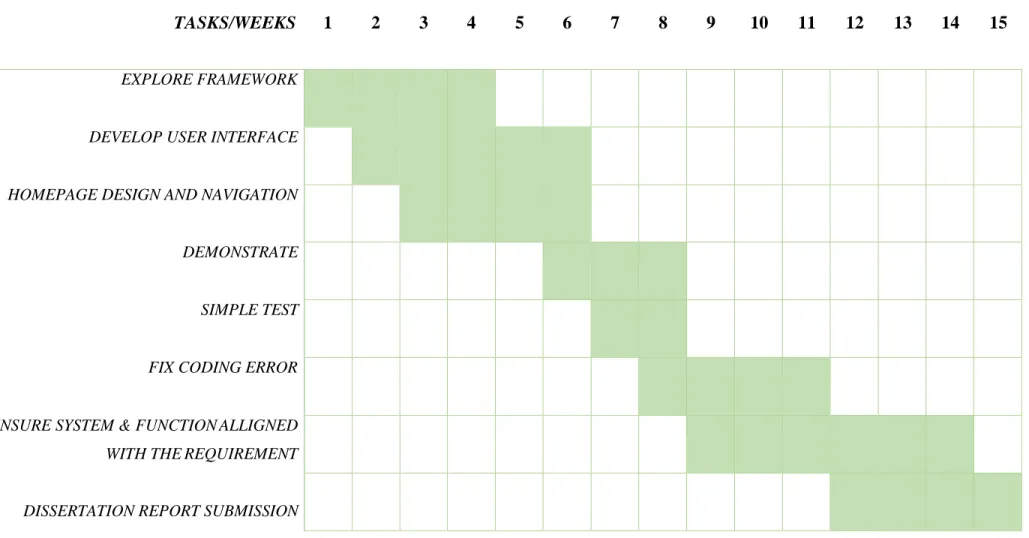
The duration of completing the project is 14 weeks during Final Year Project 1 semester, and 15 weeks during Final Year Project 2. The detailed activities description will be shown in a Gantt chart in Table 2.
1.4.3 Geographical Location Covered
This system was intended to cover the state of Perak initially, before expanding to the rest of Malaysia.
1.4.4 Target Users
The target users for this system are recognized into three categories:
• Customer – looking for something to eat or making a reservation at a restaurant
• Restaurants – businesses that are interested in make online reservation for their customer
• Delivery Rider – They deliver food and drink on the side as a part-time job.
1.4.5 Limitation
This platform will be developed only for mobile application users.
CHAPTER 2 LITERATURE REVIEW AND THEORY
The second chapter of this report will examine significant studies conducted previously by researchers and experts on themes relating to this project. At the conclusion of this chapter, the proposed solution for this project will be presented in order to address the highlighted issue from the previous chapter.
2.1 Literature Review
Restaurateurs lament high delivery charges, hidden fees
According to Nuradzimmah Daim, consumers in Malaysia have for a while been forced to 'eat' food delivery costs, especially since the emergence of the Covid-19 pandemic. With the current no dine-in ruling, many consumers and food and beverage (F&B) operators rely on food delivery platforms, but some businesses claimed they were operating at a loss due to the exorbitant delivery charges and hidden fees.
F&B operators seek govt intervention on commission fees with Malaysia’s ‘big two’
delivery platforms
According to Keertan Ayamany, claiming steep commission charges, food and beverage (F&B) operators want Putrajaya to intercede with the country’s two main delivery providers for lower fees. In a joint press conference that day, several organisations from the industry said the current situation is a “duopoly” and said the charges imposed by the two companies are making it difficult for many restaurants to financially survive during the Covid-19 pandemic.
Numerous Food Vendors Are Boycotting This Popular Food Delivery Service
When the pandemic began, many people had to change their ways to survive. This includes food entrepreneurs who had to rely heavily on deliveries to reach their customers. In order to increase their reach, they bought ads on food delivery platforms. Regretfully, this backfired horribly.
A certain food delivery service has angered several food entrepreneurs. Not only did they allegedly overcharge for their advertising services, the businesses ended up being indebted to them as well. Needless to say, these businesses are planning on taking action, and it isn’t going to be pretty. (RACHEL CHUAH, 2021)
2.2 Online Ordering System
The Internet is a well-known technology, and it has a significant impact on people's lives today. People utilise it for a variety of different purposes, including communication, education, work, and more. Many businesses are beginning to sell their products online because of the growing popularity of internet shopping. People also enjoy shopping online because of the ease it provides. It has become increasingly common for restaurants to employ online marketing in an effort to attract new clients. Some restaurants are already allowing customers to place their orders online. The restaurant's database will receive the information and data from clients who purchase online. Customers' orders will also be shown on the restaurant's screen.
Customers will appreciate the ease of use our system provides. Customers can use the internet to find a restaurant they enjoy. They are able to browse the restaurant's menu and place their order online. Deliveries and pick-ups are the two choices available to customers.
The restaurant's delivery person will bring the food to the customer's home if they opt for delivery. When a customer prefers to pick up their food, they can do it in the restaurant. Food can be paid for with cash, credit card, online banking, or PayPal.
2.3 Online Restaurant Reservation System
There has been a dramatic change in technology over the past few years, which has resulted in the development of an online food ordering system for remote areas, as well as an online food ordering app. Table reservations and meal orders can be done simultaneously on a separate site. Since the rise of smartphones with Android operating systems, there has been a significant shift in the way people use them. These platforms are important for both clients and administrators, who can utilise them to better manage their operations.
Reservation of a table at a specified day and time, which is subject to the availability of tables in the restaurants, was added in the proposed system together with the ordering system at the time of booking. The customers can also choose from three distinct alternatives, which include table reservation, ordering meals, and takeout. Table reservations can be locked or unlocked for a certain restaurant by the administrator. Aside from dynamic menu updating and pricing changes, we have also implemented data analytics and total payments.
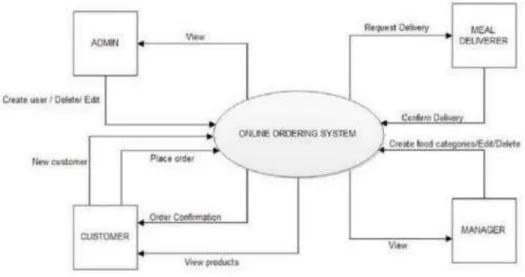
Figure 1: Mobile Applications: Architecture, Design and Development
2.4 Rider Delivery Range Using Artificial Intelligence
AI has been labelled in a context of digital transformation that enabled major business improvements to augment customer experience, streamline operations or create new business models AI technologies are able to develop cognitive abilities, or enhance human capabilities.
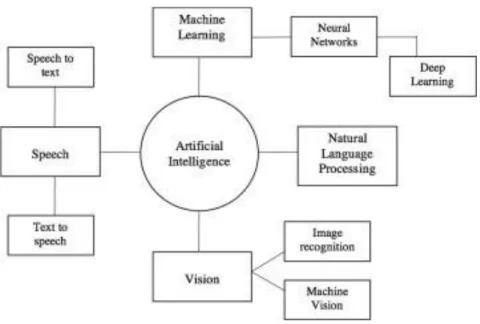
Consequently, AI developments in service delivery may potentially increase the added value to customers. In line with the above, we review in this section the AI technologies that are revolutionizing the service delivery systems. In short, artificial intelligence is being coined in the literature as human behaviours, which can be performed by machines, systems or network.
According to Diebolt et al. AI combines two properties: “self-learning by the successive and repetitive processing of data, as well as the capacity to adapt, that is to say the possibility for a scripted program to deal with multiple situations likely to vary over time”.
Figure 2: Artificial intelligence in service delivery systems
2.4 Existing System
Below are the details of existing system that offer similar services as Meal Time :
1) Food Panda
Figure 3: Food Panda logo
Food Panda is a well-known online food delivery service. Food Panda offers online menus for an incredible range of eateries in your area. Simply enter your location to learn about the type of food, the restaurant, and even the price, but we're also going to provide our
customers with a service that allows them to reserve tables online before they arrive at the restaurant, as well as place their orders prior to arriving at their own tables.
Pros Cons
Huge marketplace Large food delivery fleet Hosted on website and app
High commission fee
High delivery fee for consumer
Many hidden costs for food vendor and customers
2) Grab Food
Figure 4: Grab Food logo
GrabFood is Southeast Asia's fastest growing food delivery service, serving customers delightful meals from street food to restaurant dining.
Pros Cons
Huge marketplace
Largest food delivery fleet in Malaysia Hosted on website and app
High commission fee Delivery radius limitation
Many hidden costs for food vendor and customers
2.5 Comparison Between Similar Systems
Figure 5: Meal Time Logo
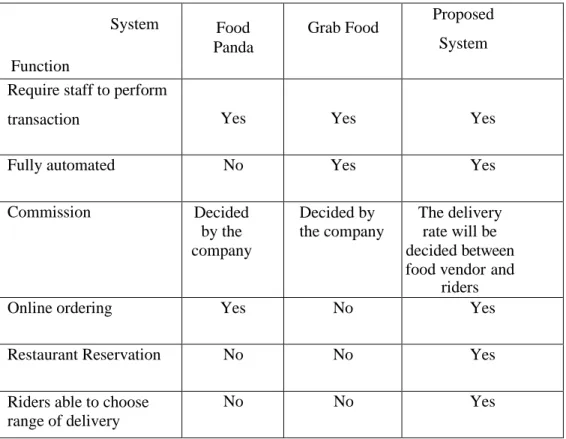
System Function
Food Panda
Grab Food Proposed System Require staff to perform
transaction Yes Yes Yes
Fully automated No Yes Yes
Commission Decided
by the company
Decided by the company
The delivery rate will be decided between food vendor and
riders
Online ordering Yes No Yes
Restaurant Reservation No No Yes
Riders able to choose range of delivery
No No Yes
Table 1: Comparison
CHAPTER 3 METHODOLOGY
3.1 Research Methodology
To ensure that the project or study is finished with minimal risk and in a timely way, each project must have a unique approach. The authors used the Agile Software Development Life Cycle to construct this online delivery and booking platform (SDLC).
One of the primary characteristics of agile development is that it incorporates two distinct methodologies, those of incremental and repeatable development. Agile is a software development methodology that focuses on delivering value to customers quickly. Every two- week iteration is divided down into two smaller ones. An Agile development process will be applied twice a month to ensure that the product satisfies customer expectations.
Meanwhile, the software development life cycle (SDLC) is used to create software.
Design, programming, and testing are all important parts of the Meal Time app development process. In order to meet a given budget and deadline, the author opted to use the SDLC process.
3.2 Project Activity
There are several subtasks that fall under the pillars of project activity. The Agile SDLC process, like this one, has a number of sub-tasks that constitute it a complete methodology. For this study, SDLC is a significant component because it not only studies modification, but it also involves developing a mobile app, which makes it relevant for this study.
Figure 7: Software Development Life Cycle (SDLC)
3.2.1 Requirement Gathering
For this study, I conducted surveys to gather information from online food delivery consumers, delivery riders, and owners of restaurants and food vendors. When conducting this survey, I use Google Forms. Demographic Profiles, food delivery perspective, rider perspective, and restaurant and food vendor owners' perspective are the five divisions I break it down into.
In addition, I conducted interviews with 22-year-old J&T riders to learn more about the present delivery rider communication channel and protocol. J&T rider Muhammad Hafid bin Jainal is currently working as a part-time J&T rider and also as a FoodPanda and GrabFood rider.
3.2.2 Design the Requirement
After gathering all the requirements, I began the design process in this step. In this step, I created a flowchart depicting the entire application process, from the time a user logs in to the time the user exits the application. I use lucid chart, a web-based tool, to create the flowchart.
In addition to being completely free, this tool can assist me in creating even the mostbasic flowchart.
To progress to the next phase of development, I use the flowchart because I can see the structure and direction of my progress. There were no dangers or functionalities in this project that did not satisfy the initial objectives, thus I was able to prevent any issues.
3.2.3 Construction / Iteration
After completing the design and application flow, we enter the third step, which is the construction or development process. This streamlines the development process because it doesn't waste time on additional features that don't fulfil the original requirements. A small application with minimum functionality can be developed in a predetermined amount of time, saving both time and money. As a result, the development flow has been finished in advance, which means that all risks, additional work, barriers, and challenges may be dealt with with greater forethought. As the system requires a user interface and a database mechanism to store user information, this part will focus on the front and back ends of the project.
3.2.4 Deployment
As soon as the first iteration has been finished, the deployment phase can get under way. The deployment phase does not have to wait for the completion of all processes or iterations in Agile. The product can be released and delivered to users for testing so that any modifications to the requirements on the following iteration can be updated without delaying time.
There are two ways to go about deployment: formally and informally. In the beginning, the deployment will be informal, with only a prototype available to users, allowing them to test out some features that have not yet been finished. This is followed by an official release on Google Play Store, where every Android smartphone user can download and utilise the software.
3.2.5 Testing
After the first iteration is complete, the testing step can begin. After two weeks of development, the first iteration of a product is considered complete. As a result, the developer can carry out a few simple tests to check that the software performs as expected.
User Acceptance Testing, or UAT, is the next step in the testing process. This is a test conducted by actual users in order to uncover any bugs or new requirements that developers may have neglected. All iterations of the product have been completed and the final product is ready for testing.
.
3.2.6 Feedback & Report
In the last phase, the author will receive feedback from the public. Online delivery app users between the ages of 18 and 50 are particularly well-suited to providing comments. The author will either make changes to the application or include this information in the report as a result of this feedback. It's critical to gather feedback because the purpose of this study is to determine whether or not consumer opinions and reactions are beneficial.
In addition, the author will write a final year project report as a final-year student's last
task. This report is also meant to serve as a guide for future research into mobile apps and online
food delivery.
3.3 Time Frame for the Project Development
Table 2: Gantt Chart for FYP I
KS/WEEKS 1 2 3 4 5 6 7 8 9 10 11 12 13 14 15
IDEA & TITLE PROPOSAL
INTRODUCTION
AIM & OBJECTIVE
ANALYSIS, SURVEY &
INTERVIEW METHODOLOGY
PROPOSAL DEFENSE
DESIGN & DEVELOPMENT
INTERIM REPORT SUBMISSION
Table 3: Gantt Chart for FYP II
TASKS/WEEKS 1 2 3 4 5 6 7 8 9 10 11 12 13 14 15
EXPLORE FRAMEWORK
DEVELOP USER INTERFACE
HOMEPAGE DESIGN AND NAVIGATION
DEMONSTRATE
SIMPLE TEST
FIX CODING ERROR
ENSURE SYSTEM & FUNCTION ALLIGNED WITH THE REQUIREMENT
DISSERTATION REPORT SUBMISSION
3.4 Key Milestone
Table 4: Milestone for FYPI & FYPII
Num. Milestone Completion Week
1. Requirement Gathering Week 5
2. Methodology Week 6
3. Proposal Defense Week 12
4. Interim Report Submission Week 12
5. Prototype Development Complete Week 25
6. Dissertation and Technical Report Week 28
7. Project Submission and Presentation Week 29
3.5 Tools
This section the author describes the tools used to conduct the study. With this tool, a prototype can be completed and can be used as strong evidence in realizing the outcome of this study. It involves application development in terms of front end, back end, hardware and software.
3.5.1 Frontend
Basically, the front end is the main display layout to the user. To prepare the UI, several tools have been used by the author. The first Flutter where it is an official integrated development environment for Google's Android operating system. Next, the author uses the Native Script framework to help the author develop a mobile app. This framework is special for mobile app development and hasvarious libraries that are suitable for mobile app development.
Android Studio Native Script Framework
3.5.2 Backend
The back-end process takes place behind the scenes. Users will not see any movements and processes that occur but can only see the outcome through the User Interface.The back end is important for processes such as data storage, data retrieval such as GET and POST,
organizing and organizing data efficiently.
Among the tools used by the author is Firebase which is one of Google's products.
Hence, it is very reliable and quality. The main task of Firebase is for authentication, which isthe login or sign-up process, database storage, machine learning, and more.
3.5.3 Hardware
In this project, among the hardware involved is an android smartphone. It aims to execute coding in a real smartphone and be able to experience this application for yourself in real-world situations. Smartphones other than android are not involved because this application is specifically for Android users only. Apart from that, the second hardware is a laptop. Of course, a laptop is needed for writers to start a coding project.
3.5.4 Software
In an IT project, the software is the most important tool. Jom Ride also requires software
such as Android Studio to write code easily. In addition, GitHub Desktop is also needed tomake
it easier for writers to store, transfer and keep track of each coding activity. Next, the third
software is Firebase which serves as a cloud database and authentication. Firebase is a product
of the giant company Google; therefore, its quality is very excellent and reliable
CHAPTER 4 RESULT AND DISCUSSION
4.1 Data Gathering and Analysis
As stated in the table in the completion of this project, data gathering was done tocollect information with a qualitative and quantitative approach.
4.1.1 Use Case Diagram
Figure 8: User Sign in
Figure 9: Add and Create Restaurant
Figure 10: Customer Make Booking
4.1.4 Questionnaire Survey Analysis
In the first section, I started to explain and summarize about this project because I want
respondents to understand the objectives, goals, and output of my study.
Figure 11: First section of survey Google Form
While the second section, I asked respondents to fill in the Demographic Profile such as name, gender, and so on. This is because my main target is to get respondents who use delivery app, delivery rider and restaurant owner as well.
Total Respondent
Gender
In section three, I invited responders from the delivery rider community to provide their perspectives on the current delivery apps that they use. I'm curious as to whether I accurately identified their issue.
How long you work as delivery rider?
Which companies do you work for (you can choose more than one)?
Which vehicle do you use to complete your deliveries?
If there's a communication channel that dedicated solely to delivery riders? would you agree it?
Do you wish to contact with other delivery riders using a professional platform other than Whatsapp in order to
obtain and share
information?
In section four, I invited responders from the restaurant and food vendor owners community to provide their perspectives on the current delivery apps system that they use. I'm curious as to whether I accurately identified their issue.
Do you believe that Food
Delivery Apps are now taking more money from you?
Do you believe the price in the delivery app right now is too high?
In section five, I invited responders from the customer community to provide their perspectives on the current delivery apps that they use. I'm curious as to whether I accurately identified their issue. Total 10 responses as customer.
Do you believe the price in the delivery app right now is too high?
What's the average number of times per week that you use a delivery app?
Based on the survey, the author can see that most of the respondents will support this
delivery and booking apps. This GoogleForm survey further strengthens the authors ’support that
online delivery apps right now have some issues, especially in current pandemic situations.
Primarily, once a user visited the apps, they will directly be on the log-in page. The login page was designed to allow a user to log in and they will have entire access to the website.
Users must enter their email and password to log in, however, in the case where the user does not have an account, they will require to sign up.
4.2
Prototype
4.2.1 Deliverable Interface
Table 5: Login Page
Table 6: Owner Menu Page
Next up, this is what restaurant owner menu page looks like. The restaurant owner able to add
tables, accept and view reservation, and post jobs for delivery rider.
Table 7: Reservation Page
Next up, restaurant owner able to view the reservation list made by customer.
Table 8: Rider Recruit Page
On this page, restaurant owner able to post job for recruiting delivery rider for their
restaurant. After that, rider will be able to view the job posted by the restaurant owner and then apply
for the job.
Table 9: Rider Payment Page
On this page, restaurant owner able to make payment for the delivery rider
Table 10: Customer Reservation
On this page, the customer can look for their preferred restaurant to make reservation.
4.2.2 User Testing
Figure 12: Meal Time Dashboard
In the experimentation section, the author is also a developer for the Meal Time prototype.
Here, the developer has conducted detailed testing in the Login page, Register, Restaurant Owner Page, Customer Reservation Page, Rider Booking Page, Payment.
Each time a user registers, user data will be saved and will be authenticated before they can
Figure 13: Customer Reservation Confirmation
On this page, the customer can view their reservation confirmation. Each reservation will be
updated into the database and can be displayed for the user to view and monitor his record.
CHAPTER 5 CONCLUSION AND FUTURE WORK
In conclusion, the system provides a platform for delivery riders to communicate with one another in order to resolve problems and concerns that may emerge, as well as to eliminate third- party involvement in payment issues, which have become an issue for online food delivery services in recent times. Additionally, the system has a function that allows restaurant owners to reserve a rider for a specified length of time to do delivery duties for them. Additionally, the system provides a platform for customers in the event that they wish to visit a restaurant and discover that no table is available for dinner/lunch, then they must wait a long time for a table to become available. With the assistance of this application, consumers may choose the size of the table based on their requirements and preferences, for example, the table can be held according to the number of visitors. This application will grow in importance in the future days as more people become interested in Android and the fast lane.
4.1 Recommendation for Future Work
The system's ultimate goal as the project proceeds will be to fully develop in response to user comfort and input.
● The system should be enhanced with a more diverse menu of sustaining foods, which would increase customer satisfaction. At the moment, it comes with pre-defined fix menus.
● To develop this System in Malay Language.
● In the future, the system will be available on Apple's iOS mobile platform.
● The scope of this project will be expanded in the future to encompass the entire country.
REFERENCE
FAYYADH JAAFAR. (2021). Vendors on Foodpanda protest ‘hidden costs.’ The Malaysian Reserve. https://themalaysianreserve.com/2021/11/09/vendors-on- foodpanda-protest-hidden-costs/
Gregorash, B. J. (2016). Restaurant revenue management: apply reservation management?
Information Technology and Tourism, 16(4), 331–346.
https://doi.org/10.1007/S40558-016-0065-0/FIGURES/1
Hwang, J. (2008). Restaurant table management to reduce customer waiting times. J Foodservice BusRes, 11(4), 334–351. https://doi.org/10.1080/15378020802519603 Hwang, J., & Yoon, S. Y. (2009). Where would you like to sit? Understanding customers’
privacy-seeking tendencies and seating behaviors to create effective restaurant environments. J Foodservice Bus Res, 12(3), 219–233.
https://doi.org/10.1080/15378020903158491
Keertan Ayamany. (2021). F&B operators seek govt intervention on commission fees with Malaysia’s‘big two’ delivery platforms | Malaysia | Malay Mail. Malay Mail.
https://www.malaymail.com/news/malaysia/2021/07/14/fb-operators-seek-govt- intervention-on-commission-fees-with-malaysias-big-t/1989862
Nuradzimmah Daim. (2021). Restaurateurs lament high delivery charges, hidden fees.
New StraitsTimes.
https://www.nst.com.my/news/nation/2021/07/711409/restaurateurs-lament-high- delivery-charges-hidden-fees
RACHEL CHUAH. (2021). Numerous Food Vendors Are Boycotting This Popular Food DeliveryService. Hype Malaysia. https://hype.my/2021/250230/boycott-food-delivery- service/
Reis, J., Amorim, M., Cohen, Y., & Rodrigues, M. (2020). Artificial Intelligence in Service Delivery Systems: A Systematic Literature Review. Advances in Intelligent Systems and Computing, 1159AISC, 222–233. https://doi.org/10.1007/978-3-030-45688-7_23 Resmi M. (2020). IMPACT OF AI IN ONLINE FOOD DELIVERY SYSTEM - Tech Blogs.
Infolks
Group. https://infolks.info/blog/impact-of-ai-in-online-food-delivery-system/
Yeo, S. F., Tan, C. L., Teo, S. L., & Tan, K. H. (2021). The role of food apps
servitization on repurchase intention: A study of FoodPanda. International Journal
of Production Economics,234, 108063.
APPENDICES