Service Discovery
By
Ahmad Syazwan Shaharum
Dissertation in partial fulfillment of the requirement for the
Bachelor of Technology (Hons) Information Technology
Universiti Teknologi PETRONAS
Bandar Seri Iskandar 31750 Tronoh
Perak Darul Ridzuan
JULY 2005
Approved by
CERTIFICATION OF APPROVAL
Service Discovery
by
Ahmad Syazwan Shaharum
A project dissertation submitted to the Information Technology Programme
Universiti Teknologi PETRONAS in partial fulfilment of the requirement for the
BACHELOR OF TECHNOLOGY (Hons) (INFORMATION TECHNOLOGY)
(Mr.Anang Hudaya A.Amin)
UNIVERSITI TEKNOLOGI PETRONAS
TRONOH, PERAK July 2005
CERTIFICATION OF ORIGINALITY
This is to certify that I am responsible for the work submitted in this project, that the original work is my own except as specified in the references and acknowledgements, and that the original work contained herein have not been undertaken or done by unspecified sources or persons.
AHMAMYAZWAN SHAHARUM
n
Abstract
Service discovery is necessary to enable computers to interact with each other through heterogeneous wired and wireless networks in a seamless way. To discover a service, a client uses one of these protocols to issue a query to a central server or an individual service provider. The service description in the query may contain a specific name and set of one or more attributes. The server or provider attempts to match the query's pattern with the pattern of a service its database contains, then it returns the appropriate response to the client. For this project the methodology use will be the Rapid Development Application methodology that is found most suitable assist in this project.
Requirement analysis has been done in order to seek for the characteristics and areas that need to be put in action in getting the result. Next will be the design phase where the process to design the service-oriented and Jini architectures within the client/server architecture. For the implementation phase, both the architectures are going to be set up simultaneously using Jini Network Technology. Therefore with developing service discovery with Jini technology, the minimum of manual intervention which it is include
in the Jini vision.
i n
ACKNOWLEDGEMENT
Throughout this project entitled Service Discovery is done with the help of many people. I would like to express my gratitude to Allah, The Al-Mighty, for giving me the strength, ability and feasibility in carrying out all the research and tasks required.
I would also like to express my highest appreciation to my project supervisor, Mr.
Anang Hudaya Muhd. Amin for the time he spent in providing me guidance and good advices throughout my final year project. Thanks to University Technology of Petronas in general and the Information Resource Center management staffs specifically for their helping hands in assisting me in conducting and finding the good research materials.
Not to forget, I would like to thank my colleagues, Suhana Suarni, Mohd Faitz Adam, Mohd Azizi Ahmad, Mohamed Ferdaus Abdul Wahab, and Khairil Anuar Othman for give me the energy and ideas to me in developing this project as the first in University Technology of Petronas.
Lastly, I would never forget and thanks too, to my family, all the lecturers involved, and all my friends who have been giving me continuously supports from the very beginning of this project kick-off upon the completion.
Thank you.
TABLE OF CONTENTS
CERTICIFATION OF APPROVAL CERTIFICATION OF ORIGINALITY ABSTRACT . . . . CHAPTER 1:
CHAPTER 2:
CHAPTER 3:
CHAPTER 4:
CHAPTER 5:
REFERENCES APPENDICES
INTRODUCTION
1.1 Background of Study
1.2 Problem Statement
1.3 Objectives and Scope of Study
LITERATURE REVIEW AND THEORY
METHODOLOGY
3.2 Rapid Application development. .
3.1 Requirement Analysis and Planning Phase
3.2 Design Phase . . . .
3.3 Construction and Implementation Phase .
3.4Cutover
3.5 Tools and Equipments
3.5.1 Software and Hardware .
RESULT AND DISCUSSION
4.1 Findings .
4.2 Results and Discussion .
CONCLUSION AND RECOMMENDATION
5.1 Relevancy to the Objectives
5.2 Recommendation . . . .
i
ii
iii
1 2 3
7 7 8 11 13 13 14
15 15 17
19 19 20 21
LIST OF FIGURES
Figure 1: Service-oriented Architecture . . . 9
Figure 2: Jini Architecture . . . 11
CHAPTER 1
INTRODUCTION 1.1 Background of Study
Broadly, a service discovery is a collection of protocols for developing dynamic client/server applications. Client/server is nothing new, and in fact many of the concepts in service discovery are not ground breaking. Instead, the advantages provided by service discovery arise because a number of important features are bundled and standardized.
Highly dynamic interactions between clients and services is the norm service discovery-enabled clients seek needed services based on their type (e.g. printing, file storage) and based on descriptive attributes that identify the manufacturer, the cost of using the service, or other interesting facts. These technologies allow services introduced into a network to be discovered, configured and used with a minimum of manual intervention. Enabled services announce their presence when they enter the network and (if possible) announce their demise when they leave the network. Applications which display a client in need of an IP address, for example might seek a DHCP server, communicate with the server, and finally be granted one already exist in networked
environments.
Basically, these clients and services are typically developed from scratch, with little support for the developer other than "here's a C compiler. Get to work." Service discovery technologies generalize and standardize the environments in which client/server applications are developed and used, and implementations of the various service discovery protocols provide software tools that make the development effort much easier and interactions between clients and services more dynamic than usually seen in today's systems.
There is a lot of common group among the various choices in service discovery frameworks. All support the concept of client and service which are simply entities that need and offer some functionality (e.g. printing), respectively. Clients perform discovery in order to find needed services. A discovery attempt generally classifies the services by type, and may optionally include requirements such as a manufacturer, serial number or other services attributes. Whether services are sought directly or a catalog is consulted, a client needs a very little information about its environment which it can locate services dynamically, with little or no static configuration. When a service enters the network, it
will perform service advertisement, either directly to clients or to one or more service
catalogs. The advertisement includes necessary contact information, and will also includeeither descriptive attributes or information that will allow these attributes to be
discovered.
1.2 Problem Statement
Connecting the needy clients and the providers' available services is the point of service discovery. Service discovery technologies directly attack the "I don't know where you are" and "I don't know how to talk to you" issues.
One problem user's encounter with increasing frequency and severity is the installation, configuration, and management of peripherals. This is a client/server
problem in disguise. The complexity of this problem is becoming more serious as laptops, handheld computers, printers, scanners, wireless devices, external storage devices, digital cameras and other peripherals are integrated into networked environments
in the home and office. Inexperienced computer users may become quite frustrated in dealing with the configuration and interaction of such a multitude of devices.Introducing a new device can include physical installation, removing device
drivers for a device being replaced, installation of devices drivers included with the new
device, determining that the included device drivers are outdated or designed for a
different operating system, necessitating downloading and installing new device drivers, and unexpected interactions withexisting devices. Concrete evidence of user's frustration
with these situations can be seen in the red faces and angry tones of users. Configuration headaches can be compounded many times over in environments with numerouscomputers. Service technologies take an important step towards eliminating manually installed device drivers, relying instead on standard interfaces to put devices in touch.
1.3 Objective and Scope of Study
Following are the objectives of service discovery protocols:
• Discovery. The ability to find a service provider if there is a service in the network with the properties described in the request. In order to achieve this goal,
protocols implement the following functions:- Use a description language. To facilitate the discovery process, services
are semantically described following a certain description language.Service requests are also expressed using this description language.
- Search for services. Service requests are expressed using the description language and are addressed to the directory nodes or disseminated in the
network.
Service discovery can make things more convenient by allowing the types of available services to be discovered easily. It is the needed services may be discovered on demand, with minimal prior knowledge of the network.
Typically, to discover a service, a client uses one of the protocols to issue a query to a central server or an individual service provider. The service description in the query may contain a specific name and set of one or more attributes. The server or provider attempts to match the query's pattern with the pattern of a service its database contains, then it returns the appropriate response to the client.
CHAPTER 2
LITERATURE REVIEW AND/OR THEORY
Service discovery is a field which that need an exploration with the purpose to view the ability of its function in the network world. There are many researches which applied the concept of service discovery in their project such as in ubiquitous computing.
This sounds very visionary and will probably remain a dream for a long time to come. On a more modest scale, [8] says that:
"One of the visions of ubiquitous computing is the ability to use arbitrary devices such as cell phones and hand held computers to interact with arbitrary remote networked appliances such as TVs, printers, and EKG machines."
This is more close to the project; this is where service discovery comes in. An article with good coverage of this subject, [9], says:
"Future computing environments will consist of a wide range of network based appliances, applications and services interconnected using both wired and wireless networks. In order to encourage the development of applications in such environments and remove the need for complex administration and configuration tasks, researchers have recently developed a range of service discovery and interaction platforms. The key function of such service location and device interaction technologies is to allow users and applications to deploy, discover and interact with the services provided by devices and software components on the network. This interaction is required to occur without the users, the applications, or the service providers needing detailed knowledge of the local network configuration."
Due to this, it gives all the rationale needed to motivate investigations into service discovery where it shows that the author current understanding about the topic is in the right path. This is actually motivates to continue the research and explore this topic
further.
The tools that available for service discovery are many and one of them is Jini Network Technology. Each of the tools available has their own specialty and vision.
From the official Jini architecture specification, Jini is defined as:
"A Jini system is a distributed system based on the idea federating groups of users and the resources required by those users. The focus of the system is to make the network a more dynamic entity that better reflects the dynamic nature of the workgroup by enabling the ability to add and delete services flexibly."
Jini is a service discovery technology based on Java, developed by Sun
Microsystems. It has platform-independent which it can rely on mobile code as well. Jini Network Technology can be phrased as a powerful tool for this topic and the usage of this tool might help to the successful product in the end of the day.
CHAPTER 3
METHODOLOGY/PROJECT WORK
3.0 Rapid Application Development
Rapid Application Development is the methodology chosen for this project due to the time constraints and level of difficulties which might happen in the middle of accomplishing it. Extreme programming will be applied simultaneously. Each phase in this methodology will be explained in detail below:
3.1 Requirement Analysis and Planning Phase
This phase is where research about this topic takes place. The idea is to get the knowledge and improve the understanding about service discovery in order to continue to
develop this project. The task while doing the research starts with identifying and listing
down all the possible entities, applications or technologies such as Corba, Soap, Jini and others in order to select the most suitable entities that are going to be used to develop this project. Besides, the most important thing is to study and understand well about service discovery architectures.Service discovery architecture is actually a little bit different with other network architecture. Inside the architecture, consist of a unique entity which varies with other network architecture. The reason to study and grasp the idea of the architecture will lead
to the development of service discovery. After all the architectures from all the
application such as Corba, Jini and others have been identified and analysed, only the
most suitable architecture will be selected for this project. The next task that needs to bedone is to identify and list down all the possible and available tools that can be used in
service discovery. The most preferable will be tools which are free and easy to download
from specific websites. The final task is to select the most suitable tools that is going to
be used in next phase.3.2 Design Phase
Design phase will focus on the service discovery architecture. The concept of network that will be applied in this project will be the client/server architecture. This concept will also be applied simultaneously with the architecture mention before. The tools chosen for this project is a tool from Sun Microsystems, Jini. The decision to use Jini as the application for this project is based on the comparison that has been done on several other protocols and application available. The comparison can be viewed in the Appendix A.
The reason to select Jini as the application or middleware for this project is because the central vision of Jini is the realization of a distributed computing environment that can support rapid configuration that will allow the configuration of devices and software being amended using a simple "plug and play" model. Essentially,
the goal is to allow any device or a software component to be connected to a network and announce its presence. Other components that wish to make use of it can then locate it and call it to perform tasks. The reconfiguration takes place invisibly, reducing the
administration load of the programmer developing the system.Three main concepts are brought together in the formation of a running jinni system. Each of these different classes of component is important to the realization of the
Jini model of distribution.
• A Service is a piece of independent functionality that is made available to
the others users and can be accessed remotely across the network. Services include devices ( e.g. printers and cameras) and software components (e.g.file systems). Jini services are routinely managed as a co-operating set
known as a Jini community.
• A Client is a device or software component that would like to make use of a service. Jini seeks to support a very heterogeneous selection of clients
embracing a wide variety of hardware devices and software platforms.
• A Lookup service helps clients find and connect to services. The lookup
service acts as a broker between the needs of the client and the services it
knows about across thee network.
These central components combine with simple principles to form the foundation of Jini. These three principles ensure that Jini services can spontaneously interconnect with each other without cumbersome administration. These principles are embodied within Jini in term of how Jini makes use of the concept of client, service and lookup
service.
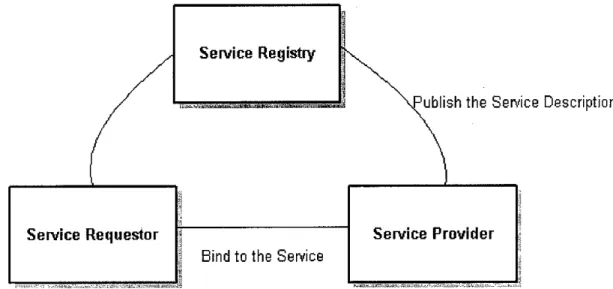
The first architecture that needs to understand is the service-oriented architecture.
This architecture takes the existing software components residing on the network and allows them to be published, invoked and discovered by each other. SOA allows a software programmer to model programming problems in terms of services offered by components to anyone, anywhere over the network.
Service Registry
ublish the Service Description
Service Requestor Service Provider
f Bind to the Service
Figure 1: Service-oriented Architecture
Below are the functions of each entity:
Service Provider
The service provider is responsible for publishing a description of the service to the
service registry. Normally, the service provider hosts the web service.Service Registry
The service registry is a repository that provides the capability of discovering services by the service requestors.
Service Requestor
A software application that is responsible for discovering and invoking the service. The service requestor binds to the service obtained from the service registry.
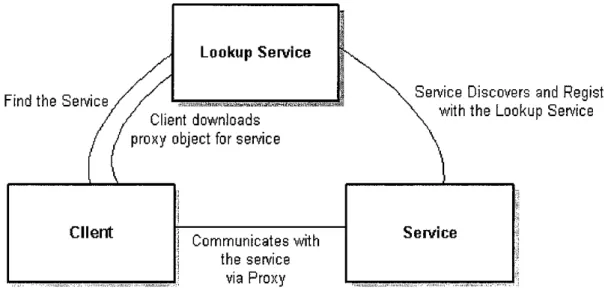
Next architecture is the most important architecture to apply in developing the
project as it been called as Jini architecture. As Jini sytem is been implemented in this project, it needs to use its own architecture which comprised of Lookup service, Jini
service and Client service. It may notice the diagram of the Jini architecture closely resembles the architecture of Web services. This is another reason why the Jini architecture has a foundation that is rooted in the dynamic principles of a SOA. Below are the functions of each entity together with the architecture.Lookup Service
The lookup service keeps track of the Jini services and provides the proxies to
communicate with the service. In addition, the lookup service is a Jini Service as well.The Sun reference implementation of the Lookup Service is reggie.
Jini Service
Jini Service are registered with the lookup service and are capable of being invoked through their public interface which is defined via a Java remote interface. The
underlying system that allows Jini services to communicate is RMI.Jini Client
The Jini client is software that requests the proxy from the lookup service in order to
invoke the Jini service.
10
Find the Service
Client downloads
proxy object for service
Communicates with the service
via Proxy
Figure 2: Jini Architecture
Service Discovers and Register with the Lookup Service
Service
3.3 Implementation Phase
This is the phase where both the architectures are going to be set up simultaneously using Jini as the tool selected in the earlier phase. Programming part will also take place. It involve in programming a program which will act as a service in this project. The programming language used is Java so that the program is compatible with Jini which also a product of Java Microsystems.
The development starts with required Jini services are up and running. It has its own setup and configuration to run Jini. In order to make sure that the environment has been setup accordingly, here is a checklist for getting setup generally.
• Run the RMI activation daemon. It should run this on the same machine
that will be running the lookup service on, and the activation daemon should be started before the lookup service.
• Run a Jini HTTP server which will supply downloadable code for the Jini lookup service; this server can be run on the same machine as the lookup
service. This ensures that the code is able to download the classes in the
reggie-dl.jar file, which contains the code needed to use the lookup
11
service. In addition, all the programs wrote before need to be able to supply code to Jini services and to each other.
• Run the Jini lookup service. The service should run on a machine on the same network subnet on which it intend to run the programs. This is because Jini's multicast discovery protocols are by default, only configured to find lookup services running 'nearby' the object doing discovery.
This configuration of services is sufficient to run most Jini services. While all these programs, lookup services, HTTP servers, activation daemon, and the clients and servers can be run and need to develop on the same machine, and Jini applications are
intended to be distributed and run across a number of machines.
Next step is Jini deployment where it has three Jini-aware applications running:
• A Jini lookup service that helps clients locate service
• The Jini service under development that have been tested
• A Jini client program that uses the service under development
There are few steps to follow in order to run the project and the aim is to illustrate
the principles involved in developing a Jini service. Firstly is to define a service interface
where it defines what the service will do. It is essentially the way in which services are described to Jini and made available to potential users. The service proxy objectimplements this interface and the clientuses it whenever it searches the lookup services.
Secondly, publishing the service interface with a lookup service and to make it available to the Jini framework in order to allow potential clients to find and use the
service. A program is needed wwhich it handles finding a lookup service and publishing the proxy. This is normally called the 'wrapper' process and takes care of the interactions
with Jini needed to publish the proxy.
12
Next is discovering a service via a lookup service where a thing needs to be done is to find a jinni lookup service. It means to make a request to the Jini framework for lookup service. The principle way of doing is to use the LookupDiscoveryManager class.
This class will aalow to find instances of the lookup service that are nearby the network.
Run the lookup service that is configured to support that group name somewhere in the
network is a must.
Continue with the next step which registering with a lookup service. The process of registration with a lookup service which will call two arguments which are the service items and second is the requested duration of the ease. After registering the service proxy, the wrapper checks to see if this is the first time has been registered. If it is the first time,
it writes the service ID that has been returned into the service item so that future
registrations use the same ID. It also stashes the registration result into a hastable so that it can retrieve it in the future. Final part is to compile and run the programs and see
whether it show success or its failure.
At the same time, error checking will also takes place in order to check the functionality according to the requirements. After examined the prototypes, final product
will be released.
3.4 Cutover
The final phase in this methodology consists of the product is ready to be launched. Then it ready for handover the project to the university, besides report preparation and presentation.
3.5 Tools /Equipment Required
In this project, the main tool that going to be used for the coding is using the
application that are available on the internet and it is free to download. Below are the list
tools and equipments that have been used for this project development process.13
3.5.1 Software Requirements
Jini Network Technology by Sun Microsystems
•
o Jini 1.1 o Jini 1.1.2 o Jini 2.1 Beta 2
Java Development Kit version 5 (JDK-5)
Java2 Enterprise Edition Software Development Kit version 4 (J2EESDK-4)
3.5.2 Hardware Requirements
•
Personal Computer / Desktop
o Window XP
o Pentium 4 processor with 2.4 GHz o 256 MD RAM memory
o 1 GB Hard Disk space Network Interface Card (NIC)
• Network Cable
14
CHAPTER 4
RESULT AND DISCUSSION
4.1 Findings
This is the critical and the most important part of this project. All research and product are presented here, in this section. Both research and product must achieve its objectives as to announce as a successful project.
There were several problems faced during the development of this project. The problems might be trouble to deploy programs on multiple machines. This is because the distributed nature of their deployment means that Jini applications cannot rely on many of the assumptions which could take for granted when developing Java programs within a single machine environment. In fact, developing Java applications in the same way probably develop "standalone" Java applications by doing everything on one machine
with the same CLASSPATH.
During the deployment stage, because of convenience or necessity which it may develop and test the code on only one machine. In such cases, it is easy to run into
problems because by running everything on one machine. It is not exercising parts of the
code that may cause things to break when the components of distributed system run ondifferent hosts.
It is the great danger when testing only 'locally". The apparent early convenience of taking the easy way out can result in greater headaches down the road. It is a good idea to get in the habit of thinking about multi machine environments from outset. The best way to avoid future deployment problems is to mimic the multi machine setting which will eventually be expected to run.
15
Many of the problems encounter in developing Jini programs arise from the integration of code and the need to download software across the network. Often errors occur because the code that has been anticipated is not being downloaded correctly. If fortunate, then no code is downloaded and the error will immediately visible. However, it is more than possible that it still can be downloaded from the wrong location and the errors will not be as immediately visible. These situations made the development process delayed and to avoid introducing subtle and problematic errors, attention to configuring the services that support the downloading code is demanded. The setup and configuration was not as easy as it see when there were many things to consider and understand so that all parts are working especially those servers. It is impossible to configure without any reference because if Jini was configured wrongly, no services available in the end of the day.
In addition, during the configuration and setup the Jini 1.1 environment, the main problem occurred which was the reggie, the Jini build in function to lookup for services was not functioning although those three servers which were RMI activation daemon, Jini HTTP server and Jini lookup service. These three servers were interrelated so that the function of lookup for service can be applied accordingly. In this case, the Jini HTTP server was not functioning accordingly as it could not supply the downloadable code for Jini lookup service. So the result was no service available although the end result supposed to be the other way round.
After few testing and investigation, the problem mentioned above was because of the version of Java Development Kit (JDK) used. Jini 1.1 was only compatible with JDK 1.3 which could not be downloaded in Java websites as this JDK already in the stage of end of life (EOL). The only JDK available to download was the latest version JDK 5.1.
This new JDK which been installed was not compatible with Jini 1.1 and as the result, problem mentioned before produced. The reason why Jini 1.1 selected for the development tools was because the tutorials that managed to get and available were focusing on using this version only and no other versions tutorial available.
16
Therefore the next step was to change Jini version as to find the one which support or compatible with JDK 1.5. Jini 2.1 Beta 2 was the version selected and this new version has additional functions as it was the enhancement product from Jini 1.1. The new environment needed to be setup and configured and the author managed to encounter the problem mentioned above which the server functioning accordingly. Next problem
occurred was to locate the reference or the address of services in order for user to
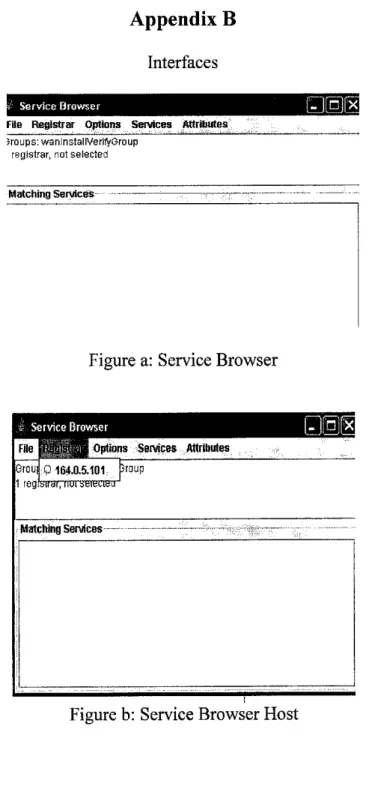
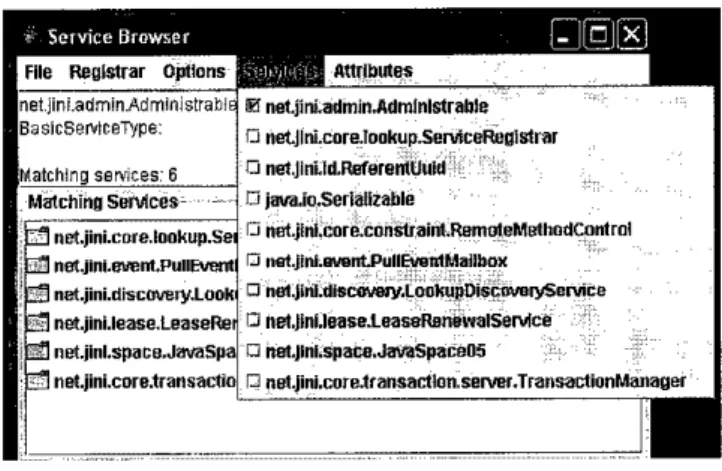
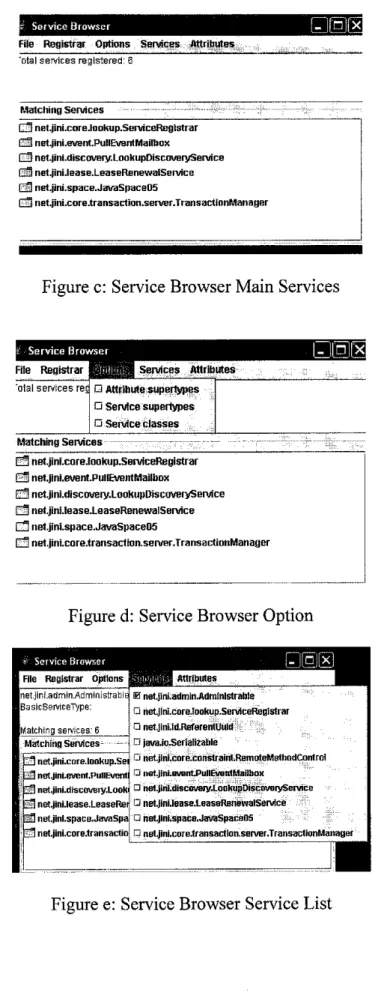
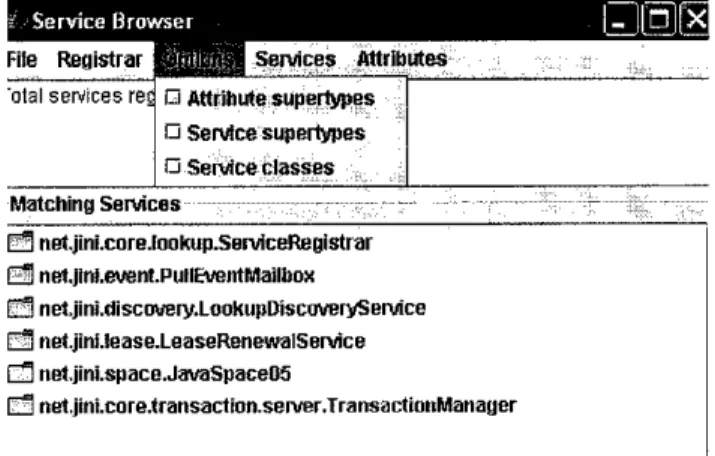
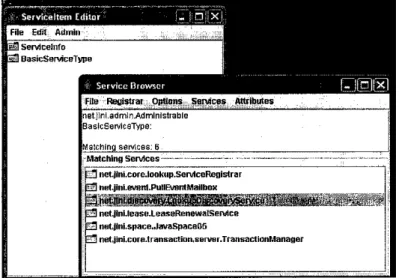
communicate directly with services. Service registry do not able to provide the proxy to user so as a result, user could not able to execute or use the service. This was the problem which the developer unable to settle by schedule. The services can be view by service browser but the proxy not provided as it suppose to.
4.2 Result and Discussion
The final product for this project will be a product that enables to show the functionality of how service discovery is actually works by using the Jini Network Technology by Sun Microsystems. The ability to search for services can be proved when user able to contact the Jini community which implements a particular Java interfaces and download code which implements that interfaces. The key factor for the product was by implementing two architectures which were service-oriented architecture and Jini
architecture.
Based on the final product developed, some of the objectives were achieved and this was due to the problems occurred and the developer level of expertise. The product able to show the ability to search for a service by using the service-oriented architecture is to show that it is already achieve the project objectives and already prove it. Therefore the product do achieved its objectives which mainly focus on the ability to search for a service in a different way from usual. The services introduced in the network are actually to be discovered, configured, and used with a minimum manual intervention.
17
The end result for this product was the product was able to show those services available to user but the user does not have the ability to execute the service they desired.
In other words, the user able to search and discover the available services but they could not use the service. Here are the steps in searching for service which firstly, user will search a specific service from the lookup service. Then, the lookup service will do an 'advertisement' and announce about the service that users looking for and the lookup service itself will tells the users the specific proxy to download the service. Previously, the service itself must register with the lookup service so that the service will visible in the lookup service perspectives. Next step was users will use the proxy given by lookup service to download the service which in other words, users can communicate with the particular service after the users have been given the proxy for particular service by lookup service.
Based on the steps stated before, the part which not functioning was the one user will use the proxy given by lookup service to download the service which in other words, users can communicate with the particular service after the users have been given the proxy for particular service by lookup service. The problem faced here was about the user could only view the services available by viewing them at service browser but do not able to communicate and execute the services user desired. User could not get the proxy to communicate with the services. The user only could search and view the services listed by service registry but could not execute the services desired.
18
CHAPTER 5
CONCLUSION AND RECOMMENDATION
5.1 Relevancy to the Objectives
As stated in chapter 1, the main objectives which is the ability to find a service provider if there is a service in the network with the properties described in the request is achieve and can be run by the product to prove that the objectives are implemented. The idea of service discovery is actually different with the usual type of network which available outside. Achieving the objectives acts as prove that service discovery is actually can be implemented in network and it brings together with its advantages which to show that service discovery itself is special type of networking concept.
Service discovery which implemented in this project leads to the minimum of manual intervention in network. The significance of lookup service is where its role is to identify the services which are available in the network and provides the proxies to user in order the user to communicate with the services that they would like to discover and use. This is actually minimizing the manual intervention compare to the usual concept of network. This is suitable for low level of user where the complexity of installation, configuration and management of peripherals. With service discovery technologies, clients and services are designed to support dynamic integration, of which the peripherals installation problem mention above is a specific case.
19
5.2 Recommendation
Currently in this project, service discovery is implemented within the concept of client /server architecture. In other words, the service-oriented and Jini architectures are subset of client/server architecture. As a recommendation, service discovery can be implemented in mobile or wireless concept. This is actually level up the implementation of service discovery in the network world.
Diversify the usage of service discovery into mobile concept will made service discovery more usable in the real world where user can search for services at anywhere they go. This specifically can be used by the auditors and other travelers which might needed the services during their travel. This will help the user to discover any services available which they can use specifically in their work.
In addition, when service discovery is implemented in mobile, Jini should make the tool in object-oriented so that the software or tools being used is attractive, interactive
and effective. This is the ideal for mobile user in the future.
20
REFERENCES
1. Adrian Friday, Nigel Davies, Elaine Catterall, Supporting Service Discovery, Query and Interaction in Ubiquitous Computing Environments, Second ACM international workshop on Data engineering for wireless and mobile access,
2001.
2. J. Allard, V Chinta, L. Glatt, S. Gundala, and G. G. Richard, III, "Jini Meets UPnP: An Architecture for Jini/UPnP Interoperability,"submitted for publication.
3. Salutation Service Discovery Architecture, www.salutation.org.
4. Javasoft RMI documentation, www.javasoft.com/rmi.
5. Robert Flenner, Jini and Javaspaces Application Development, Sams, 2002.
6. Golden G. Richard III, Ph.D, Service and Device Discovery: Protocols and Programming, McGraw-Hill, 2002.
7. Olufisayo Omojokun, Prasun Devan, Directions in Ubiquitous Computing: A Position Statement, The Second IEEE Workshop on Internet Applications, 2001.
8. Adrian Friday, Nigel Davies, Elaine Catterall, Supporting Service Discovery, Query andInteraction in Ubiquitous Computing Environments, Second ACM international workshop on Data engineering for wireless and mobile access,
2001.
9. W. Keith Edwards , Tom Rodden, Jini Example by Example, Prentice Hall PTR,
2001.
10. Superstring: A Scalable Service Discovery Protocolfor the Wide AreaPervasive Environment, Sydney, September 2003. Proc. of the 11th IEEE International
Conference on Networks.
11. Sun Microsystems. Jini architecture specification version 2.0, June 2003.
12. Sun Microsystems. Jini technology surrogate architecture specification, October
2003.
21
APPENDICES
22
to
Appendix-Comparativetableonservicediscoveryprotocols TypeofArchitectureStorageofSearchKventnoti-ServicedeServiceseFaulttolNetworkSecurity networkservicein formation methodsfieationscriptionlectionand usage eranceand mobility support
scalability JinilifijEnterpriseCentralizedOnLookupBothactiveDistributedJava,proxyUsageLeasemech-Service- networkServiceandpassive discovery forfinding theLookup Service
eventsobjacteJavaRMI viaprcccy objects anismfor granting accessto services grouping -Theuseof federation
Authentieatior Authorization (accesscon trollists) Confidentialitj -Integrity UPnP111)EliterpnseMPOneveryBothactiveEventingXMLdeUsage-bbcpirytime-- networkcontrolpointandpassive discovery forfinding services
mechanismscription, basedon UPnP template language
messages encapsulated inSOAP
foradvertise ments -"Device unavailable1' notification 5LP113]Enterpnse1.Central1.OnDA1.both-Service--Lifetimetor-MoreDAOptional networkized(with2.OnUAactiveandtemplatesserviceregis-Scopeauthentica DA)andSApassiveregisteredtrationsmechanismtionofDA 2.P2P*UA=UserdiscoverywithIANAforserviceandSA(us (withoutAgent2.activedisgroupingingdigital DA)SA=Servicecoveryofsersignatures) *DA=Agentvices Directory Agent BluetoothSmall,maxClient-OneveryRequest/-Serviceat-Implicit(no-Determined SDP[9]imum8 devicesthat canbelow- costand low-power
ServerserverResponse messagesbe tweenclient andserver
tributes(ID andvalue)
cachesare maintained)
inthe Bluetooth connection negotiation phase SahitationAnynetworkb'lacible(canyerviceSalutationLong-terraServicedeUsagePeriodic-Userau- [10]heP2PorRegistrvManagerrequestsscriptionthroughavailabilitythentication centralized)onevery Salutation Manager
Protocol betweentwo SLMs
recordsRFCcheckof services(username andpass word) INS/TwineLargeandOverlaynetblachre-Service-Hierarchies--KachstrandMash-based- [5]dynamicenworkofresolverholdsdiscoveryofattribute-isstoredpartitioning vironmentssolverawhich formaDHTarang©of keysand theirvalues
messages axerouted inO(logN) hops
valuepairsonmultiple nodes -Hybrid stateman agement scheme
ofresource descrip tionsamong resolvers Continuedonnextpage
> •tJ » S >
4^
TypeotArchitecttireStorageofSearcttKventnotiServicedeServiceseFaulttolNetworkSecurity networkservicein formation methodsficationscriptionlectionand usage
eranceand mobility support
scalability SSDS115JWide-areaHierarchicalSDSserverspassive-XML;ag-Softstateof-MultipleAuthemicatior structureofdiscoveryofgregationserviceansharedhierofendpoints SDSserversSDSservers dient queries arerouted throughthe hierarchy
ofservice descrip tionsusing Bloom- filterei crossed terminals (BCT)
nouncementsarchies -Shedding serverload byspawning onanearby machine
viadigital signatures, privacyvia encryption andaccess rightsvia capabilities CSP[1]Wide-areaThree-tier:ServersExploring-Attribute-SelectionFrequent-Hierarchical- proximity.thehierarchyvalue;ag—throughupdatesforstructure domainandofserversgregationcontextintra-domain-Minimal global;hiofserviceattributemovements;overhead erarchicaldescripnoupdatesassociated structureoftionsusingintheglobalwith serversCantroid method
networkunpopular services INSid]Dynamicypanning-Overlaynet--Domain-Narae---ReplicationSpawning- andmobiletreeoverlayworkformedSpaceRe-speeifiers,ofserviceINRsto networkbyINRssolverfor INRdiscov ery -Pseeive discoveryfor services -Earlyand latebinding
consistingof attributes andvalues
informal tionamong resolvers -SorVetate namea«- changesand updates
candidates resolvers SuperstringWide-areaDHToverlayResolutionQueriesare-Hierarchical--DistributionSuperetringRe [2]networkhierarchyreeolveddescriptionofthestortrustprob thatmatchesthroughmodelageandlemad theservicetheroutingqueriesdressedby descriptionprocessamongsev eralnodes
meansofa reputation system JXTA|28|Wide-areaVirtualnetRendezvous-Loosely--XML--Index-Scalable-Certificate P2Pworkoverlaypeersconsistentreplicadistribauthority- DHTcomtionamongutedhashbasedtrust binedwithresolversindexingmodels alimited--Periodic-nofrequent—Credential rangeren-randomupdatesmechanism dea'wc'ijsupdatesasDHTformessage walker(usedandheartislooselyvalidation forout-of-beatamongconsistent-Encryption syncindices)rendezvous-Clientand serverau thentication viadigital signatures
to TypeofArchitecttireStorageofSearchKventnotiServicedeServiceseFaulttoI™INetworkSecurity networkservicein formation
methodsfies*ionscriptionlectionand usage
eraneeand mobility support scalability CDS112]HundredsorHash-basedSmallsetofApplying
-Attribute-SelectionNamesareLoadBal
- thousandsoverlayrendezvousthehashvaluepairsqueryopstoredinaancing ofmobilenetworkpointsforfunctiontotimizationsoftstateMatrixto deviceseachcontent nameAVpairsin thequeryalgorithm: nodewith thesmallest response timeorthe nodewith smallest databaseis selected
fashionshareregis trationand queryload CJloServLocal-areaHierarchicalNameUAgetstheEventsubRDF-RegistrationHierarchicalAuthenticatior Mandwide-Serversservicehiscriptionschemasisperistructureofservice areamanagein-, formationof services
erarchyand queriesthe nameserver using:R.QL
through eventagentanddescrip tionsodically renewedproviders OneKingLarge-scaleUniversalPersistent-DiscoveryofPersistentTextualdeUsage-serFilerepli-Scalable- toRuleP3PringstorecontactnodequeriesforscriptionviceimplecationoverdistribAuth.entica.tioi ThemAllthroughatbootstrapnotiEcapmentationsmultipleutedhashwithdigital [6]aDHTover laynetwork
-Distributed searchen ginefor finding services
tionofnew services
storedon theoverlay network
nodesindexing -Caching usedtoavoid overloading nodes
signatures SplendorMobilead-*burcomDirectories-Activeand----SoftstateAggregation- [24]hocnetworksponents;passivedisstorageandfilteringauthentication —publicenclients.coveryofofserviceofservice- vironmentsservices, directories andproxies
directories -Clients querydi rectorieefor services information •Hard-state storageof servicesrep resentedby proxies
registrationaauthorization confidentiality -integrity -non- repudiation ServiceMobilead-OverlayServiceAcQueries--Languages-RingCheck-Scaling- Rings[IT]hocnetworksstructurecessPointsareroutedthatsupmessagethroughthe ofhierarpresentonthroughport"dist"periodicallyhierarchical chicalringseveryringtheringand"sum"checkingforstructure thatgroupshierarchyfunctionsconsistency-Algorithms services--Algorithmsforring whichareDescriptionsforbrokenrestructuring geographaresuntringsand icallyandmaiisedatnetworkpar eemanticallySAPpointstitionand closereintegration Continuedonnextpage
to On
IVpeorArchitectureStorageofSearchJiventnoti-ServioedeServiceseFaulttolINetworkSecurity networkservicein formation
methodsftcationscriptionlectionand usage
eranceand mobility support
scalability LANESMobilead-Loosely-NodeswithinDiscovery----ProactiveAlgorithms- [16]hocnetworkscoupled lanesoverlay structure
alaneshare thesameser viceinforma tion
messagesare transmitted from.lane tolaneus inganycast routing
maintenance -Algorithms fornode login/logoff, brokencon nections, networkpar titionand reintegration
£oroptimiz ingthelanes structure KozatandMobilead-AsubestofDistributedSourcebased
----PeriodicThroughthe
- Tassiulaehocnetworksthenetworkdirectorymulticastserviceregisuseofmul [IS]nodesforma dominating set(virtual backbone)
locatedon thevirtual backbone
treealgo rithm
tration -Algorithms forbackbone maintenance
tipleservice brokernodes PRO-DOHomeapCentralizedCentralactsClientsaskSubscribers-Selection-Central-- [27]pliancesasareposithecentralarenotifiedDeviceselectionand ^C(poor),toryforserforservicesaboutanycanrequestre-election 3D(medium)viceinformachangeinforthebest-Recovering andtionthestateofmatchedfromCen 30GD(powerful)aserviceservicetral/Backup devicesUsage through XMLpars ing
failure -Softstate for3Q0D devices,pe riodicpollof 3Ddevices DEAPspsceWirelessP2PEntireworldModified
-Includesa
-Nodes
_. [21]ad-hoc single-hop
viewon everydevice
passive search
TTLandthe address
broadcast theirentire view-rapid convergence KonarkWirelessMPServiceregBothactiveClientsmayXMLUsage-Serversperi-- [14]ad-hoc multi-hopistryon •everydeviceandpassive discovery
subscribeto events
SOAPodicallyan nouncetheir services Aliia[23]Ad-hocP2PSnodes areorga nizedin alliances
Everynode cachesad vertisements fromnodes initsalliance -Passivedis- oovery -Activedis coveryby multicast orbroad castservice requests Adjustment ofadvertise mentrates andalliance diameter basedon mobilityof nodes
Policies foraccess rightsand credential verification O'o-ntimtedonnezcipage