i-SIGN HIJAIYYAH EDUCATIONAL COURSEWARE FOR HEARING-IMPAIRED
CHILDREN
IFFA NOOR SHEDATULL SALMI BT KAMAL
FACULTY OF COMPUTING AND INFORMATICS UNIVERSITI MALAYSIA SABAH
2022
i-SIGN HIJAIYYAH EDUCATIONAL COURSEWARE FOR HEARING-IMPAIRED
CHILDREN
IFFA NOOR SHEDATULL SALMI BT KAMAL
THESIS SUBMITTED IN PARTIAL FULFILLMENT FOR THE DEGREE OF BACHELOR OF COMPUTER SCIENCE WITH
HONOURS
(NETWORK ENGINEERING)
FACULTY OF COMPUTING AND INFORMATICS UNIVERSITI MALAYSIA SABAH
2022
i
NAME: IFFA NOOR SHEDATULL SALMI BT KAMAL MATRIC NUMBER: BI18110027
TITLE: i-SIGN HIJAIYYAH EDUCATIONAL COURSEWARE FOR HEARING-IMPAIRED CHILDREN
DEGREE: BACHELOR OF COMPUTER WITH HONOURS (NETWORK ENGINEERING) VIVA’S DATE: 17 JANUARY 2022
CERTIFIED BY;
1.SUPERVISOR Signature
Puan Shaliza Hayati A.Wahab
i
equations, summaries and references, which have been duly acknowledged.
IFFA NOOR SHEDATULL SALMI BT
KAMAL BI18110027 22/FEBRUARY/2022
ii
ACKNOWLEDGEMENTS
My Supervisor, Madam Shaliza Hayati A. Wahab, deserves my sincere gratitude for her instruction, advise, and suggestions for improvement on my project development process, requirement specification, and so on. She also invited me to attend various seminars and, most importantly, she encourages me, never exerting pressure on me and always reassuring, elevates my enthusiasm during the completion of this project and report writing which improves the overall quality of the assignment.
In addition, I'd like to convey my gratefulness to Dr. Nordin Saad, my academic advisor, for his invaluable guidance and advice, as well as encouragements when facing difficulties, despite the fact that he had been dealt with so many problems. My gratitude also goes to Dr. Tan Soo Fun, FYP Coordinator, for all of her dedication and commitment in assisting us.
I would also like to take this opportunity to thank all of my friends, particularly those in HC05 Network Engineering, who have always been supportive of anything I'm working on, for assisting me with system design and great ideas. Their assistance is greatly appreciated.
Finally, and most importantly, my genuine special thanks go to my parents and family for their care, support, encouragement, and inspiration throughout the process, which motivated me to finish the studies and this project.
In addition, I'd like to convey my gratefulness to Dr. Nordin Saad, my academic advisor, for his invaluable guidance and advice, as well as encouragements when facing difficulties, despite the fact that he had been dealt with so many problems. My gratitude also goes to Dr. Tan Soo Fun, FYP Coordinator, for all of her dedication and commitment in assisting us.
iii
ABSTRACT
Zaman teknologi mudah alih telah membuka tingkap kepada aplikasi android. Laman web semakin lenyap dan telefon bimbit semakin berkembang. Inilah masa yang sesuai untuk berubah daripada pembelajaran konvensional kepada aplikasi, yang telah menjadi salah satu rutin harian kita kerana terbukti teknologi mempunyai keupayaan untuk menambah baik banyak aspek dalam kehidupan seharian kita juga dalam pembelajaran. Perisian aplikasi android yang dibangunkan ini berguna untuk pembelajaran pelajar bermasalah pendengaran kami. Ia akan memberi mereka lebih keselesaan dan antara muka pengguna yang lebih baik. Ia bertindak sebagai alat pembelajaran untuk pelajar yang mengalami masalah pendengaran atau pemula untuk mempelajari huruf Hijaiyyah juga akan direka bentuk dengan beberapa permainan yang sesuai bertindak sebagai latihan dan alat untuk pelajar memupuk pengetahuan dan kemahiran belajar. Pelajar dan guru kedua-duanya boleh menggunakan ini untuk alatan pembelajaran di sekolah dan di rumah atau di luar bilik darjah melalui aplikasi ini dan bukannya mempelajarinya melalui bahasa Arab atau beberapa kajian bahasa isyarat konvensional yang lain. Aplikasi ini diharapkan dapat menjadi telinga para pelajar.
iv
ABSTRACT
Following the age of mobile technology opens the windows to the android app. The website is vanishing and the mobile phones are evolving. This is the right time to change from conventional learnings to app, which has become one of our daily routines as it is proven that technology has the ability to improve many aspects in our daily lives also in learnings. We are developing the android application software which would be a useful for our hearing-impaired students’ learning. It gives us more comfort and a better user interface. It acts as a learning tool for students suffered hearing impaired or a beginner to learn Hijaiyyah letters also will be design with some appropriate games acted as exercises and tools for students to foster knowledge and learning skills. Students and teachers can both use this for learning tools at both school and at home or outside classroom through this application instead of learning it through Arabic language or some other conventional studies of sign language. This app is hope to be the ears for the students.
v
TABLE OF CONTENTS
DECLARATION ... i
ACKNOWLEDGEMENTS ... ii
ABSTRACT ... iii
ABSTRACT ... iv
LIST OF TABLES ... vii
LIST OF FIGURES ... viii
Chapter 1: INTRODUCTION ... 1
1.1 Introduction ... 1
1.2 Problem Background... 2
1.3 Problem Statements ... 2
1.4 Project Objectives ... 2
1.5 Project Scopes ... 2
1.6 Project Organization ... 3
Chapter 2: LITERATURE REVIEW ... 4
2.1 Introduction ... 4
2.2 Existing System ... 4
2.2.1 Quran Isyarat ... 6
2.3 Adaptive Learning Systems ... 8
Chapter 3: METHODOLOGY ... 10
3.1 Introduction ... 10
3.2 Addie Model ... 11
3.2.1 Analysis ... 11
3.2.2 Design ... 12
3.2.3 Development ... 12
3.2.4 Implementation ... 13
3.2.5 Evaluation ... 13
3.3 External Requirements ... 14
3.3.1 User Interfaces ... 14
3.3.2 Software Requirements ... 14
3.3.3 Hardware Requirements ... 14
Chapter 4: SYSTEM ANALYSIS AND DESIGN ... 15
4.1 Introduction ... 15
4.2 Systems Design ... 15
4.3 Platform Used ... 15
vi
4.3.1 MIT App Inventor & MIT App Inventor Companion ... 15
4.3.2 Microsoft Word ... 15
4.4 Use Case Diagram ... 16
4.5 App’s Flowchart ... 17
Chapter 5: INTERFACE AND IMPLEMENTATION ... 18
5.1 Introduction ... 18
5.2 System Implementation ... 18
5.3 Interface Design ... 18
5.3.1 Homepage ... 19
5.3.2 Menu ... 20
5.3.3 Hijaiyyah Board ... 21
5.3.4 Hijaiyyah with Hand-Sign ... 22
5.3.5 Exercise ... 23
5.3.6 Congrats Page ... 24
5.3.7 Wrong Answer ... 25
Chapter 6: TESTING AND EVALUATION ... 26
6.1 Introduction ... 26
6.2 Integrate Testing ... 26
6.3 Usability Evaluation ... 29
6.3.1 Questionnaire ... 29
6.3.2 Summary Of Responses ... 30
6.4 Conclusion ... 44
Chapter 7: FUTURE ENHANCEMENT AND LIMITATION ... 45
7.1 Introduction ... 45
7.2 Project Strengths ... 45
7.3 Project Limitation ... 45
7.4 Future Work ... 45
Chapter 8: CONCLUSION ... 46
8.1 Introduction ... 46
8.2 Summary ... 46
References ... 47
vii
LIST OF TABLES
Table 1. Summary of Previous Application ... 5
Table 2. Integrate Testing: Homepage Page ... 26
Table 3. Integrate Testing: Menu Page ... 27
Table 4. Integrate Testing: Hijaiyyah Board Page ... 27
Table 5. Integrate Testing: Exercise Page ... 28
Table 6. Integrate Testing: Congratulation Page ... 28
Table 7. Interval Scale for Likert Scale ... 29
Table 8. Questions about usability in the questionnaire statistics of percentages of the scores of the answers ... 44
viii
LIST OF FIGURES
Figure 1. Videos of Sign Language used in Quran Isyarat ... 7
Figure 2. Quran Isyarat focusing only on Surah ... 8
Figure 3. User Model Perspective ... 9
Figure 4. Addie Model ... 11
Figure 5. Development process Flowchart ... 13
Figure 6. Use Case Diagram ... 16
Figure 7. Page: Homepage ... 19
Figure 8. Page: Menu ... 20
Figure 9. Page: Hijaiyyah’s Board ... 21
Figure 10. Hijaiyyah with Hand-Sign ... 22
Figure 11. Exercise ... 23
Figure 12. Page: Congrats Page ... 24
Figure 13. Page: Wrong Answer ... 25
Figure 14. Question 1 ... 30
Figure 15. Question 2 ... 30
Figure 16. Question 3 ... 31
Figure 17. Question 4 ... 31
Figure 18. Question 5 ... 32
Figure 19. Question 6 ... 32
Figure 20. Question 7 ... 33
Figure 21. Question 8 ... 33
Figure 22. Question 9 ... 34
Figure 23. Question 10 ... 34
Figure 24. Question 11 ... 35
Figure 25. Question 12 ... 35
Figure 26. Question 13 ... 36
Figure 27. Question 14 ... 36
Figure 28. Question 15 ... 37
Figure 29. Question 16 ... 37
Figure 30. Question 17 ... 38
Figure 31. Question 18 ... 38
Figure 32. Question 19 ... 39
Figure 33. Question 20 ... 39
Figure 34. Question 21 ... 40
ix
Figure 36. Question 23 ... 41 Figure 37. Question 24 ... 41 Figure 38. Question 25 ... 42
1
Chapter 1: INTRODUCTION
1.1 Introduction
This chapter is divided into seven sections. Chapter 1 introduces general overview and background of this project with the title “I-Sign Hijaiyyah Educational Courseware for Hearing- Impaired Children”. This is an individual project with the project separates by two sessions where the first session is to strategize the project and the second session will be the operational of the project. This module is concerns about the discussion of the ideas for the project.
Our daily lives have been transformed and influenced by new technology every day.
Education is proved to be the first indicator in a lot of things. As we know there are lot of teaching aids that can facilitate student to understand their subject to be better but there is not much apps that available for blind and deaf student specifically in learning Hijaiyyah letters in Malaysia. i-Sign Hijaiyyah Educational Courseware is designed especially for the hearing- impaired children in order to learn Hijaiyyah hand- sign in a way more interactive rather than using the manual or traditional way of learning the hand- sign. A survey has been conducted in a primary special needs school; the school is lack of e-learning for the hand- sign.
2 1.2 Problem Background
The problem motivation for this project is more than 70 million people in the world suffer hearing impaired. Some of the applications that available in the market does not meet the requirement for the use of special needs schools in Malaysia, to learn Hijaiyyah letters.
1.3 Problem Statements
The problem statements for this project are:
i. Previous applications did not meet the requirement for the use of special needs schools in Malaysia.
ii. Previous applications using Arabic language, which is hard for Malaysian students or the beginner to understand the language.
1.4 Project Objectives
Here are some of the project objectives:
i. To develop a simple hand-sign app to learn Hijaiyyah letters.
ii. To build a hand-sign app for Hijaiyyah letters that meet the Ministry of Education requirements in the text book which using ‘Kod Tangan Bahasa Melayu’ (KTBM).
1.5 Project Scopes
The android application will be designed to maximize the ease of use of official website in mobile view. Specifically, the application is designed for student suffering hearing impaired to enjoy learning Hijaiyyah letters through mobile apps in a very fun and creative way yet simple. The application will facilitate students with hand- sign board and games exercises.
Specifically, the application is designed for hearing-impaired students as a learning tool. This application can be used by school students (suffer hearing impaired), or a beginner. Teachers can also use this application for class sessions.
3 1.6 Project Organization
This report contains 5 chapters. Chapter 1 talks about the overview of the project, objective, problem background, project scope, and also the project organization.
Chapter 2 contains the literature review which related to this project based on journals, articles and books and also the existing systems. In Chapter 3 the reviews about the method used and the overall framework taken in building this project were discussed here. The project system development life cycle model and other related method used will help in organizing the development phases more systematically.
Chapter 4 contains about system analysis and design. The design of the method discussed in Chapter 3 along with the requirements needed for the project. This chapter also contain the flowchart and the storyboard of the project. Lastly chapter 5, discussed the results of the project explanations on how this project is believe to give good impact for those needed.
4 2.1 Introduction
This chapter discuss about the literature review that has been done and the researches related with evolving and developing, the best mobile apps that may help the impaired students (hearing). To create an effective mobile apps, there should be a decision-making structure that can control the apps decision making and its behaviour. Later chapter will discuss about the types of technique that can be used to create the decision-making structure for a mobile app. This goes the same for the evolutionary of the mobile apps. In the end of this project the effectiveness of methods used will be evaluated.
There are more than 70 million people in the world suffer hearing impaired. According to National Deaf Children’s Society (2015), the number of deaf children is 32 million.
These children deserve to have a quality education same as hearing children.
Realizing that situation, this study will indicate software to aid in their learning process.
The use of multimedia as a learning tool is widely renowned in era of urbanization nowadays. It is growing tremendously in the world. Multimedia is one of the learning media that utilizes a special device in the form of animation, image, text and audio (Khanif Thoifatul Maulidah, Mohammad Efendi, Sihkabuden, 2018). According to (Mayer, 1997) multimedia is a computer utilization in creating and combining text, graphics, audio, video and animation by combining various features that allows users to navigate, interact, create and communicate.
2.2 Existing System
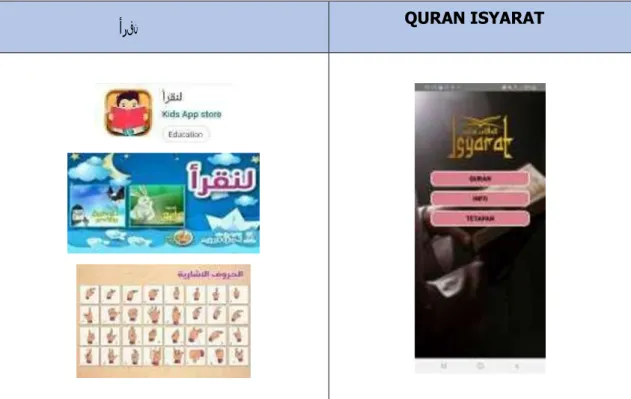
The idea of using a direct lesson of Hijaiyyah hand- sign with normal Hijaiyyah letters is based on the several applications available in the market with addition of exercise for the student to test their memory on what they learn. In addition, this application
5
will use the hand- sign code of Bahasa Melayu (Kod Tangan Bahasa Melayu) which meets the preferences of Ministry of Education in the text book. The previous application available is using the Arab style of hand- sign which the code is totally different from the special needs school in Malaysia. The aim for this project is to help the teachers in classroom to have more interactive learning in their classroom using this application rather than using the manual style of teaching like cards or manually show the hand- sign to the children in front of the class.
Table 1. Summary of Previous Application ن
ق
ر أ QURAN ISYARAT
Using Arabic Style Hand- sign. Does not meet the Ministry of Education requirements in the text book which using ‘Kod Tangan Bahasa Melayu’ (KTBM).
Static hand-sign
No exercise or game to test the children understanding after learning the hand- sign.
Using Arabic language. Hard for Malaysian students to understand the language in learning Hijaiyyah letters.
Unsuitable for the students who want to learn from the basic as the hand sign codes are assembled together as one complete verse.
6
they do not meet the requirement for the use of special needs schools in Malaysia while our courseware is aimed to help the children in learning subject ‘Pendidikan Islam’ for the Hijaiyyah hand- sign and also provide exercises in a more intriguing ways in the courseware
2.2.1 Quran Isyarat
In 2009, The Research Group, Ibnu Ummi Maktum Research Center (UMMI) at Universiti Sains Islam Malaysia (USIM) feels compelled to assist in the development of the first Quran Signal Application of its kind for the Deaf Community in Malaysia, as well as a model of Deaf OKU friendly application on an international level.
Besides that, Quran Isyarat, an Android-based Quranic sign language application, is ground breaking in Malaysia, according to project leader Dr Norakyairee Mohd Raus, who also heads UMMI. It has the capability to be a high-impact product and an international model for a deaf-friendly Quranic sign language application.
7
Figure 1. Videos of Sign Language used in Quran Isyarat
The application, which is still in its early stages, features only 11 surahs. It includes the Hijaiyyah Sign Code, an Arabic letter sign language, Makhraj transliteration of the Arabic language articulation points, and sign language interpreter video translation.
This available apps is however was using Arabic Style Hand- sign which did not meet the Ministry of Education requirements in the text book which using ‘Kod Tangan Bahasa Melayu’ (KTBM) or ‘Bahasa Isyarat Malaysia (BIM) which is the official language for deaf community in Malaysia according to Disabilities Act 2007 (the Act).
8
Figure 2. Quran Isyarat focusing only on Surah
2.3 Adaptive Learning Systems
In order to enhance the efficiency of learning through this apps, adaptive learning systems (ALSs) deal with adequate customization and adaptation methods and tools such as smart curriculum sequencing, navigation guidance, intelligent problem generation and analysis of solutions, both adaptable interfaces and interactions, adaptive contents, and so forth. Due to the obvious significant gains of ALSs, future
"real-world" e-learning platforms are likely to include adaptive techniques and method.
Adaptive learning system is viewed as a system that may adapt its activities in order to provide learning content and educative and instructive environment and method for each student based on their unique information/characteristics such as knowledge, objective, experience, interest, background, and others. Learner model
9
or user model is a description of the individual information/characteristics of learners.
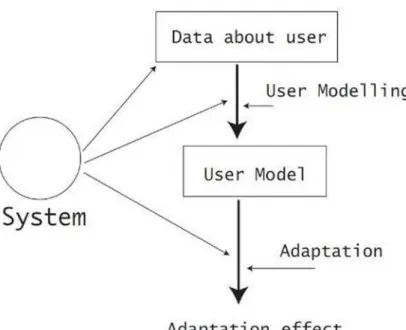
The adaptive learning systems employs the learner model to raise the efficiency of the adaptation task, but it does not design or manage the model. The user modelling system is in charge of obtaining data in order to generate and upgrade learner models. To put it another way, the user modelling system manages the user model and offers the adaptive system with the information it requires. Following Figure summarizes the interaction between user modelling system and adaptive system;
User Model perspective.
Figure 3. User Model Perspective
10 3.1 Introduction
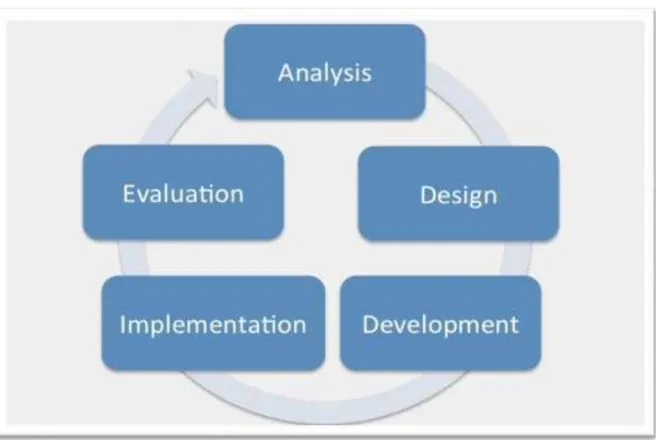
This chapter discusses about how a system is being developed and explain the methods that used to develop and test the system in evolving the mobile apps the special needs students. The ADDIE model (Analysis, Design, Development, Implementation, and Evaluation) is an iterative process used by instructional designers to carefully consider all of the elements leading to the best result. Each phase of the model that used in the system and the activity that need to be carry out in each phase will be discuss in this chapter so that the whole project can be developed in a more organized method without leaving out any implementation steps. The software and hardware requirement as well as the operation system environment used will be included in this chapter.
11 3.2 Addie Model
Figure 4. Addie Model
To develop i-Sign Hijaiyyah Educational Courseware for Hearing-Impaired Children, our team use ADDIE methodology to guide this project. The ADDIE model was based on earlier model, The Five Step Approach which had been developed by U.S Air Force (Clark, n.d.). The ADDIE model retained this five-step feature and included many sub-stages within each of five broad phases. Due to the hierarchical structure of the steps, one had to complete the process in a linear fashion by completing one phase before starting to the next.
3.2.1 Analysis
In this first stage, planning has been done. After some discussion and project proposed to project supervisor, the studies on the existing mobile apps have been done.
12
Unfortunately, the existing mobile apps found in the internet are too limited and so is the reference related to the project.
The problem statement has been created. Based on the problem statement, the objective and project scope of this new have been identified.
Nowadays, a lot of teaching aid for educational purpose are only focusing for normal student that have ability to see and hear. Study was proved that teaching aid for students hearing impaired receiving limited support (Chataika, 2009). i-Sign Hijaiyyah Educational Courseware will help children to learn using more interactive ways which will focusing on educational purpose.
3.2.2 Design
Second phase is to design how courseware will be like. Prototype or storyboard will be design according what’s rule that have been assigned by KPM. Efficient meetings with supervisor are required to obtain better feedback and opinions.. The design of the courseware will meet the needs of reading comprehensions to the hearing- impaired students. It is hoped that hearing-impaired students would be able to understand the text with this courseware and can also learn sign language in the case of this study was Kod Tangan Bahasa Melayu (KTBM).
3.2.3 Development
In this third phase, the elements that has to be consider will be discuss to develop this multimedia interactive courseware such as the text, graphic and illustrations, and sound.