ISSN 0127-9386 (Online)
http://dx.doi.org/10.24200/jonus.vol8iss3pp300-321
300
STRENGTHENING ACCOUNTABILITY AND GOVERNANCE OF CROWDFUNDING: ENHANCING FUNDING OF HIGHER EDUCATIONAL
INSTITUTIONS
*1Muhammad Nazmul Hoque, 2Norhayati Mohamed, 3Md. Abul Kalam Azad, 4AFM Nuruzzaman & 5Zaid Bin Mat Yusop
1 Faculty of Accountancy, Universiti Teknologi MARA, Cawangan Selangor, Kampus Puncak Alam, 42300 Selangor, Malaysia.
2 Accounting Research Institute, UiTM Shah Alam, 40450 Shah Alam, Selangor, Malaysia.
3 Department of Business and Technology Management, Islamic University of Technology, Gazipur, Bangladesh.
4 Department of Da’wah and Islamic Studies, International Islamic University Chittagong, Bangladesh.
5 Universiti Poly-Tech Malaysia, 56100 Kuala Lumpur, Wilayah Persekutuan Kuala Lumpur, Malaysia.
*Corresponding author: [email protected] Received: 15.05.2023 Accepted: 17.08.2023
ABSTRACT
Background and Purpose: The reduction in government funding requires public universities to seek different forms of funding for their activities, and crowdfunding has become an essential enhancement to public university funding sources. This research aims to evaluate the strength of accountability and governance of crowdfunding for public universities
Methodology: The study has adopted factual data based on relevant literature reviews and documents on crowdfunding.
Findings: This study explored the aspects that will strengthen the accountability and governance framework of crowdfunding, especially for public universities. To increase public confidence in
301
crowdfunding, it must be well-governed with strict criteria to ensure proper accountability and transparency to reduce the possibility of corruption and prevent fraud. From the strengthening of the crowdfunding mechanism, it can be concluded that the governance system developed will include methodologies and standards for evaluating the sources of funds, protecting the donors, evaluating projects qualified for funding, and reinvestment of contributions, where applicable
Contributions: The significance of this study is that it makes a new contribution by investigating perspectives on improving accountability and governance of crowdfunding. Moreover, the current study suggests that Malaysia may determine the level of adaptation of crowdfunding mechanisms and the sustainability of crowdfunding as an alternative platform to fund Malaysian public universities in the future.
Keywords: Crowdfunding, governance, accountability, transference, higher education.
Cite as: Hoque, M. N., Mohamed, N., Azad, A. K., Nuruzzaman, A. F. M., & Zaid, B. M. Y. (2023).
Strengthening accountability and governance of crowdfunding: Enhancing funding of higher educational institutions. Journal of Nusantara Studies, 8(3), 300-321.
http://dx.doi.org/10.24200/jonus.vol8iss3pp300-321
1.0 INTRODUCTION
Due to the rapid rising costs higher learning institutions and their global demand, university finance has become essential (Teixeira & Landoni, 2017). One problem is that public spending on public institutions has significantly increased as a result of growing public and governmental demand for higher education in the hopes of promoting more economic growth and higher living standards. As a result, universities are looking for various types of financial support for their operations. Crowdfunding, a tool made feasible by the digitization of money, is one of these new forms. Crowdfunding has become a means of funding and has created considerable attention in the academic literature since the rise of social media and online platforms for crowdfunding.
In 2019 crowdfunding platform had become a large industry with a total value of transactions of around $6 billion (USD). However, there is little academic research on crowdfunding as an alternative platform to finance public universities. By creating a thorough understanding of the role of crowdfunding at public universities in Malaysia, this study seeks to close the knowledge of crowdfunding platform. First, the study will assess the potential of crowdfunding as an alternative platform to finance public universities. Second, this study will
302
examine the registered equity crowdfunding (ECF) platform operators and crowdfunding institutions' accounting and governance practices. Third, in order to retain accounting and governance elements, this research also investigates crowdsourcing as a fund collection technique, concentrating on higher education settings. Finally, with a view to supporting public universities in Malaysia, this research provides a conceptual model that identifies a variety of funding methods that may work in equity crowdfunding marketplaces.
In 2017, the allocation of funds for public universities in Malaysia was reduced to 70%
of their operating expenditure, with the other 30% generated from other sources of income.
Public universities received a total of RM 6.12 billion in operating budgets for 2014 (Amran et al., 2014). However, the budget allocation for the next two years has been drastically reduced (Da Wan et al., 2018). In this context, public universities are advised to focus on self-generated income and create various income sources. In this regard, they must initiate plans to improve connectivity with other networks. One of the possible sources is contributions from the public through crowdfunding platforms, which can significantly improve the financial sustainability of higher learning institutions in Malaysia.
Overall, Malaysia has established twenty public universities. Among those, the only public institution in Malaysia that has created a crowdfunding platform is Universiti Teknologi Malaysia (UTM). Other public universities have internet-based endowment or waqf platforms, and these platforms are recognized as online charity or donation. There are other third-party platforms for crowdfunding whose aims are to provide educational support and increase finance to develop crowdfunding campaigns, such as JomDonate and Skolafund. Basically, JomDonate and Skolafund are the most important crowdfunding platforms that raise funds and assist students with tuition fees or any other educational project activities. Donors intend to finance the Skolafund plan based on the amount agreed upon. If the targeted agreement fill up, the crowdfunding platform will return funds to donors (Alma’amun et al., 2021).
However, initiatives that use crowdsourcing could not actually get the funds they need due to the problems associated with information variability. It has been shown that Malaysian crowdfunding platforms could not have a strong governance mechanism and may need to rely on other financial sources for assistance (Mokhtar et al., 2012). A study conducted by Lew et al. (2019) found that Malaysian crowdfunding activities are lower than those of other countries and are less successful. They expressed that this is because of the lack of knowledge regarding crowdfunding and the lack of proper accountability and governance systems in Malaysia. Due to these gaps, the crowdfunding initiatives have not been sustainable. Hence, it
303
is necessary to find out the best practices of crowdfunding platforms in Malaysia to be self- reliant and more sustainable in funding educational institutions.
This study focused on the crowdfunding mechanism, applications, and common characteristics. It will also assess the level of accountability and transparency of crowdfunding platforms in Malaysia to reduce the possibility of corruption and prevent fraud. Finally, it examined public confidence in crowdfunding in Malaysia and the significant role of crowdfunding in enhancing the sustainability of public university funding.
2.0 LITERATURE REVIEW
2.1 Definitions and Applications of Crowdfunding
Crowdfunding refers to activities whereby members of the public collect donations through social media to support various projects (Carvajal et al., 2012). In particular, crowdfunding is described as virtual group activities to obtain pledges for funding, sponsorships, and participation from non-expert ordinary citizens. In 2015, the financial investment services and capital markets reported that the proposed legislation aims to activate investment and protect investors in the production, cultural material, and scholarly services (Lee, 2016). This concept is set out in the proposal for a compliance decree. Although crowdfunding is rooted in donations in which several individuals raise contributions, it is distinct from general fundraising (Ordanini et al., 2011). The words "crowd" and "funding," which is inferred by their etymology, are derived from the active support of "crowds" for funding projects made known across social networks (Kim, 2012). Compared with conventional approaches, crowdfunding is an efficient way to overcome regional borders in raising funds for non-profit initiatives through social networking (Saxton & Wang, 2014). Supporters make their donations known indirectly or directly by reminding their friends about the causes or initiatives. This initiative, in turn, allows members of their social networks to be active and sponsored. Since Social Networking Sites (SNS) fundraising focuses on trustworthy relationships between friends, colleagues, families, and other associates, it is more beneficial to promote involvement (Oh & Kim, 2017).
There are four different forms of crowdfunding: reward-based, peer-to-peer lending, equity crowdfunding, and donation-based (Thaker et al., 2018). Donation-based crowdfunding refers to charity where charitable people don’t get rewards or returns. Equity crowdfunding means donors fund organizations in return for equity (Vrontis et al., 2021; Davis, 2011). Peer- to-peer lending crowdfunding indicates a significant expansion of the lending paradigm and enables borrowers to get loans from investors with or without interest. Meanwhile, in reward-
304
based crowdfunding, individuals or groups can donate to projects in exchange for non- monetary rewards.
Reward-based crowdfunding is used to fund cultural events and government initiatives that provide supporters or donors with non-cash rewards, such as concert tickets, appearance and performance tickets, or participation in a general list of contributors. For less viable purposes within the current economic system, such as non-profit ventures, experimental company ideas, and artistic and cultural endeavors, reward-based crowdfunding has been promoted (Dollani et al., 2016). In the United States and Europe, reward-based crowdfunding has been distributed among crowds for films and musical recordings with little investment.
Public ventures were also funded by reward-based crowdfunding. Since 2015, the City of London has successfully used crowdfunding for urban renovation initiatives. People or neighbourhood groups propose business strategies to support platforms to enhance urban neighbourhoods and ecosystems throughout the region. People will donate to the programs they choose, and the project begins with financial input from the community until the target number of funds is reached. This approach helps address financial problems in public initiatives and encourages people's spontaneous engagement (Se-Shin & JunYoung, 2018). This report concentrates on reward-based and not equity crowdfunding, primarily targeted at startups and small enterprises.
2.2 Crowdfunding Platforms in Malaysia
The two reportedly very popular crowdfunding frameworks in Malaysia are fundraising focused on incentives and equity. Compared to equity-based crowdfunding, it is less regulated in other countries for reward-based crowdfunding. Mystartr has been one of the country's oldest crowdfunding industries in Malaysia. The website was opened in 2012, and ventures worth Malaysia effectively supported more than RM1 million in 2017. Pitchin, also established in 2012, is another big crowdfunding site in Malaysia. Compared to Mystartr, it provides Malaysians with award-winning crowdfunding and equity. It is the best-established crowdfunding site in Southeast Asia, effectively financing ventures like the first Indie Fest in Penang, TAPAUfest, and TeeSomethingNice in 2014. Other sites include Skolafund, Peoplender, ATA PLUS, Netrove Initiatives, Alix Global, Ethis Kapital, Edspace Projects, and GIVE.MY are less comprehensive than the previous two firms.
On February 10, 2015, the Securities Commission of Malaysia released a new set of rules for equity-based crowdfunding under the 2007 Capital Markets and Services Act to regulate equity crowdfunding platforms. The FundedByMe, Crowdo, Eureeca, Equity.pitchIn,
305
and Crowdplus.asia equity crowdfunding sites have been authorised. When the regulations were released, Malaysia was officially the first ASEAN country to create regulations on shareholder crowdfunding platforms that enable Malaysian start-ups to provide an alternative channel to buy.
2.3 Crowdfunding and Governance
Research on governance has suggested several frameworks that will defend and support investors in generating value. These frameworks may work internally (using internal methods) or externally (using external means). The corporate governance structures that have drawn the greatest attention are the board of directors and significant investors (or ownership structure), as these act as internal governance mechanisms that affect management (Shleifer & Vishny, 1997; Uhlaner et al., 2007). In addition, legislation shielding owners from expropriation, as external management structures, is often commonly discussed (Shleifer & Vishny, 1997; La Porta et al., 2000). According to Shleifer and Vishny’s (1997, p. 769) review of corporate literature, "judicial rights for consumers and centralised ownership are central elements of a strong corporate governance scheme." While the official governance mechanisms mentioned above have been given considerable attention, there may also be successful methods of illicit governance (Mustakallio et al., 2002; Chrisman et al., 2018).
2.4 Crowdfunding and the Level of Accountability
Empirical studies and scientific literature have identified many phases of digital crowdfunding (Mollick, 2014). Nonetheless, most of the studies are concerned with financial aspects (Agrawal et al., 2014). On the other hand, Astebro et al. (2019) indicated the factors which affect the success of campaigns, such as advertising and marketing, and socio-economic context, like the description of the donors' or investors' behavior, which will help to promote continuous investments. However, factors relating to the user experience of the user interface (UI) of crowdfunding apps, such as how information is presented to users, how it is visualized, and the specific GUI components, have received minimal focus. The majority of the operations thought of reward-based crowdfunding platforms, which led to this circumstance. For instance, e-commerce websites like Kickstarter and Indiegogo are used for crowdfunding campaigns.
Primary information, on the other hand, suggests a description of the projects and a limited number of reward possibilities, along with a timeframe and delivery date. The hazards in this circumstance are mostly restricted to obtaining goods and products later than expected or not being paid due to production problems.
306
As opposed to this, equity crowdfunding platforms (such as Mamacrowd and Seedrs) are exchanges where investors may buy stakes in organizations in exchange for potential future rewards. Other issues and information must be made available to the user in order for them to be concerned about the operation’s benefits and risks. Equity crowdfunding sites, on the flip side, such as Mamacrowd and Seedrs, are commercial spaces where people can participate in becoming stakeholders in a sector rather than making an investment with a potential upside.
For the user to be concerned about the dangers and advantages of the operation, a number of elements also need to be disclosed as extra information. Additionally, in comparison to reward- based websites, equity crowdfunding platforms already offer a similar user interface and access. Due to this platform's singularity, there is a chance that non-professional users may comprehend and subsequently ignore the inherent risk associated with equity funding or investments. The uniqueness of this platform structure, however, raises the possibility that non- professional users could incorporate two and, as a consequence, overlook the inherent risks related to equity funding or investments. Additionally, it is even more important to ensure that all users have equal access to vital and accurate information given that equity crowdfunding platforms cater to a range of investors, including investment businesses, seasoned investors, and non-professionals.
Similarly, the government should encourage public universities to adopt managerial and business-style accountability that encourages regular assessment. This transformation in government behavior toward public universities is evaluated as a system to build public universities' structures and organizations to be more accountable and transparent. Universities are also expected to be more responsive to societal challenges, including mutual relationships with industries, and more concerned with funding, particularly for students and their academic requirements (Horta et al., 2021). Thus, government and public higher education administration must play the role together in the accountability of crowdfunding.
2.5 Crowdfunding and the Level of Transparency
Transparency in crowdfunding is crucial because it ensures investors’ funding visibility in the crowdfunding platform. Many countries have evaluated transparency in different aspects, such as information transparency. For instance, Michener and Bersch (2013) created a transparency model in which they outline the characteristics of transparency that are acceptable: visibility and deducible ineffability. These are essential and equally adequate conditions for transparency. Additionally, they looked at the empirical framework that might be used to assess the transparency requirement, where visibility denotes the extent to which information is both
307
complete and searchable. At the same time, ineffability refers to the degree to which information is disintegrated, clarified, and facilitated.
Additionally, transparency must be accurate and applicable to the intended audience.
Hood (2007) distinguished between direct and indirect transparency, emphasizing that direct transparency is intended for a wider audience while indirect transparency relates to the level of comprehension by specialists. The usual campaign form on an equity crowdfunding platform has the components listed below, as seen in Figure 1. The project description comprises text, images, and video that describe the group, the strategy, the trade opportunity, the business climate, the policy explanation, and its advantages. Financial information disclosure includes the growth of the present amount, the objective of the campaign and fairness allocation. While feedback helps to draw users' networks with the group, potential investors include current information regarding completions as well as major successes throughout and after the campaign that investors must have. Full lists of investments were assured and protected during the campaign. Unfortunately, the majority of platforms have this kind of data and offer a wide range of viewing options. Besides, the structure for envisioning information shows low ineffability, reducing indirect transparency.
Figure 1: Components of an equity crowdfunding platform Source: Michener and Bersch (2013)
Transparency of financial information, the most important of all the components, is portrayed as having many problems. This is due to the fact that investment motions are inherently difficult. However, several parts of the information are not noticeable on the majority of the platforms. For instance, the distinction between assured and committed investment has been shown by only one website. This is because, as compared to other crowdfunding formats,
308
raising equity typically involves substantial sums of money. Clients assure a sum that they can give (i.e., transferring finance) by the closing of the campaign. Nonetheless, as there is no commitment for the financial backer to fulfill their promise, there frequently is a disagreement between the sum guaranteed by clients and the money ultimately taken at the closing of the raising money round. When this uncertainty contributes to subsequent investments, it may lead to increasing guaranteed sums, which might affect a campaign's achievement consistency given the amount increased at any given moment and, eventually, lower the level of platform trust.
Many equity crowdfunding campaigns adhere to the typical crowdsourcing model, in which the first contribution is crucial for attracting follow-up investments. As a result, before beginning the campaign, funders typically collect investments from a variety of sources (such as colleagues, friends, experts, investors, or relatives). The terms of such investments may be negotiated separately from the platform and may give rise to different rights than those granted to customers who purchase equities on the crowdfunding website. Unlike consumers who buy shares on a crowdfunding platform, these sorts of investments may entail conditions that are interfered in or freely negotiated by the medium and may yield multiple remedies. It's crucial to increase the inferability and visibility of this type of data in order to promote even indirect openness.
2.6 The Governance System of Crowdfunding Initiatives in Public Universities in Malaysia
Higher learning institutions, like universities, depend on the assistance of government funding.
However, it has now become very challenging for universities to increase funding because of economic constraints, which have caused governments to cut allocations to higher learning institutions. The total amount allocated to public universities in Malaysia by the Ministry of Higher Education (MoHE) dropped from RM13.38 billion in 2016 to RM12.12 billion in 2017.
As a result, public universities' shared operating financial plans for 2017 have been cut by nearly RM1.5 billion (19.23%), a larger cut than the budget for 2016. According to the Ministry of Education and Ministry of Finance, the overall budget for the mixed operating allocation for roughly 20 institutions in 2017 is RM6.12 billion, which is a drop of RM1.46 billion (19.23%) from the allocation of RM7.57 billion in 2016. Figure 1 displays the financial or budgetary allocation for the MoHE from 2012 to 2017, which was made public by the government in the yearly budget.
309
Figure 2: Budget allocation in 2012-2017 by Ministry of Higher Education Source: Ministry of Higher Education (2017)
The MOHE has awarded autonomous positions to five universities: Universiti Malaya, Universiti Sains Malaysia, Universiti Kebangsaan Malaysia, Universiti Teknologi Malaysia, and Universiti Putra Malaysia. One of the most crucial elements of universities' efforts to achieve economic sustainability is financial autonomy, which is regarded as both a challenging and crucial aspect of university autonomy. To propel the universities into generating their own income, MoHE has established a key performance indicator (KPI) for the five public higher learning institutions mentioned above to generate 30% of their operating expenses from their own sources. Public universities must control their spending and look for new ways to increase their money in light of the budget cuts. The government is a major source of alternative funding for public institutions. According to Wheat et al. (2013), supporting public organizations, including public higher education sector government crowdfunding methods, has many different kinds of goals and programs. Previous research has shown that government mechanisms for using crowdsourcing as an alternative source of finance for higher education have been launched (Hollow, 2013). As a result, the government actively participates in providing financial support to public universities that use crowdfunding sites.
Many measures have been taken to address this issue and distinguish between different ways of making money, including marketing research and development (R&D) internally, reducing employment costs, lowering act and improvement costs, increasing free consultation services, and hiring and renting on-campus properties (Azlan & Joriah, 2016). In order to build
310
funding methods that will ensure their financial sustainability, Malaysian universities have actively solicited contributions, set up an endowment and Islamic funding, such as waqf, and Zakat system. Hasbullah and Rahman (2021) mentioned that universities had used these methods to raise contributions. Another avenue they can strengthen is crowdfunding (Rashid et al., 2020; Colasanti et al., 2018). Currently, overseas higher education institutions have taken measures to reform the platform of accumulating funding through crowdfunding. Generally, crowdfunding is a structure of financing using the crowd as the donors who contribute a little money to donate to a cause through online media platforms (Borst et al., 2018). Crowdfunding funds are linked to specific campaigns and initiatives in the context of higher education funding, including entrepreneurship, research, support for student travel or study expenditures, and university foundations (Rusdin et al., 2017; Llorente & Morant, 2015).
Malaysian universities have not widely used crowdfunding. For example, out of the twenty public universities, Universiti Teknologi Malaysia (UTM) is the only Malaysian public university that has established a crowdfunding platform. However, even when it is open, there is no crowdfunding campaign available on the channel because the website is frequently down.
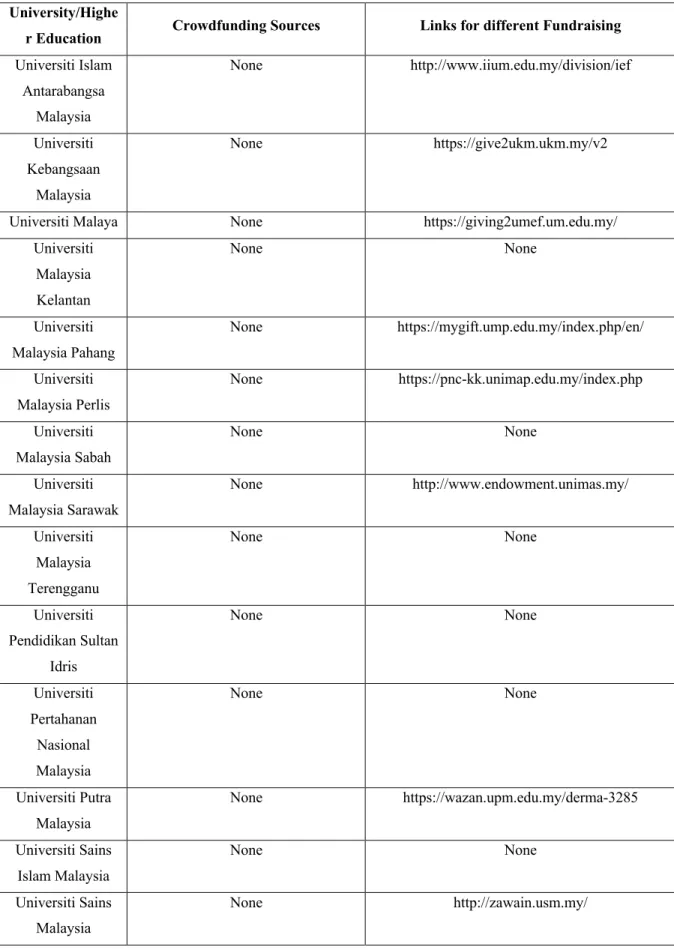
The other government universities have websites for internet endowment, funding, donation, and Islamic endowment. These are recognized forms of online fundraising, but they are not considered crowdfunding. The data on the crowdfunding websites used by Malaysian public universities is displayed in the appendix no 1.
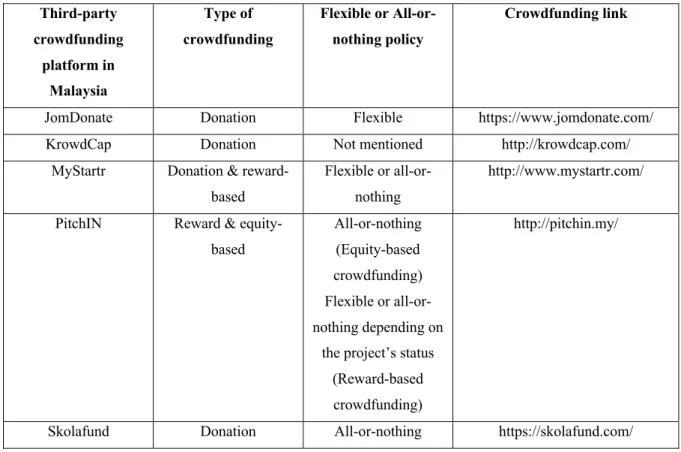
University students or alumni in Malaysia utilize third-party sites to raise money for their campaigns. Table 2 depicts the third-party platforms in Malaysia (JomDonate, KrowdCap, MyStartr, PitchIN, and Skolafund) that provide services for universities. Only one or two of the campaigns using the KrowdCap, MyStartr, and PitchIN platforms were linked to a public university. University students used Skolafund and JomDonate to generate money to boost the fund in order to pay for their tuition and other educational expenses. Students could choose the length of their campaign at JomDonate for up to 30 days, but not at Skolafund where the maximum length is 30 days. The other distinction is that JomDonate worked on a simple and easy strategy, while Skolafund ran on a go big or go home approach. Students have a right to any increase in funds throughout the JomDonate financing term as they are the project's leader or owner. According to the agreed-upon goal amount, the project owner is entitled to the funds at Skolafund. The crowdfunding website will reimburse each project's sponsors if it falls short of the declared financing goal. According to the agreed intended amount, the project manager at Skolafund approved the fund. The crowdfunding platform will redirect all supporters to that
311
particular project if it is unable to reach the predetermined financing goal. The fees for these sites ranged from 5% to 10%. The cost of MyStartr is the highest of all the platforms.
3.0 RESEARCH DESIGN
In light of the objectives, the study embraced the qualitative approach as the methodology of the study. Qualitative research is a type of study that examines data gathered through language and behaviour in natural settings. This research is characterized as qualitative because it endeavors to clarify and evaluate the strength of accountability and governance of crowdfunding for public universities
4.0 ANALYSIS AND DISCUSSION
4.1 The Function of Crowdfunding and its Development in Higher Education
According to Broucker et al. (2018), crowdfunding initiatives are being implemented in tertiary educational institutions as a logical result of new government policies backed by a neo-liberal economic strategy that have been changing institutions as well as other welfare services to be more market-oriented and governed by organizational rationality. To combat growing expenses, tertiary institutions must supplement their allocations with money from external sources (Drezner & Huehls, 2014). The most well-known institutes receive more funding from wealthy donors and their alumni who want to boost their prestige, visibility, and reputation (Bekkers & Wiepking, 2011).
These institutions focus on research and can create ground-breaking work that bears the donor's name in association with higher education research, establishing a lasting legacy.
Less renowned, teaching-focused universities are less attractive to potential outside donors because they lack the institutional resources and skills to arrange crowdsourcing and other fundraising events and frequently have student populations made up of older students with reasonably low-paying jobs and tend to be less affluent, more diverse, and less diverse in general (Gearhart et al., 2019). The most crucial variables predicting university donations—
social and economic status, income, and wealth—are undermined by the fact that these colleges are frequently found in economically struggling areas. Crowdfunding and other fundraising initiatives may not be driven by organizations in less prestigious, teaching-focused universities.
However, they could also be motivated by professors and students who want to collect funds to address financial issues, assist students, and enhance the inadequate learning and teaching resources at their institutions. Regardless of how prominent a university may be, its ability to acquire funds may have an impact on it. This is because particular academic fields, such as
312
business schools, engineering institutions, and the health science sectors, are more likely to attract the interest and favor of donors than other academic disciplines due to their potential to have an immediate impact on society (Nwakpuda, 2020).
Crowdfunding fits into a larger pattern of privatization in higher education, but it will also inevitably exacerbate inequality between and within colleges. Crowdfunding is becoming a more popular fundraising strategy for universities, but it is mostly employed by professors and students. It is direct, purely internet-based, tends to target larger audiences, and asks for comparatively modest contributions. Crowdfunding is predominantly project-based, which implies that it has a relatively strong rational basis for collecting funds by concentrating on time-constrained operations rather than on building sustainable and lengthy associations. This is in contrast to the principles of the theory of relationship marketing that underpin traditional academic fundraising (Jung & Lee, 2019). Similar to other kinds of crowdfunding in tertiary learning institutions, crowdfunding is impacted by common interests (both the contributors and the proponent) and a degree of personal and emotional commitment to the suggested initiatives (Cho et al., 2019). To support academic activities within this framework, some institutions have started urging their students and staff to take part actively in crowdfunding initiatives (Gearhart et al., 2019). The uneven distribution of funds for higher education is a major incentive, encouraging those getting less support to work harder for extra resources (Colasanti et al., 2018). It is well documented that institutions with limited resources develop a variety of techniques to raise additional funds, like focusing on the programs they provide, lowering tuition, or rebranding themselves to stand out and be more appealing to prospective students (Cattaneo et al., 2019; Horta et al., 2021).The crowdfunding model involves interaction between three parties: fundraisers (who propose the ideas or projects), funders (who decide to provide financial backing for ideas or projects), and crowdfunding sites (who connect the fundraisers to the funders). Crowdfunding platforms get a portion of the funds collected during the campaign (Ordanini et al., 2011; Belleflamme et al., 2014). However, information asymmetry occasionally causes funders to be in the dark about the ideas or projects being pitched, which may have an impact on the amount of money they donate (Vismara, 2016;
Colombo et al., 2015; Zheng et al., 2014).
Prior research has shown that donation and incentive-based crowdfunding platforms have been used by educational campaigns and projects to collect money. These programs might involve operating costs, tuition fees, research costs, project costs for student-proposed projects, and scholarships (Siva, 2014; Ingram et al., 2016). To gain a comprehensive understanding of university crowdfunding platforms, Ingram et al. (2016) carried out a study on CrowdUni, a
313
charity-based crowdfunding platform used at a significant research university situated in North America. They noted that the purpose of CrowdUni was to allow young university graduates to participate in such events by making small donations and to collect modest sums for initiatives related to universities. The platform and the individuals in charge of it are a part of the University's Alumni and Development Office in terms of governance. To ensure that raised funds are used for their intended purpose, an operational unit within the university must be assigned responsibility for the administration of raised funds. Individuals who are assigned the role of Project Ambassadors are made responsible for running project campaigns or modules.
Furthermore, the site is restricted to crowdfund initiatives related to the institution. Siva (2014) noted that to combat rising rivalry and dwindling public funding sources, researchers are turning to crowdfunding sites as an alternate source of funding. These experiments, though they lacked a theoretical underpinning and statistical findings, sufficed as exploratory research.
Rusdin et al. (2017) reviewed the beneficial role of social networks in online crowdfunding, which may help secure grants for academic research at universities.
4.2 The Role of Crowdfunding in Enhancing Funding Sustainability
Universities are increasingly depending on donations from private contributors to maintain their programs due to the decline in financing from state and federal resources. They have thus looked for creative ways to raise money (Colasanti et al., 2018). Given the present economic situation and growing university demands, crowdfunding might potentially become an innovative strategy for colleges in their fundraising efforts (Colasanti et al., 2018).
Crowdfunding, along with information collection and crowd voting, is one of four crowdsourcing categories connected to educational activities (Solemon et al., 2013). Tertiary educational institutions can either create their own private crowdfunding websites or use those websites that are commercially created and hosted by various companies like Scalefunder, Kickstarter, or USEED.
Crowdfunding initiatives in higher education institutions can have a wide range of goals, including sponsoring sporting team clothing, student education, and academic research (Solemon et al., 2013). In tertiary learning institutions, crowdfunding has the benefit of broadening the donor base. Along with more traditional stakeholders like alumni, a variety of internal and external parties, such as teachers, students, community members, and staff, will be able to contribute (Craven, 2013). Crowdfunding may also take advantage of social media's interactive features and wide audience reach to help project organizers and funders swiftly spread the word about their initiatives. They could be able to achieve the crowdfunding
314
project's objective capital goal thanks to this choice (Colistra & Duvall, 2017). However, little is understood at this stage about college students' impressions of and reasons for supporting university crowdfunding initiatives.
5.0 CONCLUSION
From the explanation above, it can be inferred that using crowdfunding is a crucial strategy for obtaining resources that are often out of reach. In contrast, there are concerns about whether crowdfunding can be a long-term and sustainable method of generating money in areas where state financing is declining or for universities that primarily enrol students from low socioeconomic backgrounds. This study also emphasized that to increase public confidence in crowdfunding, it must be well-governed with strict criteria to ensure proper accountability and transparency to reduce the possibility of corruption and prevent fraud. The research suggests utilizing crowdfunding as a tactic to help public universities raise money so they can provide learning opportunities tailored to the requirements of their students and the expectations of the labor market and society. The current study has provided results based on relevant literature and documents that may assist Malaysian higher learning institutions in establishing the appropriate crowdfunding method and generating income. In addition, future research may empirically examine the relevant issues affecting the enhancement of crowdfunding governance in Malaysian higher learning institutions. And last, in places like Malaysia, where alumni donations and philanthropy are well-established traditions, crowdfunding may be a successful means of raising money. This approach might not work well in nations with distinct cultural attitudes, lower incomes, and higher reliance on financing from other nations.
ACKNOWLEDGEMENT
This article is funded by the Universiti Teknologi MARA, Shah Alam, Malaysia, Grant No.
600-RMC/DANA 5/3 BESTARI (TD) (010/2022) and Accounting Research Institute (HICoE) and Ministry of Higher Education, Malaysia.
REFERENCES
Agrawal, A., Catalini, C., & Goldfarb, A. (2014). Some simple economics of crowdfunding. Innovation Policy and The Economy, 14(1), 63-97.
Alma’amun, S., Kamarudin, M. K., Rozali, N. S., Nor, S. M., Sabarudin, N. A., & Rosli, F. A.
(2021). From government funding to crowdfunding: Identifying approaches and
315
models for universities. Revista Geintec-Gestao Inovacao E Tecnologias, 11(4), 4586- 4609.
Amran, F. H., Abdul Rahman, I. K., Salleh, K., Syed Ahmad, S. N., & Haron, N. H. (2014).
Funding trends of research universities in Malaysia. Procedia - Social and Behavioral Sciences, 164(1), 126-134.
Astebro, T. B., Fernández Sierra, M., Lovo, S., & Vulkan, N. (2019). Herding in equity crowdfunding. SSRN.
Azlan, A., & Joriah, M. (2016). Changes and challenges in financial autonomy. In M. T.
Fauziah & N. L. Y. A. Melissa (Eds.), Governance reforms in public universities of Malaysia (pp. 59–77). Universiti Sains Malaysia.
Bekkers, R., & Wiepking, P. (2011). A literature review of empirical studies of philanthropy:
Eight mechanisms that drive charitable giving. Nonprofit and Voluntary Sector Quarterly, 40(5), 924–973.
Belleflamme, P., Lambert, T., & Schwienbacher, A. (2014). Crowdfunding: Tapping the right crowd. Journal of Business Venturing, 29(5), 585-609.
Borst, I., Moser, C., & Ferguson, J. (2018). From friendfunding to crowdfunding: Relevance of relationships, social media, and platform activities to crowdfunding performance. New Media & Society, 20(4), 1396-1414.
Broucker, B., De Wit, K., & Verhoeven, J. C. (2018). Higher education for public value: Taking the debate beyond new public management. Higher Education Research &
Development, 37(2), 227-240.
Carvajal, M., García-Avilés, J. A., & González, J. L. (2012). Crowdfunding and non-profit media: The emergence of new models for public interest journalism. Journalism Practice, 6(1), 638-647.
Cattaneo, L. B., Chan, W. Y., Shor, R., Gebhard, K. T., & Elshabassi, N. H. (2019). Elaborating the connection between social class and classism in college. American Journal of Community Psychology, 63(3–4), 476–486.
Cho, M., Lemon, L. L., Levenshus, A. B., & Childers, C. C. (2019). Current students as university donors? Determinants in college students’ intentions to donate and share information about university crowdfunding efforts. International Review on Public and Nonprofit Marketing, 16(1), 23–41.
Chrisman, J. J., Chua, J., Breton-Miller, I. L., & Miller, D. (2018). Governance mechanisms and family firms. Entrepreneurship Theory and Practice, 42(2), 171-186.
316
Colasanti, N., Frondizi, R., & Meneguzzo, M. (2018). Higher education and stakeholders’
donations: Successful civic crowdfunding in an Italian university. Public Money &
Management, 38(4), 281-288.
Colistra, R., & Duvall, K. (2017). Show me the money: Importance of crowdfunding factors on backers’ decisions to financially support kickstarter campaigns. Social Media Society, 3(4), 1-12.
Colombo, M. G., Franzoni, C., & Rossi-Lamastra, C. (2015). Internal social capital and the attraction of early contributions in crowdfunding. Entrepreneurship Theory and Practice, 39(1), 75–100.
Craven, J. (2013, May 24). Universities explore crowdfunding, social media to raise money.
USA Today. www.usatoday.com/story/news/nation/2013/05/24/
Davis, A. (2011). Beyond the banks: Innovative ways to finance Britain’s small businesses.
National Endowment for Science, Technology and Arts, United Kingdom.
Da Wan, C., Sirat, M., & Razak, D. A. (2018). Education in Malaysia towards a developed nation. ISEAS. https://www.iseas.edu.sg/images/pdf/ISEASEWP2018-4Wan.pdf Dollani, A., Lerario, A., & Maiellaro, N. (2016). Sustaining cultural and natural heritage in
Albania. Sustainability, 8(8), 1-19.
Drezner, N. D., & Huehls, F. (2014). Fundraising and institutional advancement: Theory, practice, and new paradigms. Routledge.
Gearhart, M. C., Berg, K. A., Jones, C., & Johnson, S. D. (2019). Fear of crime, racial bias, and gun ownership. Health & Social Work, 44(4), 241–248.
Hasbullah, N. A., & Rahman, A. (2021). Endowment and waqf funds in Malaysian Higher Education: A conceptual study. Jurnal Syariah, 29(1), 127-154.
Hollow, M. (2013). Crowdfunding and civic society in Europe: A profitable partnership? Open Citizenship, 4(1), 68-73.
Hood, C. (2007). What happens when transparency meets blame-avoidance? Public Management Review, 9(2), 191-210.
Horta, H., Meoli, M., & Vismara, S. (2021). Crowdfunding in higher education: Evidence from UK Universities. Higher Education, 83(1), 1-29.
Ingram, C., Vaast, E., & Teigland, R. (2016). Corporate crowdfunding: Does being part of a university affect a platform's operations?. In 2016 49th Hawaii International Conference on System Sciences (HICSS) (pp. 4606-4613). IEEE.
Jung, Y., & Lee, J. (2019). Learning engagement and persistence in Massive Open Online Courses (MOOCS). Computers & Education, 122(1), 9-22.
317
Kim, H. (2012). Issues of the crowd funding of the culture and arts sector – Legislation and policy alternatives. Korean Association Arts Management, 23(1), 41–64.
La Porta, R., Lopez-de-Silanes, F., Shleifer, A., & Vishny, R. (2000). Investor protection and corporate governance. Journal of Financial Economics, 58(1), 3-27.
Lee, H. S. (2016). Effect of perceived risk, perceived benefit, and Korea wave to crowdfunding participation in China. The Journal of the Korea Contents Association, 16(1), 204-213.
Lew, J. L., Cheah, S. Q., Cheah, Y. Y., Chew, H. L., & Tang, S. M. (2019). An insight to Malaysian crowdfunding success. (Final year project). Universiti Tunku Abdul Rahman, Malaysia.
Llorente, R., & Morant, M. (2015). Advances in crowdsourcing. Springer.
Michener, G., & Bersch, K. (2013). Identifying transparency. Information Polity, 18(3), 233- 242.
Mokhtar, S. H., Nartea, G., & Gan, C. (2012). The Malaysian microfinance system and a comparison with the Grameen Bank (Bangladesh) and Bank Perkreditan Rakyat (BPR- Indonesia). Journal of Arts and Humanities, 1(3), 60-71.
Mollick, E. (2014). The dynamics of crowdfunding: An exploratory study. Journal of Business Venturing, 29(1), 1-16.
Mustakallio, M., Autio, E., & Zahra, S. A. (2002). Relational and contractual governance in family firms: Effects on strategic decision making. Family Business Review, 15(1), 205–222.
Nwakpuda, E. I. (2020). Major donors and higher education: Are stem donors different from other donors? Nonprofit and Voluntary Sector Quarterly, 49(5), 969–988.
Oh, S. W., & Kim, H. G. (2017). Crowdfunding performance: The effect of social capital and the mediating role of electronic word-of-mouth. The Journal of Internet Electronic Commerce Resarch, 17(1), 155-169.
Ordanini, A., Miceli, L., Pizzetti, M., & Parasuraman, A. (2011). Crowd‐funding:
Transforming customers into investors through innovative service platforms. Journal of Service Management, 22(4), 443-470.
Rashid, M. A., Deo, K., Prasad, D., Singh, K., Chand, S., & Assaf, M. (2020). TEduChain: A blockchain-based platform for crowdfunding tertiary education. The Knowledge Engineering Review, 35(1), 1-15.
Rusdin, M. F., Ghazali, M., & Abd Razak, S. (2017). Online crowdfunding as academic grants:
A systematic literature review. Journal of Telecommunication, Electronic and Computer Engineering, 9(3-4), 187-193.
318
Saxton, G. D., & Wang, L. (2014). The social network effect: The determinants of giving through social media. Nonprofit And Voluntary Sector Quarterly, 43(5), 850-868.
Se-Shin, K., & JunYoung, C. (2018). Civic participation in urban revitalization through crowd funding. Urban Infrastructure Serve, 1(2018), 28–30.
Shleifer, A., & Vishny, R. W. (1997). A survey of corporate governance. The Journal of Finance, 52(2), 737-783.
Siva, N. (2014). Crowdfunding for medical research picks up pace. Lancet, 384(9948), 1085–
1086.
Solemon, B., Ariffin, I., Din, M. M., & Anwar, R. M. (2013). A review of the uses of crowdsourcing in higher education. International Journal of Asian Social Science, 3(9), 2066-2073.
Teixeira, P., & Landoni, P. (2017). The rise of private higher education. In P. Teixeira, S. Kim, P. Landoni, & Z. Gilani (Eds.), Rethinking the public-private mix in higher education (pp. 21-34). SensePublishers.
Thaker, M. A. M. T., Thaker, H. M. T., & Pitchay, A. A. (2018). Modeling crowdfunders’
behavioral intention to adopt the crowdfunding-waqf model (CWM) in Malaysia: The theory of the technology acceptance model. International Journal of Islamic and Middle Eastern Finance and Management, 11(2), 231–249.
Uhlaner, L., Wright, M., & Huse, M. (2007). Private firms and corporate governance: An integrated economic and management perspective. Small Business Economics, 29(3), 225-241.
Vismara, S. (2016). Equity retention and social network theory in equity crowdfunding. Small Business Economics, 46(4), 579-590.
Vrontis, D., Makrides, A., Christofi, M., & Thrassou, A. (2021). Social media influencer marketing: A systematic review, integrative framework and future research agenda.
International Journal of Consumer Studies, 1(45), 617-644.
Wheat, R. E., Wang, Y., Byrnes, J. E., & Ranganathan, J. (2013). Raising money for scientific research through crowdfunding. Trends in Ecology and Evolution, 28(2), 71-72.
Zheng, H., Li, D., Wu, J., & Xu, Y. (2014). The role of multidimensional social capital in crowdfunding: A comparative study in China and US. Information &
management, 51(4), 488-496.
319 APPENDIX 1
Table 1: Malaysian public universities and crowdfunding platforms
University/Highe
r Education Crowdfunding Sources Links for different Fundraising Universiti Islam
Antarabangsa Malaysia
None http://www.iium.edu.my/division/ief
Universiti Kebangsaan
Malaysia
None https://give2ukm.ukm.my/v2
Universiti Malaya None https://giving2umef.um.edu.my/
Universiti Malaysia Kelantan
None None
Universiti Malaysia Pahang
None https://mygift.ump.edu.my/index.php/en/
Universiti Malaysia Perlis
None https://pnc-kk.unimap.edu.my/index.php
Universiti Malaysia Sabah
None None
Universiti Malaysia Sarawak
None http://www.endowment.unimas.my/
Universiti Malaysia Terengganu
None None
Universiti Pendidikan Sultan
Idris
None None
Universiti Pertahanan
Nasional Malaysia
None None
Universiti Putra Malaysia
None https://wazan.upm.edu.my/derma-3285
Universiti Sains Islam Malaysia
None None
Universiti Sains Malaysia
None http://zawain.usm.my/
320
http://yayasan.usm.my/index.php/explore/yayasa n-usm/ways-to-give/dermasiswa-kasih Universiti
Teknikal Melaka Malaysia
None None
Universiti Teknologi Malaysia
https://digital.utm.my/ict- services/crowd-funding/
https://ir.uitm.edu.my/id/eprint/2723 4/
None
Universiti Teknologi Mara
Malaysia
None https://www.uitm.edu.my/index.php/en/giving- uitm
Universiti Tun Hussein Onn
Malaysia
None https://epayment.uthm.edu.my/endowment/inde x/2
Universiti Utara Malaysia
None None
Universiti Islam Antarabangsa
Malaysia
None http://www.iium.edu.my/division/ief
Universiti Kebangsaan
Malaysia
None https://give2ukm.ukm.my/v2
Source: Alma’amun et al. (2021)
321 APPENDIX 2
Table 2: Third-party crowdfunding platforms in Malaysia
Third-party crowdfunding
platform in Malaysia
Type of crowdfunding
Flexible or All-or- nothing policy
Crowdfunding link
JomDonate Donation Flexible https://www.jomdonate.com/
KrowdCap Donation Not mentioned http://krowdcap.com/
MyStartr Donation & reward- based
Flexible or all-or- nothing
http://www.mystartr.com/
PitchIN Reward & equity- based
All-or-nothing (Equity-based crowdfunding) Flexible or all-or- nothing depending on
the project’s status (Reward-based crowdfunding)
http://pitchin.my/
Skolafund Donation All-or-nothing https://skolafund.com/
Source: Alma’amun et al. (2021)